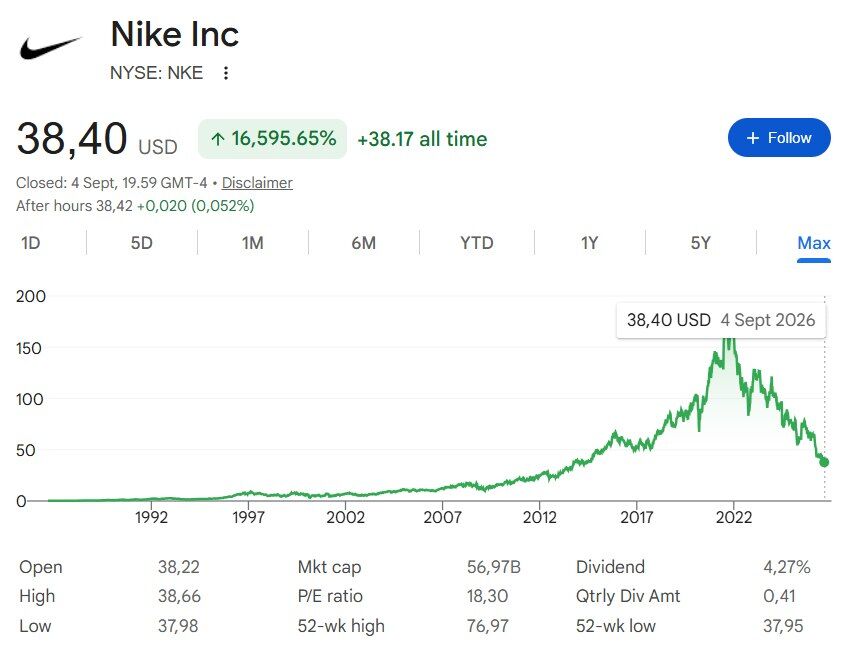
S&P Dow Jones Indices said Nike will be removed from the S&P 100 before the open on Sept. 21, 2026, with Palo Alto Networks set to replace it. Nike’s shares closed at $38.40 on Sept. 4, valuing the company at about $56.97 billion.
The move marks Nike’s first exit from the S&P 100 in roughly 18 years, but it does not amount to a delisting. Nike remains in the S&P 500 and continues to trade on the NYSE, while S&P said the rebalance is meant to keep each index representative of its market-cap range.
For investors, the key issue is index tracking. Funds tied specifically to the S&P 100 typically have to rebalance around the effective date, which can create mechanical selling in Nike and buying in Palo Alto Networks.
Nike’s slide provides the backdrop: the stock is down roughly 78% to 80% from its 2021 peak, and recent reporting puts fiscal 2026 revenue at about $46.4 billion, with Greater China revenue around $5.85 billion. Still, S&P did not cite one single event as the reason for removal.
Apple’s Sept. 9 preview centers on a $2,000-plus foldable and iPhone 18 Pro
Ahead of the event, reports continue to focus on the foldable’s name, price and biometric choice, with investors watching Apple’s premium-product strategy.
Apple is set to hold its fall event at 10 a.m. Pacific time on Sept. 9, and multiple reports say a foldable iPhone and the iPhone 18 Pro line are likely to headline the show. The foldable is widely rumored to be called “iPhone Ultra” and to cost more than $2,000.
The most persistent leaks describe a book-style foldable with roughly a 5.5-inch outer display and a 7.8-inch inner display. Other reports point to an A20 Pro chip, Touch ID, dual rear cameras and a less-visible crease, while Apple’s first product event under new CEO John Ternus is also drawing attention.
For investors, the key question is whether Apple can extend its premium pricing without dulling demand for AAPL’s next iPhone cycle. A foldable debut could also keep the supply chain in focus, especially if iPhone 18 Pro shipments and component orders ramp alongside it.
Apple has not officially confirmed the foldable’s name, specifications, price or launch timing. For now, the story remains a pre-event mix of media reporting and supply-chain speculation rather than a finalized product announcement.
Anthropic is now expected to begin marketing its initial public offering in mid-October at the earliest, according to people familiar with the matter cited by multiple reports. The timing is later than the late-September window that had circulated earlier, and it could still change.
The company had already filed a confidential draft S-1 with the SEC on June 1, while reports say it is also lining up a $15 billion revolving credit facility before meeting analysts. Investor chatter has pushed the potential IPO valuation toward $2 trillion, though Anthropic has not set or confirmed any target.
The revised timetable keeps Anthropic in the spotlight alongside SpaceX, whose June listing was cited at about a $2.01 trillion valuation, and far above Anthropic’s latest private mark of roughly $965 billion. That spread is why the next pricing signal matters for AI-related public-market appetite.
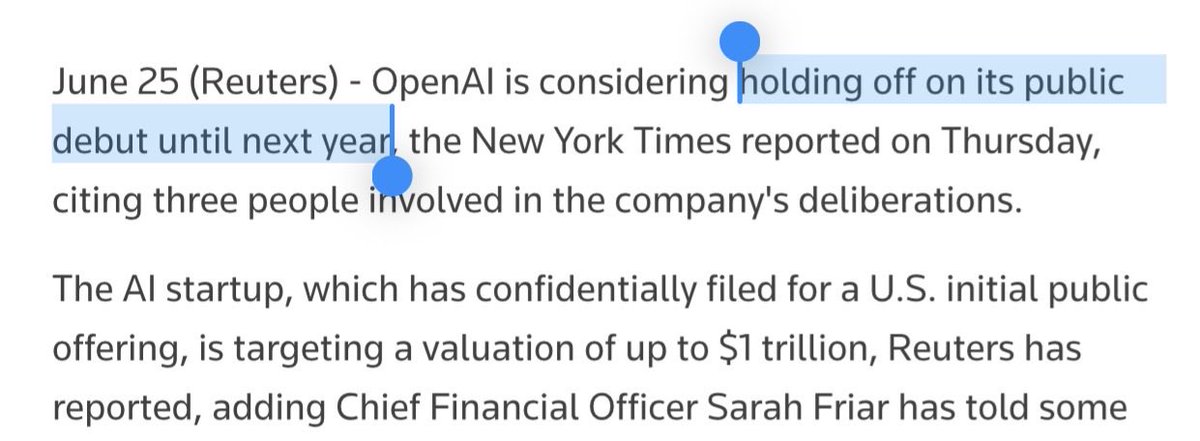
Anthropic has declined to comment on the revised schedule, and no final deal size or syndicate has been confirmed publicly. Separate reporting has also suggested OpenAI may not go public until 2027, underscoring how uneven the IPO paths among frontier AI companies have become.
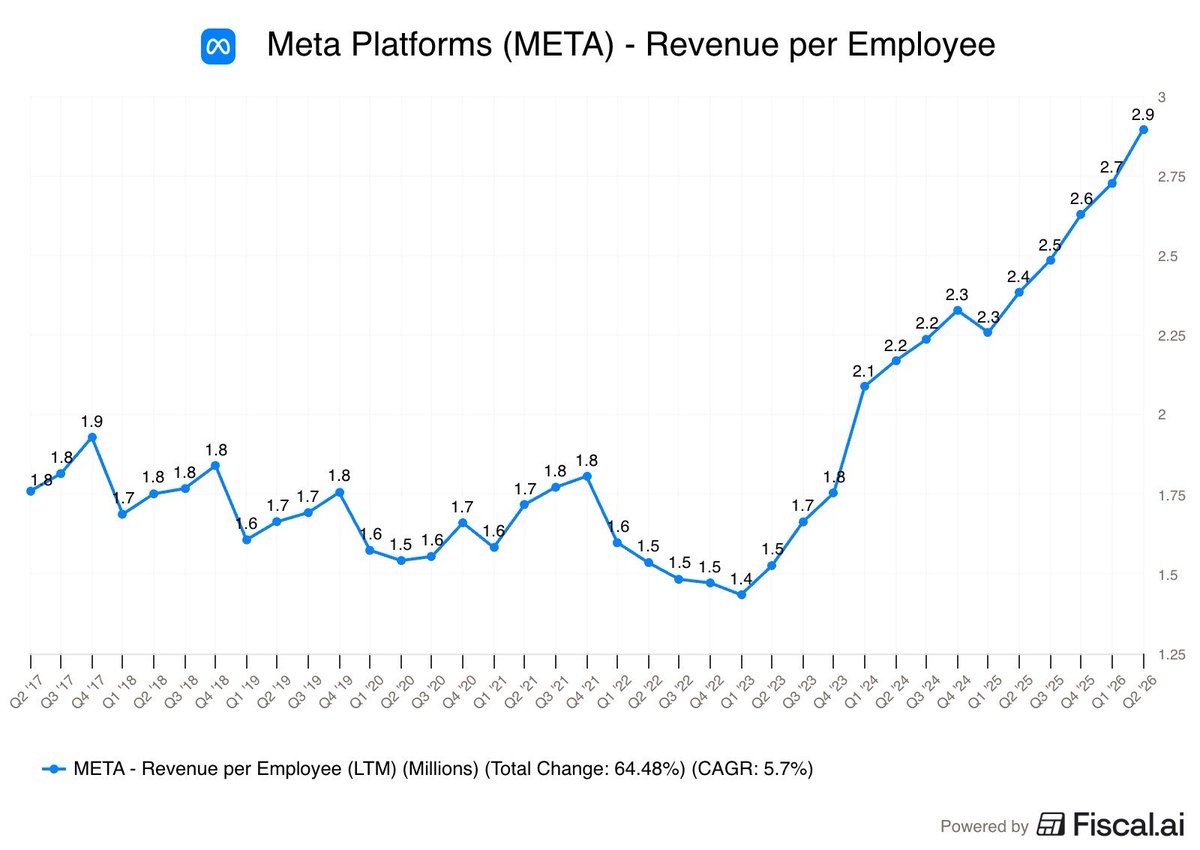
Meta reported second-quarter 2026 revenue of $60.8 billion, up 28% year over year, while annualized revenue per employee reached about $2.9 million, a new company high. The figure is drawing fresh attention on X as investors focus on operating leverage at scale.
The backdrop is still Meta’s core ad engine: ad impressions rose 14% and average price per ad increased 12%, helping revenue growth hold up. At the same time, capital expenditures came in at $31.08 billion for the quarter, keeping the market’s attention on how quickly AI investment can translate into monetization.
META was quoted at $616.77 in the social-media signal, with trading sentiment centered on the tension between strong ad performance and heavier spending. Investors will be watching whether the company can sustain profit growth while funding its AI buildout.
In its earnings release, Meta said AI is accelerating the core business and creating new opportunities. The latest per-employee revenue milestone adds another data point to that narrative, but it also highlights how much of the company’s valuation case rests on continued execution in ads, AI and infrastructure.
How this story unfolded
2026-07-084 posts · 3 authors
BofA argued investors overestimate HBM cost pressures and underestimate Nvidia's pricing power, while other posts questioned BE's valuation and promoted ELMT.
Company
Berkshire says 8% of Iowa load came from data centers as Abel flags AI power upside
Abel says power is the bottleneck for AI buildout, but Berkshire will only serve hyperscalers if other customers are protected.
Berkshire Hathaway CEO Greg Abel said the company sees a “significant opportunity” in powering AI data centers and that about 8% of its Iowa load came from data center customers last year. He added that Berkshire will only serve hyperscalers if there is no negative impact on other customers’ rates and the projects create a net benefit for existing users.
The remarks fit Berkshire’s broader push into energy infrastructure as AI demand rises. Abel also said energy remains the key constraint on data-center expansion, and Berkshire previously disclosed a $10 billion direct purchase of Alphabet stock this spring as Google’s parent raised $80 billion for AI compute infrastructure.
For investors, the comments keep the “power-and-picks-and-shovels” trade in focus, including IREN and BTDR on the data-center side and Berkshire Hathaway Energy on the utility side. The Motley Fool cited Berkshire’s 2025 annual filing saying BHE’s U.S. utilities have 32,400 net megawatts of generation capacity in operation and under construction, with about $33.5 billion planned for expansion in 2026-2026.
Berkshire has framed the role as supplying electricity and transmission, not operating the data centers themselves. Abel said the company has discussed the policy with governors and regulators, and that no specific site has been rejected so far.
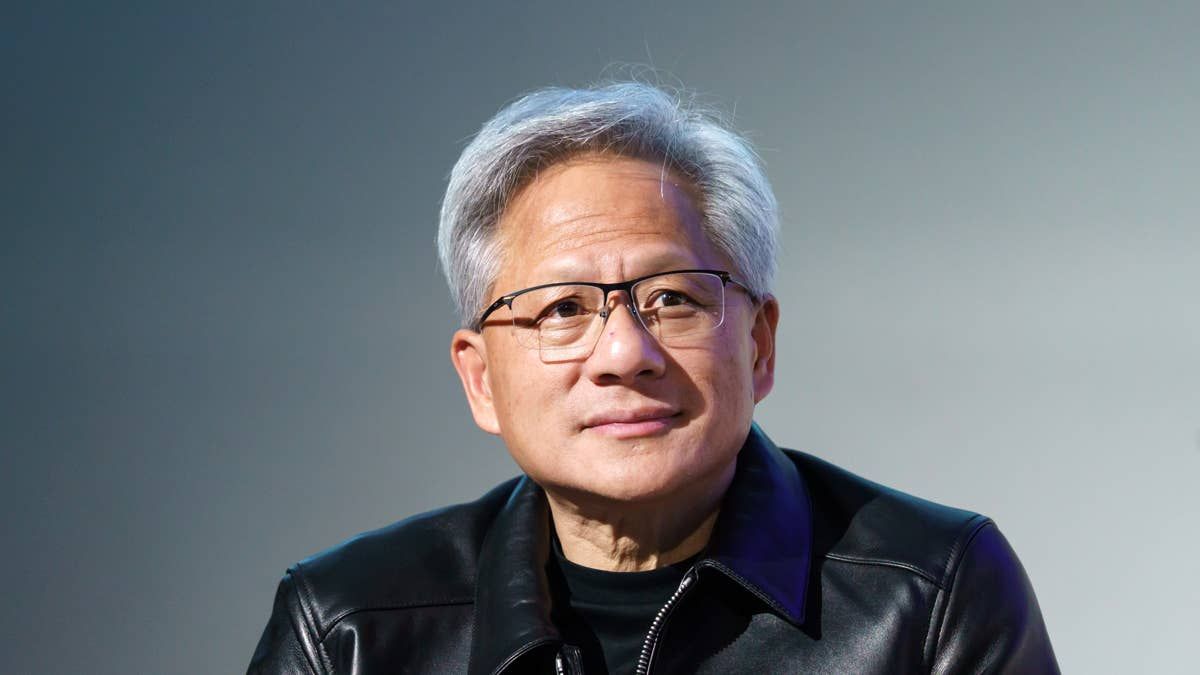
Reuters Breakingviews said Nvidia’s reported $12.9 billion move for Hugging Face looks less like a classic acquisition and more like an insurance policy. The logic is that Jensen Huang is not just buying a platform; he is trying to keep the developer ecosystem aligned with Nvidia’s orbit.
CNBC separately reported that Nvidia’s equity investments reached $99 billion as of July 26, up from about $7 billion a year earlier. The same report said Nvidia had committed more than $40 billion in 2026, including about $50 billion in frontier AI labs and a $30 billion OpenAI investment announced in February.
For investors, the significance is that Nvidia is acting as both chip supplier and capital allocator across the AI supply chain. That has implications for NVDA itself as well as the AI cloud and infrastructure names that sit inside or around its ecosystem, even if the Hugging Face deal described in the commentary remains a strategic read rather than a confirmed earnings event.
Nvidia says the investments are meant to broaden its ecosystem, create growth opportunities and strengthen its competitive position. The next set of updates will likely center on follow-on disclosures around OpenAI, CoreWeave, Nebius and related infrastructure bets.
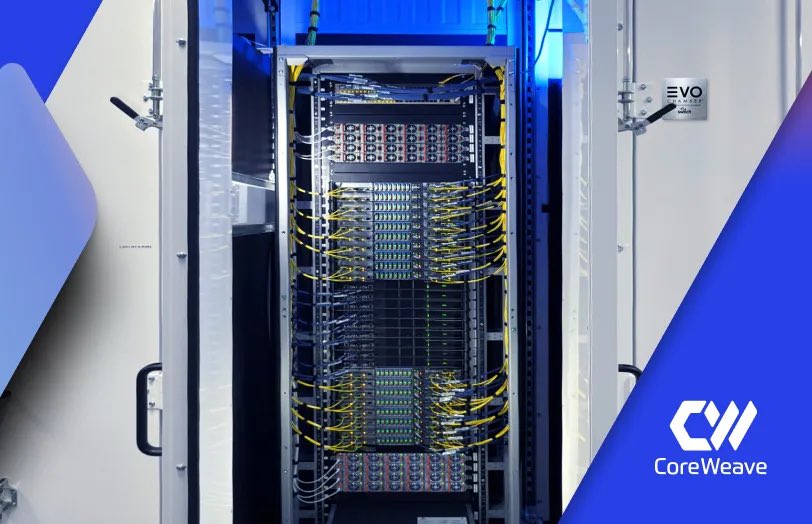
Multiple X posts on Sunday said Dell has delivered the first production NVIDIA Vera Rubin NVL72 racks to CoreWeave, with CoreWeave reportedly receiving its first production racks. The rack configuration cited in the posts matches the platform’s published design: 72 Rubin GPUs and 36 Vera CPUs per rack.
This is an incremental step beyond the companies’ earlier public announcements. CoreWeave said on June 1 that it had completed the industry-first bring-up and validation of Vera Rubin NVL72, and Dell said it was first to ship systems built on the Vera Rubin platform to CoreWeave. Today’s social chatter is therefore best read as a delivery-and-deployment update, not a brand-new product reveal.
For the market, the development keeps the focus on CRWV, DELL and NVDA. CoreWeave gains another signal that its AI cloud fleet is expanding; Dell reinforces its position as a key AI server integrator; and Nvidia’s next-generation Rubin roadmap moves one step closer to revenue-generating deployment.
The most verifiable figures remain those in the official disclosures: CoreWeave described Vera Rubin NVL72 as a 72-GPU, 36-CPU rack with 260 TB/s NVLink 6 fabric, while Dell said its systems can move from delivery to production in under 6.5 hours. The 20.7 TB HBM4 figure circulating on social media was not confirmed in the primary materials reviewed.
How this story unfolded
Company
Huawei AI output seen at under 4% of Nvidia in 2026 as H100 gap persists
New estimates say Huawei remains constrained by HBM supply, underscoring a widening generation gap in AI chips.
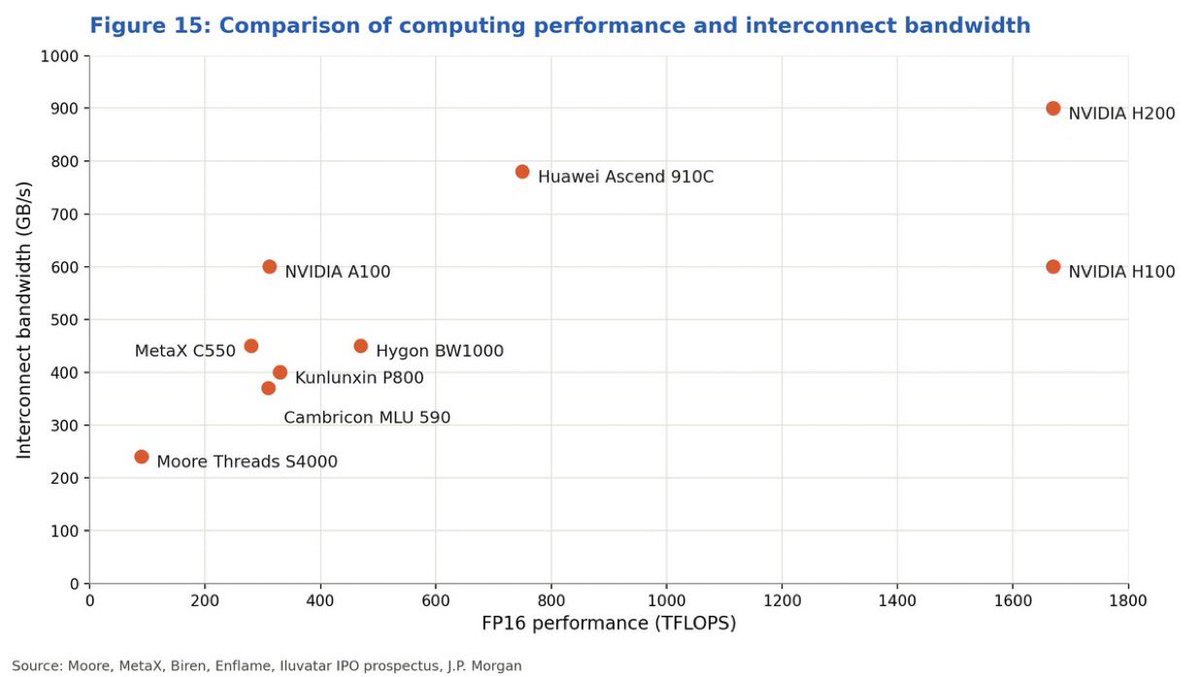
Fresh reporting citing Epoch AI says Huawei’s AI compute output will be less than 4% of Nvidia’s in 2026, even after accounting for stockpiled foreign HBM, domestic substitutes and smuggled memory. The same analysis says Huawei’s latest Ascend 950DT delivers about 1 PFLOP of FP8 performance, roughly half of Nvidia’s H100.
The broader constraint is memory, not just chip design. Epoch AI argues that limited HBM supply is the binding bottleneck for Huawei, and that if the company relied only on Chinese-made HBM, its output could stay near 1% of Nvidia’s through 2028.
For investors, the update reinforces Nvidia’s lead in AI accelerators and keeps NVDA at the center of the compute trade. Huawei’s progress matters more for China’s domestic AI stack and local chip supply chain than for Nvidia’s global position.
No new response from Huawei was cited in the materials reviewed; the numbers in circulation come from research estimates and media follow-up rather than a fresh company disclosure.
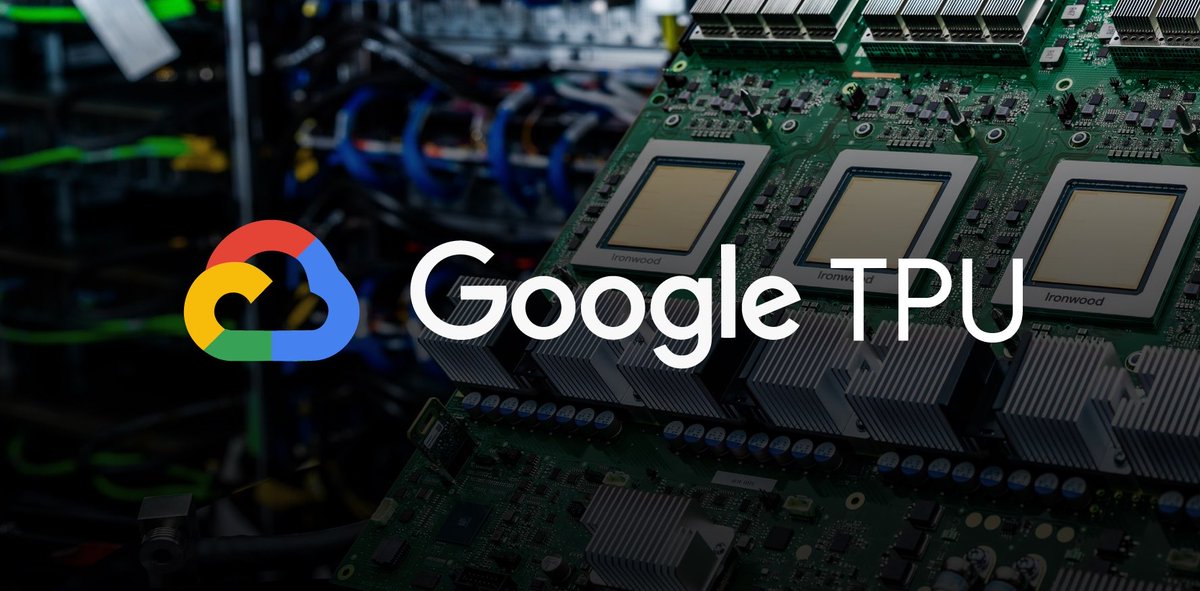
At SEMICON Taiwan, Google AI infrastructure chief Amin Vahdat said the company has accelerated its TPU roadmap from one generation every two years to two releases a year. He added that Google intends to move even faster over time.
The shift underscores how aggressively Google is trying to shorten the design-to-deployment loop for its custom silicon as generative AI workloads evolve. It also follows earlier reporting this year that Google had already been tightening its TPU cadence.
For investors, the main ticker to watch is Alphabet (GOOGL), since TPU performance and supply cadence are tightly linked to Google Cloud’s AI infrastructure strategy and its effort to commercialize more of its hardware stack. Supply-chain names such as Broadcom are also part of the broader read-through, though Google did not announce any partner-specific change in this update.
Google did not provide a launch timetable for the next TPU models in the keynote remarks. The new information is the cadence itself: from a two-year rhythm to two chips per year, with the possibility of faster rollouts later.
How this story unfolded
2026-07-094 posts · 4 authors
Nomura projected TSMC CoWoS capacity to nearly double by 2027, Anthropic demonstrated successful TPU training, and discussions highlighted hardware topology's impact on model efficiency comparisons.
Markets
Bitcoin-Gold 90-Day Correlation Hits 0.50 as Nasdaq Slips to 0.30
Bitwise and other market trackers say BTC is trading less like a tech proxy and more like a hard asset
Market trackers say Bitcoin’s 90-day correlation with gold has climbed to +0.50, near the 2020 pandemic-era peak, while its link to the Nasdaq 100 has slipped to about 0.30, a one-year low. The latest readings were echoed across Kobeissi Letter, Coin Bureau and crypto market coverage on Sept. 6.
The move comes against a macro backdrop of rising debt and renewed Treasury support measures. Reports say the U.S. Treasury doubled long-bond buyback size from $2 billion to at least $4 billion per operation on Aug. 19, while U.S. federal debt has topped $40 trillion.
For markets, the implication is a clearer split between Bitcoin, gold and U.S. growth stocks. Investors appear to be treating BTC and gold as parallel hedges against currency debasement, which can also reshape short-term sentiment around crypto miners, exchanges and other digital-asset names.
Bitwise chief investment officer Matt Hougan has framed the debate as growth versus inflation: if the U.S. grows out of debt, AI stocks may lead; if it inflates out, Bitcoin benefits. Other analysts caution that such equity decoupling has historically been unstable.
Japan’s Ministry of Internal Affairs and Communications has reportedly filed a new ITU architecture labeled J-BLUEBIRD-NGSO for 136 satellites. The filing surfaced in X posts on Sept. 6, with both posts pointing to a Sept. 4 submission date.
The move comes after months of public discussion around AST SpaceMobile’s partnership with Rakuten in Japan and the broader J-LEO direct-to-device project. ITmedia reported in June that AST’s constellation design had already been revised as Japan evaluated its sovereign satellite network plans.
For investors, the filing is more of a regulatory and spectrum signal than an immediate commercialization milestone. ASTS remains the primary stock tied to the development, while Rakuten is the key local partner in the background.
Prior reporting had already indicated Japanese regulatory support for a 700 MHz direct-to-smartphone satellite framework. Any broader reading of the 136-satellite plan should wait for confirmation from MIC or the ITU filing itself rather than social-media summaries alone.
Robinhood CEO Vlad Tenev has reiterated the company’s tokenization pitch, saying everyone should be able to access high-quality financial assets wherever they live. He also described Robinhood Chain as a network purpose-built for real-world assets, saying the platform’s Stock Tokens are now available across 120-plus countries.
The update lands against the backdrop of Robinhood Chain’s rapid post-launch growth. Public mainnet went live on July 1, and since then the network has accumulated a large amount of stablecoins and tokenized equities as Robinhood expands its onchain finance stack.
The latest data point is scale: Arbdata and Dune estimates put total assets on Robinhood Chain at roughly $1.87 billion to $1.94 billion. CryptoBriefing also reported that RWAs on the chain are valued at about $143 million to $149 million, across 194 tokenized stocks and ETFs.
For HOOD, the chain is becoming a new distribution layer that extends Robinhood’s brokerage user base into tokenized markets. The development also adds competitive pressure on tokenization and Ethereum-layer-2 activity, with Robinhood increasingly positioned as a retail gateway to onchain assets.
How this story unfolded
2026-07-0925 posts · 17 authors
Robinhood Chain launched with Chainlink as its official data and cross-chain oracle provider, and its 24-hour DEX volume surpassed $500 million.
Company
Calacanis says Nvidia is OpenAI and Anthropic’s top rival as Hugging Face deal reaches $12.93 billion and Anthropic compute contracts top $275 billion
The new X chatter widens Nvidia’s rivalry beyond chips into enterprise compute and open-source distribution, highlighting a much broader AI platform fight.
Jason Calacanis said on X that Nvidia is now the No. 1 competitor to OpenAI and Anthropic, not only in tokens but also in enterprise compute. He also framed Jensen Huang as a leading open-source provider in America, signaling a shift in how the market is thinking about Nvidia’s role.
That view lands against a rapidly expanding backdrop: media reports say Nvidia has agreed to acquire Hugging Face for about $12.93 billion, while Hugging Face says more than 18 million developers, researchers and creators use the platform. Separate reports put Anthropic’s 2026 compute commitments at more than $275 billion, underscoring how large the AI infrastructure race has become.
For investors, the implication is centered on NVDA. If Nvidia is moving from chip supplier to a broader AI infrastructure platform spanning model distribution, compute, and ecosystem control, the company’s competitive set starts to look less like semiconductor peers and more like the frontier AI labs themselves.
The X post does not itself add a formal corporate disclosure, but it amplifies an already visible market narrative: Nvidia is increasingly being discussed as a strategic layer across AI rather than a single hardware vendor.
Elon Musk said on X that he does not have a “big pile of cash,” adding that his wealth sits in SpaceX and Tesla stock. The message was widely reposted across market accounts on Saturday, keeping the focus on his equity-heavy net worth.
The comment echoes a long-running theme: Musk’s fortune is tied mainly to company shares, not cash balances. Recent coverage also noted that SpaceX’s stock has been volatile since its June listing and is heading into another share-unlock window this month.
For markets, the immediate read-through is sentiment around SPCX and TSLA rather than a change in fundamentals. SpaceX price swings can move Musk’s paper wealth materially, while Tesla remains an important part of the overall holdings mix.
There was no additional formal clarification from Musk beyond the post circulating on X. Investors are now watching the upcoming SpaceX unlock schedule and whether trading activity changes the valuation backdrop for SPCX.
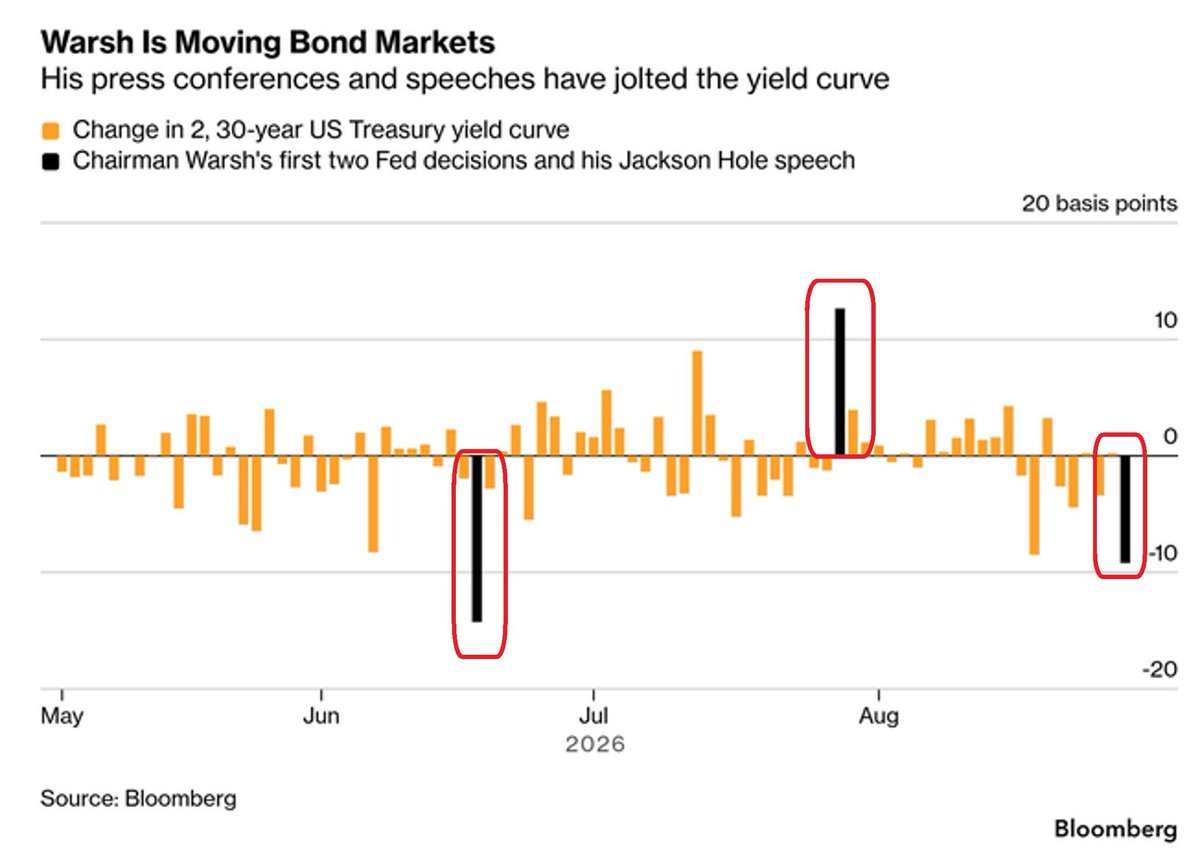
On X, traders linked Nasdaq-100 futures, or NQ, to what they called "Warsh === bond volatility," arguing that the index can live with higher long-term yields if the move is orderly and corporate earnings remain strong. The real risk, they said, is a sharp swing in bonds that can force a violent near-term repricing in growth stocks.
That chatter comes as U.S. 10-year Treasury yields have recently hovered near 4.8%, while the 30-year yield has been close to 5.3%. Separate reports also said Warsh used his Jackson Hole remarks to keep inflation front and center, citing elevated PCE inflation and treating the 2% target as non-negotiable.
For equities, the biggest sensitivity is in rate-heavy technology names and the Nasdaq-100 complex, where valuation depends more heavily on discount rates than on near-term cash flow. When Treasury volatility spikes, traders typically expect sharper moves in megacap tech and other long-duration assets than in rate beneficiaries such as banks or energy.
Markets are now looking past the current yield level and toward the next catalysts, especially the upcoming CPI release and the September FOMC meeting. The setup suggests the main trade is not simply higher rates, but the speed and disorder of any bond move.
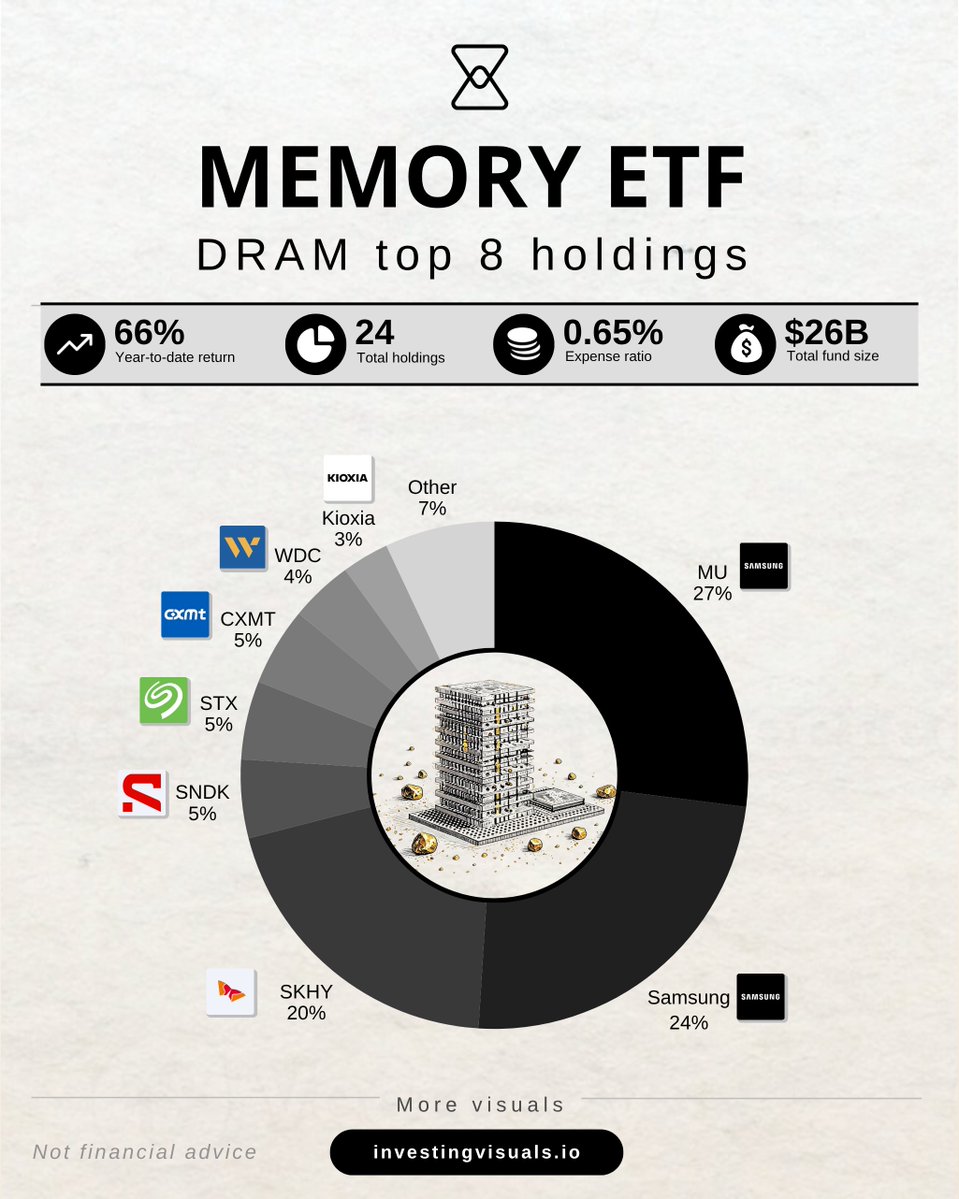
A fresh X market signal says memory demand is not slowing down and supply is still not catching up. The same post argued that the DRAM ETF remains the simplest way to get exposure to the trade.
That view lines up with recent reporting that hyperscaler capex expectations for 2027 have climbed to $1.3 trillion, while AI data-center buildouts keep pulling DRAM and NAND away from PCs and smartphones.fool.com startupfortune.com
For the market, the DRAM ETF has become the clearest public proxy for the memory upswing, and the X post said it is up 115% year to date. Its top holdings are tied to Micron, Samsung and SK hynix, which maps to MU, SSNLF and SKHY.
The key point is not a fresh corporate announcement, but a continuing market rerating of memory names. For now, the best-supported facts are still centered on tight supply, rising prices and AI-related demand absorption.
Blue Owl cuts Loparex loan to 5 cents as OBDC NAV stands at $14.26
Bloomberg’s report puts a fresh spotlight on valuation discipline across private credit, where paper marks can move far faster than public trading signals.
Blue Owl Capital’s OBDC fund has reportedly slashed the value of a Loparex-related loan to about 5 cents on the dollar, with another tranche marked near 22 cents. The Bloomberg-linked reporting renewed scrutiny of how aggressively private credit managers are marking stressed loans.
The latest move comes after months of debate over Blue Owl’s valuation practices. OBDC’s second-quarter filing showed net asset value per share at $14.26, while the fund said non-accrual loans were still a small share of fair value at roughly 0.8%.
Investors are watching because Blue Owl sits at the center of the listed BDC and private-credit ecosystem. A rapid markdown on a single borrower can amplify concerns that software- and tech-heavy loan books are being valued slower than underlying credit risk evolves, keeping pressure on OBDC’s discount to NAV.
Reports also say Loparex is under default-related forbearance and may face a Chapter 11 filing. Blue Owl has said the mark-down followed the collapse of a proposed recapitalization and M&A transaction that would have brought in fresh equity.
How this story unfolded
2026-07-107 posts · 7 authors
Private credit default rates hit a record high, and UBS's exit from Blue Owl raised industry alarm.
2026-07-309 posts · 8 authors
Company
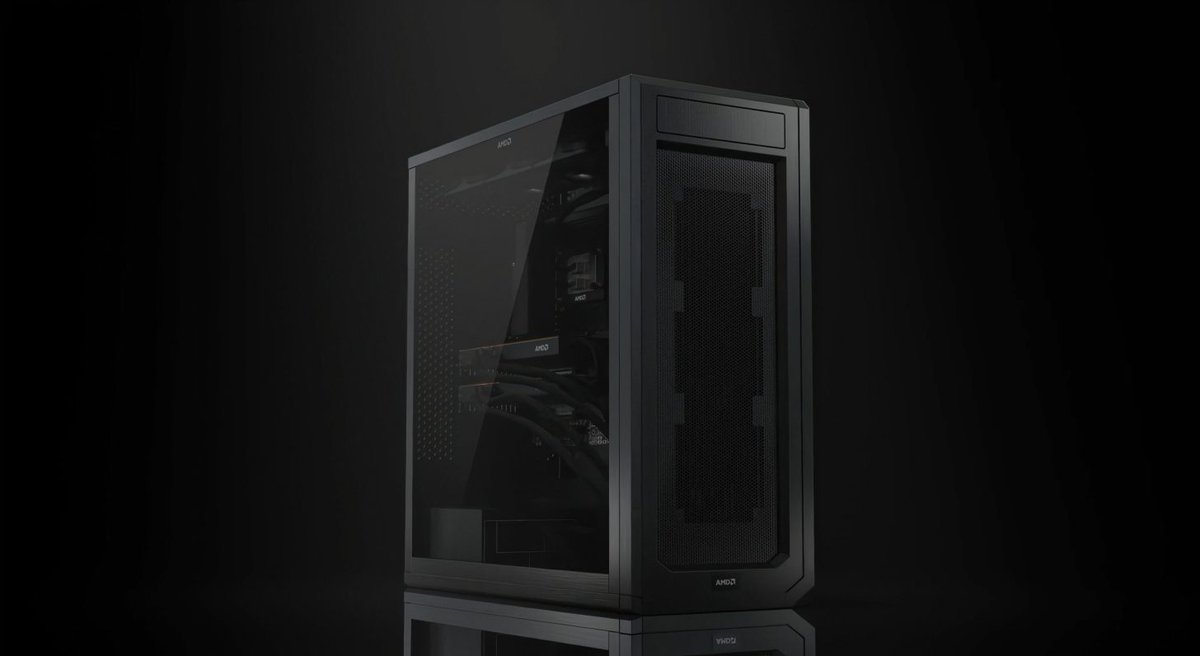
AMD unveils 96-core Halo Station with 2 MI350P GPUs and up to 576GB HBM3E
The IFA workstation is pitched for local trillion-parameter AI and sets up a fresh comparison with NVIDIA’s DGX Station.
AMD introduced the Threadripper Halo Station at IFA 2026, a desk-side AI workstation built around a 96-core Threadripper Pro 9995WX and two liquid-cooled Instinct MI350P accelerators, with support for up to four cards. AMD framed the system as hardware for running trillion-parameter-class models locally.
Each MI350P accelerator carries 144GB of HBM3E memory, giving the two-card configuration 288GB and the four-card configuration up to 576GB. AMD also says the system can be configured with as much as 2TB of DDR5 memory, though it has not disclosed pricing or availability.
The launch positions AMD more directly against NVIDIA’s DGX Station concept by bringing datacenter-style compute into a workstation chassis. For investors, the relevance is less about immediate sales and more about AMD’s continued push to broaden its AI hardware footprint beyond servers and into developer systems.
AMD has not yet provided a final commercial rollout plan, a launch date, or pricing for the machine. The company is currently treating the Halo Station as a showcase platform rather than a finished product.
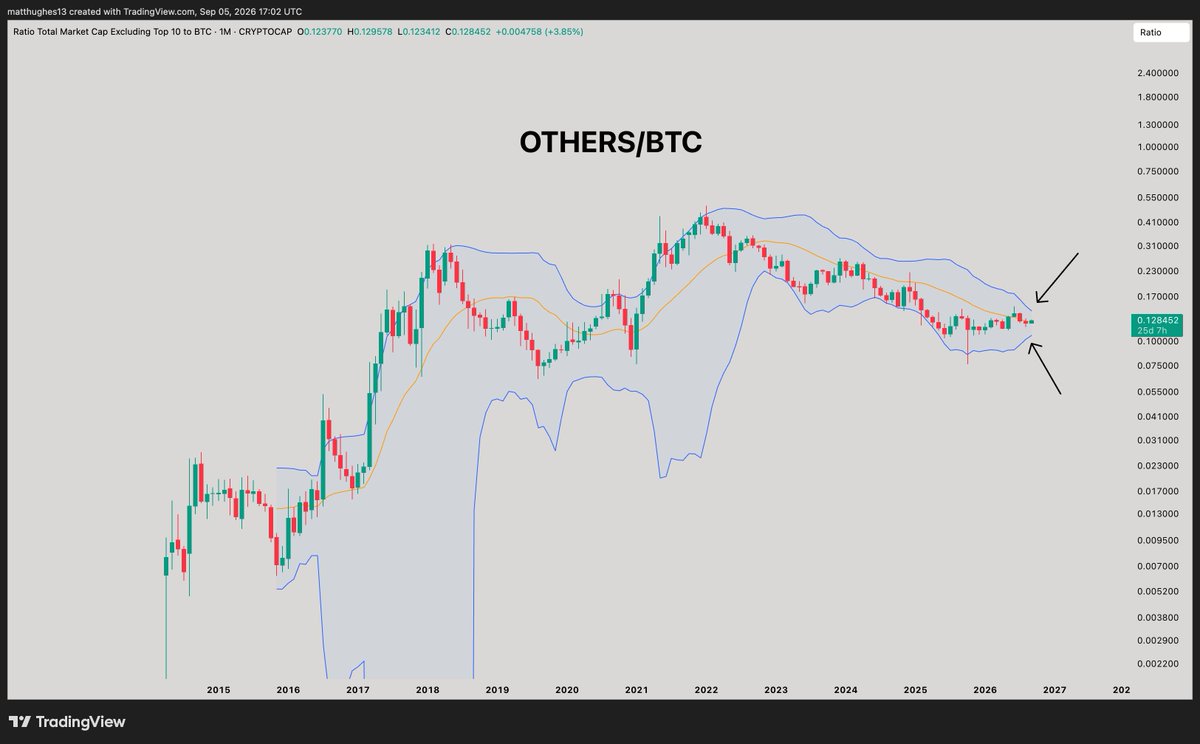
On X, trader GreatMattsby said the monthly Bollinger Bands on OTHERS/BTC have tightened to their narrowest level ever, while the 20-month moving average is being reclaimed as support. The post has revived debate over whether altcoins are nearing a large move relative to Bitcoin.
The backdrop is not just one chart. Coinspeaker said OTHERS/BTC monthly MACD has turned bullish for the first time in about 22 months, and The Market Periodical reported that TOTAL2/BTC showed bullish divergence on weekly charts in early September.
For crypto markets, the signal matters mainly as a relative-strength setup rather than a directional call on the entire market. If the ratio keeps stabilizing, trading flows can rotate more aggressively within Bitcoin, Ether and larger altcoins, but the cited analyses all stop short of calling the move confirmed.
No project or exchange has formally commented on this specific chart pattern. Traders will now watch whether OTHERS/BTC can hold above its 20-month average and whether the Bollinger compression expands into a decisive move.
Today’s incremental signal is a renewed bullish note on Zeta Global from Steven Fiorillo on X, where he said he is still bullish and believes the company is “just getting started.” The post itself is not a corporate announcement, but it pushes Zeta back into the market conversation.
The broader backdrop is management’s long-running pitch that Zeta is not a conventional SaaS name. In a recent Basis Points interview, CEO David Steinberg framed the company as an “outcomes business” and described a long runway for growth, including comments that it took 18 years to reach the first $1 billion in revenue and that the business could double that figure over the next 3-4 years.
For the market, ZETA remains a closely watched AI application software stock. Futubull’s market page showed Zeta Global closing at $18.79 on May 22, with a market cap of about $4.684 billion, and also listed several broker actions in late May, underscoring that the name is still being traded largely on growth expectations and valuation debate.
Importantly, today’s X signal is a sentiment update, not a new filing, deal, or regulatory action. The key questions for investors remain customer conversion, AI monetization, and whether upcoming results can back up the long-term narrative.
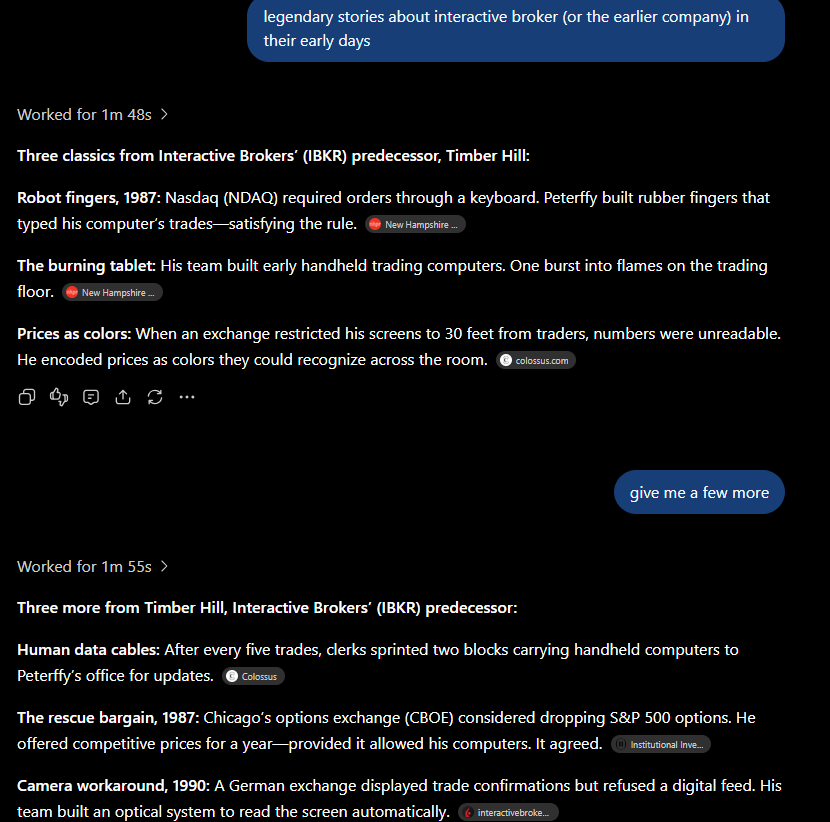
Interactive Brokers (IBKR) drew attention on X today after orrdavid posted, “Great companies are built by doing things differently, taking risks,” tagging $IBKR. The post does not include any new company disclosure, so it reads as sentiment rather than fresh corporate news.
The broader backdrop is the recent wave of coverage around IBKR’s second-quarter performance and valuation. Public reports cited Q2 revenue of $1.88 billion and described the stock as having pulled back roughly 7% to 10% from its highs, easing some of the premium attached to the shares.
For the market, IBKR remains the key name in the discussion. The debate is still about whether its growth story can justify a rich valuation after the pullback, so attention stays on IBKR itself rather than on the brokerage group as a whole.
Importantly, the X signal does not amount to an official company statement, earnings update or guidance change. What is confirmed for now is continued investor attention around growth, valuation and whether the recent pullback creates a more attractive entry point.
Meta reported Q2 revenue of $60.8B beating estimates but EPS missed, sending shares down 9%; capex guidance narrowed to $130-145B.
2026-07-3136 posts · 32 authors
Citadel bought most of Situational Awareness's equity portfolio; Apple's June quarter revenue rose 16% to $109.4B; Amazon raised 2026 capex to $220B.
2026-08-0532 posts · 22 authors
Revenue growth comparisons showed SpaceX leading; a former NBIS employee discussed Nvidia's revenue-share model; AMD fell 10% post-earnings as the beat was insufficient.
2026-09-056 posts · 6 authors
S&P began assessing hyperscaler investment risks to ratings; The Economist noted in-house chip designs threaten Nvidia purchases; Broadcom forecast Anthropic-only chip revenue equal to its current semiconductor runrate.
2026-09-066 posts · 6 authors
Meta's annual revenue per employee hit a record $2.9M; one view held that the scarce asset is contracted power plus GPU allocation, not chips.
Alphabet reported strong Q2 results, Google Cloud stated for the first time that revenue primarily comes from TPU system sales, sparking debate on its shift from cloud provider to hardware vendor.
2026-08-1918 posts · 18 authors
Marvell disclosed an expanded custom-chip partnership with Google covering TPU-related AI accelerators, storage, and networking, granting Google warrants worth $12.2 billion, while Broadcom shares came under pressure.
2026-09-0330 posts · 23 authors
Broadcom began production of Google's next-gen TPU v8i, with Anthropic planning 5GW deployment in 2027; Broadcom's earnings showed AI semiconductor revenue up 221% YoY, sparking debate over MediaTek's growing role.
2026-09-046 posts · 5 authors
Broadcom reiterated Google TPU leadership, but BofA noted a puzzling drop in Google's GW allocation, raising concerns about MediaTek's rising influence; TPU v8 splits into training and inference variants.
2026-09-063 posts · 3 authors
Google accelerated its TPU roadmap from one generation every two years to two per year, a 4x increase, with executives confirming a shortened custom silicon cycle, fueling discussions on the ASIC revolution.