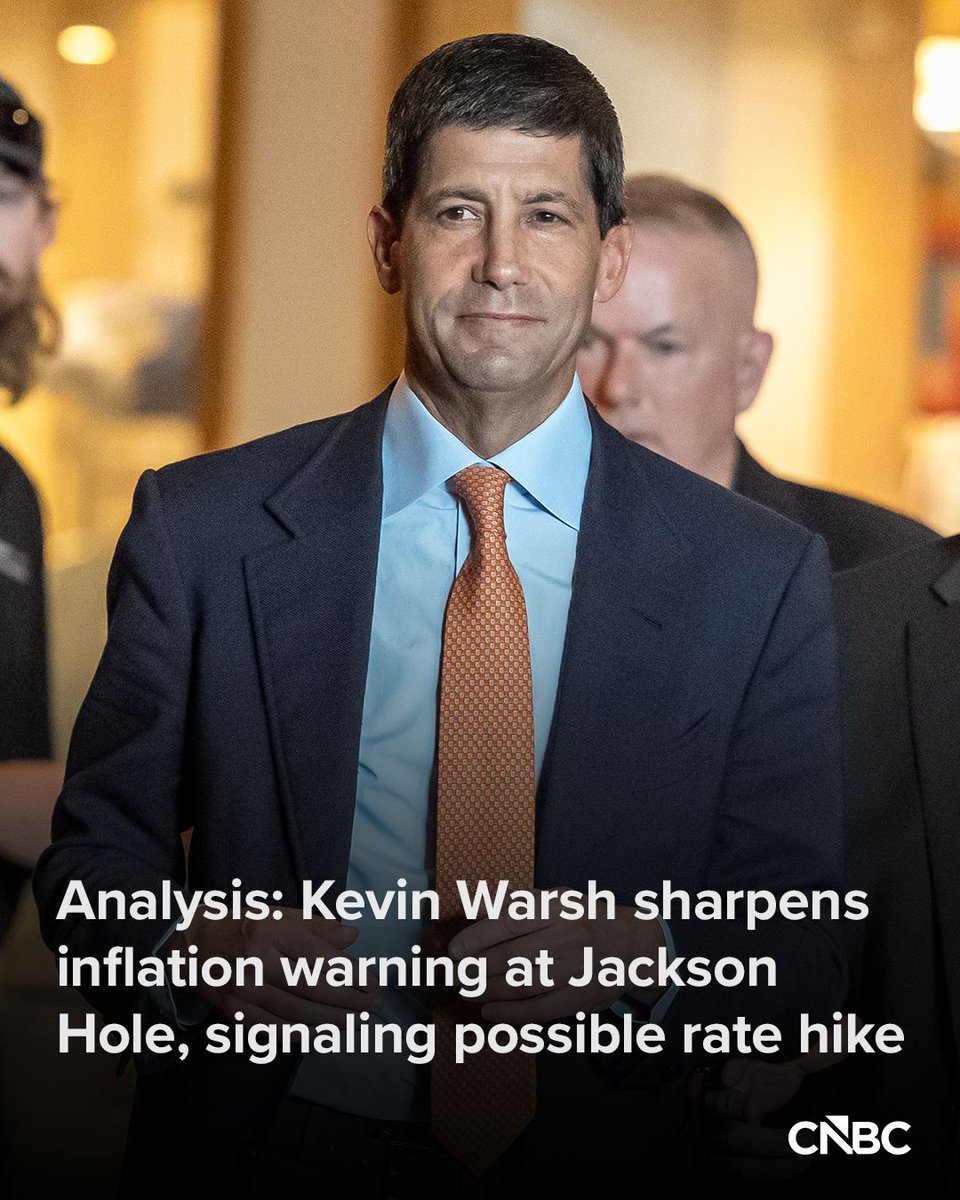
Federal Reserve Chair Kevin Warsh used his Jackson Hole speech to say this summer’s inflation readings were better than expected but did not show meaningful improvement in underlying trends. He added that if inflation does not move back to target quickly enough, policymakers still have work to do, a message markets read as more hawkish than his recent press conference.
The speech also sharpened Warsh’s broader communication strategy. Since taking office, he has pushed back against forward guidance and said investors should not rely on the Fed for their next trade, a stance that has left markets searching for a clearer reaction function.
Markets responded quickly. The 2-year Treasury yield rose to 4.31%, its highest since late July, while the dollar firmed as traders reassessed the odds of easier policy later this year. Rate expectations for the September meeting also shifted after the remarks.
The policy backdrop remains sticky inflation: the July PCE price index was unchanged on the month and up 3.7% from a year earlier, according to the latest data cited in the coverage. That keeps attention on the Fed’s next meeting and on whether Warsh’s tougher tone translates into a sustained shift in pricing across rates and currencies.
After Jackson Hole remarks, prediction markets and futures now price the September decision as a near coin flip, lifting rate-sensitive assets and short-end yields.
On Aug. 29, multiple prediction and futures markets showed a clear repricing toward a September Federal Reserve rate hike. Signals circulating on X put Kalshi at 53%, while Polymarket was around 51%; separate reports said CME FedWatch was as high as 56% to 57.5%.
The move followed Fed Chair Kevin Warsh’s Jackson Hole remarks, where he said the summer inflation readings were better but not enough to show a meaningful improvement in underlying trends. CNBC reported that the September meeting had shifted from nearly 70% odds of no change to a near coin flip between holding and a 25-basis-point hike.
The repricing pushed short-term Treasury yields higher, with the 2-year yield hitting its highest level since late July. The dollar also strengthened, and the policy-sensitive UUP ETF was among the assets most directly tied to the shift in rate expectations.
The exact probabilities differ across Kalshi, Polymarket and CME, but the message is consistent: the September meeting is now a live event. Market differences reflect liquidity and contract structure, not a different read on the core policy surprise.
Apple said on April 20 that Tim Cook will step down as CEO and become executive chairman, with hardware chief John Ternus set to take over as chief executive on September 1. The latest X signal sharpens that timeline, saying Cook will step down as CEO on August 31. The board has already approved the transition as part of a long-running succession plan.
Apple’s announcement highlighted Cook’s 15-year tenure, during which the company’s market value rose from about $350 billion to $4 trillion. It also credited him with expanding Apple into wearables and services, while Ternus brings a product- and hardware-focused background to the top job.
AAPL is the key stock to watch because the leadership change sits at the center of Apple’s corporate narrative. Shares were quoted around $320 in the X posts, and investors will likely focus on whether the new chief executive can preserve Apple’s margin structure, product cadence and capital return policy.
Apple has not indicated any change to its planned timing, and the succession was framed by the company as the result of careful, long-term planning. The broader event line begins with Apple’s April 20 announcement, while today’s signal reflects the newest confirmation circulating in markets.
これまでの経緯
企業動向
OpenAI ends Cursor partnership after SpaceX’s $60 billion deal, cutoff set for Nov. 12英語原文
OpenAI cited trust and contract concerns after Cursor changed control to SpaceX, putting its model supply on a deadline.
OpenAI said it will wind down its partnership with Cursor and stop supplying models to the AI coding tool on Nov. 12, 2026. The company said it could not be confident SpaceX would use its technology within OpenAI’s terms of service after Cursor’s change in control.
The move follows SpaceX’s completed $60 billion acquisition of Cursor parent Anysphere earlier this month. OpenAI also pointed to past disputes with Elon Musk’s companies as part of its rationale for invoking the contract’s change-of-control provisions.
For the market, the immediate impact is on Cursor’s model stack: the product will lose OpenAI access after the deadline and may lean more heavily on Anthropic, Google and in-house models. For SpaceX, the decision adds another operational wrinkle after folding Cursor into its broader AI push; for OpenAI, it underscores how the rivalry with Musk is spilling into commercial partnerships.
Cursor has said it is speaking with OpenAI to resolve the issue, while OpenAI said it is giving the company maximum notice under the agreement. The dispute does not mean Cursor shuts down immediately; it concerns the continued availability of OpenAI models through the platform.
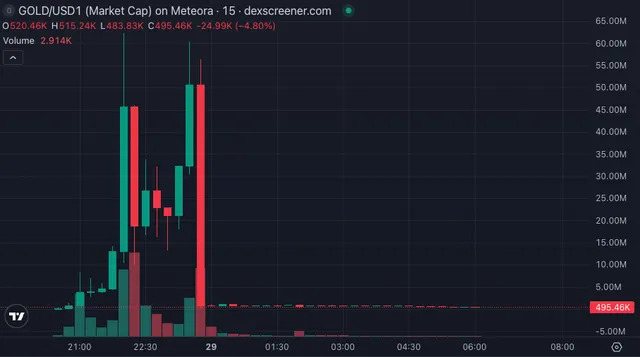
Lookonchain said realtrumpcoins (@realtrumpcoins1) deleted its GOLD-related posts after promoting Trump Digital Gold ($GOLD). The account’s deleted posts included a follow-up message telling users to invest and wait, while onchain data showed the developer held 600 million tokens and 15 newly created wallets bought 224.5 million GOLD for $18,657.
The episode builds on earlier reporting that GOLD briefly surged past a $60 million market cap before collapsing sharply, with prices later reported as low as about $600,000. The project has also drawn scrutiny over whether the promotional account was compromised and whether any apparent link to Trump-branded merchandise amounts to official endorsement.
For crypto traders, the key issue is not a listed-company impact but the mechanics of a highly concentrated meme coin: thin liquidity, rapid social-driven inflows, and a sudden reversal once promotional material disappears. That combination can magnify short-term losses and make attribution of responsibility difficult until platform control and wallet ownership are independently verified.
As of now, the verifiable facts are the deleted promotion, the concentrated supply, and the severe price swing. Prior public denials from Eric Trump about unauthorized coin launches remain relevant background, but they do not by themselves resolve who controlled the account during the GOLD promotion.
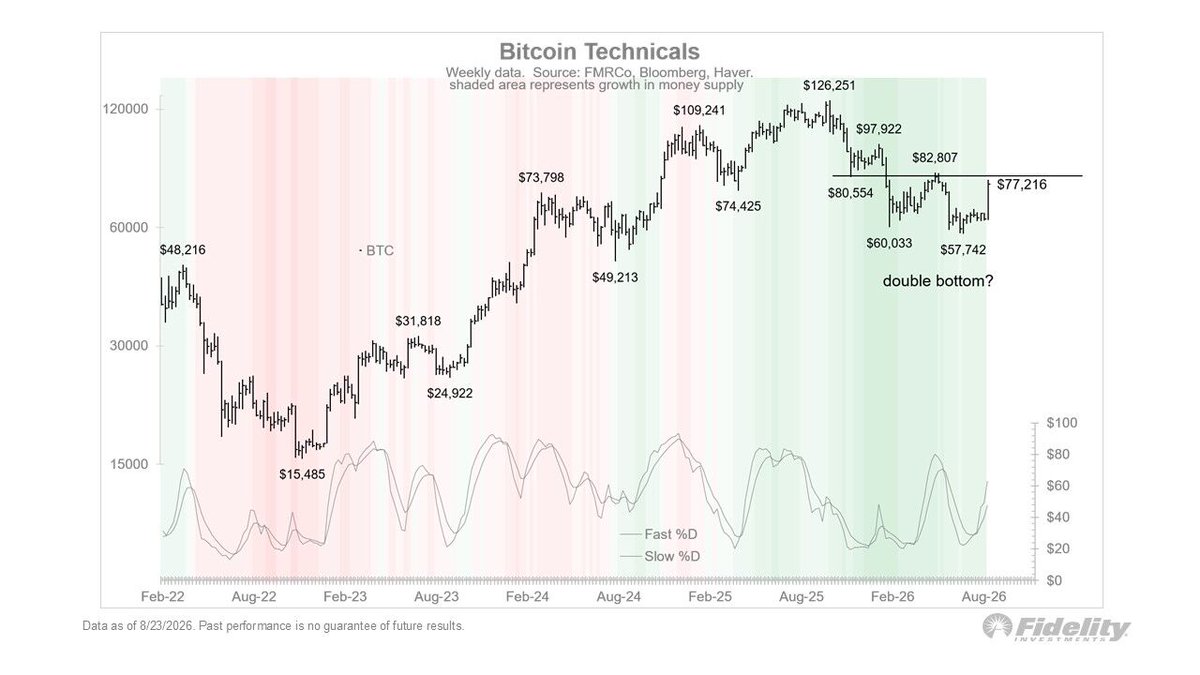
Bitcoin traded around a critical $80,000 line on Friday, with Fidelity’s Jurrien Timmer saying a move above that level would confirm a double-bottom pattern. The coin had earlier tested $81,455 before slipping back below the threshold.
The move came after Fed Chair Kevin Warsh reiterated that inflation must move clearly and quickly back toward the 2% target, a message that pushed short-term Treasury yields higher. Reports said Bitcoin fell into the $76,845-$76,877 area intraday, turning $80,000 from a support area into a live battleground.
Traders are now watching whether BTC can reclaim the $80,000-$80,400 zone or whether downside momentum extends toward the $74,000-$75,000 support band. Market plumbing also showed stress, with crypto liquidations running in the hundreds of millions of dollars as leveraged longs were forced out.
ETF flows remain an important backdrop. Recent spot Bitcoin ETF inflows helped fuel the prior push above $80,000, but Friday’s pullback shows macro rate expectations still have the upper hand in the near term.
これまでの経緯
2026-07-23投稿8件 · 投稿者7人
Fidelity bought $23M in Bitcoin; Strategy, BlackRock, Fidelity, and Coinbase pledged $15M for open-source development, and the Bitcoin Security Consortium launched.
決算
Nvidia posts $96B revenue and $108B guidance, but chips fail to break out英語原文
A blockbuster quarter keeps NVDA at the center of AI trading, yet breadth across semis remains limited.
Nvidia reported quarterly revenue of $96 billion and guided for $108 billion next quarter, extending its run as the market’s key AI bellwether. CNBC said the results were monstrous, but not enough to trigger a breakout across the broader chip sector.
The report matters because it tests whether AI capital spending is still deepening or merely concentrating in one dominant name. Forbes noted that Jensen Huang’s fortune jumped enough to make him the world’s sixth-richest person after the earnings release, underscoring how heavily the market still leans on Nvidia as the main AI valuation anchor.
Trading action was mixed: Nvidia shares advanced, while the wider semiconductor group did not follow through in lockstep. That divergence suggests investors are still debating how much of the AI spend will spill over into memory, equipment and adjacent chip names versus staying concentrated in NVDA.
Commentary around the report also pointed to higher credit-protection costs on Nvidia debt, a reminder that equity enthusiasm is not the only market signal in play. Those credit-market concerns are secondary to the company’s results, but they add another layer to how investors are pricing the AI trade.
Meta is testing robots inside its data centers to handle tasks such as plugging and unplugging cables, power-cycling servers, reseating hardware and inspecting equipment. Reports say the company is evaluating systems from ABB, Kinova and Watney Robotics.
The trial comes as Meta keeps scaling the physical backbone behind its AI buildout. Recent reporting also said Meta is exploring sales of computing capacity and AI models, underscoring how infrastructure is becoming both a cost center and a potential business line.
If the robots move beyond testing, investors will watch the implications for data center operating costs, deployment efficiency and the broader automation supply chain. Meta would stand to benefit through lower labor intensity, while robotics vendors could gain a foothold in hyperscale facilities.
Meta has not separately confirmed the widely circulated claim that a single cable robot could replace roughly 80% of some technician workloads. For now, that figure remains a reported estimate rather than a company-verified metric.
Solana validators have approved SGP-0002, a proposal to double the network’s annual disinflation rate from 15% to 30%. Multiple reports put support at about 67.0%, just above the 66.67% threshold needed for passage.
The vote is Solana’s first binding on-chain governance decision and is meant to accelerate the path toward the protocol’s 1.5% terminal inflation rate. Reported estimates say the new schedule would reduce issuance by roughly 18.9 million SOL over the next six years.
For the market, the change tightens SOL’s expected supply growth and may weigh on staking yields as fewer new tokens are distributed to validators and delegators. CoinDesk cited an implied value of about $1.47 billion for the issuance cut, but that figure will move with SOL’s price.
Kraken reportedly flipped from opposition to support late in the process, helping the proposal cross the line. Even so, the governance vote is not the final technical step; implementation still depends on the SIMD-0550 path and client coordination before any production schedule change.
Bitwise’s Solana Staking ETF, BSOL, has crossed $1 billion in assets under management about 10 months after launch, making it the first Solana ETF to reach that level. Bitwise said most of the roughly $1 billion of inflows arrived during a bear market.
The milestone matters because it shows investors are still buying Solana exposure through a listed fund even as SOL remains roughly 60% below its all-time high. Coverage also notes that BSOL shares have traded about 40% below their listing price, underscoring that the AUM growth has not simply come from token price appreciation.
At the category level, Solana ETFs have gathered about $1.7 billion in cumulative flows and more than $13 billion in trading activity since launch. That points to a still-active market for spot crypto ETFs, with BSOL accounting for the bulk of the inflow story so far.
Bitwise called the result an “impressive indication of investor conviction.” Reports also cited institutional interest in the broader Solana ETF group, though those holdings come from public filing data rather than a company disclosure of motives.
これまでの経緯
2026-07-29投稿7件 · 投稿者5人
Bitwise's Solana Staking ETF (BSOL) became available on one of the world's largest wealth management platforms.
2026-08-12投稿4件 · 投稿者3人
規制
Meta runs full-page ads pressing TikTok, YouTube after $18 billion teen-safety deal英語原文
The company’s post-settlement campaign turns a legal fight into a broader push for tougher youth protections across social media.
Meta has begun running full-page newspaper ads across the United States urging TikTok and YouTube to adopt the same teen-safety restrictions it agreed to in its settlement with state attorneys general. The move is the latest public step in a wider effort to frame youth protection as an industry-wide standard rather than a company-specific fix.
The campaign follows Meta’s agreement to pay states up to $18 billion and to implement stronger age-identification and teen time-limit measures. In the same legal wave, Snap had already settled, while TikTok has also exited parts of the litigation, leaving Meta and YouTube at the center of the remaining pressure campaign.
For investors, the issue keeps attention on META’s regulatory and product-compliance costs, while also spotlighting Alphabet’s YouTube and TikTok as potential targets of comparable scrutiny. Any broader adoption of similar safeguards could affect ad products, age-verification systems and content-distribution rules across the sector.
Meta has publicly argued that rivals should match its protections for teenagers, but there is no indication in the cited reports that TikTok or YouTube have agreed to do so. The ads extend a courtroom dispute into a competitive and policy debate over what youth safety should look like online.
Floodlight’s new reporting says at least 45 of the 62 gas generators at DataOne’s Vineland, New Jersey data center were operating. The New Jersey Department of Environmental Protection said it saw natural-gas power equipment during a July 29 inspection, but that the site has no permit for power generators and no permit application under review.
The project sits at the center of a larger AI infrastructure buildout. WHYY reported the facility is a 300-megawatt data center being developed by DataOne for Nebius to support Microsoft’s AI infrastructure, part of a deal described in coverage as worth $17 billion; Latitude Media also reported earlier stop-work notices over an LNG tank and fuel-cell units.
For investors, the key tickers are NBIS and MSFT. Nebius is the company tied to the site, while Microsoft is the end customer referenced in the project’s commercial backdrop; any extended regulatory pause could affect construction timing and delivery milestones, even as the underlying contract remains in place.
DataOne has previously said it would meet applicable environmental and permitting requirements. NJDEP said it will make a full compliance determination after reviewing additional information, leaving the next regulatory step as the main near-term variable.
Semafor reported that Google and Microsoft both held talks to rent capacity at Nscale’s Monarch campus in West Virginia before Anthropic secured the site in a $45 billion deal. The first building covers 460MW of capacity and is expected to come online next year.
The new detail adds to an already intense scramble for AI infrastructure. It suggests the Anthropic transaction was not just a one-bid process, but part of a broader auction for scarce compute among leading AI and cloud players.
For markets, the story keeps attention on the AI data-center supply chain, including Nscale and infrastructure-linked vendors, while also highlighting how aggressively hyperscalers are weighing rent-versus-build decisions. The report describes Google and Microsoft as early participants, not confirmed buyers.
No fresh public response from Google or Microsoft was included in the latest report. The broader takeaway is that compute demand remains tight enough to draw multiple large buyers into the same project, even if some ultimately walk away.
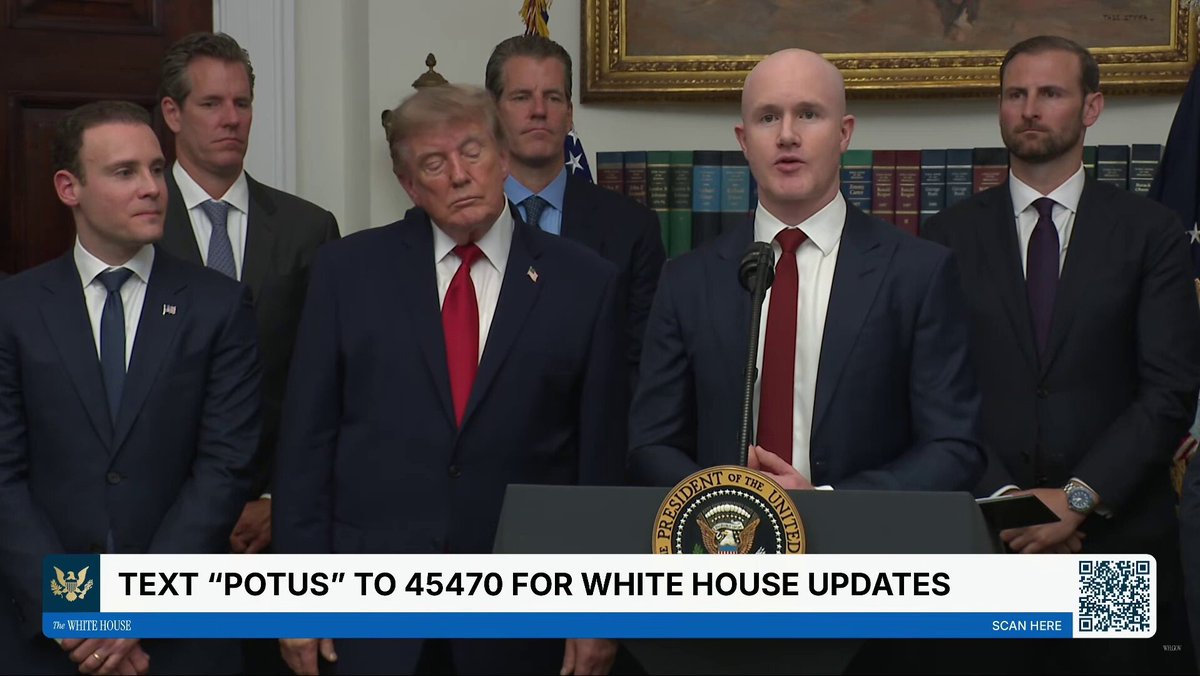
Coinbase CEO Brian Armstrong said on Aug. 28 that he expects the U.S. Senate to hold a key procedural vote on the CLARITY Act on Sept. 15, and that the bill could clear the 60-vote hurdle. Sen. Cynthia Lummis separately confirmed that Majority Leader John Thune has scheduled the vote for 2:00 p.m. that day.
The CLARITY Act is one of the central U.S. crypto regulatory bills, with debate focused on SEC versus CFTC jurisdiction, stablecoin yield rules, and ethics restrictions for lawmakers’ crypto holdings. A cloture vote would not be final passage, but it would end debate and clear the way for a formal Senate vote.
For markets, the calendar matters for Coinbase (COIN) as well as bitcoin, stablecoins, and crypto trading venues more broadly. Clarifying the legislative path tends to shape sentiment around whether digital-asset rules will become durable rather than remain a patchwork.
That said, the bill still needs bipartisan support. Reports note that Republicans cannot reach 60 votes on their own, and Democratic concerns over ethics and banking-industry impacts remain central obstacles.
これまでの経緯
2026-07-01投稿4件 · 投稿者3人
140 companies launched a new stablecoin, targeting Coinbase's revenue model.
The ruling sharpens the line between state gaming law and federal derivatives oversight, with implications for prediction markets and legacy sportsbooks.
On Aug. 28, the Ninth U.S. Circuit Court of Appeals ruled that Kalshi’s sports-related event contracts are not “swaps” under the Commodity Exchange Act, clearing Nevada to keep enforcing its gaming laws. The decision pushes the long-running dispute closer to a possible Supreme Court showdown. cnbc.com
At the center of the case is whether Kalshi’s contracts are federally regulated event contracts or simply sports betting in a different wrapper. The court said the contracts were not swaps because they were sports bets, and its ruling conflicts with an April Third Circuit decision that had gone the other way in a New Jersey case. californiaglobe.com
The stock market reaction was immediate. DraftKings rose 7% and Flutter Entertainment gained more than 6% as investors reassessed the competitive threat from prediction markets. The move suggests traders see stricter state-level constraints on Kalshi as supportive for incumbent sportsbooks. cnbc.com
Nevada regulators welcomed the outcome, saying the ruling vindicates their position that the products are sports betting and should be regulated by the state. Kalshi has maintained that it is operating as a designated contract market; the broader legal fight over sports, entertainment and election contracts remains unresolved. reviewjournal.com
Schwab adds SOL, AVAX and LINK as $13.08T platform broadens crypto access英語原文
The brokerage is widening its spot-crypto offering beyond BTC and ETH, giving its huge client base access to three established tokens over the coming months.
Charles Schwab said it will add Solana, Avalanche and Chainlink to Schwab Crypto in the coming months, expanding the platform beyond the Bitcoin and Ethereum spot trading it launched in May 2026. The new assets will be available to clients through the same brokerage experience.
The move builds on Schwab's push into direct crypto trading and its massive retail footprint. The firm reported about $13.08 trillion in client assets and roughly 39.8 million active brokerage accounts at the end of the second quarter.
For the tokens involved, the significance is distribution: SOL, AVAX and LINK will sit inside a mainstream brokerage platform rather than only on crypto-native venues. Schwab says crypto trades carry a 75-basis-point fee, with custody and execution handled through its banking and infrastructure setup.
The rollout is still phased, so the assets are not immediately available and transfer functionality remains limited. Even so, the announcement underscores how large brokerages are normalizing spot crypto access for mainstream investors.
これまでの経緯
2026-07-01投稿3件 · 投稿者3人
Schwab analysts discussed bitcoin's mid-year outlook and the Clarity Act's impact, while Coinbase's CEO proposed tokenized equities with 24/7 settlement.
市場
Goldman Sachs disclosed as top known holder of $88.1 million in Solana ETFs英語原文
Fresh 13F data shows Wall Street firms are among the most visible holders of spot SOL ETFs, underscoring early institutional participation.
Goldman Sachs has been disclosed as the largest known holder of spot Solana ETF exposure, with about $88.1 million, according to the latest batch of 13F filings cited by Bloomberg ETF analysts and market reports. The disclosure places the bank at the top of publicly known holders for the product.
The data is not a real-time position sheet. Form 13F captures institutional holdings as of the end of the quarter, so it is best read as a snapshot of early demand rather than current exposure. Recent coverage also places Electric Capital and Morgan Stanley near the top of the disclosed holders list.
For SOL, the significance is institutional breadth rather than price action. The filings suggest that spot Solana ETFs are attracting both traditional asset managers and crypto-native firms, a mix that can matter for liquidity, distribution, and how the market gauges product demand.
The development does not speak to operating results for any listed company, but it does put Solana ETF products and their disclosed holders under closer market attention. Further 13F updates will show whether these early allocations persist or broaden.
Avalanche said Bitwise, VanEck and Grayscale now hold more than 5 million AVAX combined, with 3.49 million of those tokens staked. The update was echoed in a Cointelegraph post citing Avalanche as the source.
The disclosure adds to a running story around AVAX-focused funds and staking. Recent fund-level filings and product pages have shown the issuers disclosing AVAX holdings, staking ratios and distribution mechanics, suggesting staking is becoming part of the product structure rather than a side feature.
For AVAX, the key market takeaway is not a price call but a likely focus on supply, redemption liquidity and how staking rewards are passed through to fund investors. The companies directly in frame are AVAX, Bitwise, VanEck and Grayscale.
Cross-checked figures include the combined figure of more than 5 million AVAX and 3.49 million staked from Avalanche/Cointelegraph, plus earlier product disclosures showing Bitwise at 2,638,856.23 AVAX, VanEck at 1,823,393 AVAX and Grayscale at about 640,989.86614991 AVAX in separate reporting.
The French quantum company’s first trading session underscores investor appetite for rare hardware names as it enters the public market with $360 million in cash.
French quantum-computing company Pasqal made its Nasdaq debut on August 28 after completing a merger with blank-check firm Bleichroeder Acquisition Corp. II. Shares were up as much as 73% intraday before settling around a 40% to 52% gain, depending on the market snapshot cited by different outlets.reuters.com
The transaction valued Pasqal at about $2 billion and left the company with roughly $360 million in cash to fund manufacturing, technology development and commercial expansion.pasqal.com Pasqal said it generated €16.5 million in revenue in 2025 and counts Saudi Aramco, Crédit Agricole CIB and LG Electronics among its customers.
Reuters said Pasqal has seven quantum processing units deployed, with three more in production, and systems installed at supercomputing centers in France, Germany, Italy and Canada.reuters.com That makes it one of the few quantum names on public markets with deployed hardware rather than a pure roadmap story.
The debut adds a fresh public-market reference point for quantum-computing stocks, even as the sector remains challenged by error rates and limited scalability. For investors, Pasqal’s listing highlights continued demand for scarce quantum hardware exposure rather than a broad read-through for the whole industry.
Canada on August 28 said it will provide Xanadu Quantum Technologies with C$195 million for an advanced photonics research, development and manufacturing facility in Toronto. Xanadu said the project, called Project OPTIMISM, carries a total price tag of C$893 million and is expected to create 275 jobs.
The funding is the federal portion of up to C$390 million in government support Xanadu disclosed in March. The company said it expects Ontario’s share of up to C$195 million to be announced soon, and that the new site will handle integration, packaging, testing and assembly of photonic and semiconductor components.
For XNDU, the announcement strengthens the financing backdrop behind a capital-intensive buildout and underlines the company’s push to industrialize quantum hardware. Reuters reported the federal support as a C$195 million loan, equivalent to about US$140.78 million, while the government release and company materials used the Canadian-dollar figure.
Xanadu said the facility is intended to support future quantum data-centre deployment and to deepen Canada’s domestic quantum supply chain. The company and Ottawa both framed the move as a major step for Canada’s quantum manufacturing ambitions.
TrendForce said combined output value for NVIDIA’s GB300, VR200 and VR300 NVL72 rack systems could exceed $710 billion in 2027, up 214% year over year. The research firm also expects NVL72 rack shipments to rise more than 50% in 2027.
The estimate extends NVIDIA’s move from selling accelerators to delivering rack-scale AI systems. TrendForce said Vera Rubin systems should carry roughly double the average selling price of GB300, while upstream costs such as wafers and HBM may also rise.
For investors, the implications reach beyond NVDA into memory, networking, power and cooling suppliers, as well as ODMs. NVIDIA’s own recent commentary about roughly $40 billion of revenue opportunity per gigawatt for Vera Rubin adds context to the scale of the infrastructure buildout.
The report fits a broader narrative of AI infrastructure spending shifting from chips alone to integrated data-center deployments. That makes the rack transition itself a key driver of capital allocation across the supply chain.
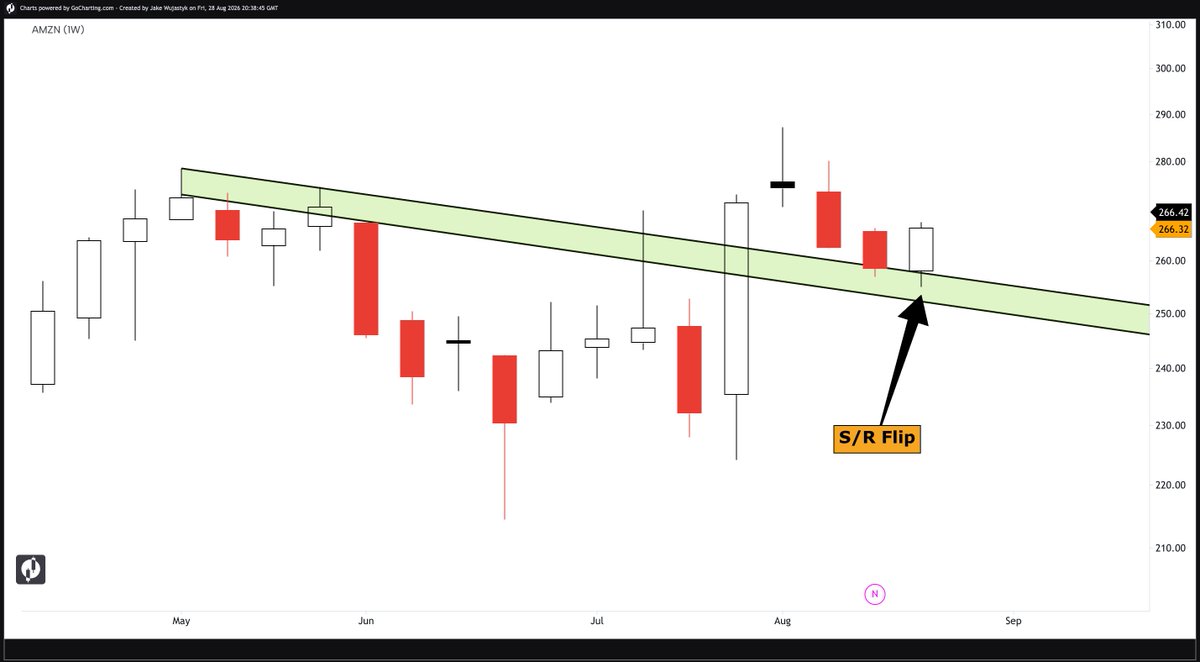
Evercore ISI lifted its price target on Amazon to $355 from $315 on Aug. 28 and kept an Outperform rating. The firm said its 14th annual U.S. online retail survey found that 57% of Alexa AI users bought a product they had not previously been aware of, calling it the first survey evidence that agentic AI is adding to Amazon Retail.
The note extends the AI-driven narrative that has surrounded Amazon since its early-August earnings report. Amazon posted $200.6 billion in second-quarter revenue, up 20% year over year, while AWS revenue rose 37% to $42.2 billion; management also raised full-year capital spending plans to $220 billion.
Amazon shares rose nearly 4% in intraday trading on Aug. 28 as investors weighed whether AI shopping tools can meaningfully lift retail conversion and whether AWS can absorb the heavy investment in compute and infrastructure. The move also kept attention on valuation and free-cash-flow pressure.
Amazon has not issued a separate public response to the survey. For now, the market is treating Evercore’s latest work as incremental evidence in an already live debate over how quickly Amazon can monetize AI across retail and cloud.
According to Politico, House Speaker Mike Johnson plans to meet Elon Musk in Texas on Friday. The report also says Musk is considering putting at least $100 million into Republican efforts through his America PAC for this year's midterm elections.
The meeting is drawing attention because Musk emerged as one of the largest individual political donors in the U.S. in 2024, when he spent about $290 million backing Trump and other Republicans. With both parties ramping up fundraising for the midterms, investors are watching whether any new contribution would be steered toward tight House races.
For Tesla, the news is more about political optics than operations, but TSLA can still react to any rise in Musk-related headline risk. The market focus is on whether the money actually materializes and whether it is directed at battleground districts.
Neither side has publicly confirmed the meeting details, and Musk's team has not clarified the final size or allocation of any potential spending.
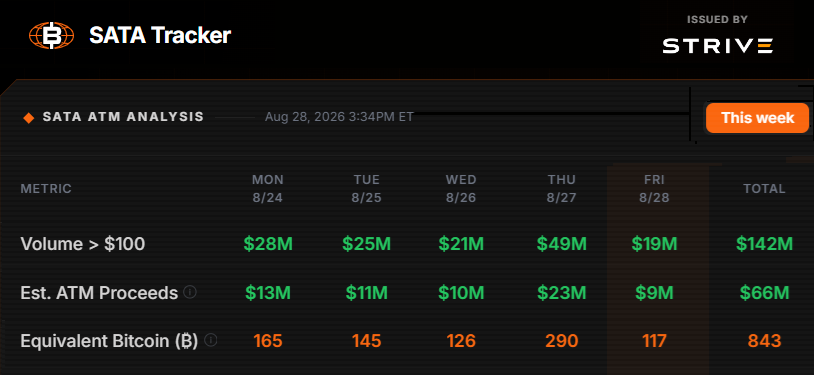
New X signals suggest Strive’s SATA preferred stock may have generated funding capacity for another 843 Bitcoin this week, equivalent to roughly $66 million at the week’s estimated price range. One intraday note also said SATA traded 37,000 shares in a single minute, about 53 times the normal session pace.
The update builds on a series of recent Bitcoin-treasury purchases and funding estimates tied to SATA. Media reports earlier this week, citing BitcoinTreasuries.NET and company filings, said Strive’s SATA activity had already been estimated to support about 1,192 Bitcoin in one week, with more than 100 additional Bitcoin-equivalent funding capacity added within the first two hours of Friday trading.
For investors, the key linkage is between SATA trading activity and ASST’s treasury expansion. When SATA trades at or above its $100 stated value, Strive can more easily issue shares through its ATM program and direct proceeds toward Bitcoin, making preferred-share turnover a direct driver of potential BTC accumulation.
The latest signals have not been matched by a fresh company filing specifically confirming a new 843-BTC purchase. But they reinforce how closely SATA volume and Strive’s Bitcoin-buying capacity remain tied together in the market’s eye.
これまでの経緯
2026-07-01投稿10件 · 投稿者6人
Strive announced it will no longer automatically issue new SATA shares at $100, while reaffirming the 13% annual dividend rate.
企業動向
Microsoft reassures staff as data center concerns grow over power, water and emissions英語原文
An internal memo underscores the tension between AI infrastructure expansion and sustainability goals.
Microsoft’s development chief Noelle Walsh told employees this week that the company is addressing questions about data centers’ energy use, water consumption, emissions and effects on local communities. The memo, reported by multiple outlets, frames the company’s message as one of social value and impact reduction rather than a new financial disclosure.
The backdrop is Microsoft’s rapid buildout of AI infrastructure, which has intensified scrutiny over electricity demand, water availability and the company’s ability to meet earlier emissions commitments. Walsh reportedly said AI has made those targets harder to hit, while pointing to improvements in hardware efficiency, lower water use and plans to add dozens of gigawatts of renewable energy.
For investors, the memo does not change earnings by itself, but it matters because hyperscale data centers sit at the center of Microsoft’s AI spending story. Any later disclosure on power contracts, capex guidance or construction timing could matter more for MSFT than the internal reassurance campaign itself.
So far, the reporting points to an internal communications effort, not a policy reversal or a formal project delay. The new information is that Microsoft is actively trying to calm workforce concerns while defending the societal case for its data center expansion.
Nike said it has named former Foot Locker executive Kristin Bauer to lead operations at Converse, effective Sept. 14. Bauer most recently served as Foot Locker’s chief supply chain officer and will report to Nike COO Venky Alagirisamy, according to reports citing an internal memo.
The appointment comes as Converse remains under pressure. Bloomberg reported that Converse revenue has fallen for 13 straight quarters, underscoring why Nike is continuing to reshuffle leadership around the brand while it works through a broader turnaround.
The timing also matters for investors watching NKE. Nike separately said it will release first-quarter fiscal 2027 results on Oct. 1, giving the market a near-term checkpoint on whether the company’s brand reset is translating into better execution.
No compensation details for Bauer were disclosed in the reporting cited, and Nike has not publicly laid out additional operating targets tied to the move.
Baker Hughes' latest weekly count showed the number of U.S. oil rigs falling by 5 to 447 for the week ended Aug. 28. The total U.S. rig count held at 588, while gas rigs rose by 5 to 132.
The update extends the recent back-and-forth in U.S. drilling activity. On Aug. 21, Baker Hughes reported 452 oil rigs and a total count of 588, so the latest print marks a fresh pullback in oil-directed drilling without changing the overall total.
Rig counts are watched as an early indicator of upstream activity and can influence sentiment around oilfield service names and exploration-and-production stocks, including Baker Hughes, Halliburton and SLB. The oil/gas mix shift matters for expectations around near-term production trends and capital spending.
Baker Hughes publishes the North America rotary rig count weekly, and investors often use it to gauge how producers are adjusting drilling plans. In this release, the divergence between oil and gas rigs was the main move in the data.
これまでの経緯
2026-07-03投稿13件 · 投稿者5人
US Baker Hughes oil rig count rose to 445, with total rigs up to 580.
2026-07-10投稿7件 · 投稿者7人
Baker Hughes received conditional EU approval for its $13.6 billion Chart deal, with rig data released same day.
市場
金は$4,462、銀は$67に下落、ジャクソンホールのタカ派転換で英語原文
Precious metals gave back part of August’s gains as traders repriced the odds of a September Fed move
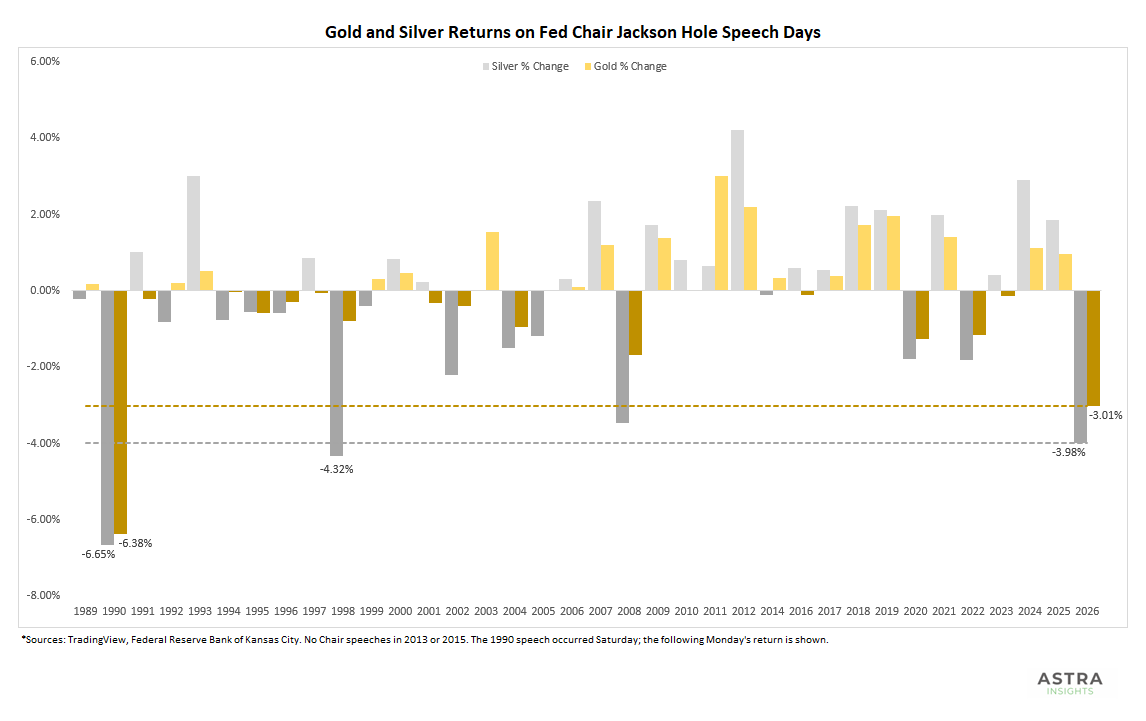
In New York trading on August 29, spot gold fell to around $4,462 after Federal Reserve Chair Kevin Warsh struck a hawkish tone at Jackson Hole, while silver slid toward $67. Multiple reports put gold’s intraday decline at about 3%, with silver posting a larger drop.
The pullback comes after a strong August run. Zacks said on August 28 that gold had risen about 14% this month and was trading near $4,700, underscoring how quickly the market reversed once rate expectations shifted again.
The move rippled through precious-metals ETFs and mining shares. GDX briefly weakened before stabilizing, while SLV also came under pressure as a stronger dollar and higher Treasury yields reduced the appeal of non-yielding assets.
Markets are now watching upcoming inflation prints and the next Federal Reserve meeting for confirmation of whether the hawkish repricing sticks. For gold and silver, the key near-term driver remains the path of U.S. rates and the dollar.
An X post circulating on Saturday says Tom Lee-linked GRNY holds roughly $210 million combined in SPCX and MU. The claim still needs confirmation from a filing or another primary source before it can be treated as a settled fact.
The backdrop is Fundstrat’s recent pro-tech stance. In materials published on Aug. 26 and Aug. 27, the firm said Nvidia’s results and Jackson Hole were “clearing events” for the market and argued that the AI complex could keep advancing.fundstratdirect.com fundstrat.com
For the market, a reported allocation to SPCX — a SpaceX-linked vehicle — and MU would be read as a bet on both private-space exposure and AI memory demand. Micron has been a focal name in that trade: MarketBeat cited quarterly revenue of about $41.46 billion, up 345.8% year over year, alongside a broadly bullish analyst backdrop.marketbeat.com
At this stage, the public signal does not include a filing number, valuation method or an official fund statement. Until those details appear, the post should be treated as an unverified lead rather than a confirmed position update.
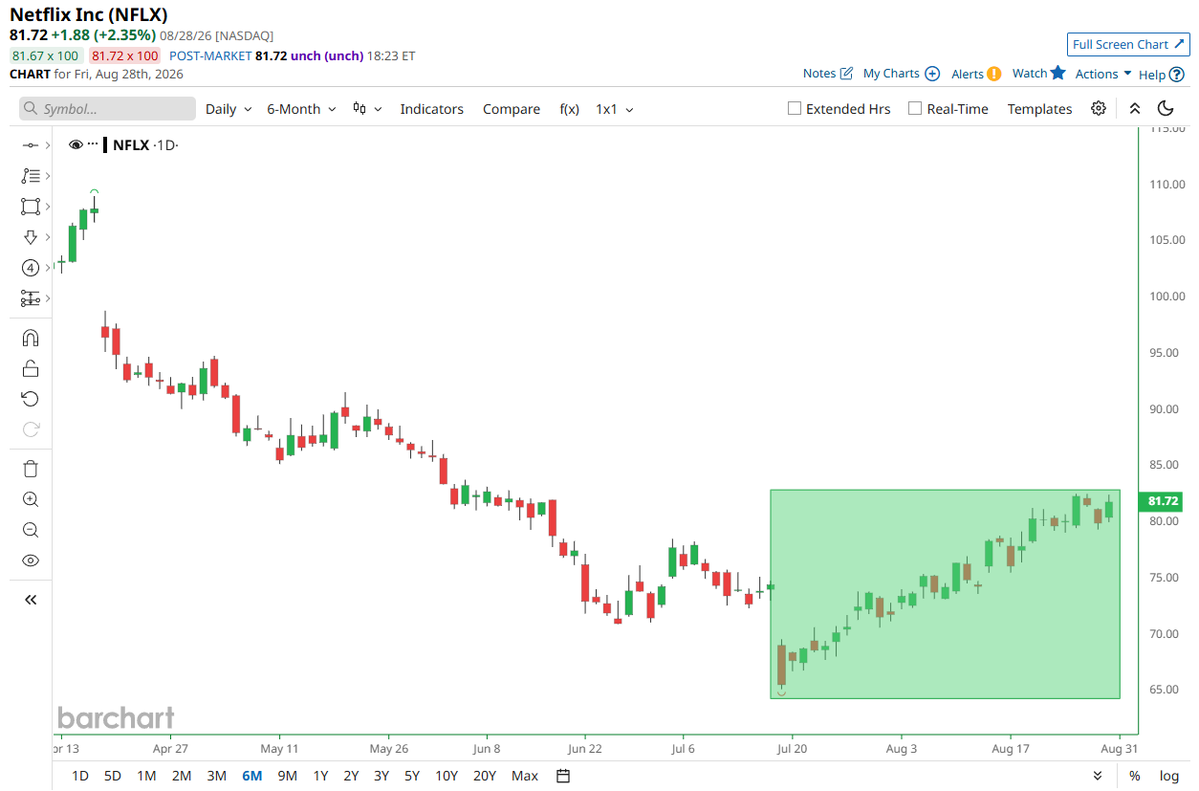
Pershing Square added Netflix in the second quarter, part of what multiple reports described as Bill Ackman’s biggest portfolio overhaul in years. Reuters, as republished by MarketScreener, said Ackman believes the company’s earnings are set for strong growth and that the stake was initiated in Q2.
The new X signal is not a fresh corporate announcement, but a renewed market narrative: traders are linking Netflix’s recent recovery to institutional buying. Posts from Barchart and TrendSpider highlighted that NFLX has risen about 25% from its July low and has posted six straight green weeks.
That backdrop matters because recent coverage has focused on valuation, ad-tier expansion and margin improvement rather than a sudden shift in fundamentals. The Motley Fool also noted that Ackman has argued Netflix has effectively won the streaming wars, which has reinforced interest in the stock.
For markets, the direct focal point is NFLX, while Visa and Mastercard are secondary beneficiaries of the broader Pershing Square reallocation story. The social buzz mainly reflects a sentiment reset around Netflix, not a new company-specific catalyst.
これまでの経緯
2026-07-03投稿7件 · 投稿者7人
Bill Ackman criticized Ro Khanna as a rich radical seeking power by any means.
決算🔥進行中
Dell heads into Monday earnings with $51.3B AI backlog and $16.1B AI server revenue in focus英語原文
Traders on X are arguing over the setup, but the real issue is whether Dell can keep converting AI demand into revenue.
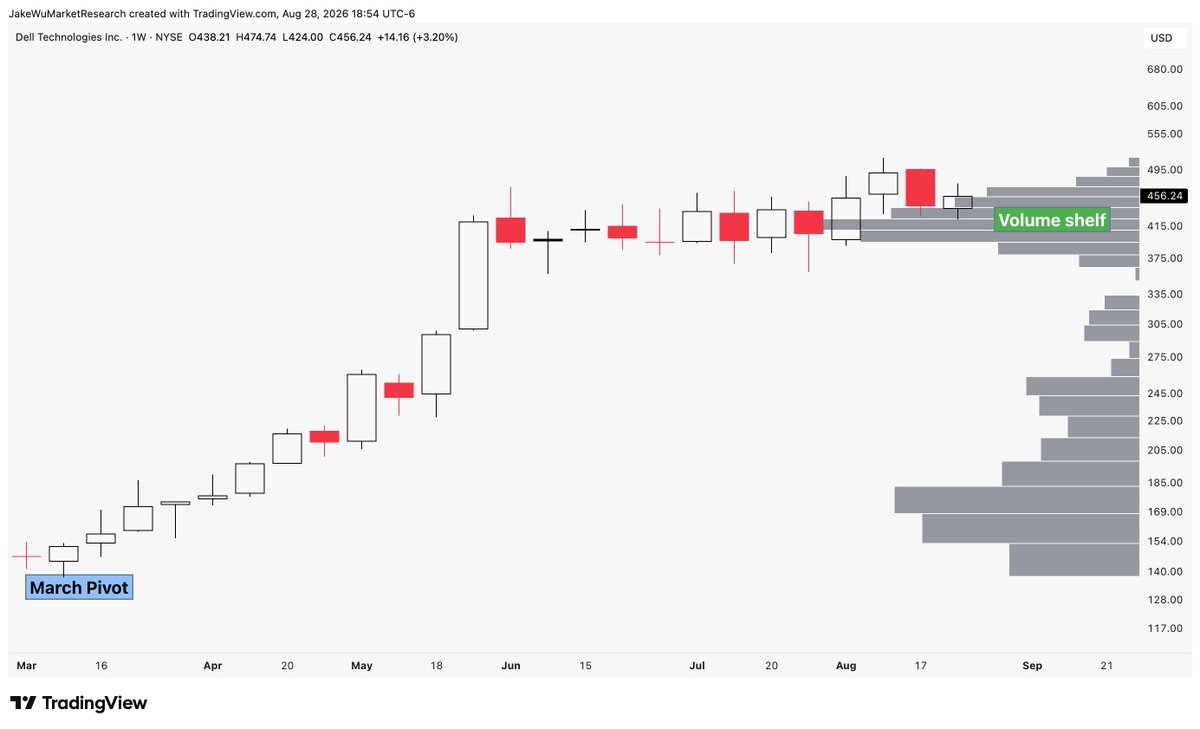
Dell Technologies (DELL) is set to report earnings next Monday, and the latest X chatter shows traders split over the setup ahead of the print. The new information is not a fresh company disclosure, but the market’s renewed focus on event risk as the report gets closer.
What remains central is Dell’s last reported AI momentum: a $51.3 billion AI backlog and $16.1 billion in AI server revenue. Zacks highlighted those figures on Aug. 29, while Investopedia noted on Aug. 28 that the stock is heading into a report due after Tuesday’s close.
For the market, the read-through goes beyond DELL alone. The update matters for AI infrastructure names, data-center hardware suppliers and other companies tied to enterprise IT spending, because Dell is a key bellwether for demand conversion in servers and storage.
No company response to the technical-trading comments on X was visible in the material reviewed. For now, the story is about anticipation, not prediction: investors are watching whether Dell can keep turning AI orders into recognized revenue when it reports next week.
これまでの経緯
2026-07-07投稿4件 · 投稿者4人
Rosenblatt raised PENG's price target to $75, citing 22.6x forward earnings and FY27 EPS of $3.32.
マクロ🔥進行中
Warsh氏のジャクソンホールでのタカ派姿勢で9月利上げ確率57%に上昇英語原文
Traders repriced the September meeting after Warsh said inflation still has more work to do, pushing front-end yields higher.
After Federal Reserve Chair Kevin Warsh struck a hawkish tone at Jackson Hole, traders quickly lifted the odds of a September rate hike. Market pricing now puts the chance of a 25-basis-point move around 56% to 58%, according to recent FedWatch and prediction-market updates.
The shift comes even though recent inflation prints have eased from summer levels. Warsh said the Fed needs to be confident underlying inflation is moving toward 2% clearly and at sufficient speed, otherwise it still has work to do.
The repricing was most visible in the front end of the Treasury curve, where the 2-year yield moved higher relative to the long end. Rate-sensitive growth stocks are typically the first to feel that kind of pressure, which is why traders were focused on policy rather than company-specific news.
Warsh stopped short of offering explicit forward guidance, but his remarks were enough to turn the September meeting into a near coin flip. The next jobs report and the September 11 CPI release should help determine whether that pricing sticks.
これまでの経緯
2026-07-30投稿4件 · 投稿者4人
The Fed held rates steady but saw its first hawkish dissent this cycle with three members favoring a 25bp hike, while rate hike odds on CME FedWatch jumped to 35.8%.
市場
Refiners VLO and MPC keep pressing highs as GAI trade fades英語原文
X chatter says the group held firm into the close, while a fresh Zacks note keeps the sector on watch.
X posts on August 29 said $VLO, $MPC, $PSX and $DINO finished strong after an intraday dip, with several names trading near or at all-time highs. One trader also flagged low correlation between refiners and “GAI infrastructure” stocks as a feature of the setup.
The broader backdrop remains a powerful refining-margin cycle. Market coverage in recent weeks said Marathon Petroleum and Valero Energy together earned about $8.8 billion in Q2 2026, helped by tighter global refining capacity and firmer gasoline, diesel and jet fuel spreads.
Near-term, the market is still treating refiners as a momentum group rather than a fading trade. A Zacks piece published on August 28 also singled out an energy stock as a #1 Strong Buy, adding to the bullish tone around the sector.
For now, the incremental signal is price action: refiners are still attracting buyers even after strong runs. That keeps $VLO, $MPC, $PSX and $DINO in focus as long as crack spreads stay elevated and earnings revisions remain supportive.
Palantir and Nvidia expanded their sovereign AI partnership, Tim Cook cited unprecedented memory cost surges, and IREN pivoted half capacity to software cloud.
2026-07-14投稿24件 · 投稿者22人
A study found 96% of US stocks never profited investors, Trump reinstated a Hormuz blockade fee, and Apple hit new all-time highs.
2026-07-28投稿30件 · 投稿者26人
Apple surpassed $5 trillion market cap, malware in app stores stole crypto seed phrases, and markets awaited key economic data.
2026-07-31投稿65件 · 投稿者46人
Citadel bought Situational Awareness's portfolio, Tesla led profit growth forecasts, and Apple reported $109.4B revenue.
2026-08-27投稿13件 · 投稿者13人
Apple printed a MACD bull cross, and App Store revenue turned negative for the first time in a decade due to Epic's injunction.
2026-08-28投稿10件 · 投稿者10人
Tim Cook announced stepping down as Apple CEO, Nvidia gained $453B in a day, and Summers warned on stimulus.
2026-08-29投稿2件 · 投稿者2人
Cook's departure was confirmed, and Samsung absorbed memory cost hits to gain share, pressuring Apple.
Analysts compared the consortium launch to the 2017 New York Agreement, highlighting its institutional heft and quantum defense focus, with the $15M developer fund detailed.
2026-08-19投稿6件 · 投稿者6人
Fidelity predicted a Bitcoin breakout due to record-low volatility, while Arkham showed client purchases hit $134M in 2 days; debates on self-custody emerged.
2026-08-21投稿4件 · 投稿者4人
Spot Bitcoin ETF volume surpassed $5.3B with net inflows of $517M, led by BlackRock's IBIT ($284M), ARK, and Fidelity.
2026-08-29投稿1件 · 投稿者1人
Fidelity's Jurrien Timmer noted Bitcoin testing $80K resistance, with a move above confirming a double-bottom bullish pattern.
Charles Schwab, managing $13 trillion, publicly urged the US Senate to pass the Crypto Clarity Act.
2026-07-28投稿7件 · 投稿者6人
Five major asset managers including BlackRock and Fidelity, managing over $30 trillion, endorsed the Clarity Act, with Schwab's research head saying its passage was not priced into bitcoin.
2026-08-27投稿13件 · 投稿者12人
Charles Schwab announced plans to add Solana, Avalanche, and Chainlink trading, offering direct SOL access to its 39.9 million brokerage accounts.
2026-08-28投稿9件 · 投稿者7人
Schwab confirmed expanding its crypto offerings, with its global equity research director naming BTC, ETH, SOL, XRP, and HYPE as top picks.
2026-08-29投稿6件 · 投稿者5人
Charles Schwab was seen as quietly evolving into a crypto exchange, citing a rebirth of the debasement trade in bitcoin, while officially launching Solana and other tokens.