US stocks closed sharply higher on Wednesday after Democrats won control of both the Senate and House of Representatives. The Dow Jones Industrial Average rose 3.04% to 53,362.57, the S&P 500 gained 1.58% to 7,688.73 and the Nasdaq Composite added 1.44% to 25,736.51.
The rally was split within technology. Microsoft rose 6.68%, Amazon 6.12% and Alphabet 3.18% on expectations that a slower AI infrastructure buildout would ease cash demands on hyperscalers. Data center operators moved the other way: Hut 8 fell 23%, IREN 11% and Core Scientific 10%, while the Philadelphia Semiconductor Index dropped 3.13% to a six-month low, with Nvidia down 3.17% and Micron down 7.00%.
Democratic gains in data center-heavy states including Texas, Ohio and Georgia drove the divergence. Texas governor-elect Gina Hinojosa campaigned on a moratorium on new data center approvals; the state accounts for roughly 25% of US data center capacity expected to be operating by 2030, putting about 13 gigawatts of projects at risk.
Elon Musk-linked shares also fell, with Tesla down 3.34% and SpaceX down 3.81%, erasing more than $120 billion in combined market value. Musk spent nearly half a billion dollars backing Republican candidates, and Texas turning blue adds state-level regulatory risk to his companies.
Vice President JD Vance said in a social media post Wednesday that "the reason we lost is the war," adding that the president himself had said so the night before. Crude fell sharply after the remarks: WTI settled at $88.12 a barrel, down 8.3%, and Brent settled at $94.62, down 8.7%, both the lowest closes since Aug. 31.
The trigger was Democrats' sweep of the House and Senate in Tuesday's midterms. Incoming Senate Democratic leader Chuck Schumer has vowed to push to end the Iran war, and analysts say a Democratic Congress could constrain military spending in the Middle East, raising pressure on Trump to seek an exit. Trump told the Financial Times on Tuesday there were no immediate plans to strike Iran, while Qatar stepped up mediation efforts.
The selloff spread across energy: the Energy Select Sector SPDR Fund (XLE) fell more than 5%, refiners Marathon Petroleum (MPC) and Valero (VLO) dropped roughly 8% to 10%, ExxonMobil (XOM) fell 4.6% and ConocoPhillips (COP) 5.1%. Gasoline futures headed for their lowest close since March 10, though US diesel stockpiles remain at low levels, leaving supply yet to catch up with the peace trade.
Views on what comes next diverge. Rapidan Energy's Bob McNally said traders are betting the administration will quit the war: "We're not buying it. We think escalation is more likely." Raymond James analyst Pavel Molchanov said a durable off-ramp is needed for prices to move sustainably lower. Iran's Supreme Leader Ayatollah Mojtaba Khamenei said US hostility would persist regardless of which party holds power, and a senior Iranian official told Reuters the two sides remain far from a deal.
Brent crude futures settled $8.98, or 8.7%, lower at $94.62 a barrel on Nov. 4, while US West Texas Intermediate fell $7.97, or 8.3%, to $88.12, according to Reuters. Both benchmarks closed at their lowest since Aug. 31, and the slide extended into a fourth session on Nov. 5, with Brent trading near $93.6.
The trigger was the US midterm elections, in which Democrats won control of the House and Senate. President Donald Trump acknowledged the Iran war weighed on his party and said there were no immediate plans to strike Iran; Vice President JD Vance distanced himself from the decision to go to war. Qatar stepped up mediation, but a senior Iranian official told Reuters the two sides remain far from a deal.
Supply is adding pressure. Vortexa ship-tracking data showed Gulf exports of crude, condensate and refined products averaged 17.1 million barrels per day in October, down from 18.9 million bpd in September but still roughly three-quarters of pre-war levels. The EIA reported US crude stocks fell 865,000 barrels to 409.8 million barrels in the week to Oct. 30, against expectations for a 877,000-barrel build.
For equities, cheaper crude supported consumer and leisure names, with XLY and PEJ cited in market chatter as moving higher. Analysts cautioned that a breakdown in talks or renewed escalation could quickly restore the risk premium; Yemen's Houthis said they targeted Riyadh's King Khalid International Airport, a claim Saudi authorities did not confirm.
Democrats took control of both chambers of Congress in the US midterms. According to CNBC, voters rebuffed data centers in every ballot measure except one during the 2026 midterms, a result read as a signal that the pace of data center construction could slow.
Cipher Digital (NASDAQ: CIFR) fell sharply on Wednesday. Benzinga attributed the drop to concerns that tighter regulation following Democratic midterm victories could delay data center construction and slow expansion. The stock had already lost 53.9% in October amid AI financing fears, after an $850 million convertible debt offering triggered back-to-back double-digit declines.
Credit markets are repricing as well. Bloomberg reported that credit markets are starting to price in winners and losers from an expected slowdown in data center development after the Democratic sweep. Meanwhile, some technology giants led the market higher on Wednesday as investors bet a Democrat-controlled Congress will slow the massive AI spending that is eating up free cash flow.
Not every read is bearish. A tech investor on X argued the end game of the AI revolution is unchanged and that a slower pace of data centers and capex is itself bullish, since it eases capex worries for Big Tech. JPMorgan's US Market Intelligence team also remains tactically bullish, arguing the recent selloff in technology shares may create an opportunity for a near-term recovery.
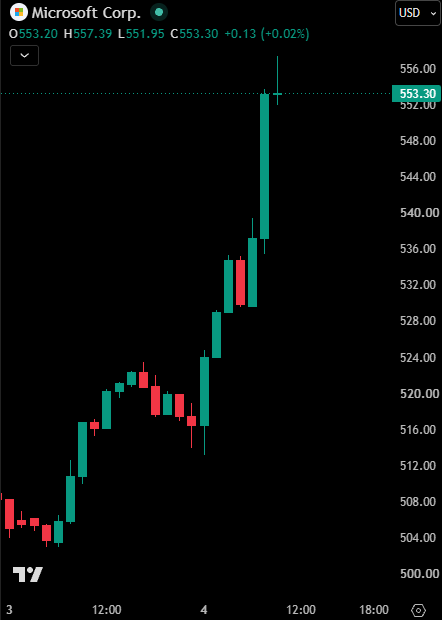
Microsoft (MSFT) rose nearly 7% in early trading on Nov. 5, pushing its market capitalization above $4 trillion to a record high and making it the world's third-largest company by market value. Amazon (AMZN) gained about 7% the same morning, adding roughly $190 billion in market cap.
The synchronized move in the two hyperscalers was read as a concentrated expression of the AI infrastructure investment thesis. Analysts have argued that Big Tech's ballooning data-center budgets are shifting from a cash drain to a profit engine.
According to Kobeissi Letter and Unusual Whales, Microsoft added about $255 billion in market value on the day, with the two stocks together adding roughly $445 billion.
Coverage in this site's news library shows Amazon has erased its post-earnings sell-off, holds an Anthropic stake valued at about $6.2 billion, and posted its fastest cloud revenue growth in nearly five years.
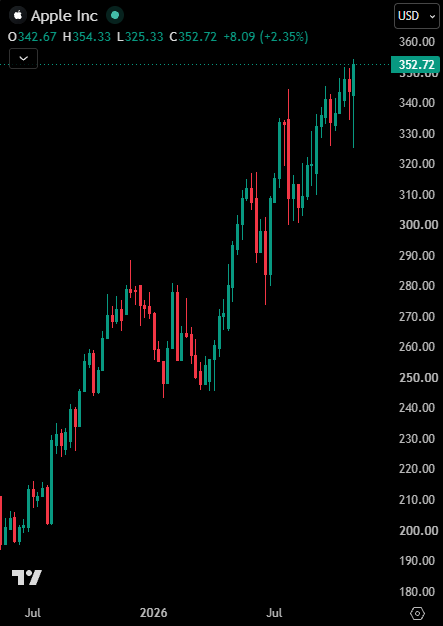
Apple (AAPL) rose 7% on Nov. 5 to a fresh all-time high, with its market value exceeding $5.1 trillion and the company back on top as the world's most valuable, according to multiple market accounts posting on X.
The same batch of posts said Apple had regained its position as the largest stock by market capitalization and described it as the best-performing Magnificent 7 name of 2026. The claims come from market commentary accounts; the materials contain no statement from Apple itself.
Coverage in our news library over the past 48 hours focused on institutional position changes, with several firms buying or selling Apple shares in their latest quarterly filings. One report noted the stock surging after the company's fiscal 2026 annual report. None of those reports addressed market-cap rankings or the single-day gain.
If the $5.1 trillion valuation and 7% move hold, Apple would lead other large technology companies on market value, though the materials provide no comparable figures for peers.
AMD reported third-quarter 2026 revenue of $13.4 billion, up 45% from $9.2 billion in the same quarter last year. Data center revenue surged 97% to $8.55 billion, fueled by AI chips and server processors.
The company expects revenue from AI chips for data centers to overtake revenue from its server processors in the fourth quarter. CEO Lisa Su said customers have expanded their deployment plans since the company last updated investors 90 days earlier, and guided for more than 80% revenue growth in 2027.
AMD shares rose 4% after hours as revenue guidance topped estimates. Some market commentary noted the stock was being sold on fears of a data center slowdown despite the strong results.
For comparison, Intel grew revenue 21% in the same period, less than half AMD's pace. Stifel sees AMD stock reaching $725.
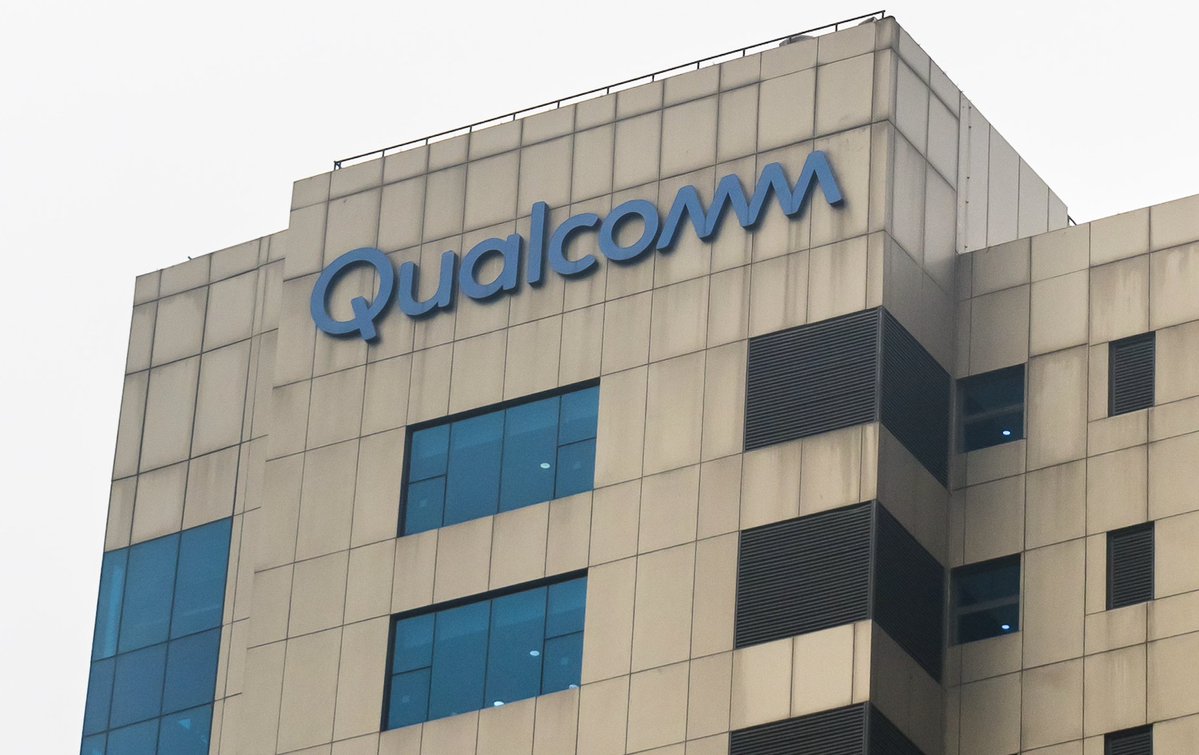
Qualcomm said Wednesday that SpaceX has selected its Dragonwing QRU100 radio units, QDU100 baseband processors and Layer 1 RAN software for Starlink Mobile's planned nationwide terrestrial 5G network in the US, with deployments across tens of thousands of macro cell sites expected to begin in 2027. Qualcomm called it its biggest 5G infrastructure deal to date but did not disclose financial terms.
SpaceX had publicly ruled out becoming a nationwide carrier in March, then moved into spectrum acquisitions and talks with tower companies. The Qualcomm deal points to conventional high-power macro infrastructure rather than the smaller cell sites attached to Starlink rooftop terminals that Musk had floated, according to analysts.
For Qualcomm, the agreement extends its push beyond smartphone chips into telecom infrastructure, where it would compete with Marvell, Broadcom and Intel. For AT&T, Verizon and T-Mobile, it signals a potential fourth national carrier backed by spectrum and satellite capacity. Mobile Experts principal analyst Joe Madden estimates SpaceX will spend at least $100 billion on its combined satellite and terrestrial network, including spectrum.
Qualcomm EVP Durga Malladi said the company has high confidence in SpaceX's commitment but declined to discuss contractual guarantees. SpaceX did not comment on the investment figure.
Sources:
Company🔥Developing
Goldman, Apollo Seek Buyers for SpaceX's $40 Billion GPU Financing
The multi-tranche structure keeps the debt off SpaceX's balance sheet and is billed as the largest GPU financing on record
Goldman Sachs and Apollo Global Management are approaching Wall Street investors to sell portions of a roughly $40 billion financing package for SpaceX's AI chips, Bloomberg reported. Some potential buyers have been asked to subscribe up to $500 million ahead of the formal syndication process, according to the report. Reuters said it could not independently verify the report; Goldman declined to comment, while Apollo and SpaceX did not immediately respond.
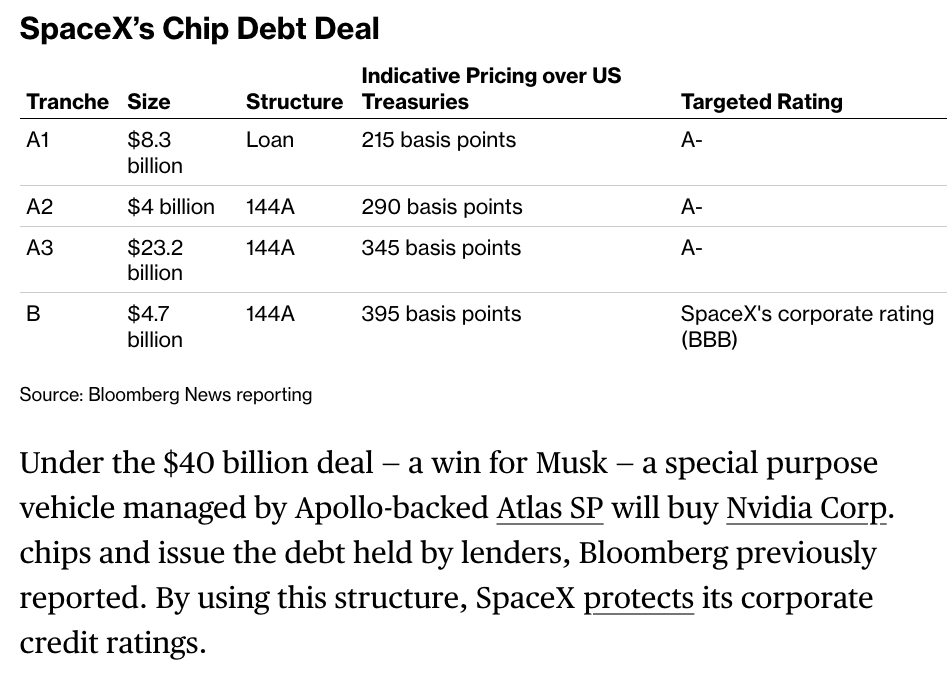
SpaceX disclosed the deal in October: a special purpose vehicle managed by Apollo-backed Atlas SP will buy Nvidia chips and issue debt to lenders, with SpaceX leasing the equipment under a five-year agreement. The debt includes an $8.3 billion senior secured loan slated for bank syndication and multiple bond tranches for asset managers, with Goldman leading the loan and Apollo the key bond investor; PIMCO is also participating. Together with $7 billion in lease prepayments, the financing will fund roughly $47.3 billion of Nvidia Rubin chips expected to be delivered in the first half of 2027.
The marketing push comes as appetite for AI-linked deals is being tested. SpaceX and Tesla shares fell after Democrats won the midterm elections; SpaceX's data center is in Memphis, Tennessee, with additional sites under development in Mississippi. Presentation materials say SpaceX's obligation to pay rent is absolute and cannot be paused by invoking force majeure.
The parties involved include SpaceX (SPCX), Goldman Sachs (GS), Apollo (APO) and chip supplier Nvidia (NVDA).
Company
CVS to split pharmacies from Aetna insurance; shares fall 14%
The company also beat Q3 estimates and raised guidance, but investors focused on execution and synergy risks in the breakup
CVS Health said on Nov. 4 that it plans to separate its roughly 9,000 retail pharmacies from Aetna, its health insurer, and its pharmacy benefit manager, creating two independent companies by 2028. The company described the move as creating two distinct leaders in healthcare.
The announcement came alongside stronger-than-expected third-quarter results: adjusted EPS of $2.09, up 30.6%, and revenue of $108.4 billion, up 5.4%. CVS raised its full-year adjusted EPS guidance to at least $8.20 and set a 2027 floor of at least $8.65.
Despite the beat, CVS shares fell 14% in the session. Investors weighed execution costs and the potential loss of synergies; one market commentator noted possible overlap in HR, IT and finance roles, though no separation-related layoffs have been announced.
After the split, the retail pharmacy company will face prescription pricing and store-level pressures directly, while the insurance and pharmacy services business will need to manage medical costs on its own. Consumer effects, including drug prices and pharmacy access, depend on how the two entities are ultimately structured.
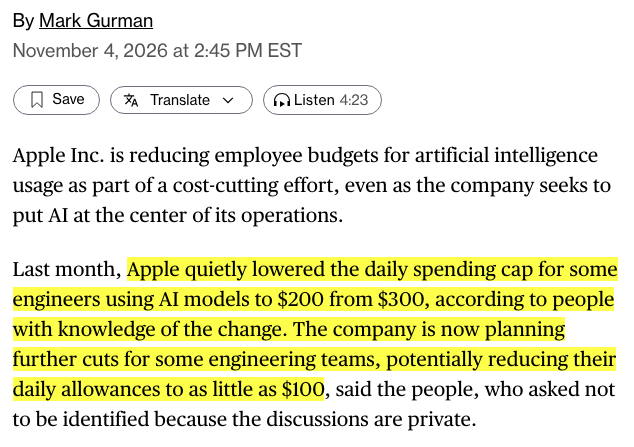
Apple has lowered internal AI usage budgets, cutting the daily AI spending cap for some engineers to $200 from $300 and weighing a further reduction to $100, according to Bloomberg. Some non-engineering teams could see daily limits fall from $100 to as little as $25.
The adjustment comes as Apple's AI capital expenditure remains far below peers. Its fiscal 2025 capex totaled about $12.7 billion, while Microsoft, Alphabet, Meta and Amazon combined to spend more than $400 billion in calendar 2025; Amazon alone expects about $200 billion this year. Apple's fiscal 2025 R&D spending was $34.6 billion.
The report lands as some investors treat Apple as a hedge against AI spending volatility. The stock is up 27% in 2026, the biggest contributor to the S&P 500's 12% gain and the best performer among the Magnificent Seven; its correlation with the chip index has been negative since early July.
Bloomberg said Microsoft and McKinsey have similarly limited employee AI use to contain costs. Apple has not publicly commented on the internal budget changes.
Snap Q3 revenue of $1.72B misses estimates; DAUs at 495M fall short
Revenue and daily active users both came in below expectations, sending shares down more than 10% after hours; Q4 revenue guidance midpoint is roughly in line with estimates
Snap reported third-quarter revenue of $1.72 billion after the bell on Wednesday, slightly below the $1.73 billion expected. Daily active users came in at 495 million, below the 499.31 million estimate. Adjusted EBITDA was $382.6 million, above the $338.1 million expected.
Shares fell more than 10% in after-hours trading following the report. CNBC reported that the company missed on both revenue and daily active users.
The company guided fourth-quarter revenue to $1.95 billion to $1.99 billion, a midpoint of about $1.96 billion that is roughly in line with estimates.
Snap also announced that Snapchat+ paid subscribers surpassed 30 million, an increase of 5 million, according to TechCrunch.
AppLovin reported third-quarter earnings of $4.30 per share, above the $4.07 consensus, on sales of $2.185 billion versus $2.078 billion expected. The company also raised its fourth-quarter sales guidance, and the stock rose 13% in after-hours trading.
According to the newsroom's recent reports, several law firms this week reminded AppLovin investors that the lead-plaintiff deadline in a securities class action is November 16, 2026. The suit alleges significant development delays in the generative AI video creative tool for the AppLovin Ads platform, contrary to what investors were told.
Elsewhere in the same session, Qualcomm reported EPS of $2.17 and revenue of $10.4 billion, both slightly above estimates, while ARM posted EPS of $0.52 on revenue of $1.44 billion, also ahead. Datadog beat on adjusted EPS of $0.81 and revenue of $1.197 billion and raised guidance, yet fell 17% pre-market.
The lawsuit's allegations have not been adjudicated and are not established facts. AppLovin did not respond in the materials reviewed.
Qualcomm reported fiscal fourth-quarter revenue of $10.44 billion, above the roughly $10.11 billion consensus but down 7% year over year. Adjusted EPS came in at $2.17 versus $2.16 expected, down 28% year over year, while GAAP EPS was $1.17.
By segment, handset revenue fell 26% to $5.14 billion, automotive revenue jumped 89% to $1.99 billion and internet of things revenue rose 4% to $1.89 billion. For the first quarter, the company guided revenue of $10.4 billion to $11.2 billion and non-GAAP EPS of $2.15 to $2.35, a profit outlook below consensus.
Qualcomm said fiscal 2027 marks the start of its non-handset revenue inflection, including the ramp of its data center business, with non-handset revenue projected to grow more than 60% year over year. The comment shifts investor focus from handset cyclicality to the pace of new business lines.
The stock moved lower after hours as investors weighed the softer profit guide. Coverage in the newsroom over the past 48 hours centered on earnings previews and a SpaceX agreement, which is a separate event from the results themselves.
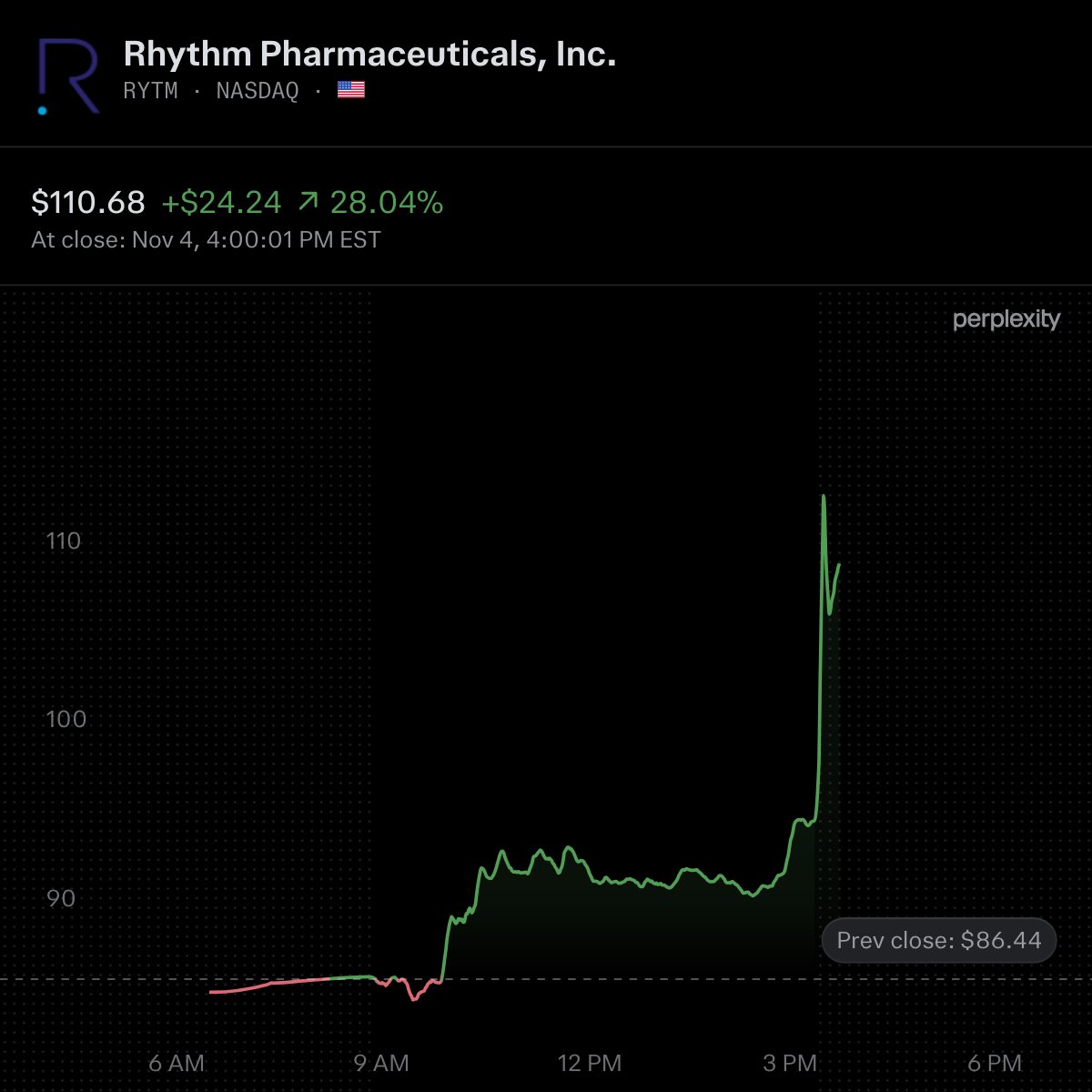
AstraZeneca has made an offer of about $10 billion to acquire obesity drugmaker Rhythm Pharmaceuticals, with the non-binding proposal valuing the company at as much as $134 a share including milestone payments, Reuters reported on Nov. 4, citing three people familiar with the matter. The figure is above the $124-per-share offer reported earlier the same day by The Wall Street Journal.
The acquisition would be pursued through AstraZeneca's rare-disease business Alexion, which the company bought for $39 billion in 2021, two of the people said. Rhythm develops therapies for rare neuroendocrine and metabolic disorders; in March the FDA expanded use of its drug Imcivree for a rare form of obesity caused by brain damage.
Rhythm shares closed up 28% at $110.68, giving it a market capitalization of about $7.64 billion — below the reported offer level, a gap that suggests investors see execution risk. AstraZeneca, which has a market value of about $292 billion, declined to comment; Rhythm did not respond to a request for comment.
The proposal is non-binding and there is no certainty the parties will reach a final agreement, Reuters reported.
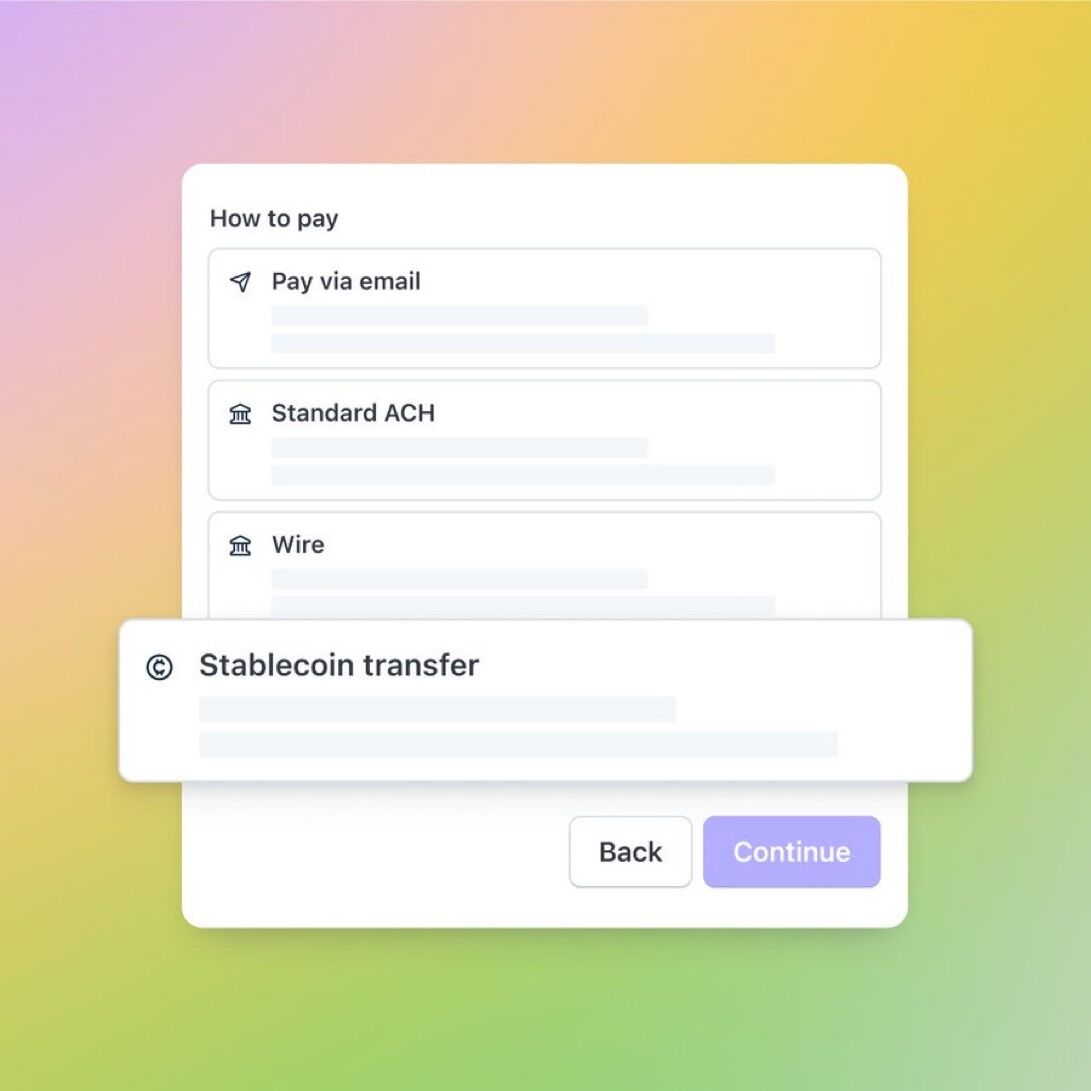
Stripe's Global Payouts is now in public preview, letting eligible US businesses send USDC and OUSD to recipients' external crypto wallets in more than 160 markets. Funds are drawn from a USD or USDC balance in Stripe Treasury and typically arrive within minutes. USDC runs on nine networks including Arbitrum, Avalanche C-Chain, Base, Ethereum, Optimism, Polygon, Solana, Stellar and Tempo; OUSD runs on Base, Ethereum, Solana and Tempo.
The capability was not new on Wednesday. An Oct. 16 announcement by Neetika Bansal, Stripe's business lead for Money as a Service, already described instant stablecoin payouts to 160 markets, and this week's documentation supplied the operational detail: tokens, networks and geographic limits. Stripe reopened USDC payments for US businesses in 2024, added stablecoin infrastructure through 2025 acquisitions, and made OUSD a default option across its financial products by the end of September 2026.
Stripe lists stablecoin payouts at $0.50 per payment plus 0.5% of the amount sent, against a $25 SWIFT wire fee. On that basis a $1,000 payout costs $5.50 and a $10,000 payout costs $50.50, with the two charges equal at $4,900. The figures exclude currency conversion, which starts at 0.5%, and a platform fee. For fintechs, payroll providers and remittance firms moving funds in bulk, speed and per-transfer cost are the comparison points.
The sharpest constraint disclosed is geographic: businesses located in New York are excluded from the public preview and can only register for notification, with no date given for availability. Recipients must supply an email, name and address, using a company name for business recipients, and senders must confirm the wallet supports both the chosen stablecoin and network.
Company
Trump Media Hits Record Low of $5.23 as Democrats Sweep Congress in Midterms
Shares of the Truth Social parent sold off after the election results, becoming a market gauge of Trump's political standing.
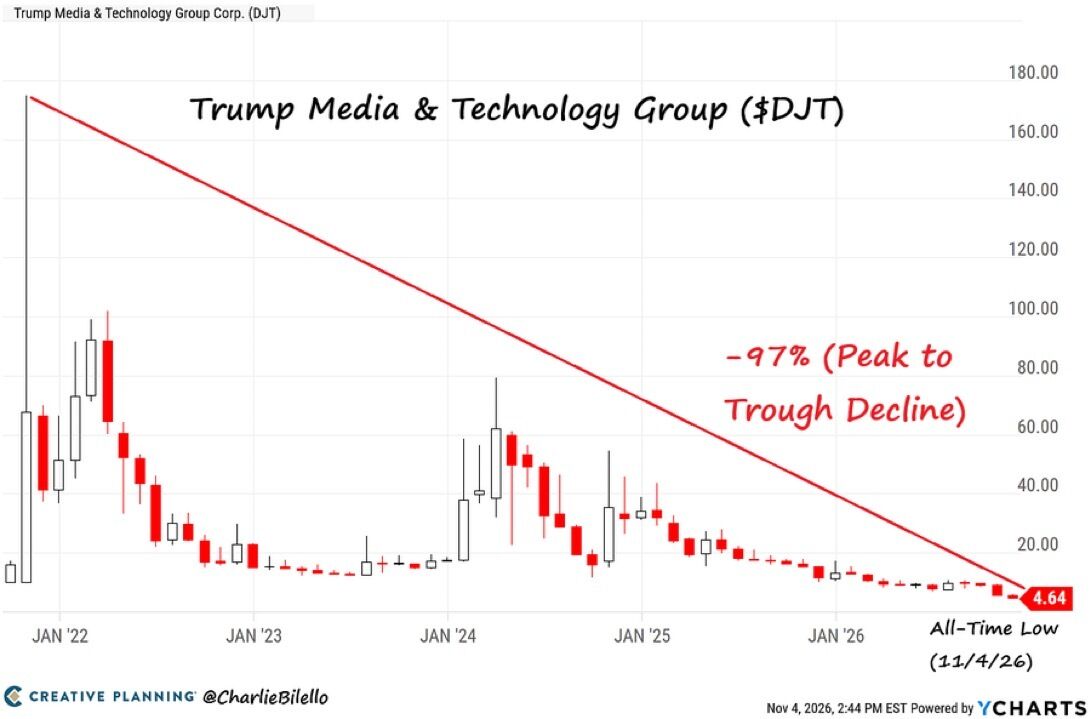
Trump Media & Technology Group (NASDAQ:DJT) fell sharply after the open on Nov. 4 as midterm results became clear. Piqmarkets reported a drop of more than 11% shortly after the opening bell and an all-time intraday low of $5.23; Schaeffers put the stock down 10.8% at $5.31 at its last check.
The trigger was Democrats winning control of both chambers of Congress in the Nov. 3 vote. Barron's framed the stock as a market sentiment indicator for President Donald Trump, while Forbes noted the selling occurred in premarket trading.
Over a longer horizon, the stock is down about 97% from its peak, and the company has posted cumulative net losses of $1.8 billion since inception, according to Charlie Bilello. Invezz reported that its market capitalization has shrunk from more than $10 billion.
Reported single-day declines vary by timing: Polymarket cited nearly 14%, piqmarkets more than 11%, Schaeffers 10.8%, and Finbold roughly 7% in premarket trading.
Coherent (COHR) reported first-quarter fiscal 2027 revenue of $2.37 billion, above the $2.31 billion consensus, up 50% year over year and 56% on a pro forma basis. Adjusted EPS came in at $2.09, up 80% year over year, while non-GAAP gross margin reached 40.6%, up 184 basis points.
For the second quarter, the company guided revenue of $2.55 billion to $2.75 billion and adjusted EPS of $2.28 to $2.48, with adjusted gross margin of 40% to 42%. Management also said it expects fiscal 2027 pro forma revenue growth above 60% and its first $3 billion revenue quarter by the end of the fiscal year.
The beat-and-raise quarter drew attention to the durability of demand in Coherent's optical communications business. Materials show the stock moved higher in after-hours trading.
Estimates cited by different sources varied slightly: Zacks put the EPS consensus at $2, while some X accounts cited $1.93 to $1.98. The company's official release confirmed the core revenue and margin figures.
Mercado Libre reported third-quarter 2026 revenue of $10.75 billion, beating expectations of $10.66 billion and rising 45% year over year, while earnings per share came in at $8.83 against expectations of $9.36.
The profit shortfall was tied to higher logistics spending, while revenue growth was driven by the company's e-commerce and fintech businesses.
Motorola Solutions also reported quarterly results, with adjusted EPS of $4.69 and net sales of $3.38 billion both above estimates; it raised its fourth-quarter adjusted EPS guidance and lowered its sales guidance.
Investors focused on Mercado Libre's margins and on Motorola's revenue outlook following the reports.
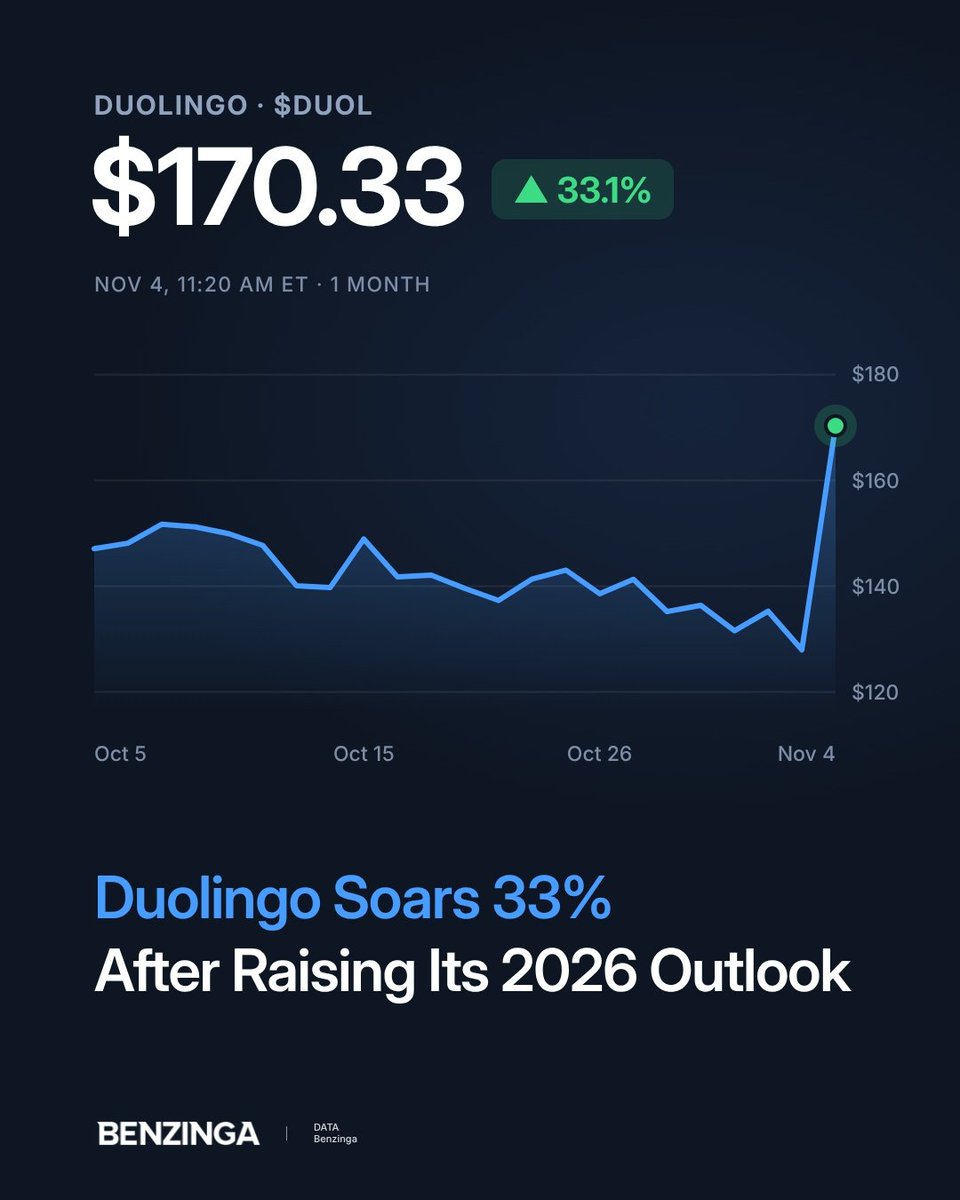
Duolingo (DUOL) rose about 33% in a single session after beating on revenue and raising its 2026 sales outlook, its biggest day in years. Wells Fargo also upgraded the stock to Equal Weight and lifted its target to $120.
X market accounts gave differing figures: stockmktnewz said the stock was up almost 35% so far today, trendspider said up 30%+ on the day, benzinga said up 33%, and wolf_terminal said it closed up 26%. A Seeking Alpha report in our newsroom database said Q3 2026 revenue and user growth exceeded expectations and cited a 26% share price surge, matching the closing figure.
The move was concentrated in Duolingo itself: per the posts, a month of selling was erased in one session, with the stock bouncing hard off its 30-week simple moving average.
In the background, several law firms issued investor alerts in the past 48 hours over a securities class action against Duolingo, with allegations focused on its Energy feature and AI-first representations, according to our newsroom database.
AMC Entertainment Holdings reported third-quarter 2026 results after the close on November 4, with revenue of $1.71 billion versus an estimate of $1.54 billion, up 31.6% year over year. Adjusted earnings per share came in at $0.13, beating the $0.11 estimate, while adjusted EBITDA reached $347.5 million against an estimate of $249 million, up 183.7% year over year.
By segment, U.S. markets net revenue was $1.30 billion, up 29% year over year, and international markets contributed $412.0 million, up 40%. The company said both revenue and adjusted EBITDA surpassed the previous all-time highs set in Q2 2026, marking its second consecutive record-setting quarter; before 2026, the quarterly revenue record dated to Q2 2019 and the adjusted EBITDA record to Q4 2017.
Despite the beat, AMC shares hovered around the flatline on Thursday as investors weighed what comes next. On the earnings call, management attributed the growth to a stronger box office, higher attendance and demand for premium screens.
Coverage of the results noted that AMC topped the Zacks Consensus Estimate on both earnings and revenue, compared with a loss of $0.21 per share a year earlier.
Riot Platforms sold 10,599 bitcoin in the third quarter of 2026, cutting its holdings from 11,380 to 2,418, with proceeds earmarked for data center development. The company also disclosed a 15-year, 910 critical IT MW triple-net powered land lease with a leading Frontier AI Lab at Corsicana, Texas, representing roughly $28 billion in total contract value.
The sale is part of Riot's shift from pure bitcoin mining toward AI compute infrastructure. Third-quarter earnings came in at $0.01 per share, beating the Zacks Consensus Estimate of a $0.34 loss.
Shares jumped nearly 15% following the disclosures. The central question for investors is whether bitcoin-sale proceeds can fund the heavy capital spending required for the data center buildout, and how mining cash flow looks after the sharp reduction in holdings.
Riot did not name the AI lab in its public materials. The lease and bitcoin-sale figures come from the company's November 4 third-quarter results and strategic highlights.
Uber said it handled 4.06 billion trips in the third quarter, up 16% from a year earlier. The company said it could have handled more in several international markets, where higher fuel costs and driver shortages left Mobility growth one to two percentage points below expectations.
CEO Dara Khosrowshahi said Uber is "investing significantly" to bring more drivers onto the platform, which now counts about 10.8 million drivers. Uber has also committed about $10 billion to driverless vehicles and expects around 700 fully driverless cars on the app.
The shares rose in premarket trading after the results, with investors weighing slower growth against heavier spending. Separately, Amazon named Uber Eats its official restaurant delivery partner for U.S. Prime members, offering $0 delivery fees and ending its existing deal with Grubhub.
Uber also said very few people use personal AI agents to book rides, with only four such orders completed in the quarter, underscoring that agent-driven demand remains negligible for now.
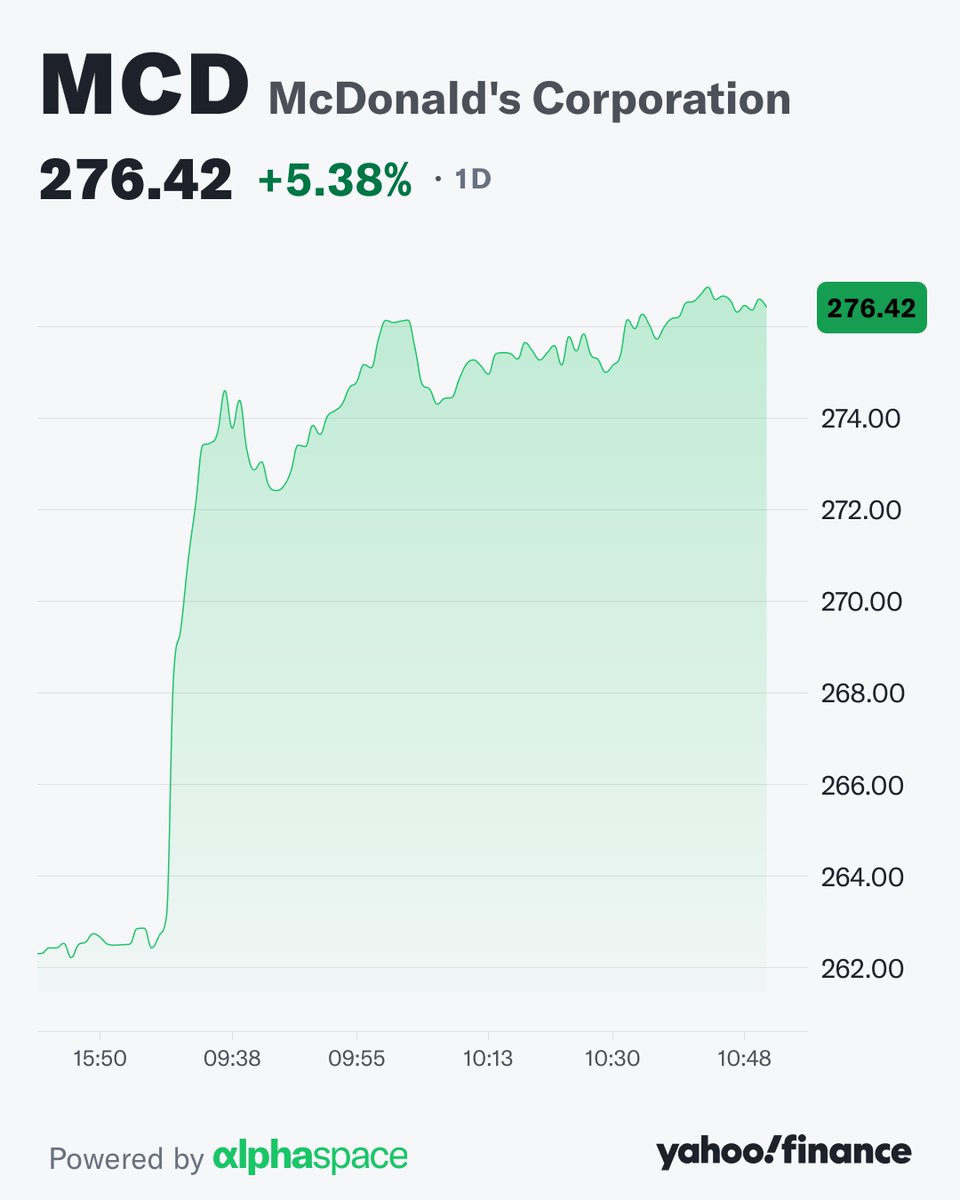
McDonald's US same-store sales fell 0.2% in the third quarter as fewer customers visited its restaurants, though higher spending per visit cushioned the decline. The company reported quarterly earnings of $3.57 per share, beating the Zacks Consensus Estimate of $3.36 and up from $3.22 a year earlier.
The US sales decline was smaller than investors had feared, and shares rose 5% following the results, according to Investing.com. The focus now is whether value promotions can bring back traffic.
McDonald's is expected to address the mix of weaker traffic and stronger ticket sizes on its earnings call. Separately, AIA Group cut its stake in McDonald's by 42.5% in the third quarter, per its latest 13F filing.
The company did not immediately provide further comment on the traffic decline.
Circle reported third-quarter revenue and reserve income of $865 million, up 17% year over year, with $182 million of that total coming from its ARC token presale rather than core USDC operations. Earnings per share came in at $0.84, double the $0.84 analyst consensus.
Reserve income fell 8% to $657.6 million, while net income from continuing operations rose 5% to $226 million. The company also disclosed a workforce reduction of about 5%, drawing scrutiny over the quality of its growth.
Shares rose more than 4% to $76 intraday, reversing a 3% premarket decline and joining a broader post-midterm rally in stocks and crypto.
Circle did not provide further comment in the disclosed materials on the staff cuts or the token presale contribution.
Morgan Stanley says it is live on DTCC tokenization service, discloses no scale
DTCC's depository holds $114 trillion in custody; the tokens are 1:1 mirrors of securities it already holds, and the bank's actual usage remains opaque
Morgan Stanley said in a Nov. 3 post on X that it is among the first banks to use the Depository Trust & Clearing Corporation's Tokenization Service (DTS), converting U.S. equities and Treasuries into token form. The post named no securities, amounts or blockchain, and did not say whether the tokens are held for clients or the bank itself, leaving the scale of its use unclear.
DTS went live Oct. 28 under the Depository Trust Company, DTCC's depository subsidiary. DTCC calls the tokens "digital twins," backed 1:1 by securities DTC already holds, retaining the underlying CUSIP and investor rights, with DTC remaining the official record keeper. The service runs on the Canton Network and DTCC's private Besu network, with Stellar and Circle's Arc expected in 2027; a December 2025 SEC no-action letter covers Russell 1000 stocks, major index ETFs and Treasuries.
Twenty DTC participants signed up at launch, including Morgan Stanley, J.P. Morgan, Citi, Bank of America, Barclays, UBS and Fidelity, but DTCC named none as having tokenized. Amy Oldenburg, Morgan Stanley's head of digital assets strategy, said the hands-on experience of integrating tokenized securities with established market infrastructure will inform the firm's digital asset build-out.
Morgan Stanley separately expects to support tokenized equities on its alternative trading system in the first quarter of 2027, later than its previous H2 2026 target. DTCC lists on-chain netting, digital cash and wider settlement and collateral uses among items for 2027 and later on a roadmap it calls "indicative and subject to change."
How this story unfolded
Company
Qualcomm CEO says Dragonfly C1000 CPU still on track to ship to Meta as scheduled
The delivery timeline for the chip had not been publicly confirmed before, giving Meta's custom compute hardware supply chain a clearer time reference
Qualcomm's CEO said the Dragonfly C1000 CPU remains on track to ship to Meta Platforms as scheduled. The remark was relayed by financialjuice and aistocksavvy, both attributing it to the Qualcomm chief executive.
Dragonfly C1000 is a Qualcomm CPU product built for Meta, and its delivery cadence had seen little public confirmation. The CEO-level "on track" language gives observers a firmer time reference for Meta's custom compute hardware supply chain.
The item touches both Qualcomm and Meta shares. For Qualcomm, the product sits within its push beyond handsets; for Meta, it bears on the pacing of its compute infrastructure sourcing and in-house development. Coverage in the newsroom's 48-hour window centered on institutional position changes, with no other account of the Dragonfly C1000 delivery timeline.
Meta had not publicly responded to the shipment timetable as of publication. Neither Qualcomm nor Meta disclosed the shipment volume or value of the product.
Separately, Qualcomm earlier this week signed a network technology agreement with SpaceX, a distinct event line from Dragonfly C1000, according to reports carried in the newsroom.
e.l.f. Beauty reported second-quarter fiscal 2027 net sales of $520.8 million, up 51% year over year, with adjusted EPS of $1.21, adjusted EBITDA of $123.4 million (up 86%) and adjusted net income of $72.7 million. The company raised its fiscal 2027 revenue guidance to $2.00 billion to $2.03 billion and lifted its full-year sales growth outlook to 22%-24% from a prior 18%-20%.
The company attributed the growth to marketing campaigns and broad contributions across its portfolio, marking its 31st consecutive quarter of net sales growth. Results were released in a company statement on Nov. 4, with management discussing them on the same-day earnings call.
Both the quarterly figures and the guidance came in above analyst estimates, and the shares traded at $118 after hours. For peers in mass beauty and consumer staples, the growth rate offers a comparison point, though the materials do not provide specific figures for competitors.
CEO Tarang Amin told CNBC that the company continues to see broad-based growth across its portfolio. The figures cited come from the company's release and media coverage.
Joby Q3 revenue hits $55M, beats estimates; raises FY26 outlook to $135M-$140M
The electric air-taxi developer beat quarterly estimates and won expanded Air Force funding, while certification and cash burn remain the longer-term tests
Joby Aviation reported third-quarter fiscal 2026 revenue of $55 million, beating estimates of about $39.2 million and up 144% year over year. The company raised its full-year revenue guidance to $135 million to $140 million, above the roughly $121 million consensus. Its loss of $0.22 per share came in narrower than the $0.25 expected.
Operationally, the company said its Blade business carried more than 44,000 passengers in the quarter, a record, and that 17 aircraft are now in production. Shares rose about 5% in after-hours trading following the report.
Separately, Joby said the U.S. Air Force has expanded its autonomous flight contracts to nearly $37 million, following the company's coast-to-coast flight tour.
Barron's noted that certification progress and future cash needs remain central to the company's longer-term prospects. Joby reported $2.2 billion in cash and investments.
Chime reported third-quarter 2026 revenue of $718 million, up 32% year over year and above the $700 million estimate. Adjusted EBITDA came in at $137 million versus $117 million expected, while active members reached 10.9 million, up 20% year over year.
The company raised its full-year revenue guidance to $2.79 billion-$2.80 billion, above the $2.77 billion consensus. Reuters reported that Chime lifted its 2026 revenue growth forecast to 28%, compared with the 26.6% expected by analysts in LSEG estimates.
Finsee noted that growth was driven mainly by paycheck advances and installment loans, alongside lower staff costs, a mix that puts more weight on credit products.
EPS figures differ across sources: the X signal cites $0.11, while Zacks reported $0.15, both above the $0.09 consensus. The final figure should be confirmed against the company's official release.
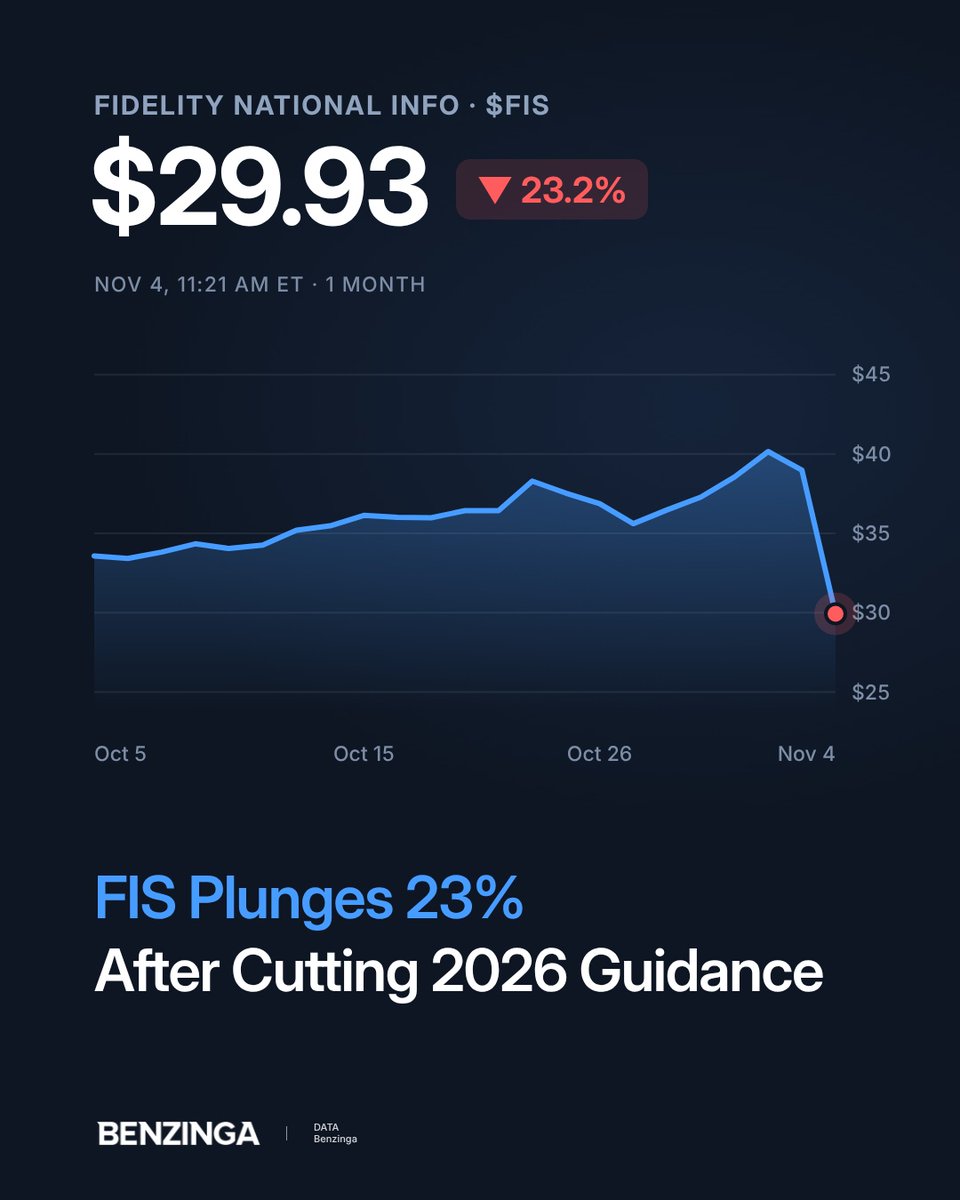
Fidelity National Information Services cut its full-year outlook after reporting third-quarter results, with 2026 guidance coming in below estimates. Q3 earnings were $1.61 per share, in line with the Zacks Consensus Estimate and up from $1.51 a year earlier.
According to X signals, the stock had climbed to $40 on Monday and was trading near $30 after the update, a 23% single-day decline described as its worst drop in years. Barron's attributed the cut to slowing underlying revenue growth.
The company separately announced that Chief Financial Officer James Kehoe will step down, naming Alexandra Brooks interim CFO, putting a management change alongside the guidance reset.
One analysis noted that despite a largely in-line quarter and strong free cash flow generation, the sharp cuts to Q4 and full-year outlooks drove the selloff, leaving the shares at what it called a rock-bottom valuation.
MetLife reported third-quarter 2026 adjusted revenue of $19.91 billion against an estimate of $19.88 billion, with adjusted EPS of $2.78 versus an estimate of $2.77, putting both headline measures roughly in line with expectations.
Book value per share came in at $30.73, compared with an estimate of $39.64, a gap of about $8.91 and the largest deviation among the disclosed metrics.
Because revenue and adjusted EPS were close to consensus, the incremental information from the quarter centers on book value per share, which diverged from expectations by a wider margin than the headline figures suggest.
MetLife CFO John McCallion also released a third-quarter 2026 financial update video the same day, which the company points to for further detail.
Expedia Group reported third-quarter 2026 revenue of $4.94 billion, up 12% year over year and above the $4.74 billion consensus. Adjusted EPS came in at $9.39, up 24% and ahead of estimates, while adjusted EBITDA of $1.69 billion also beat expectations.
The Seattle-based online travel agency raised its full-year revenue forecast to $16.37 billion-$16.43 billion from $16.05 billion-$16.22 billion, and lifted its revenue growth outlook to 11%-12% from 9%-10%. It now expects gross bookings of $131.4 billion to $131.9 billion, above the $130.22 billion consensus, citing steady international travel demand.
Free cash flow was negative $1.40 billion for the quarter, worse than the expected negative $1.1 billion, a soft spot in an otherwise strong report.
Investors are weighing whether the raised guidance offsets the cash flow shortfall as Expedia heads into the holiday travel season.
Redwire (NYSE:RDW) reported third-quarter 2026 revenue of $109.0M, up 5.4% year over year but below estimates of roughly $125.5M to $126M. Adjusted loss per share was $0.06, better than the expected $0.12 loss. The company affirmed its FY26 revenue guidance of $450M to $500M.
The results were released after the close on Wednesday. Redwire said backlog expanded and gross margins reached a record, but profitability metrics were mixed: adjusted EBITDA came in at -$5.3M versus -$4.7M expected, and free cash flow was -$66.4M against a -$21.7M estimate.
Shares fell about 5% in after-hours trading and continued lower on Thursday as investors weighed the revenue shortfall and heavy cash burn against the EPS beat.
The materials did not include a specific management response to the results.
SpaceX reportedly seeks $40B in Apollo-led financing to fund Nvidia AI chip purchases.
2026-10-089 posts · 9 authors
Apollo and banks are in talks to finance SpaceX's $40B GPU purchase, while Broadcom and others reportedly arrange over $110B for OpenAI and Anthropic chips.
2026-10-2629 posts · 25 authors
SpaceX officially announces a $40B GPU lease deal with Apollo, marking the largest GPU financing ever.
2026-10-2711 posts · 11 authors
Goldman Sachs participates in SpaceX financing, Meta's stock sale, and Anthropic's IPO; Pimco buys $4B of SpaceX's AI debt.