US inflation data for August kept the market firmly on edge about a possible Fed hike next week. X-sourced signals put the odds at 86.5% on CME FedWatch, with several market posts and reports clustering in the low-to-mid 80s.
The catalyst was a hotter-than-expected inflation mix. Convera said August headline CPI rose 0.4% month over month and core CPI rose 0.3%, while PPI also increased 0.4% m/m and 5.4% y/y, reinforcing the case for a September rate move.
The repricing is being felt across rates, the dollar and rate-sensitive equities. Ainvest noted that the 10-year Treasury yield slipped back to 4.91% even as traders leaned into a hike, and the setup matters for financial stocks, the dollar and high-duration tech names if policy expectations keep shifting higher.
There is still no consensus on the path beyond September. A Bloomberg survey cited in the feed showed a majority of economists expecting the Fed to hold steady through year-end and into 2027, underscoring the gap between market pricing and the economist base case.
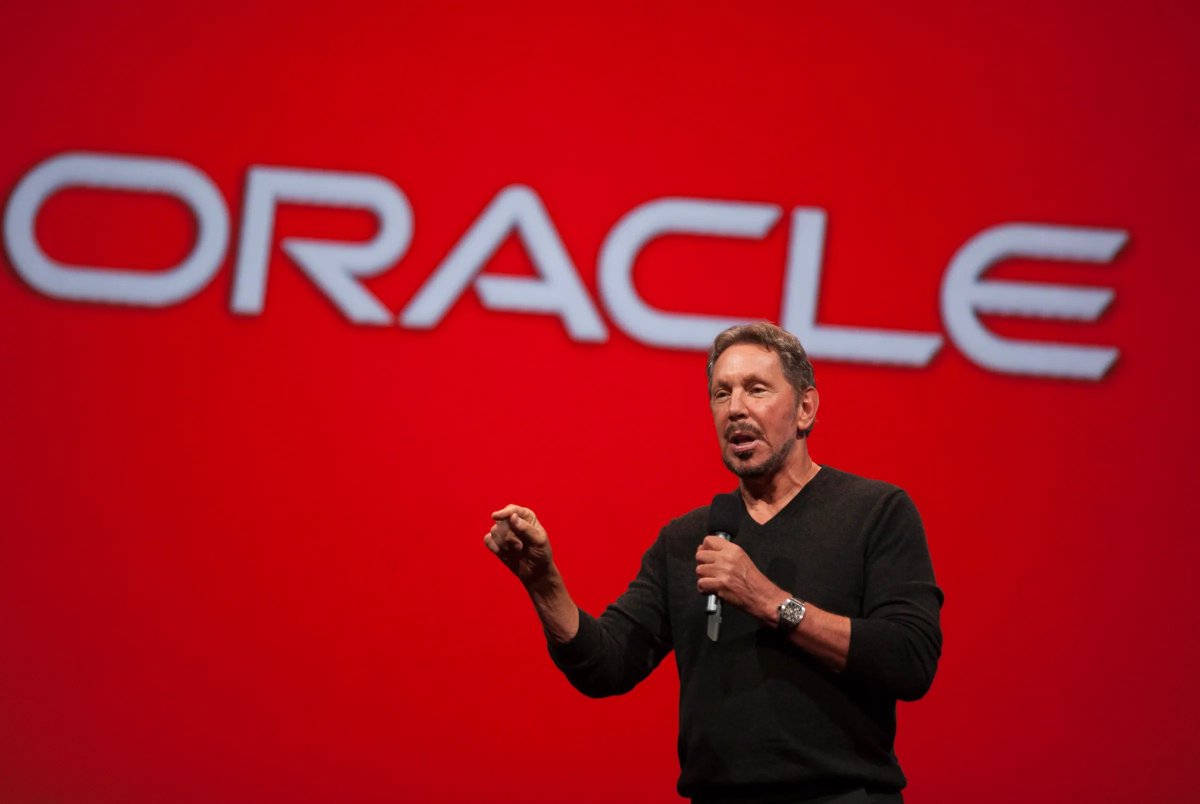
Oracle founder Larry Ellison has adopted a Rule 10b5-1 trading plan that would let him sell as many as 50 million shares of Oracle stock, worth about $7.5 billion at Thursday’s close. The plan was established on June 22 and disclosed in a filing published Friday.
The sale is prearranged rather than a spot decision. CNBC reported that even if Ellison sells the full amount, he would still own about 1.1 billion Oracle shares, or more than 40% of the company.
The disclosure comes as investors continue to track Oracle’s AI infrastructure push and the funding behind it. Oracle shares remain the key market focus, with the plan serving as a lens on insider liquidity rather than a change in control.
Reuters, citing two people familiar with the matter, reported that the White House is considering how to use the Defense Production Act to expand U.S. oil refining capacity. The discussions reportedly followed a meeting between President Donald Trump and nearly a dozen refiners, with officials focused on whether federal support could help add capacity.
The backdrop is a tightly run U.S. refining system, with utilization at 98% according to Reuters. Refiners are said to prefer funding that improves efficiency or expands existing plants, rather than financing a brand-new refinery, and the DPA has never been used to add refining capacity.
The policy watch puts Valero, Marathon Petroleum, Phillips 66 and Delek in focus. For those names, the market is likely to track any hints of subsidies, priority access to constrained equipment, and potential changes to project economics, while the latest report still reflects deliberations rather than a formal decision.
Reuters also noted that a presidential determination in April already authorized DPA support for U.S. petroleum production, refining and logistics capacity. That puts the current report in the context of an existing policy framework, with the Brownsville project and Reliance's 20-year offtake deal underscoring the broader push to expand domestic refining supply.
Apple introduced new Apple Watch Series 12 and Ultra 4 “Audio Intelligence” features on Sept. 10-11, including Siri Recap, which summarizes nearby conversations, and Live Rewind, which can show a transcript of the previous 15 seconds. Legal experts cited in multiple reports say the always-on listening tools could run into state eavesdropping and wiretap laws.
The key issue is not only whether audio is stored, but whether the device is intercepting conversations without clear notice and consent. Reported coverage notes that federal law generally follows a one-party-consent standard, while roughly 11 states require all-party consent for recordings; California, Illinois and Massachusetts are among the stricter jurisdictions.
For investors, the immediate impact is on Apple’s compliance and product rollout narrative rather than near-term earnings. AAPL has recently been supported by enthusiasm around the iPhone Duo launch, but any state-level enforcement or litigation could shape how broadly the Watch features are offered and what warnings or controls Apple must add.
Apple says Siri Recap does not store recordings or verbatim transcripts, instead creating high-level summaries, and advises users to be mindful of people around them. Still, experts quoted in the coverage argue the absence of an audible notice could leave users exposed if conversations are captured in jurisdictions with stricter consent rules.
Commerce Secretary Howard Lutnick said on Sept. 11 that President Donald Trump’s promised $5,000 dividend checks for U.S. adults would not be paid with taxpayer money. He said the administration would use money it “earns,” citing a proposed Trump Platinum Card program and the government’s Intel stake.
The financing question matters because the payout would cost roughly $1.3 trillion, according to NBC News. NBC also reported that White House economic adviser Kevin Hassett said the administration was weighing a congressional reconciliation route, though the offsets would still need to be negotiated.
On Intel, Lutnick claimed the government holds about 500 million shares and that the stock’s rise from $20 to $100 means the administration is up about $50 billion on paper. NBC said the government spent $8.9 billion of CHIPS Act funds on the stake and has not sold the shares, so the gain remains unrealized.
For investors, the remarks keep Intel in the policy spotlight and underscore how closely the chipmaker is tied to Washington’s industrial strategy. But the arithmetic still shows a huge gap: a 10% Intel stake would need a $13.5 trillion valuation to cover a $1.35 trillion payout.
市場
ビットコインのゴールデンクロス、7.98万ドルで消失、利上げ確率は86%に急上昇英語原文
A brief daily EMA crossover was undone by a pullback, after hotter core CPI reset Fed pricing across crypto markets.
Bitcoin briefly pushed to $79,837 and triggered a daily golden cross as the 50-day EMA moved above the 200-day EMA. The move did not hold: BTC later fell back to about $77,438, pulling the shorter average back below the longer one the same day.
The reversal came after U.S. August core CPI rose 0.3% month over month, above the 0.2% consensus cited in market reports. Odds of a 25-basis-point Fed hike at next week’s meeting were repriced sharply higher, with reports placing them in the high-70s to mid-80s depending on the venue.
That matters for crypto because higher rate expectations tend to lift Treasury yields, strengthen the dollar and reduce appetite for non-yielding assets such as bitcoin. The price swing also spilled into broader digital-asset sentiment and trading around BTC-linked products.
At the moment, the move looks more like a macro-driven repricing than a single-asset event. Technical indicators on shorter time frames still show some trend structure, but the daily golden cross has already flipped back off for now.
The U.S. Treasury said the federal budget deficit for August came in at $166.8 billion, smaller than the $221.1 billion consensus estimate and well below the revised prior-month figure of $432.0 billion. For the first 11 months of fiscal 2026, the deficit totaled $1.97 trillion.
The monthly swing was heavily influenced by calendar timing, with benefit payments and other large outlays shifting between July and August. Reuters said that, adjusting for those timing effects, the August deficit would have been about $248 billion.
For markets, the print matters mainly for near-term Treasury cash planning and bill supply expectations rather than as a clean read on the fiscal trajectory. Investors are watching the year-to-date deficit, refinancing plans and cash-balance trends more closely than any single month.
Reuters also reported $12.84 billion of net customs-duty inflows in August and noted that net interest costs fell to $86 billion, both of which helped shape the monthly headline. The Treasury’s statement is the key source for the official numbers.
Bloomberg reported that SemiAnalysis has acquired Citrini Research, the independent investment-research firm founded by James van Geelen. Van Geelen will remain CEO of Citrini for now, and reports say he is also planning to launch a new fund.
The transaction brings together two closely watched research platforms: SemiAnalysis, known for semiconductor and AI infrastructure analysis, and Citrini, which gained attention for market-facing thematic research tied to AI spending. Deal terms were not disclosed.
For markets, the significance is less about an immediate listed-company impact and more about the consolidation of research influence and audience reach. The firms’ coverage overlaps in AI infrastructure, memory, and semiconductors, but no transaction value was disclosed, so there is no verified financial metric to attach to the deal itself.
Bloomberg said the sale price could not immediately be determined, while both van Geelen and SemiAnalysis CEO Dylan Patel confirmed the acquisition. Follow-up reporting also indicated van Geelen may set up a new fund, though he declined to comment on that point.
Business Insider, citing people familiar with the matter, reported that Jeff Dean’s AI startup Discovery Loop is seeking funding at around a $50 billion valuation. Reuters later carried the same report and noted that the deal terms could still change and there is no guarantee the company will close at that valuation.
The new report follows an earlier fundraising plan that had Discovery Loop seeking about $1 billion at roughly a $10 billion valuation only weeks ago. The company says it aims to use AI to accelerate scientific and engineering discovery, and its founders include Jeff Dean, Sanjay Ghemawat, Quoc Le and Oriol Vinyals.
For markets, the main read-through is to Alphabet (GOOGL) and the broader AI infrastructure trade, where private-market pricing can influence sentiment around talent retention, compute spending and the economics of frontier-model startups. Investors also tend to compare such rounds against other top-tier AI labs and deep-tech startups.
Discovery Loop declined to comment, and Dean did not respond to requests for comment. Because the financing is still being negotiated, the reported valuation should be treated as a target rather than a completed transaction.
Google has completed its talent deal with AI startup Mechanize, according to multiple reports. Mechanize co-founder and former CEO Tamay Besiroglu is now a research scientist at Google DeepMind, and more than a dozen former Mechanize employees have also joined Google.
Mechanize was founded in 2025 and focused on AI coding and agentic software development. Earlier reporting valued the startup at about $500 million after roughly $9.1 million in funding, while negotiations with Google were said to be worth more than $1.5 billion; the final deal terms were not disclosed.
For Alphabet, the significance is less about headline price than capability acquisition: the deal appears aimed at strengthening Google’s coding tools and midtraining work on frontier models. That keeps Google in the same talent-and-technology race that has shaped recent AI deals across the sector.
Mechanize has not disclosed the final economics, and Google has not detailed the structure beyond what public postings and reporting indicate. The reported $1.5 billion-plus figure remains a negotiation benchmark, not an officially confirmed purchase price.
Bloomberg reported that Leopold Aschenbrenner’s Situational Awareness has established a prime brokerage relationship with Clear Street as the fund rebuilds its public-market book. The move is the latest sign that the fund is reactivating trading after a turbulent summer in AI-linked positions.bloomberg.com
The new brokerage relationship follows a sharp reset earlier this year. Prior reporting said the fund’s public-equity portfolio fell 67% in July, prompting escalating collateral calls and a sale of most public holdings to Citadel while it kept its private-book exposure intact.ainvest.com
Follow-up coverage says Situational Awareness is rebuilding positions in AMD, Intel, SK Hynix and Sandisk, and has returned to options trading. For the market, that keeps attention on AI-linked hardware names and on the plumbing of leverage, because Clear Street is stepping in where larger banks had scaled back exposure.headlinesbriefing.com
Neither firm has commented on the specific setup. What is clear is that the fund is back in the market with a new prime broker and a more conservative leverage profile than before.
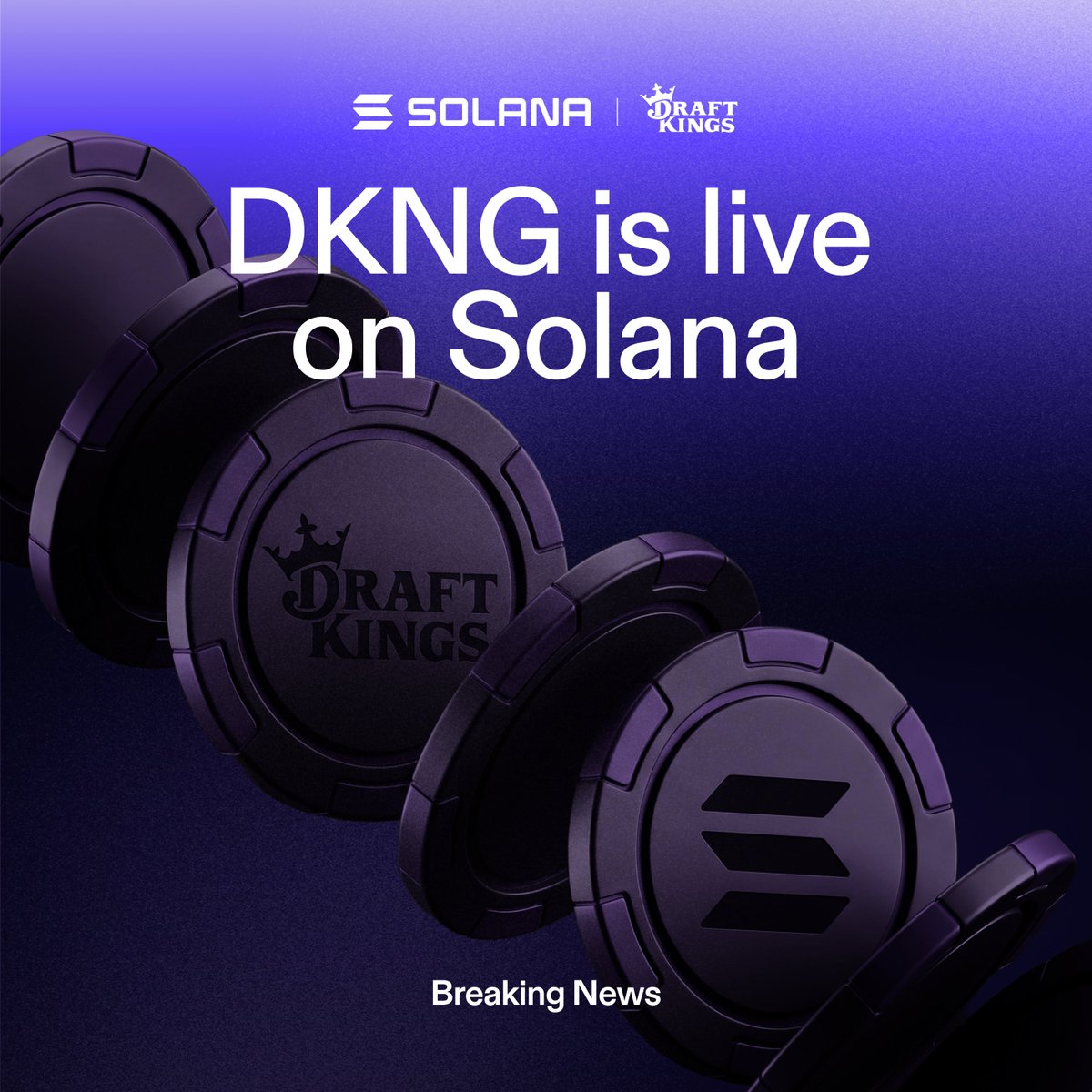
X signals show both $WEN and $DKNG described as live on Solana via Sunrise and issued by Backpack Securities. Based on the platform metadata and Backpack’s public materials, this reads more like a tokenized-stock listing/distribution update than a conventional exchange listing.
Sunrise says it offers eligible users access to third-party liquidity on Solana, while the products are framed as tokenized equities rather than direct share ownership. Separate coverage on WEN notes the record is labeled as stock-class on the platform and carries restricted-region flags, but the legal issuer chain and actual executed trading have not been independently confirmed.
For markets, the immediate relevance is whether tokenized wrappers for Wendy’s and DraftKings can create 24/7 on-chain liquidity around names that normally trade only during regular market hours. DraftKings had already drawn fresh attention a day earlier, after Backpack said its DKNG token is 1:1 convertible with ordinary shares and accessible through Solana DeFi venues.
At this stage, the public record still falls short of confirming formal offering documents, first on-chain trades, or regulatory approval. The available statements align on issuance and distribution language, but they do not by themselves establish the full legal status of the products.
NVIDIA CEO Jensen Huang said Australia’s planned 2GW of AI infrastructure represents about $80 billion. The remark adds a fresh valuation lens to NVIDIA’s Sept. 9 announcement, which outlined a multi-partner buildout but did not disclose a total project cost.
In that earlier announcement, NVIDIA said it is working with eight Australian cloud and data-center partners — including Firmus, Sharon AI, IREN, Megaport, ResetData, CDC, NEXTDC and AirTrunk — to expand land, power and shell capacity for AI factories by 2027. NVIDIA also said Sharon AI plans to deploy as many as 68,000 GPUs, while CDC said it already operates more than 550MW across Australia and New Zealand and has another 800MW under construction.
For NVDA, the signal is still about AI infrastructure demand, not a finished deployment: the company is selling the platform, networking and software layer while partners carry most of the construction and power-procurement risk. Shares tied to the buildout narrative, including IREN, can also stay in focus as investors gauge who captures the spend across compute, networking and power systems.
The key limitation is that NVIDIA has not broken out financing, site-by-site delivery timing or how much capacity is already grid-connected. That means Huang’s $80 billion estimate should be read as a scale indicator for the opportunity, not proof that the full 2GW is online or fully funded.
AMD told the Goldman Sachs Communacopia + Technology Conference that EPYC is intended to run a “significant majority” of the agents powering agentic AI. The company also said the CPU-to-GPU mix in server deployments is moving up from roughly 1:1, though it stopped short of giving a fixed ratio.
The framing builds on AMD’s broader thesis that agentic workloads differ from prompt-response inference because they create continuous CPU-heavy activity such as control-plane operations, API calls, database queries and tool execution. AMD said its server CPU total addressable market has expanded to $220 billion, up from earlier $60 billion and $120 billion estimates.
For investors, the message broadens the AI infrastructure debate beyond GPUs alone and points to AMD’s EPYC, Venice and rack-scale offerings as a larger part of the AI buildout. That could matter for AMD shares as well as for comparisons with Nvidia, which remains the dominant GPU vendor in AI data centers.
AMD did not announce a new order, revenue figure or a fixed deployment ratio at the conference. Instead, management framed the opportunity as customer-dependent and said the mix of CPUs and GPUs varies by workload and system design.
Dell Technologies surged more than 10% on Friday and briefly hit a record after RBC Capital Markets initiated coverage with an Outperform rating and a $640 price target. Intraday quotes put the shares in the $558.56 to $562 area, extending a powerful rally that has made Dell one of 2026’s standout large-cap winners.
The move comes on top of Dell’s recently reported AI-server momentum. Dell said second-quarter AI-server orders totaled $60.9 billion, AI-server revenue was $16.4 billion and backlog reached $95 billion, while full-year revenue guidance was raised by $25 billion to $192 billion.
The stock’s outsized gain also lifted sentiment across AI data-center hardware names, including HPE, as investors keep favoring suppliers tied to the infrastructure buildout behind artificial intelligence. CNBC said Dell is up nearly 350% year to date, underscoring how far the market has already re-rated the company.
RBC’s call adds a new catalyst, but the underlying story is still Dell’s conversion of backlog into revenue and cash. Some reports also noted that S&P Dow Jones Indices will add Dell to the S&P 100 before the open on Sept. 21, which could bring one-time index demand.
Tesla’s Europe account has officially posted the first full specification set for the European Semi: up to 550 km of range at 40 tonnes gross weight, 1.0 kWh/km energy use, and Megacharger support of up to 800 kW. Tesla also says the truck can recover about 60% of range in 30 minutes and will use camera-based side monitoring instead of traditional mirrors.
The update extends a long-running European rollout plan for the Semi. Reuters and CNBC had already reported that Tesla was preparing European specs and launch details around IAA Transportation in Hannover, while Tesla’s German website indicated deliveries would begin next year.
For investors, the key point is that Tesla is moving its Semi from teaser phase to a named European product with quantified specs, even though pricing and a firm on-sale date are still missing. The move also puts TSLA in clearer competition with European heavy-duty EV makers such as Daimler Truck, Volvo, MAN and Scania.
The numbers being circulated are consistent across the official post and multiple reports: 550 km, 40 tonnes, 800 kW, roughly 9,100 kg curb weight, and about 60% recharge in 30 minutes. That makes this a concrete product disclosure rather than a rumor-driven headline.
Rocket Lab said on Sept. 11 that it has filed a formal protest with the U.S. Government Accountability Office over NASA’s award of a $700 million Mars Telecommunications Network contract to Blue Origin. The company argues that NASA’s evaluation of its proposal was inconsistent and did not align with congressional eligibility criteria.
The dispute stems from NASA’s effort to replace aging Mars relay assets with a new communications orbiter. Reporting shows the agency issued a request for proposals in May and selected Blue Origin in early September, with delivery targeted no later than Dec. 31, 2028 and deployment around 2030.
For Rocket Lab, the case matters because the MTN award is tied to deep-space infrastructure and government procurement, a key business area for the company. The headline risk sits with RKLB, while Blue Origin is the selected contractor but not publicly traded.
Rocket Lab said procurement standards are meant to protect fair competition and public investment. NASA has not yet issued a detailed response to the specific protest allegations.
Kroger said Thursday that second-quarter adjusted EPS came in at $1.09, above the $1.05 consensus, while comparable sales excluding fuel rose just 0.2%. At the same time, the company lowered its full-year identical sales excluding fuel outlook to 0.2%-0.8% from 1%-2%.
Management pointed to a more cautious consumer, a tougher grocery competitive backdrop and pressure in parts of the pharmacy business. The updated outlook also includes about a 140-basis-point headwind tied to the Inflation Reduction Act.
Investors are likely to focus more on the sales reset than the earnings beat, since identical sales excluding fuel is Kroger’s key gauge of underlying demand. Shares may also track whether e-commerce, pharmacy and cost discipline can offset slower traffic and more promotion-heavy shopping.
Kroger reaffirmed its full-year adjusted EPS and FIFO operating profit guidance and said it will keep investing in store execution, online growth and margin discipline.
Uber CEO buys 141,000 shares for $10.0 million as stock trades near year-low levels英語原文
Khosrowshahi’s rare open-market purchase lands alongside comments that layoffs could help lower ride prices, keeping attention on margins and reinvestment.
Uber CEO Dara Khosrowshahi bought 141,000 shares on Sept. 10 at an average price of $70.9642, spending about $10.01 million. The company’s Form 4 filing shows his direct holdings rose to 1,367,100 shares after the transaction.
The purchase drew attention because it came while Uber’s shares were still trading near their lower range for the year. In a separate public appearance, Khosrowshahi said riders could eventually see lower prices after the company’s recent layoffs, adding that the savings would be reinvested into the business.
Investors often read insider buying as a vote of confidence in the company’s fundamentals, but not as a short-term forecast for the stock. For Uber, the bigger debate remains how cost cuts, reinvestment, autonomous-vehicle spending and competition will shape future profitability.
Recent coverage also noted that Uber’s latest quarter showed solid growth and strong free cash flow, but the market is still weighing those results against heavy investment needs and industry-wide pressure from autonomous driving competition.
Apple said customers can begin preordering the iPhone 18 Pro and iPhone 18 Pro Max at 5 a.m. PT on Sept. 12 through Apple.com and the Apple Store app. The timing was echoed by FinancialJuice and First Squawk on X, matching the company’s published schedule.
This is the operational step following Apple’s new-product launch, not a fresh product announcement. Outside reports say Apple also offered a “Get Ready” flow so buyers could preselect models, accessories, financing and trade-ins before the preorder rush.
For markets, the timing is relevant mainly to AAPL because early preorder traffic is often treated as an initial read on demand for the new lineup. Apple has not published per-configuration shipping estimates, so any delivery timing beyond the launch calendar remains unannounced.
No additional sales or inventory figures were disclosed with the preorder opening. The confirmed details remain the start time, the sales channels and the preorder-preparation process.
Stellantis plans to invest more than €1 billion at its Hordain plant in northern France to build a new van, according to people familiar with the matter cited by Bloomberg. The program also includes R&D spending elsewhere in France to support the vehicle, alongside a push to bring some manufacturing steps in-house and increase automation.
The move comes as the automaker continues to reshape its European manufacturing network. Stellantis has been pushing new commercial-vehicle products and tighter cost control across the region, and earlier disclosures also pointed to more than €1 billion earmarked for its Mulhouse plant in eastern France.
For investors, the announcement underscores a heavier capex cycle for STLA even as management tries to improve plant utilization and efficiency. It also matters for suppliers tied to outsourced assembly and modules, although the company has not commented publicly on the reported plan.
Bloomberg reported the investment on Sept. 11, and the company had not immediately responded to requests for comment. Separate reporting in recent days has also highlighted Stellantis’ parallel efforts in Canada, reinforcing that the overhaul is broader than a single site.
企業動向
コーニング、最大20億ドルの自社株売却を発表、GLWとベライゾンの光ファイバー契約は継続英語原文
The company filed an at-the-market equity program days after unveiling a multiyear fiber supply pact, adding a financing overhang to a high-demand story.
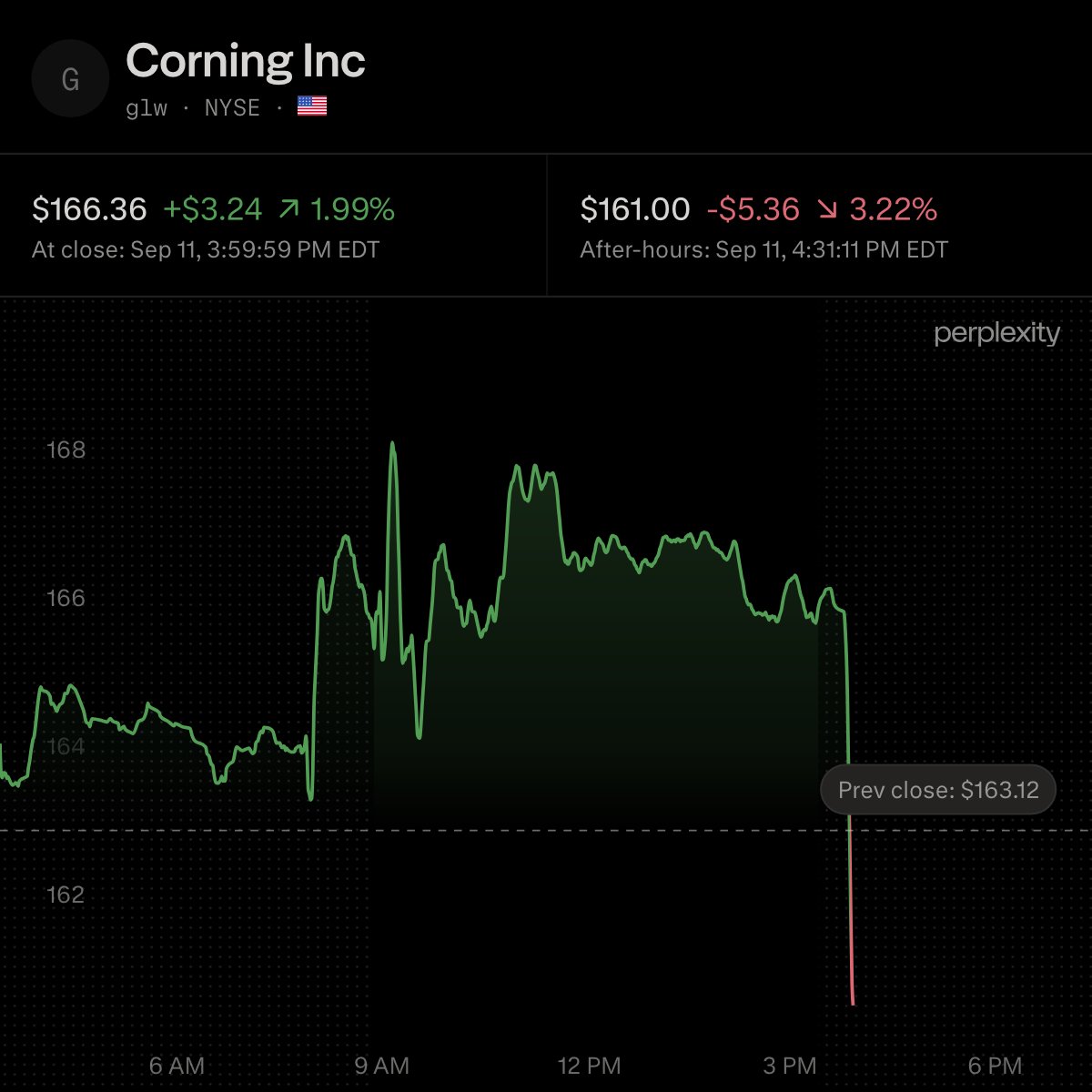
Corning said on Friday it had entered into an equity distribution agreement with Goldman Sachs, giving it the option to sell up to $2 billion of common stock through an at-the-market program. The filing says proceeds may be used for general corporate purposes, including share repurchases, dividends, debt reduction, acquisitions, working capital, capital spending and investments.
The financing move comes just after Corning disclosed a multiyear agreement with Verizon covering more than 80 million miles of high-density optical fiber and connectivity products through 2032. That contract has been read by investors as further evidence that demand tied to AI infrastructure and broadband buildout remains robust.
For GLW shareholders, the new filing adds a potential dilution debate to an already active rerating story. Optical-communications peers and suppliers in the AI infrastructure chain have also been in focus as the market weighs how much of the demand surge is already reflected in valuations.
Corning’s prospectus does not specify an immediate sale schedule, and the number of shares ultimately issued will depend on prevailing market prices. The company said the program is authorized capacity, not a completed equity raise.
Baker Hughes said on Friday that the number of active oil rigs in the United States rose by one to 450 in the week ended Sept. 11, while the total U.S. rig count climbed by three to 591. Gas rigs increased by two to 132, according to the weekly report echoed by several market wires on X.
The Baker Hughes rig count is a closely watched leading indicator for drilling activity and oilfield services demand. It follows the prior week’s counts of 588 total rigs, 449 oil rigs and 130 gas rigs, while U.S. crude output had already rebounded to an average of 13.947 million barrels per day in the latest EIA reading.
For energy stocks, the data can influence sentiment around drillers and service names such as SLB, Halliburton and Baker Hughes, though a one-week move does not by itself translate into immediate production changes. Traders also tend to read the report alongside crude-price moves and broader supply narratives.
Baker Hughes says the rig count has been published for decades as a business barometer for the drilling industry. The company’s weekly tally remains one of the market’s standard reference points for tracking upstream spending and activity trends.
これまでの経緯
2026-07-17投稿4件 · 投稿者4人
Iraq's PM met ExxonMobil's CEO in Houston to expand cooperation and end Iranian gas imports; S&P downgraded Baker Hughes.
2026-07-18
市場
SpaceX stock closes a week above IPO aVWAP as SPCX holds above $135英語原文
Traders are treating the IPO average price as support, adding a fresh technical layer to a stock already moving through lockup releases.
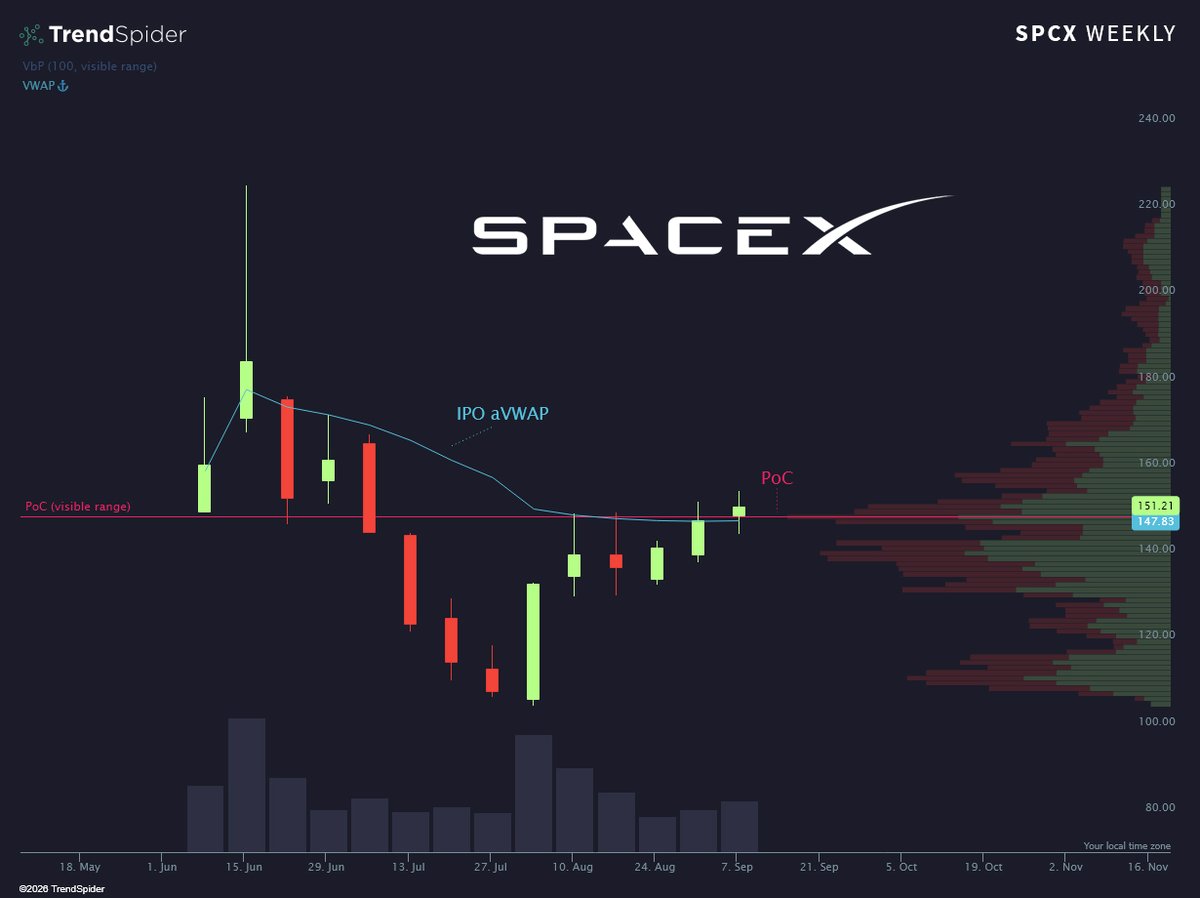
X traders said SpaceX stock just logged its first weekly close above the IPO aVWAP since its second week of trading, with one post describing the IPO aVWAP and ATH as having flipped from resistance to support. That makes this a technical-market development rather than a company announcement.
Recent reporting puts SPCX around $148 and notes that a $1,000 purchase three months ago would now be worth about $1,097.63 in one scenario. The same coverage also points to a large lockup-release calendar, with additional shares scheduled to become sellable on Sept. 24, Oct. 9 and Oct. 24.
For investors, the move matters because SPCX is being watched not only for fundamentals but also for supply overhang and momentum signals. Reporting this week also cited SpaceX second-quarter revenue of about $7.8 billion, while Street coverage continues to focus on Starlink growth and new compute contracts as valuation drivers.
No company response was included in the social posts, and the technical setup is now being tested against the next wave of unlocks and trading volumes.
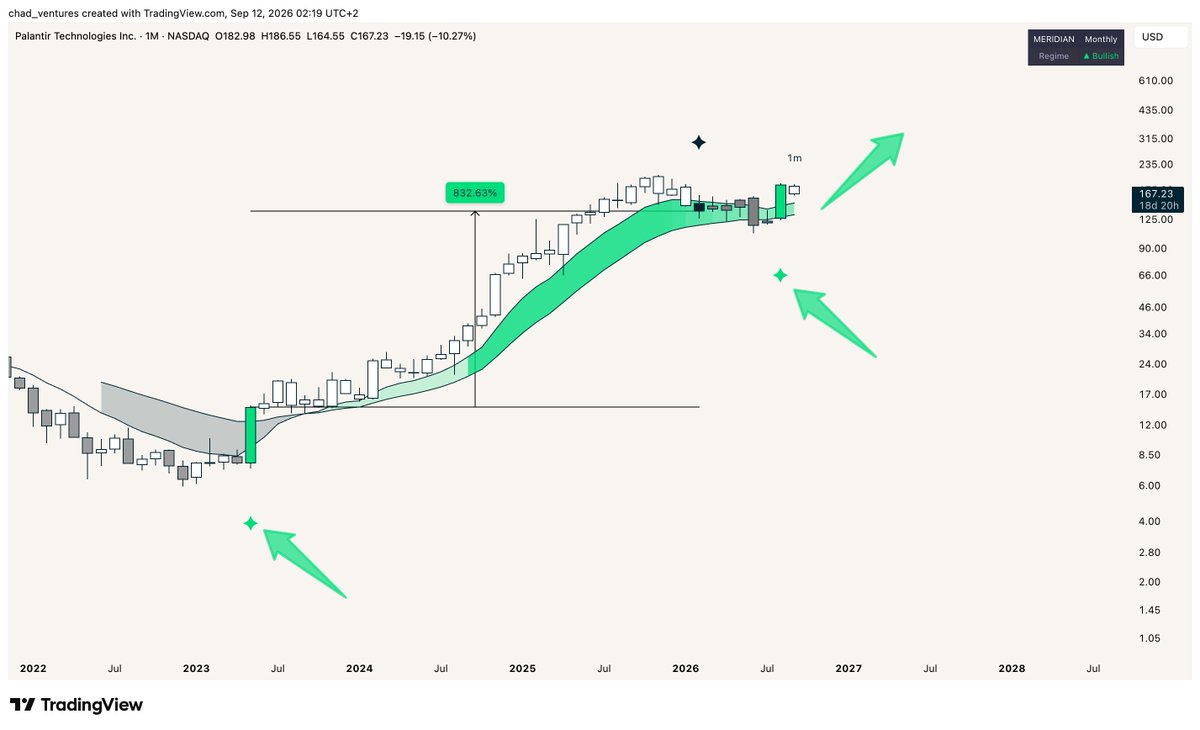
An X post about a “Meridian North Star” monthly-chart signal is circulating around Palantir Technologies (PLTR), but that technical claim is not a company filing or official announcement. The post is gaining traction because it lands right after a strong earnings update that kept traders focused on momentum.
Palantir said second-quarter revenue rose about 93% year over year, while U.S. commercial revenue jumped 149%. The company also lifted full-year U.S. commercial guidance to at least $3.424 billion, implying growth of at least 134%, and total full-year revenue guidance to roughly $8.15 billion to $8.16 billion.fool.comainvest.com
Market coverage on September 10-11 put the stock around $166-$168, even as analysts lifted targets, including D.A. Davidson’s move to $250 and a consensus target near $192.ad-hoc-news.de That makes the chart chatter part of a broader valuation debate, not a standalone catalyst.
For now, the verified story is the post-earnings rerating: strong U.S. commercial growth, higher guidance, and elevated expectations. The X signal is best read as trading noise layered on top of those fundamentals.
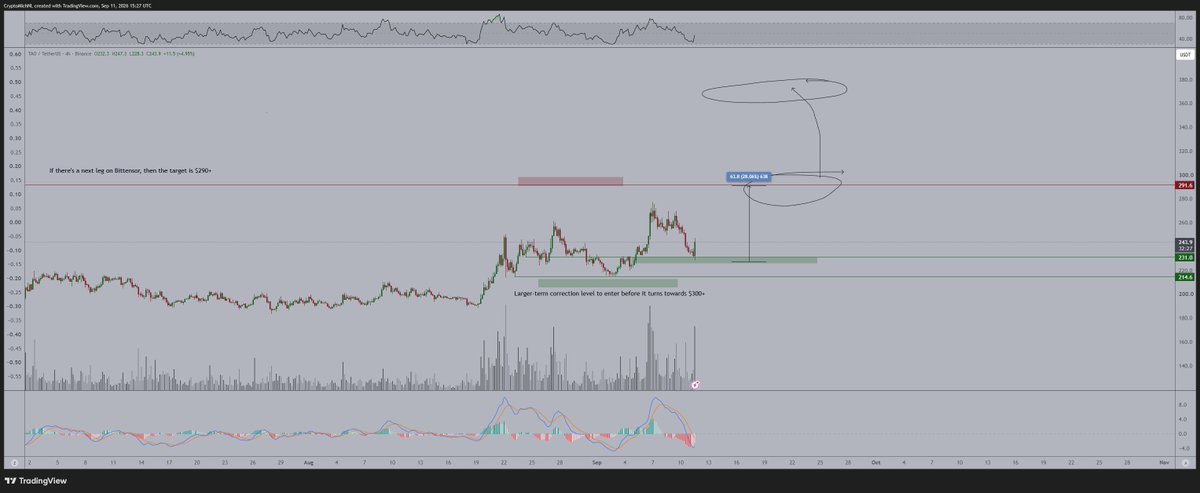
On X, traders are focusing on two fast-moving crypto names: Ethereum and TAO. Several posts said ETH is fighting around the $2,550 weekly-close area, with a break above that level seen as a setup for a move toward $3,000. TAO was also highlighted as bouncing from support, with some traders eyeing $300 next.
The backdrop is a sharp Ethereum rebound after recent macro-driven volatility. Multiple reports said ETH briefly climbed to around $2,667 after CPI data, while liquidation trackers showed between roughly $101 million and $255 million in ETH short liquidations over the prior day, depending on the data source and cutoff used.
For the market, ETH remains the key bellwether for crypto risk appetite. A sustained hold above $2,550 would likely keep trading interest elevated across ETH-linked spot, derivatives and leveraged products, while a stronger ETH tape often feeds rotation into higher-beta altcoins such as TAO.
These are trader views, not official price targets. What can be verified from the public record is that ETH has moved back into the $2,550 area and TAO is being discussed as a support-to-rebound trade.
In a fresh interview, Elon Musk said solar will ultimately account for essentially 100% of the energy humanity harnesses, likening the sun to a free giant fusion reactor. The message echoed the X posts circulating today and underscored Tesla’s long-running bet on solar, storage and charging infrastructure.
The comment lands against a concrete business backdrop: Tesla has signed two long-term power-purchase agreements totaling about 600 megawatts of planned capacity, including ContourGlobal’s Arizona solar-plus-storage project and Zelestra’s 140-megawatt Lumen Farm solar project in Texas.businessinsider.com
For investors, the story is less about a near-term shift in vehicle demand and more about how TSLA’s energy segment is being framed as a bigger strategic pillar. That matters for Tesla shareholders and for solar, storage and grid-equipment suppliers tied to utility-scale power buildouts.
There was no new financial guidance attached to the remarks. So the immediate market relevance is narrative and strategic, not a fresh earnings update or a disclosed order book change.
Market chatter on Friday pointed to the Suezmax SEAWAYS SABINE, a 158,493-dwt tanker built in 2012 at Samsung in Korea, as having changed hands for $75 million. The buyer has not been identified, and the figure remains unconfirmed by the parties involved.
The vessel is linked to International Seaways (NYSE: INSW). Vessel-tracking and maritime database listings identify the ship as IMO 9594755 and classify it as a Suezmax, but the transaction price itself still comes from market reports rather than an official filing.
If the sale is eventually verified, it would be a closely watched reference point for secondhand crude-tanker valuations, especially for ships of similar age and size. Investors often use such deals to gauge fleet values and asset recycling prospects.
So far, no public statement from the owner or brokers has been found confirming the sale. Any later closing details or price adjustments would need to be checked against official documents or broker notes.