President Donald Trump said on Sept. 22 that he supports restricting U.S. diesel exports, telling reporters he had called for not sending diesel out of the country. Treasury Secretary Scott Bessent said the administration is studying whether such a move is feasible, including the impact on refining capacity and whether a full or partial ban would work.
The discussion comes as U.S. diesel prices have surged to record levels. CNBC, citing AAA, said the national average reached $6.53 per gallon; Reuters reported a record $6.5107 per gallon. Either way, the data point to an unusually tight fuel market.
Diesel matters well beyond the U.S. because it powers trucking, farming equipment and industrial machinery, and the United States is a major global exporter. Any export curbs would likely be watched for their effect on refinery runs, domestic fuel prices and supply balances in Europe and Latin America.
For now, the administration has only said it is examining the idea, not that it has adopted it. The comments amount to a fresh policy signal rather than a finalized rule, keeping markets focused on what happens next in Washington.
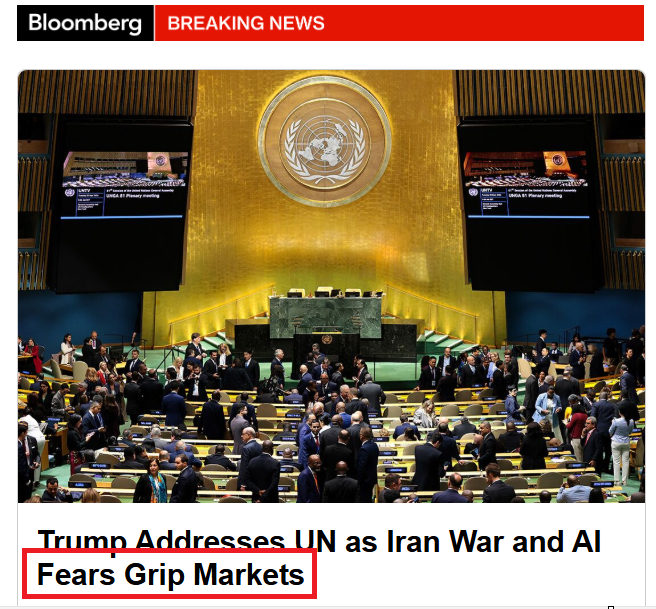
President Donald Trump used his UN General Assembly speech in New York to warn that he could “annihilate” Iran if no deal is reached, while also urging other countries to join a campaign of complete economic isolation. The comments came as U.S. and Iranian officials held their first talks since June on the sidelines of the gathering.
The talks matter because they follow the U.S.-Israeli air campaign against Iran earlier this year and renewed tensions around the Strait of Hormuz, a route that previously carried about 20% of global oil and liquefied natural gas flows. Tehran said the discussion was conducted through Qatari mediation and rejected claims that it had dropped its preconditions.
For markets, the immediate focus is on crude oil and shipping risk, since any deterioration in the standoff could reprice supply disruption odds. U.S.-listed funds and ETFs tied to oil prices, including USO, tend to move first when Hormuz risk or sanctions rhetoric intensifies.
Trump said he believes a deal could come after the U.S. midterm elections in November, while envoy Steve Witkoff described the latest round as constructive and promising. Iran, however, has continued to frame the talks as a channel for conveying its conditions rather than a shift in position.
これまでの経緯
2026-07-25
マクロ
FRB利上げヘッジが増加、トレーダーは緩やかな利上げ経路を織り込む英語原文
Options flows suggest markets are positioning for fewer hikes than current rates imply.
Bloomberg reported that options traders are hedging against the Federal Reserve delivering fewer rate hikes than markets are currently pricing in. Interest-rate swaps now imply three quarter-point hikes by next June, a view that hardened after last week’s Fed meeting.
The backdrop is the Fed’s recent 25-basis-point increase and its signal that more tightening may still be needed to bring inflation down. Demand for call options tied to March SOFR futures has risen, showing that some investors are protecting against a milder policy path.
Bloomberg said open interest in March 2027 SOFR calls was about 2.7 million as of Monday’s close, roughly 1 million more than puts in the same tenor. One active position even targeted an overnight rate near 3%, well below the current 3.88% fed effective rate.
The move matters most for short-end rates, Treasury pricing and the dollar, not for a specific equity name. It underscores a widening split in the market over how far the Fed will ultimately go.
マクロ
U.S. September flash PMIs blow past forecasts, pointing to stronger growth英語原文
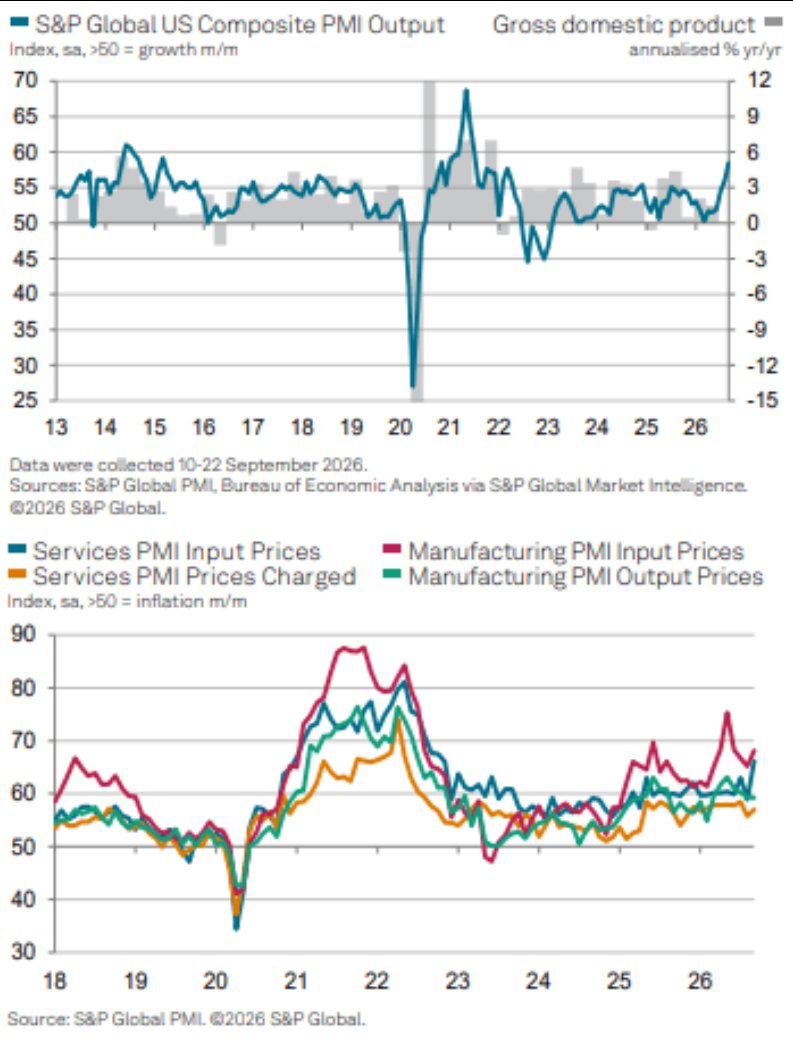
Manufacturing, services and composite gauges all came in well above estimates, signaling a firmer September expansion in private-sector activity.
S&P Global’s September flash PMI readings for the U.S. showed manufacturing at 57.0, services at 58.7 and the composite at 58.4, all comfortably above expectations. The composite index also rose from 56.0 in August, underscoring a marked pickup in September business activity.
The flash PMI survey is an early monthly gauge of private-sector momentum and is widely watched for clues on GDP, hiring and inflation. S&P Global’s August U.S. flash manufacturing PMI had been 53.2, already in expansionary territory, but September’s figures point to a sharper acceleration.
A stronger PMI print typically bolsters the case for U.S. economic resilience and can reshape expectations for Federal Reserve policy, the dollar and Treasury yields. It also tends to prompt a reassessment of rate-sensitive assets and sectors with heavy U.S. growth exposure.
For now, the market focus is on the same message from multiple wire reports: September U.S. business activity expanded far more than expected. Traders will next look for whether the stronger growth signal feeds through to inflation and the policy outlook.
Moscow Exchange (MOEX) has launched perpetual futures linked to five cryptocurrencies: Bitcoin, Ethereum, Solana, XRP and Tron. Multiple X posts say trading began on Sept. 22 and is available to qualified investors.
The move broadens Russia’s domestic crypto-derivatives offering on a regulated venue. X signals also say MOEX crypto futures have surpassed 600 billion rubles in volume, with about 72,000 investors involved.
For markets, the immediate relevance is to the listed tokens, especially Solana, XRP and TRX, which are directly referenced in the contract lineup. The launch does not appear to be the same event as recent SOL treasury and swap-volume coverage in the site’s news cache.
No additional statement from MOEX was included in the supplied materials. Based on the available information, the new product is a perpetual futures offering rather than a spot or custody service.
DoorDash said it agreed to pay $131.5 million to settle a New York City probe into whether it complied with minimum-pay rules for couriers. The company said the underpayments were unintentional and apologized to affected Dashers.
The case centers on city enforcement of pay rules for app-based delivery workers. The X signal and the local news database both point to the same matter: investigators found DoorDash underpaid or paid late to more than 200,000 New York City delivery workers.
For investors, the main takeaway is a compliance cost and a one-time cash outflow for DoorDash (DASH). Uber (UBER) appears in the social posts only as a comparison point and is not identified in the materials as a direct party to this case.
DoorDash also acknowledged the mistake publicly, with one post quoting the company as saying, “We screwed up.” Reuters and other outlets reported the settlement on Sept. 22, 2026, after the city probe concluded.
SoFi Technologies and Mastercard said stablecoin settlement is now live across SoFi Bank, N.A.’s debit and credit card program. The setup uses SoFiUSD, issued by a federally regulated bank, and routes settlement through Mastercard’s global payments network.
This is a follow-through on the earlier partnership story, moving the arrangement from announcement to live use. The reporting in the news file describes it as a first step for a broader rollout, making the update relevant beyond a simple product mention.
For the market, the announcement is most directly relevant to SOFI and MA because it ties SoFi’s banking platform to Mastercard’s payments rails. It also highlights how stablecoin settlement is being embedded into card infrastructure rather than kept at the margins of crypto use cases.
No additional dispute or denial appears in the available materials. What can be verified is the live status of the stablecoin settlement network within SoFi’s card program.
Cointelegraph cited on-chain data showing that short-term Bitcoin holders sent 47,600 BTC in profits to exchanges as the price approached $88,000. The move points to rising profit-taking pressure at elevated levels.
The background matters because Bitcoin had already cleared $86,000 in a separate report from the previous day, with ETF flows back in focus. That same news flow also highlighted BlackRock’s expanding Bitcoin-linked product lineup, underscoring how institutional demand and price action are increasingly intertwined.
For the market, the key read-through is sentiment around BTC-linked products such as IBIT, which tend to trade with spot Bitcoin momentum and flow expectations. The signal today is less about a fresh price target and more about a growing incentive for holders to lock in gains after the run-up.
Even so, some market participants argue Bitcoin’s role in the financial system is becoming more established rather than less. Blockware Intelligence’s head said Bitcoin “is not going anywhere” and that deeper capital markets could lead to shallower bear markets.
Multiple X posts put AMD back in the spotlight, with one saying the stock first crossed the $1 trillion market-cap mark and traded above $615 after a 10% jump. Our news library had already reported on Sept. 22 that AMD became the latest technology company to reach a $1 trillion valuation, while Zacks on Sept. 23 said the stock closed at $623.77, up 1.34% on the session.
The backdrop is an ongoing rotation in AI-linked semiconductor names. Recent coverage in our archive says the market has begun reassessing AMD’s place in the AI chip race, while another piece noted that the AI stocks driving Monday’s Nasdaq record finish were slightly lower on Tuesday.
In the broader tape, the X feed said AMD’s move helped lift the Philadelphia Semiconductor Index by about 4.3%, and that NVDA, INTC and ARM also rallied. Another post pointed to Intel’s gains on stronger CPU demand, suggesting the rally has broadened beyond a single name.
Taken together, the materials frame this as a continuation of the AI-chip trade rather than a fresh company-specific announcement. No formal company response appears in the provided sources.
Meta’s new AI assistant Muse is reportedly leaning on human contractors for some phone calls. Reuters, citing internal posts, said the experiment began shortly after the calling feature launched.
The disclosure adds a fresh layer to the high-profile rollout of Muse. In the past two days, Meta’s AI push has been heavily promoted across the web, with company-linked coverage and social posts amplifying the product launch.
For investors, the update keeps META at the center of the AI trade while raising questions about trust, privacy and product readiness. Related coverage has also framed Muse as a possible disruptor for businesses that rely on consumer inertia.
Employees have reportedly raised privacy concerns over sensitive information that users might share during calls. The latest signal suggests Meta is still using human help to bridge early gaps in the assistant’s capabilities.
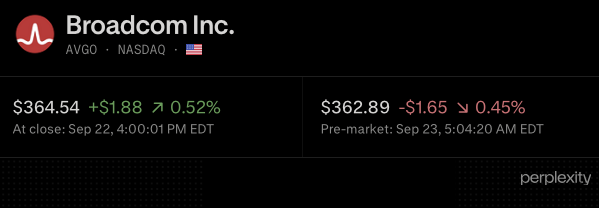
Chinese authorities are reviewing Broadcom’s switch hardware in state-backed data centers, according to reports cited by the Financial Times and Reuters. The FT report says preliminary findings suggest Broadcom equipment may account for as much as 90% of installed gear in some of those facilities.
The review fits China’s broader drive to localize critical infrastructure and reduce reliance on foreign technology in sensitive networks. If the process leads to tighter procurement rules, it could pressure Broadcom’s networking-related exposure in China.
AVGO is the direct ticker in focus, while the story also matters for the broader data-center networking and optical-interconnect supply chain. Investors will be watching whether the review translates into sourcing shifts toward domestic suppliers.
At this stage, the story is based on media reports rather than an official announcement. The reported 90% figure remains a preliminary estimate cited by the FT, not a confirmed government statistic.
Multiple X posts citing Bloomberg say Meta CEO Mark Zuckerberg is set to attend a White House state dinner for Chinese President Xi Jinping this week. Wall St Engine also listed a broader group of expected tech and business attendees, including Elon Musk, Jensen Huang, Sam Altman, Sundar Pichai, Jeff Bezos, Tim Cook, Satya Nadella and Michael Dell.
The incremental development is Zuckerberg’s inclusion on the reported guest list, which puts Meta closer to the center of the U.S.-China high-level optics around the dinner. That comes as the company has already been drawing attention in recent days for the momentum around its Muse AI product in the site’s news flow.
For markets, META is the clearest name to watch in this report. The guest-list expansion may keep investors focused on Meta’s policy posture and AI narrative, but the provided material does not quantify any direct financial impact.
No separate company statement is included in the source set, and the report remains framed as a Bloomberg-sourced plan to attend rather than a formal on-the-record confirmation from Meta itself.
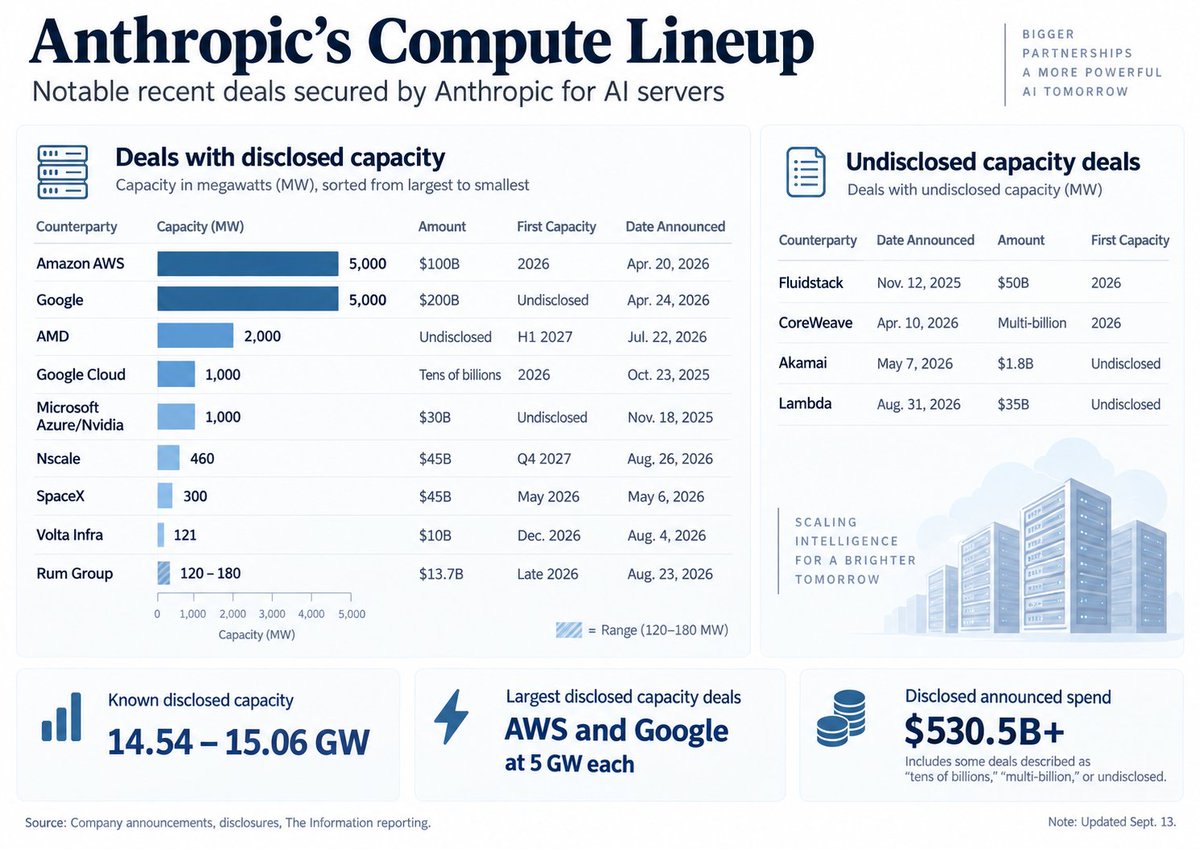
Anthropic is in early talks with Stream Data Centers to lease as much as 1 gigawatt of data center capacity, according to The Information. The proposed buildout could rely mainly on Google/Broadcom TPUs, with Nvidia GPUs also in the mix.
The discussions underscore how aggressively leading AI labs are scrambling for compute. Reuters reported in July that Meta was in talks to lease compute to Anthropic in a potential deal worth up to $10 billion over two years, highlighting the scale of demand across the sector.
If the talks progress, the ripple effects could reach Alphabet, Nvidia and the data center developer backed by Apollo. Alphabet could deepen TPU adoption, Nvidia could still win GPU demand, and Stream Data Centers would emerge as a new large-scale capacity supplier.
The companies have not publicly confirmed the structure, economics or final counterparties. For now, the deal remains an early-stage discussion rather than a signed agreement.
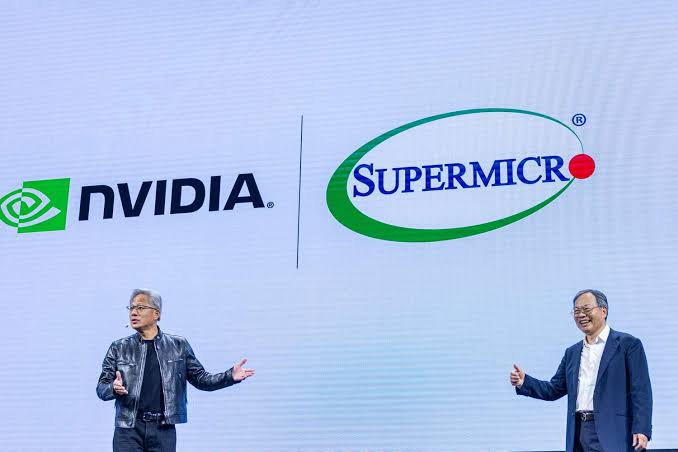
Supermicro said it has begun shipping NVIDIA Vera Rubin NVL72 racks. The signal says each rack includes 72 Rubin GPUs, 36 Vera CPUs, 20.7 TB of HBM4 memory and 216 TB/s of NVLink scale-up bandwidth.
The same post also mentions a 16-rack Scalable Unit with 1,152 Rubin GPUs and 331 TB of HBM4, paired with direct liquid cooling. That makes the update more concrete than a product tease, because it spells out the rack-level configuration now being shipped.
For the market, the update centers on SMCI and NVDA. Supermicro sits on the system-integration side of AI infrastructure, while Nvidia supplies the Rubin platform, so the shipment milestone is relevant to both names.
No denial appears in the provided materials. The incremental takeaway in today’s signal is the wording around shipping, plus the newly specified rack, memory and bandwidth figures.
AWS has received the first approval for NATO RESTRICTED cloud workloads, allowing it to support restricted workloads across all NATO member nations. The X signal describes AWS as the first cloud provider to clear this standard.
The fresh angle in today’s signal is the scope of that approval: it is tied to sensitive government and defense use cases. The post also says AWS already has 15 regions in NATO member nations, underscoring its existing footprint in the bloc.
For Amazon, the market takeaway is that AWS may be better positioned for public-sector cloud contracts that require stricter handling standards. Separately, recent coverage in the site’s news database said Amazon rolled out new agentic AI for third-party sellers, showing the company is still pushing product updates across both cloud and retail.
No revenue or contract value was provided in the source material. The report is based only on today’s X signal and the matching Amazon coverage in the news database.
Multiple X signals say Microsoft is preparing deeper discounts for enterprise Copilot customers while building a new AI “super app” that combines coding tools and AI agents. One report citing The Information says corporate subscription discounts could range from 30% to 50%.
The shift suggests Microsoft may be trying to lower the entry barrier for enterprise AI adoption while monetizing more through usage-based features. The same signal says the new pricing structure could begin in October, with some customers eligible for roughly 30% off.
For markets, the key ticker is MSFT because Copilot is central to Microsoft’s enterprise AI push. Investors will likely watch whether lower pricing boosts adoption fast enough to offset pressure on subscription revenue in the near term.
The reports describe guidance to sales staff and media coverage, not an official Microsoft announcement. No separate confirmation appears in the local news library over the past 48 hours.
企業動向
Amazon rolls out always-on AI agent for third-party sellers英語原文
Seller Assistant can monitor pricing, inventory, listings and account health around the clock, deepening automation across merchant operations
Amazon has introduced a new AI agent for third-party sellers on its main e-commerce site. The upgraded Seller Assistant can run workflows to monitor and act on pricing, inventory, listings and account health even when a seller is offline, and merchants can describe tasks in plain English with guardrails.
Reuters in the news library and the X posts describe the same event: Amazon’s new agentic AI service for marketplace sellers. The social posts add that the tool is Claude-powered and already being framed as part of real marketplace operations.
The update puts $AMZN’s seller ecosystem in focus, as investors will be watching whether the automation improves merchant productivity and strengthens Amazon’s control over the commerce stack. AMZN is the primary ticker here; Claude is mentioned in the materials, but no separate listed counterpart is identified as a core market name.
There is no denial in the materials provided. Based on the sourcing, this is a product rollout rather than a financial or regulatory development.
Multiple X posts indicate that SpaceXAI’s Grok Bot AI agent has surpassed 400,000 weekly users roughly a month after launch. Bloomberg-linked presentation material seen by Wall Street Engine said weekly users reached 418,000 as of Sept. 14, up 24% from the prior week.
The update gives a clearer read on early adoption for a product that sits at the center of Elon Musk’s company’s AI ambitions. It also suggests the service has moved beyond launch buzz into a phase where usage trends can be measured and tracked.
For investors, the data adds another point to the SPCX AI story, though it is separate from recent coverage about the stock and broader valuation narratives in the site’s news flow. No company denial or correction appears in the supplied materials.
At this stage, the only hard figures available are the weekly user count and the week-over-week growth rate. Those figures come from the X signal set and are consistent across several republished wires.
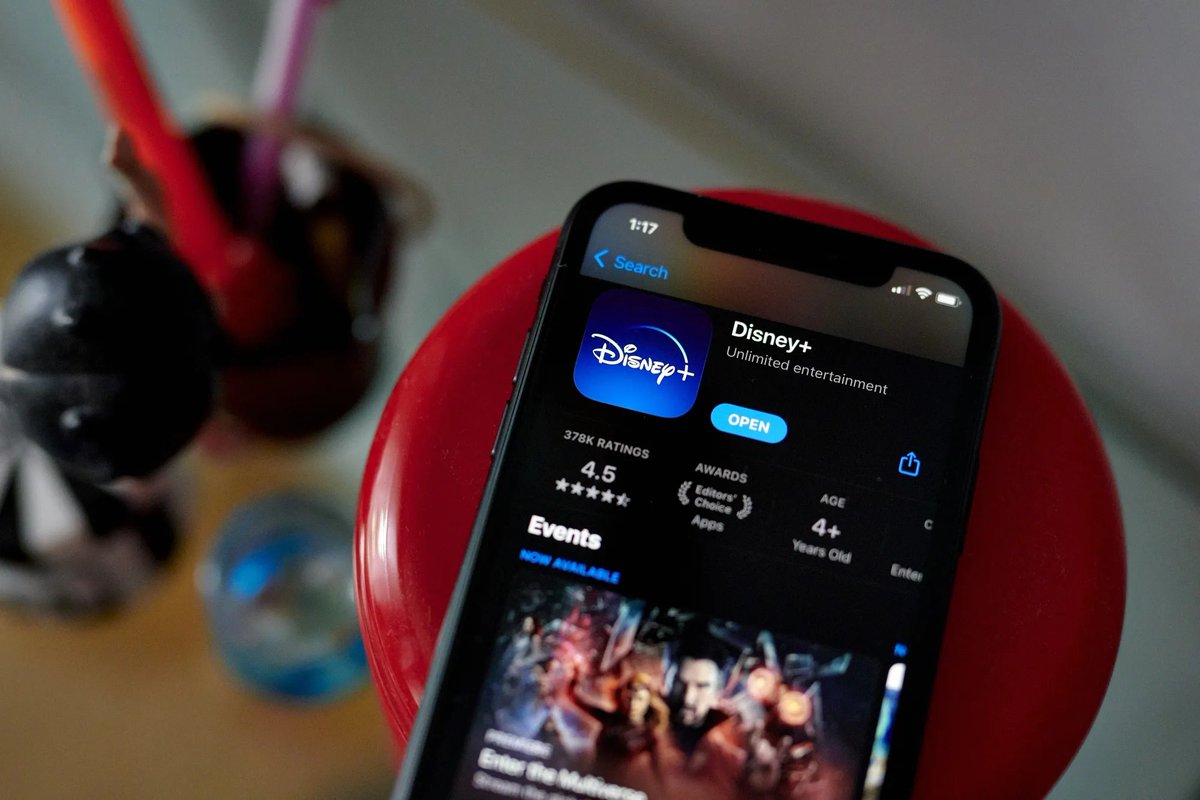
Disney is planning to raise the monthly price of Disney+’s ad-free plan by 13% to $21.49, or $2.50 more than before, according to multiple media reports citing sources. Hulu’s ad-free plan would rise by the same amount, while the ad-free Disney+ and Hulu bundle would increase to $21.99.
The reported move extends Disney’s pattern of regularly adjusting streaming prices to support the economics of its direct-to-consumer business. In September 2025, Disney announced a broad round of U.S. streaming price increases across Disney+, Hulu and related bundles, a reminder that pricing remains a key lever for the company’s media strategy.
For investors, the main question is how far Disney can push pricing without denting subscriber retention. Disney is the clear primary stock in focus, because changes to Disney+ and Hulu pricing feed directly into the company’s streaming revenue and margin outlook.
As of now, the details are being carried by media reports citing people familiar with the matter, and Disney has not publicly expanded on the reported pricing plan in a standalone statement. If implemented, the move will likely renew attention on the balance between higher average revenue per user and subscriber churn.
President Donald Trump’s latest financial disclosure shows 1,156 securities transactions made on his behalf in July, with CNBC calculating total activity at roughly $79 million to $270 million. The biggest reported transactions were July 20 sales of between $5 million and $25 million each in Microsoft and Amazon.
The filing extends a pattern of heavy trading in Trump’s accounts. CNBC and The Guardian both reported that the month also included activity in defense names, ETFs and bonds, and that Trump later added small purchases in Microsoft and Amazon on July 23.
For investors, the disclosure is most notable for the scale and mix of the trades rather than any single transaction. The report also shows activity in names such as Oracle, Nvidia and SpaceX, underscoring how broad the portfolio rotation was during the month.
The White House has said independent advisers manage the accounts without Trump’s input. Because periodic disclosures list dates and value ranges rather than exact prices, they reveal activity and timing, but not the precise economics of each trade.
Multiple X signals say Alibaba is accelerating data-center expansion in Europe and the Middle East to support its global AI infrastructure push. The posts also mention planned cloud regions in Turkey, Finland and the Netherlands, plus added capacity in Malaysia, Germany, the UAE, France and Hong Kong.
The move fits a broader company backdrop in which Alibaba’s cloud and AI businesses are already gaining attention. Zacks on the site’s news desk noted on Sept. 22 that the company’s cloud and AI businesses are accelerating, reinforcing the market’s focus on infrastructure spending.
For markets, BABA is the direct name tied to this development. Investors will likely keep tracking the pace of the company’s overseas buildout and how it fits into the stated 20 GW infrastructure plan, although the available material does not add financial detail beyond that.
Business and aistocksavvy both cite the 20 GW global infrastructure buildout, with aistocksavvy attributing the remarks to Li Feifei at the Yunqi conference. Based on the provided materials, this update should be read as a fresh signal on expansion plans rather than a full new filing or financial disclosure.
Multiple X posts citing Bloomberg say Apple is developing a screenless health and fitness tracker designed to compete with Whoop. The report says the device has been in development for several months, and Apple has not yet decided whether to release it.
TechCrunch also covered the same story on 2026-09-22, saying Apple is working on a new screen-less fitness tracker that would put it into direct competition with Whoop. The outlet described Whoop as a fitness-tech company whose valuation recently topped $10 billion.
If Apple moves ahead, the project would add a new wearable form factor to its lineup and could reshape how the company positions health-focused hardware. For now, the key market question is whether the prototype effort becomes a commercial product.
No public response from Apple was included in the signal. The reporting so far is consistent across wires: Apple is exploring a simplified, screenless approach to fitness tracking.
IonQ said it demonstrated what it calls the industry's first end-to-end real-time quantum error correction decoder running on a standard, off-the-shelf CPU. In the company’s account, the benchmark testing scaled to as many as 408 logical qubits.
The result matters because quantum error decoding is widely seen as a key bottleneck on the path to fault-tolerant quantum computing. IonQ is arguing that the classical workload can stay real time without requiring a large amount of dedicated classical hardware as systems scale.
Shares of IonQ moved higher after the announcement, and the broader quantum-computing group also benefited in market trading, according to the reported coverage in the news library. CNBC and other outlets framed the update as a major technical breakthrough for the sector.
For now, the evidence in hand is the company’s own statement and multiple media reports repeating it. No conflicting claim is included in the provided materials.
Qualcomm today unveiled Snapdragon 8 Elite Gen 6 and the higher-end Snapdragon 8 Elite Extreme Gen 6, its first 2nm smartphone chips. Multiple posts say the Extreme tier can run a 30B-plus parameter model locally on the device, underscoring a stronger push into on-device AI.
The same launch was reported by TechCrunch and CNBC on 2026-09-22, both describing the chips as flagship smartphone processors centered on AI capabilities. CNBC also said the launch comes as the smartphone market faces pressure from rising memory prices and broader supply constraints.
For QCOM, the announcement further shifts the flagship-chip story toward local AI execution. It also highlights why premium phones may need more memory and leading-edge silicon, although the materials do not quantify any downstream financial effect.
One detail mentioned in the social posts is a sensing hub that can run models up to 200 million parameters. That point does not appear separately in the newsroom items, so the core verified takeaway remains the launch of the two 2nm chips and their AI focus.
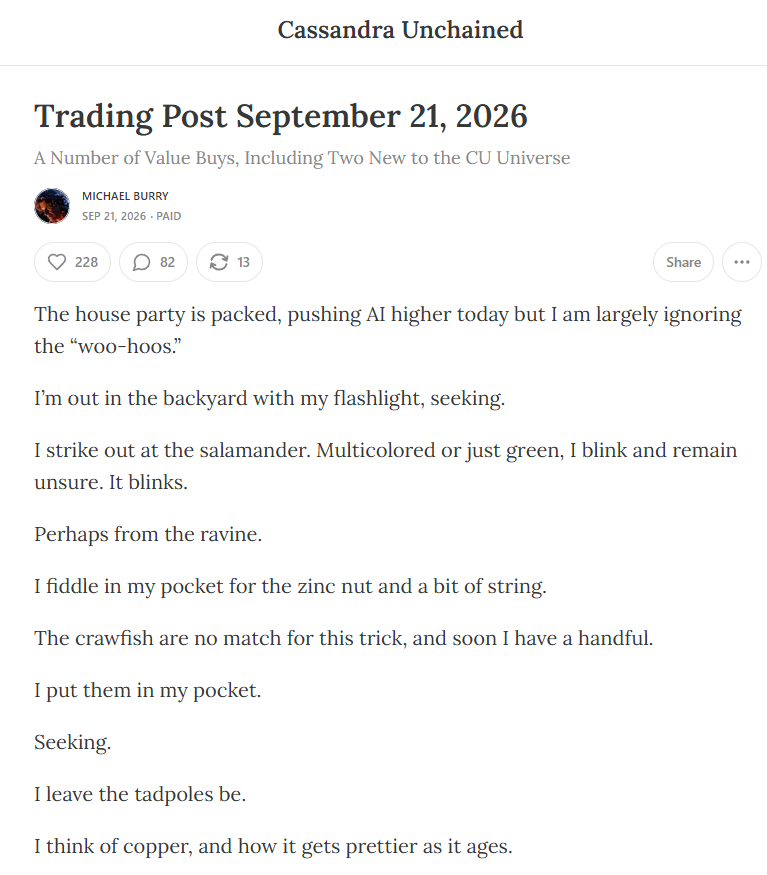
Michael Burry disclosed in a new Substack post that he added “in some size” to short positions in Micron (MU), Nebius (NBIS), the iShares Semiconductor ETF (SOXX) and Palantir (PLTR). Multiple outlets later repeated the disclosure, framing it as a fresh escalation of his bearish stance on AI-linked equities.
The timing matters because Burry also cited Acer chairman and CEO Jason Chen’s comments on memory markets: some advanced parts remain tight, but DDR4 has more sellers than buyers, while expanding Chinese supply could weigh on prices. TechNews reported that Acer expects fourth-quarter prices for different products to rise 5% to 20%, even as traditional DRAM supply improves.
For markets, the names he highlighted sit across the AI trade. Micron is the memory chip leader, Nebius is an AI infrastructure play, SOXX is a broad semiconductor proxy, and Palantir has become one of the most closely watched AI software stocks. Burry’s latest move therefore reads less like a macro call and more like a targeted bet on valuation and cycle normalization within semis and AI infrastructure.
Public reporting has not added further detail on the size or structure of the new shorts beyond Burry’s own wording. One article also noted Micron’s recent quarter showed $41.46 billion in revenue and an 84.6% gross margin, underscoring how much momentum the trade is going against from a fundamentals perspective.
Anthropic and OpenAI each rolled out cheaper AI models on Sept. 22. Anthropic launched Claude Opus 5.5, while OpenAI introduced GPT-6 Sol and GPT-6 Luna.
The releases come after both companies recently called for a slower pace in frontier AI development, but the new products show they are still competing aggressively on price and efficiency. Anthropic said Opus 5.5 should cost about 40% less to run than Opus 5, while OpenAI said Sol and Luna cut API prices by 50% versus GPT-5.6 promotional pricing.
The move matters because enterprises are scrutinizing AI budgets more closely and increasingly comparing frontier models with cheaper open-weight alternatives. Pricing and inference efficiency are becoming as important as raw benchmark performance in winning business customers.
Anthropic said Opus 5.5 includes the same class of safety safeguards previously reserved for its most advanced systems and is already available on major cloud platforms. OpenAI positioned Sol for more complex workloads and Luna for high-volume tasks, underscoring how the rivalry is shifting toward cost-effective deployment.
Bank of America Co-President Dean Demare said on Tuesday that the bank’s markets business will not be as robust in the third quarter as it was in the second. The remark is a fresh management read-through on trading conditions rather than a formal earnings update.
The backdrop matters because larger US banks have been navigating a mix of flatter yield curves, volatile energy prices and shifting Fed expectations. In that setting, investors tend to treat comments from BofA executives as a useful gauge for the broader money-center bank complex.
For Bank of America, the immediate market focus is on BAC’s markets revenue trajectory and how it compares with peers that also rely on trading and capital markets activity. If similar guidance emerges from other lenders, analysts may revisit expectations for the sector’s quarterly revenue mix.
No new numbers were disclosed in the comment, and the statement was qualitative. BofA did not provide a more detailed breakdown of the markets outlook in the signal cited here.
Qualcomm said it will acquire PickNik Robotics, the company behind MoveIt. Multiple X posts said Qualcomm plans to integrate MoveIt and MoveIt Pro into its Dragonwing robotics platforms.
MoveIt is described in the posts as a widely used open-source robotics manipulation framework used in industrial automation, service robotics, and mobile manipulation. Qualcomm also said MoveIt will remain open source.
The move extends Qualcomm’s edge AI push into robotics software, with attention centered on how Dragonwing could benefit from the MoveIt ecosystem. The key market focus is Qualcomm itself, given the deal’s role in its robotics strategy.
No deal value or closing timetable was included in the X signals provided.
Royal Caribbean Group has agreed to acquire a 50% stake in Sandals Resorts International for about $3 billion. The companies also issued a joint announcement confirming the transaction.
CNBC first reported on Sept. 22 that Royal Caribbean was nearing the deal, and Reuters reported on Sept. 23 that the agreement had been reached. The X signals from multiple outlets point to the same Sandals transaction.
For Royal Caribbean, the move extends the company beyond cruises into Caribbean all-inclusive resorts. Reuters said the deal will broaden its vacation portfolio, while Barron’s said closing is expected in early 2027.
RCL is the key stock in focus because Royal Caribbean is the acquiring party. Sandals is not a listed company, so the market impact is centered on RCL’s expansion strategy and deal execution rather than a second tradable equity.
McDonald’s used its latest investor day to unveil a new long-term strategy, McDonald’s > NEXT. The company said it is targeting a low-to-mid 50% operating margin by 2030 and roughly 250 basis points of restaurant-level efficiency gains.
The plan extends a broader push to upgrade restaurants, train workers and improve service. CNBC had flagged on Sept. 22 that the company would outline more details about its newest growth strategy at the investor day, making Monday’s disclosure the latest step in the same event line.
For investors, the key question is whether those efficiency gains translate into stronger unit economics and a better growth profile for MCD. The disclosed spending plan also underscores how much McDonald’s is leaning on its franchise system to support the turnaround effort.
No denial or competing company statement was included in the provided materials. Based on the sources, this is the company’s own public update and not a separate, unrelated development.
Novo Nordisk is open to considering a direct New York listing that would replace the ADR structure used by U.S. investors today, according to the Financial Times, cited in multiple market wires. CEO Mike Doustdar said the move could help raise the company’s profile in the United States.
The Reuters follow-up in our news library covers the same event line, saying Doustdar described the idea as an “upgrading” of the New York listing. The company’s U.S. business matters because it generates more than half of Novo’s revenue.
Shares tied to NVO were softer in premarket trading, with one X signal citing a 1.8% decline. The market reaction reflects how investors are parsing any potential change to the company’s U.S. capital-markets presence.
Novo has not said the proposal is under active discussion, so the latest update is limited to management openness rather than a formal decision. That keeps the story in the realm of strategic signaling for now.
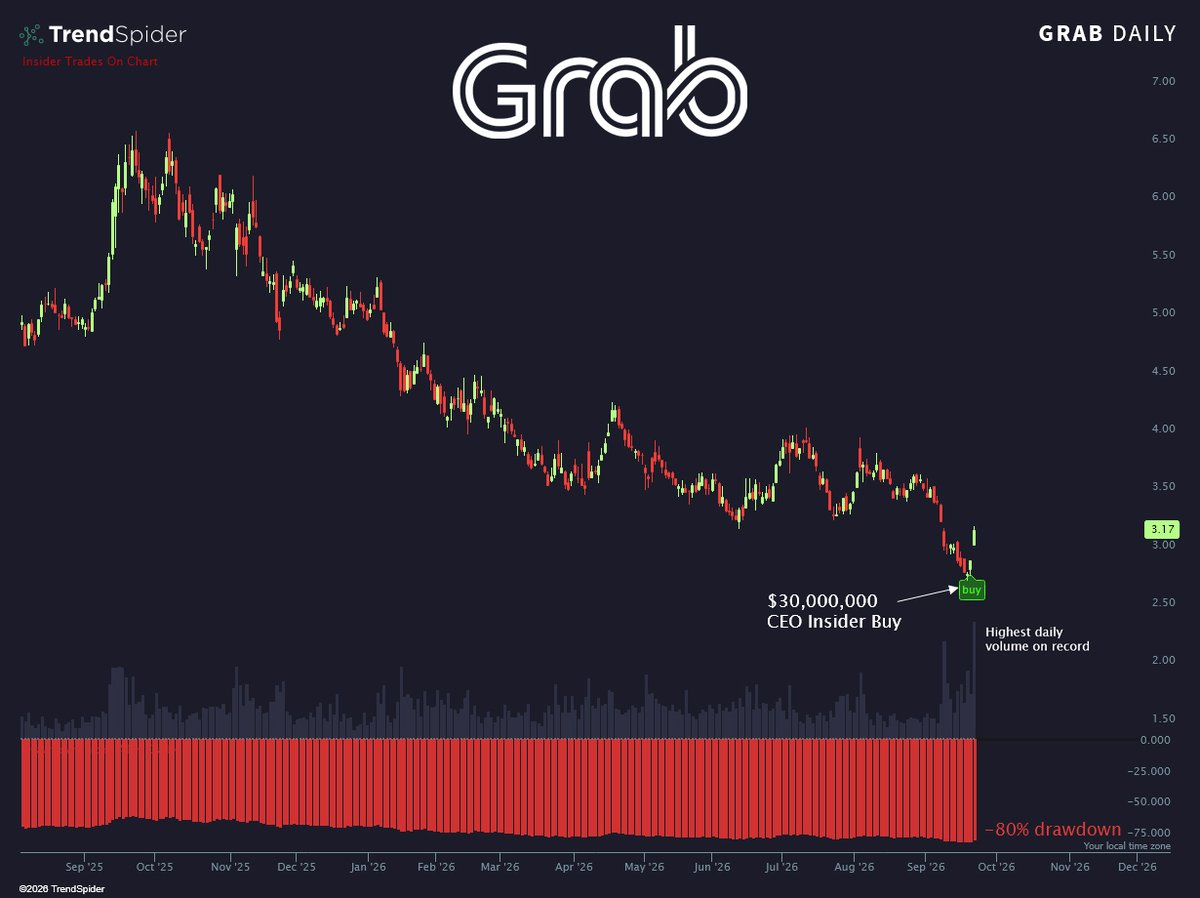
Grab executives bought more than $30 million worth of company shares this week. Reuters reported the buying came after the stock fell to a three-year low.
The move follows the company’s previously reported deal to acquire Atome-related assets, which has kept the market focused on Grab’s valuation and execution. The story is part of the same event line covered in the newsroom database and Reuters.
For the market, the key point is the buying itself: management was stepping in while GRAB shares were under pressure. The X signal also said the CEO bought $30 million and that trading volume set a record, but the newsroom database only confirms the broader weekly purchase total.
No forward-looking conclusion can be drawn from the purchases alone. Any further disclosure from the company would be the next material update, not this one.
DigitalOcean has opened Managed Agents in public preview, letting developers run Claude Code, Codex CLI, OpenCode, LangGraph or custom agents on its cloud. The product combines inference, execution and tool access, while preserving session state and providing pause/resume controls.
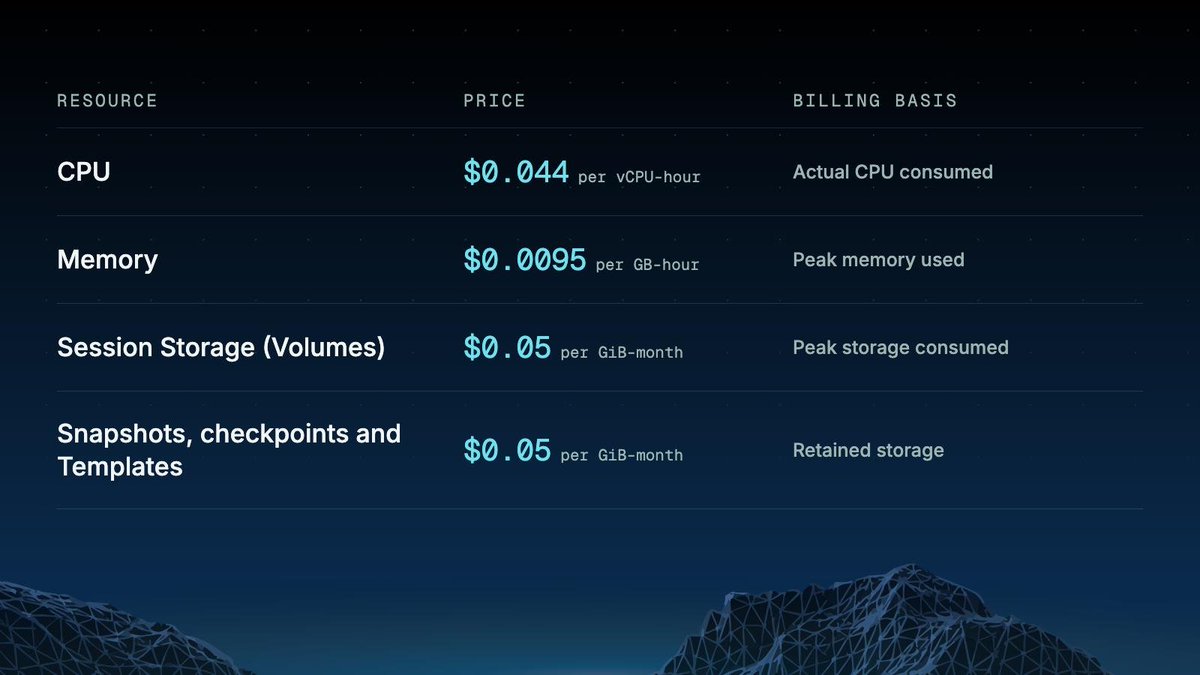
The company says each session runs inside a dedicated Firecracker microVM, with resume times of about 300 milliseconds. It also says CPU billing is based on actual consumption, so charges drop to zero when an agent is idle and stop when a session is paused.
For DigitalOcean, the launch packages sandboxing, inference and tool connectivity into a single managed offering aimed at AI agent workloads. The platform says it connects to more than 16,000 tools, including GitHub, Stripe and Snowflake, making it easier for teams to deploy agents without stitching together separate vendors.
So far, the news flow centers on the product rollout and its feature set, with no disclosed customer migration figures or revenue contribution. For DOCN, investors will likely focus on whether the new service helps differentiate its cloud stack in AI infrastructure rather than on immediate financial impact.
Meta’s Muse has added two new partnerships: PayPal for shopping and checkout, and Instacart for grocery shopping and delivery. X posts also say Muse’s partner list now includes Expedia and Shopify.
The new tie-ups add to the recent stream of Muse coverage in the site’s news library, showing Meta pushing the personal AI assistant toward more practical consumer use cases. Business Insider coverage on Sept. 22 and Sept. 23 also framed Muse as a major focus of Meta’s AI promotion effort.
For markets, META is the primary stock directly tied to the development. PayPal is the clearest counterpart mentioned in the update, but the event is centered on Meta’s product rollout and partner expansion.
No transaction value or financial impact was disclosed in the materials provided. Any broader significance will depend on how Meta and its partners describe the integrations going forward.
Cantor Fitzgerald kept its Overweight rating on Meta Platforms and raised its price target to $860 from $680. The firm said personal AI agents could emerge as the third S-curve in AI as capabilities continue to advance.
The call lines up with Meta’s recent push around Muse. Our newsroom database shows Meta has been promoting the new personal agent app, while Alexandr Wang has been posting frequently to amplify the launch.
For markets, the main read-through is to META. Cantor’s view frames Meta as a leading beneficiary of the personal-agent theme rather than just another contender in the model race.
No response from Meta was included in the source material. The X posts also argue that Meta’s model, compute and distribution could help it bring an agent layer to billions of users ahead of many rivals.
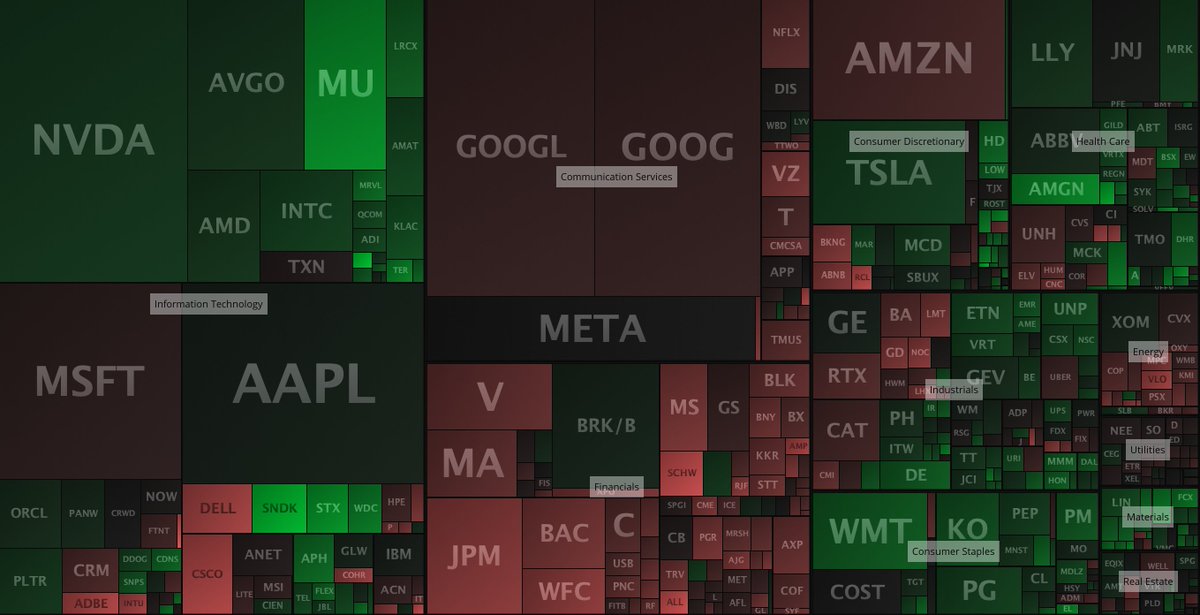
The Nasdaq-100 closed at 30,732.40 on Sept. 22, setting a record close. The move came after the index’s quarterly rebalance lifted SpaceX’s weight to 2.82% from 1.28%.
The rally was reinforced by a strong semiconductor tape and broader AI-linked tech leadership. Market reports said the Philadelphia Semiconductor Index had risen about 87% in 2026, while Microsoft was down roughly 18% to 20% year to date, underscoring a sharp internal split within large-cap tech.
The weighting change created a mechanical bid from passive funds. Estimates published in market coverage put forced buying at roughly $15.5 billion to $22 billion, with the Invesco QQQ Trust alone needing about $7.4 billion of additional SpaceX exposure.
The impact is centered on the Nasdaq-100 and ETF flows rather than a single company’s fundamentals. Investors are watching how the index’s heavier SpaceX allocation reshapes trading in the benchmark and in the megacap tech complex around it.
QQQ, the ETF tracking the Nasdaq 100, hit a new all-time high on Tuesday and was up 21.7% for 2026, according to market chatter on X. Traders also pointed to a five-session winning streak and renewed call buying in large-cap tech names.
The move fits a broader market tape that has been led by technology and semiconductors. Al Jazeera reported that the Nasdaq Composite also touched a record, while TradingKey said the Nasdaq 100 closed at 30,732.40 on Monday, up 0.82%, underscoring the strength in the index’s biggest constituents.
The relative performance gap versus financials is part of the story: XLF has lagged while XLK and QQQ have continued to draw flows. That matters because QQQ is heavily weighted toward mega-cap growth stocks, so its strength reflects sustained demand for the market’s largest tech names rather than a broad-based rally.
There was no new company-specific announcement behind the move. This is a market recap of a momentum-led session, with traders watching whether tech leadership can continue to outpace the more defensive corners of the market.
The company beat quarterly profit and revenue expectations and issued full-year sales-growth guidance, sharpening investor focus on the recovery story.
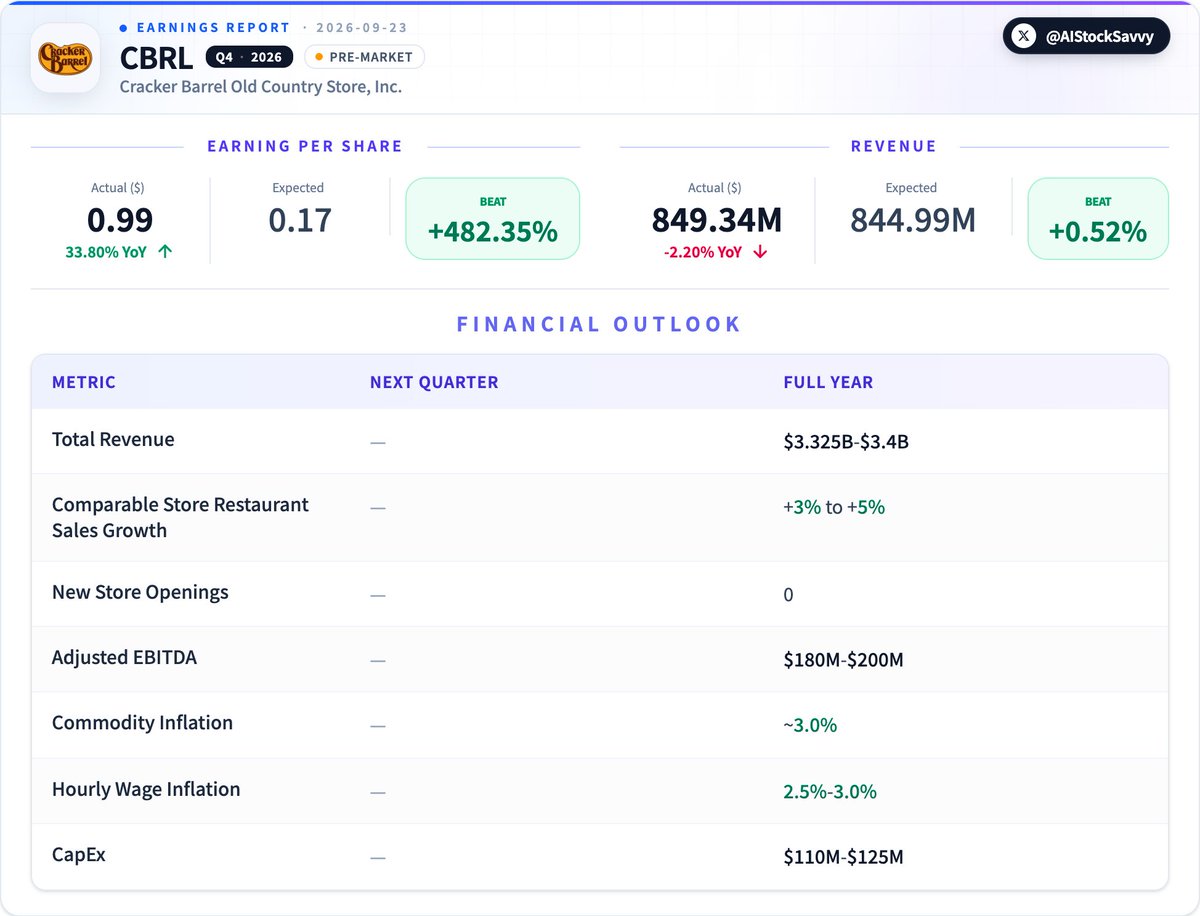
Cracker Barrel Old Country Store, Inc. (CBRL) reported fourth-quarter fiscal 2026 results that came in above Wall Street expectations. The Wall Street Journal also said the chain issued guidance for full-year sales growth.
Zacks said quarterly earnings were $0.99 per share versus the consensus estimate of $0.20. MarketBeat reported revenue of $849.3 million and adjusted EBITDA of $62.1 million, while the WSJ noted the company earned $12.2 million, or 54 cents a share, versus $6.75 million, or 30 cents a share, a year earlier.
Shares moved higher after the report, with Barron's saying the stock jumped after the company beat analysts' estimates and another X post showing a 6.9% premarket gain. For the market, CBRL is the key subject here, with the earnings beat and sales-growth guidance driving the reaction.
The X signal also flagged an implied move of about plus/minus 15.25% ahead of earnings, underscoring elevated trading expectations around the release.
The Mortgage Bankers Association said the average contract rate on 30-year fixed conforming mortgages rose to 7.12% in the week ended Sept. 18, up from 6.97% a week earlier. Total mortgage application volume fell 1.5% on a seasonally adjusted basis, marking a third consecutive weekly decline.
The data suggest borrowers are increasingly reaching for adjustable-rate mortgages to lower upfront borrowing costs. MBA said ARM applications accounted for 9.8% of the market last week, up from 8.4% the prior week, while refinance applications slipped 3% and were 62% below a year earlier.
Higher mortgage rates continue to weigh on both purchase and refinance activity. Purchase applications fell 1% week over week and were down 11% from the same period last year, signaling that elevated financing costs are still cooling housing demand.
MBA chief economist Mike Fratantoni said more borrowers opted for ARMs as fixed rates moved sharply higher. Investors often watch the weekly survey for fresh signs on housing affordability and the near-term direction of mortgage demand.
He says the real risk is the dollar, while cash and bonds still leave investors exposed; gold and international stocks are the main diversification alternatives
In his latest memo, Howard Marks said the roughly $40 trillion U.S. debt load is not a reason to sell U.S. stocks. His argument is that if the real concern is the dollar’s purchasing power, moving from equities into cash or bonds does not solve the problem because those assets are still dollar exposure.
The view adds to Marks’s recent warnings about U.S. fiscal pressures. External reports said he framed the issue as one of fiscal management and currency purchasing power, not a problem with U.S. companies themselves, and noted that gold and international stocks can help diversify risk, even though each brings its own trade-offs.
For markets, the message is about asset allocation rather than a direct call on any single company. The ETFs mentioned in coverage were GLD for gold and VXUS for international equities, both of which fit the diversification theme, but neither is presented as a forecast or a signal to abandon U.S. stocks.
Across the coverage, the consistent takeaway is that Marks does not recommend dumping U.S. stocks solely because of debt concerns, nor does he argue for a wholesale exit from dollar assets. No specific market direction was forecast in the reporting.
Iranian officials rejected Trump's claim of Tehran's seriousness on talks, while commentary criticized QE for hollowing out foreign ownership of US debt.
2026-08-03投稿163件 · 投稿者70人
Trump canceled US strikes on Iran citing a near deal, crashing oil below $79 and lifting stock futures, while IRGC forces fired on ships.
2026-08-11投稿170件 · 投稿者60人
Iran ruled out future negotiations with the Trump administration and declared the Strait of Hormuz closed until 2029, the end of Trump's term.
2026-08-18投稿124件 · 投稿者57人
Trump said no talks with Iran were ongoing or scheduled, while his approval fell to a presidency-low 33%, with the Iran conflict a major concern.
2026-09-22投稿160件 · 投稿者57人
Trump warned of big events with Iran, Tehran offered to reopen Hormuz within seven days if demands met, and the US proposed a $5 billion energy fund.
2026-09-23投稿173件 · 投稿者53人
Trump said the US may blow up Pickaxe Mountain in Iran and revealed a three-hour meeting with the Iranian delegation, calling it very successful.