Nvidia disclosed in a recent SEC filing that it owned 122.8 million SpaceX Class A shares, valued at about $21 billion at the end of the second quarter. The filing gives the clearest public look yet at Nvidia’s financial exposure to Elon Musk’s rocket company.
The stake is widely understood to have come through Nvidia’s investment in xAI, which later intersected with SpaceX through asset and ownership changes. That backdrop matters because SpaceX has been building out AI infrastructure and has recently deepened its relationship with Nvidia’s chips and systems.
For markets, the disclosure adds another data point on how far Nvidia’s capital is now reaching beyond semiconductors into Musk-linked assets. It also keeps NVDA, SpaceX and related AI-supply-chain names in focus as investors assess the size and nature of those cross-holdings.
Neither company appears to have offered new commentary beyond the filing itself. The key development is the quantified stake: 122.8 million shares, worth roughly $21 billion at quarter-end.
The U.S. Office of the Comptroller of the Currency gave World Liberty Trust Company preliminary conditional approval on Aug. 14, a step that clears the way for the Trump family-backed crypto venture to build a national trust bank. The approval is not final; the firm still must meet pre-opening requirements before it can open.
The OCC letter says World Liberty does not intend to become an FDIC-insured depository institution or a bank under the Bank Holding Company Act, and it does not plan to seek a Federal Reserve master account. Instead, the company plans to take over issuance and custody of USD1 and offer fiduciary digital-asset custody services to institutional clients.
The move matters for crypto-market infrastructure because USD1 has already grown into a multibillion-dollar stablecoin. American Banker reported USD1 circulation above $4 billion, underscoring that the charter is tied to an existing product rather than a purely prospective one.
The approval follows public criticism over Trump-family conflicts, but the OCC said career staff reviewed the application under established procedures. Reuters, Bloomberg, CNBC and others reported the decision as a conditional approval, not a final bank charter.
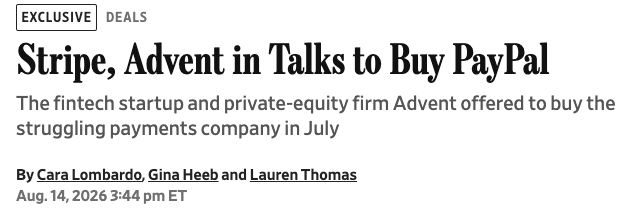
PayPal is in renewed talks to sell itself to a group led by Stripe and Advent International, with the discussions now centered on a price above the $60.50-per-share offer made in July, the WSJ reported. That bid valued the payments company at more than $53 billion, but PayPal’s board had viewed it as too low.
The takeover interest dates back to April, and Reuters previously reported that Stripe and Advent had lined up about $50 billion in committed bank financing and roughly $17 billion in equity for the proposal. The company has also been pushing its own turnaround plan, including AI-driven cost cuts and a simplified structure, as management tries to prove the business can stand on its own.
For investors, the stakes are less about a completed deal than about what it says on valuation and strategic optionality for PYPL. A deal would likely draw antitrust scrutiny because Stripe and PayPal are major online payments platforms, while the financing structure suggests the bidders are serious enough to keep negotiations alive.
PayPal, Stripe and Advent have not publicly commented on the latest talks. For now, the key question is whether the sides can agree on a higher number or whether PayPal keeps leaning on its turnaround plan to justify holding out.
How this story unfolded
2026-07-1564 posts · 49 authors
Stripe and Advent jointly proposed a $53 billion acquisition of PayPal at $60.50 per share.
Company
Anthropic Q2 revenue tops $11.5 billion, up 14x from a year ago
The company also says adjusted operating income turned positive as it courts investors ahead of a possible IPO
Anthropic disclosed to prospective investors that second-quarter 2026 revenue topped $11.5 billion, up at least 14 times from $787 million in the same period a year earlier. The company also said adjusted operating income turned positive in the quarter, marking a first for the AI startup.
The figures build on a much stronger first half of the year, when Anthropic reported about $4.73 billion in Q1 revenue. The new disclosure matters because it gives investors another hard data point on how quickly Claude adoption is translating into sales ahead of a possible public listing.
For markets, the update reinforces the valuation debate around AI software, cloud infrastructure and model-serving demand. Investors are likely to watch how these quarterly numbers compare with the company’s annualized run-rate and whether the profitability trend holds into future filings.
The revenue figures were shared with prospective investors and independently echoed by multiple outlets, while Anthropic has not publicly disputed them. For now, the key issue is less the headline growth rate than what it implies for pricing, margins and IPO timing.
Berkshire Hathaway increased its Alphabet stake by 83% in the second quarter, ending June with about 106 million shares worth roughly $37.8 billion to $37.9 billion. That lifted Alphabet to Berkshire’s third-largest U.S.-listed equity holding, behind Apple and American Express.
The disclosure came in Berkshire’s quarterly 13F filing, which reflects holdings as of June 30 and was released about six weeks later. The filing also showed higher stakes in Delta Air Lines and several homebuilders, underscoring a broader move back into net buying after 14 straight quarters of net stock sales.
For the market, the Alphabet position is the headline because of its size and because it signals renewed conviction in a mega-cap tech name alongside Berkshire’s cyclical bets. The 13F is backward-looking, so it confirms quarter-end positioning rather than providing a live read on current portfolio changes.
Warren Buffett said he had personally backed the Alphabet investment, while Berkshire is now led by Greg Abel. Alphabet’s own recent financing activity around AI infrastructure adds another layer of context to the timing of Berkshire’s larger stake.
The Wall Street Journal reported that U.S. Commerce Secretary Howard Lutnick has told Apple that using Chinese memory chips is not a good idea. The report also says Apple has been testing memory from CXMT and YMTC and weighing whether to use it in some products sold in China.
The issue matters because it sits at the intersection of an AI-driven memory crunch and tougher U.S. restrictions on Chinese semiconductor suppliers. Apple has already said it is evaluating all options, while prior reporting noted that surging memory prices are raising component costs across the industry.
For investors, the message ripples through Apple’s sourcing decisions and the broader memory trade. Names such as Micron and SanDisk in the U.S., and Samsung Electronics and SK hynix in Korea, are being watched as the market gauges whether general-purpose memory remains tight; CXMT and YMTC remain under U.S. policy scrutiny.
In late July, a bipartisan group of U.S. senators urged Apple not to use memory from CXMT or YMTC in any product sold anywhere in the world. Apple has not publicly confirmed any final decision to adopt Chinese memory chips, so the reports should be read as pressure and testing, not as a completed procurement shift.
Company🔥Developing
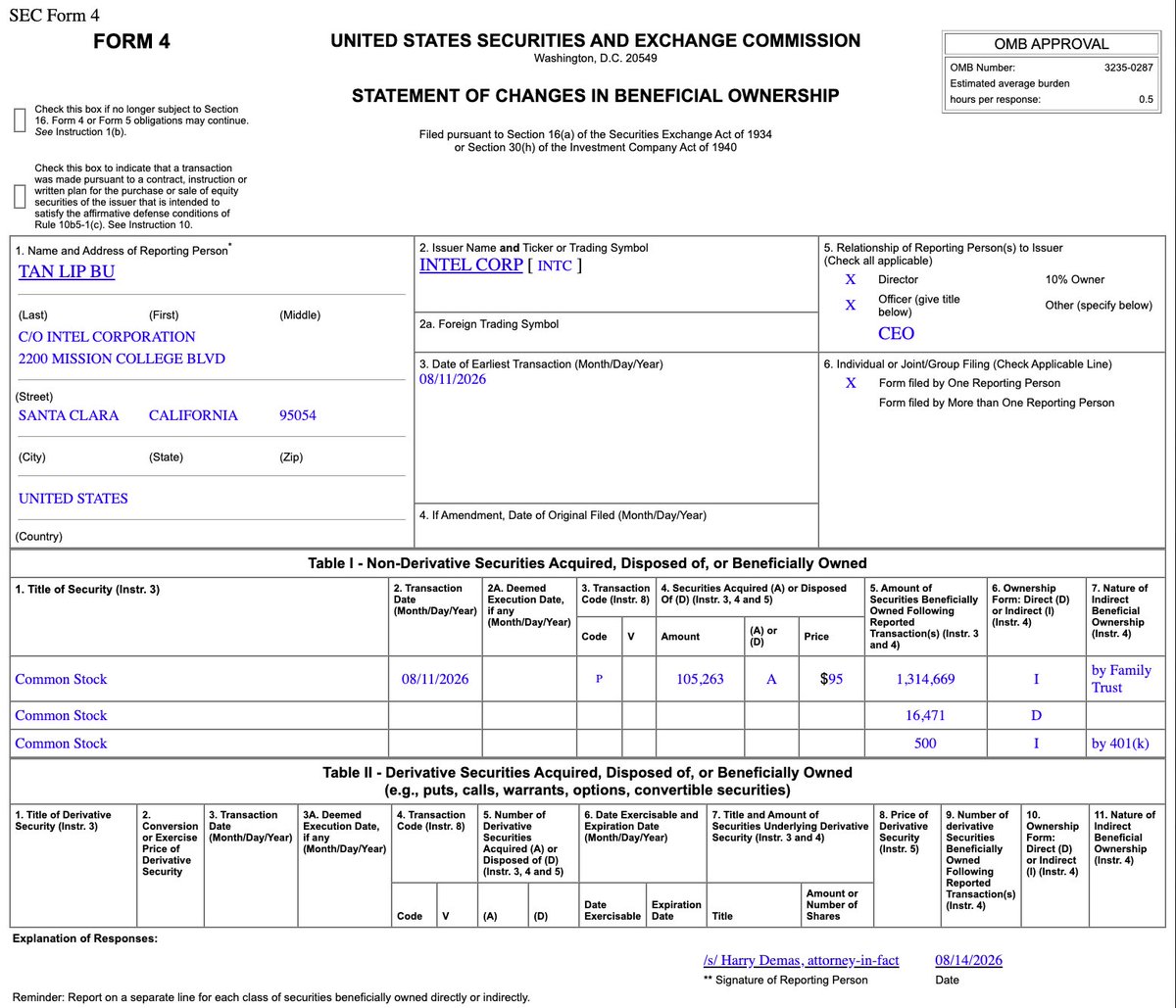
Intel CEO buys 105,263 shares for $10 million as $20 billion raise lands
A new SEC filing shows Lip-Bu Tan added to his stake at $95 a share, alongside Intel’s expanded $20 billion stock offering for capex and working capital.
Intel disclosed in an SEC Form 4 that CEO Lip-Bu Tan bought 105,263 shares of Intel common stock on 2026-08-11 at $95.00 each, a purchase worth roughly $10 million. After the transaction, his beneficial ownership rose to 1,314,669 shares held through a family trust, plus 16,471 shares directly and 500 shares via a 401(k).
The purchase comes as Intel has expanded its equity financing to $20 billion from an earlier $15 billion plan, pricing shares at $95 apiece. The company says the proceeds are intended for capital expenditures and working capital, with the money aimed at foundry buildout and data-center CPU investment.
In the market, insider buying often gets read as a confidence signal, especially when paired with a large capital raise at the same price public investors are paying. Intel’s turnaround story still hinges on execution, but the new filing adds a fresh data point for investors tracking management conviction.
Intel did not issue a separate public comment on the purchase beyond the filing itself. The combination of insider buying and a larger financing package now frames the next phase of Intel’s foundry strategy more sharply for traders and long-term holders alike.
How this story unfolded
2026-06-195 posts · 4 authors
Intel CEO Lip-Bu Tan called memory the biggest shortage and announced plans to hire top CPU architects for agentic AI chips.
Company
Bezos-led group buys 30% Liverpool stake at over $7 billion valuation
The deal would keep Fenway Sports Group in control while bringing fresh capital into Liverpool’s ownership structure
Multiple outlets reported on Friday that a consortium including Amazon founder Jeff Bezos has acquired roughly a 30% minority stake in Liverpool Football Club. The deal reportedly values the Premier League club at more than $7 billion, while Fenway Sports Group is said to retain control.
Liverpool has already been through a similar playbook before. FSG bought the club in 2010 for about £300 million and later sold a minority stake to Dynasty Equity in 2023, making the new transaction part of a longer trend of monetizing the club’s rise without a full sale.
For markets, the story matters mainly to sports finance, private capital and any Amazon-related sentiment, rather than to Amazon’s consolidated results. Bezos’ personal investment does not amount to a corporate acquisition by Amazon, and the key follow-up will be governance terms, board representation and whether the consortium has any path to a larger future stake.
So far, reporting has not laid out a full term sheet. The transaction is still being described as a minority investment, not a change in overall control of Liverpool.
Multiple reports published on Aug. 14 said JPMorgan Chase told Polymarket in October 2025 to find another bank, citing regulatory concerns. Polymarket has since shifted to a different lender, though the companies still appear to have some remaining commercial links through other JPMorgan entities.
The development matters because Polymarket has spent the past year rebuilding its U.S. regulatory posture. The company acquired QCX and QC Clearing and obtained narrow CFTC no-action relief on certain reporting and recordkeeping obligations; CFTC records also list QCX LLC, doing business as Polymarket US, as a designated contract market.
For markets, the story touches JPMorgan (JPM) as well as the broader prediction-market trade, where banking access and compliance credibility can affect growth. Reports also said JPMorgan invited Polymarket CEO Shayne Coplan to a private banking event in Miami earlier this year and may be interested in an underwriting role if the company eventually pursues an IPO, though no public filing has been announced.
Neither side has publicly framed the move as a complete break. JPMorgan declined to comment, while Polymarket told the FT it maintains a close relationship with the bank across multiple entities and fund-flow operations; the CFTC also has not publicly confirmed the scope of any new investigation.
S&P Dow Jones Indices said Reddit will join the S&P 500 effective before the open on Aug. 18, replacing AvalonBay Communities. Reddit shares jumped about 11% in after-hours trading, with some reports putting the move closer to 13% in Friday trade.
The inclusion extends a fast rise for the social platform, which reported its eighth straight quarter of revenue growth above 60% in late July. Chief executive Steve Huffman also said search referrals had been choppy, blaming part of the volatility on Google’s Gemini-powered AI Overviews.
The market reaction centers on forced buying by index-tracking funds. ABC News said trillions of dollars are benchmarked to the S&P 500, while 24/7 Wall St. cited a JPMorgan estimate that funds may need to buy 16.7 million Reddit shares, nearly triple its average daily volume.
Reddit will replace AvalonBay Communities in the benchmark, and the swap itself is part of a broader set of S&P index changes announced by S&P Dow Jones. For investors, the key issue is whether the mechanical demand from index funds can sustain the stock’s move beyond the inclusion date.
Madison Square Garden Sports filed a public Form 10 registration statement on Aug. 14 to advance the separation of its New York Rangers business from its New York Knicks business. The company said the new entity would be named MSG Rangers Corp. and that shareholders would receive a pro rata distribution of its common stock if the deal is completed.
This follows a confidential Form 10 filing in May and MSGS’ Aug. 13 earnings release, which said the company still expects to complete the spin-off by the end of October 2026, subject to approvals and other closing conditions. The filing also says MSG Sports would be renamed MSG Knickerbockers Corp. after the separation.
For investors, the filing is a concrete step toward splitting a single listed sports owner into two separate public companies, which could change how the Knicks and Rangers are valued and traded. MSGS said the spin-off is intended to be tax-free for shareholders, but completion is not assured.
MSGS reported fiscal 2026 revenue of $1.1538 billion, up 11% year over year, and fourth-quarter revenue of $278.7 million, up 37%. The company said higher playoff-related revenue helped the quarter, while also noting expenses tied to the proposed spin-off.
Nvidia said last week that it has signed memorandums of understanding with six major financial firms — Apollo, BlackRock, Blackstone, Brookfield, Goldman Sachs and KKR — to build financing platforms for AI infrastructure. Jensen Huang said the company could backstop as much as 25% of the potential transactions, giving the effort a scale of more than $500 billion in third-party capital.cnbc.com whbl.com
The backdrop is a rapidly expanding AI debt market. Goldman Sachs said AI-related debt issuance has reached about $500 billion year to date in 2026, with hyperscalers accounting for roughly 40% of the total; it also said the big tech group had issued $194 billion so far this year, versus $108 billion in 2025.goldmansachs.com
Investors are becoming more selective as supply swells. CNBC cited PIMCO commentary warning that hyperscaler capex could exceed $1 trillion annually from 2027, while a leveraged AI hedge fund, Situational Awareness, reportedly saw assets fall from $45 billion to about $10 billion after a tech selloff and margin calls.cnbc.com
For equity and credit markets, Nvidia and other AI-linked names are now at the center of a financing story rather than just a chip-demand story. Private credit, infrastructure funds and high-yield markets are emerging as the likely pressure valves if public bond demand proves insufficient.cnbc.com
How this story unfolded
Company
Airbnb says AI writes 60% of code as Q2 revenue rises 17% to $3.6bn
Chesky frames AI as a speed-up engine while Airbnb tests AI search and new product flows
Airbnb CEO Brian Chesky said AI now writes about 60% of the company’s code, underscoring how deeply the travel platform has embedded generative AI into product development. He tied that shift to faster execution, saying AI has cut the time from concept to launch on some initiatives by as much as 60%.
The comment builds on Airbnb’s stronger-than-expected second quarter, when revenue rose 17% year over year to $3.6 billion and gross booking value increased 16% to $27.2 billion. Airbnb also said it is testing AI search and rolling out AI-assisted features across search, sign-up, checkout, payments and support.
For investors, the update keeps ABNB in focus as a consumer internet name using AI to improve efficiency rather than simply add a chatbot front end. The stock has been rallying after the earnings report, with the company pitching AI as a driver of faster feature delivery and lower customer-support costs.
Airbnb said it will continue expanding AI tools for guests and hosts while keeping core search as the default during the rollout of AI search. Chesky also signaled that AI spending will rise, arguing the return in productivity and bookings outweighs the higher inference bill.
Tesla Roadster demo rumored for August, with $50,000 deposits still hanging
Reports say the long-delayed supercar may finally be shown this month, but the event is being framed as a remote-controlled demo rather than a customer-ready launch.
Multiple reports say Tesla is preparing to show a new Roadster as early as this month, with the demo planned at SpaceX’s rocket test site in McGregor, Texas. The suggested setup is unusual: an empty car, remote operation, and a cold-gas thruster package tied to SpaceX hardware.
The Roadster has been a long-running delay story. Electrek says Tesla took $50,000 reservations for the standard model and $250,000 for the Founders Series in 2017, and that the launch date has slipped at least eight times since then.
For investors, the immediate read-through is mostly sentiment-driven. TSLA gets another high-profile product headline, while SPCX stays part of the broader Musk narrative because the demo is reportedly linked to SpaceX-developed thrusters and a SpaceX facility.
What remains unconfirmed is the final format and whether Tesla will stream the event live or release edited footage later. For now, this is a media-led update rather than a formal company announcement.
Thrive Capital discloses $215.5 million purchase of 904,038 Amazon shares
The filing adds another public-market bet to Joshua Kushner’s private-tech heavyweight and underscores how AI-linked cloud exposure is shaping its portfolio.
Joshua Kushner’s Thrive Capital disclosed a purchase of 904,038 Amazon shares, worth about $215.5 million at the end of the second quarter, according to a regulatory filing. The move was first reported on Friday and quickly circulated across market wires.
Thrive is best known for backing private technology names such as OpenAI and SpaceX, but the filing shows it has been building a broader public-equity book as well. The firm also maintained positions in Figma, Oscar Health and Shopify.
For Amazon, the interest centers on AWS and the company’s role in AI infrastructure, both of which have helped keep the stock in focus after Amazon crossed the $3 trillion market-cap mark earlier this month. Thrive has said understanding public markets improves its judgment in private markets.
Amazon and Thrive did not immediately comment on the latest filing. The disclosure comes after Thrive raised more than $10 billion for its latest fund earlier this year, giving it more firepower to expand beyond traditional venture investing.
U.S. oil-and-gas rigs rise to 593, oil count hits 455 since March 2025
Baker Hughes’ latest weekly tally shows U.S. drilling activity extended its recent recovery, a closely watched gauge for upstream spending and future supply.
Baker Hughes’ weekly tally showed 593 active oil and gas rigs in the United States as of Aug. 14, up 5 from the prior week. Oil-directed rigs increased by 1 to 455, while gas-directed rigs rose by 4 to 128, according to the company’s data and multiple wire reports.
The count is a widely used leading indicator for the U.S. energy patch because it reflects drilling activity that can feed into future oil and gas output. Baker Hughes’ website says the rig count has been tracked for decades and is used as a business barometer for drilling and oilfield services demand.
For markets, a higher rig count is generally relevant for oilfield-service names such as Halliburton, SLB and Baker Hughes, because more rigs usually mean stronger demand for drilling, completion and related services. That said, a single weekly move does not by itself determine near-term production trends.
Reuters reported that the latest increase left the U.S. total at its highest since March 2025, while the oil rig count reached its highest since May 2025. The data also marked the second time in three weeks that U.S. energy firms added rigs, underscoring a firmer drilling backdrop this month.
South Korea’s July trade surplus was revised up to $30.39 billion from the previously reported $30.32 billion, while export growth was nudged higher to 63.0% from 62.8%. Import growth was unchanged at 26.5%, according to the updated trade data circulated by financial news wires.
The revision follows an exceptionally strong June reading, when South Korea’s trade surplus reached a record $36.15 billion. July still marked the 18th straight month of surplus, and earlier flash data showed semiconductor exports remained the key driver, jumping 178.8% year on year to a record $41.01 billion.
For markets, the update matters for the won and for shares tied to exports, semiconductors and shipping, because it reinforces the view that external demand remains robust. South Korea’s government has also said in its Green Book that exports are rising sharply and the recovery trend is strengthening.
How this story unfolded
2026-06-1731 posts · 18 authors
South Korean retail investors poured $800 million into SpaceX on its first trading day, while the defense ministry adjusted the civilian restriction zone near the military border.
2026-07-28111 posts · 65 authors
South Korea's stock market plunged nearly 8% amid an accelerating global chip selloff, with the KOSPI falling over 7.5% in its third-biggest daily loss on record.
Earnings
Walmart, Home Depot Set for August Earnings as Consumer Data Softens
A packed retail earnings week will help investors gauge whether higher fuel costs and weaker jobs data are starting to crimp household spending.
A cluster of U.S. retail earnings is due next week, with Walmart, Home Depot, Target, Lowe’s and TJX all on the calendar. The latest X signal points to one central question: is consumer resilience holding, or are softer spending trends finally showing up in retailer guidance?
That backdrop has turned more important after recent data showed signs of cooling. Public reports say the University of Michigan’s preliminary August consumer sentiment reading fell to 51, while July retail sales posted their biggest decline in more than a year, sharpening attention on how demand is evolving.
For markets, Walmart and Target matter most because investors often use them as read-throughs on household behavior, while Home Depot and Lowe’s offer clues on housing-related spending. Any commentary on traffic, promotions or margins could move the shares and set the tone for the broader retail group.
The focus right now is on the pre-earnings setup, not the actual results. The reporting window mainly covers the quarter ended July 31, giving investors a near-term test of how retailers view demand, pricing and inventories heading into the fall.
Oracle said Project Jupiter remains on schedule and that it is working closely with partners to move the project forward, directly addressing rumors circulating on social media. The comment did not identify any change to the project plan.
The project is Oracle’s AI data-center campus in Doña Ana County, New Mexico. Public reporting says the roughly 18-mile Green Chile pipeline, operated by Energy Transfer subsidiary Transwestern Pipeline, now has a new target completion date of Feb. 1, 2027, versus Aug. 15, 2026.
Investors have been watching the project closely because Oracle’s AI infrastructure buildout is a major part of the company’s spending story, and execution risk can spill over to related names. Bloom Energy and pipeline-linked counterparties are among the stocks most directly exposed to the project’s progress.
Oracle has not said the pipeline slip changes the broader schedule, and the company’s latest statement is best read as a rebuttal to delay speculation rather than a fresh project update. The New Mexico campus has already faced regulatory and permitting friction, which keeps any infrastructure milestone highly material.
U.S. drone makers and suppliers rallied on Aug. 14 after the White House unveiled fresh tariffs on imported unmanned aircraft systems and components. Unusual Machines jumped as much as 24.2%, while Red Cat gained 8.8%, AeroVironment rose 1.3% and Kratos added 2.9%.
The new proclamation splits duties by product type and sensitivity: particularly sensitive drones and certain components face a 100% tariff, smaller drones face 25%, and imports from the EU, Japan, Liechtenstein, South Korea, Switzerland and Taiwan are subject to a 15% rate. The White House says the policy is meant to support U.S. production and reduce dependence on foreign supply chains.
Investors appeared to favor companies with domestic manufacturing or parts exposure. CNBC noted Unusual Machines makes drones and drone components, and the company added Donald Trump Jr. to its advisory board in November 2024. Overseas suppliers could be the other side of the trade, with Times Now citing an analyst who said Israel-based Next Vision Stabilized Systems fell more than 5% in Tel Aviv.
The White House said the tariffs take effect 21 days after signing, while less sensitive drones and parts are delayed by 180 days. The order was signed on Aug. 13 and triggered the move in drone-related shares a day later.
SanDisk climbed about 14% on Friday, extending the powerful rally that followed its Aug. 13 Investor Day. The stock is up 38% over the past week, making it the clear leader in the memory group.
The move is being driven by the market’s reaction to SanDisk’s updated long-term model and its exposure to AI data-center storage demand. Recent coverage has highlighted long-term customer agreements, clearer pricing visibility, and margin expansion as the main reasons investors are re-rating the stock.
The broader memory complex is trading in sympathy. Western Digital gained 17% over the week, Micron rose 13%, and SK Hynix climbed 23%, showing that investors are increasingly treating SanDisk as a direct AI-storage beneficiary; JPMorgan’s fresh bullish call added another layer of momentum.
This is still a sentiment-driven rerating rather than a new earnings release. The latest leg higher was sparked by the Investor Day outlook and follow-up analyst upgrades, which kept traders focused on the company’s long-duration growth story.
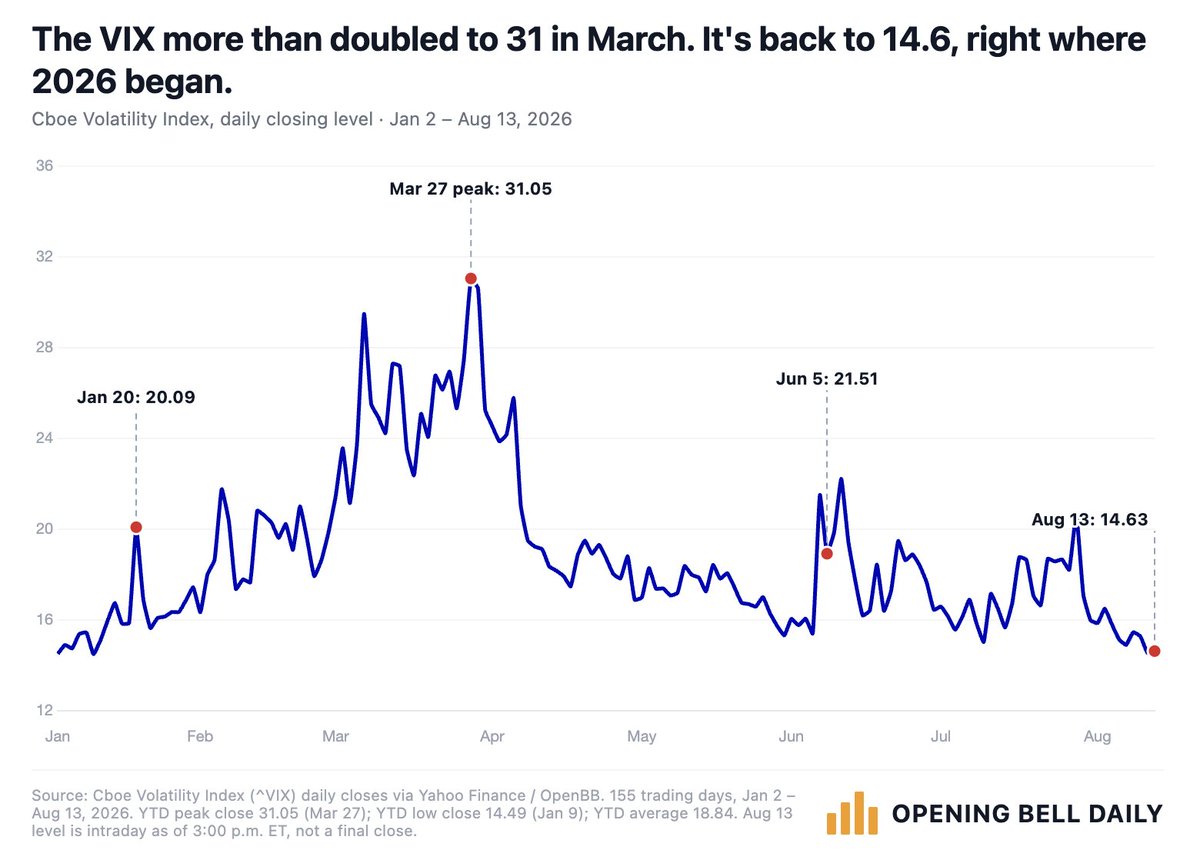
SPY volume hits lowest since Feb. 2025 as VIX hovers near 14.3
Muted trading and subdued volatility suggest the latest S&P 500 grind is being shaped more by positioning and options flow than by fresh macro catalysts.
Multiple X posts show SPY weekly volume falling to its lowest since February 2025, while Barchart said Friday’s trading was the lightest since Feb. 19, 2025. At the same time, VIX traded around 14.3, near this year’s lows.
The setup fits a broader low-volatility tape in U.S. equities. CNBC reported earlier this month that S&P 500 options volume hit record levels, including a record in zero-day-to-expiry calls, underscoring how heavily derivatives have been driving index moves.
For the market, that keeps SPY and S&P 500 options at the center of attention, with low volume making the tape more sensitive to rebalancing flows and hedging activity. A softer VIX also tends to shape intraday swings in VIX-linked products, broad ETFs and higher-beta sectors.
For now, the signal confirms a quiet tape rather than a directional call. The key takeaway is that complacency is not the right framing on its own; positioning and options mechanics still appear to be setting the pace.
Markets
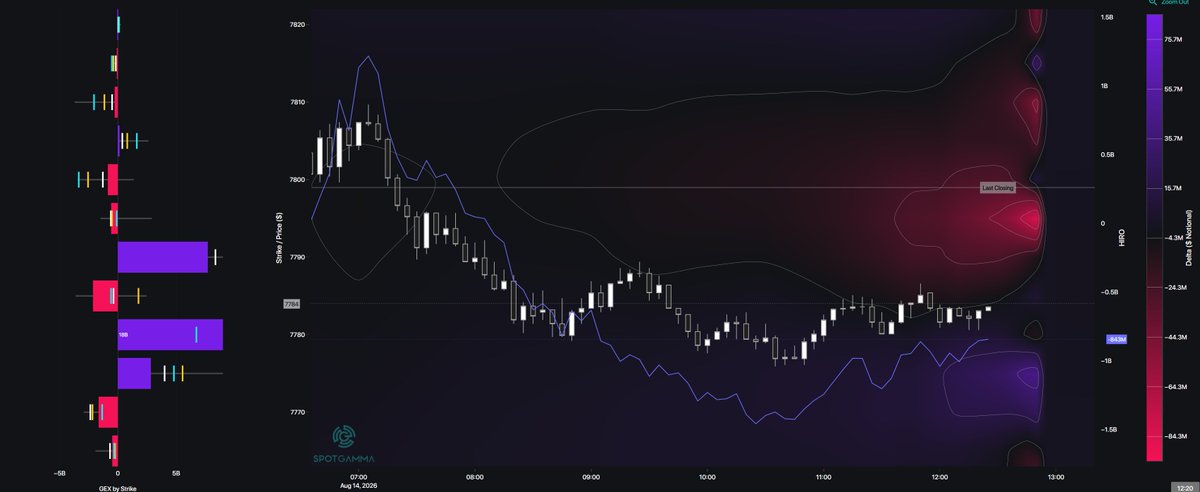
SPY 0DTE call wall drops to 775 as SPX gamma stays pinned near 7,780
Week-end volatility sellers are leaning on lower option walls, keeping SPY and SPX trapped around tighter strike levels.
Fresh X posts suggest SPY’s 0DTE and all-expiry call wall has rolled down to 775, while SPX gamma remains concentrated around 7,780-7,790. That combination points to a tighter intraday range as traders position for a quieter weekend close.
Outside reporting broadly matches the setup. Longbridge, citing LSEG options data, said the S&P 500’s heaviest call positioning sits near the 7,800 strike and that the market has returned to a positive-gamma regime. Theotrade separately described more than $1 trillion in positive gamma around 780 and called 777 the day’s max pain level.
The immediate market impact is mostly in index products such as SPY, SPX and QQQ, where dealer hedging and volatility selling can shape short-term price action. High-beta names like SPCX and NBIS may also feel the spillover through shifts in risk appetite rather than through any company-specific catalyst.
It is worth noting that the bearish phrasing in the X feed is trader commentary, not a confirmed outcome. What is confirmed is the new option-pinning evidence: a lower call wall, persistent positive gamma, and a market still being steered by strikes rather than fundamentals.
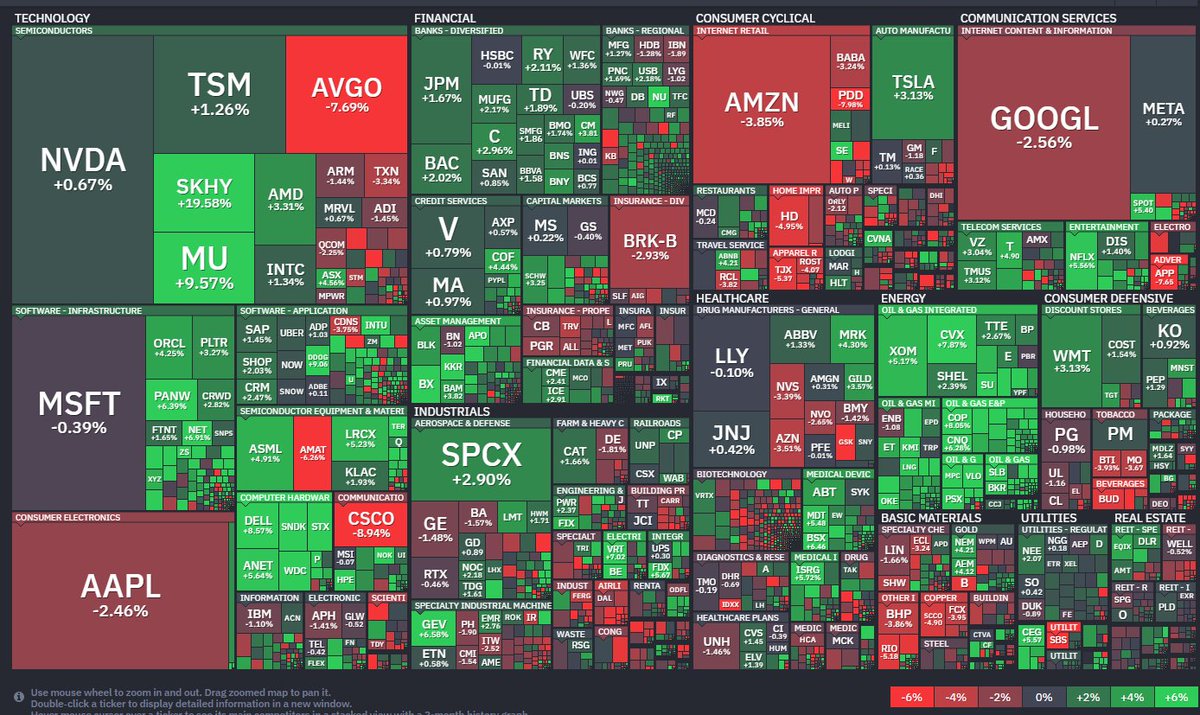
U.S. stocks eased off record levels on Friday, but the S&P 500 still finished the week up 0.4% for a third straight weekly gain. The Dow fell 0.6% on the week, while the Nasdaq edged up 0.1%.
The pullback came after the benchmark hit fresh highs a day earlier, helped by a cooler inflation read that reinforced expectations the Federal Reserve will likely stay on hold in September. Semiconductor and memory names were among the clearest winners in the recent rally.
Reddit surged after S&P Dow Jones Indices said the social-media company will join the S&P 500, while SanDisk and Micron continued to draw strong buying interest. Some post-earnings losers, including Applied Materials and Cisco, underscored how selectively investors are rewarding results.
For now, traders are weighing softer inflation, a cooling labor market and the durability of corporate earnings. The week’s action suggests the index is still holding near record territory even as investors trim some risk at the margin.
South Korea's stock market collapsed 44% in 40 days, erasing $2 trillion in market cap, prompting the finance ministry to announce market stabilization plans.
2026-07-31110 posts · 69 authors
The KOSPI surged nearly 15% as global chip stocks rallied, while South Korea conducted a rare market intervention by selling US dollars to strengthen the won.
2026-08-1454 posts · 24 authors
Incheon Airport recorded 38.4 million international passengers in H1 2026, surpassing Heathrow and Changi, while uranium hit its highest level since February.
2026-08-1524 posts · 13 authors
South Korea proposed talks with North Korea to formally end the Korean War, while Japan's defense minister visited a controversial shrine, potentially straining regional ties.