U.S. stocks extended their rally on Aug. 13, with the S&P 500 pushing through the 7,800 mark for the first time and closing near an all-time high. The Nasdaq and the Dow also finished higher as investors kept piling into large-cap technology names.
The latest leg higher was driven by upbeat results from AI-linked companies and a softer-than-feared inflation reading. Reuters and AP both reported stronger-than-expected updates from Super Micro Computer and CoreWeave, which helped keep momentum concentrated in semiconductors and AI infrastructure.
Chipmakers and AI infrastructure names led the market again, including Nvidia, Micron, data-center operators and other cloud-computing plays. The S&P 500 information technology sector outperformed, underscoring how earnings and capital-spending expectations around AI continue to dominate trading.
Traders also increased bets that the Federal Reserve will hold rates steady at its September meeting, easing some rate-hike anxiety. Some market commentary put the day’s U.S. equity wealth gain at more than $700 billion, an estimate based on the index move rather than a company disclosure.
The U.S. Census Bureau said July retail and food services sales totaled $763.6 billion, down 0.6% from June and below expectations for a 0.1% increase. Year over year, sales were up 5.0%, while the control group fell 0.4% and core retail sales slipped 0.3%, reinforcing the message that consumer spending slowed in July. census.gov
The report showed declines in nonstore retailers, motor vehicle and parts dealers, gasoline stations, and electronics and appliance stores. Restaurants and bars were the only service category in the release to rise, gaining 0.5% in the month, while the Bureau noted the figures are not adjusted for inflation. census.gov
The data hit consumer-sensitive stocks and left traders focusing on retail chains, autos, fuel-related names and e-commerce operators, where July sales trends matter for near-term revenue expectations. The control-group decline is also watched closely because it feeds into GDP calculations and gives a cleaner read on goods spending. tradingview.com
June retail sales were revised up to a 0.2% gain, and TD Economics said the weaker July print was influenced by lower fuel-dealer sales and the earlier timing of Amazon Prime Day, while still being broadly consistent with consumer spending growth in the third quarter. economics.td.com
The White House said on Aug. 14 that President Donald Trump signed a proclamation imposing tariffs on imported drones and their parts, including a 100% ad valorem tariff on certain drones deemed especially sensitive for national security. Smaller drones that lack those capabilities will face a 25% tariff, while drone imports and parts from the European Union, Japan, Liechtenstein, South Korea, Switzerland and Taiwan will be taxed at 15%, and the UK at 10%.
The move extends Washington’s broader push to reduce reliance on foreign-made strategic goods and to rebuild domestic manufacturing capacity. Drones sit at the intersection of consumer electronics, industrial hardware and defense technology, which has made the sector a recurring focus of U.S. trade and security policy.
Drone-related shares rallied on the news, including AeroVironment, Ondas, Kratos, Red Cat and Unusual Machines, as investors weighed the possibility of higher import costs and more demand for U.S.-based suppliers. The market reaction reflected expectations that companies with domestic production or onshoring strategies could gain relative advantage if the tariffs are implemented as announced.
The public reporting now centers on the White House proclamation and wire-service summaries, with no detailed explanation yet on how customs will apply the tiered rates in practice. Investors will be watching for implementation guidance, exemption rules and any pushback from affected overseas suppliers and U.S. importers.
Sources:
Regulation
Detroit automakers say North American revamp could add $2 billion a year as 50% U.S. content rule looms
The White House is weighing stricter auto-origin rules, setting up a new lobbying push from Detroit. The proposal could reprice cross-border parts flows across North America.
Detroit’s automakers are preparing to tell the White House that proposed changes to the North American trade pact could add at least $2 billion in annual costs to each company. Reuters said U.S. negotiators have also floated a rule requiring vehicles to contain at least 50% U.S.-made content to qualify for lower tariffs.
The dispute comes amid a broader push to tighten automotive rules in the U.S.-Mexico-Canada trade framework. Reuters previously reported that U.S. Trade Representative Jamieson Greer has told Mexico’s auto and steel industries not to expect Trump-era tariffs to disappear, while BCG said industry participants are bracing for higher North American content thresholds and stricter U.S. content requirements.
Any shift would hit the most integrated names first, including General Motors, Ford and Stellantis, along with suppliers that move parts across the U.S., Mexico and Canada. A rule that shifts tariff treatment toward U.S.-origin content would also force automakers to revisit sourcing, pricing and plant allocation decisions across the region.
The cost figures and the 50% content threshold are based on sources and have not been formally finalized by the three governments. The companies are expected to press their case directly with U.S. officials in the coming talks.
S&P Dow Jones Indices said Reddit will be added to the S&P 500 on Aug. 18, replacing AvalonBay Communities. Shares of the social platform jumped more than 11% in after-hours trading after the announcement.
The move is significant because index funds tracking the benchmark typically need to buy the new constituent to mirror the index. Reddit went public just two years ago, so the addition underscores how quickly it has scaled into a large-cap name.
The stock reaction also reflects a familiar pattern around index inclusions: investors often price in passive demand before the effective date. Reddit’s latest results were already strong, but the new catalyst shifted the focus to fund flows and benchmark ownership.
Separately, recent coverage has highlighted investor scrutiny around Reddit’s search-referral traffic and the platform’s exposure to AI-driven changes in web discovery. For now, though, the immediate market story is the S&P 500 entry and the expected buying tied to it.
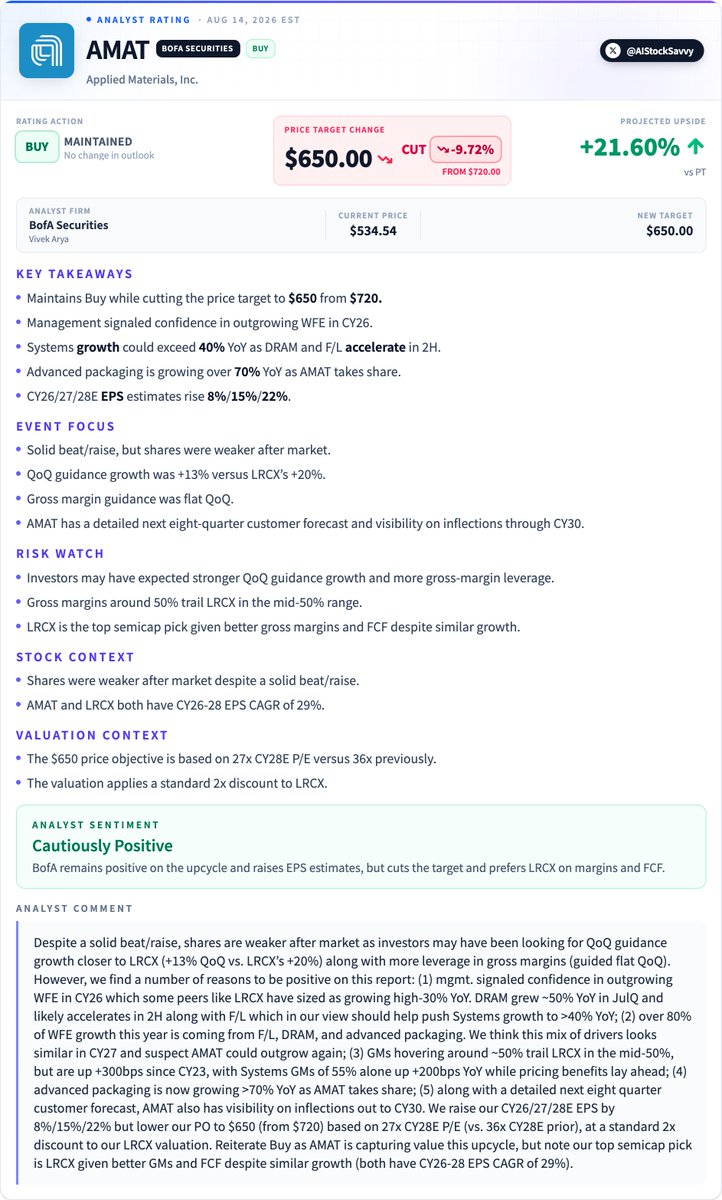
Applied Materials reported fiscal third-quarter revenue of $9.12 billion and adjusted EPS of $3.50, topping Wall Street estimates. The company also guided fourth-quarter revenue to $10.25 billion, plus or minus $500 million, above the consensus view.
The results extend a run of beats for one of the semiconductor equipment industry’s bellwethers. Reuters and the company’s earnings materials show analysts had expected roughly $8.99 billion to $9.00 billion in revenue and about $3.39 to $3.40 in adjusted EPS for the quarter.
Even so, the stock slipped in after-hours trading, underscoring how elevated expectations can outweigh a clean beat. Applied Materials’ results are closely watched for signals on memory-chip spending, AI-driven fab investment and broader demand for chipmaking tools.
The company also said non-GAAP operating income reached $3.10 billion and free cash flow was $2.33 billion. Management said customer demand visibility has improved and that it expects another strong growth year in 2027.
Company
Workday jumps 20% on Silver Lake buyout talks, valuation near $43B
Reuters says the private-equity firm has been in discussions for months; no deal has been announced.
Workday shares surged in intraday trading after reports surfaced that Silver Lake is exploring a takeover of the enterprise software company. Reuters said the talks have been ongoing for months and put Workday’s market value at about $43 billion.
The move comes against a backdrop of pressure on large software names as investors debate how AI could reshape their business models. Workday, which sells human capital management and finance software, has been closely watched as the sector re-rates.
WDAY was one of the day’s most active names, with the stock repeatedly halted as traders priced in a potential control premium. The rally reflects deal speculation, not a confirmed transaction, and the company has not announced an agreement.
For now, the key question is whether the discussions produce a formal bid or fade without a transaction. Any further disclosure from Workday or Silver Lake would be the next market catalyst.
Multiple reports citing The Information say Tesla is preparing to unveil its next-generation Roadster as soon as this month, with a flying-style demonstration planned at its McGregor, Texas test site. The limited-edition version is said to use SpaceX cold-gas thrusters.
The Roadster has been one of Tesla’s most delayed and closely watched projects, so any new showcase would mark a notable update to a long-running product narrative. Today’s news is not about a confirmed launch; it is about a new report that Tesla may finally stage a high-profile demonstration.
For TSLA, the main market relevance is sentiment. A dramatic Roadster reveal could revive attention on Tesla’s product pipeline and on the company’s recurring overlap with SpaceX branding and engineering, even though the details remain unconfirmed.
For now, the reports are media-based and Tesla has not publicly confirmed the stunt or the technical setup. Whether the demo happens, and what it actually shows, will depend on the company’s official announcement.
Anthropic investors are reportedly targeting an October IPO that could value the AI company above $2 trillion, according to multiple reports citing the Financial Times. If it goes ahead at that level, the debut would surpass SpaceX’s $1.77 trillion listing as the largest stock market debut on record.
The latest speculation builds on Anthropic’s prior fundraising momentum. In May, the company’s valuation reportedly reached $965 billion, and backers have pointed to rapidly rising annualized revenue as the key support for a much larger public-market valuation later this year.
The market is also weighing a more complicated backdrop for AI assets. Reports citing Ramp data say some customers are approaching their AI spending limits and switching to cheaper models, a reminder that investor enthusiasm for top-tier AI growth still has to contend with pricing pressure and budget discipline.
Anthropic has not publicly commented on the IPO chatter. For investors, the headline number matters because it would reset benchmarks across the AI sector and invite a direct comparison with SpaceX’s record-setting public debut earlier this year.
SpaceX has completed its $60 billion all-stock acquisition of Cursor parent Anysphere on August 14, according to market signals and follow-up reporting. The deal is now effective, and Cursor shareholders are said to receive about 389.3 million Class A shares.
The transaction traces back to SpaceX’s April agreement to acquire Cursor, which Reuters reported in June as a formal $60 billion deal. Earlier coverage also put Cursor’s annualized B2B revenue at roughly $2.6 billion, underscoring why the coding-agent startup mattered in the first place.
For investors, the main relevance is the implied dilution and the strategic signal for SpaceX’s AI agenda. Based on the reported share count, the deal implies roughly 2.9% dilution, while strengthening SpaceX’s positioning against rivals such as OpenAI and Anthropic in AI coding tools.
As of now, there has been no public denial of the closing itself in the materials reviewed. The completion marks one of the largest technology acquisitions of the year and extends Musk’s push to integrate AI software deeper into SpaceX’s business mix.
How this story unfolded
2026-06-1656 posts · 52 authors
SpaceX announced an all-stock $60 billion acquisition of Cursor, which has over 1 million paying customers and $2 billion in annualized revenue.
Company🔥Developing
Apple trains China-specific AI model with Alibaba support, Reuters says
The update suggests Apple is building a localized AI stack for China instead of simply plugging in Alibaba’s model unchanged.
Reuters reported on August 14 that Apple has trained a large language model specifically for the China market, with support from Alibaba. The report says this is a China-specific model rather than a simple reuse of Alibaba’s Qwen system.
The new detail matters because it adds a layer to Apple’s previously reported China AI plan. In July, Reuters said Chinese regulators had approved Apple Intelligence for use in the country, with Alibaba’s Qwen and Baidu’s technology expected to help power the service.
For investors, the development keeps both AAPL and BABA in focus. It also underscores how Apple’s China AI rollout may rely on a hybrid approach: Apple-controlled software plus local partner support to meet China’s rules.
Neither company disclosed model size, launch timing or commercial terms in the Reuters report. Alibaba has previously said its Qwen models would be integrated into Apple Intelligence experiences in China.
How this story unfolded
2026-07-1516 posts · 14 authors
2026-07-168 posts · 6 authors
2026-08-083 posts · 3 authors
Company
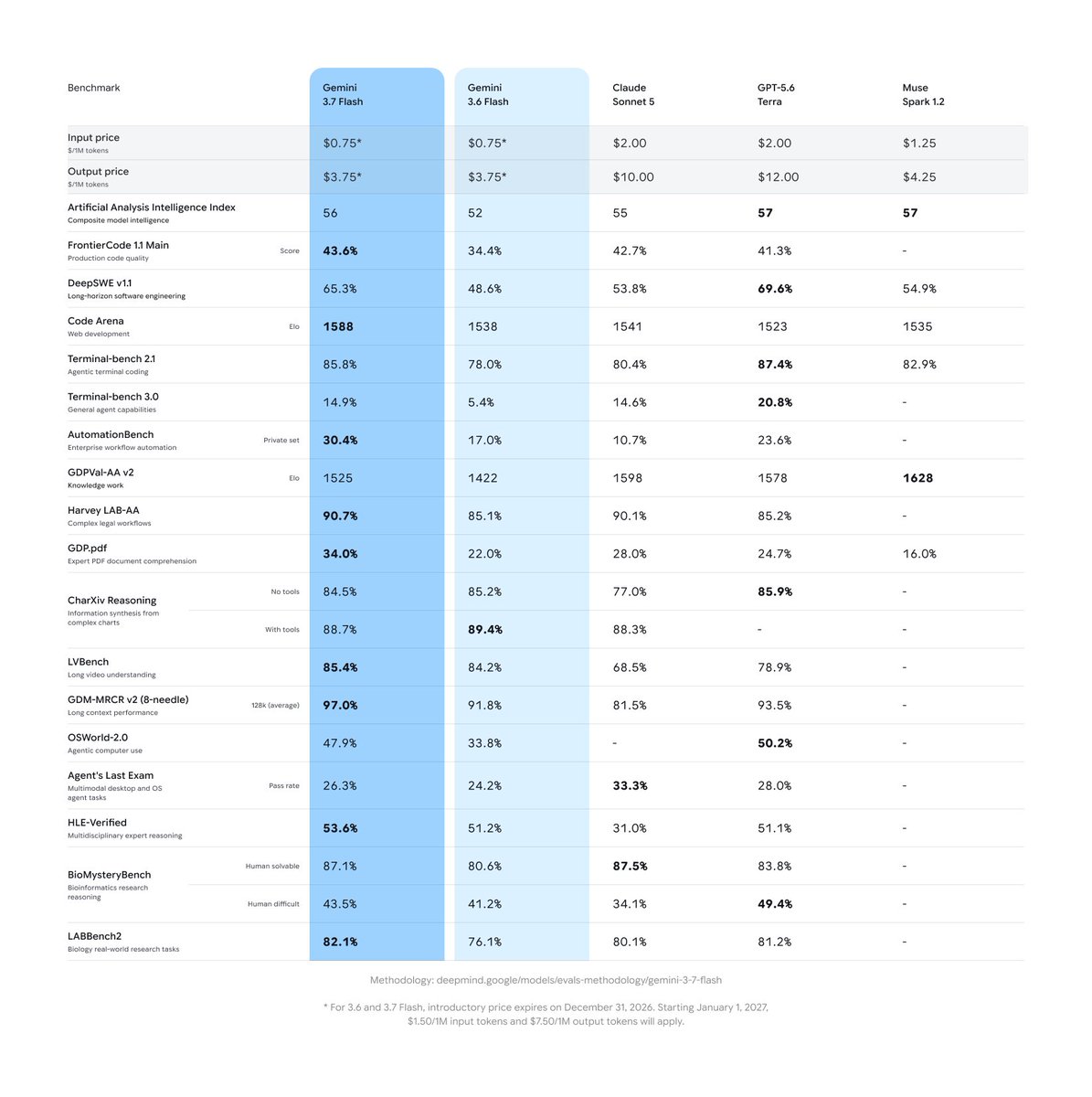
Google launches Gemini 3.7 Flash at $0.75 per 1M input tokens, FrontierCode 43.6%
The new model targets coding and agent workflows, and Google is also switching Gemini Spark to it from day one.
Google unveiled Gemini 3.7 Flash on August 13 and set an introductory price of $0.75 per 1 million input tokens and $3.75 per 1 million output tokens through year-end. The company also said Gemini Spark will start using the model immediately.
The update pairs pricing with performance. Google said 3.7 Flash scores 43.6% on FrontierCode 1.1, up from 34.4% for 3.6 Flash, and 65.3% on DeepSWE v1.1, versus 48.6%-49.0% for its predecessor depending on the report. The model is being pitched for coding, debugging and multi-step agent workflows.
For investors, the main read-through is to Alphabet’s AI stack and the broader race with OpenAI and Anthropic on cost-efficient enterprise models. Lower token pricing can improve adoption of Google’s API, AI Studio and Spark, but the commercial impact will depend on customer uptake.
So far, the public record is consistent across Google-linked disclosures and Reuters reporting, and there has been no company denial of the launch pricing or benchmark numbers. The event is a product rollout rather than a legal or regulatory development.
OpenAI said on Aug. 13 that it is rolling out an “Ultrafast” mode for GPT-5.6 Sol in limited preview to a small group of API customers. Cerebras said the tier can deliver up to 750 output tokens per second and run as much as 14 times faster than standard processing.
The move is a deployment update, not a new model launch. OpenAI had already previewed the GPT-5.6 family on June 26, including Sol, Terra and Luna pricing, but this week’s Ultrafast tier shifts the emphasis to faster inference for financial research, coding, incident response and customer support workflows.
For Cerebras, the announcement adds another commercial proof point for its fast-inference strategy. Shares in CBRS were volatile around the company’s Aug. 13 quarterly results, but the cloud segment’s 287% growth and 103% rise in core revenue show why investors are watching any new customer-facing wins closely.
OpenAI has not disclosed broader availability timing or pricing for Ultrafast, and the companies have not detailed input-speed or time-to-first-token metrics. The real test will be whether the promised throughput holds up under customer workloads and at scale.
How this story unfolded
2026-06-2423 posts · 19 authors
Cerebras reported strong Q1 results and announced multi-year partnerships with OpenAI and AWS.
Company
Uber, Pony.ai to expand Europe robotaxi plan to 2,000-plus vehicles across 4 new cities
The deal builds on Zagreb testing and broadens the partners’ robotaxi footprint in Europe, with Middle East deployment also in the frame.
Uber and Pony.ai said on Aug. 13 that they plan to deploy more than 2,000 robotaxis across Europe, expanding an existing partnership that started with testing in Zagreb, Croatia. The new rollout would add four more European cities and extend the collaboration beyond the original pilot market.
The partnership has been building for more than a year. Reuters and earlier coverage from Bloomberg, The Verge and TechCrunch indicate the companies first tied up in 2025, then moved into Zagreb testing and validation in 2026 before announcing this larger European push.
For Uber, the move deepens its role as a distribution layer for autonomous vehicles rather than just a ride-hailing app. For Pony.ai, it is another overseas commercialization step, with Europe becoming a key test bed for scaling its L4 driving system beyond Asia.
The companies have not disclosed a launch date, city-by-city allocation or total fleet timing. Any rollout will still depend on local regulation, vehicle deployment and operational readiness in each market.
Ackman returns to Netflix with 3.15 million shares, about $240 million
Pershing Square disclosed a fresh Netflix stake four years after a costly exit, underscoring renewed conviction in the streamer’s competitive position.
Bill Ackman’s Pershing Square disclosed a new 3.15 million-share position in Netflix, worth roughly $240 million, in its latest filing. The move comes four years after the hedge fund exited the stock following a loss of more than $400 million.
Ackman said in a letter to investors that Netflix has effectively won the streaming wars. Reports also said the position accounts for about 4.9% of Pershing Square’s portfolio, making Netflix one of the fund’s most visible new bets this quarter.
For the market, the disclosure puts NFLX back in the spotlight as investors weigh subscriber growth, advertising revenue and margin expansion. Pershing Square also opened new stakes in Visa, Mastercard, S&P Global, Intercontinental Exchange and Alcon, broadening the portfolio shift beyond media.
So far, the figures appear consistent across the filing and multiple reports, and there has been no contradiction from Pershing Square on the position size or its return to Netflix.
Bank Leumi has announced a partnership with Galaxy Digital to let customers buy, hold and sell Bitcoin, Ether and Solana inside the Leumi Trade app. The service is slated to go live as early as 2027 and will run in a dedicated, secured section of the banking app.
The move would make Leumi the first bank in Israel to offer direct digital asset trading if it clears the Bank of Israel’s approval process. Leumi is Israel’s largest bank and serves about 2.5 million clients, while the deal also includes Galaxy’s Custody Infrastructure platform, formerly GK8.
For Galaxy, the partnership extends its institutional trading and custody stack into mainstream banking. For Leumi, the product could deepen engagement across Leumi Trade and Pepper, though key terms such as fees, spreads, tax handling and external wallet withdrawals have not been disclosed.
Investors will likely focus on whether the Bank of Israel approves the offering and how quickly the rollout can proceed. Until then, the announcement is a strategic step rather than an immediate revenue catalyst for Galaxy Digital or Leumi.
Advanced Micro Devices is moving ahead with a four-part debt offering that could raise $4 billion to $5 billion, according to Reuters and Bloomberg reporting. The notes are expected to mature in 2029, 2031, 2033 and 2036, and AMD said the net proceeds would be used for general corporate purposes, which may include debt repayment.
The financing adds to a wider wave of capital raising across chipmakers as they expand AI infrastructure, data centers and manufacturing. Reuters also reported earlier this month that AMD guided third-quarter revenue above Wall Street estimates and said data-center sales could more than double by 2027.
For investors, the deal matters because it could reshape AMD’s balance-sheet flexibility while the company competes with Nvidia and Intel across AI and processor markets. The bonds are expected to settle on August 17, and the transaction would likely rank as AMD’s largest-ever investment-grade bond sale if completed at the top end of the range.
AMD said it remains committed to a strong financial balance sheet and strong investment-grade ratings. The company has not disclosed a more specific breakdown of how it would allocate the cash beyond general corporate uses.
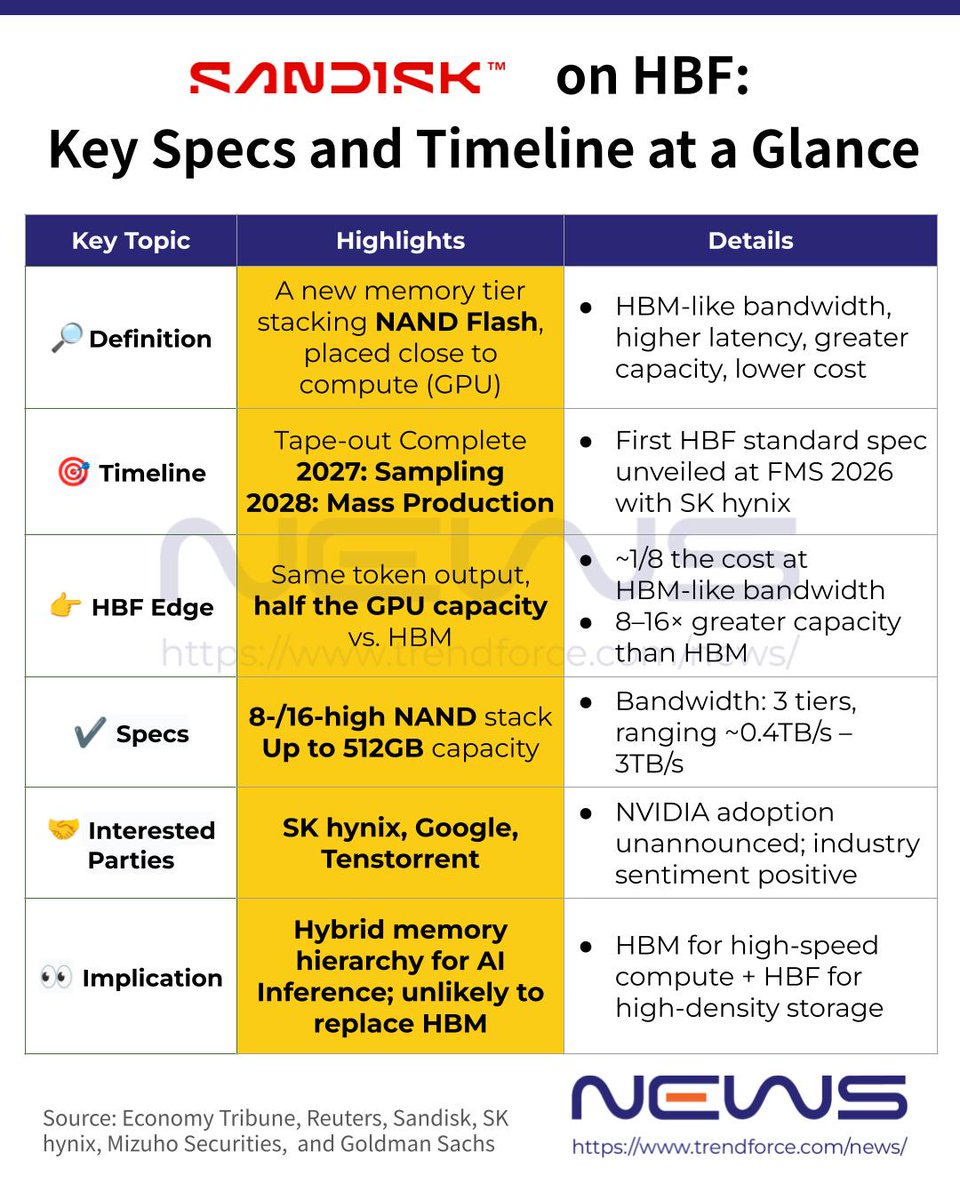
SK hynix and SanDisk have published the first High Bandwidth Flash (HBF) technical specification through the Open Compute Project, laying out an 8-die and 16-die NAND-based architecture with capacity up to 512GB and bandwidth grades from about 0.4TB/s to 3.0TB/s. The spec is aimed at AI inference systems that need more near-compute capacity than HBM alone can provide.
The event line dates back to August 2025, when the companies began their HBF standardization work, and to February 2026, when the consortium was formed. Search results also show Google and Tenstorrent joining as members; today’s X signal adds a new claim that Meta has joined as well, although that addition has not yet been confirmed in the primary materials we reviewed.
For investors, the relevance is ecosystem depth. More hyperscaler or accelerator participation would reinforce the market’s view that SNDK and SK hynix are trying to create a new memory tier for AI inference, but the public materials still describe a specification, not a shipping product, customer deployment or pricing framework.
SanDisk’s publicly discussed roadmap points to first HBF memory samples in the second half of 2026 and inference-device samples in early 2027. Until those milestones turn into product evidence, HBF remains an interoperability and standard-setting story rather than a commercialization story.
How this story unfolded
Company
LG and Nvidia eye a bipedal humanoid robot for Q1 2027
Fresh reports suggest the partnership is moving from broad physical-AI plans toward a visible hardware milestone.
LG is reportedly developing a new bipedal humanoid robot with Nvidia, built on the Isaac GR00T platform, with a public unveiling targeted for the first quarter of 2027. The reports frame the project as the latest step in the two companies’ expanding physical-AI collaboration.
The new chatter follows the June meeting in Seoul between LG Group Chairman Koo Kwang-mo and Nvidia CEO Jensen Huang, when the two sides discussed robotics, AI data centers and smart manufacturing. Since then, media reports say working-level talks have continued on investment size and development timing.
For investors, the storyline centers on LG Electronics, LG Innotek and LG CNS as potential beneficiaries if the robot effort becomes a commercial product, while Nvidia stands to broaden the reach of its robotics stack beyond chips into software and tools. The market will be watching whether this becomes a showcase for Nvidia’s Isaac GR00T ecosystem.
So far, however, the latest reports describe a target debut and ongoing collaboration rather than a finalized product launch. Neither company has separately confirmed detailed specifications or commercialization terms for the robot in the new reports.
Apple has formally opened an advanced manufacturing center in Houston and said the site is already shipping its first advanced AI servers. The company also said Mac mini manufacturing will begin there later this year.
The new milestone builds on Apple’s February announcement that it would expand its Houston campus to add Mac mini production and an advanced manufacturing training center. Apple previously said server production in Houston began in 2025 and was already ahead of schedule.
For investors, the news reinforces the AAPL narrative around US onshoring and the company’s supplier ecosystem, including the manufacturing partner operating the Houston site. Apple said the Houston operations will create thousands of jobs.
Apple has not disclosed a fresh, exact investment figure for the center in this latest step, but reports described the commitment as running into hundreds of millions of dollars. The company has separately said the Houston site’s AI server production started last year and the Mac mini line will launch this year.
How this story unfolded
2026-06-185 posts · 5 authors
Apple CEO Tim Cook announced price hikes on iPhones, Macs, and iPads due to a memory chip shortage, calling the increases unavoidable.
2026-06-2551 posts · 47 authors
Apple officially raised Mac and iPad prices, with specific increases announced, such as MacBook Air up $200 to $1,299.
Macro
U.S. retail sales fall 0.6% in July; control group drops 0.4%
July spending came in below forecasts, putting fresh pressure on third-quarter growth estimates and consumer-demand reads.
U.S. retail sales fell 0.6% month over month in July, according to the Commerce Department, missing the 0.1% increase economists had expected. The control-group measure, which feeds directly into GDP calculations, declined 0.4% after rising 0.4% in June.
The report matters because the control group strips out autos, gasoline, building materials and food services, making it a cleaner gauge of consumer spending embedded in GDP. July weakness was broad enough to include a 2.2% drop in nonstore retailers and declines in motor vehicle and parts dealers, gasoline stations and electronics stores.
For markets, the data can reshape near-term growth expectations and move retail-related names, especially e-commerce and discretionary-spending stocks such as Amazon. It also tends to feed same-day revisions to third-quarter GDP models, though that is a forecasting adjustment rather than a verdict on the broader economy.
Earlier reporting showed June retail sales rose 0.2%, helped by some categories tied to online and vehicle spending. July’s pullback suggests that support did not carry through the full month, adding a fresh data point for investors parsing consumer demand.
Japan’s Ministry of Finance said on Aug. 14 that in the week through Aug. 8, Japanese residents bought ¥1.6294 trillion of foreign bonds and ¥963.5 billion of foreign stocks. Over the same period, foreign investors sold ¥368.5 billion of Japanese stocks and ¥58.7 billion of Japanese bonds. mof.go.jp
The print extends the recent pattern of Japanese money moving abroad while foreign investors trim Japanese equities. Weekly flow data are noisy, but they are watched for clues on yen hedging demand, rate-differential trades and marginal foreign participation in Tokyo shares. newsquawk.com
MoneyDJ reported that the ¥963.5 billion purchase of foreign stocks was the second-highest this year, while the ¥1.6294 trillion foreign-bond buying was also among the year’s largest weekly prints. The same report said foreigners were net sellers of Japanese stocks for a second straight week. moneydj.com
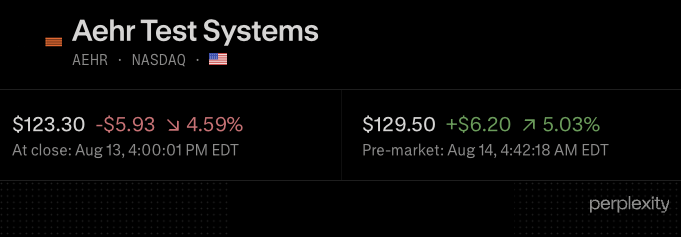
Jefferies has initiated coverage of Aehr Test Systems with a Buy rating and a $175 price target. According to the X signal, the firm called Aehr the only vendor qualified for both wafer-level and package-level burn-in in AI production.
The call matters because Aehr’s business mix has been shifting quickly toward AI and silicon photonics. On Aug. 4, the company announced a follow-on production order from its lead silicon photonics wafer-level burn-in customer, adding another concrete sign of manufacturing scale-up.
Shares traded higher in premarket activity as the new coverage reinforced the market’s AI burn-in narrative. The stock has already been moving on backlog growth, earnings guidance and repeated commentary that Aehr is transitioning away from its legacy SiC dependence.
For now, the new catalyst is the initiation itself rather than a fresh company announcement. Further upside or downside will likely hinge on whether the company can convert the AI and silicon photonics story into additional disclosed orders and revenue scale.
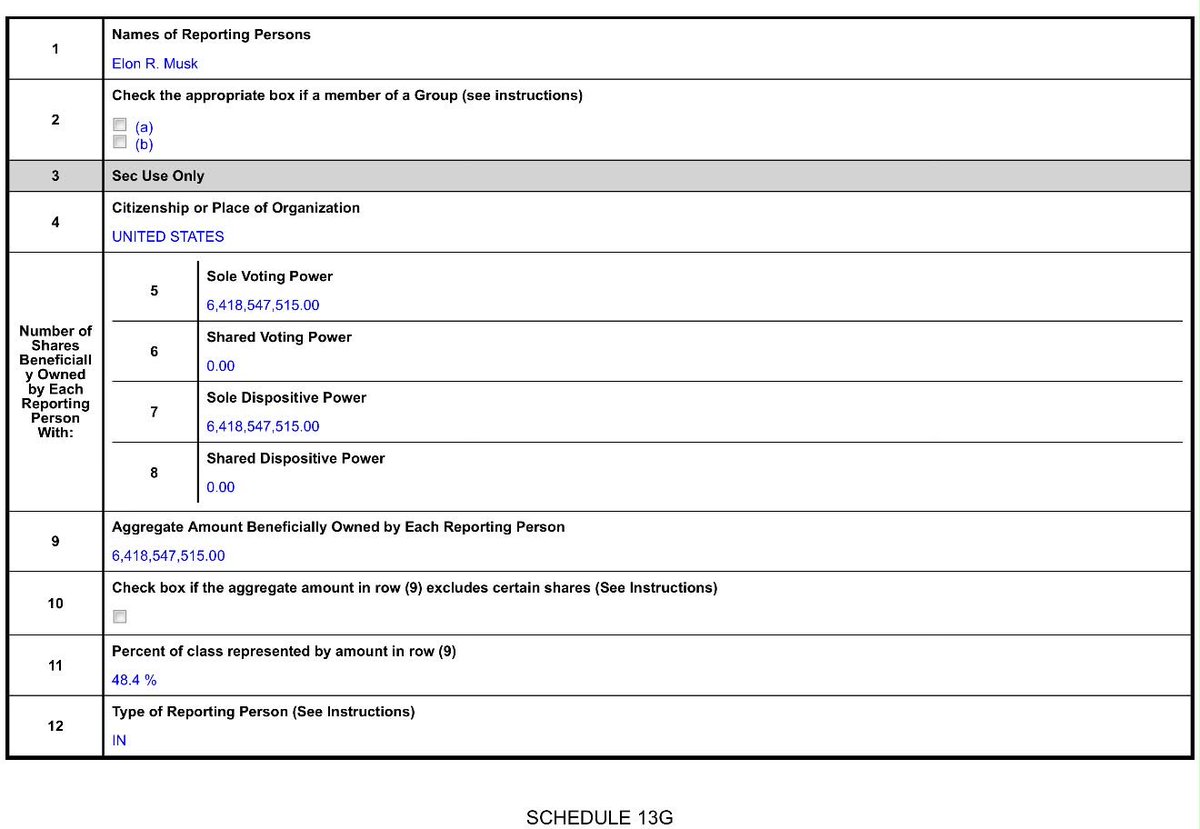
Elon Musk disclosed ownership of 6,418,547,515 SpaceX shares in a new SEC filing, equal to a 48.4% stake. The figure was amplified across market accounts on X as a new regulatory data point rather than an operating update from the company.
Ownership filings like this are closely watched because they update the market on control, concentration and implied valuation. Publicly available records have long shown Musk’s holdings routed through associated trusts and vehicles, with share counts changing over time as filings are updated.
For investors, the main relevance is to SpaceX’s trading narrative: capital structure, control and headline valuation remain central to how the stock is being discussed. Recent coverage in the past 48 hours has also focused on SpaceX’s price action and milestone chatter, underscoring how sensitive sentiment remains around the name.
No company response was included in the X signal. The key verified figures are 6.42 billion shares and a 48.4% stake, both tied to the new SEC disclosure.
How this story unfolded
2026-06-1534 posts · 27 authors
Musk says SpaceX could reach $1 trillion revenue by 2030, with Tesla and SpaceX having 7 major factory projects and over $200 billion in CapEx.
FTX's 5% stake in Cursor, sold for $200k in 2023 bankruptcy proceedings, is now worth over $3 billion; all Cursor founders became billionaires.
2026-07-0818 posts · 15 authors
SpaceXAI and Cursor plan to release their first jointly developed AI model as soon as Wednesday, expected to compete with Anthropic's Opus 4.8 and OpenAI's GPT-5.5 in some respects.
2026-08-0512 posts · 12 authors
SpaceX reported Q2 revenue of $7.8 billion, up 92% YoY and beating estimates; Starlink was the only profitable segment, while Space lost $542 million.
2026-08-134 posts · 4 authors
SpaceX stock rose 10% in a day, nearly 50% off its recent low; Morgan Stanley set a $300 price target; Grok 4.6 launched, performing close to GPT-5.6.
2026-08-149 posts · 9 authors
SpaceX officially closed its $60 billion acquisition of Cursor, issuing 389.3 million Class A shares at an implied price of ~$154.13, 14.2% above the IPO price.
J.P. Morgan raised global WFE growth forecasts, SPY holdings revealed Nvidia as top weight, and QuantumScape's solid-state battery tech was discussed for AI data centers.
2026-07-098 posts · 8 authors
Meta's plan to double AI compute to 14GW by 2027 and produce in-house Iris chips boosted semis, while Nvidia, Meta, Alphabet, and Microsoft lost $191 billion in market cap.
2026-07-106 posts · 5 authors
Goldman Sachs released supply/demand heatmaps for DRAM segments, and a leaked Meta memo confirmed 7GW in 2026 and 14GW in 2027 compute expansion with long-term supply agreements.
2026-07-313 posts · 3 authors
Amazon's Q2 earnings showed AI infrastructure demand remains supply-constrained with multi-year contracts, while Microsoft's results proved AI demand absorbs capex, driving a strong tech rebound.
2026-08-133 posts · 3 authors
A SanDisk executive said Meta will join the HBF consortium to co-develop open standards, and SanDisk has taped out its first high-bandwidth flash memory die.
2026-08-145 posts · 5 authors
Meta officially joined the HBF consortium as the first spec was released, and Mizuho noted HBF delivers HBM-like bandwidth at 1/8th to 1/10th the cost.
Microsoft followed Apple in announcing Xbox price hikes due to memory chip costs, while reports emerged of Apple shaking up its Mac chip strategy.
2026-07-3144 posts · 37 authors
Apple reported Q3 2026 earnings with revenue and EPS beating estimates on strong iPhone and Mac performance, though Greater China revenue missed expectations.
2026-08-123 posts · 3 authors
Apple said it would redesign app icons after user complaints about Tahoe Mac icons, alongside unrelated posts on retail and a gaming company.
2026-08-146 posts · 6 authors
Apple opened an advanced manufacturing center in Houston with hundreds of millions in investment, shipping first AI servers and planning Mac mini production this year.