Bloomberg reported that Nvidia has told some of its biggest customers that prices for servers containing its AI chips will rise by more than 15% in many cases. The increases are expected to apply to systems shipped early next year and will cover flagship platforms such as Vera Rubin and Grace Blackwell.
The move comes after a sharp run-up in memory costs across AI hardware. Industry estimates have shown that memory is taking up a much larger share of the bill of materials in Nvidia’s newest systems, making DRAM a central cost driver rather than a side component.
For the market, the pricing change matters because Nvidia’s largest buyers are the cloud companies and data-center operators building out AI capacity at scale, including Microsoft, Alphabet, Amazon and Oracle. Higher server prices can ripple through procurement budgets, vendor negotiations and delivery plans across the AI infrastructure chain.
Nvidia has not publicly confirmed the Bloomberg report yet. The reported price changes are for future shipments, not retroactive charges on already-delivered systems.
Alibaba said on August 23 that it plans to place new shares to non-U.S. investors outside the United States, aiming to raise about HK$80 billion. The company said the proceeds will be used entirely to strengthen its full-stack AI capabilities, including AI infrastructure, cloud computing and model development.
The placement comes after Alibaba’s latest quarter, when revenue rose 9% year over year, AI cloud and compute services revenue increased 45%, and net income fell 75%. Capital expenditure also jumped 75% to RMB67.678 billion, underscoring the scale of its AI spending push.
For investors, the issue matters because it adds dilution risk while signaling that Alibaba intends to keep funding AI expansion aggressively. The announcement will likely remain a key driver for Alibaba’s Hong Kong shares and U.S.-listed ADRs as the market weighs growth potential against the cost of the buildout.
Alibaba has repeatedly said AI demand is helping drive its cloud business, and its June-quarter results showed triple-digit growth in AI-related product revenue for a twelfth consecutive quarter. This placement extends that strategy by giving the company more capital to expand compute capacity, models and AI applications.
US spot Bitcoin ETFs pulled in about $507 million on Thursday, the biggest daily intake since early May, according to SoSoValue-based reports. BlackRock’s IBIT led the session with roughly $285 million, or 56% of the total, underscoring how concentrated the bid remains in the largest fund.
On a weekly basis, Bitcoin ETFs drew about $1.92 billion, the strongest week since October 2025. The move came alongside a broader crypto rally, a US Treasury decision to expand longer-dated bond buybacks, and renewed attention on US crypto regulation.
The flow surge matters most for the major issuers and market-makers tied to BTC products, especially IBIT and other spot Bitcoin funds. Ether ETFs also saw strong demand during the same stretch, suggesting institutional money is spreading across digital-asset vehicles rather than staying in one product.
There is some reporting variance on the week’s total, with different outlets citing a lower figure when using different cutoffs or asset baskets. The common thread across the reports is the sharp acceleration in ETF demand after a quieter stretch earlier in August.
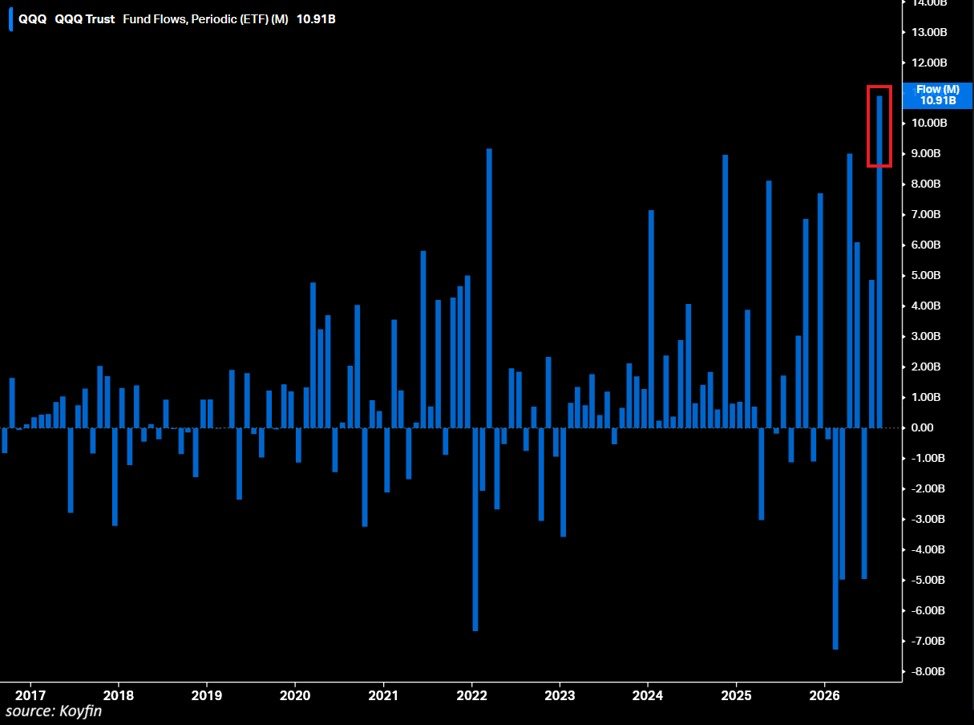
New market data show the Invesco QQQ Trust (QQQ) has taken in $10.9 billion so far in August, putting it close to a monthly record. Multiple ETF flow trackers have identified QQQ as one of the month’s biggest asset gatherers in U.S. equities.
The latest figure builds on already strong weekly creations. ETF Channel said QQQ’s shares outstanding rose by roughly 2.95 million in the week ending Aug. 11, implying about $2.1 billion of net inflows, while ETF Central put QQQ’s weekly inflow at about $3.0 billion for the week ending Aug. 14.
The continued buying underscores persistent demand for Nasdaq-100 exposure and its heavy tilt toward megacap growth stocks. Because QQQ is market-cap weighted, new creations generally increase underlying demand for names such as Microsoft, Nvidia and Apple.
By comparison, reports on spot bitcoin ETFs put August inflows at about $1.92 billion, still well below QQQ’s single-fund haul. That gap suggests traditional large-cap tech exposure remains a dominant destination for investor capital even amid strong interest in crypto products.
How this story unfolded
2026-06-275 posts · 5 authors
SpaceX officially announced its inclusion in the Nasdaq-100 index effective July 7.
Company🔥Developing
Micron says 16 customer deals back $22 billion in commitments as supply stays tight
The company says demand keeps outrunning supply, and it is adding more strategic agreements to deepen visibility into revenue.
Micron Technology said at a recent forum that it still sees no clear point at which supply catches demand, while customer demand signals have strengthened since its last earnings report. The company added that data-center demand for DRAM remains especially strong and that it cannot fully meet requests from customers.
The new incremental detail is the scale and structure of Micron’s customer lock-ins. Micron had previously disclosed 16 Strategic Customer Agreements with $22 billion of cash and cash-like commitments, including $18 billion in cash, and said it has signed additional agreements since then.
For investors, that keeps the thesis centered on Micron’s own pricing power, revenue visibility and the persistence of tight memory supply. MU remains the key stock here, while the read-through also matters for DRAM/HBM supply-chain names and data-center hardware exposure.
Micron said most of the covered revenue is tied to five-year take-or-pay contracts with no customer outs, and some deals use floating pricing or price bands. The company’s message is that AI-related demand is being converted into longer-dated supply commitments rather than a near-term normalization in the market.
How this story unfolded
2026-06-2566 posts · 47 authors
Micron announced 16 five-year supply agreements, HBM4 ramp running twice as fast as HBM3E, with cumulative minimum revenue of ~$100B.
Markets
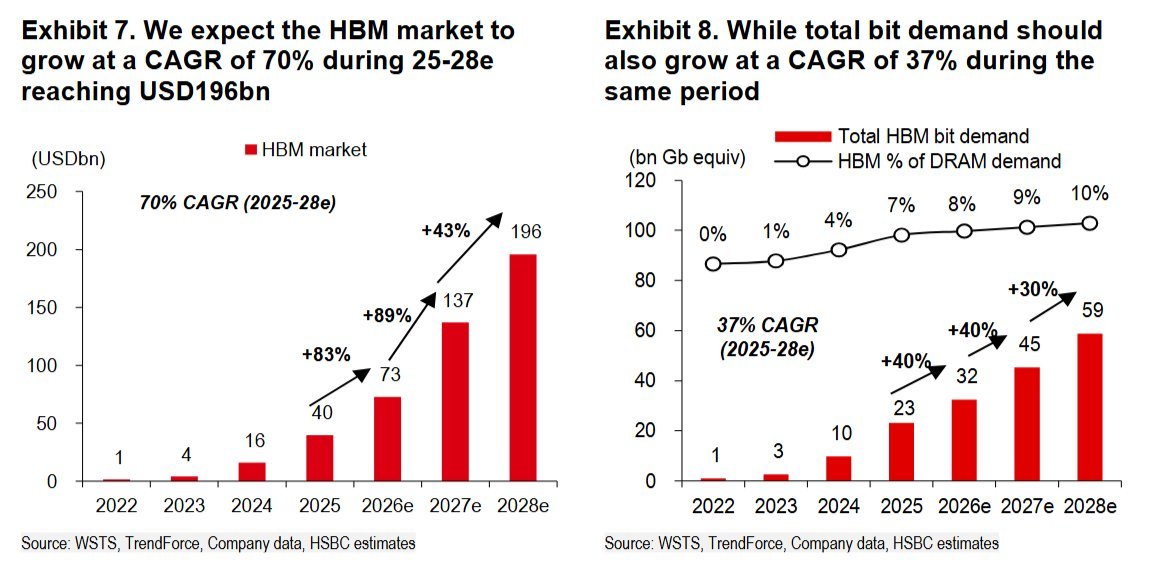
HSBC sees HBM reaching $196bn by 2028 from $40bn in 2025
Recent calls from Goldman Sachs, JPMorgan and Chinese media point to a tight HBM supply backdrop as AI capex keeps reshaping the memory market.
X signals cited HSBC as projecting the HBM market to expand from $40 billion in 2025 to $196 billion by 2028, implying roughly 70% CAGR from 2025 to 2028. The original report was not available in full in the materials we could verify, so this remains a quoted market estimate rather than a fully sourced disclosure.
The HSBC numbers line up with a broader wave of bullish research. Goldman Sachs said memory price increases could run through mid-2027, albeit at a slower pace, while JPMorgan argued HBM shortages may persist through 2027 and possibly into 2028. sina.com.cn moomoo.com
For the market, the implication is continued differentiation across memory names: HBM suppliers and packaging-linked players stand to benefit more than commodity DRAM and NAND producers. A Shanghai Securities News report said AI compute demand is still drawing away advanced capacity, keeping HBM supply tight and lifting product pricing across the chain. paper.cnstock.com
Recent trading has also reflected that view, with memory-related stocks rallying around Aug. 13 as investors leaned further into the AI-memory cycle trade. If HSBC's estimate is accurate, the debate is shifting from whether HBM is a growth story to how long the supply constraint can support pricing.
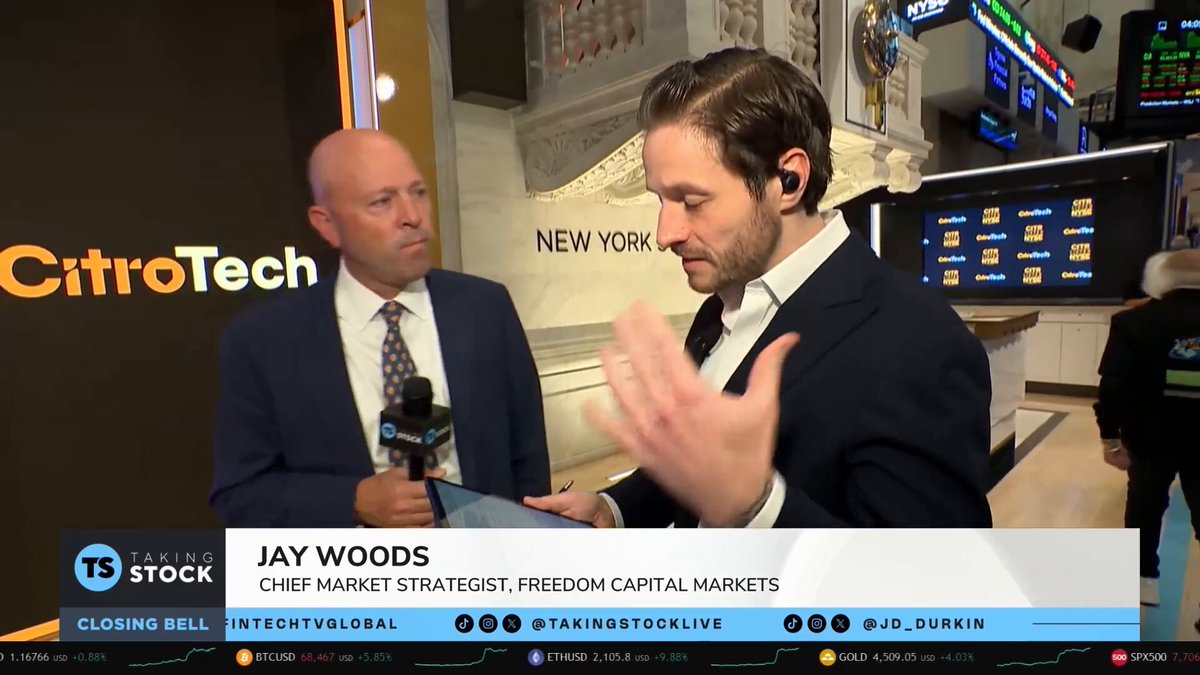
Nvidia will report fiscal Q2 results after the close on Aug. 26, and traders are treating the event as one of the week’s most important market catalysts. On X, Freedom Capital Markets’ Jay Woods said he expects the company to beat again and sees room for the stock to run toward $240 from around $216.
The attention reflects Nvidia’s role as the flagship of the AI trade, not just a single semiconductor name. Reuters noted last month that the company briefly became the first public company to top $4 trillion in market value, underscoring how closely its results now track broader tech sentiment.
The key debate heading into the print is guidance and the durability of data-center demand. A 24/7 Wall St. report citing company guidance said Nvidia’s data-center revenue grew 92% to $75.2 billion last quarter, while management guided for about $91 billion in revenue for the next quarter, excluding data-center compute revenue from China.
A strong report would keep Nvidia, AMD and Broadcom at the center of investor comparisons, while also feeding into the AI spending narrative around Microsoft, Meta, Alphabet and Amazon. With expectations already elevated, any disappointment in guidance or margin trends could translate into outsized moves across the chip and megacap tech complex.
Elon Musk has said the AI bottleneck is moving from chips to electricity. The X signal links that view directly to Tesla’s Cybercab and Optimus plans, arguing that millions of autonomous vehicles and robots would drive persistent inference demand.
The comment extends Musk’s recent public remarks about AI infrastructure. In prior coverage, he said memory chip output was growing about 20% a year while demand was rising around 200%, a buyer-side estimate rather than an independent industry measure; his broader point was that power, cooling and electrical equipment are becoming the binding constraints.
For investors, the message broadens the Tesla debate beyond EV deliveries. If Tesla’s autonomy and robotics rollout accelerates, capital spending on compute, power and grid-related infrastructure could matter as much as vehicle unit growth in how the market prices the story.
Separately, Tesla is also dealing with a nearly 3 million-vehicle recall in China tied to door-handle issues, keeping both the core auto business and the AI narrative in focus. Tesla has not issued a new standalone response to the power-bottleneck comment in the X signal.
How this story unfolded
2026-06-305 posts · 5 authors
Tesla VP teased July 7 Giga Texas news; Agility Robotics announced SPAC merger.
Company
Amazon lifts Echo and Fire TV prices by 60% as memory costs climb
Fortune said the company raised prices across several devices, showing AI-driven memory inflation is now reaching consumer hardware.
Amazon raised prices overnight on several first-party devices, including Echo, Fire TV, Kindle and eero. Fortune reported the company moved to offset “significant increases” in memory costs, and follow-up coverage said the cheapest Echo Dot rose 60%.
The move comes as AI-related demand keeps pressure on DRAM, NAND and other memory components used across data centers and consumer electronics. According to the reporting, Amazon said it had absorbed the higher costs for as long as it could before passing some of them on.
For investors, the key point is margin pressure across hardware lines. AMZN is both a major buyer of memory for its own devices and a large spender on AI infrastructure, so tighter component supply can hit both sides of the business.
Ring products were not included in the price changes cited by the reports. Separate coverage also noted Amazon’s 2026 capital spending plans were lifted to $220 billion, underscoring how the company is being squeezed by the same supply chain it helps create.
Bitcoin has moved back above the short-term holder cost basis, according to traders posting on X, who say the market has reclaimed the $67.4K level and is now trading in the mid-$70Ks. For them, that shift matters because it suggests the latest rebound is being defended by buyers rather than just a brief squeeze.
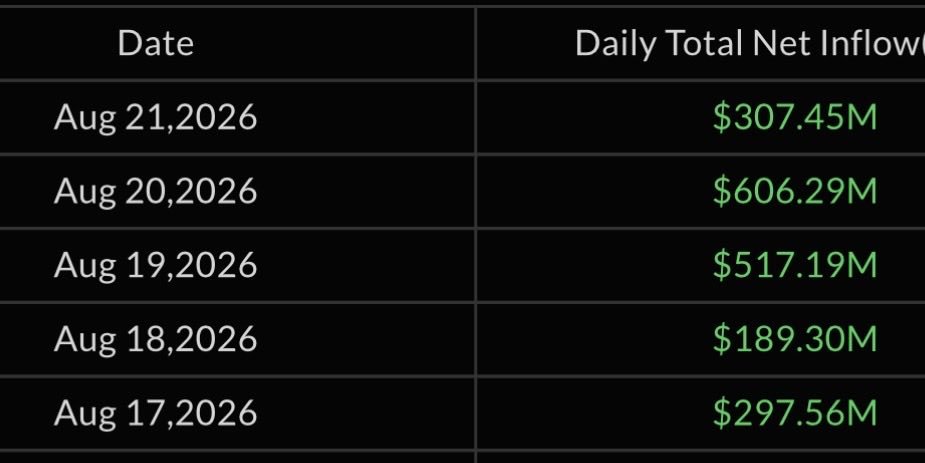
The backdrop includes a stronger bid from U.S. spot Bitcoin ETFs and a macro tailwind from Treasury’s expanded long-dated bond buyback plan. Decrypt reported roughly $517 million of net inflows on Aug. 19 and about $606 million on Aug. 20, while Treasury’s move was framed by analysts as a liquidity-positive development.
For now, traders are focused on the $80K-$83K band as the next resistance zone to clear. A continued grind higher would likely keep ETF-linked sentiment, crypto exchange shares, and other risk assets in focus, especially if short covering persists alongside cash buying.
Talk on social media has also centered on whether the U.S. could one day buy bitcoin for a reserve, but that remains speculation rather than confirmed policy. The immediate market narrative is still being driven by spot demand, Treasury liquidity signals and forced short liquidation.
How this story unfolded
Markets🔥Developing
Eric Trump denies new TRUMP coin rumor after $TRUMP jumps 33%
The latest denial cools speculation around a new Trump-family token, while keeping focus on the existing $TRUMP trade.
Eric Trump on August 23 rejected market chatter about a new Trump meme coin or token, calling the claims false and saying that nobody is launching any kind of coin. Multiple X posts circulating today carried the same denial.
The denial lands against a familiar backdrop. Trump-family-linked crypto projects have repeatedly faced rumors, with Truth Social previously denying a memecoin launch and Eric Trump earlier distancing the family from an “official TRUMP wallet” announcement.
The immediate market impact showed up in the existing $TRUMP token, which was said to have gained more than 33% on speculation tied to a new Trump-family token on Robinhood Chain before the denial hit.
For traders, the key issue remains whether any Trump-branded crypto initiative has official backing. When that question is left unresolved, $TRUMP tends to be the first asset to move on rumor and the first to give back gains on denial.
How this story unfolded
2026-06-2426 posts · 20 authors
A poll showed most Americans deemed the Iran war not worth it, Trump's approval hit a second-term low, and he announced Iran agreed to keep the Strait of Hormuz open with no tolls.
Markets
Trump team moves 2.62 million TRUMP to OKX, about $6.21 million
The latest on-chain transfer is the first in four weeks, extending a pattern of large token movements into exchange custody.
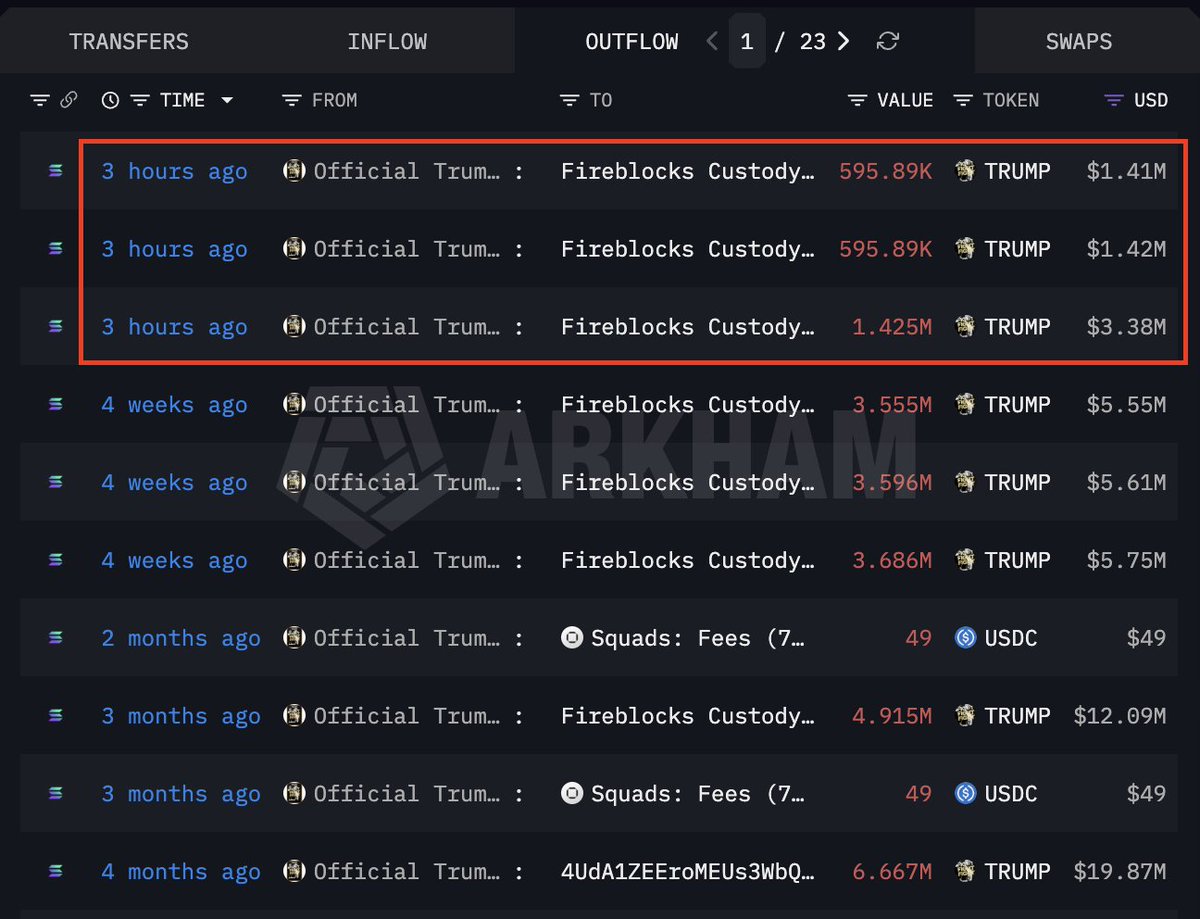
On-chain monitors said the Trump team moved 2.62 million TRUMP, worth about $6.21 million, to OKX three hours ago. Lookonchain later tracked the same 2.62 million TRUMP leaving a team-linked wallet and ending up at the exchange. It was the first visible transfer in four weeks.
The token has seen repeated large outbound moves from team-controlled wallets into custody or exchange addresses. Reuters reported in July that a team wallet sent 7 million TRUMP worth about $17.22 million to BitGo in May, while Gate News said the team had moved 48.25 million TRUMP worth about $172.4 million over five months.
Because TRUMP is a politically linked meme token, exchange inflows are closely watched for clues on supply, liquidity and trading activity. There is no public statement indicating that this latest transfer was an official sale, but such moves often draw fresh attention in spot and derivatives trading.
For now, traders are focused on whether more team-held tokens will follow the same route into exchange custody. No response from the Trump team was available at the time of reporting.
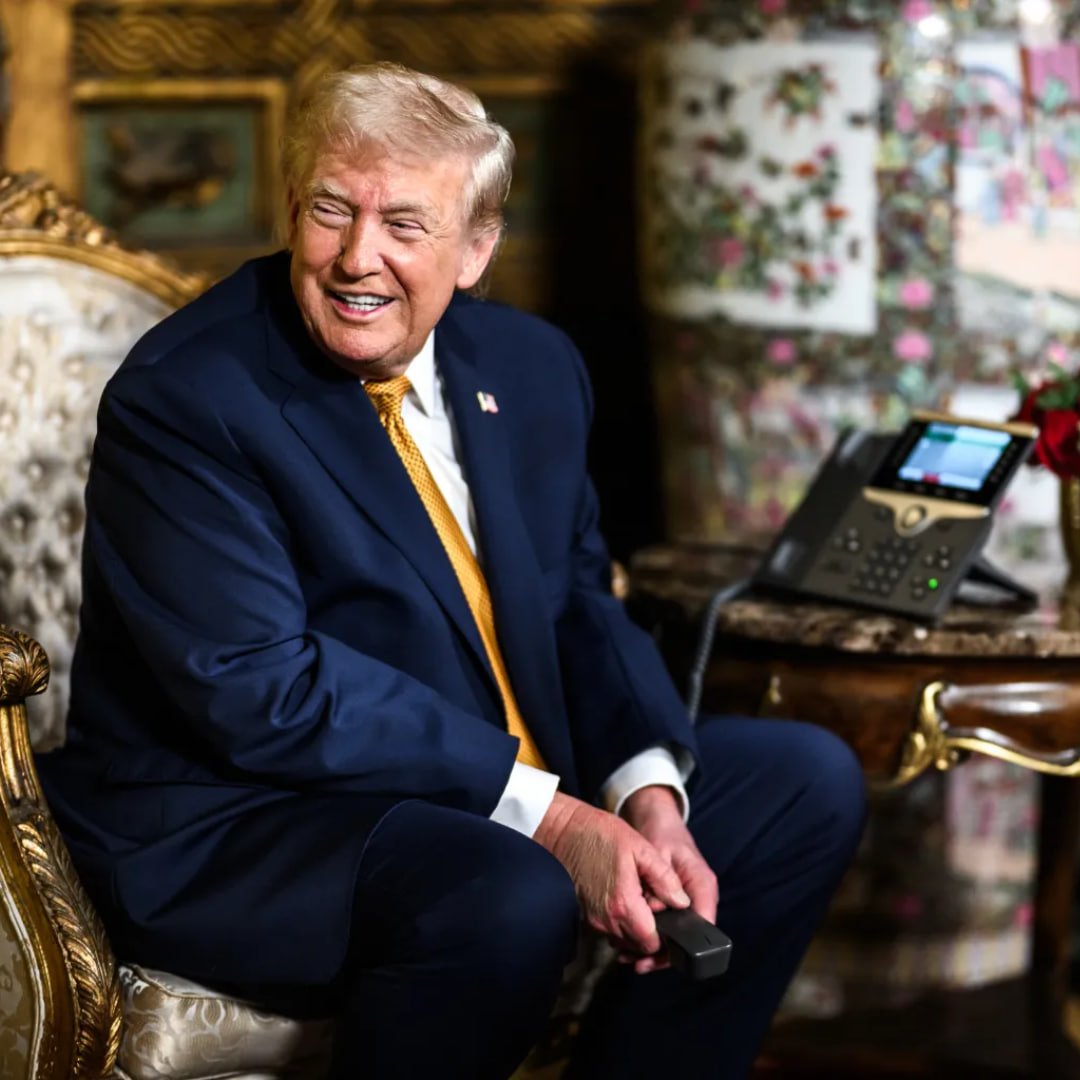
President Donald Trump disclosed 1,051 securities trades in June, with the transaction ranges adding up to as much as $263 million, according to new government filings released on August 22. The filing has been picked up by multiple outlets and trading trackers that parsed the report.
The latest batch extends a pattern of unusually active trading earlier this year. CBS News previously counted 3,642 transactions in the first quarter, while Open Cabinet’s filing tracker says Trump’s reported transactions through June 29 reached 8,940 across large late-filed batches.
The June activity included purchases of Berkshire Hathaway, Visa, Mastercard and Cintas, keeping attention on names that can be sensitive to consumer spending, financial conditions and portfolio rebalancing. Bloomberg had already described Trump’s trading volume as extraordinary, and the new filing adds another large disclosure to that record.
The Trump Organization says the accounts are run by independent third-party managers and that Trump does not direct individual trades. Under federal rules, officials must report securities transactions above $1,000 within 45 days.
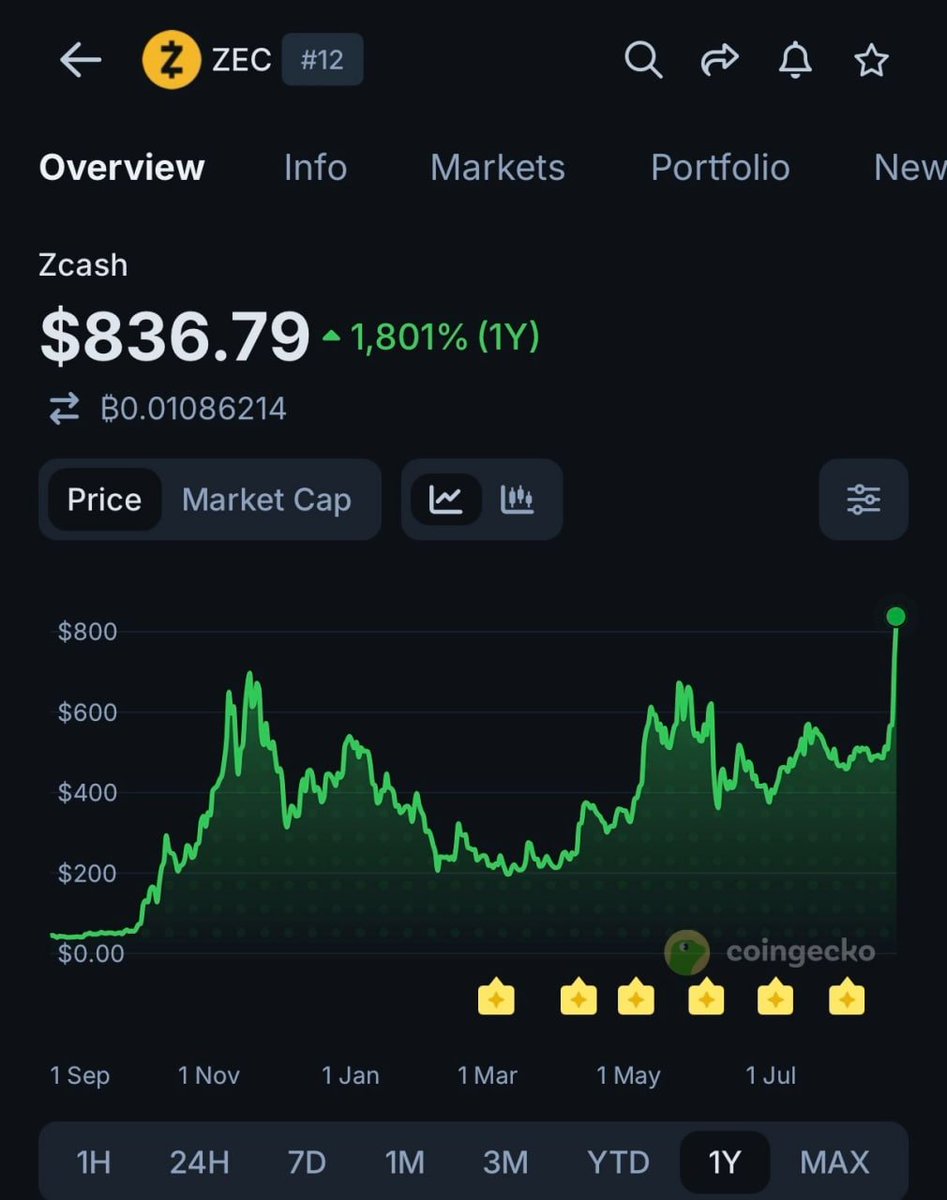
Zcash (ZEC) climbed above $836 on Saturday, marking an eight-year high. Multiple posts on X cited Grayscale’s latest filing as the latest catalyst behind the move.
The immediate backdrop was Grayscale’s fourth amendment filed on Aug. 18 to convert its Zcash Trust into a spot ETF on NYSE Arca under the ticker ZCSH. CoinDesk reported that the filing is still subject to SEC review and does not mean approval has been granted.
CoinDesk also said ZEC futures volume reached about $4.55 billion on Friday, far above roughly $553 million in spot trading, with open interest near $1.35 billion. That gap suggests leveraged positioning played a major role in the rally, which also lifted ZEC’s market value to about $13.87 billion.
The token’s earlier June drawdown followed the discovery of a vulnerability in the Orchard shielded pool, according to CoinDesk. For now, the move reflects ETF speculation, sentiment and derivatives activity rather than any confirmed regulatory decision.
Coinbase CEO Brian Armstrong said on X on Aug. 21 that most G20 countries already have, or are building, crypto trading frameworks, while the United States remains an outlier. He urged the Senate to move the CLARITY Act forward on Sept. 15, a date that has now become the market’s focal point.
The backdrop is a scheduled cloture vote in the Senate, which would require 60 votes to end debate and move the bill toward a floor vote. The legislation, passed by the House in July, is designed to split oversight between the SEC and the CFTC.
For Coinbase, clearer rules could reduce the compliance gray zone that has shaped U.S. digital-asset trading. The stock reaction is tied to whether investors see a path toward more durable crypto-market rules, rather than to any immediate operating change.
Armstrong did not claim passage is guaranteed; instead, he argued that the U.S. should not remain behind peers that have already set crypto rules. The next key milestone is the Senate procedural vote on Sept. 15, followed by further legislative steps if cloture succeeds.
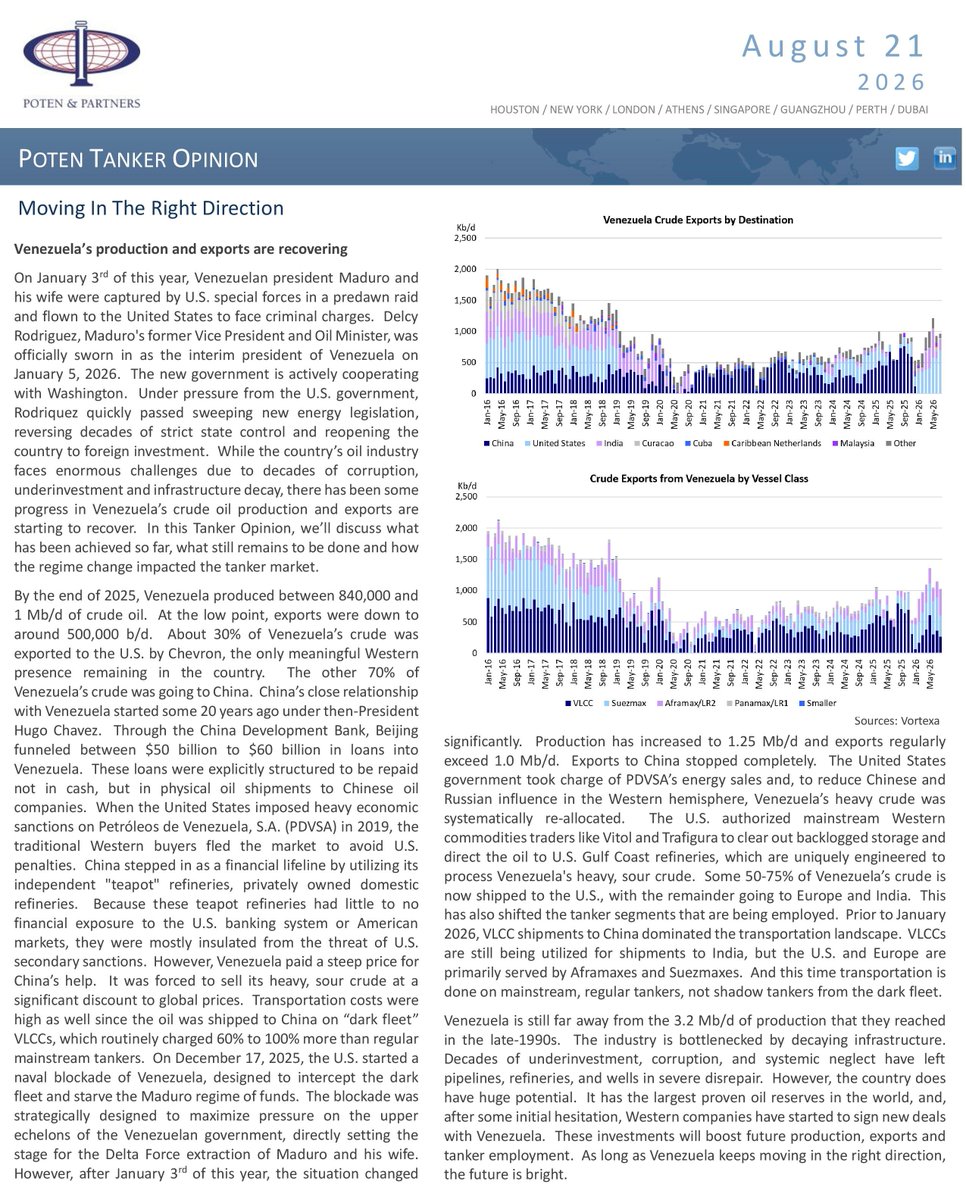
A senior U.S. energy official said in Houston that Venezuela is now producing about 1.25 million barrels per day, with more than 500,000 barrels per day — roughly half of output — flowing to U.S. refineries. He said those plants were built specifically to run Venezuelan crude.
The remarks point to a sharp normalization in Venezuela’s oil trade after years of sanctions-driven disruption that had pushed exports toward Asia. Industry coverage also cites a Venezuelan official projecting output of 1.245 million barrels per day by the end of August and export growth close to 20% this year.
For U.S. refiners with heavy-crude processing capacity, the trade mix matters because Venezuelan barrels are a close fit for their units. Investors often watch Valero, Marathon Petroleum, Phillips 66 and HF Sinclair for any implications for feedstock sourcing and refinery margins.
Bloomberg also reported that BP has joined the Venezuelan oil trade, underscoring that more foreign traders are re-entering the market. The figures currently rest on official comments and trade reporting rather than a full company-by-company disclosure of flows.
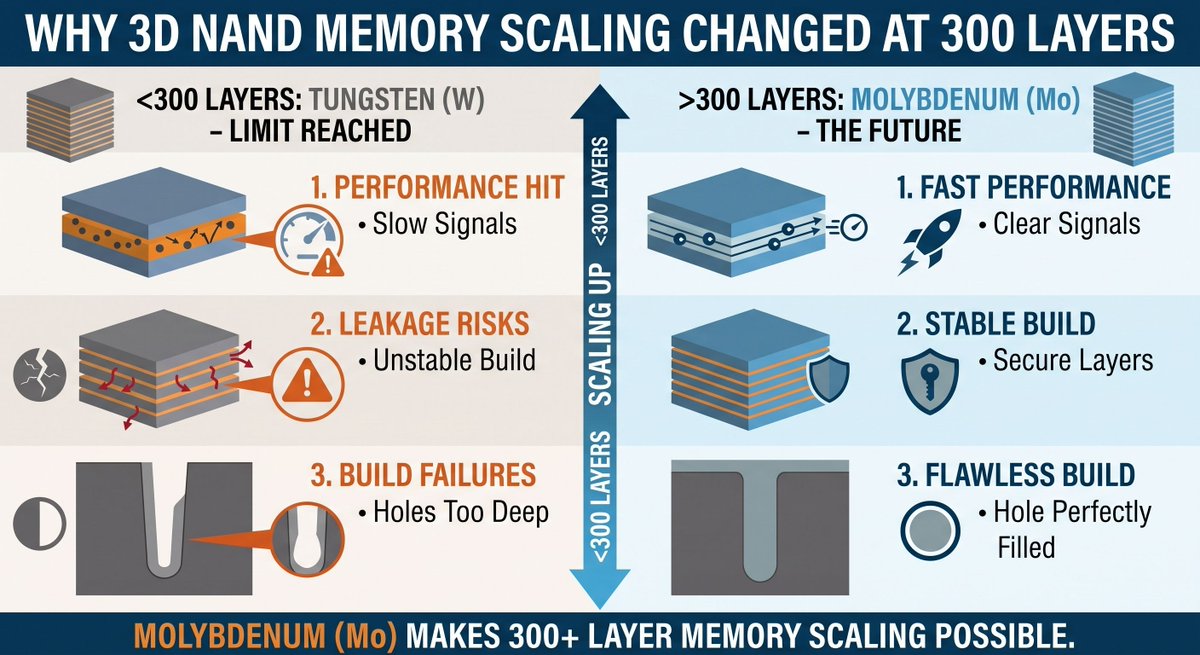
Reports indicate SK hynix has completed production validation for its 375-layer 3D NAND and is preparing to move the technology into mass production. A key process change is the partial replacement of tungsten with molybdenum in word-line metal structures.
The shift matters because 3D NAND no longer scales by shrinking laterally; it scales by stacking. Once layer counts move above roughly 300, tungsten word lines run into higher resistance and barrier-layer constraints, and Samsung had already introduced molybdenum in its 286-layer NAND generation.
For the market, the immediate impact is more about rising attention than a sudden demand shock. Copper miners such as Freeport-McMoRan and Southern Copper are being watched because molybdenum is often recovered as a by-product of copper operations, but there has been no company disclosure tying this directly to a near-term earnings step-up.
At this stage, the main questions are whether the process can scale smoothly, how quickly suppliers can qualify materials, and how widely molybdenum spreads across next-generation NAND nodes. The trend is real, but the commercial ramp is still early.
Keyrock, as cited by multiple outlets, said AI agents executed about 176 million on-chain transactions from May 2025 through April 2026, settling roughly $73 million. The same reporting said 98.6% of machine-payment value settled in USDC, underscoring stablecoins’ dominance in this early market.
The backdrop is the rise of autonomous software that can buy data, compute and digital services without a human clicking through each step. Those workflows are heavily skewed toward tiny, frequent payments, where card rails struggle on fees and settlement speed.
For markets, the data keeps USDC and Circle at the center of the AI payments narrative, while Coinbase, Stripe and Visa continue building adjacent infrastructure. Any sustained growth in machine-to-machine spending would also benefit wallet, compliance and payment-rail providers.
Still, the reported volumes remain small relative to conventional card networks, and legal questions around authorization and liability are unresolved. The takeaway is infrastructure momentum, not a wholesale replacement of today’s payment stack.
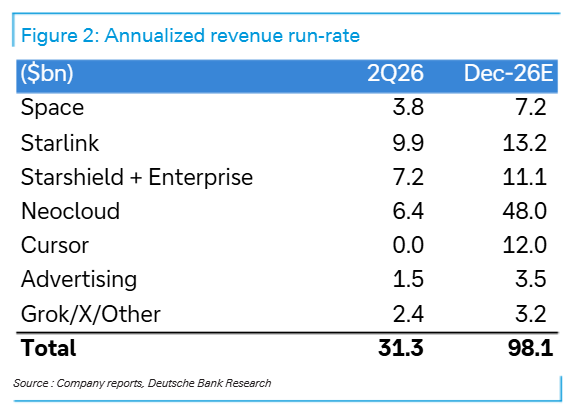
Deutsche Bank maps SpaceX to $100B ARR, with $48B in neocloud
A fresh breakdown circulating on X puts AI infrastructure at the center of SpaceX’s year-end revenue math and keeps investors focused on capex and valuation.
A set of posts circulating on X today says Deutsche Bank sees SpaceX ($SPCX) heading toward $100 billion in annualized recurring revenue by year-end, with roughly $48 billion coming from neocloud, $13 billion from Starlink and about $12 billion from Cursor. The posts are drawing attention because they frame the company’s growth story around AI infrastructure rather than launch services alone.
The backdrop is SpaceX’s second-quarter earnings, which showed revenue of $7.81 billion versus $6.93 billion expected by analysts. Multiple reports also said management discussed a path to the $100 billion ARR mark on the call, helped by existing contracts, including $1.6 billion of second-quarter neocloud revenue, all from Anthropic.
For the market, the key question is how much more capital SpaceX must deploy to sustain that ramp. Reports say second-quarter capex reached $15.8 billion, with AI spend taking a large share, so investors are likely to keep watching SpaceX’s financing needs and the knock-on implications for compute suppliers such as Nvidia.
The figures in today’s X chatter are being used as a bank-style breakdown rather than an official company filing. That means the useful signal is the scale of the AI-driven revenue mix, not a fresh corporate announcement of a revised target.
How this story unfolded
2026-07-075 posts · 5 authors
Company
APA, BP and peers in UK asset exits, with $20bn-plus portfolios and 4.7% payouts in focus
X is reviving debate over how large energy groups manage UK oil and gas exits, shareholder returns and dividend discipline.
A fresh X thread singled out APA, BP, INEOS and Harbour Energy, framing the discussion around how the group handled UK exposure. Based on recent published coverage, the common thread is asset sales, portfolio reshaping and capital returns rather than one new corporate event.
In the background, BP confirmed in mid-August that it was marketing its North Sea assets. Investors’ Chronicle said BP produced 117,000 barrels of oil equivalent per day in the region last year, versus 2.3 million boepd groupwide, while Harbour Energy was reported to be targeting $800 million of shareholder returns in 2026.
For the market, the story matters because these names sit at the intersection of cash generation and payout policy. APA said it operates a portfolio worth more than A$20 billion, while BP’s current dividend yield was cited at 4.7% and Harbour’s 2026 return plan was described as equivalent to roughly 15% of market cap.
No company rebuttal was identified in the sources reviewed, so the signal reads as a renewed focus on UK energy portfolio discipline and income returns, not a fresh confirmed corporate announcement.
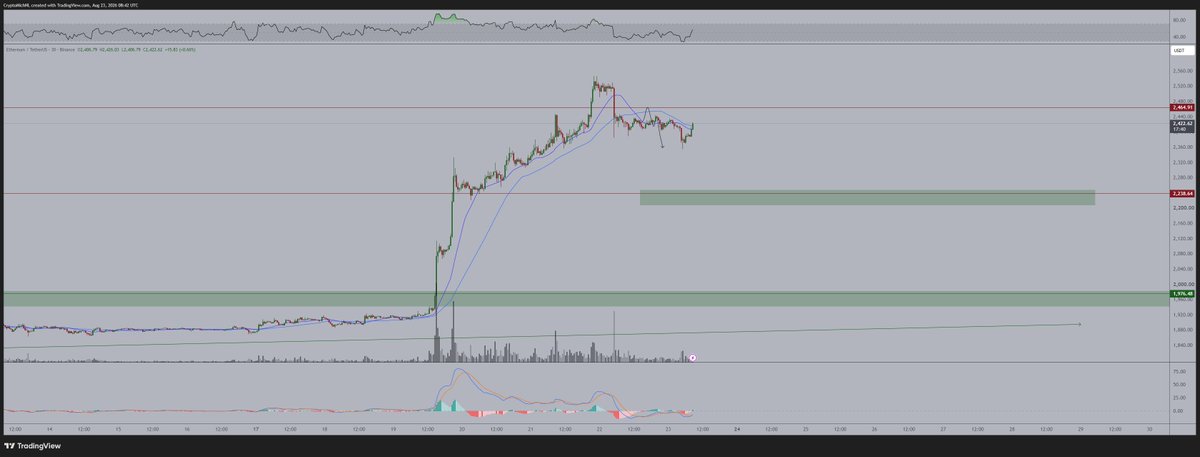
X chatter centers on ETH’s key technical levels after a fresh move back above the line, with macro liquidity and Clarity Act hopes still framing the tape.
Ether moved back above the $2,400 area on Aug. 21, and traders on X quickly shifted to debating whether the next stop could be $2,450, then $3,000 and beyond. Several posts framed the move as a possible base for another advance if support holds, while others said the earlier drop under $1,550 looked like a bear trap that has now been reversed.
The backdrop remains the same recent burst in crypto sentiment: Treasury buyback expansion and renewed White House support for the Clarity Act helped drive a sharp ETH rally on Aug. 19-20. Multiple outlets reported ETH gains of roughly 17% to 18% in a single session, alongside about $1.1 billion to $1.14 billion in short liquidations, underscoring how leveraged positioning amplified the move.fxleaders.com
For markets, a stronger ETH usually feeds sentiment across crypto-linked names such as Coinbase, Robinhood and Strategy, but the X signal itself is about traders repricing technical levels rather than a fresh policy decision. The key issue is whether follow-through buying can survive once the initial squeeze fades, because the Clarity Act still needs to move through Congress.mudrex.com
How this story unfolded
2026-07-163 posts · 3 authors
KOLs highlighted Larry Fink's bullish remarks and BlackRock's crypto plans, with Joe Lubin hinting at insider bullish alpha.
Markets
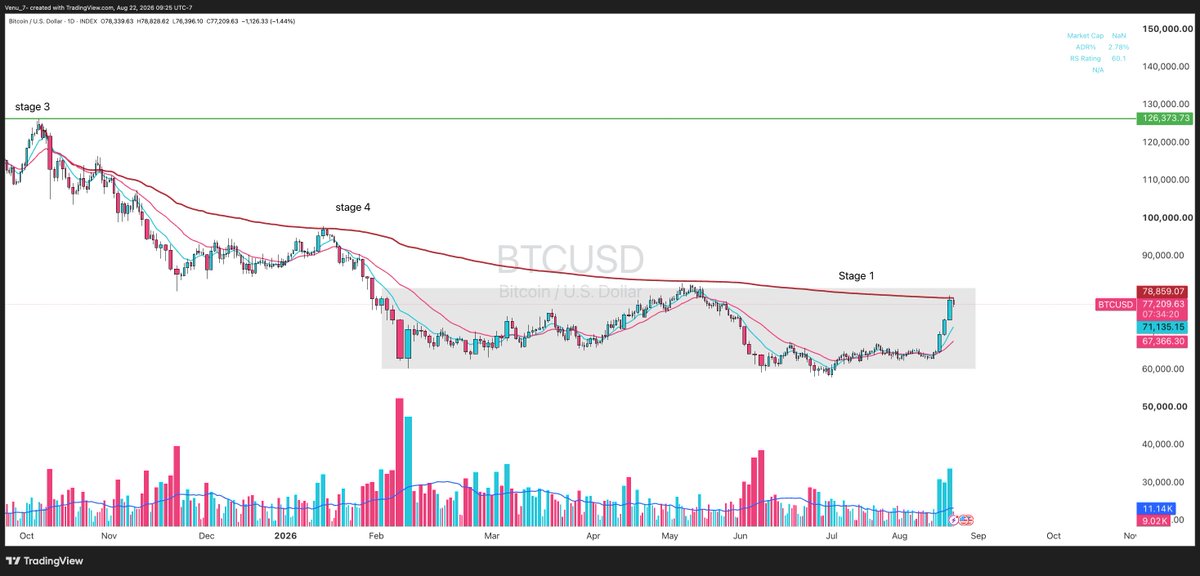
Bitcoin reclaims its 30-week SMA as HOOD and CRCL volumes jump 2x
An X-thread says Bitcoin has moved back into Stage 1, with heavier trading over the past three days putting crypto-linked names back in focus.
The new information today comes from an X signal arguing that Bitcoin has completed its Stage 4 drawdown and reclaimed the 30-week moving average. The post says ATH VWAP may cap the move near term, but notes that volume has run at roughly 2x normal for the past three days and that the 200-day has been reclaimed.
This is primarily a technical read rather than a fresh fundamental catalyst. As context, crypto-linked equities have already been seeing heavier activity: Circle was reported on August 23 as trading on unusually strong volume, and the company’s August 5 second-quarter update showed USDC transaction volume up 151% year over year, while revenue rose 7%.
The names most likely to trade off that backdrop are Coinbase, Circle and Robinhood, with HOOD explicitly mentioned in the signal and CRCL benefiting from renewed attention around stablecoins and crypto payments. In that sense, the X post points to a risk-on setup for the group, not to a company-specific announcement.
No company denial or fresh formal disclosure appears to change the technical interpretation in the signal. For now, this reads as a market-structure update centered on price action and volume rather than a new corporate development.
Walmart is launching Scenario, a new women’s apparel, bags and accessories brand, with most items priced below $25. The move was first reported by the Wall Street Journal and marks another bid by the retailer to win younger, trend-conscious customers.
The launch comes just days after Walmart reported U.S. comparable sales growth of 2.6% for the quarter ended July 31, its slowest pace in years. Management said it received nearly $2.9 billion in tariff refunds and has been using part of that windfall to fund price cuts.
Investors have been watching whether Walmart’s value strategy can keep driving traffic even as growth moderates in key categories. Shares fell about 9% after the earnings release, reflecting concerns over the company’s softer sales outlook and the durability of its margin mix.
Walmart has said it executed more than 11,000 rollbacks in the quarter and continues to lean on digital, marketplace and delivery growth. Scenario appears to extend that playbook into fashion, where price and trend positioning are critical to gaining share.
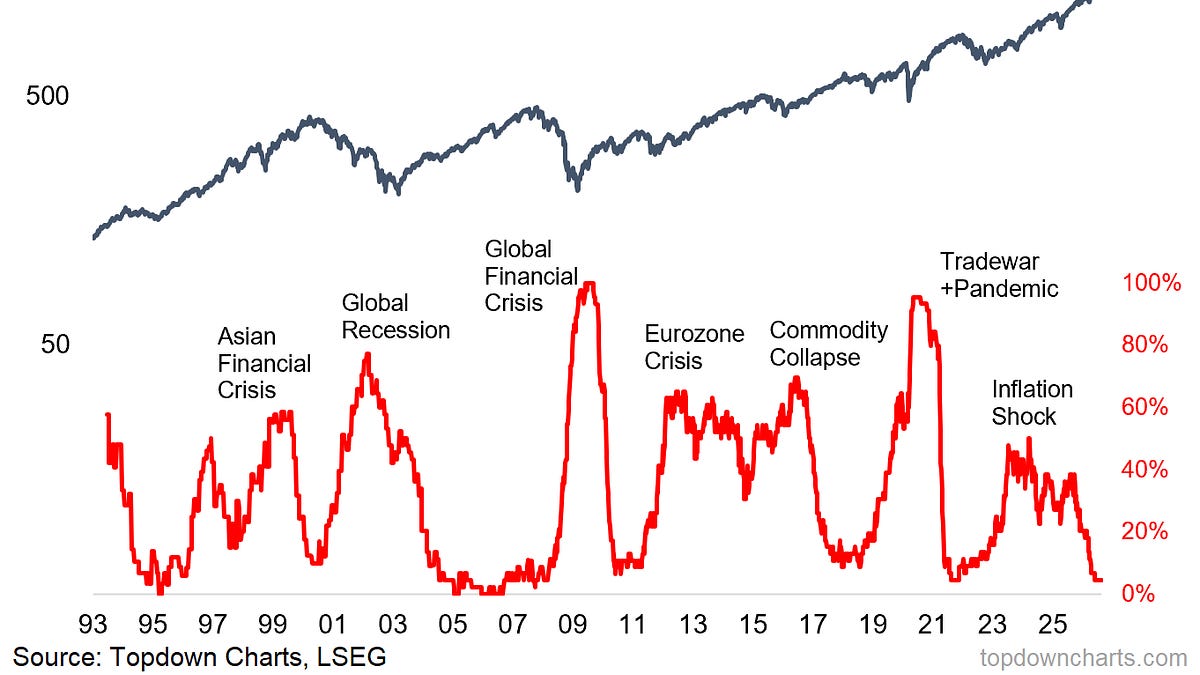
Callum Thomas released a new Weekly S&P 500 ChartStorm on Aug. 23, with this edition centered on the global earnings pulse, tech-sector sentiment signals, positioning, valuations, the contrarian corner, volatility technicals and gold versus bonds. chartstorm.info
The weekly charts are widely used by market watchers to monitor breadth, earnings revisions and positioning changes in U.S. equities. In his earlier Aug. 16 and Aug. 9 updates, Thomas said equal-weighted stocks were improving relative to cap-weighted benchmarks and that earnings revisions were strengthening while investors rushed into tech stocks. chartstorm.info chartstorm.info
For markets, the key question remains whether mega-cap tech can keep leading while broader participation and credit conditions stay supportive. The note also keeps gold, bonds and volatility on the radar as investors weigh relative value across risk assets. chartstorm.info
No new company announcement or macro release was attached to the tweet itself; the update appears to be a fresh market read rather than a new event.
According to multiple posts on X, WOLF Financial is running a two-week stock-picking competition on GameStock with a $1,000 prize pool. The top 10 finishers will receive $100 each, and entrants must register before Monday’s market open.
GameStock’s website and App Store listing describe the platform as a daily fantasy stocks trading app that also covers crypto, futures and perpetuals tournaments. The service says it supports head-to-head play, creator-led contests and private leagues.
For tickers such as SKHX, SPCH, HOOG and UNHG, the immediate effect is likely to be more attention around the competition rather than any company-specific fundamental catalyst. For GameStock, the partnership helps it tap into a creator audience and market its tournament format.
No regulatory or corporate filing has been cited in the posts, and the public pages reviewed frame this primarily as a promotional contest. The key new detail today is the multi-account confirmation of the $1,000 prize pool and the Monday cutoff for entry.
On X, StockSavvyShay and StockMarketNerd said their next deep-dive will be about Nvidia (NVDA), with the episode set to drop on Monday. The post is the new information today; it confirms renewed attention around the stock, but it is only a content teaser, not a company announcement.
Nvidia’s broader backdrop remains its push into AI infrastructure and financing partnerships. Recent reports said the company signed memorandums of understanding with a group of financial institutions to help assemble $500 billion in long-term capital for AI build-out, while CEO Jensen Huang said each gigawatt of AI compute could cost roughly $50 billion to $60 billion.
That keeps NVDA in focus alongside the listed firms involved in the financing effort, including BlackRock, Blackstone, KKR, Apollo Global Management, Brookfield, and Goldman Sachs. It also matters for AI-capex comparables such as Alphabet and Amazon, where the scale of spending and the path to monetization continue to drive investor attention.
There has been no new public company response tied to this X post. For now, the signal mainly says Nvidia remains a central topic in the AI trade, and any fresh details from the upcoming episode could add to that discussion.
SpaceX joins the Nasdaq-100 tomorrow with a sub-1% weight, expected to trigger billions in passive inflows.
2026-07-079 posts · 8 authors
SpaceX officially joins the Nasdaq-100 with a $2.1 trillion market cap but a weight below 1%, with JPMorgan estimating $4.3 billion in passive inflows.
2026-07-083 posts · 3 authors
BlackRock announced plans to launch its own Nasdaq-100 ETF (ticker IQQ) with a 0.12% expense ratio, lower than QQQ's 0.18%.
2026-07-284 posts · 4 authors
The Nasdaq-100 enters correction territory, on track for its worst July in 22 years amid an AI-led selloff.
2026-08-053 posts · 3 authors
Investors increasingly use leveraged ETFs as long-term holdings, while some suggest SpaceX's IPO marked the Nasdaq peak.
2026-08-231 post · 1 author
NVIDIA is the largest holding in both the S&P 500 and Nasdaq-100, with ETFs offering various exposure methods.
Adeia's hybrid bonding patents drew attention for HBM exposure, while H100 rental prices fell 30% from May peak, raising AI compute demand concerns.
2026-06-3015 posts · 15 authors
Micron's report suggested memory cycle bottom has passed with price-driven growth; Samsung, SK hynix, and Micron were sued in California for alleged DRAM price fixing.
2026-07-0918 posts · 15 authors
Goldman Sachs flagged memory as tightest supply area with DRAM up 250-300% YoY; global memory sales hit record $74.6B, Micron announced $250B+ US investment.
2026-08-225 posts · 5 authors
Micron shares up ~8x in two years, CEO cited SCAs as evidence demand outpaces supply; DIGITIMES sees memory boom extending into 2027.
2026-08-239 posts · 7 authors
AI firms pre-ordered most of 2027 RAM supply, prices up ~500% in 12 months; Nvidia AI server prices set to rise over 15%.
US Bitcoin ETFs saw a record $6.4 billion in 30-day outflows, with daily and weekly net outflows continuing to widen.
2026-08-1128 posts · 24 authors
Spot Bitcoin ETFs saw their biggest weekly inflow since April at $850 million, with BlackRock noting investors are holding long-term on the dip.
2026-08-1526 posts · 21 authors
UAE sovereign funds, Edleman Financial, and Paul Tudor Jones's firm disclosed combined Bitcoin ETF holdings exceeding $800 million.
2026-08-2131 posts · 25 authors
Spot Bitcoin ETF daily volume surpassed $5.3 billion, with weekly purchases of $1.6 billion, the highest in 10 months.
2026-08-2227 posts · 21 authors
Combined Bitcoin and Ethereum ETF volume exceeded $7.5 billion, with Bitcoin ETFs posting $1.92 billion weekly inflows, the strongest since October 2025.
2026-08-2314 posts · 8 authors
BlackRock bought 11,098 BTC and 132,769 ETH in 48 hours, while Standard Chartered predicted $500K Bitcoin by 2030.
Market chatter centered on the US stock market's systemic size, SpaceX's Nasdaq-100 inclusion forcing index fund buying, and Trump Accounts proposing child ownership stakes.
2026-07-2145 posts · 34 authors
Discussions covered a proposal for Baron Trump to go to the front lines, net approval for the Iran attack dropping to -30%, and Trump's threat of multiplied retaliation for each US soldier killed.
2026-07-2266 posts · 35 authors
Trump announced a 100% tariff on imported generic drugs from August 2028, rising to 200% in 2029, while analysis suggested Gulf states paid for peace to avoid escalation.
2026-08-2225 posts · 19 authors
Ron Paul criticized Trump for choosing empire over America, Washington advanced crypto policy with the Clarity Act, and Canada's trade-war denial drew commentary.
2026-08-2310 posts · 10 authors
Eric Trump denied rumors of a new Trump meme coin, calling them false and fraudulent, after speculation had pumped the TRUMP token over 33%.