Brent crude briefly topped $110 a barrel on Friday for the first time since May and settled at $109.86. U.S. WTI reclaimed the $100 level, closing at $101.41, as oil extended its weekly advance.
The move came as attacks near the Strait of Hormuz increased, with Saudi Arabia intercepting a missile aimed at Yanbu, while Ukraine said it would continue striking Russian refineries. Traders also weighed emergency stock releases from the IEA and the U.S. government aimed at easing product tightness.
Higher crude prices tend to support energy-linked assets, but they raise input costs for airlines, transport companies and chemical producers. The market is now focused on whether supply disruptions in the Middle East and Russia persist into next week.
For now, the key trade is still centered on shipping security in the Middle East and uncertainty around Russian diesel output. The late-week bid suggests investors are pricing a higher near-term risk of supply interruption.
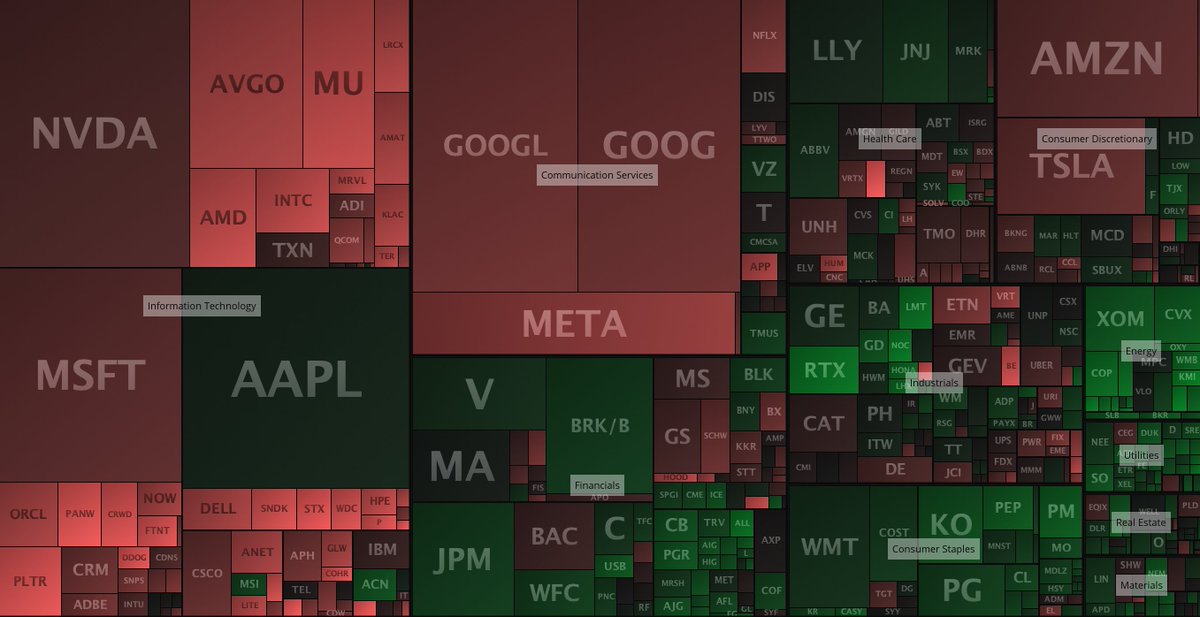
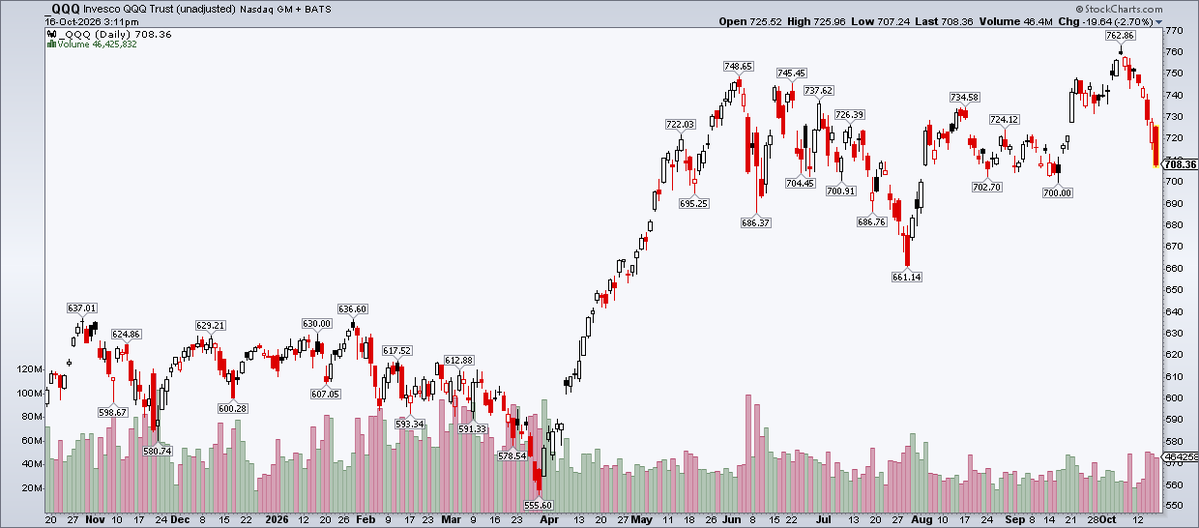
The Nasdaq 100 fell 2.5% on Friday and finished the week down 5.5%, its steepest weekly drop since April 2025. Several reports also said the index was about 6% to 7% below its Oct. 6 record high.
The move came amid continued selling in AI infrastructure, semiconductors and cloud names, with investors rotating away from high-valuation tech. Media accounts pointed to a broad risk-off tone rather than any single company-specific catalyst.
Megacap names including Nvidia, Microsoft, Amazon, Meta and Broadcom all lost ground, while Apple was one of the few gainers among the largest constituents. The VIX rose into the 20 to 22 range, underscoring the jump in volatility.
Both X-sourced signals and independent reporting pointed to the same weekly loss figure, and Reuters-style coverage in Chinese media echoed the 5.5% decline. The data suggest a market-wide tech repricing rather than a one-off event.
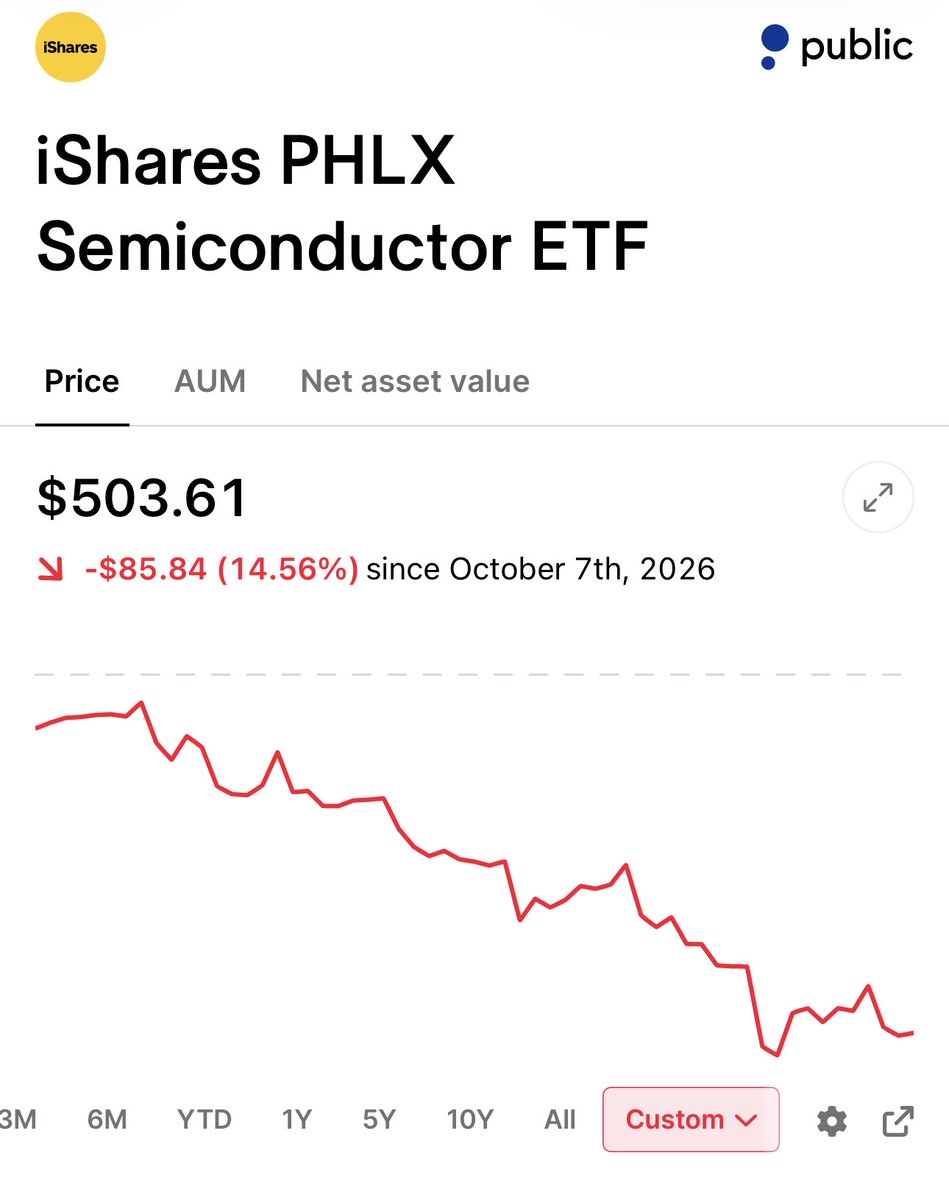
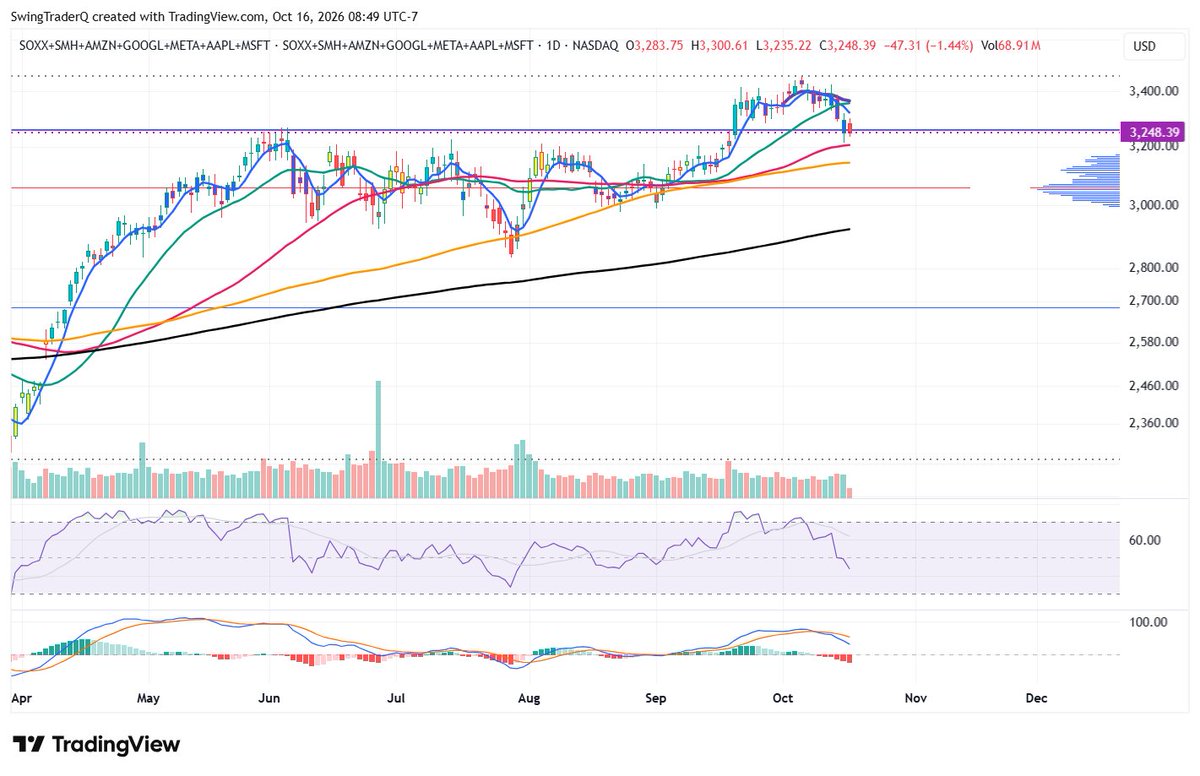
The Philadelphia Semiconductor Index fell again on Friday, logging an eighth straight decline and matching its longest losing streak since the 2008 financial crisis. Several reports said the broader chip complex remained under pressure, while the iShares Semiconductor ETF (SOXX) also extended its slide.
The selloff comes as investors worry that the AI infrastructure boom may be outrunning returns, while hotter-than-expected U.S. inflation has reinforced expectations for elevated rates and a higher cost of capital. Bloomberg noted the sector had surged sharply earlier in 2026 before the recent reversal.
Within the group, Broadcom, Micron, AMD, Intel, Lam Research and KLA were among the notable decliners. CoreWeave also fell about 12% in the session, with its bond yields moving above 15%, adding to concerns over debt-funded AI buildouts.
So far, the reports point to valuation pressure, AI capex anxiety and credit-market stress rather than a fresh company-specific catalyst. The market debate has shifted from how large the AI opportunity can become to how profitable the investment will ultimately be.
How this story unfolded
2026-08-1915 posts · 13 authors
Semiconductor ETF SOXX fell 7.7% over two days after a 20%+ rally since July 29, while hedge funds made their second-largest weekly US equity purchase in 12 months, 70% in single stocks.
Markets
AI stocks slide as oil tops $110 and Wall Street turns risk-off
Tech weakness deepens while higher energy prices keep inflation worries alive
U.S. stocks fell again on Friday as the AI trade came under heavier pressure and energy prices pushed higher. The selloff left the major averages lower and extended a week in which investors reassessed both valuation risk and financing risk in the AI complex.
Bloomberg and Reuters both framed the move as a one-two punch: cooling sentiment around AI infrastructure spending and a jump in oil above $110 a barrel. That combination matters because it feeds concerns that inflation could stay sticky while borrowing costs remain elevated.
Among the hardest-hit names were CoreWeave and Broadcom, while chip stocks broadly weakened. Reuters said CoreWeave fell 12% on the day and about 25% over five sessions, and its bonds were sold off sharply enough to push yields above 15%.
The move also hit the broader market tone. Reuters said the S&P 500 and Nasdaq were headed for their sharpest weekly declines in months, as traders headed into the weekend more cautious about both earnings and the policy outlook.
Nvidia CEO Jensen Huang said in Berlin that the latest AI stock selloff will pass, telling Bloomberg the technology will be transformative across every industry and every country. He argued that near-term market noise does not alter the fundamentals.
The comments came during a volatile stretch for AI-linked shares. Reported market data show the Philadelphia Semiconductor Index has fallen for eight straight sessions, its longest losing streak since 2008, while Nvidia has declined in seven of the past eight trading sessions.
The market backdrop matters because investors are increasingly questioning whether AI capital spending can be sustained at current levels. CoreWeave, an AI infrastructure provider backed by Nvidia, has also been under pressure, and Huang said he remains optimistic about the company and that its cost of capital is decreasing.
There was no new earnings guidance or formal company disclosure in the remarks. For now, the incremental takeaway is mainly rhetorical: Nvidia is trying to steady sentiment around the AI trade while the market reprices risk in the sector.
Anthropic has received a BB+ credit rating from KBRA, one notch below investment grade. At the same time, multiple reports say Wall Street banks are assembling roughly $60 billion in financing tied to the company’s AI chip buildout.
The development matters because it shifts AI expansion from a pure product story to a credit-market story. The reported package is linked to Anthropic’s chip capacity plans with Google and Broadcom, underscoring how capital-intensive the AI race has become.
For markets, the headline puts Broadcom and Google’s chip ecosystem back in focus, while bond investors are watching the pricing of AI-related risk. If the financing advances, the coupon, structure and investor demand will serve as an important test of appetite for large-scale AI debt.
KBRA and Anthropic have not publicly commented on the rating details, and Blackstone has not commented on reports that it may anchor the junior debt with a double-digit yield.
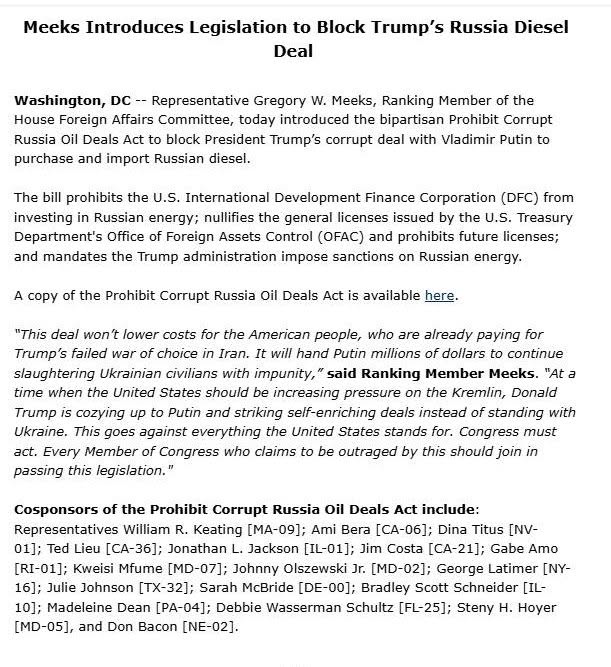
House lawmakers on Friday introduced a bipartisan bill aimed at blocking President Donald Trump’s proposed Russian diesel deal. The measure was led by Rep. Gregory Meeks of New York and co-sponsored by one Republican, Rep. Don Bacon.
Based on the bill summary and follow-up reporting, the legislation would revoke a Treasury Department general license that currently allows Russian diesel sales and imports through April 2027. It would also bar the U.S. International Development Finance Corporation from investing in Russia’s energy sector and direct the administration to tighten sanctions.
The development matters for energy markets because Russian diesel flows and sanctions policy can affect refining margins, fuel prices and broader crude sentiment. That puts energy-linked ETFs such as XLE and USO in focus, even though the immediate driver here is policy risk rather than company-specific fundamentals.
The bill now faces the normal congressional process, while the White House and Treasury may have to defend or revise the underlying licensing framework. Whether Russian diesel actually reaches U.S. and global markets will depend on how the sanctions regime is enforced going forward.
CoreWeave remains the clearest stress point in the AI credit market, with recent reporting showing its bonds under pressure and its credit protection trading at elevated levels. Investors are treating the company as a live test of whether the AI infrastructure boom can support the debt being used to finance it.
That concern sits against a broader wave of AI-related borrowing. Reuters said CoreWeave’s five-year CDS briefly moved above 1,000 basis points, while broader reporting has put 2026 AI-linked debt issuance at nearly $500 billion, underscoring how quickly the financing cycle has expanded.
The market impact extends beyond CoreWeave. Wider spreads for Oracle, Broadcom and other AI-linked borrowers suggest traders are demanding more compensation for the sector’s refinancing and execution risk, especially if future cash flows take longer to materialize.
So far, there has been no new public denial from CoreWeave tied to the latest bond-market move. For investors, the key question has shifted from AI capacity growth to whether the capital structure behind that growth can withstand higher funding costs.
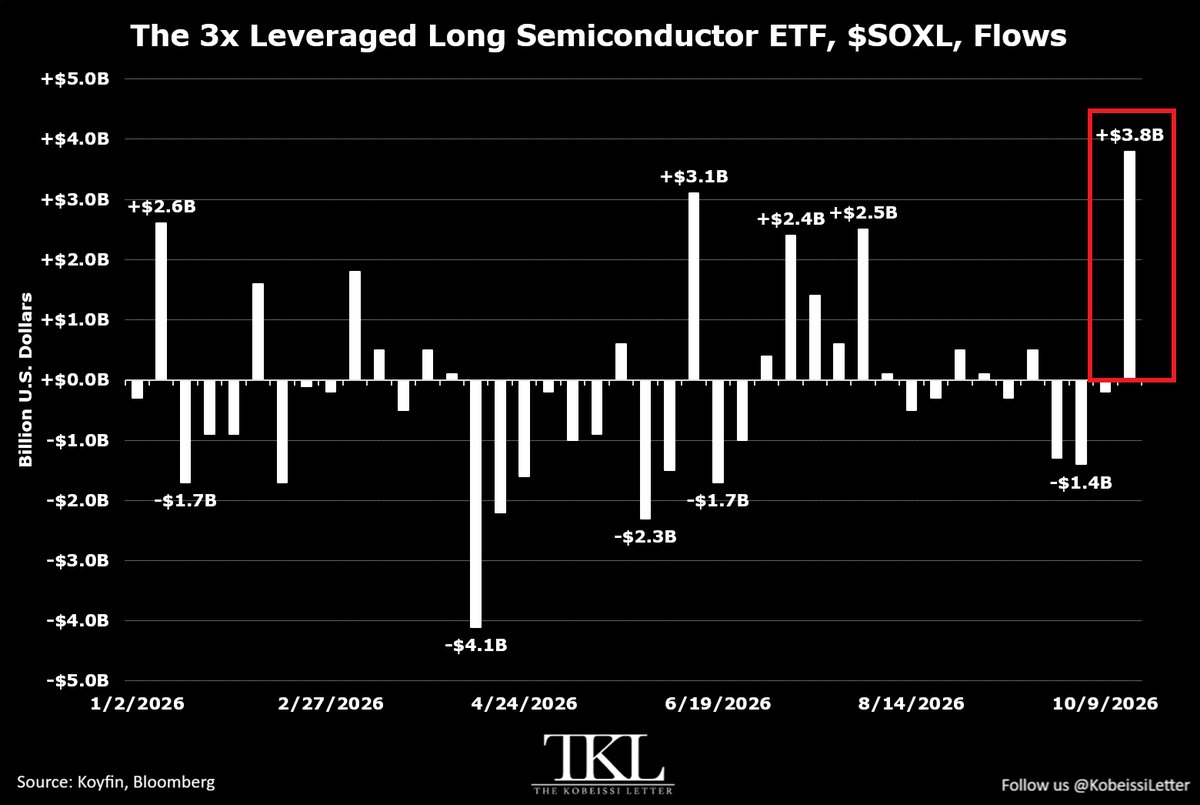
Direxion Daily Semiconductor Bull 3X ETF, or SOXL, has taken in about $3.8 billion in inflows so far this week, putting it on pace for its largest weekly intake on record. The fund is doing so even as it has fallen nearly 21% this week, according to the reports.
The move comes amid a sharp slide in semiconductors. The Philadelphia Semiconductor Index has dropped about 12% over the past six trading sessions, wiping out roughly $1 trillion in market value, while VanEck Semiconductor ETF (SMH) has also attracted more than $430 million over the past three trading days.
The flows suggest some investors are using semiconductor ETFs as tactical trading vehicles rather than stepping away from the sector. SOXL and SMH have become key tools for betting on short-term moves in chip stocks during the selloff.
Baird Strategas ETF strategist Todd Sohn said the latest pullback has not discouraged leveraged dip-buying demand. The reports frame the activity as a sign of continued appetite for high-beta semiconductor exposure despite rising volatility.
Elon Musk said Tesla’s new Roadster “will be sentient” and added that buyers will be able to ask it to perform the tricks shown autonomously. The comment is the latest add-on to the car’s high-profile unveiling.
The event itself is not new: Business Insider reported on Oct. 16 that Musk unveiled Tesla’s flying, thrust-powered Roadster. Today’s signal adds fresh reactions from outside Tesla, including Sam Altman and President Trump.
The discussion centers on TSLA, with the Roadster at the core of the story. It also keeps Tesla in the spotlight as the company continues to frame the vehicle as a showcase for autonomy and new propulsion technology.
Altman said the car “looks amazing” and “quite amazing,” while Trump said he was “very happy” for Musk and called the demo “very impressive.” Those remarks amplify the buzz, but they do not add new pricing or delivery details beyond what has already been reported.
Michael Dell said in an interview that he expects the memory crunch to get worse next year. The signal also cited about $95 billion in AI server backlog, with DRAM supply still constraining deliveries.
The comments extend a broader market focus on AI server supply chains, especially how memory availability can affect shipment timing. Recent coverage in our news library shows Dell shares and the wider AI hardware group had already been volatile.
Dell Technologies is described as leaning on just-in-time manufacturing and a negative cash conversion cycle to weather a potential AI downturn. The related tickers here are MU, SKHY, WDC and SNDK, as tighter memory supply can shape delivery volumes and supplier pricing power.
No additional formal response from Dell was included in the material. The key update is not a new earnings figure, but a fresh read on AI demand versus memory supply constraints.
Donald Trump said the move to limit Ukraine’s access to SpaceX’s Starshield was not his decision, adding that he did not know who ordered it. Ukrainian officials had said the military communications service was briefly restricted and that the change affected drone operations.
The episode sits at the intersection of battlefield communications and U.S. policy toward Kyiv. Reuters cited three officials saying the instruction came from inside the White House, while a senior U.S. official separately denied that the president personally made the request.
For markets, the headline mainly matters as a geopolitical-risk read-through for SpaceX-linked defense and satellite communications themes. SpaceX is privately held, so the immediate trading impact is more likely to show up in sentiment around adjacent public names rather than in SpaceX shares themselves.
The public record is still mixed on attribution: Trump denied issuing the order, Musk said usage limits are decided by the U.S. military or the president, and Ukrainian officials said the service was being restored. The confirmed point for now is that Ukrainian users experienced a temporary restriction; the exact author of the order has not been definitively identified.
On Oct. 16, U.S. crude futures climbed above $100 a barrel, with intraday trading reaching $101.02, while Brent touched $109.58 and settled at $109.86. The move was driven by renewed concerns over Middle East supply and a refinery outage in Russia.
Reuters said the rally reflected escalating tensions around the Strait of Hormuz and uncertainty over Russian diesel supply. CNBC added that at least nine commercial vessels have come under attack near Hormuz since Sunday, amplifying fears over crude transport and refined-fuel flows.
Higher oil prices tend to feed into inflation expectations and can reshape sector positioning across energy and consumer stocks. Among the tickers in focus, Colgate-Palmolive (CL) is not the direct catalyst, but the stock is exposed to the knock-on effect of higher packaging, freight and petrochemical costs, which can alter margin expectations for staples names.
There was no new company response from CL tied to the oil move in the available reporting. The latest fresh company item remains its scheduled third-quarter earnings webcast on Oct. 30.
The Financial Times reported that the UK’s Competition and Markets Authority is preparing proposals that would require Apple to change the iPhone operating system and open tap-to-pay access to rival wallet providers. Apple is expected to challenge the move in court.
The dispute centers on control of the iPhone’s NFC payment interface rather than the hardware itself. The CMA designated Apple as a strategic market status firm last year, and the proposed remedies would move the UK closer to the EU-style wallet opening framework.
For markets, the immediate implications sit in Apple’s services narrative and in the prospects for fintechs such as PayPal, Revolut and Monzo, which have long sought access to iPhone tap-to-pay functionality. Apple argues that restricting NFC access protects user security and helps prevent fraud.
This remains a regulatory and legal process, not a final ruling. If the CMA formalizes the proposal and Apple litigates, the next question will be how UK courts balance platform security claims against competition remedies.
US August TIC long-term inflows jump to $279.2 billion, topping estimates
The Treasury’s August TIC report showed stronger foreign demand for U.S. long-term securities, keeping cross-border capital flows in focus for rates and dollar markets.
The U.S. Treasury said on Oct. 16 that net foreign purchases of long-term securities, after adjustments, totaled $279.2 billion in August. That was well above the $75.2 billion forecast and compared with a revised minus $27.9 billion in July.
On a gross basis, foreign residents bought $300.7 billion of long-term U.S. securities in August, including $257.8 billion by private investors and $42.9 billion by official institutions. U.S. residents bought $21.6 billion of foreign long-term securities over the same period.
The TIC report is watched as a gauge of overseas appetite for U.S. Treasuries and other dollar assets, though the Treasury notes the custody-based data cannot fully identify ultimate ownership. Because the series is volatile and often revised, investors usually focus on whether the strength persists in coming months.
The broader monthly net TIC inflow, including short-term securities and banking flows, came in at $199.8 billion. That keeps the report relevant for rates, the dollar and broader asset-allocation debates, even if the headline number can move on one-off transactions.
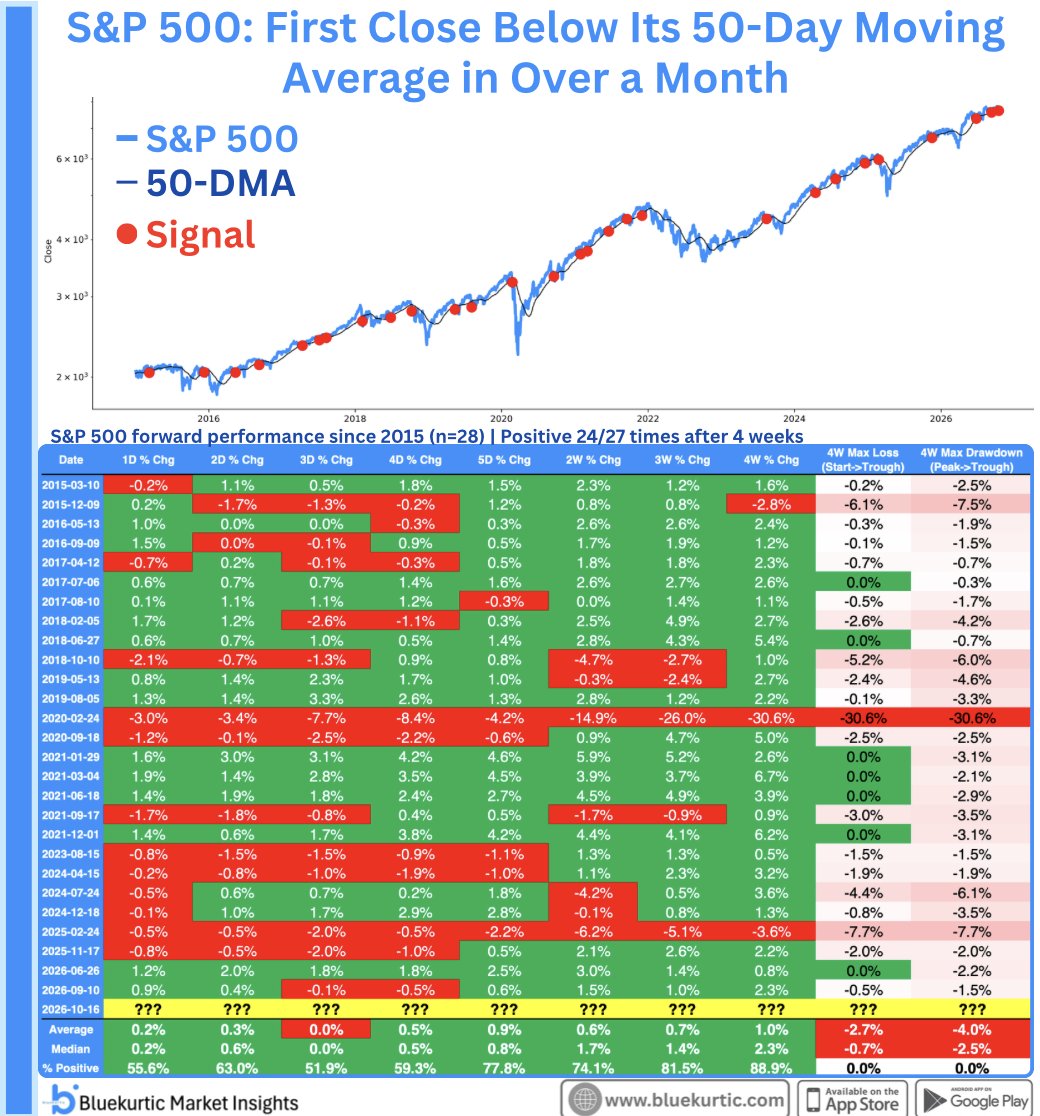
US stocks finished Friday with a clear jump in near-term stress: the S&P 500 closed below its 50-day moving average while VIX futures and skew indicators firmed, pointing to heavier hedging demand. UCapital reported the S&P 500 at 7,659.44, and PreMarketDaily cited the same close while describing it as the first clean break below the 50-day in months.
The move matters because it was not just a one-day index drop. PreMarketDaily said the VIX closed at 19.99, just under the 20 threshold, while traders on X highlighted a backwardated VIX futures curve and a sharp rise in one-month skew, a combination that usually reflects demand for protection rather than calm positioning.
The pressure was felt most in growth and tech-linked names. X posts pointed to QQQ testing the 700 area, while market commentary linked the broader selloff to AI infrastructure and semiconductor weakness; UCapital also noted CoreWeave as a key pressure point in the tech washout.
Taken together, the new evidence is about market structure, not a single headline. The mix of a 50-day moving-average break, firmer volatility, and inverted front-end vol pricing makes Friday’s close a more meaningful risk-off signal for US equities than the index decline alone.
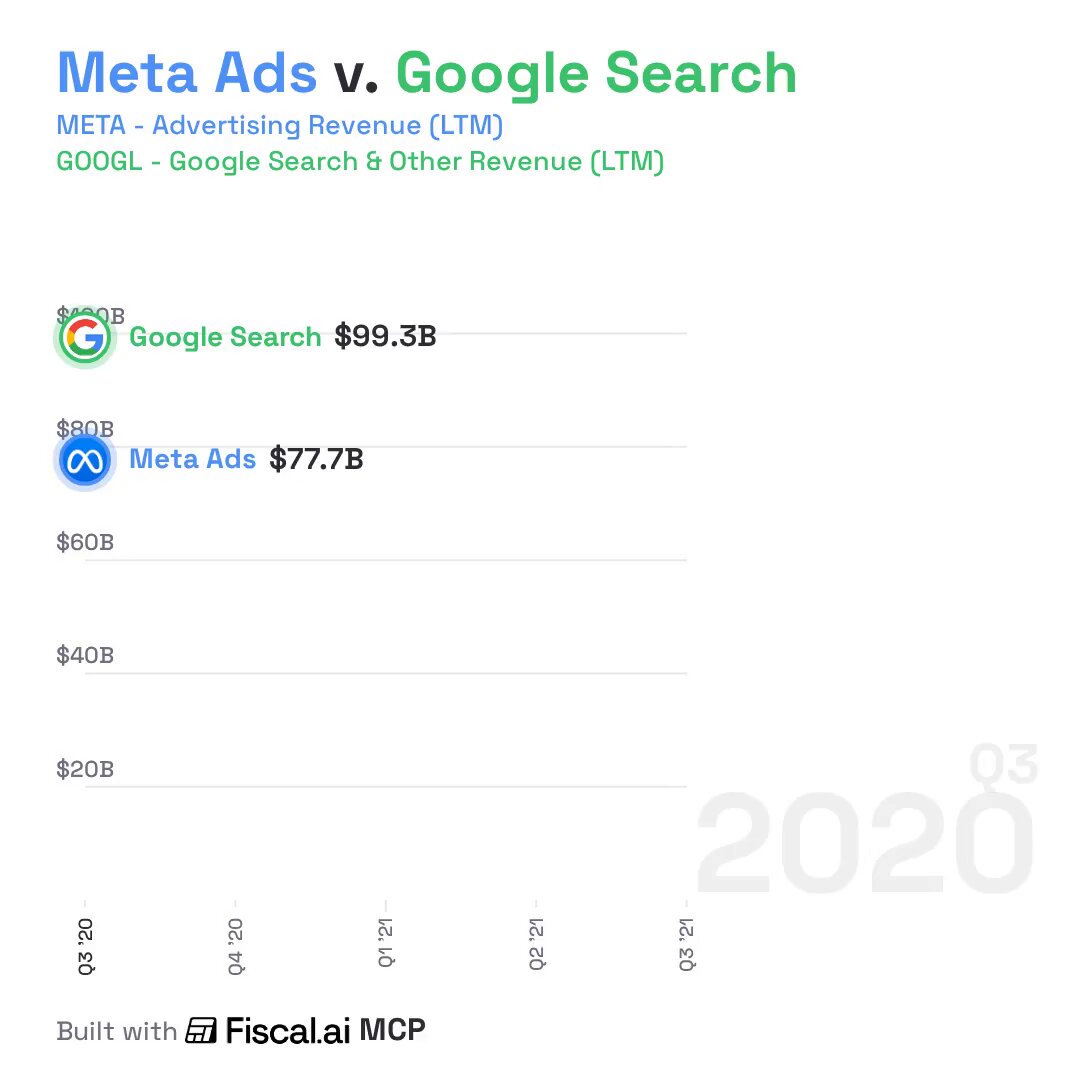
Multiple posts on X say Meta’s ad business is closing in on Google Search, with quarterly revenue now about $4 billion behind. The posts cite roughly $59.4 billion in Meta ad revenue for Q2 2026 versus $63.3 billion for Google Search and other.
The new angle is the mechanism behind the gap. According to the posts, AI helped Meta serve 14% more ads at 12% higher prices by improving prediction before users even search.
Our recent coverage around Meta’s upcoming earnings has also focused on AI as a support for ad growth. If the posted figures are accurate, the relative distance between Meta and Google’s search ad engine has narrowed materially.
For markets, the comparison matters most for META and GOOGL as it shapes the narrative around ad-share competition and monetization efficiency. The key question going forward is whether Meta can sustain that pace and whether Google Search keeps its lead in absolute revenue.
Apple’s new foldable iPhone Duo appears to have sold through its first wave of preorders almost immediately. Bloomberg, as cited in the signal, said initial inventory was gone within minutes and estimated delivery dates moved from Oct. 23 to Nov. 16–23.
Other reports point to even longer waits for buyers. Yahoo Finance said the $1,999 iPhone Duo sold out in minutes and pushed delivery to late January, while a YouTube-linked report said shipping estimates slipped into 2027 within minutes of preorder opening.
The market read-through has been constructive for Apple shares, with Benzinga saying the stock hit a record high after the sellout. Still, analysts in the signal noted that limited starting supply makes the speed of the sellout harder to use as a pure demand gauge.
There was no direct Apple response in the provided material. For now, the main takeaway from the reports is that the iPhone Duo launch is starting with tight supply and strong attention on AAPL.
Multiple trackers showed U.S. spot crypto ETFs turned negative across all four major assets on Oct. 16, with estimated outflows of $82.39 million in Bitcoin funds, $69.68 million in Ethereum funds, $2.47 million in XRP funds and $12.67 million in Solana funds. The figures point to a broad pullback rather than a single-asset rotation.cryptopanic.com
Background reports using Farside and SoSoValue data also put Bitcoin ETF outflows at about $82.39 million and Ethereum ETF outflows at $69.68 million for the day. Lookonchain’s update, however, showed Bitcoin ETFs still positive at $15.86 million and Ethereum ETFs down $60.84 million, highlighting that flow data can differ by source and timing.cryptobriefing.com lookonchain.com
For the market, synchronized outflows can weigh on sentiment in the largest spot crypto ETF complexes and keep attention on fund-level liquidity, issuer concentration and trading volumes. Recent coverage says BlackRock’s IBIT and ETHA remained the main drivers of daily changes, while Solana products continued to post weekly redemptions.cryptotimes.io crypto.news
No fresh issuer comment was identified in the cited reports; the main development is the cross-source confirmation that Oct. 16 was a broadly negative session for spot crypto ETF flows.
Politico reported that Anthropic representatives have been quietly pitching Capitol Hill lawmakers on a draft bill for frontier AI safety and security. A company spokesperson later said the proposal reflects Anthropic’s Advanced AI Framework, which it has been discussing with federal and state lawmakers since June.
The draft would sharply limit when the government could block a model’s release or use, reserving that power for cases involving a foreseeable, imminent risk of more than $1 billion in damages or more than 50 deaths or serious injuries. The risk would have to stem from a biological weapon, a model escaping developer control, or a cyberattack, according to the report.
For investors, any such framework matters most for ANTP and other frontier-model developers because compliance, testing and disclosure requirements could raise operating costs and slow deployments. It would also create a formal role for independent evaluators and Commerce Department registration, with knock-on implications for cloud, safety-audit and model-deployment vendors.
For now, the news is about lobbying and draft language, not enacted law. The broader significance is that a leading AI lab is trying to help define the rules that would govern its own technology as Washington weighs tighter frontier-AI oversight.
X posts indicate traders are focusing on a busy earnings week, with repeated mentions of NFLX, META and TSLA. One post says NFLX, META and TSLA earnings are due next week, while another lays out NFLX on Tuesday and META on Wednesday.
Recent coverage in the site news library aligns with that schedule. Investopedia says Netflix is set to report Tuesday afternoon, and Meta is expected to report after the closing bell Wednesday.
The market focus is on how the stocks may react around those reports, with traders already discussing expected price moves. In this signal, TSLA appears as part of the same broader earnings-heavy trade, but META and NFLX are the primary names tied to the new discussion.
No company response is cited in the provided material. The fresh development here is the renewed trader attention on the upcoming reports, rather than a new corporate action.
Deutsche Bank has announced a digital asset custody service for institutional and corporate clients in Europe, with the initial lineup including bitcoin, ether, USDC, EURC and EURAU. The bank said the offering remains subject to the applicable regulatory timeline and is not intended for retail customers.
The move builds on work that began in September 2023 with crypto infrastructure firm Taurus. Reuters reported on Friday that Deutsche Bank is also weighing an expansion into Asian financial centers in 2027.
For the market, the step highlights how major banks are pushing deeper into regulated crypto infrastructure rather than trading exposure. The key variables now are regulatory approval, the pace of client onboarding and where the bank chooses to launch next in Asia.
How this story unfolded
2026-08-194 posts · 4 authors
Deutsche Bank likened the doubling of Treasury buybacks to 'Operation Twist' and flagged low positioning in consumer staples.
2026-09-1620 posts · 18 authors
Markets
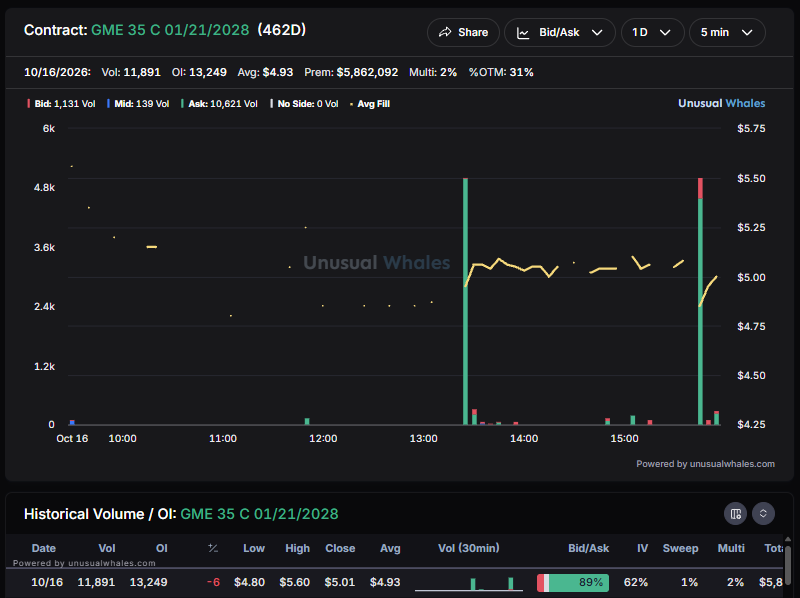
GME 35-call sees another 5000 contracts trade; OI may rise by 10000
Unusual Whales tracked fresh activity in the 2028 GME 35-strike call, with traders waiting for Monday’s open-interest update to confirm the print.
On X, option-flow trackers flagged another 5,000 contracts traded in GameStop’s 2028 $35 call. snorlax_uw said the contract already had 5,000 contracts opened in May and that open interest could jump by 10,000 when Monday’s data posts if the latest print also counts as opening activity.
The print matters because open interest helps traders distinguish between simple turnover and fresh positioning. Unusual Whales-style flow data is widely used to monitor large options trades, especially in names like GME where sentiment and volatility can move quickly.
For GameStop, changes in the options chain can influence how investors read near-term positioning, but a single trade does not prove a directional bet. The key confirmation point will be Monday’s updated OI figure, which will show whether the latest 5,000 contracts were opened, closed, or rolled.
The activity was circulated on X by flow accounts; no company response has been identified.
Cantor Fitzgerald raised its price target on Strategy (MSTR) to $208 from $186, according to the latest X signal. This is the fresh incremental development in today’s news flow.
In the same 48-hour window, our news library says MSCI is preparing to remove Strategy from its global indexes. 247wallst said the stock had already dropped 9.6% on that update.
The two messages point in opposite directions for MSTR sentiment: a higher target from one brokerage, and index-related pressure from the other side. For investors, the key issue remains how passive flows and valuation signals interact around the stock.
No further explanation from Cantor Fitzgerald was included in the signal, and no response from Strategy was cited in the provided materials.
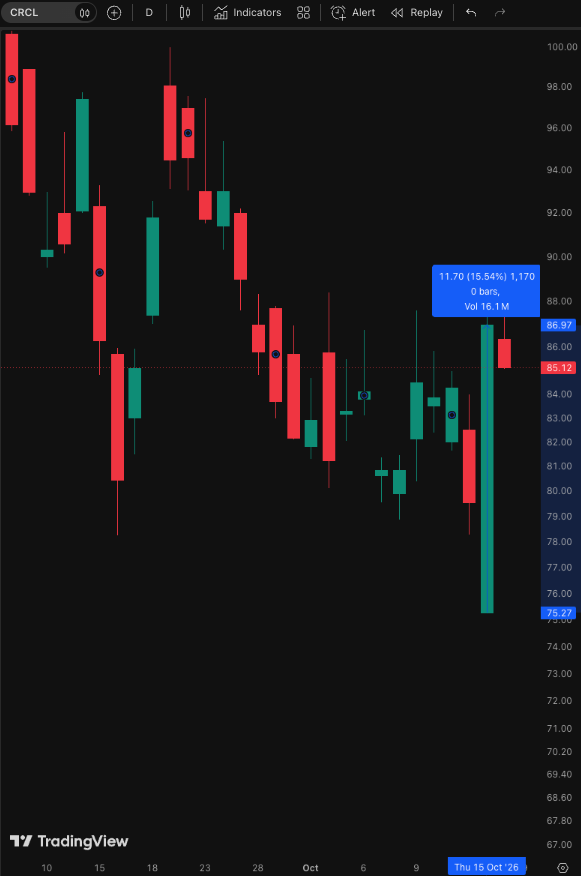
Circle CEO Jeremy Allaire said the company plans to enter about 40 emerging and developing markets, with Southeast Asia, Latin America, Africa and the Middle East as key targets. He framed the move as a sign that the stablecoin industry is shifting from early adoption to mainstream scaling.
The comments were made in a Reuters interview on Oct. 16 and are the latest public update on Circle’s international push. Circle has already agreed to buy Singapore-based payments company Tazapay for $400 million, a deal that would give it access to local banking and payment rails across more markets.
For investors, the story keeps Circle (CRCL) centered on USDC distribution and cross-border payments. USDC has about $73.3 billion in circulation and roughly a quarter of the stablecoin market, while the broader use of stablecoins is moving beyond crypto trading into payments and remittances.
Allaire also said AI agents are beginning to use USDC for small online payments and research tasks, adding another emerging use case. He did not provide market-by-market revenue guidance or a forecast for adoption timing.
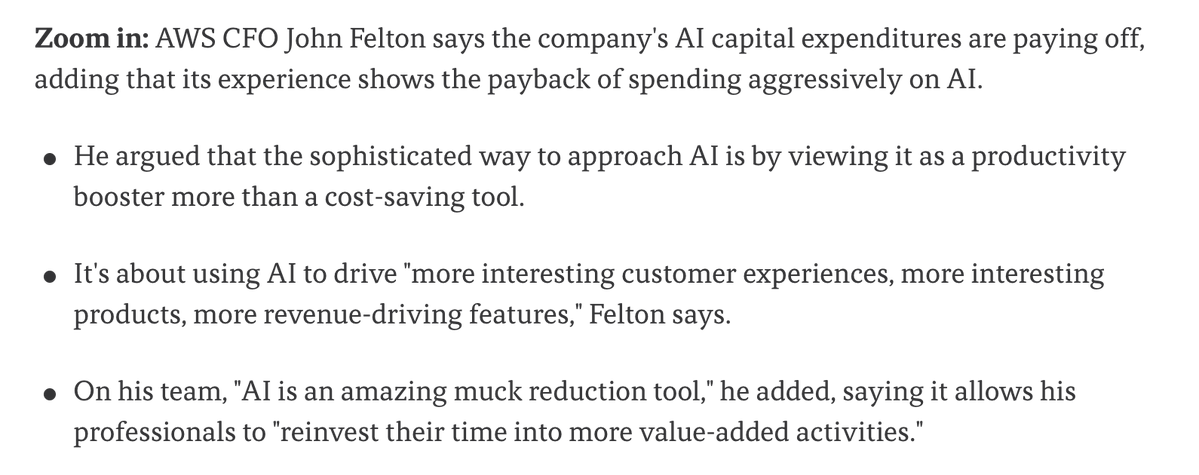
Amazon Web Services CFO John Felton said AI-related spending is sustainable because it is driving material innovation and the company’s AI capex is generating returns. He added that payback on servers is less than 3 years.
Felton also said AWS’s order backlog is nearly $500 billion as of Q2, spanning large corporates, AI labs and SMEs. On top of that, AWS AI revenue is running at over $25 billion and growing at a triple-digit pace year over year.
For AMZN, the update gives investors a more concrete view of AWS monetization and capital efficiency. Recent coverage has also pointed to AWS as a key profit engine for Amazon, making the cloud unit central to how the market weighs the company’s AI spending.
Felton pushed back on criticism of data-center expansion, saying these projects create jobs and that communities should not be alarmed by the anti-data center movement. The comments were management remarks and not independent verification of the claims.
Russian presidential envoy Kirill Dmitriev said in Moscow on Friday that the US Treasury Department asked the Russian Direct Investment Fund to help implement a diesel agreement, including payment processing and other “tactical” issues. He said the fund would work to make sure payments are efficient and reach the intended recipients.
The diesel deal itself was announced last week after a call between President Donald Trump and President Vladimir Putin. Russian officials said the arrangement would send Russian diesel to the US and global markets, while Ukrainian President Volodymyr Zelenskyy warned that easing restrictions on Russian diesel exports could help finance Moscow’s war effort.
Dmitriev also said Russia and the US are discussing a broader set of joint projects, including data centers, Arctic energy, LNG and projects tied to Russian nuclear power plants. The comments suggest the diesel arrangement is being treated as part of a wider, still-early economic opening.
There has been no independent public confirmation from the US Treasury in the materials reviewed. For markets, the key focus is whether the reported payment mechanism can be executed without breaching sanctions rules and whether the talks expand into other commodities or infrastructure projects.
Tech analyst Dan Ives said on X that after just landing from Korea, he is seeing memory chip demand versus supply at roughly 13 to 1. The comment was echoed in CNBC-linked coverage and underscores how tight the memory market still looks to some investors.
The timing matters because the debate around memory stocks has shifted from a simple shortage story to a more complicated one: competition from China’s CXMT on one hand, and the risk of future oversupply as new capacity comes online on the other. At the same time, AI infrastructure demand continues to support DRAM and HBM pricing.
The most exposed names remain Samsung Electronics, SK Hynix and Micron, which have been among the hardest-hit and most closely watched stocks in the latest selloff. Any change in sentiment around memory supply and pricing tends to flow quickly into those shares.
Ives has also argued that the global AI buildout will keep memory demand elevated and that Chinese memory technology still trails Korea by about three years. Those are his views, not independently verified industry consensus.
JPMorgan Chase CEO Jamie Dimon said the bank will not allow outside AI agents to log in to customer accounts and act on their behalf, citing security risks. He argued that letting an agent make payments could require customers to hand over banking credentials and that such systems may not always act in the customer’s best interest.
The stance fits a broader pattern across U.S. banking: institutions are welcoming AI as a financial helper, but not as a free agent with payment authority. Bloomberg reported that several banks are actively blocking unauthorized AI agents that try to move clients’ money, while JPMorgan says it still supports customer-authorized data sharing through open-banking connectors.
For JPMorgan, the issue matters both operationally and strategically. The bank is piloting its internal Smart Cash tool to forecast cash flow and move funds within the bank to optimize yield, while outside consumer-agent products such as Meta’s Muse are trying to connect to financial data via Plaid.
JPMorgan said it has no timeline for allowing third-party agents direct access to customer accounts. Dimon also framed the issue as a liability question, telling customers who use such tools that they should understand the risk transfer involved.
How this story unfolded
2026-09-107 posts · 7 authors
JPMorgan upgraded Meta to Overweight with a price target raised from $640 to $820, citing AI potential beyond ads.
Company
Nebius director buys 296 shares under 10b5-1 plan, lifting stake 5.0%
A newly amplified Form 4 shows Arne Grimme bought NBIS stock in two open-market tranches; the trade lands as the name remains a high-volatility AI infrastructure play.
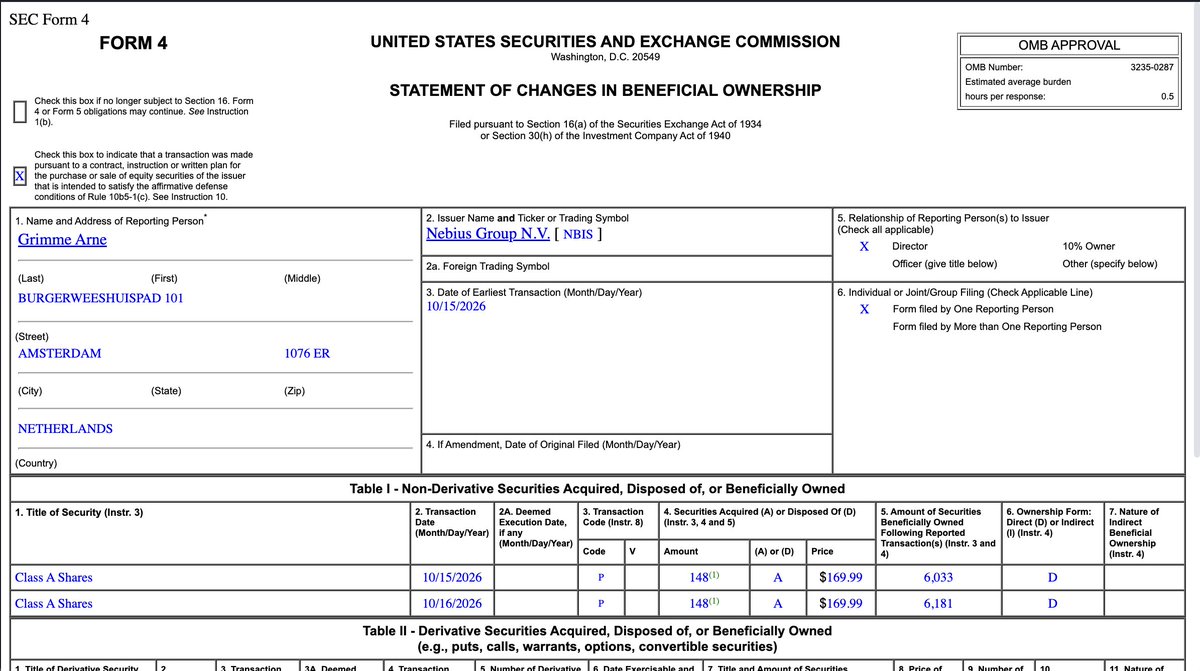
Nebius Group N.V. director Arne Grimme bought 296 Class A shares over Oct. 15 and Oct. 16 at $169.99 apiece, for a total of about $50,317. The transaction was disclosed in a SEC Form 4 filed Oct. 16 and marked as executed under a pre-arranged 10b5-1 plan.
The fresh news flow today is the social-media amplification of that filing, which put the insider purchase back on traders’ radar. Public records show Grimme’s direct holdings increased to 6,181 shares from 5,885 shares, a gain of roughly 5.0%.
Nebius remains a closely watched stock because of its rapid growth and large swings. Market coverage cited the shares around $165.47 on Oct. 17, while the company’s latest quarterly revenue was $582.3 million, up 454% from a year earlier.
For NBIS, insider buying is a sentiment signal rather than a fundamental catalyst. Because the trade was made under a 10b5-1 plan, it should not be read as a discretionary timing call by the director.
Multiple signals indicate Rocket Lab's Neutron first launch has slipped again, with the latest reporting pointing to a 2027 target. Seeking Alpha's coverage argues the setback does not change its bullish thesis, but the timing remains the market's main focus.
This is part of the same ongoing Neutron delay storyline that has been building over the past two days in the news flow. The issue is no longer just the launch date itself, but what repeated schedule changes say about execution.
RKLB remained under pressure after the update, with one signal citing another 8% retreat and another reporting the stock at $55.25 after the delay news. Because Neutron is central to Rocket Lab's growth narrative, the timeline shift matters directly to how investors value the name.
No fresh company response appeared in the materials provided. The discussion in the signal set is being driven mainly by analyst commentary and media reaction.
A wedding video from China went viral on X after a bride reportedly surprised the groom with an Nvidia RTX 5090 graphics card, a gift widely described online as worth about $12,000. In the clip, the groom is said to have cried and lifted the box over his head as guests filmed the moment.
The reason the story spread so quickly is that the RTX 5090 sits at the top end of Nvidia’s consumer GPU lineup, where limited availability can push resale prices far above list price. Earlier coverage cited an ASUS ROG Astral RTX 5090 with an approximate sticker price of about $4,000, versus an elevated market price around $12,000.
For Nvidia, the episode is more a branding moment than a fundamental business event, but it keeps the NVDA ticker in the middle of a highly shareable consumer-tech story. There were no fresh earnings, guidance changes, or company comments attached to the viral clip.
So far, the details appear to come from social posts and secondary media write-ups rather than an official statement from the couple. Any exact valuation of the gift still depends on confirmation of the model, purchase channel, and local market pricing.
Seeking Alpha published a market note on Oct. 16 arguing that U.S. Treasury bill issuance is running ahead of maturities, creating a net liquidity drain. The piece says about $59 billion in bills settled last week, with another $63 billion expected to settle next week.
The backdrop is simple: when new bills settle, cash leaves the financial system and moves to the Treasury’s account, reducing near-term liquidity. The author also argues that with the Fed’s reverse repo facility largely depleted, bill settlement flows now hit bank reserves more directly.
For markets, the article links that cash drain to potential pressure on the S&P 500, the Nasdaq and semiconductors, which have been sensitive to funding conditions. Social-media chatter around $SMH shows traders are paying close attention to the theme, though that is market commentary rather than a factual confirmation of price direction.
This is an analytical market piece, not an official warning. The key figures come from the author’s tracking of Treasury settlement schedules and should be cross-checked against Treasury issuance data as it updates.
X posts today showed a clear rise in market chatter around the idea that AI is no longer just a sector trade, but a link between equities, bonds, private capital, inflation and profits. On Seeking Alpha, several same-day pieces argued over whether the move reflects three overlapping bubbles, a Fed inflation problem, or merely a pullback.
The broader backdrop is a debate over whether AI data-center buildouts, chip demand and financing structures are tying together corporate capex, credit pricing and macro inflation. One of the cited articles says Goldman Sachs expects trillions of dollars in AI infrastructure spending, while Gartner estimates cumulative revenue may still fall short of what would be needed to justify the returns.
The market impact is most visible in semiconductors and AI infrastructure names, especially SMH, SOXX, NVDA, AVGO, MSFT and GOOGL. Bonds and small caps are being used as the cross-asset contrast set, with traders watching whether AI capex can keep supporting earnings and valuation premiums.
At this stage, the signal is mainly about narrative dispersion rather than a single corporate event. The new information today is that AI has moved in market commentary from a technology theme to a macro trade touching inflation, rates and sector rotation.
Baker Hughes data released for the week ended October 16 showed the U.S. active rig count unchanged at 603, while oil rigs fell by three to 459. Gas rigs rose by one to 133 and miscellaneous rigs increased by two to 11.bakerhughesrigcount.gcs-web.com
The rig count is widely used as a leading indicator for the drilling industry because it tracks activity that drives demand for oilfield services, equipment and completion work. On a year-over-year basis, the total U.S. count is up 55 rigs, with oil rigs up 41, suggesting activity remains above last year’s level.rigandrefinery.com
For markets, the main read-through is to U.S. oilfield services and exploration-and-production names, including Halliburton, SLB and Baker Hughes, as traders reassess near-term drilling momentum. A flat headline count with a small drop in oil rigs points more to a mix shift than a broad change in sector activity.
A third-party economic calendar also reported the same oil rig print of 459 versus 462 previously, confirming the latest weekly release.investing.com
Zeta Global continues to highlight AthenaOS after its debut at Zeta Live. In the company’s latest public messaging, AthenaOS starts with a business objective, combines enterprise knowledge with Zeta’s customer and market intelligence, and recommends next steps while learning from outcomes. Zeta also says teams remain in control of their data.
AthenaOS was first unveiled on Oct. 8 at Zeta Live 2026, where Zeta positioned it as an enterprise intelligence operating system. The company also introduced Athena MCP, the Athena Inference Model, and early work on a specialized chip and supporting data-center infrastructure. Zeta said the system is in limited internal beta, with public beta expected later this year and general availability planned for the first quarter of 2027.
For the market, the main impact is on Zeta’s product narrative and long-term valuation story rather than immediate revenue. GuruFocus reported on Oct. 16 that Zeta shares fell 5.2% to $31.81, making AthenaOS disclosure a fresh lens for investors evaluating the company’s push into enterprise AI infrastructure.
Zeta has not announced a new financial forecast or a change in commercialization timing. For now, the public record remains centered on product rollout, partnerships, and beta progress.
How this story unfolded
2026-08-2420 posts · 16 authors
SOXX turned red on Sunday night, with focus on a potential fake-out before NVDA earnings; MU fell 6%, AMD 3%, and SOXX dropped nearly 3%.
2026-09-2326 posts · 20 authors
Michael Burry disclosed increased short positions in MU, NBIS, and SOXX; semiconductor ETF AUM hit record highs, with SMH at $70B and SOXX at $46B.
2026-10-1541 posts · 24 authors
SOXX fell for an 8th straight session, its longest streak since 2010 and near the 2006 record of 9; in all 6 prior cases, it rebounded within two days.
2026-10-1630 posts · 24 authors
Semiconductor stocks erased over $2 trillion in market cap since Oct 6; BTIG noted only two prior cases of SOXX falling 7 straight days then gapping down 1%+, both in 2002.
2026-10-1717 posts · 12 authors
3x leveraged long SOXL attracted $3.8B inflows this week, on track for a record, after three weekly outflows; BofA said NVDA, AVGO, MU trade like post-crash Cisco.