The U.S. Labor Department said Thursday that the Producer Price Index rose 6.3% in September from a year earlier, above expectations for 5.3%, marking the biggest annual increase since December 2022. On a monthly basis, PPI climbed 1.3%, while core PPI rose 5.0% year over year and 0.7% from August.
Energy was the main driver, with gasoline prices jumping 20.3% and helping lift final-demand goods prices 2.6%. Services prices also advanced 0.8% on the month, suggesting inflation pressures are broadening beyond fuel.
The hotter PPI came alongside a 0.8% increase in September retail sales, a sign consumer demand is still holding up despite higher prices. Markets quickly reassessed the odds of another Fed hike this month and pushed up expectations for tighter policy by year-end.
The immediate market reaction is likely to be felt in Treasury yields, the dollar and rate-sensitive sectors. Airlines, retailers, freight operators and consumer-service companies remain the most exposed if input-cost inflation keeps feeding through to margins.
CBS News reported that the White House and Pentagon have prepared plans to use the GBU-43/B Massive Ordnance Air Blast bomb, known as the “mother of all bombs,” against military targets in Iran if ordered by President Trump. A White House spokesperson said the administration does not comment on sensitive plans and that Trump keeps all options open.
The report lands against the backdrop of a protracted U.S.-Iran conflict that escalated after U.S.-Israeli strikes in February and has since centered on the Strait of Hormuz, sanctions and intermittent attacks. ABC News said Trump has told aides he would not strike Iran before the midterm election, while also describing recent talks with Tehran as “productive” without giving details.
For markets, the immediate read-through is to crude oil, shipping and defense names, with traders often watching the USO ETF as a liquid oil proxy. But the reporting is about contingency planning, not an executed order, so any asset reaction remains tied to whether the White House turns that option into action.
ABC also quoted Trump as saying he would not use nuclear weapons against Iran and had no plans to deploy U.S. ground troops. The Hindu, citing CNN, said officials have raised questions about whether the MOAB could destroy suspected underground nuclear sites, underscoring that the weapon is not a deep-penetration bomb.
How this story unfolded
2026-08-1749 posts · 26 authors
Trump confirmed a backchannel with Iran's Revolutionary Guard, and the US and Iran reportedly agreed to extend their 60-day ceasefire.
Geopolitics
Reuters says White House internally ordered a slowdown of Ukraine’s Starshield
US officials say Trump did not personally order any curbs, as scrutiny grows over who controls the battlefield system
Reuters reported that the decision to limit Ukraine’s use of SpaceX’s Starshield came from inside the White House. According to two US officials and one Western official briefed on the matter, Pentagon leaders received a message that the Ukrainian military’s Starshield service needed to be slowed.
The issue matters because Starshield supports battlefield communications and drone operations. Ukrainian officials said military-grade Starlink receivers stopped working when mounted on fast-moving objects, disrupting drone guidance; a Ukrainian Defense Ministry source later said the equipment was again working in motion, but only up to about 100 mph (160 kph).
The controversy has also intensified questions over control of SpaceX’s military-linked satellite services. CNBC, citing Reuters, said a senior US official denied that President Donald Trump ordered the curbs, while Elon Musk posted on X that any limits on speed or usage are decided by the US military or ultimately the president.
For SpaceX, the episode adds political risk to a business that supplies both commercial Starlink service and defense-focused Starshield systems. Reuters also said Ukraine had reached out to senior officials at the White House, State Department and Pentagon for answers and was told it was a White House decision.
MSCI said Thursday it will apply a new non-operating company framework that puts Strategy (MSTR) under review for possible exclusion from its global investable market indexes. The rule takes effect after the close on Nov. 30, and MSCI plans to publish the final list of affected companies on Nov. 11.
The change follows MSCI’s consultation on companies that mainly hold assets rather than operate a business. Reporting from Bloomberg and The Block says the new approach uses operating assets and five financial ratios, with existing index members generally needing to fail the screen in two consecutive annual assessments before removal.
If Strategy is ultimately removed, index-tracking funds would have to sell the stock, not the company’s bitcoin holdings. JPMorgan analysts previously estimated passive outflows of about $2.8 billion in a removal scenario, while Strategy said in August that funds tied to MSCI’s global indexes held about 13 million shares, or 3.1% of basic shares outstanding.
MSTR closed at $151.29 on Oct. 15. The new methodology could also affect other bitcoin treasury companies, including Metaplanet and SharpLink, though Strategy remains the central name in the current MSCI process.
How this story unfolded
2026-09-015 posts · 5 authors
Strategy responded to MSCI's proposed 'non-operating company' exclusion, calling it misguided and flawed.
Markets
CoreWeave debt stress deepens as the AI trade faces a financing test
X chatter points to rising energy and funding costs across AI buildout; recent coverage shows CoreWeave’s debt and credit protection under pressure.
A cluster of X posts is circling the same theme: the AI buildout that has powered profits for a handful of companies may also be lifting energy and financing costs across the broader economy. Several posts argue that the gap between strong end-demand and deteriorating funding conditions is becoming harder to ignore.
Recent coverage in the site’s news file puts CoreWeave at the center of that pressure. CNBC said the company’s credit default swaps had reached distress levels and that yields on its 2031 bonds topped 15%; MarketWatch also reported fresh pressure in both the stock and bond market.
For investors, that shifts the focus from revenue growth to how AI infrastructure spending is financed. Nebius and other AI names are being discussed in the same valuation context, but the most immediate stress point in the materials is the debt market and the cost of leverage.
The X signal does not establish a single consensus view. What it does show is a growing debate over whether AI expansion has started to transmit higher costs through the market rather than only higher earnings for a few winners.
The European Union is preparing to speed up antitrust review of Project Bromo, a satellite joint venture backed by Airbus, Leonardo and Thales. The project is designed to build a European challenger to SpaceX and reduce the bloc’s reliance on U.S. satellite providers.
This is a follow-up to discussions that have been under way for about a year, according to people familiar with the matter cited in recent reporting. The companies have not yet formally filed, but regulators are expecting a submission in the coming weeks, which could open the door to a faster Phase 1 decision if remedies are offered.
For markets, the story matters most for SpaceX’s listed proxy SPCX and for Europe’s aerospace names, which are trying to combine satellite assets under a single platform. The regulatory pace will shape how quickly the venture can move from concept to a formal competition review.
EU competition chief Teresa Ribera has said political backing does not exempt the deal from normal scrutiny, while Commission President Ursula von der Leyen has publicly framed Project Bromo as a future European industrial champion. Airbus, Leonardo and the Commission declined to comment on the pending process.
How this story unfolded
2026-08-253 posts · 3 authors
Treasury Secretary Bessent announced a 'zero leakage' Iran sanctions strategy targeting digital assets, gold, tech, aviation, and shipping; Louisiana is set to announce a SpaceX spaceport project.
Company
Google cuts Willow quantum errors 40-fold, hits 99.99% fidelity
The company says the new result tackles a major bottleneck in scalable quantum computing and could lower the resource cost of future error-corrected machines
Google Quantum AI said on Oct. 15 that it has demonstrated “magic state cultivation” on its Willow quantum chip for the first time on real hardware, cutting errors by about 40x versus uncultivated states and reaching 99.99% logical fidelity. The work was published in Science and framed by Google as a practical step toward removing one of quantum computing’s hardest bottlenecks.
The technique matters because magic states are a core input for useful quantum algorithms, yet producing them is extremely expensive. Google said some estimates put the cost at up to 95% of a quantum computer’s total capacity, which is why any reduction in that overhead could materially improve future machine economics.
For Alphabet’s GOOGL, the result strengthens its quantum computing credentials, though it does not change near-term commercialization. Google said larger-scale demonstrations are still needed, and reports noted the test used at most 54 of Willow’s 105 qubits, underscoring how early the technology remains.
Google also said the project required months of troubleshooting after temperature drift and electrical noise interfered with measurements. The company added extra control and developed a new benchmarking method before the result stabilized, indicating the breakthrough was as much an engineering advance as a theoretical one.
Tesla used its Roadster unveiling to stage a dramatic live stunt, with multiple X posts saying the next-generation Roadster went airborne over a row of Tesla vehicles and returned to the ground after launching off a ramp. Another post described a full highlight reel of the event, while separate clips showed additional vehicle demos on site.
Business Insider reported on 2026-10-15 that Tesla had finally revealed the second-generation Roadster, placing the stunt within the same event line rather than as a separate product announcement. The Roadster has been a long-running Tesla halo-product story, so the unveiling adds a new visual proof point to an already closely watched launch.
For TSLA, the immediate impact is on narrative momentum and trader attention rather than on fundamentals. X posts also repeated a 0-to-60 time of 0.81 seconds, but the material here supports the event footage more directly than any broader product claims.
There was also a separate post about a Tesla–SpaceX merger prediction-market jump to 55%, but that is a distinct topic from the Roadster unveiling. No additional company response beyond the event materials appears in the supplied sources.
Several X posts and market headlines point to the same development: U.S. Treasury yields are moving lower today, with the 10-year yield hitting its lowest level since Sept. 23. CNBC’s wire headline also says investors are digesting hot inflation data even as Treasury yields edge down.
The move follows a stretch of hotter inflation readings and pressure on growth stocks. News in the past 48 hours shows AI-related shares were already volatile on Oct. 15, while CoreWeave bond yields climbed above 15%, underscoring how higher rates have been weighing on growth and AI-linked names.
In market terms, posts say the tech selloff has offered some relief to yields, while others describe a flight into safe-haven bonds. For names such as CoreWeave and Nebius, a decline in yields may ease valuation pressure, but the immediate story here is the bond-equity linkage rather than a company-specific catalyst.
There is no fresh corporate announcement or direct company response in the material provided. The available evidence is mostly from intraday market commentary and media wires, focused on the interaction between Treasury yields and technology stocks.
South Korean memory-chip leaders Samsung Electronics and SK hynix remained under pressure as investors focused on a fresh catalyst from China. CNBC reported that ChangXin Memory Technologies (CXMT) unveiled plans for a server memory product based on a new architecture, a move that could increase storage density and narrow the technology gap with incumbent makers.
The broader backdrop is a market still being pulled by AI-driven demand and fears of a later supply reversal. CNBC cited analysts who said the key question is whether CXMT can scale production with acceptable yields; if yields were only 50%, half the chips would effectively be wasted and the breakthrough would not quickly translate into meaningful supply.
The selloff is also being shaped by longer-dated oversupply concerns. CNBC said Counterpoint Research sees DRAM prices falling about 23% in 2028 versus 2027, though still roughly 230% above 2025 levels, and noted that long-term agreements with price floors and ceilings could soften the next downturn.
On the day, the pressure spread beyond Korea to other Asia tech names. AP reported a wider regional AI-stock rout that pushed South Korea’s Kospi and Japan’s Nikkei 225 sharply lower, with memory makers and chip-related stocks among the biggest drags.
Multiple X posts say Elon Musk is considering an Amazon competitor after users reported that Amazon blocked Grok bots from placing orders on its site. The clearest quoted line in the signal is: “Maybe we should start a competitor to Amazon.”
This sits in a broader theme already covered in the site’s news library: on October 15, 247wallst.com reported that Amazon and JPMorgan are blocking AI agents that can already pay with crypto. In other words, the dispute is not just about one bot, but about whether websites will allow automated agents to transact at all.
For markets, the immediate ticker in focus is AMZN, while SPCX is pulled into the story because several posts identify Musk as SpaceX CEO and even speculate about SpaceX and xAI being involved. Still, the available material only shows a tentative response and user reports; it does not include a formal statement from Amazon.
So the news value here is the new public signal from Musk, not a confirmed launch plan. The underlying access issue appears to be part of a wider fight over AI-agent shopping and website controls.
Mastercard and BVNK on Thursday launched Mastercard Global Money Platform, a single-integration layer that combines Mastercard’s payments network with BVNK’s stablecoin infrastructure. The platform is designed to let banks, fintechs and enterprises embed multi-currency accounts, real-time conversion, stablecoin-linked cards and local bank payouts.
The launch is Mastercard’s first major integration of BVNK since its August 2026 acquisition of the company. Mastercard said the platform taps into Mastercard Move, which reaches more than 17 billion endpoints, while card issuing is available in 130-plus countries and broader currency coverage is expected in 2027.
For Mastercard, the move extends its payment rails deeper into stablecoin use cases; for BVNK, it puts its infrastructure into products offered by banks and digital platforms. Early partners named in the launch include Nuvei, Marqeta, Ontop, Bolt Group and Almond FinTech.
BVNK said the platform is available now. Mastercard added that the product fits its broader multi-money strategy and could support future use cases including tokenized deposits and agentic commerce.
Apple and Meta are collaborating to let developers run Meta’s Muse Spark Open model locally on high-end Mac computers, CNBC reported. The report says the model can run on 2 to 4 linked Mac Studios.
The development matters because it ties two major platform companies to a concrete AI workload on Apple hardware. X posts also describe it as the first public partnership between Apple and Meta since 2017.
For markets, the direct names in play are AAPL and META. The angle is less about a product launch and more about whether Macs can serve as a practical venue for running third-party AI models locally.
The available material centers on the partnership itself and the developer setup. No additional terms were disclosed in the provided sources beyond the CNBC account and the matching republished signals.
Arthur Hayes turns bullish on BTC and ETH on bailout thesis
Hayes says he is not betting on AI’s direction, but on a future multi-trillion-dollar rescue package; Bitcoin briefly slipped below $80,000 before rebounding.
Arthur Hayes said on X that he is not betting on whether AI stocks will rise or fall, but on the possibility of a future “multi-trillion-dollar bailout,” adding that he is long BTC and ETH. That is the key new message driving today’s market chatter.
The thesis extends a macro view he has been airing in recent coverage: if leverage in AI infrastructure and data-center buildouts becomes a funding problem, policymakers could respond with larger liquidity support. That line has been echoed in reports from cointelegraph.com and odaily.news.
In crypto trading, Bitcoin briefly fell below $80,000 before bouncing back above the level, while Coin Bureau said more than $60.15 million in long positions were liquidated in the hour of the drop. Traders are again watching whether macro liquidity expectations can overpower near-term risk-off pressure.
Hayes is framing the trade around policy response rather than an outright call on AI. He did not say AI will definitely crash; instead, he said he prefers to position for the bailout that might follow any larger market shock.
Company
KFC to switch U.S. restaurants to Coca-Cola across 3,600 locations
Coca-Cola and KFC confirm a U.S. beverage partnership that will replace Pepsi in the chain’s American stores
Coca-Cola and KFC said they will bring Coca-Cola beverages to all 3,600 KFC restaurants in the U.S. for the first time. The rollout begins in January 2027, with nationwide availability expected by spring 2027. Reuters and the Wall Street Journal first reported the switch on Thursday.
The move ends a decades-long relationship between KFC and PepsiCo that dates back to Pepsi’s ownership of the chain in the 1980s. Even after Pepsi spun off the restaurant business, it remained KFC’s U.S. beverage provider, making the chain one of Pepsi’s more visible restaurant accounts.
For investors, the deal is a modest but notable negative for PEP and a branding win for KO in foodservice distribution. It also comes as PepsiCo is under pressure to improve U.S. soda performance, while Coca-Cola keeps expanding its presence at major restaurant chains.
Neither company disclosed financial terms. PepsiCo has said its separate agreements with Taco Bell and KFC International remain in place, but those deals do not affect the U.S. restaurants covered by this announcement.
Cboe to extend stock and ETF options hours for 24 names
The exchange will add pre-market and post-close sessions for options on major stocks and ETFs after regulatory approval, broadening access to names like Apple and Nvidia.
Cboe Global Markets will begin offering extended trading hours next Monday for options on 24 U.S. stocks and five ETFs. According to CNBC, the new sessions run from 7:30 a.m. to 9:25 a.m. ET before the open and from 4:00 p.m. to 4:15 p.m. ET after the close.
The move follows SEC approval granted in May, and the latest step clears the way for the exchange and the Options Clearing Corp. to support the added sessions. The eligible lineup includes heavily traded names such as Apple, Nvidia, Tesla, Microsoft, Amazon, Meta, Google, Broadcom, AMD and Palantir, along with SPY, QQQ, IWM, GLD and XLF.
For the market, the change gives traders a faster way to react to company-specific news and macro events outside regular hours, especially in high-volume tech stocks and large ETFs. Cboe said eligible underlying securities must meet thresholds including average daily options volume of 150,000 contracts over six months, a $5 billion market value and at least 10 million shares traded daily.
The expansion is part of a broader options-market structure push at Cboe, which also plans to add more morning expirations later this year. Brokers including TradeStation and Robinhood have said they intend to support the new sessions.
How this story unfolded
2026-08-25
Company
Netflix replaces content chief with Peter Rice
Bela Bajaria is reportedly leaving as Netflix faces slower growth and softer engagement. The move puts the streamer’s content strategy back in focus ahead of earnings.
Netflix is removing Chief Content Officer Bela Bajaria and replacing her with veteran film and TV executive Peter Rice, according to multiple reports. Rice is said to take over on October 26.
The personnel change comes as the company faces pressure tied to slower growth and weaker viewer engagement. Recent coverage in the news library also points to layoffs and a broader push to find new hits.
For NFLX investors, the headline matters because content leadership is central to Netflix’s programming pipeline and subscriber engagement. The market will be watching whether the new setup changes how the company develops and markets shows and films.
The materials provided do not include a direct company response. Based on the reports available here, this is a management reshuffle centered on Netflix’s content organization.
Bloomberg data cited in today’s reports show that the Direxion Daily Semiconductor Bull 3X ETF, or SOXL, has pulled in about $3.8 billion so far this week and is on pace for its biggest weekly inflow ever. At the same time, the fund’s net asset value is down roughly 21% this week, underscoring the gap between cash chasing the dip and the price action underneath it.
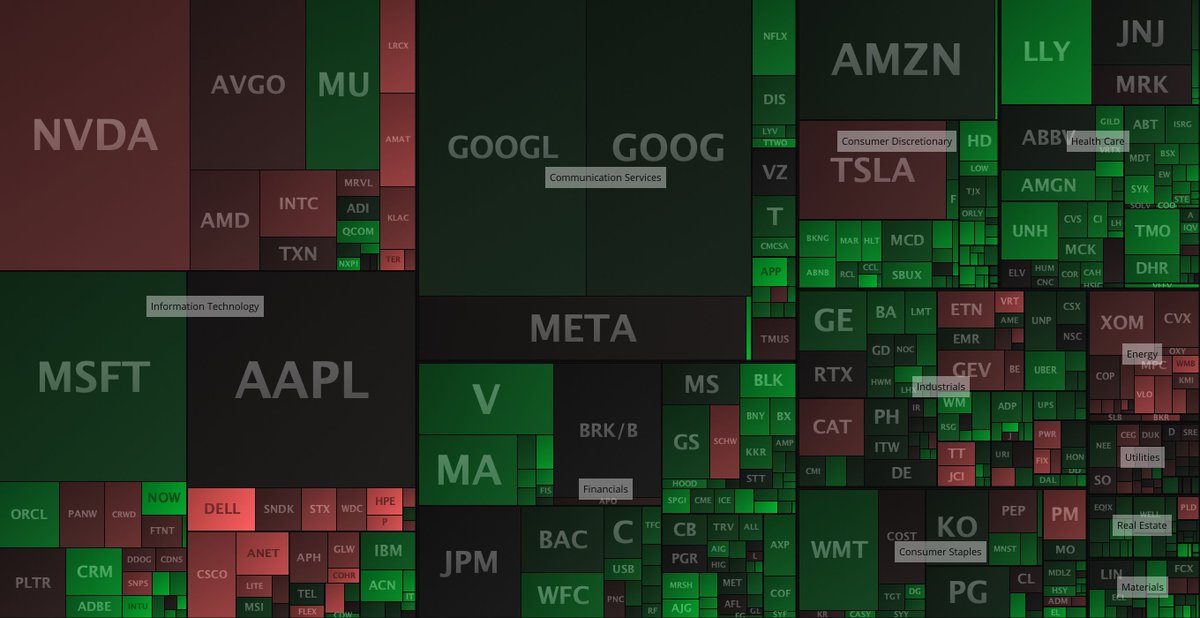
The backdrop is a sharp selloff in semiconductors. Reports cited Bloomberg as saying the Philadelphia Semiconductor Index has fallen 12% over the past six trading sessions, while CNBC said more than $1 trillion in value has been wiped from 20 major AI and semiconductor stocks this week.
That matters because SOXL is a 3x leveraged product, so flows into the fund are often a sign of aggressive short-term trading rather than a clean read on fundamentals. The move also keeps attention on SOXX, SMH and the wider AI trade, where volatility has risen alongside concern about spending, funding and stretched valuations.
There is no denial from the fund sponsor or the companies involved in the published reports, but the inflow itself does not prove a bottom. Traders will keep watching whether semiconductor ETF creations remain elevated and whether the broader chip complex can stabilize after the steep pullback.
Wedbush analyst Dan Ives said the latest AI stock pullback is a “clear buying opportunity,” the key new signal surfacing on X today. The call came as the global chip selloff extended, with Nasdaq 100 futures briefly down more than 1% and tech weakness spreading into Asia.
The main drag remains financing costs and debt stress. CNBC said 20 major global AI and semiconductor stocks have lost more than $1 trillion in market value this week, while Reuters highlighted renewed pressure around CoreWeave’s debt and credit-default swaps, which intensified concern over the funding model behind AI infrastructure.
Still, the fundamental demand story has not broken down. CNBC and Reuters both reported that TSMC posted a sixth straight quarter of record profit and guided for strong fourth-quarter revenue, suggesting AI chip demand remains robust even as investors reprice the cost of capital.
AMD was also caught in the broader rotation, with traders on X pointing to valuation pressure and scrutiny around future GPU demand. For now, the clearer takeaway is a sector-wide risk-off move, not a company-specific fundamental shock.
Anglo American CEO Duncan Wanblad said the miner has held talks with technology companies that are interested in buying equity stakes as a way to secure supplies of metals. He said there have been “deep expressions of interest,” but no stakes have been taken.
The backdrop is rising demand for copper, aluminum, steel and rare earths tied to data centers and AI infrastructure. FT also noted Anglo is still awaiting Chinese approval for its merger with Teck Resources, a deal that would create one of the world’s biggest copper producers if cleared.
For markets, the story keeps Anglo American and Teck Resources in focus because merger timing and approvals will shape the combined group’s copper profile. It also highlights a broader shift in which tech buyers may move beyond offtake agreements and look for equity exposure to upstream supply.
Wanblad made the remarks at the FT Metals and Mining Summit in London. The disclosure did not name any prospective tech investor, and the comments remain a signal of interest rather than a confirmed transaction.
Penske Automotive Group has agreed to go private in a transaction with its two largest shareholders. The deal values the company at an enterprise value of $16.3 billion, with public shareholders set to receive $212.00 in cash per share.
The agreement was announced on Oct. 15, according to the company release carried by PR Newswire. Bloomberg and CNBC both reported the deal the same day, making this the latest and most concrete update on a transaction first surfaced in the public domain today.
The stock is the direct focus of the news, and related investor-alert notices have already started to appear around the proposed sale. Those notices underscore that PAG is the main security affected by the buyout terms, especially the cash consideration and deal certainty.
For now, the key development is the agreement itself; the materials provided do not indicate completion. Any further market reaction will likely center on the transaction terms already disclosed in the announcement.
Charles Schwab reported third-quarter 2026 results with net revenue of $7.17 billion and adjusted EPS of $1.69, while net income rose to $2.91 billion. The firm also said core net new assets reached $190.4 billion and client assets climbed to $13.33 trillion.
The update extends a run of asset-growth and trading-activity strength. Multiple reports pointed to retail investors continuing to pour into equities, helping drive higher client assets, net new assets and trading volumes at the brokerage.
For the market, Schwab remains a key read-through for U.S. retail participation and brokerage activity. Investors are also focused on the mix of revenue, including net interest income, as the quarter showed continued scale expansion.
Schwab said it opened 1.2 million new brokerage accounts during the quarter and daily average trades totaled 10.69 million. Reports also cited net interest revenue of $3.48 billion, highlighting the balance between trading and interest-driven income.
Bank of New York Mellon reported third-quarter 2026 revenue of $5.676 billion, up 12% year over year, and diluted EPS of $2.34, also up 24%. On an adjusted basis, EPS came in at $2.37, ahead of the $2.27 consensus estimate, while revenue topped the $5.55 billion forecast.
The results were supported by a 12% increase in fee revenue to $4.078 billion and a 15% rise in net interest income to $1.423 billion. Management said growth reflected new business, stronger client activity and higher market values; the Securities Services unit posted $2.820 billion in revenue, led by Asset Servicing and Issuer Services.
The quarter also highlighted BNY’s profitability profile, with a 38.5% pre-tax operating margin, 29.0% ROTCE and a 10.9% CET1 ratio. Investors are parsing the release alongside earnings from peers such as PNC and US Bancorp as part of the latest read on U.S. bank earnings resilience.
BNY said it returned $1.4 billion to common shareholders during the quarter, including $436 million in dividends and $937 million in share repurchases. The company also reiterated that client demand remained healthy across products, segments and regions.
Marsh McLennan reported third-quarter revenue of $6.86 billion, above the $6.64 billion consensus cited in the signal. Adjusted EPS came in at $2.03, also ahead of the $1.97 estimate.
The company said underlying revenue grew 5%, versus the 3.9% estimate in the wire, while adjusted operating income reached $1.53 billion. Adjusted operating margin was 22.7%.
The result matters primarily for MRSH shares, as investors typically focus on whether the company can sustain revenue growth while protecting margins. The earnings beat and stronger underlying growth are the key fresh data points in today’s signal.
Related coverage in the site news database points to the same third-quarter earnings release, including commentary that Marsh & McLennan also raised a savings target for Thrive. This report, however, is centered on the numbers newly highlighted in the X wires.
Interactive Brokers tops revenue forecasts with $1.914 billion in Q3
The broker posted stronger-than-expected revenue, while adjusted EPS came in slightly below estimates as investors focused on net interest income and trading activity.
Interactive Brokers Group reported third-quarter 2026 results. Fast Stock News said revenue came in at $1.914 billion, above the $1.888 billion estimate, while adjusted EPS was $0.67 versus $0.68 expected. Wall Street Engine added adjusted pretax income of $1.45 billion and net interest income of $1.154 billion.
The new signal is about the company’s latest earnings release, not just a stock move. An earnings preview on X said investors were watching customer account growth, trading volumes and net interest income, since those metrics drive IBKR’s earnings mix.
For the market, the main focus remains IBKR itself, especially the quality of revenue and profitability. Schaeffers also put the implied move for tonight’s report at ±4.63%, underscoring the degree of expected post-earnings volatility.
A related item in the site’s news库 is N1, which covered IBKR’s market action on October 14. Because the full earnings release is not included in the site library here, the figures above are sourced from the X signal and the quoted fast-news wires.
Germany is preparing a broad AI cooperation agreement with Nvidia that could be announced next week at the “Invest in Germany” summit in Berlin, according to Handelsblatt and Reuters. The reported plan centers on two goals: building infrastructure for physical AI applications such as robot training and autonomous vehicles, and developing industrial-grade AI models.
The reported initiative would build on Germany’s SOOFI project and involve public funding in the hundreds of millions of euros. Reuters reported in November 2025 that Deutsche Telekom and Nvidia had already launched a 1 billion euro AI cloud for industrial customers, highlighting how the new effort would extend an existing industrial AI push rather than start from scratch.
If confirmed, the partnership would put Nvidia deeper into Europe’s industrial technology stack, with Siemens, Audi and Black Forest Labs named in reports as potential participants. It also keeps Germany’s push for digital sovereignty in focus, as the government seeks more domestic AI capacity without giving up control over industrial data.
Germany has not commented publicly, while Nvidia said Jensen Huang will be in Berlin next week for a speech and press engagement. For investors, the main watch items are the official announcement, the final funding size, and whether the project expands demand for Nvidia hardware and software across Europe’s manufacturing base.
Nvidia CEO Jensen Huang said the company does not need to backstop CoreWeave, adding that the cloud AI provider’s cost of capital is “actually decreasing” and that its strength is improving every day. The comments are the latest fresh signal on CoreWeave’s financing profile and appear to mark an incremental shift in tone from rescue talk to improving fundamentals.
CoreWeave has been closely watched since its public listing earlier this year, with investors treating it as one of the most financing-sensitive names in AI infrastructure. Nvidia’s role in the company has kept the stock at the center of debates about how much support the chip giant is effectively providing to the broader ecosystem.
For markets, the remarks matter most for $CRWV and $NVDA. CoreWeave’s ability to fund expansion is central to its growth case, while Nvidia’s posture reinforces its strategic influence across AI infrastructure without formally stepping in as a guarantor.
The latest comments were carried in real time by multiple market feeds and are consistent with prior reporting on Nvidia’s stake and CoreWeave’s IPO backdrop. No separate, contemporaneous response from CoreWeave was immediately available in the publicly surfaced material.
TSMC CEO C.C. Wei confirmed the company is evaluating whether to expand U.S. chip manufacturing beyond Arizona into Texas, with teams already assessing potential sites. He also said TSMC is in discussions with Elon Musk over the Terafab project, but any alliance would require TSMC to control chip production.
The update extends a broader U.S. expansion story for the world’s top contract chipmaker. In a WSJ report from the previous day, TSMC’s strong earnings were tied to sustained demand for AI infrastructure, underscoring why its manufacturing footprint remains closely watched.
For markets, the relevant names are TSM, SPCX and TSLA: TSM because the Texas plan could reshape its U.S. manufacturing strategy, and SPCX/TSLA because they are tied to Musk’s Terafab initiative. The discussion is still preliminary, with no agreement reached, so the immediate significance is in the conditions TSMC is setting rather than in any finalized deal.
Wei’s message was clear: talks are ongoing, but operational control remains a non-negotiable condition.
Amazon on Oct. 15 introduced two new Bee personal AI devices, Bee Frontier and Bee Eclipse. The company said the devices can record and analyze daily conversations, then turn them into summaries, to-do lists and reminders.
The launch extends Amazon’s consumer AI strategy beyond home assistants and into wearable hardware. The products are designed to keep Alexa+ and Amazon’s AI ecosystem closer to users throughout the day, rather than only inside the home.
Investors will likely view the move as another signal that Amazon wants a larger role in consumer AI devices, an area that could also put the company in closer comparison with Apple and Meta. The key questions now are adoption, privacy reception and whether the devices can support a subscription-driven business model.
Amazon CEO Andy Jassy said in an X post that the devices turn conversations into summaries, to-dos and reminders. Public reports so far have not disclosed shipment targets or formal financial guidance tied to the launch.
Porsche unveiled the Mission S concept on Oct. 15, using the show car to preview a new design direction for the brand. The company said the vehicle points to a mid-engine super sports car platform positioned above the 911, not a one-off halo project.
The reveal is part of Porsche’s “Sportwagenschmiede ’35” reset, which prioritizes higher-end models and profitability over volume. Porsche said the platform will accommodate gasoline, hybrid and plug-in hybrid powertrains, while ruling out a full EV for now.
For investors, the update reinforces Porsche’s bet on combustion and hybrid technology at the top end of its lineup as it tries to rebuild margins. The move also keeps attention on Porsche’s parent Volkswagen as the company pushes a more premium product mix.
Porsche has not disclosed pricing, performance figures or a production timeline for the Mission S-based model. The automaker said the platform is intended to become a permanent addition to its lineup.
The U.S. Labor Department said initial jobless claims rose by 1,000 to a seasonally adjusted 199,000 in the week ended Oct. 10. That was slightly below the Reuters forecast of 200,000 and followed an upward revision of the prior week to 198,000.
The report matters because initial claims are a closely watched proxy for layoffs. Reuters said claims stayed below 200,000 for a fifth straight week, while the Federal Reserve’s Beige Book described labor-market conditions as little changed, even as some districts still reported shortages of specialized and skilled workers.
Continuing claims fell by 4,000 to 1.710 million in the week ended Oct. 3, suggesting no clear deterioration in the pool of people already receiving benefits. The data are usually most relevant for Treasury yields, the dollar and rate expectations, but this release was close enough to forecasts to reinforce rather than rewrite the labor narrative.
AP separately noted that September payroll growth was only 29,000 and the unemployment rate rose to 4.2%, underscoring a low-hire, low-fire labor market. Together, the figures point to hiring softness even as layoffs remain contained.
Sweden’s seasonally adjusted unemployment rate fell to 8.6% in September from 8.9% in August, according to Statistics Sweden. The unadjusted rate was 8.1%, down from 8.5% a month earlier, while the trend measure held at 8.7%.
The release gives investors a fresh read on the Swedish labor market and keeps attention on the outlook for domestic growth and the Riksbank’s policy path. SCB also said the labor force for people aged 15-74 stood at 5.758 million, with 5.292 million employed in September.
South Korea separately reported a September unemployment rate of 2.6%, down from 2.7% in August. Together, the figures add to a busy macro calendar for currency and rates markets in both countries.
The official SCB release and multiple market wires converged on the same Swedish numbers, while the Korean print was echoed by several news services citing the monthly labor release. That makes the 8.6% and 2.6% readings the key verified takeaways from the day.
Reuters and other posts say Ukrainian President Volodymyr Zelenskyy has ordered strikes on Russian oil refineries to resume. The reports say the campaign had been paused for about three days before the latest decision.
The statement lands as President Donald Trump pushes an “energy ceasefire.” In the cited remarks, Zelenskyy said Kyiv was “done,” arguing Russia continued deadly attacks on Ukrainian energy facilities.
For markets, the signal matters most for refining and fuel-supply expectations. U.S.-listed names in the group include Marathon Petroleum (MPC), Delek US (DK) and Calumet (CLMT); in the site library, CLMT also disclosed a $150 million note redemption notice on Oct. 15.
Moscow responded by accusing Ukraine of violating the spirit of U.S. peace efforts. No contrary denial from Kyiv is included in the provided material.
The Russell 2000 fell into correction territory on Wednesday, dropping more than 10% from its Aug. 14 record close. Several reports linked the move to hotter inflation data and rising bets that the Federal Reserve may still need to raise rates again this year.
Small-cap stocks are more exposed to borrowing costs because many depend on debt financing and floating-rate obligations. As Treasury yields climb and financial conditions tighten, investors have been pulling back from the riskiest corners of the market.
CNBC said the index finished Wednesday down about 11% from its August high, marking its first correction since March. MarketWatch likewise reported that the benchmark had fallen more than 10% from its peak, citing higher yields and fading rate-cut expectations as key drags.
The move matters for products tied to the index, including IWM and RTY, and for rate-sensitive sectors such as regional banks, industrials, consumer names and transports. Market observers also noted that historical rebounds after prior Russell 2000 corrections have been mixed, with timing varying widely.
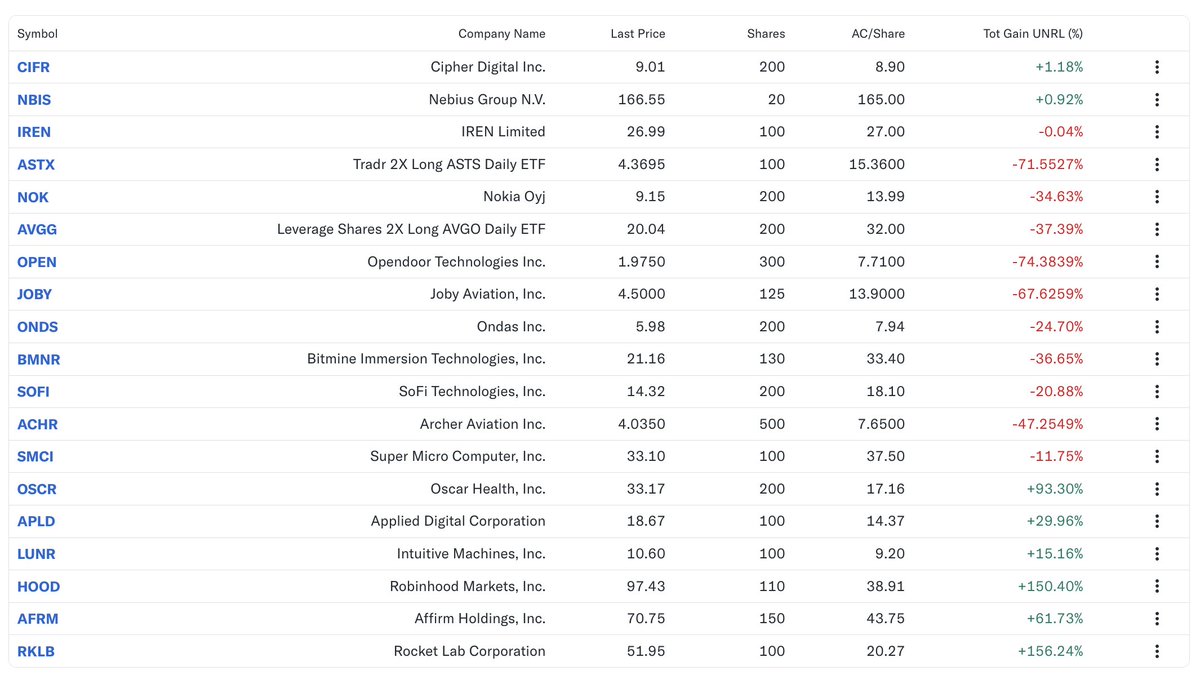
X posts from multiple traders say IREN has kept sliding, with one calling it near its worst drawdown in three years. Several posts also place the stock around $27 and say it fell about 25% over the past week.
A Zacks report on Oct. 15 said IREN is expanding liquid-cooled data centers to boost AI computing capacity and revenue per MW, but warned that $25 billion to $30 billion of fiscal 2027 capex creates execution and financing risk. That backdrop helps explain why the stock remains under close scrutiny.
The weakness is not isolated. The same stream of posts also cites sharp recent declines in ASTS, CRWV and NBIS, suggesting traders are reassessing the whole AI-linked group rather than one name alone.
No company response appears in the material. The new information today is the more explicit price action and drawdown framing, not a fresh corporate disclosure.
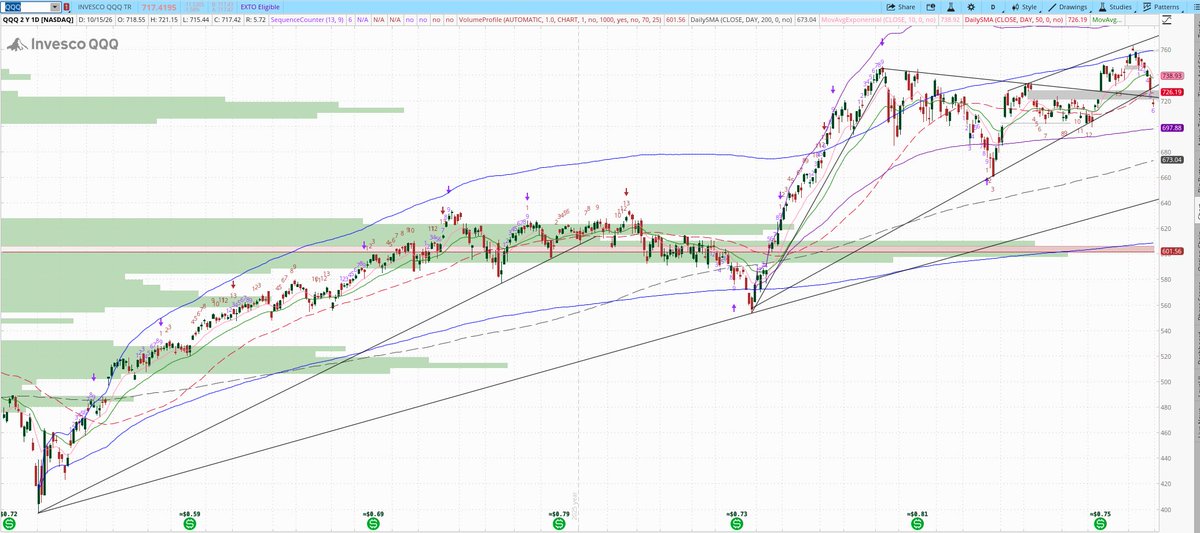
Intraday signals point to a range trade, with traders watching 772 resistance and 765 support after AI-linked weakness hit the Nasdaq side of the market.
SPY found support just above 765 while QQQ underperformed, reinforcing a mixed tape with a clear split between broad indexes and growth-heavy tech. Several trader posts described SPX/ES as range-bound around the 7700 area, with 7700 to 7730 acting as the immediate battleground.
The backdrop is a cooling AI trade: short-term commentary says the earlier leadership in semiconductors and other AI names has faded, leaving the Nasdaq more vulnerable than the S&P 500. A premarket market note also flagged negative gamma near 768 and 765, with 772 cited as a key call wall.
For the tape, that setup favors tactical range trading over a clean trend day. SPY, QQQ and ES are likely to remain sensitive to whether buyers can reclaim 772 or whether sellers press through 765, with chips and other high-beta AI names the most exposed if weakness persists.
There was no fresh company announcement or macro release directly explaining the move. The immediate story is mostly positioning, rotation and a reassessment of how crowded the AI trade had become.
Deutsche Bank upgraded Walmart to Buy from Hold and raised its price target to $136 from $113. The move helped push WMT toward multi-month highs.
The bank cited an inflationary environment as a tailwind for the retailer. That keeps Walmart in focus as investors continue to favor defensive names in a high-price backdrop.
Schaeffers Research said Walmart was up 3.3% to trade at $120.04 after the note. The outlet also said the stock was up 7% on the year and that 35 of 39 covering firms rate it Buy or better.
No company response was cited in the materials provided. The incremental takeaway is the new rating call and higher target, rather than a new operational update from Walmart.
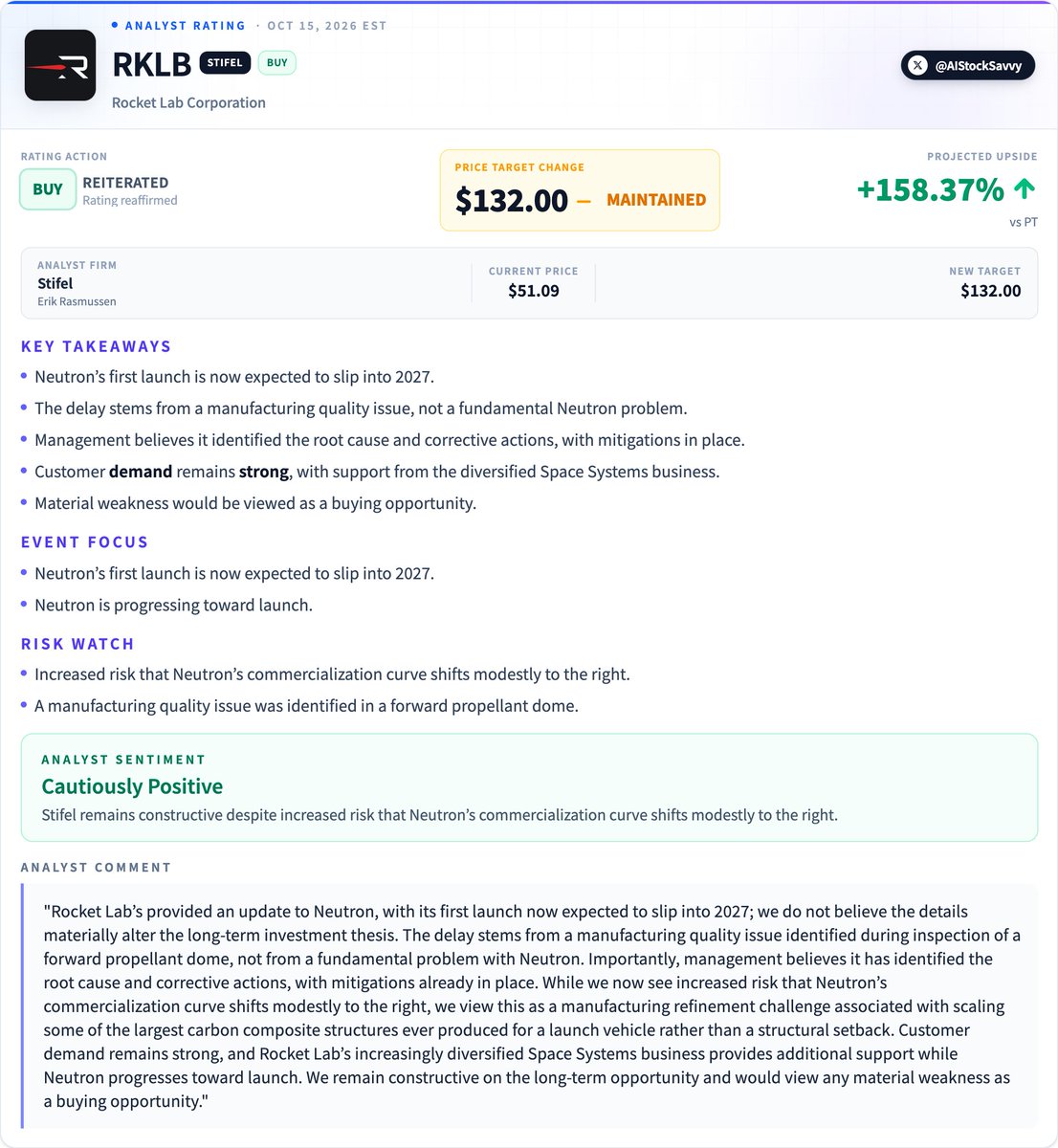
Rocket Lab USA (RKLB) drew fresh support from Wall Street after its Neutron program was pushed into 2027. Stifel reiterated Buy and kept its price target at $132, while Cantor Fitzgerald reiterated Overweight and maintained a $122 target.
The move follows Rocket Lab’s update that the first Neutron launch is now planned for 2027, instead of Q4 2026. Company materials and related coverage frame the delay as a manufacturing and refinement issue rather than a change in the broader business case.
RKLB shares have been volatile around the update, with reporting and social posts pointing to a sharp selloff. The new analyst notes suggest investors are now weighing execution timing against the company’s longer-term launch thesis.
Both Stifel and Cantor said the setback is disappointing but does not materially alter their investment view. In that sense, the latest development is less about a thesis reset than a repricing of schedule risk.
Iambic Therapeutics rose 18% in its Nasdaq trading debut on Thursday, closing at $18.91 after pricing its initial public offering at $16 a share. The San Diego-based AI drug developer raised $150 million in the US listing and trades under the symbol IAM.
The company had announced the pricing on Oct. 14, selling 9.375 million shares at the midpoint of its marketed range. Iambic said it plans to use the proceeds to advance its oncology pipeline, which is built around AI and machine learning.
The debut adds another public market data point for AI-enabled biotech names and extends Nvidia’s presence in the sector, where it is listed as a shareholder in Iambic. Bloomberg reported the stock closed up 16%, while Reuters-sourced coverage cited a gain of nearly 18%; the company’s closing price implies an 18% rise versus the IPO price.
Iambic’s offering is scheduled to close on Oct. 16, according to its IPO pricing release. The listing comes as investors continue to test appetite for early-stage life sciences companies that pair drug discovery with proprietary software platforms.
Google plans to launch four TPUs into orbit on a SpaceX Falcon 9, marking the first test of Project Suncatcher for solar-powered AI compute in space.
2026-10-025 posts · 5 authors
Google and Planet Labs successfully launched Project Suncatcher M1 on SpaceX's Transporter-18 mission, with TPUs in low Earth orbit and contact established.
2026-10-075 posts · 5 authors
SpaceX reportedly seeks $40B in financing for NVIDIA AI chips; Musk says Tesla and SpaceX will build and operate Terafab themselves, with TSMC at most subleasing.
2026-10-123 posts · 3 authors
Deutsche Bank upgrades AST SpaceMobile to Buy with a $93 price target; SpaceX and others charge $40M per MW annualized on short-term compute deals.
2026-10-135 posts · 5 authors
AST SpaceMobile lists upcoming catalysts including satellite deliveries and launches; Google confirms Project Suncatcher prototype satellite is operating as expected.
2026-10-162 posts · 2 authors
The EU prepares to fast-track antitrust approval for the Airbus-Leonardo-Thales satellite venture 'Project Bromo' to reduce reliance on SpaceX and US providers.