Brent crude rose above $110 a barrel on Oct 20, its first time at that level since May, and settled at $109.55. US WTI climbed above $107. Iran's Revolutionary Guard said the US attacked the Konarak naval base with two light projectiles early in the day, injuring two soldiers; Washington did not respond.
The immediate trigger is shipping security in the Strait of Hormuz. Iran said at least eight vessels have struck mines south of the strait in the past week, including two overnight. Yemen's Houthis separately claimed attacks on Aramco's Yanbu refinery, the Shaybah oilfield and airports in Riyadh and Abha; Saudi authorities did not immediately confirm.
Oil's move coincided with a renewed selloff in AI and chip stocks in US premarket trading, pushing investors away from risk. Recovering Gulf crude exports and the prospect of more Russian supply capped gains, but traders are pricing higher Hormuz transit risk.
Iran's First Vice President Mohammad Reza Aref said Tehran has "no choice" but to assert control over the strait and that the US must pay the price. Analysts are watching whether Brent confirms a close above $110, with technical levels pointing to $119.98-$122.14.
OpenAI Said to Speed Up Roughly $30 Billion Raise at Over $1.4 Trillion Valuation Ahead of Anthropic IPO
Reuters reports SoftBank and MGX in talks to join; Anthropic is expected to list in mid-November as both AI firms compete for the same investor capital
OpenAI is racing to lock in investor commitments for a private round of about $30 billion that could value the ChatGPT maker above $1.4 trillion, according to Reuters. The unusually fast fundraising is aimed at closing before rival Anthropic's expected public debut in mid-November.
SoftBank and MGX are among potential investors, the reports said. Coin Bureau, citing Reuters, put the new valuation against $852 billion in March; a separate post claimed $50 billion in annualized revenue for OpenAI, a figure that appeared in only one source and was not corroborated across the materials.
On the Anthropic side, its pre-IPO perpetual on Liquid rose more than 3% in 24 hours, bringing the implied valuation closer to $2 trillion after a sharp selloff last week. CNBC described Anthropic as the AI trade's last big hope for a major IPO this year.
The fundraising race comes as AI stocks flash bubble warnings: semiconductor shares posted their steepest relative decline in years, while AMD closed at $538.05, up 1.76%, according to the newsroom feed.
Anthropic is in talks to buy about $45 billion of computing power from Nvidia-backed AI cloud firm Nscale, for a second facility at its Monarch data center campus in West Virginia, according to Bloomberg, citing people familiar with the negotiations. Reuters, citing a source, said the building would deliver 460 megawatts using Nvidia's advanced Vera Rubin chips; talks are ongoing and details could change, and Anthropic did not immediately respond to a request for comment.
The discussions follow an August agreement in which Anthropic committed to spend $45 billion renting AI computing power from Nscale's West Virginia campus. Bloomberg, citing a regulatory filing for Nscale's planned IPO, said Anthropic already has infrastructure agreements with Nscale worth as much as about $44.6 billion; Reuters said Anthropic also holds a right of first refusal on Monarch's expected third building.
For the market, a second deal would deepen ties between Nvidia's chip ecosystem and Anthropic's compute buildout, with Nvidia (NVDA) central as both an Nscale investor and supplier. The report also said a cohort of investors had urged Anthropic to lower its IPO valuation target after market setbacks for AI companies, highlighting tension between infrastructure spending and fundraising.
Neither company has confirmed a deal. Bloomberg said an agreement could be finalized within days and would bolster Nscale's IPO prospects; the talks remain at the negotiation stage, with final value, capacity and timing still uncertain.
Report: US, Iran Give Preliminary Nod to Qatar-Pakistan Proposal With IAEA Checks, Partial Release of Frozen Funds
Reported plan covers confidential IAEA inspections and partial release of frozen Iranian funds; details and extent of approval remain unverified after repeated diplomatic setbacks.
Qatari outlet Al-Araby Al-Jadeed, citing sources familiar with the mediation, reported that Qatar and Pakistan presented a compromise proposal that addresses demands from both Washington and Tehran and has drawn preliminary approval from both sides. The reported plan includes confidential IAEA inspections of Iranian nuclear sites and a partial release of frozen Iranian funds.
The report comes after months of stalled diplomacy since the U.S.-Iran war began on Feb. 28. Pakistan's army chief visited Tehran for talks, and Pakistani and Qatari officials used the Doha security forum to stress sustained engagement; Iran has tied reopening the Strait of Hormuz to lifting the U.S. port blockade and easing oil sanctions, while Washington insists the nuclear program be addressed first.
For markets, the headline bears directly on oil and energy assets; USO, an ETF tracking crude futures, is the candidate instrument. Any confirmed diplomatic progress could affect the crude risk premium, but the report itself is flagged as unverified and should not be treated as a basis for pricing.
No party has confirmed the full text. The reports caution that details and the extent of the 'preliminary approval' remain unclear.
President Trump issued a statement on Truth Social thanking Elon Musk for committing to donate SpaceX (NASDAQ: SPCX) shares to American children through Trump Accounts. Trump called Musk a "legendary friend" and said the gift is "exactly what was envisioned" when Trump Accounts were created, with the goal of giving "every American Child a piece of the American Dream."
Multiple X accounts reported that the pledge would give one SpaceX share to millions of American children. Figures cited for the size of the giveaway varied across posts, and neither SpaceX nor the account administrators have formally disclosed the terms.
SpaceX has been in the market spotlight: Bernstein reaffirmed a "Buy" rating and a $248 price target on October 19, and the company is scheduled to report third-quarter 2026 earnings after Tuesday's market close. A giveaway of this scale would involve substantial share registration and account-allocation logistics that remain undefined.
Musk has not released further details beyond the commitment as relayed by Trump, and SpaceX has not publicly addressed the number of shares, timing or tax treatment of the plan.
SpaceX (NASDAQ: SPCX) reports third-quarter results after the bell on Tuesday, its second earnings release since a record IPO in June. The earnings call is scheduled for 4:30 p.m. ET, with CNBC's live coverage flagging Starlink growth, AI revenue and merger speculation as focal points.
Options traders are pricing an implied move of roughly plus or minus 6.8% in the stock following the report. Wedbush's Dan Ives named SpaceX one of his three big tech earnings focus points this week, citing Starlink-funded AI growth.
The report lands in a heavy week for tech earnings: stocks staged an oversold bounce on Monday, and results this week are seen as determining whether that rebound holds. Tesla and Meta report Wednesday, while Netflix reports after the bell Tuesday.
Separately, Bernstein reaffirmed a Buy rating and a $248 price target on SpaceX on October 19, according to Finbold. A Fool.com piece discussed the possibility of a SpaceX-Tesla merger before the end of 2026; the merger talk remains speculation and has not been confirmed by either company.
DeepSeek is helping design Huawei's AI chips, with Huawei engineers stationed at the startup's offices to feed model requirements on computation and inter-chip data transfer into chip designs, The Information reported. DeepSeek plans to start training models on Huawei's Ascend 950DT as soon as the end of 2026, while Huawei intends to prioritize DeepSeek on its next-generation Ascend 960DT, expected in the first quarter of 2027.
The collaboration binds a leading Chinese AI model developer more tightly to domestic compute. Public documentation shows DeepSeek has adapted tools to the Ascend 950 family and uses TileLang, an open-source language that helps move AI software across chip architectures, reducing dependence on Nvidia's CUDA; Huawei is meanwhile building out its CANN platform as a CUDA rival.
The technical gap remains wide. Nvidia's B300 delivers roughly seven times the raw arithmetic performance of Huawei's Ascend 950, according to Epoch AI, and training a frontier model could require more than 10,000 Huawei chips running together for weeks, making manufacturing capacity and system reliability critical. DeepSeek is not abandoning Nvidia and continues to seek access to its advanced processors, the report said.
Listed companies in the frame include Nvidia (NVDA), AMD and Intel (INTC), all of which compete with Huawei in AI chips. The report disclosed no deal value or volume figures.
The New York Stock Exchange launched extended-hours trading for NYSE American Options on Monday, Oct. 19, covering 29 large-cap stocks and ETFs including Nvidia (NVDA), Bank of America (BAC), SPY, IWM and GLD. The new sessions run 7:30-9:25 a.m. ET before the open and 4:00-4:15 p.m. ET after the close.
The NYSE, owned and operated by Intercontinental Exchange (ICE), is the second major exchange to offer extended options hours after Cboe, which announced coverage of 25 single stocks and five ETFs and has reported average extended-hours options volume above 199,000 contracts a day.
Per CNBC, starting Dec. 6, 2026, trading in those same names will stretch to 23 hours a day, five days a week, alongside SEC-approved 23-hour equity sessions also set to begin that day. The extended sessions accept limit orders only, with voluntary market-maker quoting and no stop, good-till-cancelled, complex or cross orders.
First-day volume was light, with Tesla options leading at a little over 3,000 contracts, almost all calls, ahead of the company's earnings report on Wednesday. Kevin Tyrrell, NYSE chief product officer, said extended options hours reflect market demand for investment opportunities and reliable risk management over a longer period.
General Motors reported third-quarter 2026 results before the bell on Oct. 20: revenue of $50.02 billion, up about 2.9% year over year and above the roughly $48.7 billion consensus, with adjusted EPS of $3.70 versus $3.63 expected, up more than 30% from a year earlier. Adjusted EBIT came in at $4.11 billion, below some estimates of $4.24–4.25 billion; North America adjusted EBIT was $3.59 billion while international operations contributed just $28 million, far short of expectations.
The automaker narrowed full-year adjusted EPS guidance to $12.75–$13.75 from a prior $12–$14 range, guided full-year adjusted EBIT to $14.5–$15.5 billion, and raised its adjusted automotive free cash flow outlook to $11.5–$12.5 billion from $9.5–$11.5 billion. The board also approved a new $20 billion multiyear share repurchase authorization with no expiration date, after a $6 billion program announced in January was completed.
Despite the beats, GM shares fell more than 5% in premarket trading, with some quotes showing a drop of nearly 7% that would mark the steepest one-day decline in about 15 months. JPMorgan analysts called the results an “in-line print with mixed quality,” saying improved sales volume was offset by lower prices and that investors may question pricing conviction amid rising commodity and logistics costs.
GM also declared a quarterly dividend of $0.18 per share. CEO Mary Barra said in her shareholder letter that the new buyback authorization demonstrates confidence in the company's strategy. Further detail on costs and pricing is expected on the earnings call.
Company
Apple Sets Oct. 28 'Pro and tell' Event; Analysts Expect First Touchscreen MacBook
The invite confirms Apple's second product event this month but names no products; a touchscreen MacBook Pro would mark a major shift for the lineup
Apple on Monday sent invites to media and analysts for a product launch event on Oct. 28 at 10 a.m. PT in Los Angeles, billed as "Pro and tell." The company did not disclose which products will be shown.
Bloomberg and CNBC reported that analysts expect Apple to unveil its first touchscreen MacBook, described as a touchscreen OLED MacBook Pro, alongside new M6-powered Macs and an OLED iPad mini. It would be Apple's second product event this month.
On the market side, Apple shares were indicated down about 1.5% premarket. Separately, a five-star Wall Street analyst downgraded Apple to 'Hold' from 'Buy', citing weaker iPhone shipment expectations and rising memory costs.
The touchscreen MacBook remains in the realm of reports and analyst expectations: Apple has confirmed only the date and name of the event, not any specific product.
Salesforce said it has agreed to acquire Braze for about $5.66 billion in enterprise value, paid entirely in cash at $47.50 per share. Multiple outlets reported the same enterprise value, and MarketWatch put the offer at roughly a 58% premium.
Braze provides a real-time customer engagement platform that, according to the X posts, had been taking customers from Salesforce's own Marketing Cloud. Those posts say the deal lets Agentforce act on live customer behavior and adds Braze's usage-based revenue model to Salesforce.
The market response split: CNBC reported Braze shares jumped 50% on the news while Salesforce shares slipped. 247wallst said CRM fell about 2% to $238 as ServiceNow and Adobe each gained about 2%, and MarketWatch described Wall Street's response as frosty.
The deal terms disclosed in the announcement are $47.50 per share in cash and an enterprise value of about $5.66 billion; the materials do not include further comment from Braze or Salesforce management.
A power outage at Google's London cloud data center triggered widespread disruptions across UK banking and online services, the BBC reported. Affected services included Revolut, HSBC, Lloyds, Bank of Scotland, Halifax and Royal Mail, as well as court video links.
The Wall Street Journal reported that Revolut suffered a widespread outage affecting payments, transfers and withdrawals, while Bloomberg said the disruption hit early on Tuesday. Google Cloud reported "issues" in its western Europe region; the materials do not specify a restoration time.
The central subject is Google Cloud, part of Alphabet. The newsroom's recent coverage of Alphabet focuses on shareholding changes, AI strategy and a Q3 preview; N5 notes Google Cloud grew 82% in the second quarter but does not address this outage, so no quantified impact on Google Cloud's business can be drawn from the materials.
The materials contain no formal response from Google, Revolut or HSBC on the outage.
Meta published an engineering breakdown on Oct. 20 of Prometheus, its gigawatt-scale AI supercluster in New Albany, Ohio. According to multiple accounts of the disclosure, the first phase is complete and connects hundreds of thousands of Nvidia GPUs, with plans to scale toward roughly 1 million using GB200, GB300 and eventually Vera Rubin systems. The cluster trained Meta's latest Muse models.
One operating figure cited in the posts: Muse Wonder achieved over 85% goodput during pretraining, with roughly 47,000 GPU hours between interruptions. Nvidia's infrastructure team said co-engineering cut interruptions by 99%, converting installed capacity into productive training time.
The disclosure lands after a pullback in AI chip shares. Our newsroom's files show the PHLX Semiconductor Index fell for eight straight sessions through Oct. 16, down about 16%, while Meta's equity raise drew scrutiny. For Nvidia, the buildout pace of a top hyperscaler customer is a direct read on order visibility; for Meta, funding a gigawatt-scale capex program under financing pressure is the market's focus.
Both companies framed the disclosure as the product of deep co-engineering, with teams embedded in data centers and sharing real-time telemetry. The scale and reliability figures come from the companies' own materials and have not been independently verified.
BlackRock filed a preliminary prospectus with the SEC on Monday for the iShares Bitcoin Managed Protection ETF, ticker PBIT. The fund would not hold bitcoin directly; it would use options linked to the firm's iShares Bitcoin Trust (IBIT) to offer upside exposure while seeking a level of downside protection, with gains capped in exchange.
It is BlackRock's third bitcoin ETF, after spot IBIT launched in January 2024 and the iShares Bitcoin Premium Income ETF (BITA), an options-income product introduced in June 2026. Bloomberg Intelligence analyst James Seyffart called PBIT a "buffer" fund and noted BlackRock still offers only bitcoin and ether products, with no Solana or XRP funds.
According to the filing and press reports, three overlapping options positions would initially shield against losses beyond roughly 10%, though exact protection and cap levels remain unspecified. Calamos offers a precedent: its Bitcoin Structured Alt Protection ETF is down about 1% since its October 2025 protection period began, while bitcoin fell as much as 52% from a record near $126,000.
Flows underline the demand shift: IBIT drew more than $665 million in net inflows Monday, its strongest day since October 2025, and US spot bitcoin ETFs took in about $526.6 million combined. The move extends BlackRock's lineup from plain price tracking toward hedging and income structures.
Mastercard unveiled Stablecoin Security at Money20/20 USA in Las Vegas on Oct. 19, combining payment data with blockchain analytics to surface fraud, scam, sanctions and other financial-crime risk indicators before stablecoin funds move on-chain. The service is delivered via API so banks can plug it into existing fraud-prevention and compliance systems, with Borderless.xyz and Keyrails as initial partners.
Citing a study of 593 million stablecoin transfer events across 141 million Ethereum transactions in 2025, Mastercard said nearly 60% were complex, multi-step transactions, making risk hard to assess across the full payment journey. The service launches first in North America, with global commercial availability expected in 2027.
For $MA, the move extends its existing payments risk controls into on-chain flows; safer rails could support bank and merchant adoption of stablecoin payments, while the tool itself adds an institutional risk-intelligence offering. Ann Johnson, executive vice president of Security Solutions, said financial institutions need the right intelligence and controls to participate with confidence.
The launch follows Mastercard's addition of identity, intent, behavioral and fraud insights to its Agent Pay platform about three weeks earlier, as the company builds guardrails around both agentic and blockchain-based payments.
US housing starts fall 5.2% in September to 1.221 million, a four-month low
Elevated mortgage rates and affordability constraints pushed builders to a third straight monthly pullback, a key leading indicator for residential investment and housing-linked demand.
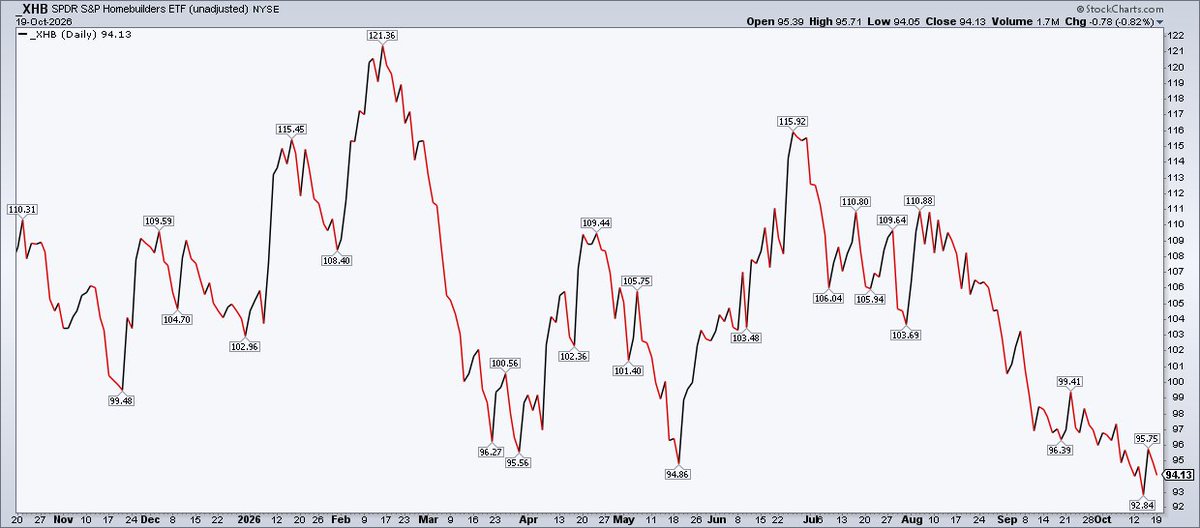
US housing starts fell 5.2% month-on-month in September to a seasonally adjusted annual rate of 1.221 million, below expectations of about 1.305 million and the lowest in four months, according to Commerce Department data released Tuesday. August was revised up to 1.288 million. Building permits slipped 0.2% to 1.400 million, a smaller decline than forecast.
Single-family starts dropped 4.6% to an 859,000 annual rate, while the multifamily segment fell 6.7% to 362,000. The National Association of Home Builders attributed the weakness to high mortgage rates, persistent affordability challenges and rising land, labor and construction costs.
Bloomberg reported the pace trailed all estimates in its economist survey, while Trading Economics called it the third consecutive monthly decline and the lowest since May's six-year low of 1.182 million. Bespoke Investment Group noted the 12-month average of housing starts is at its lowest since August 2020.
The SPDR S&P Homebuilders ETF (XHB) was near a 52-week low ahead of the release, reflecting investor caution on builder orders and inventory; the data also bears on building-materials and home-retail names tied to the housing cycle.
BofA Sticks With October Hike Call as Market Prices Only ~20%
After a hot September inflation print and no guidance from Warsh, markets treat an October 28 hold as the base case; BofA calls that a low-probability hawkish risk
Bank of America analysts kept their call for a Federal Reserve rate hike at the October 28 meeting, while conceding it is a "very close call." The bank argues the size and breadth of the September inflation beat offset prior downward revisions, with core PCE plausibly ending the year near 3.4%.
Market pricing diverges sharply. After Chair Kevin Warsh said Friday at the IMF meetings that he does "not prejudge meetings," the odds of an October hike fell from 28% to below 15%; Fed funds futures now price about 4bp for the October meeting, down from 13bp a week earlier. Goldman Sachs concluded the FOMC is set to pause in October and deliver a final hike in December.
BofA also flags a political constraint: the meeting falls six days before the elections, and policymakers may not want to risk a market disruption with a large hawkish surprise — which the bank calls perhaps the best reason to hold in October. Rate-sensitive assets therefore hinge more on the December path than on this meeting.
The disagreement centers on Warsh's intentions. BofA says it has low conviction on whether he is serious about a "sea change" at the Fed and is giving him the benefit of the doubt for now; markets read the absence of hawkish guidance as a pause signal.
How this story unfolded
2026-08-226 posts · 6 authors
Fed released weekly H.8 commercial bank data; discussions focused on QE vs. YCC definitions and Treasury interventions' impact on the dollar.
Company
Gartner: AI data centers need $8.5 trillion in revenue; over $3.5 trillion of spending at risk
The firm also expects 80% of independent neoclouds to cease operations by 2030, putting financing costs at the center of the build-out debate
Gartner chief forecaster John Lovelock said owners of AI data centers need about $8.5 trillion in revenue through 2030 to cover spending and earn a 12% return, while the firm's forecast for AI revenue tied to those facilities tops out at $3.6 trillion — leaving more than $3.5 trillion of that spending at risk. Lovelock also predicted that roughly 80% of independent neoclouds could cease operations by 2030, saying "pretty much every market" in the AI race is likely to collapse to a duopoly.
The warning lands as AI infrastructure shares come under pressure. CoreWeave (CRWV) fell about 25% in a matter of days as spending fears outran demand, while Applied Digital (APLD) posted 322% growth in AI-driven revenue but carries $6.4 billion in debt and an 866% jump in interest expense.
The neocloud cohort cited in the discussion includes Nebius, CoreWeave, IREN, Cipher and Applied Digital. Commentary on X framed the issue as a cost-of-capital problem rather than a demand problem: GPU rental prices and backlogs remain strong, but debt, refinancing risk and expensive financing are separating stronger operators from weaker ones.
Gartner's figures sharpen the debate over payback periods for compute build-outs. The next markers are balance sheets, credit markets and how quickly backlogs convert into revenue.
IREN co-CEO Daniel Roberts this week laid out how the company funds GPU purchases: on recent three-year contracts, customer prepayments account for 45% to 55% of the associated GPU capex. Combined with GPU-backed financing, prepayments and financing have covered 96% to more than 100% of GPU costs on recent deals, with payback periods of roughly two years, he said.
Roberts also said 2026 capacity is largely sold out and that recent contract pricing has more than doubled year over year. He said financing costs vary by deal — about 6% on the Microsoft-related contract and about 9% on the Mackenzie-related one, the latter covering more than 100% of costs once prepayments are included.
The remarks address persistent investor questions about debt and capex across AI infrastructure names. Roberts said IREN owns its data centers outright without related debt; the coverage ratios and payback figures are management's own account and were not independently verified in the supplied materials.
No report in the newsroom's past-48-hour file covers the same event. Separately, Microsoft's withdrawal from a U.K. data center project tied to Nscale over power delays highlights the twin constraints of power and financing on AI buildouts.
Qualcomm will cut jobs globally in what an internal memo describes as a "performance-focused reduction" following annual reviews, with the layoffs expected to begin in November, according to Reuters and CNBC, both citing the memo. The company did not disclose the number of affected employees, regional breakdown or related costs in the materials.
The move follows the company's annual performance review cycle, a routine window for personnel restructuring. The materials do not tie the reduction to a specific business line or cost target, nor do they provide financial guidance.
Qualcomm shares were down about 0.9% premarket after the report. The layoffs do not alter revenue expectations on their own; investors will watch whether the company discloses restructuring charges and margin impact in upcoming results.
Qualcomm did not provide further detail on the scale of the cuts; all reporting traces back to the internal memo.
Nvidia CEO Jensen Huang said in Berlin on Oct. 20 that the company plans to invest in four German startups: AI robotics firm Agile Robots, hospital software maker Avelios Medical, audio-generation model developer Mirelo and satellite manufacturer Reflex Aerospace. Nvidia did not disclose the size of any of the investments.
The four deals are part of a nearly $10 billion Nvidia commitment across Europe covering startups, universities and research institutions, following similar announcements in France and the UK. German Chancellor Friedrich Merz, speaking at the same Invest in Germany Summit, said Nvidia plans to invest "billions" in the country and urged companies, especially small and midsize firms, to open their data to AI.
Nvidia and Germany also announced cooperation to advance physical AI models, alongside agreements with German partners including Siemens and Mercedes-Benz. Siemens estimates the AI tools developed with Nvidia could cut engineering work needed to prepare manufacturing processes by up to 85% and lower AI-assisted production planning costs by as much as 20%.
For Nvidia, the push is aimed at embedding its AI platform in Germany's manufacturing and automotive base; for German industry, it is a bet on turning engineering strength into industrial AI competitiveness. The financial impact remains unclear because per-company investment sizes were not disclosed.
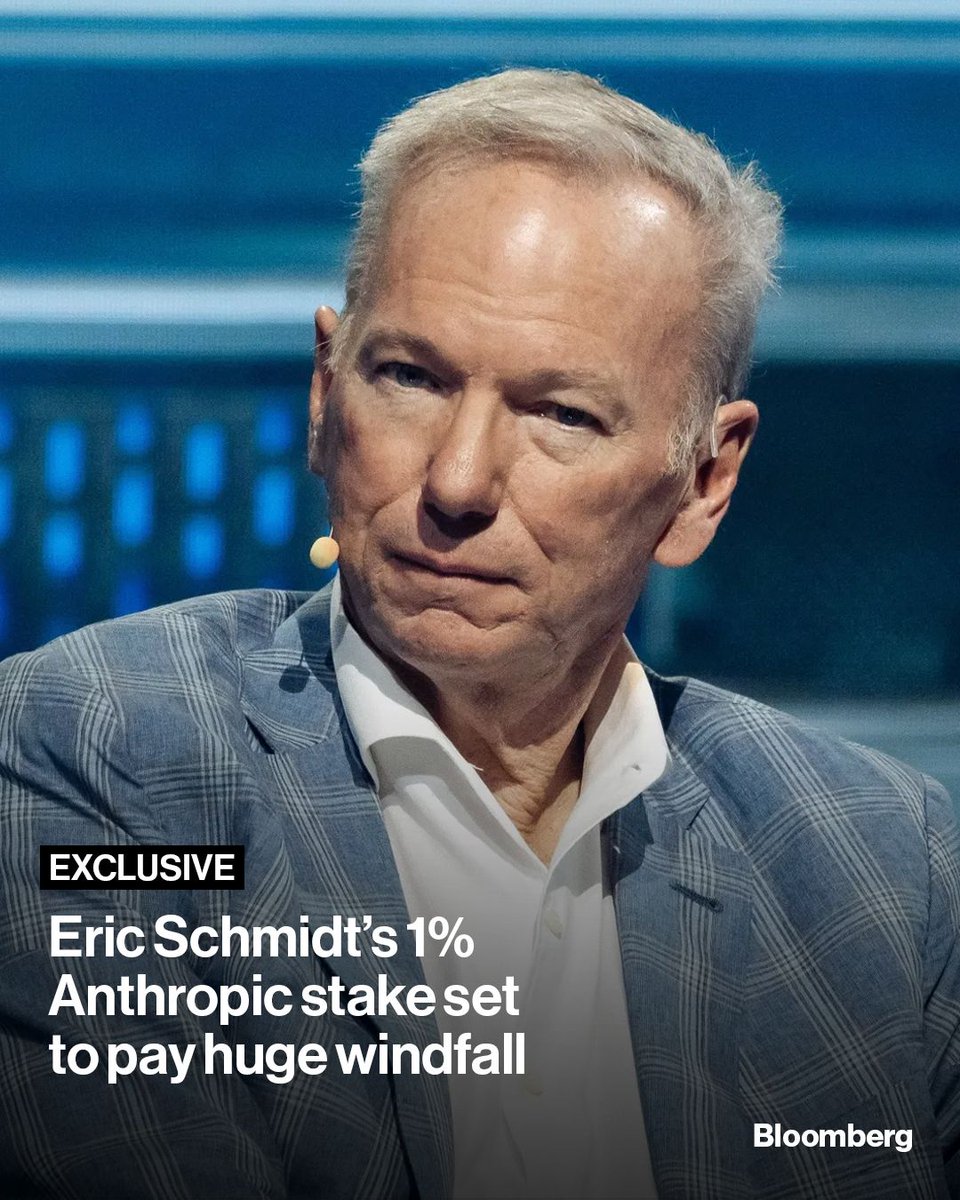
Former Google CEO Eric Schmidt owns roughly 1% of Anthropic PBC, a stake built from tens of millions of dollars he put into the startup's 2021 Series A round, according to people familiar with the matter cited by Bloomberg. Anthropic was valued at $461 million at the time, per PitchBook. Schmidt and Anthropic declined to comment, and it is unclear whether he has sold any shares.
At Anthropic's most recent $965 billion valuation, the stake would be worth close to $10 billion and add nearly that amount to Schmidt's $57.5 billion fortune. At the top of the $1.8 trillion to $2 trillion range investors cited last week, his net worth would rise by about one-third to nearly $80 billion. Marketing for the IPO is expected to begin by mid-November.
The disclosure puts Schmidt among the most prominent individual winners from Anthropic's listing. For Alphabet, Anthropic is both a major cloud and TPU customer and a direct Gemini competitor, so the early-backer roster sharpens questions about concentration of AI private equity.
Some social posts citing a $20 billion figure do not match Bloomberg's math: 1% of a $1.8 trillion to $2 trillion valuation implies $18 billion to $20 billion, while the article's own figures are close to $10 billion at $965 billion and a net worth near $80 billion at the high end.
Amazon to hire 300,000 holiday workers, up 20% in first increase in three years
After holding at 250,000 for three straight years, the retailer expands seasonal hiring even as Walmart and Target lean on existing staff, and adds health coverage for workers scheduled 30+ hours
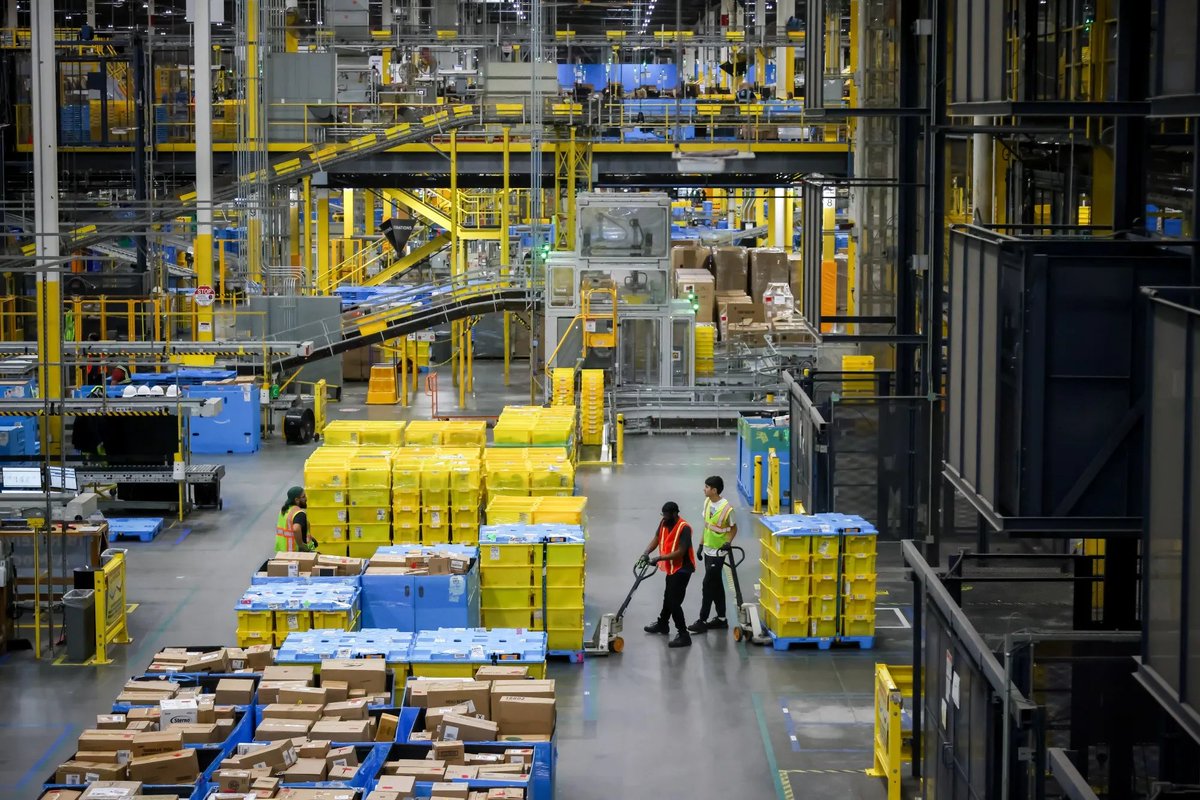
Amazon said Tuesday it will hire more than 300,000 seasonal, part-time and full-time workers across its US operations for the holiday season, a 20% increase from last year's 250,000. It is the company's first holiday hiring increase in three years, following three consecutive seasons at the same level.
Full-time roles start at $20 an hour with average pay near $24, while seasonal workers will average $20 an hour. Starting January 1, seasonal employees scheduled at least 30 hours a week will receive the same health coverage as regular full-time staff, with plans starting at $5 a week.
The move comes as the National Retail Federation forecasts US holiday sales growth of 4.2% to more than $1 trillion, even though traditional retailers including Walmart and Target are largely drawing on existing staff. Analysts surveyed by FactSet expect Amazon's North American retail revenue to rise 10% year over year to $139.8 billion in the fourth quarter.
Amazon announced a small number of layoffs in its retail division earlier this month. Walmart expanded health benefits for its workforce last week, as rising healthcare costs pressure US retailers.
Loop Capital downgraded Apple to Hold from Buy on Oct. 20, lowering its price target to $330 from $370. Analyst Ananda Baruah said the move reflects the firm's new iPhone shipment data and accompanying cuts to its Apple estimates.
Citing supply-chain checks, the firm said the 13 million iPhone shipments cut from Apple's 2026 plans will not be recovered, and Loop now expects 79 million iPhone units. The analyst also pointed to lower normalized EPS, rising memory costs and a need for a fundamental catalyst reset.
The downgrade comes alongside other Apple developments: the company has scheduled a product launch event for Oct. 28 in Los Angeles, with analysts expecting a touchscreen laptop, and it has committed up to $100 million for US titanium in a domestic manufacturing push.
The market impact centers on Apple's own valuation and earnings expectations, with Loop's shipment and cost views adding direct near-term pressure on the stock ahead of the company's results and launch event.
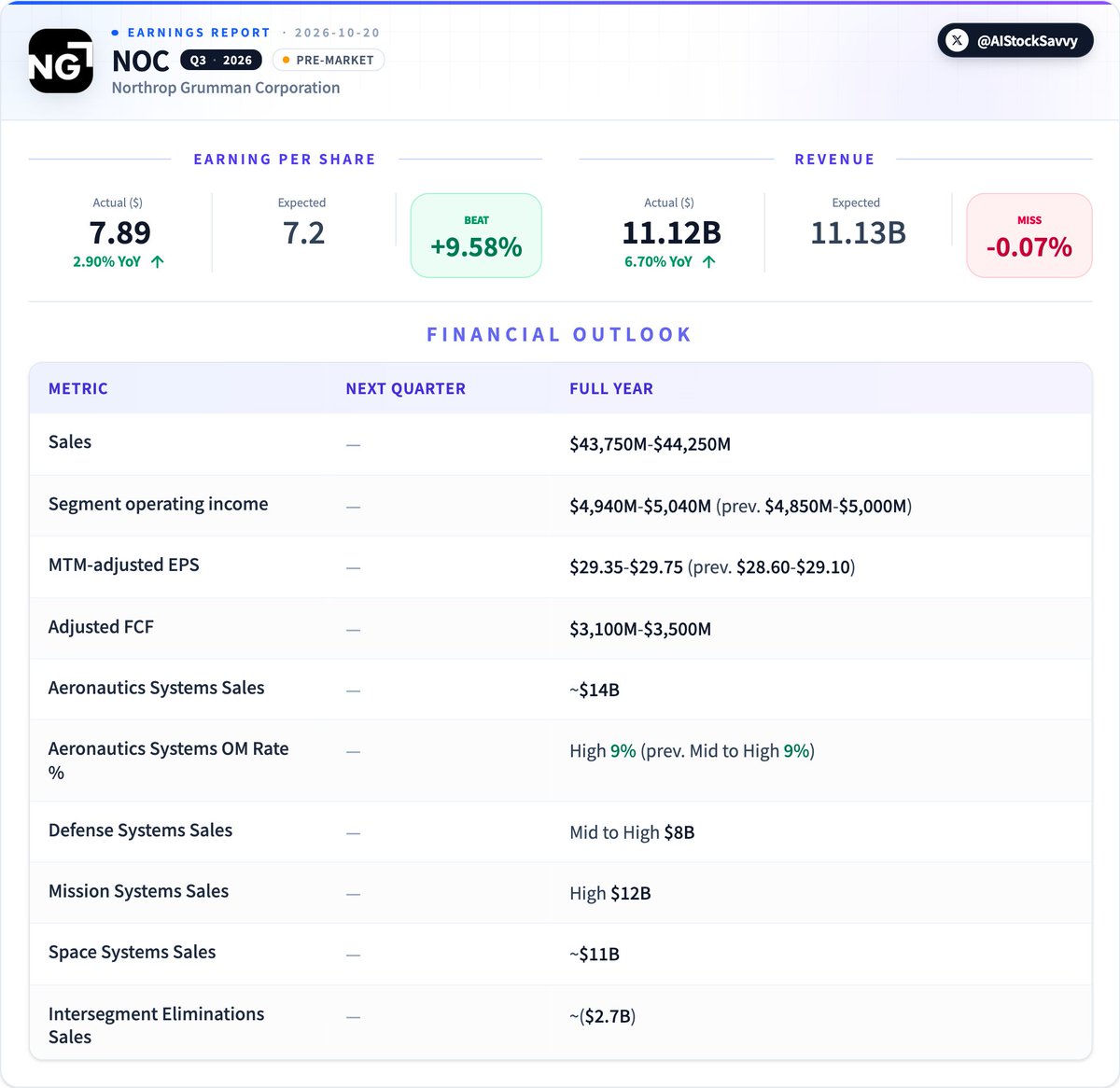
Northrop Grumman reported fiscal 2026 third-quarter sales of $11.1 billion and earnings per share of $7.89, with backlog rising to about $110 billion. The company kept its full-year sales guidance of $43.75 billion to $44.25 billion and free cash flow guidance of $3.10 billion to $3.50 billion unchanged.
The company raised its full-year adjusted EPS range to $29.35-$29.75 from $28.60-$29.10. According to reports in our newsroom, quarterly revenue rose about 6.7% year over year, backlog reached $109.6 billion and results topped consensus estimates.
By segment, aeronautics sales rose 14% and defense sales also increased, with the company citing strong demand for its global capabilities. The results came as the broader market pulled back from Monday's AI-led rally, with the defense contractor's order book seen as a relatively independent support.
Barron's reported the same day that the company's 2027 earnings outlook points to further growth. The figures above come from the company's third-quarter release and coverage by financial media.
U.S. private employers added an average of 18,500 jobs per week in the four weeks to Oct. 3, down from a revised 26,000 the prior week, according to ADP Research's NER Pulse released Tuesday. The series is a seasonally adjusted four-week moving average with a two-week lag.
The four-week average has drifted lower from 25,250 in mid-September but remains above the roughly 8,000-12,000 weekly pace seen from mid-July to mid-August. ADP describes the figures as preliminary estimates that may be revised as new data arrives.
The dollar index slipped below 102 and Treasury yields fell across the curve after the release. Softer hiring momentum is typically read as easing wage-inflation pressure, though weekly high-frequency data are volatile and need to be checked against the monthly payrolls report.
The next NER Pulse is scheduled for Oct. 27. ADP did not issue additional comment on the release.
Germany's Sparkassen opens crypto trading in banking app: five tokens, €0.99 per order
DekaBank runs execution and custody while each local savings bank decides its own start date, putting retail crypto buying inside a mainstream bank app
Germany's Sparkassen savings-bank network began offering crypto trading inside its banking app at selected institutions on October 19, covering Bitcoin, Ether, XRP, Solana and Polygon under the product name "Krypto powered by Deka." DekaBank, the group's securities arm, provides trading and custody, with custody handled in cooperation with Boerse Stuttgart. Each order carries a €0.99 fee, plus spreads.
The rollout is phased rather than a single nationwide switch-on: each local Sparkasse decides when to introduce the service, with 30 to 40 additional institutions expected to join each month and a goal of connecting most interested banks in the first half of 2027. More than 230 institutions have reportedly expressed interest. The banks will not give investment advice on crypto and do not plan heavy promotion at first.
Mechanically it is distribution rather than self-custody: customers open a dedicated crypto account with DekaBank, the bank controls the keys, and withdrawals to personal hardware wallets are not supported. Crypto holdings also fall outside Germany's statutory bank deposit insurance, and the banks warn investors could lose their entire principal.
The market read-through is channel expansion. Sparkassen-Finanzgruppe is one of Europe's largest retail banking organizations, but the phased schedule caps near-term flows, and the flat €0.99 fee plus spread will invite comparison with specialist exchanges.
Mesh and Visa have partnered to let consumers spend crypto and stablecoin balances at more than 175 million Visa merchant locations without a separate card, according to multiple reports. Users spend directly from participating wallet apps rather than manually selling or transferring assets beforehand.
Mesh is a crypto payments network backed with $200 million from PayPal, Paradigm and SBI, according to a post by Bitcoin Archive. The arrangement plugs crypto balances into Visa's existing acceptance network instead of building a separate acquiring rail.
For Visa, the deal adds a new funding source on top of its card rails; for wallets and stablecoin issuers, it adds an acceptance outlet. Coverage in the本站 news library over the past 48 hours focused on Visa's share performance, long-term growth case and U.K. merchant expansion, with no mention of this partnership.
Neither Mesh nor Visa disclosed interchange economics, supported token lists or a phased rollout schedule in the materials reviewed. One X user linked the news to the Genius Act taking effect on Jan. 18, 2027, a claim not confirmed by either party.
US spot bitcoin ETFs recorded $526.6 million in net inflows on Oct. 19, according to ETF flow data cited by Cointelegraph, while spot ether ETFs saw $103.28 million in net outflows and spot solana ETFs lost $6.72 million. tedpillows read the split as liquidity leaving altcoins for bitcoin.
The same session looks different elsewhere. Lookonchain put bitcoin ETFs at a net outflow of 1,156 BTC (about $94.94 million), while theetftracker and WOLF_Terminal reported BTC at -$82 million, ETH at -$70 million, SOL at -$13 million and XRP at -$2 million.
Weekly figures point the same way across providers. For the week ended Oct. 16, wolf_crypto_x counted $228.58 million of bitcoin ETF outflows, $320.10 million from ether and $25.50 million from solana, roughly $574.18 million combined, with ether accounting for about 56%.
Solana's Alpenglow upgrade is scheduled for Oct. 21 and targets near-instant transaction finality, and DFDV has kept accumulating SOL ahead of it, per the newsroom. ETF redemptions and on-chain accumulation are running side by side in solana's flow picture.
XRP Gets First Official X Account, Run Jointly by Ripple and XRPL Foundation
Fourteen years after launch, the token finally has an institutional voice on social media, shifting messaging from community accounts to two organizations
Ripple and the XRP Ledger Foundation have jointly launched the first official X account for XRP, with the two organizations operating it together, according to multiple reports. CoinDesk said it is the token's first official social media account in 14 years, quoting Ripple CEO Brad Garlinghouse as saying "This one has been a long time coming."
Until now, XRP's social presence has been carried largely by community-run and unofficial accounts, with no institutional channel. The joint account places token messaging under two organizational owners.
The launch comes as XRP trades under pressure. Our newsroom's recent coverage notes the token shed nearly $6 billion in market value over a week even as XRPL daily transaction volume approached $50 billion on October 19, and that Germany's Sparkassen savings banks have begun offering XRP in their apps. Whether an official account changes the market narrative is not yet supported by data.
Beyond the account's creation, Ripple and the XRPL Foundation have not disclosed further operating details.
Steel Dynamics reported third-quarter 2026 revenue of $6.51 billion, above the $6.43 billion estimate, while earnings per share came in at $5.26 versus the $5.41 consensus, though up 92% year over year. Net income was $756 million, up 87% year over year but below expectations.
Adjusted EBITDA was $1.19 billion, missing the $1.23 billion estimate, with steel shipments at 3.8 million tonnes. Operating cash flow was $845.8 million. The revenue increase was supported by improved pricing and lower imports.
The broad earnings miss could weigh on STLD shares, with investors focused on cost trends and fourth-quarter guidance. Peer steel stocks may also see sentiment spillover.
The company has scheduled its third-quarter earnings conference call and webcast for October 20, where management is expected to address the earnings shortfall.
Crown Holdings reported third-quarter 2026 net sales of $3.71 billion, above the $3.44 billion estimate and up 16% year over year. Adjusted EPS came in at $2.39, beating the $2.26 consensus and up 7% from a year earlier, as global beverage can volumes rose more than 6%.
The top-line beat came alongside softer underlying profitability: segment income was $484 million, down 1% year over year. Crown narrowed its full-year adjusted EPS outlook to $8.35-$8.45 from a prior $8.30-$8.50 range, against a $8.41 consensus, and guided to adjusted free cash flow of at least $950 million.
The fourth-quarter outlook is the pressure point. Crown sees Q4 adjusted EPS of $1.63-$1.73, below the $1.80 consensus, suggesting the earnings cadence is weighted toward the first three quarters of the year.
Zacks reported the $2.39 EPS figure against its $2.25 consensus, with prior-year EPS of $2.24, while WSJ put quarterly profit at $225 million and noted beverage-can volumes grew more than 6% year over year, consistent with the wire accounts.
Genuine Parts (GPC) reported third-quarter 2026 revenue of $6.52 billion, up 4.2% year over year and in line with estimates. Adjusted EPS came in at $2.07, up 4.5% year over year and above some consensus figures of $2.05, while comparable sales rose 2.9%.
The company narrowed its full-year adjusted EPS outlook to $7.50-$7.75 from $7.50-$8.00, and guided GAAP EPS of $5.60-$5.85. Total sales growth is expected at 3% to 5.5%, with free cash flow of $550 million-$700 million and cash from operations of $1.0 billion-$1.2 billion.
The cut to the top end of the guidance range is the key variable. X signals put the consensus full-year adjusted EPS at roughly $7.73-$7.78, above the new range's upper bound, suggesting even a top-of-range result could fall short of some sell-side models.
Within the newsroom library, Zacks cited a quarterly EPS consensus of $2.09, differing from the $2.05 in X signals, while GuruFocus referenced EPS of $1.62 on a different basis. The company's own release should be treated as the authoritative figure.
Equal-weight AI basket falls ~24% in seven sessions, trailing QQQ's ~6% drop
DratchCap calls it the worst seven-day window in five years, deeper than the DeepSeek and July episodes, as investors push back on AI premium valuations
DratchCap said in a market update dated Oct. 20 that an equal-weight AI basket it tracks fell about 24% over seven sessions, against a roughly 6% decline in QQQ, marking the worst seven-day window in five years and a deeper slide than the DeepSeek and July episodes. The firm also offered self-criticism, saying it did not respect price action enough.
A Bloomberg newsletter reported that selling stock as an AI company, or even an AI-adjacent one, has become tougher as investors ask more questions about the premium valuations being sought. Two Seeking Alpha pieces attributed the AI selloff to financing and examined the abrupt drop in AI shares.
ETF flows show a rotation within the trade. etftrends described the past quarter's most striking reversal as money moving from AI builders to AI users, while fool.com noted the iShares Semiconductor ETF is down 25% from its June peak and holds 30 of America's top AI chip and component suppliers.
The materials did not include company-level responses or a breakdown of the equal-weight basket's constituents; the decline figures reflect DratchCap's own account.
Invesco QQQ Trust traded around $716–718 on Oct. 20, unable to close above Friday's high of 726 after Monday's bounce from last week's selloff. The ETF sits below its 7-, 20- and 50-day moving averages, with RSI near 38–41 and the stochastic %K/%D below 20 — a compressed setup rather than a confirmed reversal.
Options activity added a directional signal: one trader bought 16,591 QQQ 700/675 put spreads expiring next week, a notional position above $10 million, while separate flow tracking showed roughly $26 million into QQQ puts, concentrated in short-dated single-leg trades. The structure pays off only on a break below 700 before expiry.
QQQ fell through every tracked moving average in Friday's selloff. Open interest on the Binance-listed QQQ futures contract rose 54.34% in 24 hours to 100,655.88 contracts, about $111.7 million notional, with account positioning 2.16:1 long — a snapshot that does not reveal whether new positions were longs or shorts. Positive results and AI capex commentary from Taiwan Semiconductor and ASML are the main counterweight into this week's earnings.
For traders, 726 marks the level that would extend the bounce toward the 20-day average, while 700 is where bearish positioning and dip-buying converge. A close below $708.34 support would put the lower Bollinger Band at $704.90 in play; small caps are being watched as an early funding-stress tell, with IWM at 270.89 near its lower band.
Fed Chair Warsh signaled inflation fight may continue, saying financing conditions aren't restrictive and recent price improvements haven't convinced him of a trend shift.
2026-09-1653 posts · 39 authors
House Chairman Hill introduced a Strategic Bitcoin Reserve bill; FOMC Chair Warsh held a press conference amid criticism of Democratic crypto policies.
2026-09-17186 posts · 86 authors
Fed officially hiked rates by 25 bps, the first since July 2023, ending the longest pause since 2008.
2026-10-1910 posts · 10 authors
Gold rose as Warsh's remarks eased rate-hike bets; Fed data showed nearly 1 in 5 U.S. families with debt falling behind, highest since 2010.
2026-10-209 posts · 9 authors
Fed officials attributed rising prices to surging AI investments and Iran-war-driven oil costs, not tariffs; IMF paper discussed financial repression.