US tech stocks sold off sharply, with the Nasdaq 100's decline widening from 3.6% to 4.2% intraday — its worst session since June 5 — erasing $1.3tn to $1.7tn in market value. The S&P 500 and Dow fell alongside, while the semiconductor index dropped 2.10% and small caps lost 2.10%.
The selloff is not a one-day event. The Nasdaq 100 has lost roughly $5tn over three weeks and is now in correction territory, according to Unlistedly tallied market data. Qualcomm peer Nvidia and other chip names led losses; Intel is down 32% over the same stretch.
Traders tied the selloff to disappointing tech earnings and concerns over AI capital spending. Separately, the market-implied probability of a Democratic sweep in next week's midterms jumped from 65% to 72%, a record high, up 7 percentage points in two days. Crypto-linked equities fell in tandem, with Coinbase down 12.5%.
Bulls pointed to context: the Nasdaq 100 is still up 11% year-to-date and nearly 70% off its April 2025 low, while S&P 500 Q3 blended earnings growth is tracking 30.2%.
Binance said phased withdrawals could begin returning within about 34 hours and that fresh Proof of Reserves results are due Monday, following a $6.3 billion security incident. The exchange said it has set aside $6.34 billion in company funds to cover all hack losses, with $5 billion already held in matching token assets and the remainder being bought via OTC and market purchases.
Co-CEO Richard Teng said attackers used an EIP-7702 delegation to bypass normal hot-wallet approval controls, adding that the breach went beyond one engineer's permissions and that investigators have not attributed the attack. Binance is working with the FBI and the US Secret Service to trace the remaining $3.3 billion in unrecovered funds, while about $3 billion has already been frozen.
The fallout reached adjacent assets and equities: US spot bitcoin ETFs saw more than $643 million in single-day outflows, their largest since June, while Coinbase (COIN) fell 26% in October to $138.07 and hit a two-year low on Friday as analysts cut price targets. Cantor, TD Cowen and Compass Point called the selloff a buying opportunity and said the hack would not derail crypto markets.
Circle froze 800 million USDC within hours of the hack, and the US Secret Service is working with Circle to identify, freeze and recover stolen funds, according to reports. Binance said it is coordinating with multiple law enforcement agencies on recovery.
Trump Says US Probing Whether North Korea Is Behind $6.3bn Binance Heist
Washington weighs in hours after the record crypto theft; blockchain firms have already blamed a North Korean unit, but the president says "we don't know."
Binance said on Oct. 30 that hackers stole more than $6.3 billion from its systems, the largest cryptocurrency heist on record and more than four times the $1.5 billion Bybit hack of February 2025. The exchange said the attackers appeared to have compromised an engineer's laptop, that about $3 billion of the stolen assets had been frozen, and that customer funds were safe with losses covered from company reserves.
President Donald Trump said on Oct. 31 that the US was looking into whether North Korean hackers were responsible. "We're looking at that... They say they have it pretty much under control. We'll see," Trump said, adding "we don't know" when asked about Pyongyang's involvement. The US Secret Service said it was working "around the clock" to trace, freeze and recover the funds, and the FBI is also investigating.
Blockchain analytics firms TRM Labs and Chainalysis have both linked the attack to a North Korean state-backed unit, with TRM naming the "TraderTraitor" group and saying most of the funds moved within about 20 minutes. Elliptic said the stolen assets passed through wallets tied to the earlier Bitget hack. North Korea has not responded, and the attribution remains an industry assessment rather than a confirmed official finding.
Markets reacted sharply: bitcoin fell about 5% to $76,800 and ether dropped more than 5.7%, while Coinbase shares slid 12%, also weighed down by revenue that slightly missed expectations. Stablecoin issuers including Tether, Circle and Ripple froze about $2.8 billion, but TRM said hackers had moved 18,270 bitcoins and more than 420,000 ether, beyond any issuer's reach. Binance extended withdrawal freezes by about 45 hours, and the UK's FCA said it was in contact with the exchange.
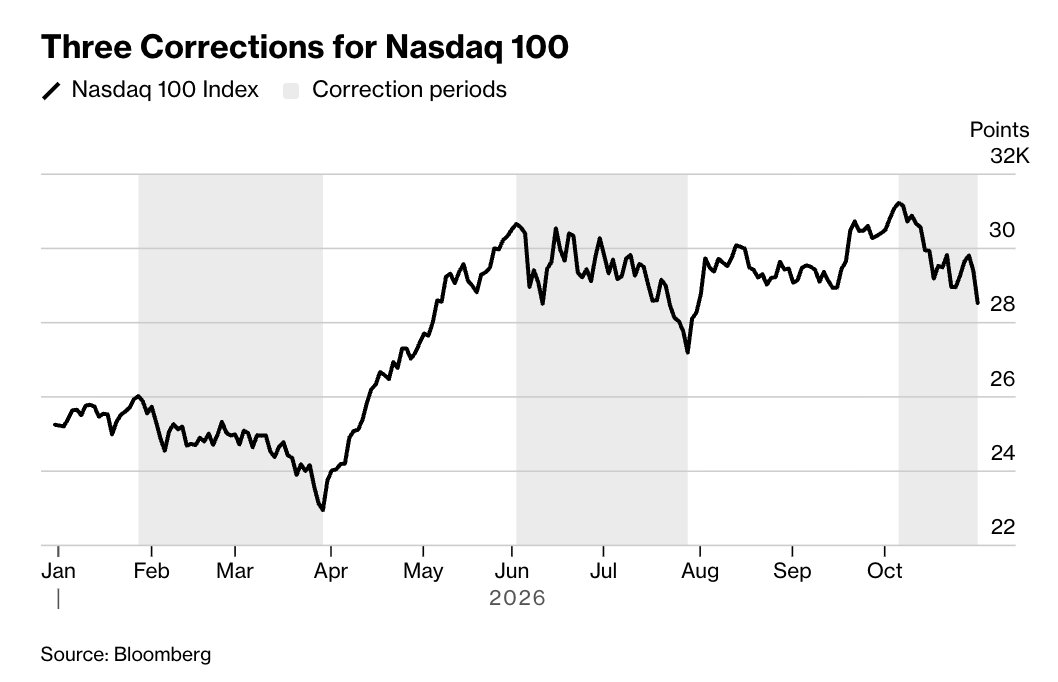
The Nasdaq 100 has fallen 10% from its October 6 record high, meeting the common definition of a technical correction, according to multiple X signals. Kalshi and Investing.com both described the move as the index officially entering correction territory, and StockMktNewz, citing Bloomberg, said it is the index's third correction this year.
The $QQQ ETF was down more than 4% intraday at $689.50, sliding through the session and sitting near its lows. Intel (INTC) fell 31% on the day, on track for its biggest single-day drop since its 1971 IPO.
Our news library shows Intel had already fallen 28% on October 30 after a wave of analyst price-target cuts and downgrades following its third-quarter earnings; MarketWatch reported that some analysts see no reason to buy the dip. Amazon fell 7% the same day after posting negative free cash flow for a second consecutive quarter.
The correction magnitude and Intel's decline come from X signals; our news library has not yet published on the same event, and the figures warrant further verification.
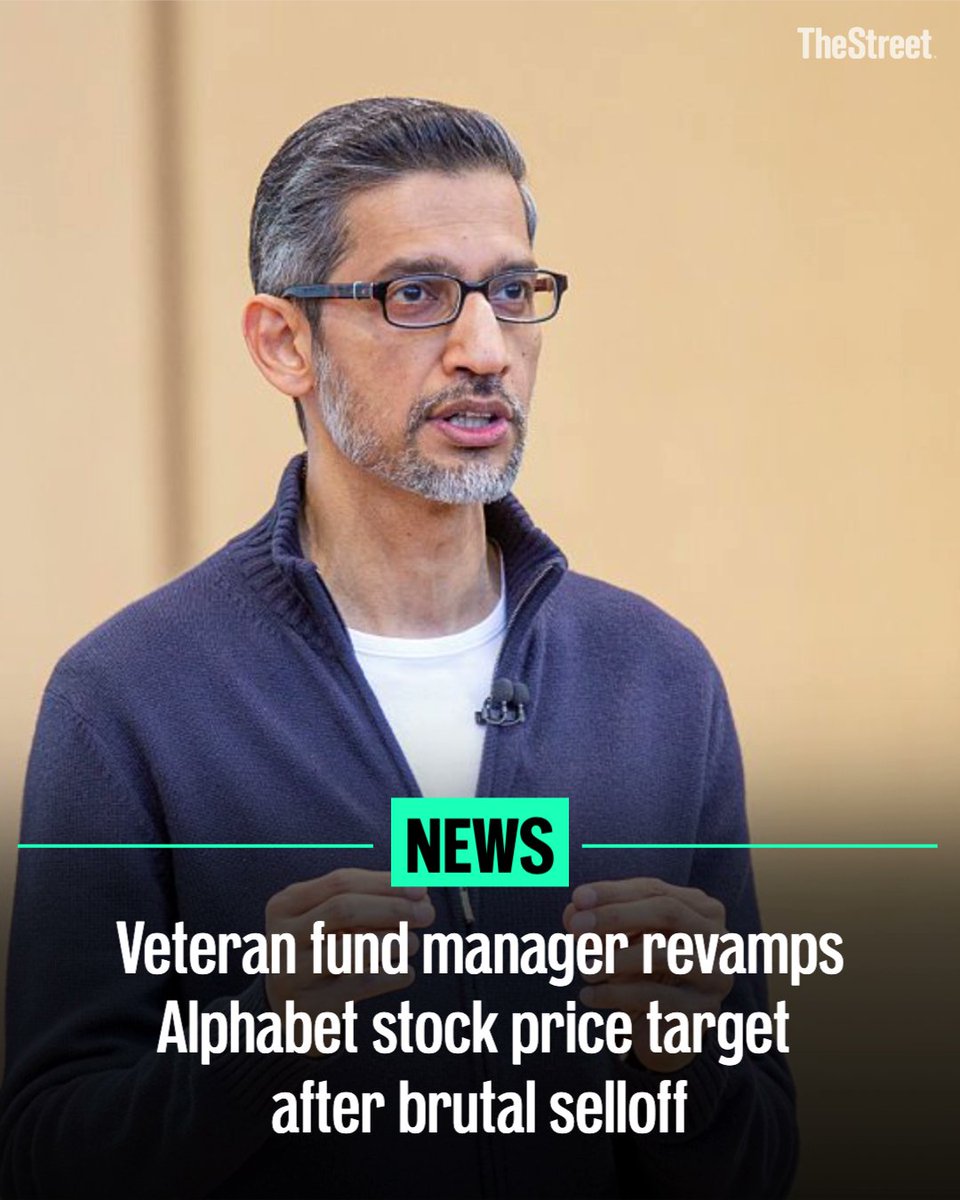
Alphabet shares fell 12.6% on Thursday, the worst single-day performance in the company's history, after its earnings report included a higher capital spending forecast. Posts circulating on X said the drop has pulled the company's price-to-earnings multiple lower.
The selloff was not isolated. Amazon closed lower on weak results and guidance, and Roblox fell 20% on a large miss in daily active users, leaving the tech sector under pressure. Bloomberg reported that share sales in Meta, Alphabet and Intel have left buyers far underwater.
Sell-side views diverged sharply. Seeking Alpha published pieces calling the stock a "Strong Buy," valuing the parts at about $337 a share, and describing the selloff as the best buying opportunity in years, while another kept a quant Hold rating.
Coverage in this site's news library showed Amazon's third-quarter results falling short of Wall Street's top-line expectations, while AWS said AI would drive 40% growth. Together with the Alphabet capex debate, those threads frame this week's tech volatility.
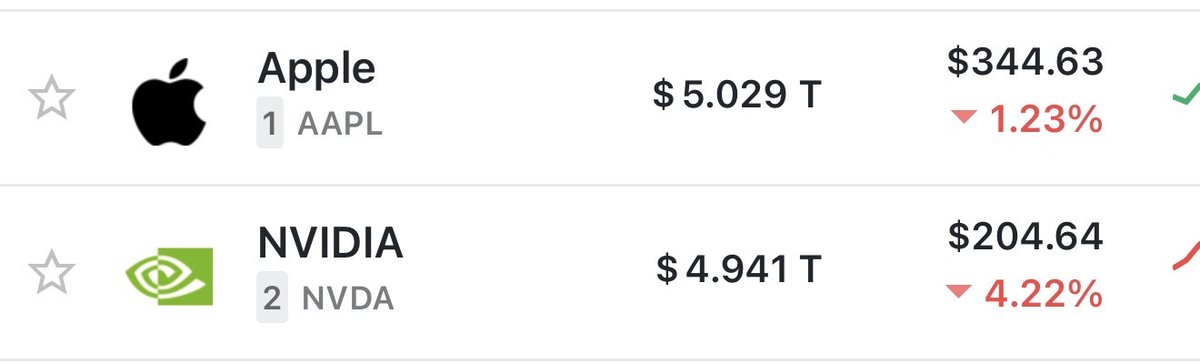
Apple closed Friday as the world's most valuable company with a market capitalization of about $5.03 trillion, overtaking Nvidia at $4.94 trillion. Apple shares rose about 4% on the day and are up 28% year to date, the best performance among the Magnificent 7.
The shift comes as investors weigh concerns about artificial intelligence spending and move toward the iPhone maker as a perceived safer holding. Apple reports earnings on Monday, with expected fiscal fourth-quarter revenue of about $113.6 billion.
Nvidia cedes the top spot. Apple recently announced its first foldable iPhone, a smart home display and its first touchscreen MacBook Pro, and its installed base tops 2.5 billion active devices.
Walter Piecyk of Lightshed Partners was not impressed with the Apple iPhone Duo's AI experience and said it will be a tough year for the company.
Blackstone has told investors that Anthropic is likely to receive a speculative-grade credit rating in the double-B range after its IPO, reversing earlier expectations of an investment-grade rating by year-end, according to the Financial Times. TechCrunch, citing the same report, said rating agencies are expected to assign a high "junk" rating.
Anthropic filed its S-1 on Oct. 26 and could go public as soon as the week of Nov. 16. A downgrade in rating expectations before listing shifts the benchmark for pricing its public debt.
Social media posts circulating the report said Anthropic has committed to a large compute buildout and that Broadcom is already guaranteeing part of its loans, which would make financing more dependent on guarantees and private channels if the rating lands below investment grade.
Anthropic and Blackstone have not publicly commented on the report, and no rating agency has published a formal rating.
The US State Department on Friday approved a proposed $2.1 billion sale to Ukraine of 500 Patriot PAC-3 MSE interceptors, along with spares, training and logistics support. The package now goes to Congress for review, with Lockheed Martin as prime contractor.
The purchase is funded entirely by allies: Canada, Germany and Norway through the JUMPACK program, plus EU-backed national funds under the Ukraine Support Loan. No US money is involved. President Volodymyr Zelensky called the approval a strong decision but said Ukraine needs interceptors now, not years from now.
Two people briefed on the decision said the missiles have yet to be manufactured and are not expected to be delivered until a couple of years into the 2030s. Ukraine's defense ministry is pressing the Pentagon to accelerate delivery, possibly by transferring missiles from US stocks and backfilling later.
The approval follows Kyiv's public complaints that Washington was slow-rolling interceptor supplies, and comes as Russian strikes killed civilians in Dnipro and Kyiv. An approved sale does not by itself speed up deliveries or ease Ukraine's immediate interceptor shortage.
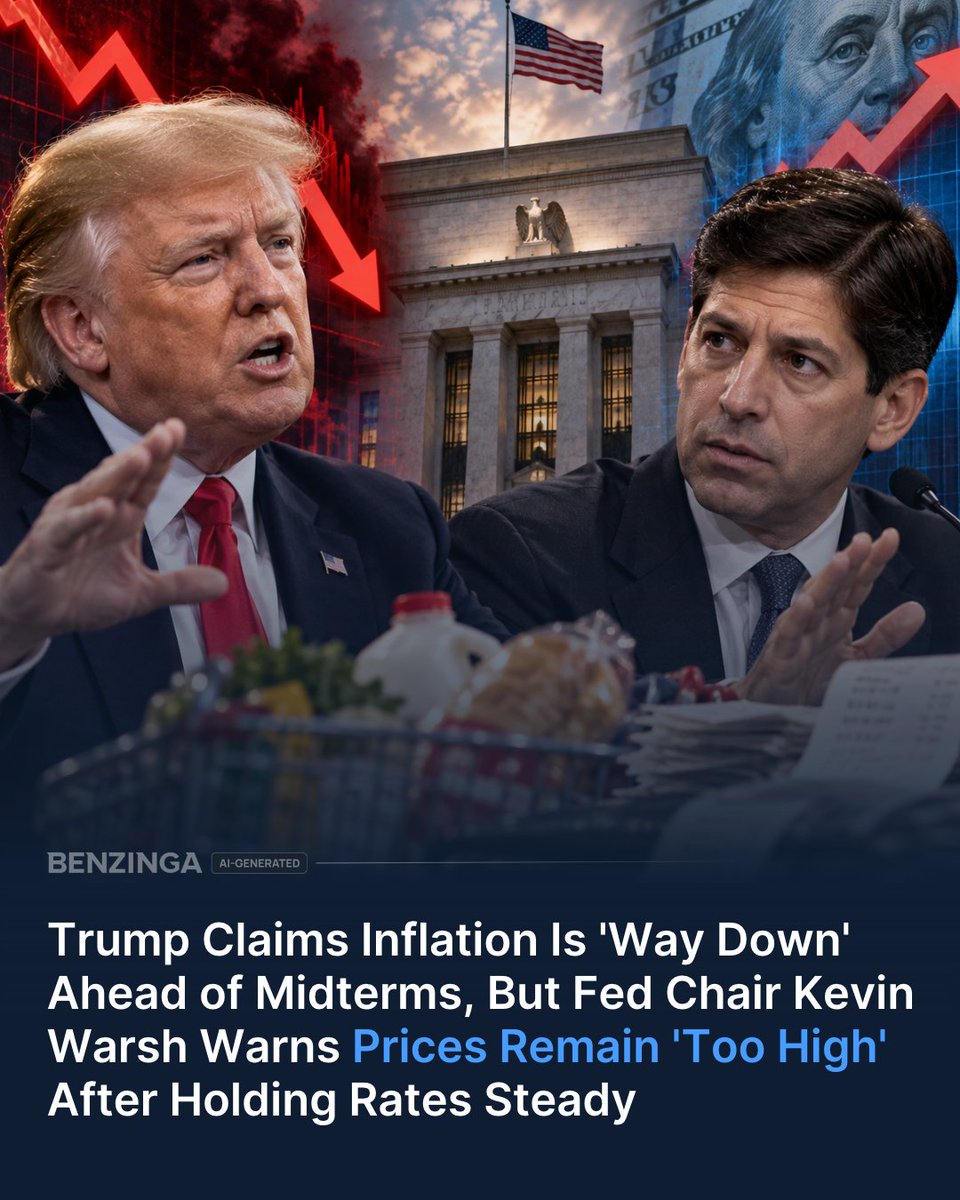
Three Federal Reserve presidents publicly called for higher interest rates on Friday, pushing back against Fed Chair Kevin Warsh's more dovish outlook as elevated inflation persists, according to Benzinga and Barron's.
Warsh has acknowledged that rising oil prices are contributing to higher near-term inflation expectations. "I am not going to be the guy who says that oil prices haven't gone up," he said. President Donald Trump, meanwhile, said inflation is "way down" and incomes are rising, describing a "Golden Age."
Energy prices sit at the center of the dispute. Our newsroom's reporting shows oil up 21% in a month, Chevron's Q3 earnings of $5.28 per share beating the $4.78 consensus, and diesel prices surging globally after refineries in Russia and the Middle East were bombed.
The open disagreement between the Fed chair and regional presidents raises uncertainty over the policy path, with Warsh's rate pause set against calls for hikes from three presidents.
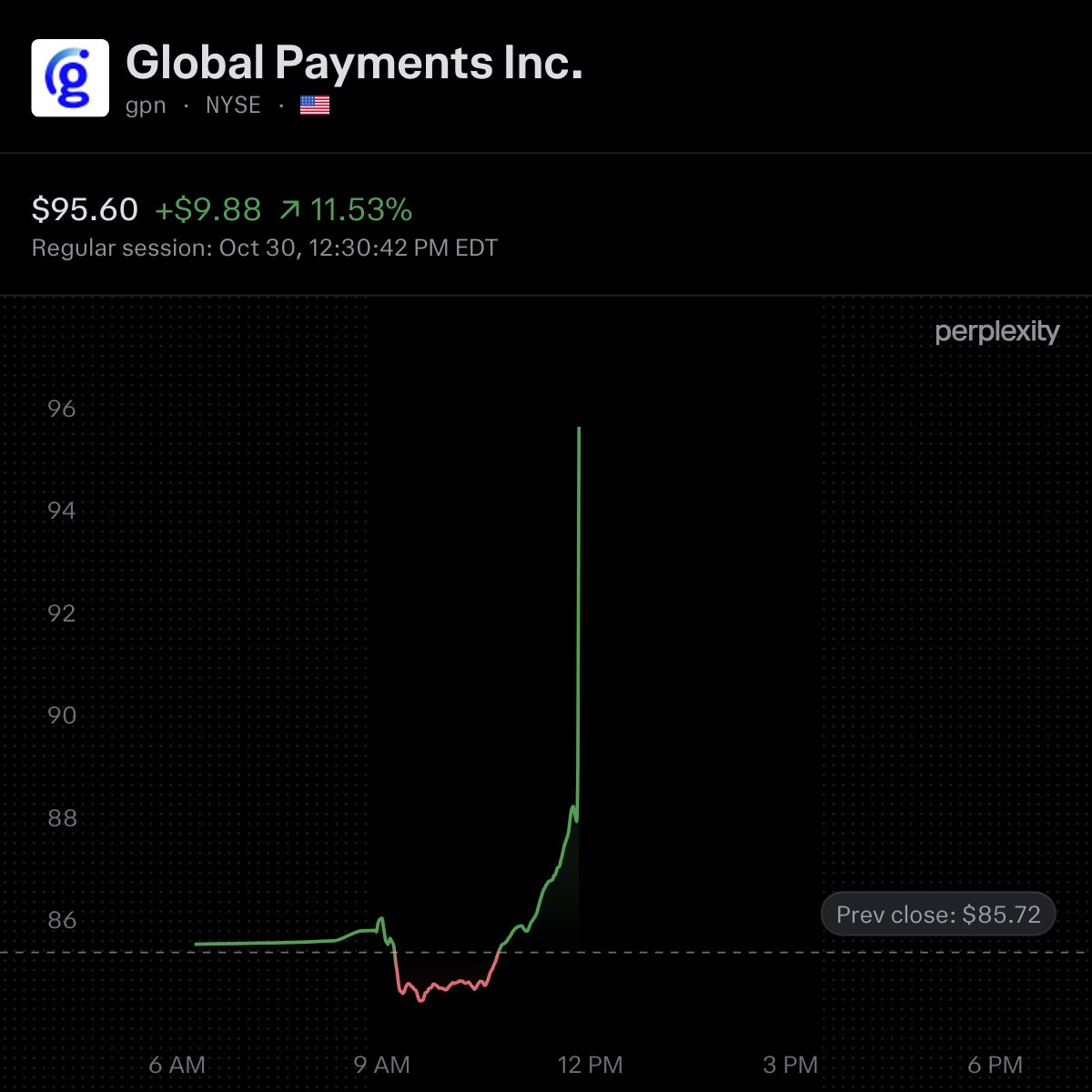
Clayton Dubuque & Rice is pursuing a take-private of payments processor Global Payments in partnership with GTCR, the company's largest shareholder, in what could rank among the largest leveraged buyouts in history, the Financial Times reported. Reuters, citing a source familiar with the matter, said talks are at an early stage and may not materialize; CD&R and GTCR declined to comment and Global Payments did not immediately respond.
Global Payments shares rose more than 11% in afternoon trading. William Blair analysts said the idea is credible given GTCR owns roughly 15% of the shares, but flagged the company's nearly $22 billion of net debt as a potential impediment, especially with rates rising.
The company agreed in 2025 to buy Worldpay from FIS and GTCR in a deal valued at more than $24 billion, a move that sent its shares tumbling and later drew activist pressure from Elliott Investment Management. The stock has fallen more than 60% from its 2021 record high, leaving a market value of roughly $23 billion.
Payments incumbents face mounting competition from fintechs and technology firms, weighing on valuations and making them candidates for private equity. Stripe and Advent International earlier offered roughly $53 billion for PayPal, talks reportedly stalled over the discount. Global Payments reports quarterly results next week.
Amazon Sets Up $80 Billion Supplier Loan Facility Backed by Hardware Purchases
The arrangement aims to preserve financial flexibility as the company spends hundreds of billions on AI infrastructure; funds can be drawn from early 2027
Amazon (AMZN) has set up a supplier financing arrangement allowing it to borrow as much as $80 billion against the value of hardware it buys, according to Bloomberg and multiple reports. The facility can be tapped from the start of 2027 through the third quarter of 2028.
The Wall Street Journal reported that Amazon had until now mostly funded data centers and chips with its own cash and record bond sales. The hardware-backed facility is the company's latest move to preserve financial flexibility as it spends hundreds of billions on AI infrastructure.
The disclosure comes amid a wave of large-scale tech financing: the materials cite a $25 billion bond offering from Microsoft (MSFT) and $37.5 billion in common and convertible preferred stock offerings from Meta (META). Amazon shares have been under pressure after third-quarter results fell short of Wall Street estimates.
Amazon Web Services grew revenue 29% in the third quarter, and CEO Matt Garman has said the company aims to "responsibly fund" its AI buildout. Amazon did not provide further comment on the facility.
Reddit (RDDT) fell as much as 30% intraday after its third-quarter earnings report, heading for the largest single-session loss in its history as a public company and touching a new 52-week low. Multiple outlets attributed the selloff to weak fourth-quarter guidance.
On the earnings call, the company flagged mounting pressure from Google search traffic while daily active user growth slowed notably; advertising growth remained a bright spot but not enough to offset concerns about stalling user expansion.
The drop pushed Reddit to its cheapest valuation since listing, with one market-data account citing a forward EV/EBIT of about 11.2x. The slide also hit holders of a popular thematic fund, though S&P 500 index funds were barely affected.
After the plunge, law firms announced investigations and solicited investors who may have suffered losses; those probes are at the intake stage and no conclusions have been reached.
Google CEO Sundar Pichai said on X that the company sent a command to its prototype satellite in orbit, booted up its Tensor Processing Unit, ran a prompt and received the first complete AI-generated response back on Earth. According to Google's blog, the satellite launched on Oct. 1 and this week, during a ground-station pass over Svalbard, Norway, its onboard Gemma model produced a haiku about being in space.
The test is the first in-orbit validation for Project Suncatcher, a Google Research moonshot that envisions solar-powered satellite constellations carrying TPUs to build AI data centers in orbit, sidestepping land and electricity constraints on the ground. TechCrunch reported the spacecraft carries four TPUs but can power only one at a time for roughly 20 minutes.
Google said it will next evaluate how the chips perform under thermal stress and radiation exposure. Ground tests in particle accelerators suggested radiation would have limited impact on inference workloads and a larger effect on training, but the team now needs real-world data. If the TPUs prove reliable, the next milestone is twin interconnected satellites in 2027 demonstrating optical inter-satellite links.
For markets, the milestone feeds the narrative around launch providers such as SpaceX and Rocket Lab: if space-based compute scales, launch costs become the decisive variable. Rocket Lab shares have been under pressure after it delayed Neutron's first flight into next year; it reports third-quarter results on Nov. 9, having guided to an adjusted EBITDA loss of $17 million to $23 million. Alphabet holds a significant stake in SpaceX, and both companies' orbital data center visions depend on Starship reaching full and rapid reusability.
Company
Google in talks to join $185 billion Golden Dome data-security effort
Pentagon is forming an industry group to harden data feeding the missile shield's command-and-control software; a deal is not final
Google is in talks with the US Defense Department to work on a new data-security effort underpinning the $185 billion Golden Dome missile defense program, Bloomberg reported, citing people familiar with the matter. The Pentagon is standing up an industry group to ensure data feeding military software built for Golden Dome can withstand attacks, such as attempts to cut access to landlines, cell towers and other critical communications infrastructure.
The talks have focused on Google's data storage, networking and cybersecurity capabilities and remain early, with plans subject to change, one of the people said. Aalyria Technologies, a networking company spun out of Google, is involved in the consortium. Golden Dome is President Donald Trump's marquee defense program; its command-and-control layer is being developed by a separate group including Anduril, Palantir and SpaceX.
The effort would mark Google's first publicly known involvement in Golden Dome. Google declined to comment, as did Aalyria. A Pentagon official said that while the office may explore preliminary concepts, no final decision has been made regarding a new consortium or industry participants.
The report touches $GOOGL, but with talks at an early stage there is no contract, revenue guidance or confirmed role; investors have no financial terms to underwrite yet.
Tesla is reportedly preparing to open consumer reservations for its Optimus humanoid robot in early December, possibly around the December 1-2 Humanoids Summit, according to The San Francisco Standard. The report puts Optimus V3 pricing above $20,000, with deliveries unlikely before late 2027.
Tesla has not confirmed the reservation plans. Musk has continued to target production of 20,000 robots, a figure that, like the reservation timeline, remains at the report stage rather than company confirmation.
The headline helped Tesla shares recover toward $400 during the session, with traders citing the report. The stock has otherwise been under pressure: our news database shows Tesla fell 3% on October 30, while Rivian rose 3% on a raised delivery outlook tied to its R2 ramp.
Optimus is positioned as a growth driver beyond the car business, but more than 70% of Tesla's revenue still comes from passenger EV sales, leaving the pace of robot commercialization a key point of disagreement for investors.
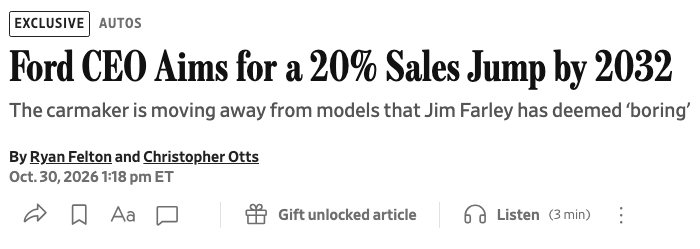
Ford Motor CEO Jim Farley told employees at a Thursday town hall that the company aims to sell 5 million vehicles a year by 2032, roughly 20% above current volumes, according to The Wall Street Journal. Ford has not issued a formal release on the target; the figures come from people familiar with the remarks.
Ford delivered about 3 million vehicles to dealers worldwide through Sept. 30, a 9% decline from the same period in 2025. The company last exceeded 5 million in global sales in 2019 and sold more than 6 million a decade ago. Part of the recent decline stems from discontinuing low-margin models including the Escape and Edge SUVs.
Farley said the increase would come from several new models, including five priced below $40,000 by 2032, among them a $30,000 EV pickup called the Fathom due to start production in late 2027 with a first-year target of over 100,000 units. In Europe, Ford plans new vehicles through partnerships with France's Renault and China's Geely, built at its Spanish plant. Ford shares closed down 0.89% on Oct. 30 and were around $12.27 after hours, down about 8.5% year to date.
Anthropic is in talks with Beacon Data Center to lease a hyperscale AI data center campus near Edmonton, Alberta, according to a Globe and Mail report. The proposed site in Sturgeon County would include four data halls powered by a 920 MW natural gas plant.
The reported talks come as Anthropic moves toward a public listing. The company filed its S-1 on Oct. 26 and could go public as soon as the week of Nov. 16, while a separate report put its net loss at $80.748 billion for the six months ended June 30 and said it is expected to receive a high junk rating after the IPO.
If a lease is signed, the gas-fired power supply would be the most closely watched element, as electricity availability increasingly shapes where large AI clusters are built. The report described negotiations only; terms, lease length and investment size were not disclosed.
Anthropic and Beacon Data Center did not publicly comment on the report, and the details rest on the Globe and Mail account.
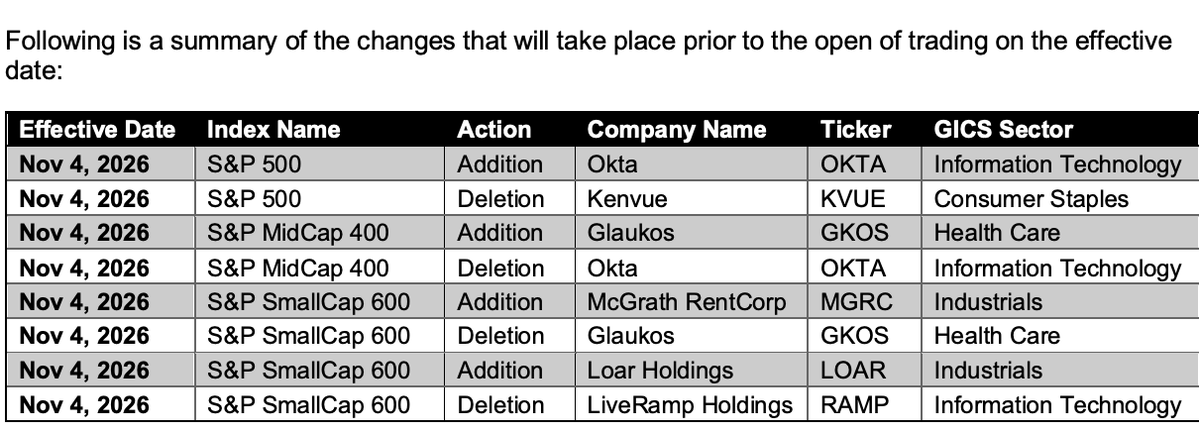
S&P Dow Jones Indices said on Oct. 30 that Okta will be added to the S&P 500, replacing Kenvue, with the change effective before the open of trading. Barron's noted that Kenvue is being acquired and will therefore leave the index.
Kenvue separately reported third-quarter earnings of $0.29 per share, beating the Zacks Consensus Estimate of $0.28 and matching the $0.28 reported a year earlier. The Wall Street Journal reported that profit and revenue rose as the company continues turnaround efforts ahead of its $40 billion acquisition by Kimberly-Clark.
For Okta, index inclusion means a new pool of buyers as funds tracking the S&P 500 rebalance; for Kenvue, the stock's narrative now centers more on the pending takeover. Commentary on X also cited 11% year-over-year revenue growth and a 13% GAAP operating margin for Okta, figures not independently confirmed in our newsroom sources.
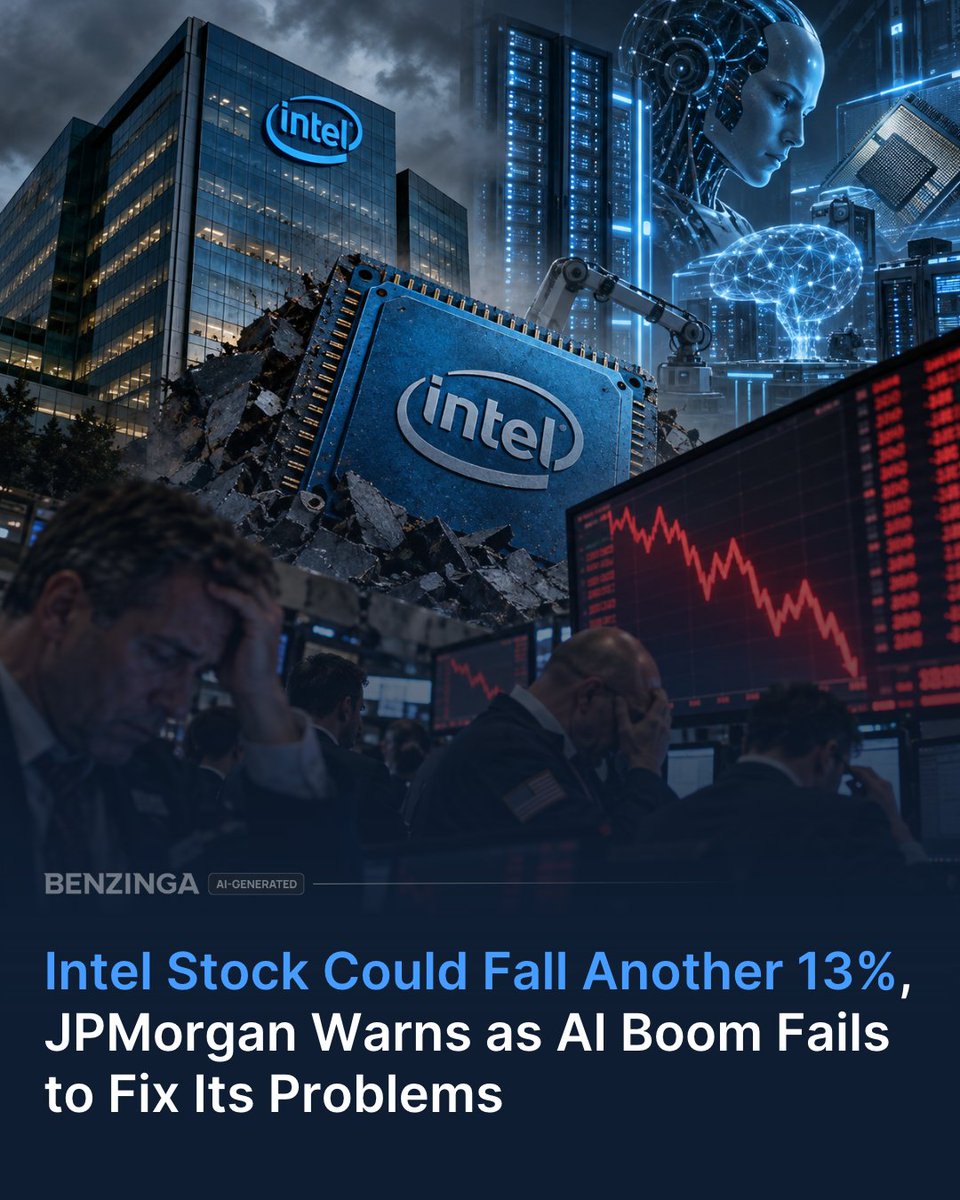
Intel's Data Center and AI business posted $7.3 billion in third-quarter revenue, up 78% year over year, making it the standout growth engine in the company's results. Client, or PC, revenue fell 5% over the same period.
JPMorgan said supply constraints for Xeon processors, PC weakness and heavy spending could keep pressure on the stock, setting up a tension with the strong data center numbers.
Intel shares fell roughly 25% to 28% on October 30 after the earnings report, with 17 Wall Street analysts cutting price targets; some analysts said there is no reason to buy the dip. Amazon fell 7% after reporting negative free cash flow for a second consecutive quarter, dragging the tech sector alongside Intel.
The key question for investors is whether AI infrastructure demand can offset the combined pressure of a shrinking PC business and rising capital expenditure, and when supply bottlenecks might ease.
ExxonMobil and Chevron reported combined third-quarter profits of about $25.3bn. ExxonMobil's profit rose to $15.4bn, with adjusted EPS of $4.23 beating the $4.08 estimate, while Chevron's profit climbed to $9.9bn, led by downstream earnings of $4.93bn versus $1.14bn a year earlier.
Both companies said the diesel crunch is here to stay. Roughly 10% of global fuel-making capacity is sidelined by disruptions in the Middle East and Russia, pushing ExxonMobil's refining margin marker to a record $50 a barrel; its Gulf Coast refineries ran at 100% utilization and Chevron's US refineries at about 98% of capacity.
The mix has inverted: ExxonMobil now earns more from making fuel than from producing oil, while its oil and gas output keeps falling. European peers moved ahead, with Shell, TotalEnergies and bp combining for about $28.4bn against $27.9bn for the two US majors, reversing a $5bn US lead in the second quarter.
For investors, the swing factor is the refining spread rather than crude prices. Brent fell about $7 in the third quarter, weighing on companies with larger upstream exposure; whether record refining margins hold will be the key test in coming quarters.
The U.S. Department of the Treasury said on Oct. 30 that Series I savings bonds bought from Nov. 1 through April 30, 2027 will pay a composite annual rate of 5.51%, up from 4.26% for purchases through Oct. 31. The composite splits into a 4.08% inflation-linked variable portion and a 1.40% fixed portion, the latter raised from 0.90% announced in April and the highest since 2006.
The variable portion tracks six-month changes in the consumer price index and is locked for six months after purchase, while the fixed portion does not change for the life of the bond. The Bureau of Labor Statistics reported September 2026 CPI up 3.7% year over year, from 3.4% in August, and a New York Fed survey put the one-year inflation outlook at 3.9%, the highest in more than three years.
For households, I bond interest is exempt from state and local income tax and federal tax is deferred until redemption, with purchases capped at $10,000 per person per calendar year. For markets, the rate raises the risk-free reference point: the 10-year Treasury yielded 4.98% on Oct. 30, while 3-month and 6-month bills yielded 4.00% and 4.15%, according to Federal Reserve H.15 data cited by Plutux Insights.
The contrast with bond funds is tax treatment. The X signal notes AGG yields about 5.3%, while reporting in our news library shows California, New York and Connecticut apply a holdings threshold that determines whether Treasury interest inside a fund escapes state tax. The I bond's state exemption is unconditional, but it comes with annual purchase limits and a three-month interest penalty for redemption within five years.
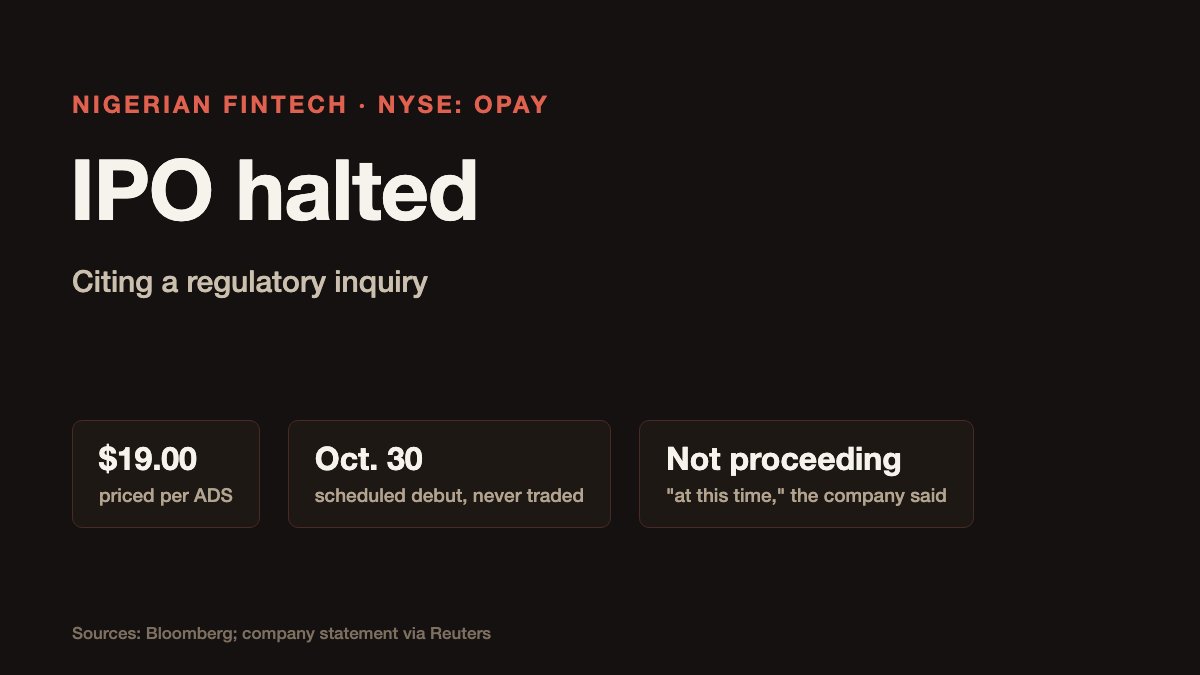
OPay priced 16 million American depositary shares at $19 each, the bottom of its $19-to-$21 range, raising $304 million at a valuation of roughly $4 billion. Trading was due to begin on the NYSE on Oct. 30 under the ticker OPAY, but no shares changed hands and the exchange halted the stock at about 3:30 p.m. New York time pending news.
In a statement on Oct. 31, the company said it and its underwriters mutually agreed to terminate the underwriting agreement dated Oct. 29, so the offering will not be completed and the ADSs will not list as scheduled. OPay attributed the move to a regulatory inquiry in a foreign jurisdiction it described as immaterial to its core operations, without naming the regulator or the country.
OPay said operations in Nigeria, Indonesia, Egypt and Pakistan continue normally and that the development should not be read as a reflection on its financial performance, operational integrity or regulatory standing. Citigroup, Deutsche Bank and Standard Bank led the offering; Standard Bank referred questions to OPay, Citi declined to comment and Deutsche Bank did not immediately respond.
The company had also planned a secondary listing on the Nigerian Exchange after the U.S. offering, approved by its board and shareholders; it is unclear how the termination affects that plan. OPay filed its Form F-1 with the U.S. SEC on Oct. 9, and the offering had been scheduled to close on Nov. 2, with underwriters holding a 30-day option for up to 2.4 million additional ADSs.
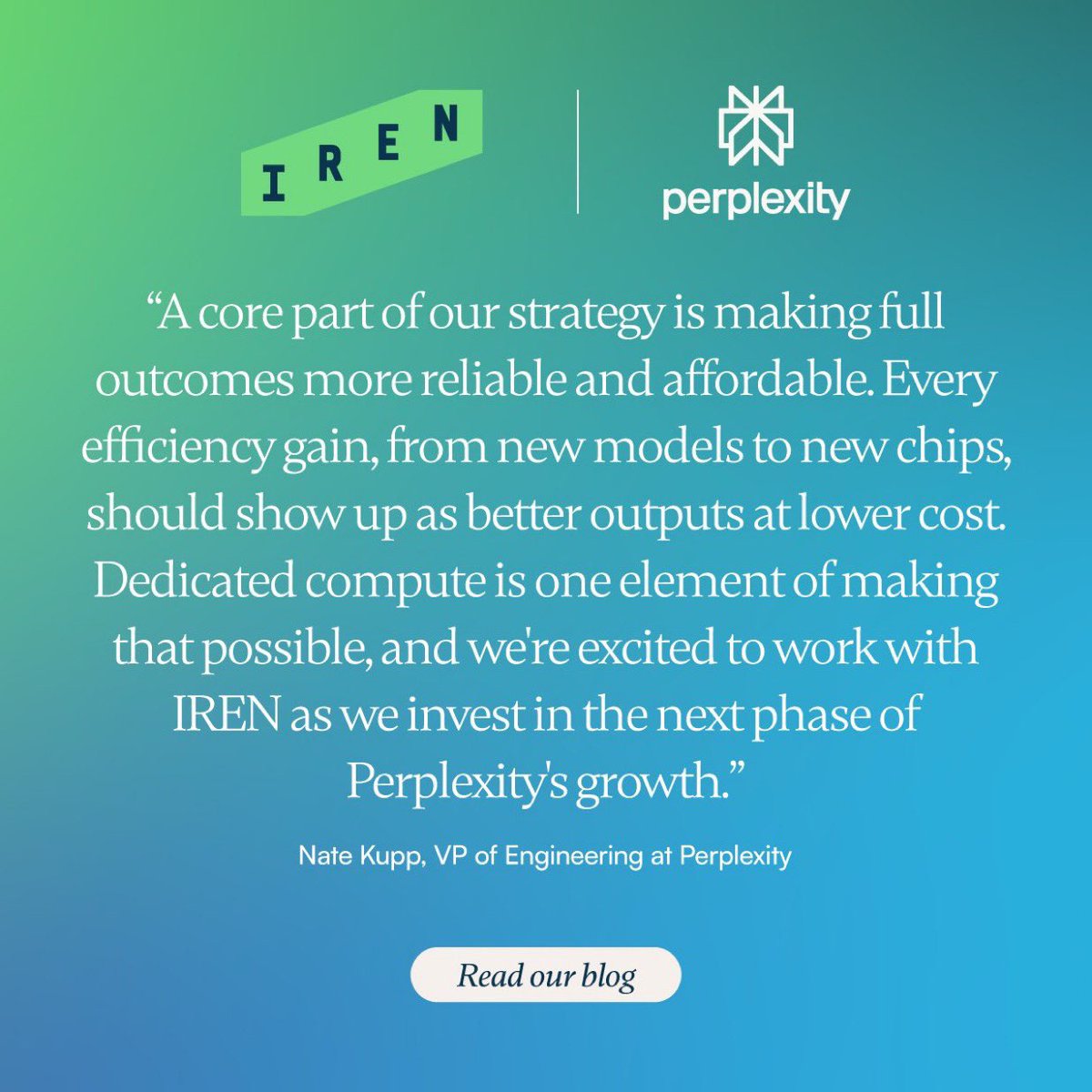
IREN confirmed that Perplexity Computer will run at its data centers on Nvidia Blackwell Ultra GPUs under a multi-year agreement. Posts circulating on X said the deal covers the compute behind the models and agents supporting Perplexity Computer.
The confirmation follows IREN's disclosure of roughly $3 billion in contracted ARR still waiting to come online, with Perplexity previously included in about $2.8 billion of multi-year contracts. The agreement moves IREN's AI cloud infrastructure from signed capacity toward a named customer workload.
The news ties directly to IREN as the compute host and Nvidia as the GPU supplier. It also lands the same day IREN shares fell 8.8% after B. Riley cut its price target to $64 from $91, according to the news library.
Nvidia and Perplexity did not provide further comment in the available material, and the agreement's value and deployment timeline were not disclosed.
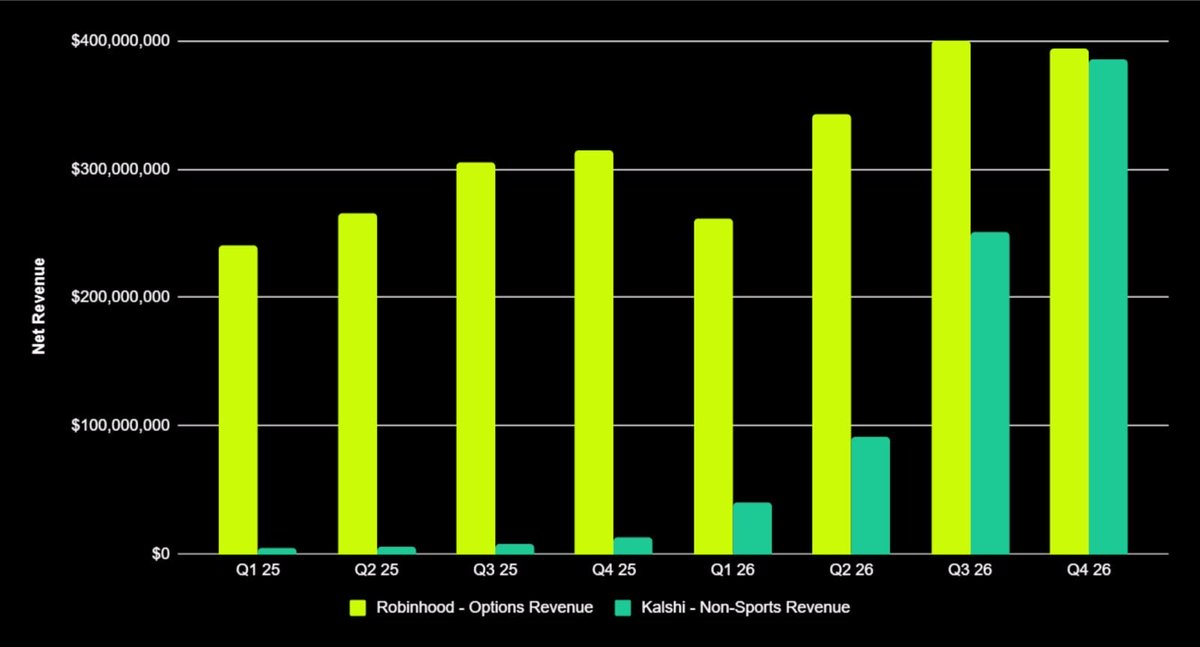
Kalshi's non-sports revenue tops $1B annualized, closing in on Robinhood's options business
Prediction market's growth is concentrated in short-duration crypto and index contracts, putting it on a collision course with brokerage options revenue
Kalshi said on Oct. 29 that it closed a $1 billion Series G at a $40 billion post-money valuation and that annualized revenue from non-sports markets has passed $1 billion. Commentary circulating on X framed that figure as on track to overtake Robinhood's options revenue, a business that barely registered for Kalshi at the start of 2025.
The growth is not coming from elections or Fed decisions. Industry estimates put roughly 80% of non-sports fee revenue in short-duration crypto, index and commodity contracts; 15-minute markets alone generated about $20 million in fees in the week to Oct. 6, or roughly $1 billion annualized. Kalshi has booked more than $2 billion in total fee revenue this year.
For Robinhood, options are a core monetization channel for high-frequency retail traders and a key support for its growth premium. If prediction-market contracts keep drawing the same users, the brokerage's options growth story faces a direct benchmark.
Kalshi is also fighting on the regulatory front: Utah has sued over its sports contracts and filed criminal charges, while the CFTC has sued to block state enforcement. The company maintains its contracts fall under federal derivatives oversight. No final ruling has been issued.
Robinhood did not publicly respond to the comparison.
Company
Polymarket lists 15-minute gold and silver up/down contracts, with Chainlink as settlement oracle
Short-horizon bets move from crypto into metals, paving the way for stock and FX contracts; settlement rests on a single price feed
Polymarket launched 15-minute up-or-down contracts on gold and silver on October 29, letting users bet whether each window's closing price will match or exceed its opening price. Chainlink was named the official oracle for the high-speed markets, settling each window on XAU/USD and XAG/USD spot data streams; a close equal to the open settles Up.
The format had previously been confined to crypto. Chainlink said Polymarket's 5-minute and 15-minute crypto markets have together logged more than $11 billion in cumulative trading volume, a combined figure covering both durations with no daily or monthly window disclosed.
Polymarket's US documentation shows the metals contracts have been listed in production since October 22, with only 15-minute, 1-hour and daily windows, no 5-minute products, and trading limited to metals hours with breaks on weekends and from 5:00 pm to 6:15 pm ET daily. Rival Kalshi also offers gold and silver contracts in the same format.
Neither company gave a launch date for stock and foreign-exchange contracts, saying only that they are "coming soon." Chainlink is a decentralized oracle network whose LINK token is the asset directly tied to the partnership; the announcement did not say whether the metals contracts are listed on a US regulated venue.
Intercontinental Exchange removed a post from its official X account on Oct. 31 about its collaboration with Trade[XYZ] to bring Hyperliquid-based perpetual futures to U.S. retail traders, then reposted it. The new version stresses that ICE "plans to" launch the market subject to regulatory approvals, and that customers must pass KYC/AML checks and access the venue through futures commission merchants that join the platform.
The underlying agreement was announced on Oct. 29: ICE will be the exclusive operator of Trade[XYZ]'s regulated markets and is making a strategic investment in the company. The retail perpetuals business is to run on a separate, dedicated clearing and regulatory structure, apart from ICE's institutional futures and clearing franchise, covering crypto, equities and equity indices, commodities and currencies, with distribution expected through ICE's joint venture with OKX.
During the deletion, users on X speculated that the partnership had been called off, and HYPE, the token tied to the Hyperliquid ecosystem, sold off. ICE has not explained why the post was taken down; the reposted version keeps the same substance while foregrounding the approval, KYC/AML and leveraged-trading conditions.
For ICE, the venture targets a retail segment that accounts for less than 1% of its current participation. The company said its minority stake in Trade[XYZ] is not expected to materially affect 2026 adjusted results, capital returns or deleveraging plans. Whether the market opens still depends on a series of U.S. regulatory approvals, including the joint venture's pending registration as a broker-dealer and FCM.
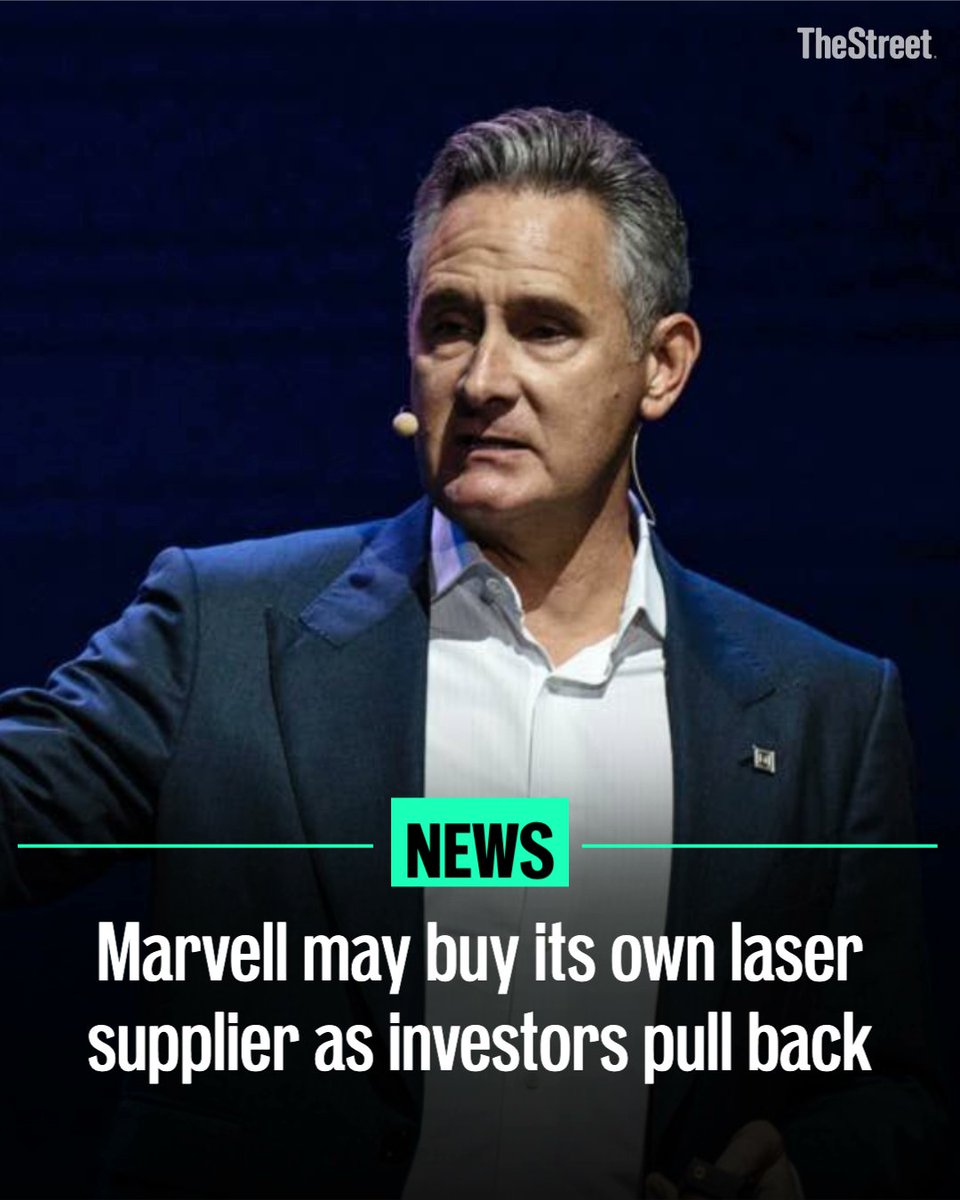
CNBC: Marvell-Lumentum deal said to carry no big premium, all-stock, no agreement yet
Lumentum's AI data-center lasers are sold out into early 2029 and Marvell is already a customer; an all-stock deal would dilute holders and faces US-China review
CNBC's David Faber said Friday that Marvell Technology's potential acquisition of Lumentum would not carry a big premium and would be structured as an all-stock deal. No agreement has been announced, and the terms and outcome remain unresolved. Lumentum shares fell 3.9% on the day.
Bloomberg reported earlier that the companies are in advanced talks and a deal could be announced as soon as next week, with Lumentum valued at about $85 billion and Marvell at about $196 billion — a combination that would rank among the largest ever in technology. Marvell is already a customer for Lumentum's lasers, which move data between AI chips in data centers.
Financially, Marvell held about $3.9 billion in cash, making an all-stock structure likely; the dilution weighed on Marvell shares, which fell as much as 12% to 14% on Oct. 29. The deal would also need US and Chinese regulatory approval, a potentially lengthy process. RBC analysts called the product portfolios highly complementary but noted Lumentum is a key customer of Marvell's DSPs, with Marvell holding 60% to 65% share.
Lumentum CEO Michael Hurlston has said its optical components for AI data centers are sold out through early 2029, with the company unable to meet about 70% of demand for some products next year. Neither company immediately responded to requests for comment.
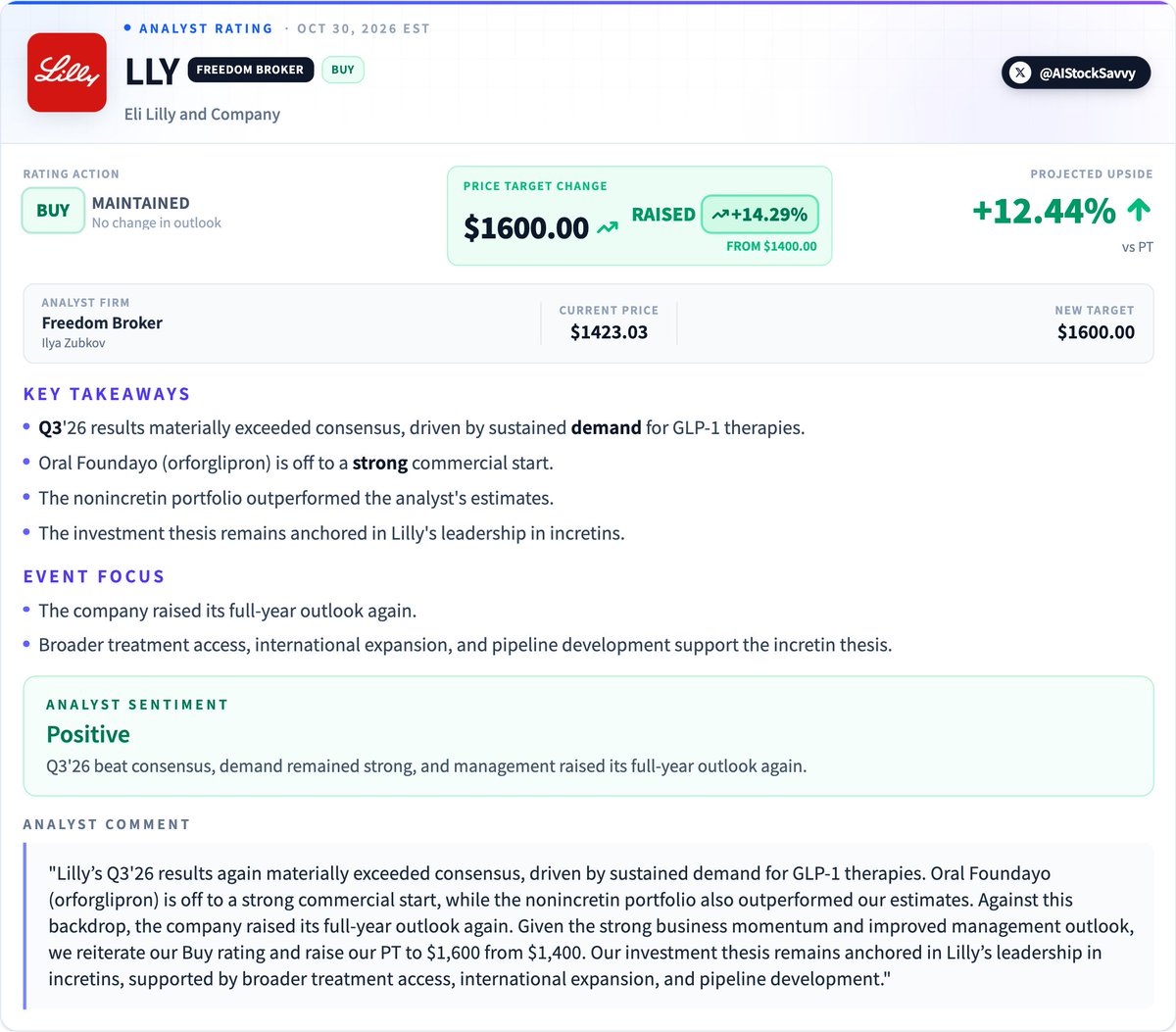
Freedom maintained its Buy rating on Eli Lilly and raised its price target to $1,600 from $1,400, citing strong business momentum, an improved outlook and leadership in incretins. Other targets cited in the same signal include Citi at $1,650, JPMorgan at $1,650, UBS at $1,625, Truist at $1,612, Scotiabank at $1,605, UBS-adjacent peers and RBC at $1,600, Morgan Stanley at $1,612 and Goldman at $1,575.
The revisions follow Lilly's third-quarter earnings call on October 29. According to our newsroom's coverage, revenue rose 39% year over year to $24.4 billion, led by the Mounjaro and Zepbound franchises, and the company raised its full-year revenue outlook, with expanded Medicare access and Foundayo traction cited as tailwinds.
The stock is up 66% since late April and at fresh all-time highs, according to the signal, and roughly 150% above an average entry in the $560s. The cluster of target-price increases points to a more uniform sell-side view of the post-earnings growth path, though targets are analyst judgments rather than forecasts of direction.
On the call, management raised the full-year revenue outlook; analysts highlighted incretin leadership and a broadening pipeline. The targets come from the banks, and the company has not commented on ratings or price targets.
Sandisk (NASDAQ:SNDK) has more demand than it can supply through 2030, according to an analyst, who framed the shortfall as a bullish case for the memory maker. The company earlier reported quarterly revenue growth of 378%, with AI-driven data-center business accounting for almost 90% of new revenue.
The stock did not follow. Sandisk shares fell about 10% on Friday as a broader technology sell-off hit high-growth names, with the Nasdaq Composite down 2.5% and the S&P 500 also lower.
The company is also proceeding with an 8-for-1 stock split against a share price of roughly $1,300. Investors are weighing whether AI memory demand converts into durable earnings and how the stock holds up in a growth selloff.
Views remain split, with at least one analysis questioning whether results are ever good enough. The supply-gap claim is an analyst view, not a company commitment on unfulfilled orders.
Turo has begun promoting Tesla's FSD (Supervised) to renters, telling customers in an email to take an FSD-equipped Tesla on a weekend getaway rather than a short showroom test drive. The rental marketplace will start labeling which Teslas on its platform carry the software.
According to X user rexshares, Turo will verify each car through direct access to Tesla's API and offer eligible hosts a free one-month trial. Neither Tesla nor Turo issued a formal statement in the source material.
The move comes as Tesla shares lagged peers: 247wallst.com reported Tesla fell 3% while Rivian rose 3% on a raised delivery outlook tied to its R2 ramp. The material did not disclose financial terms or how many vehicles the program covers.
Other Tesla coverage in the past 48 hours focused on institutional share purchases and reported discussions of a SpaceX-Tesla merger, neither of which is directly tied to the Turo arrangement.
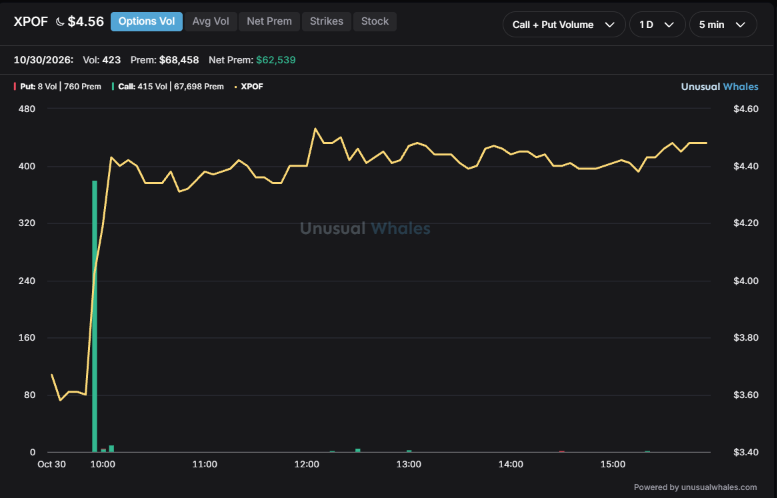
Fund 1 Investments, the third-largest holder of Xponential Fitness (NYSE: XPOF), delivered a non-binding letter to the board on Oct. 30 proposing to acquire all outstanding shares in a cash take-private at $5.61 to $7.00 per share, at least 50% above the $3.74 close on Oct. 29.
Fund 1 reported beneficial ownership of 4,170,610 shares, or 9.9% of the class, and no transactions since its prior amendment. The firm said it would seek a waiver of the stockholder rights agreement dated Oct. 12, 2026, so it can work with other interested shareholders; it is open to letting others participate while it takes a majority stake.
XPOF shares rose about 19% intraday to roughly $4.40, implying a market value of about $221 million. The proposal is non-binding and creates no enforceable obligation; the board has not publicly responded.
Starbucks CEO Brian Niccol said on Oct. 30 that the company could eventually move beyond coffee and become a multi-brand business, citing Yum Brands — owner of Taco Bell and KFC — as a comparison. "Our scale provides an opportunity to go beyond just being a one-brand company," he said, adding that other businesses could sit in a portfolio.
The remark came roughly two weeks after the chain shut down rumors that it was exploring a takeover of Chipotle Mexican Grill, reviving questions about whether Starbucks will pursue outside deals.
Niccol also discussed the fourth quarter, saying that "getting the basics right" drove results. According to the newsroom, Starbucks reported quarterly EPS of $0.8, above the $0.73 Zacks consensus estimate and up from $0.8 a year earlier, though MarketWatch noted the stock was still moving lower.
The multi-brand idea was framed only as a possibility; no targets or timetable were disclosed.
Bambusa Therapeutics (Nasdaq: BBTX) began trading on Oct. 30 at $15.18, about 5% below its $16 offer price, and closed at $14.99, down 6.3% from the IPO price. Based on shares outstanding listed in its filings, the company carries a market value of about $763.6 million.
The Boston-based company upsized the deal and sold 10,555,555 shares at $16 apiece, raising gross proceeds of about $168.9 million, versus an earlier plan of roughly 9.4 million shares at $15 to $17. Underwriters hold a 30-day option for up to 1,583,333 additional shares.
Founded in 2024, Bambusa develops long-acting bispecific antibodies. Its lead asset BBT001 targets IL-4Rα and IL-31 for atopic dermatitis and other Type 2 inflammatory skin diseases, alongside BBT002 and preclinical programs BBT003 and BBT004. Net proceeds are earmarked mainly for advancing BBT001.
Fellow Nasdaq debutant Aspen Neuroscience, a Parkinson's cell therapy developer, opened at $14.70 and fell to about $12.00, roughly 20% below its $15 IPO price. The weak first-day showings contrast with an otherwise busier October for biotech listings.
Baker Hughes data for Oct. 30 showed the US oil-directed rig count up 2 to 462, the gas-directed count down 2 to 130 and miscellaneous rigs unchanged at 11, leaving the total at 603 for a third straight week.
Year on year the total is up 53 from 546, but the mix has shifted: oil drilling has steadied while gas activity has slipped for two consecutive weeks, consistent with weak Henry Hub economics. Single-digit weekly swings sit inside the noise band; the more informative signals are the multi-week oil trend and completion and frac-spread activity.
For oilfield services names such as Halliburton and SLB, the rig count is a leading indicator of drilling demand, though per-rig productivity gains mean flat or modestly lower counts can coexist with record output, limiting the read-through to equities.
Canada stood at 226 rigs. Baker Hughes has published North American counts weekly since 1944; the international count, released monthly, was 1,122 in September, up 20 month on month.
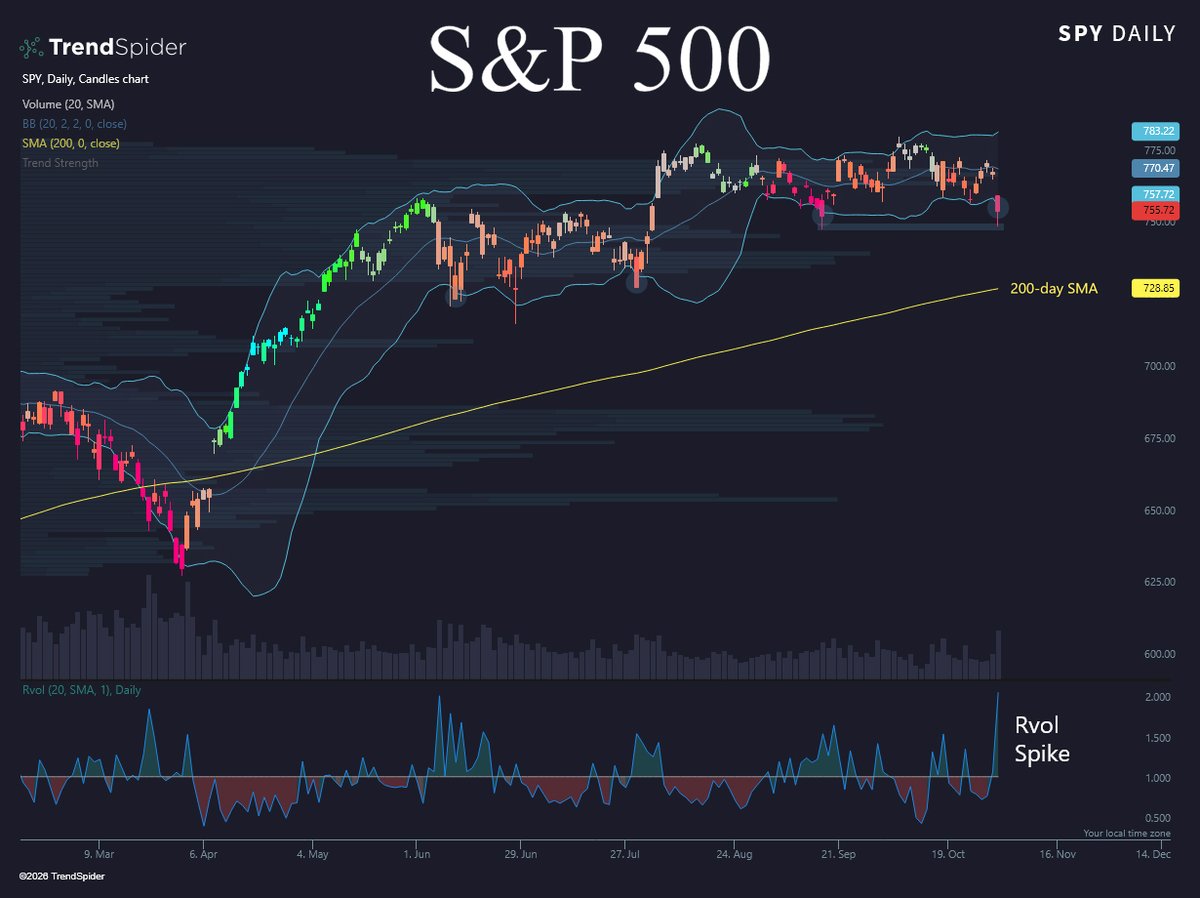
The SPDR S&P 500 ETF (SPY) broke below its September closing low on October 31 and traded under its lower Bollinger Band, with volume running at roughly twice the usual pace. Traders on X framed the move as a downside break of a tight range rather than a single-session wobble.
Options-flow data pointed the same way: gamma exposure (GEX) channels tracked by one account stepped lower through the session, with support forming near the 750 level and 755 flipping to resistance. In ES futures, 7677–7803 was described as the prior macro range; the loss of 7677 overnight triggered a bear case, and 7649 was flagged as the level needed to reclaim for a bounce.
Sector dispersion was notable. The VanEck Semiconductor ETF (SMH) had not yet taken out its October 22 low, with the 200-day moving average cited as the key reference; one trader argued sentiment is worse than price action. Bitcoin, meanwhile, bounced after finding support near its 200-day EMA and a volume shelf around $76,500.
Caveat: the levels and indicators above come from traders' own commentary and proprietary tools, not from exchanges or index providers, and definitions can differ across data vendors.
U.S. stocks split sharply on Oct. 30: the Nasdaq Composite fell 2.86% to 25,437.00, the S&P 500 lost 1.82% and the Dow slipped 1.09%, while the Philadelphia Semiconductor Index dropped 7.20%. Intel closed down 28.58%, its worst single day in more than four decades, after guiding fourth-quarter revenue to $15-16 billion versus a $17.07 billion consensus.
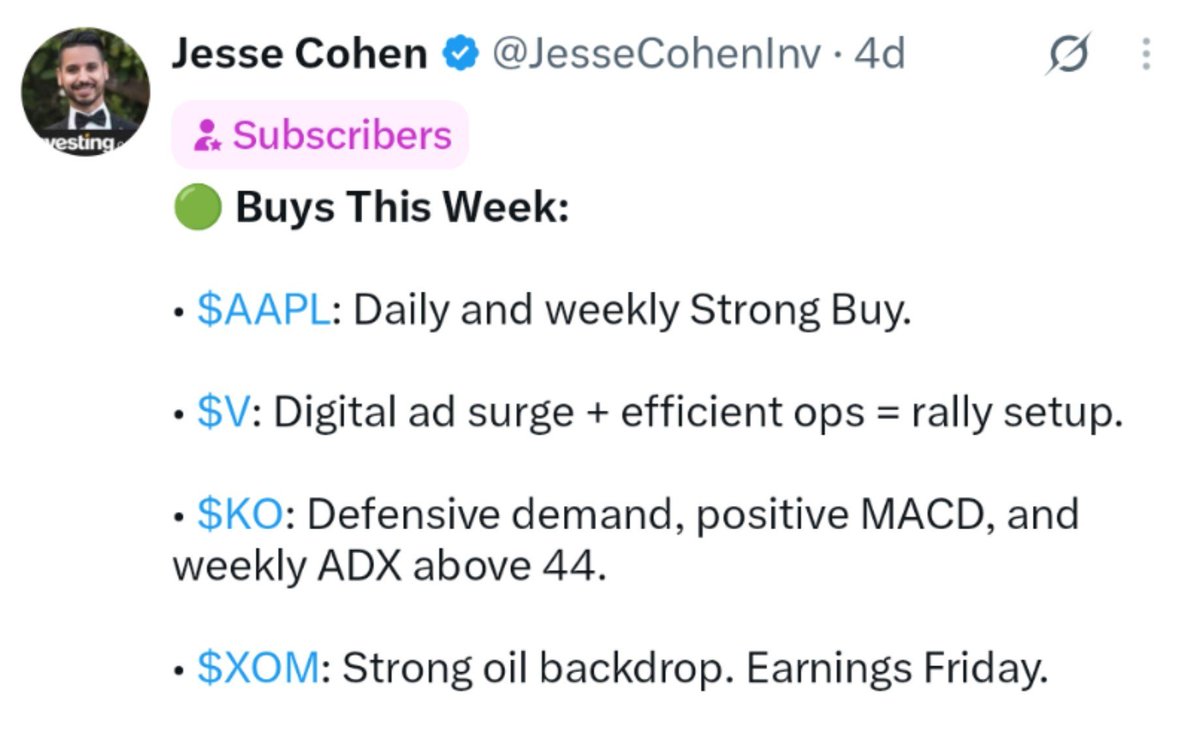
Visa, Coca-Cola and Exxon Mobil each rose about 2% the same session. Visa's fiscal fourth-quarter adjusted EPS of $3.48 beat the LSEG consensus of $3.44 on net revenue up 13% to $12.1 billion; Coca-Cola drew a 10.6% position increase from CFC Planning in the third quarter; Exxon posted third-quarter net income of $15.4 billion, or $3.72 per share, with energy products earnings of $7.17 billion edging upstream's $7.09 billion.
Sector data confirmed the rotation: energy gained 1.91% and consumer staples 1.38% within the S&P 500, while technology fell 4.24%. The Dow rose about 0.5%, with Coca-Cola and Visa both up more than 2% at record highs and Walmart and Nike up more than 4%.
Each name had its own catalyst — an analyst target hike and a 16% dividend increase for Visa, institutional buying for Coca-Cola, and wider refining spreads for Exxon — rather than one shared macro driver. Rising fuel costs meanwhile continue to build pressure on transport, logistics and manufacturing margins.
A CNBC commentary piece argued that UnitedHealth is finally getting its act together, with the author saying he is buying into the turnaround and pointing readers to CNBC Pro.
Barron's reported that the stock has gained 24% this year and that third-quarter results helped reinforce its momentum.
In a separate filing, CFC Planning Co LLC raised its stake in UnitedHealth by 9.0% in its most recent quarter, according to a Form 13F disclosure.
The items are commentary and position disclosures rather than new official company guidance, so investors should rely on formal company filings.
Bloomberg Opinion columnist Chris Hughes argues that Anthropic's initial public offering has become the "totem" of the AI trade — and that the AI trade is now the market itself. The piece frames the listing as a "$100 billion" bet and the only market that matters at present.
The Wall Street Journal's opinion pages offer a different angle: Joseph C. Sternberg writes that Anthropic's IPO will be a national-security win for Taiwan, arguing that US reliance on the island for AI chip production places it among America's top foreign policy interests.
The market conversation extends beyond the listing. Seeking Alpha published a piece titled "Forget Anthropic's IPO, I'm Buying AMD," steering attention toward chip stocks; our newsroom's recent coverage notes AMD's Data Center sales are up 107%, with OpenAI, Meta and Anthropic among major customers, and that AMD's AI partnership with Meta is expanding.
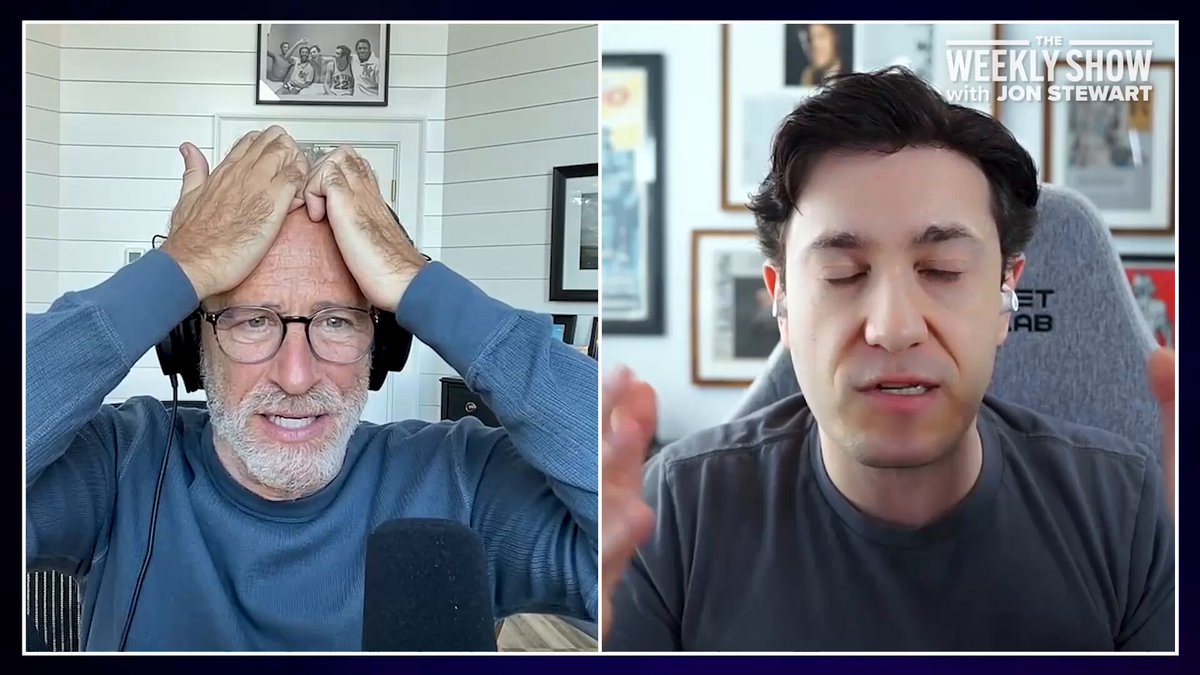
The Weekly Show podcast also released an episode with Ed Zitron examining Anthropic's valuation and details of the upcoming IPO. None of the source material disclosed specific pricing, timing or valuation methodology for the offering.
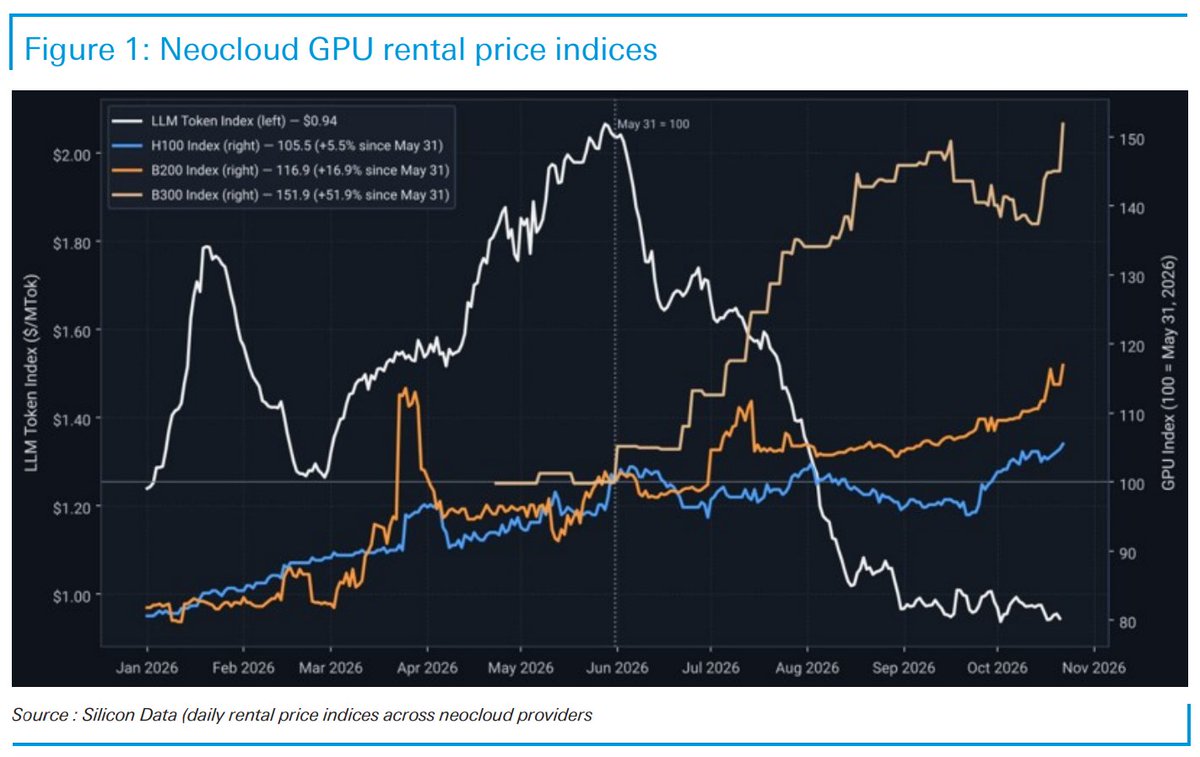
X user StockSavvyShay argued on Oct. 31 that the selloff in NBIS, CRWV and IREN looks extreme heading into November, pointing to Nvidia B300 rental prices up 52% since May and older H100s also becoming more expensive to rent. The same post said AI token prices have fallen more than half from their peak, with the text cut off mid-sentence.
Coverage in the past 48 hours has centered on individual names: one piece argues CoreWeave retains high growth potential, while another reports Elon Musk's concern that many neoclouds will not survive tightening financing, alongside CoreWeave debt trading lower in the secondary market. IREN fell 8.8% on Oct. 31 after B. Riley cut its price target.
The post's central claim is a divergence between rising GPU rental rates and the equity selloff. The materials provide no specific B300 or H100 rental quotes or methodology, so the 52% figure traces only to the post and cannot be cross-checked against our news library; the token price decline likewise has a single source.
The opposing directions of rental pricing and inference token pricing may reflect differences in supply structure, but the materials offer no further evidence. The view is the author's and does not forecast stock direction.