Bitcoin fell to $55,251.60 on Saturday, its lowest level in two years, after breaking below $57,742 on Friday, then rebounded more than 8% to about $59,952, briefly reclaiming $60,000, according to Reuters. Coin Bureau put long liquidations at over $2.1 billion as the price broke below $56,000, followed by more than $225 million of short liquidations within four hours of the rebound.
The slide came amid AI valuation concerns, rising borrowing costs, a stronger dollar and a broader risk-off move. Bitcoin is down about 28% since early October and was headed for a seventh consecutive weekly decline, the longest streak since 2022, and sits more than 50% below its record above $126,000 set in October 2025.
Flow indicators remain weak: the Coinbase bitcoin premium has been negative for 60 straight days, and Binance perpetual funding has flipped negative, which CryptoQuant's Darkfost flagged as a possible early reversal signal. BitMEX co-founder Arthur Hayes said bitcoin has decisively broken its prior local low and that $50,000 is the next real test if the Nasdaq keeps falling.
Bloomberg reported that some once-diehard crypto investors are rotating into AI stocks, prediction markets and stock perpetuals. The weakness has coincided with pressure on AI names: Anthropic (NASDAQ: ANT) closed at $88.91 on its second trading day, down 8.5% and close to its $83 IPO price, as the Nasdaq erased its 2026 gains.
President Donald Trump said in a Fox News interview aired Nov. 21 that he is willing to work with the incoming Democratic Congress to cap credit card interest rates at 10%. According to the Associated Press, he backed the standard one-year, 10% proposal, against a current median rate of roughly 22.2%.
The idea is not new. Trump first floated it during the 2024 campaign, then declared on social media on Jan. 10, 2026 that a one-year 10% cap should take effect "effective January 20," warning that card issuers who did not comply would be "in violation of the law." That date passed without any rule or statute, and the White House was later reported to have walked back the pledge.
What has changed is the politics: Democrats won House and Senate majorities in the November midterms. Sen. Elizabeth Warren says her 10% cap bill is "ready to go," and Texas Sen.-elect James Talarico campaigned on reining in card rates. A bipartisan Sanders-Hawley cap bill has sat in the Senate since February 2025.
For lenders, a cap directly compresses interest income on card balances. Bank and card stocks sold off in January when Trump first made the call; on Friday, Nov. 20, American Express closed down 3.02% at $301.70 and Bank of America fell about 3.15% to $47.04, moves tied to broader macro and rate conditions rather than this report. Responding to the interview, Warren said: "Let's cap credit card interest rates and save Americans money."
How this story unfolded
Company🔥Developing
Amazon Nears $7.5 Billion Decart Takeover, Deal Could Land Next Week
The reported price is up from the ~$7 billion WSJ flagged in October; Decart's cross-chip software is central to AWS's pitch against Nvidia
Amazon is closing in on a roughly $7.5 billion acquisition of Israeli AI startup Decart, with talks at an advanced stage and a deal possible as soon as next week, the Financial Times reported. Israeli outlet Calcalist said the price could reach $7.5 billion in a mix of cash, stock and deferred consideration, with founders Dean and Orian Leitersdorf and Moshe Shalev agreeing to stay for five years.
Founded in 2023, Decart builds real-time video and world models, but its most valuable asset for Amazon is an optimization stack that lets models move across Nvidia GPUs, Amazon's Trainium and Google TPUs. Amazon has said publicly that Decart's real-time video ran about four times faster on Trainium at half the cost of comparable Nvidia hardware — the portability argument AWS needs to sell its own silicon.
The talks have been building for months: the Wall Street Journal reported discussions at around $7 billion on Oct. 11, and Bloomberg reported in August that Anthropic had walked away from a roughly $6 billion deal after Decart's founders declined to relocate to San Francisco. A $7.5 billion price would be close to double the nearly $4 billion valuation Decart carried in May.
For investors, the report lands on two sensitive threads: AWS's competition with Nvidia is moving deeper into software, and Nvidia itself just posted a 23% weekly decline — its worst since 2008 — after Reuters reported an SEC accounting probe. Neither Amazon nor Decart has commented on the talks.
How this story unfolded
Regulation
California widens Nvidia probe to possible criminal violations of state law
The AG subpoenaed Nvidia on Nov. 19 over China chip sales and investor disclosures; the criminal angle adds to an SEC accounting probe and a one-day stock drop
California's investigation into Nvidia now extends beyond whether the chipmaker violated state securities law to a review of possible criminal violations of state law, Bloomberg reported on Nov. 21. At issue is whether Nvidia illegally sold advanced chips to China and misled investors about that conduct.
The probe became public on Nov. 19, when Attorney General Rob Bonta announced an investigative subpoena seeking information on whether Nvidia or co-founder Jensen Huang caused restricted processors or confidential information to reach China. Bonta said the principle of state corporate securities law is that companies cannot mislead their investors; the subpoena does not establish that any violation occurred.
The criminal dimension compounds pressure from other directions. Nvidia shares fell 14.01% to $125.53 on Nov. 20, a 52-week low, after Reuters reported the SEC had opened an accounting probe; Huang resigned as CEO earlier in November. A criminal review would move the legal exposure beyond civil securities claims.
Nvidia spokesperson John Rizzo said the company is cooperating fully and that "today's news will not slow Nvidia." The attorney general's office has not detailed the scope of the criminal assessment.
SEC enforcement staff are examining Nvidia's accounting practices, including a change in how it reports regional revenue, Reuters reported on Nov. 20, citing people familiar with the matter. The Wall Street Journal had earlier reported a civil probe following Jensen Huang's departure, but the accounting focus was disclosed first by Reuters. The SEC declined to comment; Nvidia did not immediately respond to requests for comment.
At issue is Nvidia's shift, starting with the August-October 2025 quarter, from reporting regional revenue by customer billing address to customer headquarters, which sharply reduced reported Singapore revenue. The WSJ and Fortune reported the change drew scrutiny as U.S. authorities examined whether Singapore-based Megaspeed helped funnel chips to China; investor Michael Burry has publicly questioned the adjustment.
Shares closed down 14% at $125.53 on Nov. 20, capping a roughly 23% weekly decline — the worst since 2008 — and about $900 billion of market value lost in the week. The stock is down roughly $2.7 trillion from its Oct. 6 record close. AMD fell 13.2% the same day, with Broadcom and Micron also weaker.
The pressure is compounding: Nvidia reported $115.8 billion in fiscal third-quarter revenue on Nov. 17, up 103% year over year, without halting the slide, while the Justice Department reviews its $12.9 billion Hugging Face acquisition. Nvidia's board said on Nov. 8 it had opened an independent investigation into reporting on Huang.
How this story unfolded
2026-09-235 posts · 5 authors
CoreWeave signed a multi-year deal with Harell Data to run AI training on Nvidia GPUs inside its secure platform, while continuing to sell older A100/H100 GPUs.
After a $20 billion stock-and-bond raise, Oracle calls itself the first hyperscaler fully funded for this AI cycle; investors still question OpenAI's ability to pay
Oracle said after Friday's close that its infrastructure contract with OpenAI is fully funded, with this month's $20 billion stock and bond sale completing the financing framework laid out at its investor day. The company said the package, including vendor financing, is in place and that further private talks with vendors are optional rather than necessary for delivery.
The statement also declared that "any media reports that will come out and say the contrary are incorrect and wrong" — an unusual pre-emptive denial that drew more attention than the funding claim itself. Oracle billed itself as the first hyperscaler fully funded for this investment cycle and said rack handovers at sites including Abilene, Texas, remain on schedule.
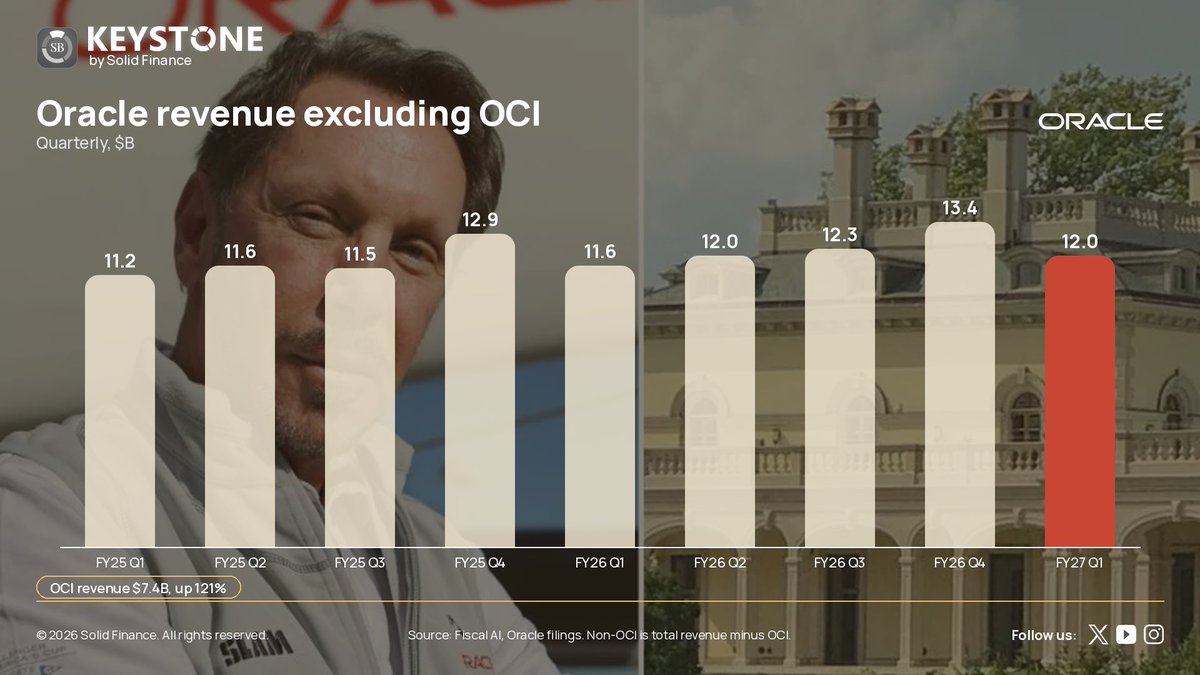
The context is a stock down almost 70% from its peak, with roughly half of Oracle's $664 billion remaining performance obligations tied to OpenAI. Shares fell about 8.8% on November 2 when the $20 billion raise was announced, on dilution and leverage concerns; fiscal Q1 OCI revenue rose 121% to $7.4 billion and total revenue 30% to $19.3 billion, but gross margin slipped to 60.0%.
Reaction was mixed: ORCL rose as much as 3.3% after hours yet closed the session down about 6.6%, and traders noted weakness in its bonds. The debate on X centered on the credibility of corporate disclosure — the same question hanging over SanDisk and Micron's emphasis on long-term agreements and price floors, whose value depends on customers' ability to pay. OpenAI did not issue a separate statement.
Company
Tesla starts FSD v15 rollout with a claimed 25x gain on safety-critical cases; wide release waits for December
Musk said wide release comes with the holiday update, then the first wave of owners got v15 about 12 hours later — the first deployment of a vision encoder shared by FSD, Robotaxi and Optimus
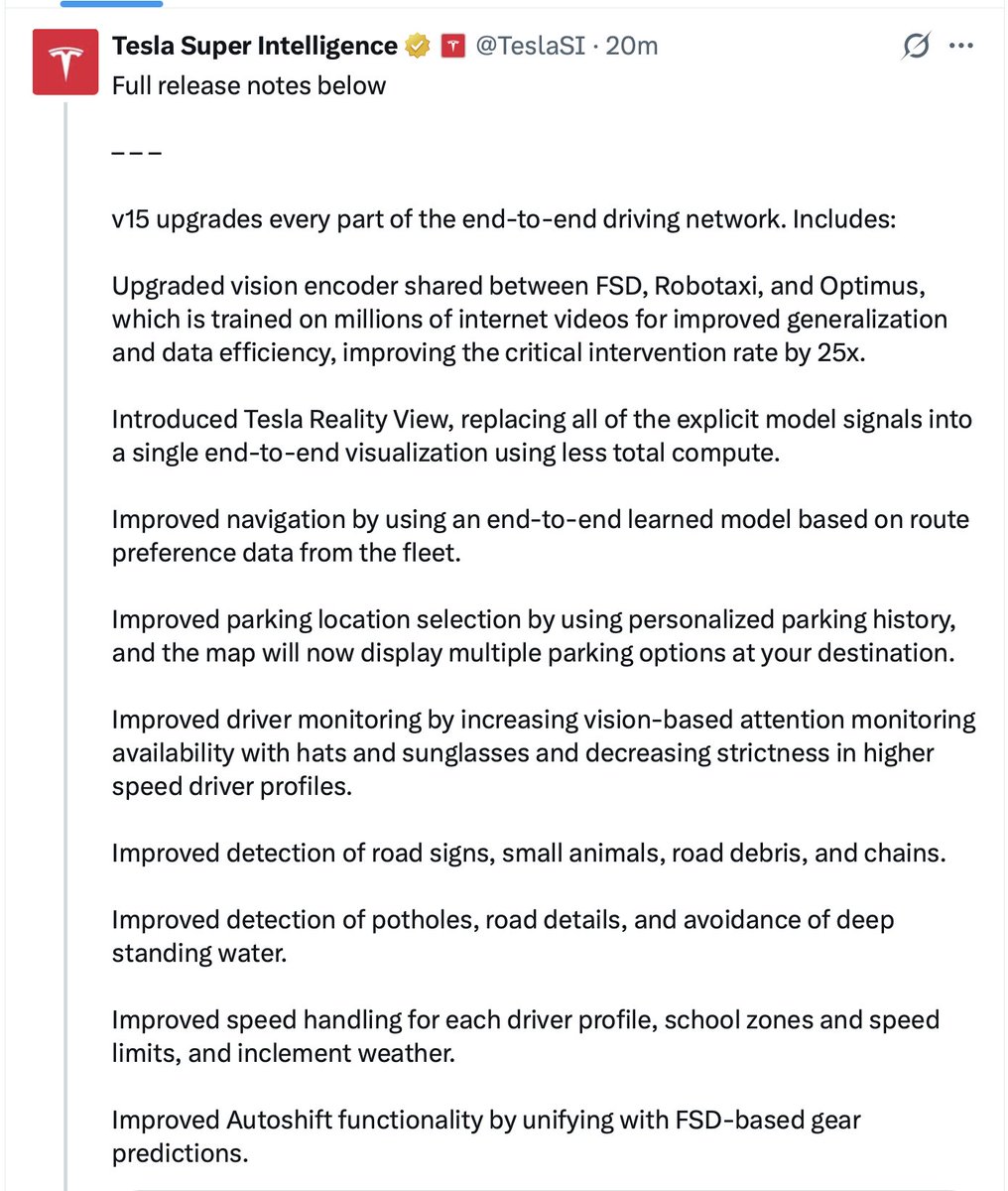
Tesla said on Nov. 21 that FSD v15 is "now starting to roll out," describing an upgrade to "every part of the end-to-end driving network" and claiming 25x better handling of safety-critical cases. The release also debuts Tesla Reality View, an in-car live visualization that shows what the car perceives and intends to do next, with arrows for planned turns and pins for intended targets.
Full release notes list an end-to-end learned navigation model trained on fleet route-preference data, parking-spot selection based on personal parking history, pothole avoidance and school-zone speed handling, plus looser vision-based attention monitoring when drivers wear hats or sunglasses. The build reaching owners is 2026.38.6.11 (FSD V15.0.1).
The rollout followed Musk's earlier post that "FSD V15 goes to wide release next month" with the 2026 holiday update; the first wave arrived roughly 12 hours later and remains limited, with broad distribution still tied to December. Tesla says the upgraded vision encoder is shared across FSD, Robotaxi and Optimus and was trained on millions of internet videos, tying the consumer software to its robotaxi and humanoid programs.
For TSLA, FSD carries much of the valuation story: paid FSD customers rose 67% year over year to 1.74 million in Q3 2026, with more than 75% of new deliveries including the feature. The 25x figure is Tesla's own and unverified externally; Electrek noted that against a prior baseline of roughly one critical intervention per 10,000 miles it would imply about 50,000 miles, and that Musk made comparable safety claims at the V12 and V14 launches. Tesla has not published the test methodology or sample size behind the number.
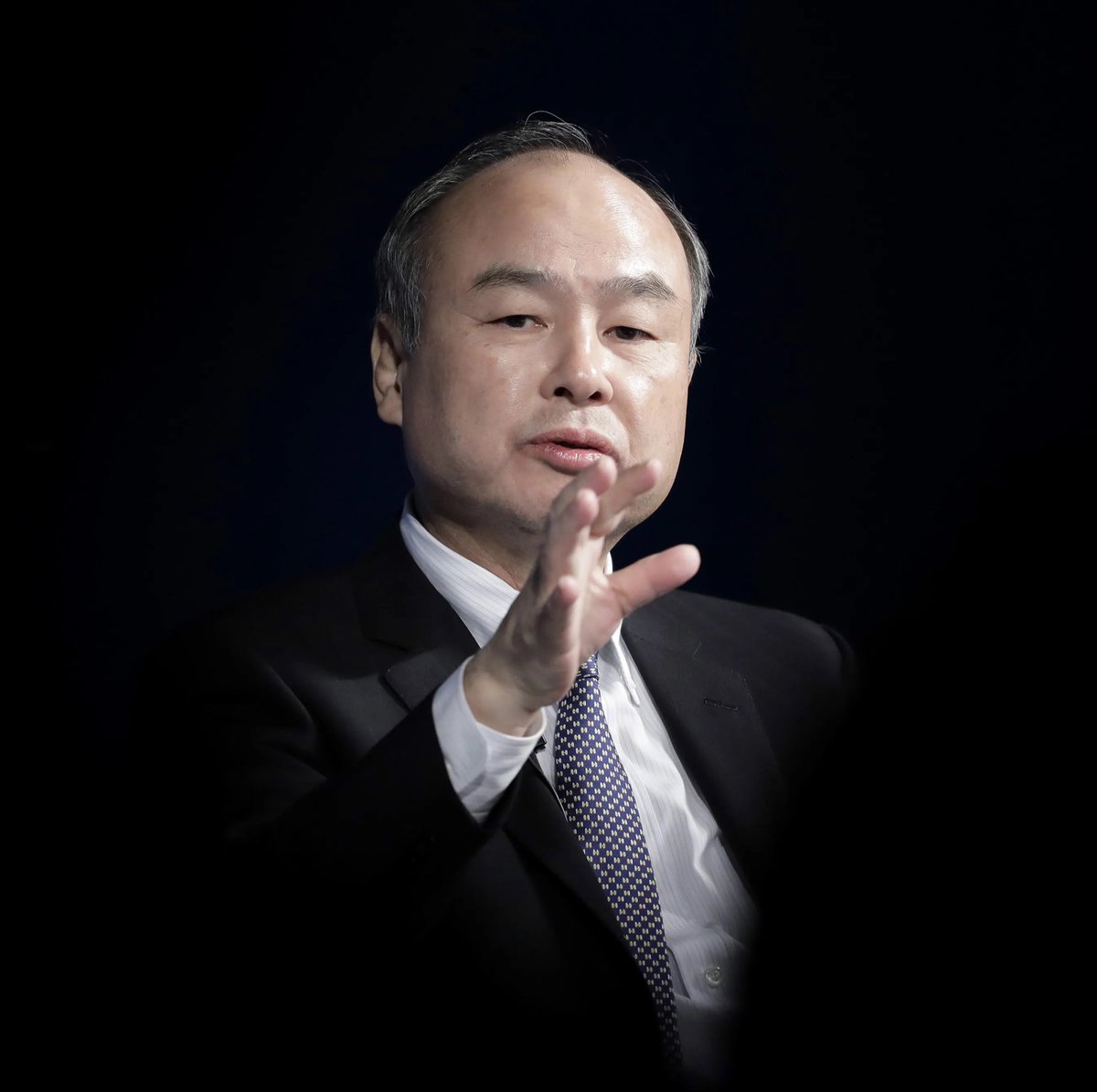
Masayoshi Son recently explored a takeover of South Korean memory chipmaker SK Hynix valued at nearly $1 trillion and approached Wall Street institutions about financing it, The Information reported. A SoftBank spokesperson told the outlet that the deal is no longer under active consideration, a statement carried in Reuters' account of the report.
SK Hynix is the world's No. 2 NAND maker and a key supplier of high-bandwidth memory, and it listed American depositary receipts on Nasdaq in July 2026 under the ticker SKHY, raising about $26.5 billion. Its market value stood at roughly $870-890 billion in mid-November, implying that a $1 trillion price would carry a substantial premium.
The report lands as SK Hynix moves to convert bonds into Kioxia shares, giving it an indirect stake of about 14.1% and making it the top shareholder in its NAND rival, though a 2018 agreement caps its voting rights at 15% until 2028. SoftBank, meanwhile, is digesting a quarterly net loss of 1.115 trillion yen and saw its shares fall 14.48% on Nov. 20.
With SoftBank ruling the idea out, the episode reads less as a live transaction than as a marker of how strategically prized memory assets have become in the AI buildout. Near-term moves in SKHY and SoftBank (9984.T) are likely to track memory pricing and AI capex trends.
Dell, Hewlett Packard Enterprise, Lenovo and Supermicro are demanding as much as 45% more for Nvidia-powered AI servers, in some cases months after contracts were signed, the Financial Times reported on November 22. Buyers affected include trading firms and other customers that depend on predictable delivery of compute capacity.
The repricing follows a year of cost pressure. AI data-centre demand has driven up memory and storage prices, prompting server makers to raise list prices repeatedly and shorten how long quotes stay valid. HPE amended its terms in February to allow price adjustments on server and GreenLake orders up to the day of shipment, while Dell applied a blended list-price increase of roughly 17% across its range, including PowerEdge, effective March 30.
For the vendors, passing costs through protects margins but tests contract credibility with large buyers; for customers, budgets fixed at signing may now require top-ups. Dell, HPE and Supermicro have all posted steep gains in 2026, leaving investors highly attuned to whether AI server demand can absorb higher prices.
The four companies did not publicly comment on the specific increases reported. HPE has previously said pricing changes occur only in the "rare" case of material cost shifts.
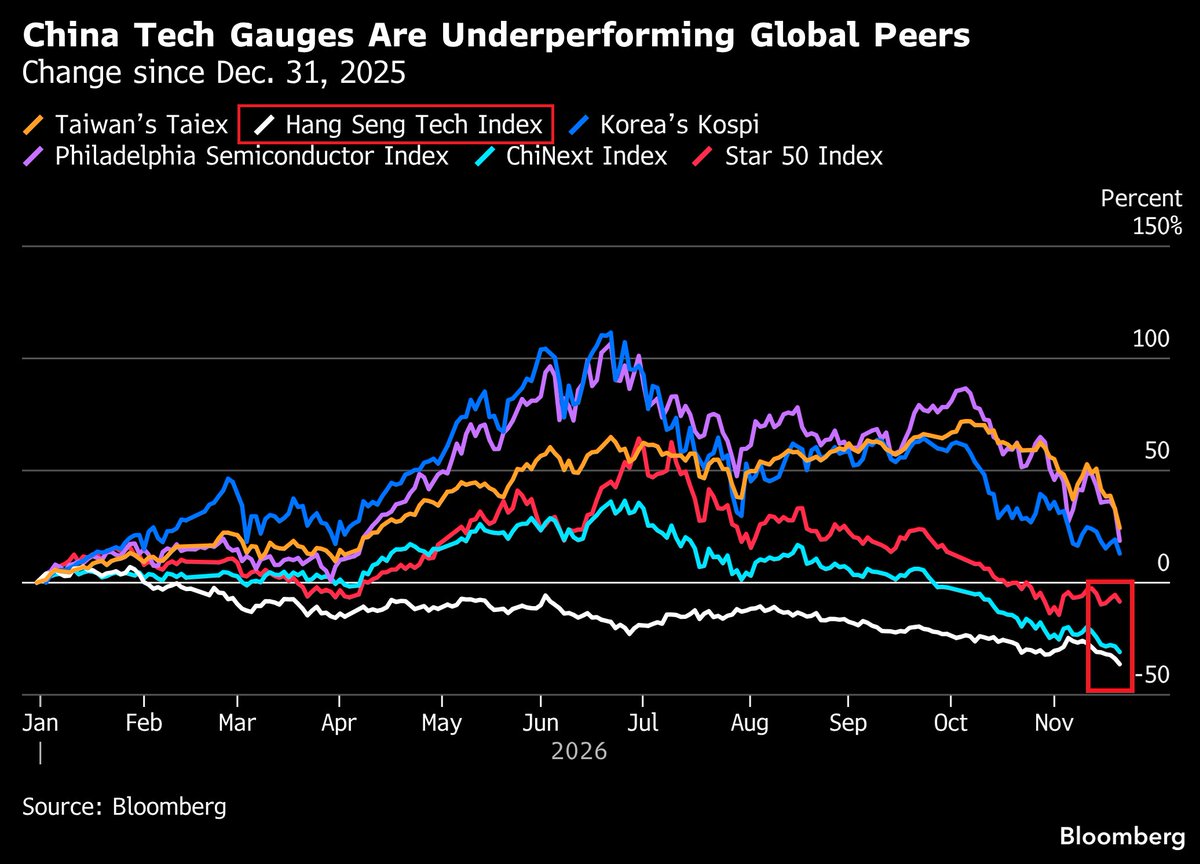
Stocks listed on three tech-focused Chinese indexes have shed a combined $1.7 trillion in market value since the end of June, according to Bloomberg data published on November 22. The Hang Seng Tech Index is down 48% from its peak and sits at a two-year low, closing at 3,511.14 on November 20, a 3.78% drop on the day.
The drawdown traces back to an October 2025 peak of roughly 6,715 points. Heavy AI capital spending, slow profit conversion, a proposed VAT on internet services and soft domestic consumption have weighed on valuations, with the gauge already down nearly 30% from its high by March 2026 before breaking below 4,000 points in late October.
Tencent fell 6.81% on November 19 and Alibaba lost 5.81% the same session, while NetEase dropped nearly 18% intraday on November 20. Bloomberg noted all three Chinese tech gauges are now negative for the year, while major peers in the US, Taiwan and South Korea remain in positive territory.
Beijing revived rescue tools from the 2024 downturn in early November, a move met with scepticism as selling resumed. The retreat has coincided with a broader global tech selloff, with technology shares leading a worldwide equity rout on November 20 as US 10-year Treasury yields fell.
How this story unfolded
Regulation
Trump says he'll bar US firms from building data centers abroad, or hit them with a "tremendous tax"
Meta is building a C$13 billion campus in Alberta; no rate, scope or start date has been specified, leaving overseas compute plans in limbo
President Donald Trump said on Nov. 20 that he will not allow U.S. companies to build data centers outside the country and that firms doing so would face a "tremendous tax." According to multiple reports, he gave no rate, scope or effective date, and no executive order or legislative text has been published, leaving the threat a verbal statement for now.
The remarks came amid mounting local opposition in the U.S. to data center power and water use. Trump argued that if domestic pushback drives tech giants abroad, the U.S. risks ceding its AI lead to China. Meta, Amazon, Alphabet and Microsoft all have data center projects outside the U.S.
Meta is among the most exposed. Its first Canadian data center, in Sturgeon County, Alberta, broke ground in July with an investment of more than C$13 billion and a planned 1-gigawatt campus scalable to 1.8 GW. The company's 2026 capital expenditure guidance stands at $135 billion to $145 billion, so any tax or block on overseas sites would reshape where that money lands.
Alphabet and Amazon shares fell about 3% and 4% respectively on the day of the remarks, according to reports, as tech stocks closed a rough week. No major U.S. tech company had issued a formal response as of publication.
Roughly 20% of GPU rental demand has been flowing through offshore channels to Chinese customers, according to an estimate by Carmen Li, chief executive of GPU pricing index provider Silicon Data. The figure circulated widely on X this week as a yardstick for how much of the neocloud order book the new US export controls touch.
The estimate lands days after the Commerce Department's Bureau of Industry and Security issued an interim final rule on Nov. 16 that regulates remote access for the first time. A data center anywhere that supplies more than 12 million aggregate TPP of compute to companies in China and other target countries needs a license; facilities already serving such customers have 90 days from the effective date to obtain one. The rule was published in the Federal Register on Nov. 19 and adds Singapore, Malaysia, Indonesia, Thailand and Brazil to the list of destinations requiring licenses for advanced AI chips. Nvidia, per FT reporting, has separately told data center customers that at least 51% of their services must go to non-Chinese companies.
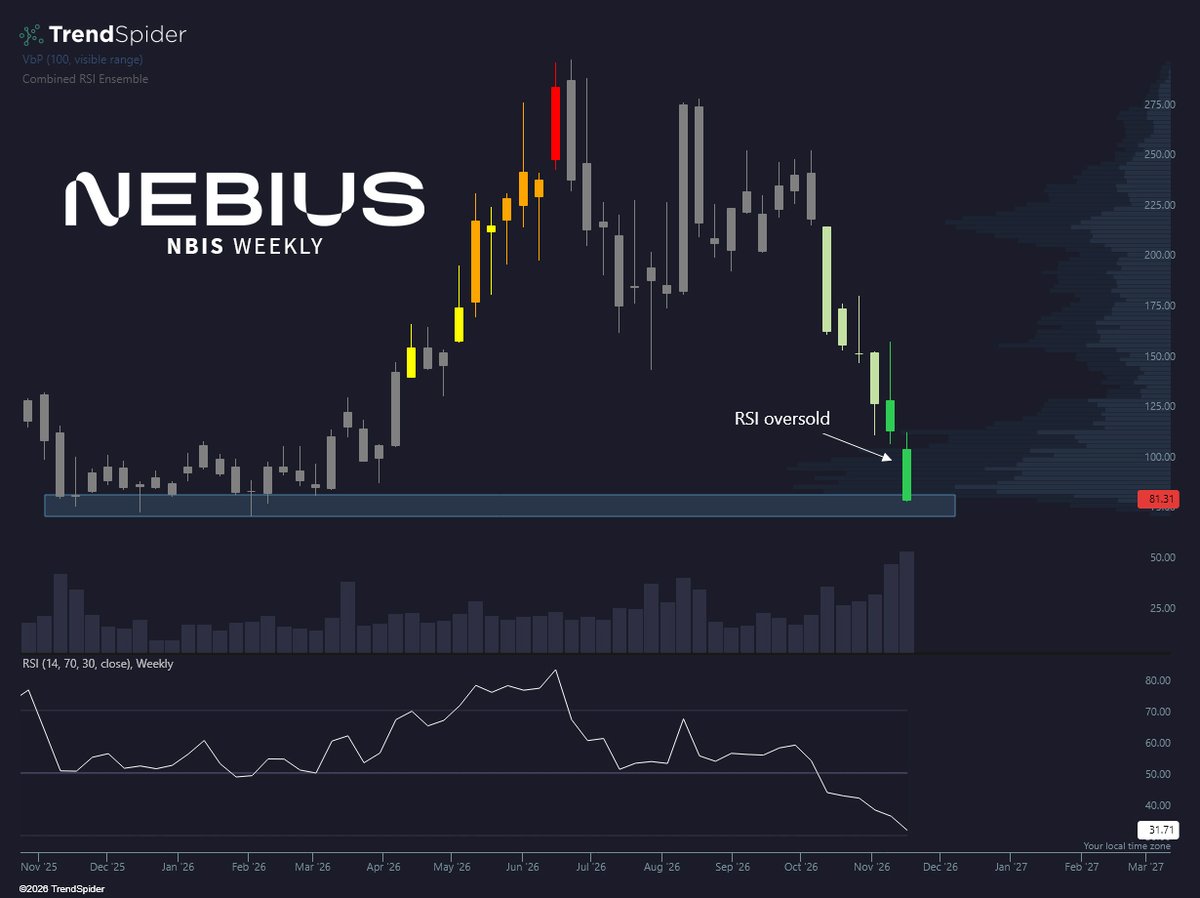
The listed neoclouds are the most exposed. CoreWeave's third-quarter revenue rose 168% year over year to $3.66 billion while its net loss widened to $709 million, against roughly $47 billion of debt. Nebius posted $980.8 million in quarterly revenue, up 571%, but guided 2026 sales to the low end of its $3.0-3.4 billion range and pushed its $7 billion ARR target out by about two months. On Nov. 20 CoreWeave fell about 9% and Nebius dropped 16% to $81.31, 72% below its June record.
Neither company discloses its China customer share, so the 20% figure is a third-party estimate rather than a disclosed revenue exposure. Nvidia has warned buyers that the new rules could expose them to legal action over Chinese access to rented capacity.
How this story unfolded
Regulation🔥Developing
Waymo files two robotaxi recalls over closed freeway lanes and hand-signal failures
The filings follow California's Nov. 11 order barring Waymo from state freeways and a nationwide pause on highway rides, pushing a regulatory fight into software fixes
Waymo filed two software recalls with U.S. safety regulators on Nov. 19: one covering robotaxis that could enter and keep driving in closed freeway lanes, and another addressing how the vehicles interpret manual traffic direction from police and emergency crews. Reuters reported the filings on Nov. 20; Waymo did not disclose how many vehicles each recall covers.
It is the company's second recall this year tied to closed freeway lanes. In June, Waymo recalled 3,871 fifth-generation automated driving systems (NHTSA campaign 26E-035) after vehicles failed to recognize ramp closure signs and drove into pre-planned work zones. The latest action follows a California Department of Motor Vehicles order on Nov. 11 that temporarily barred Waymo from operating driverless vehicles on state freeways, after three of its cars entered an active construction closure on U.S. 101 near Burlingame; the DMV said one vehicle stopped in a critical lane and did not yield to sirens or hand signals.
Waymo paused driverless freeway rides nationwide on Nov. 17-18 and has not said when highway service will resume. For Alphabet (GOOGL), Waymo is a long-dated option in the equity story rather than a current earnings driver, and the June recall drew little stock reaction, suggesting investors are treating these events as operational risk.
Waymo described the recalls as voluntary, with fixes delivered over the air. Two things to watch: when California lifts its order, and whether NHTSA opens a broader inquiry into hand-signal recognition.
How this story unfolded
2026-11-1816 posts · 15 authors
Markets🔥Developing
Anthropic's 2x Long and Short ETFs Set for Monday Cboe Debut After Stock Slips 8.5%
Tradr's ANTT and ANTZ target 200% of ANT's daily move, resetting each close, as options on the newly listed AI company also open
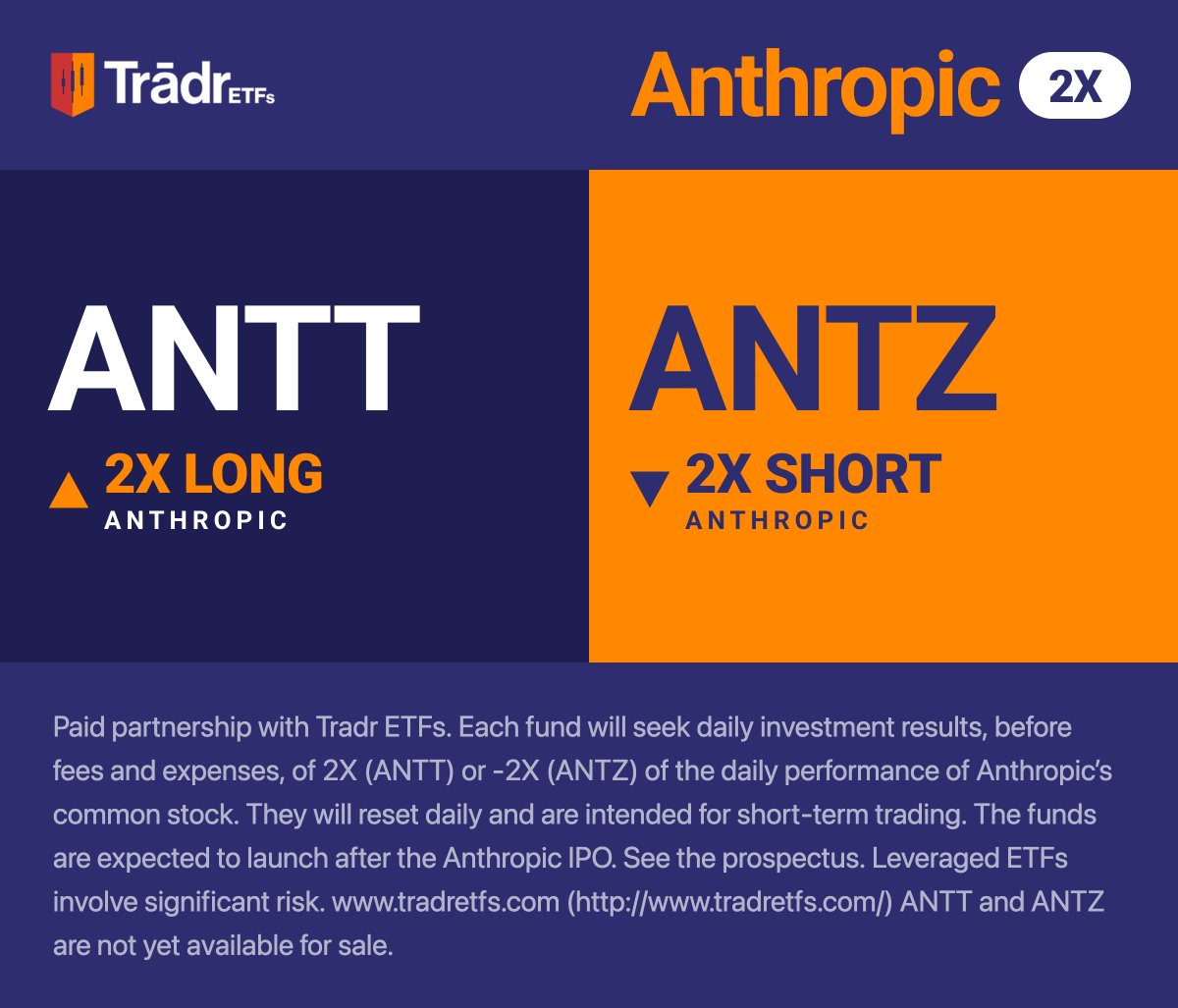
Tradr ETFs expects to list the Tradr 2X Long Anthropic Daily ETF (Cboe: ANTT) and the 2X Short Anthropic Daily ETF (ANTZ) on Monday, November 23, each seeking 200% of the daily performance of Anthropic (Nasdaq: ANT), before fees and expenses. The firm filed for the pair in early September and announced the expected launch date on November 16.
Anthropic priced its IPO at $83 a share on November 19, raising roughly $81.3 billion, and opened at $111.50, 34% above the offer price, before closing its first session at $97.17. The stock finished at $88.91 on November 20, a decline of 8.5% on the day. Cboe has said options on ANT could begin trading as soon as November 23, subject to industry readiness.
The launch is not Tradr's alone: Leverage Shares plans ANUU (2x long) and ANDD (2x short) among three Anthropic-linked funds on Cboe the same day, and GraniteShares has also targeted November 23. Because these funds reset leverage at each close, their multi-day returns can diverge from twice the underlying move, a distinction that matters most during the volatile early trading of a new listing.
The issuers flag leverage as carrying significant risk in their marketing materials. No regulator has publicly commented on the pace of listings for single-stock leveraged ETFs tied to Anthropic.
How this story unfolded
Markets🔥Developing
Solana's tokenized ANT tops $140M in two days, more than all other chains combined
Anthropic's stock fell on day two, yet onchain trading stayed concentrated on Solana — a test of whether tokenized equities can build liquidity independent of Nasdaq
Tokenized Anthropic stock $ANT, issued by Backpack Securities and listed via Sunrise, generated $134.7 million in its first 24 hours on Solana — more than 2.6 times the $51 million first-day volume of tokenized SpaceX shares ($SPCX), according to Sunrise. Over its first two days, ANT volume on Solana exceeded $140 million, more than every other chain combined.
Anthropic priced its IPO at $83 a share on Nov. 18, raising $81.3 billion in the largest listing on record, and began trading on Nasdaq under the ticker ANT on Nov. 19, opening at $111.50 and closing its first session at $97.17. Backpack and Sunrise repeated the playbook they used for SpaceX in June, bringing a 24/7 tokenized version live on listing day.
The onchain activity ran against the direction of the underlying stock: ANT slipped toward $92 on Nov. 20 as the Nasdaq Composite erased its 2026 gains. That gap suggests the token volume reflects demand from non-US buyers and round-the-clock access rather than a view on the shares.
Competition is also taking shape. Robinhood Chain's ANT token has logged about 179,000 transfers since going live on Nov. 19, while Solana recorded roughly 10 times as many ANT trades. Sunrise and Backpack say their venues account for 95% of ANT spot volume on Solana.
How this story unfolded
2026-10-263 posts · 3 authors
Anthropic filed its S-1 targeting an IPO the week of Nov. 16, revealing strong revenue growth and massive committed payments to Google and Microsoft.
Markets
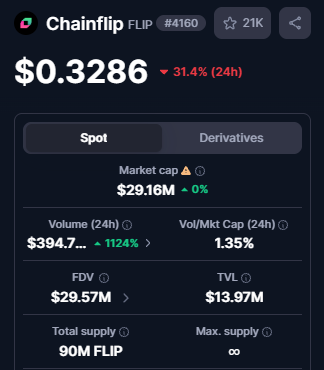
Chainflip Raises Hack Loss to About $12M Including 122.86 BTC; FLIP Falls 31%
Trackers had first flagged a $4.86M Ethereum vault drain. The protocol is offering a 10% bounty for 90% returned by Nov. 23.
Cross-chain swap protocol Chainflip confirmed an attacker took roughly $12 million in Bitcoin, Ether and stablecoins from its vaults on Nov. 21, well above the $4.86 million initially estimated by blockchain trackers. The confirmed haul includes 122.86 BTC, 520 ETH and about $4 million in stablecoins.
According to Bitquery, the Ethereum vault withdrawal cleared on a single valid signature, the only anomalous one among 299,677. The stolen ETH reached Tornado Cash within about 10 minutes, and Chainflip said the attack was roughly 10 days in the making, with activity traced to Nov. 11.
It is the protocol's second security incident in 10 weeks, after 736,442 USDT was taken from its Tron vault on Sept. 12. FLIP traded near $0.33, down about 31% in 24 hours, roughly twice the slide that followed the September breach. Chainflip has entered full safe mode, halting deposits, withdrawals, swaps and quotes.
Chainflip offered the attacker 10% of the funds, about $1.2 million, if 90% is returned by Nov. 23, and said a return would be treated as white-hat. No public response from the attacker has been reported.
Cyber, formerly known as CyberConnect, said it detected unexpected minting of about 5.21 million CYBER on Solana on Nov. 21, alongside an outflow of tokens from the bridge's Ethereum lockbox. Onchain data shows the attacker converted most of the unbacked tokens into roughly 575 ETH, worth about $968,000, and the project is investigating the suspected bridge exploit.
South Korea's Upbit and Bithumb suspended CYBER deposits and withdrawals following the incident, though spot trading remained open. DefiLlama has logged the event as a cross-chain bridge attack with losses of about $968,000; Cyber has not confirmed the root cause or outlined a reimbursement plan.
CoinGecko data shows CYBER fell about 8% on Nov. 21 to an all-time low of $0.1992 before recovering modestly. The drop followed a roughly 44% single-day rally to $0.3017 on Nov. 20 that analysts had flagged as derivatives-led and stretched.
The incident adds to a heavy year for bridge security: DefiLlama classified 25 bridge and cross-chain attacks through August 2026, up from three a year earlier. Cyber is backed by Binance Labs, and the timing of restored exchange transfers is the next focal point for holders.
SpaceX flies Falcon 9 again 32 hours after last Vandenberg launch, setting pad turnaround record
NROL-136 is the NRO's fourth proliferated-architecture launch this year, sustaining SpaceX's government cadence even as SPCX trades well below its IPO price
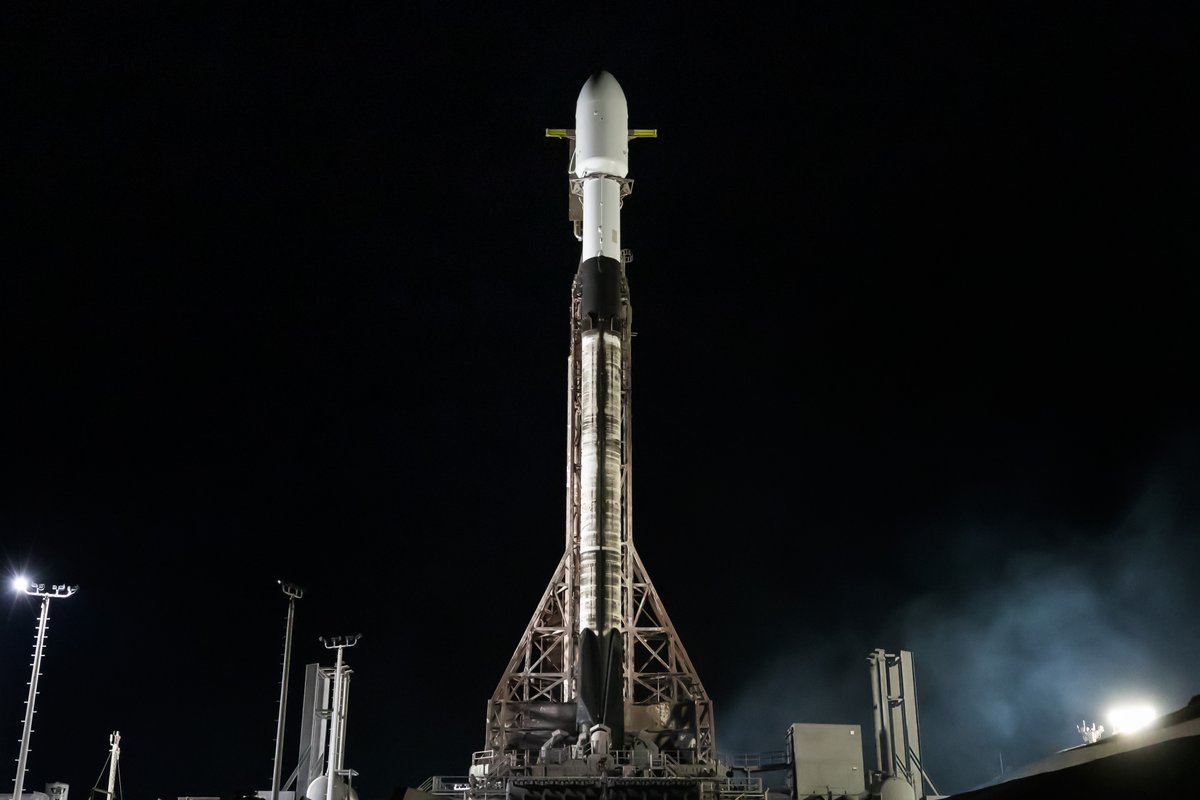
SpaceX launched a Falcon 9 carrying the National Reconnaissance Office's NROL-136 mission from Space Launch Complex 4E at Vandenberg Space Force Base at 4:23 a.m. PT on Sunday. The first stage, booster B1097, flew for the 14th time and landed at Landing Zone 4 beside the pad.
The flight came roughly 32 hours after the previous mission from the same pad, a turnaround record for Vandenberg. NROL-136 is the fourth launch this year for the NRO's proliferated architecture, a constellation of many smaller satellites intended to increase revisit rates and remove single points of failure.
Government and intelligence work remains SpaceX's most dependable revenue stream outside Starlink and underpins its launch cadence. Public-market investors have not matched that enthusiasm: SPCX listed at $135 on June 12 and has since fallen sharply, with market value down from roughly $2.1 trillion on its first trading day to about $1.9 trillion recently.
Neither the NRO nor SpaceX disclosed the number of satellites or orbital parameters for the mission.
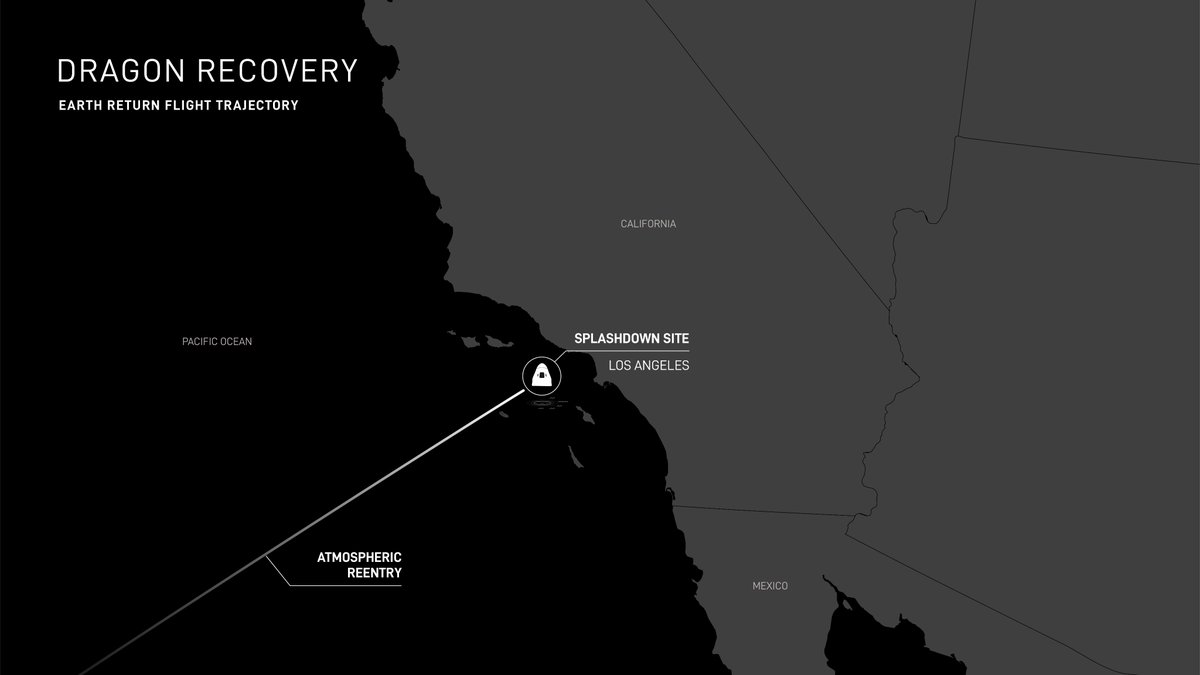
SpaceX said on Nov. 22 that the Dragon spacecraft flying NASA's 35th Commercial Resupply Services mission (CRS-35) is on track to reenter and splash down off the southern California coast near Los Angeles at about 2:05 p.m. PT, with a brief sonic boom possible along the coast. The capsule undocked from the International Space Station on Nov. 20 after its departure slipped from Nov. 18 because of unfavorable sea states at the splashdown zone.
CRS-35 launched in mid-October on a Falcon 9 to deliver supplies and research to the station, and the spacecraft has spent roughly 39 days in orbit. According to SpaceX's mission page, this Dragon previously flew CRS-26, CRS-29 and CRS-33, making this its fourth flight; recovery teams will bring it ashore to offload returning science samples.
For SpaceX (NASDAQ: SPCX), cargo Dragon is routine, repeatable business, so a single splashdown is unlikely to move the stock on its own. Shares have lately tracked a broader tech selloff and the company's AI-compute financing story: Reuters reported that Apollo and Goldman Sachs are leading a $44 billion debt financing tied to SpaceX GPUs, while other coverage described an agreement under which Alphabet would pay roughly $30 billion to rent AI capacity.
Timing and location were confirmed jointly by SpaceX and NASA; the recovery window could still shift if sea conditions change.
How this story unfolded
2026-10-02
Markets🔥Developing
VIX closes at 35.89, highest since April 2025, after touching 40.03 intraday
S&P 500's 8.6% weekly slide puts the index in correction; volatility and credit spreads now tell different stories
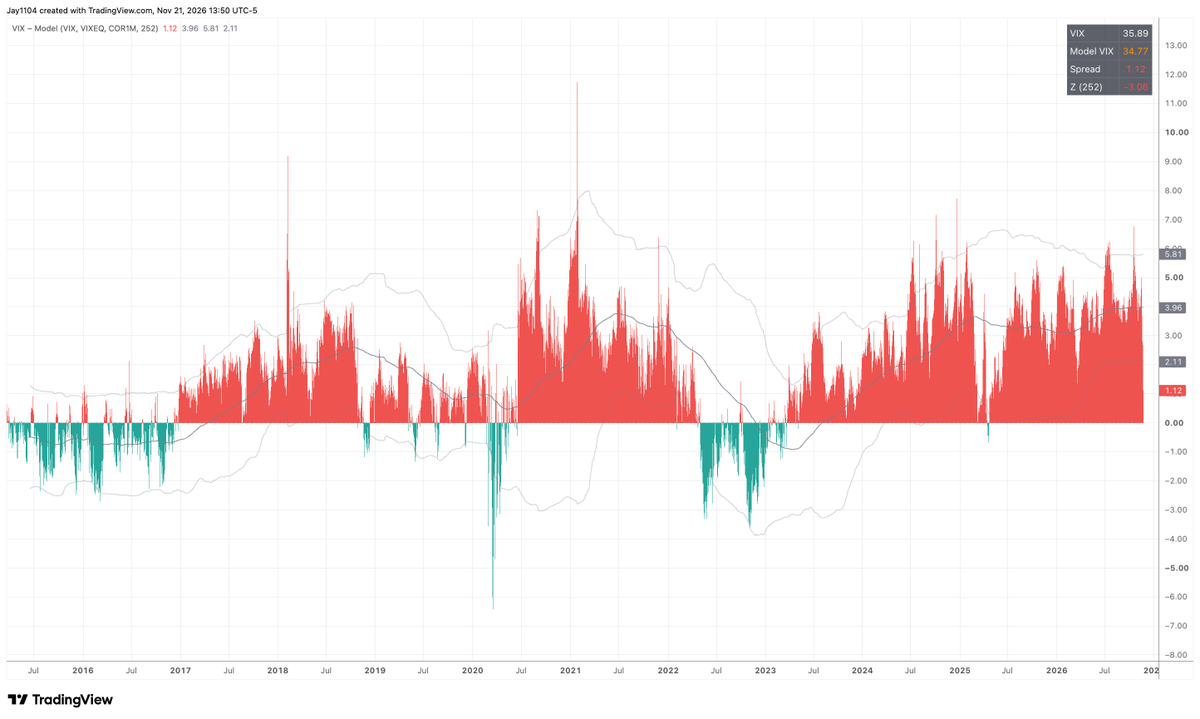
The Cboe Volatility Index closed at 35.89 on Friday, Nov. 20, up 7.45 points or 26.2% from Thursday's 28.44 and its highest close since April 11, 2025, according to Cboe data. The gauge traded as high as 40.03 during the session. The S&P 500 settled at 6,910.39, down 3.70% and its seventh straight decline; the index lost about 8.6% on the week, its worst since April 2025, and is now in correction territory.
The selloff was led by AI-linked heavyweights. Nvidia closed at $125.53, down 14.0% on the day and roughly 39% below its late-October level near $204, while memory names including Micron and SanDisk fell sharply and Anthropic's post-IPO retreat added to tech pressure. The one-month 50-delta implied correlation gauge jumped about 7 points to above 30, a sign options markets are pricing broader index-wide moves rather than dispersion.
Readings of the level diverge. Charlie Bilello noted that a VIX close above 35 sits in the top 5% of observations since 1990 and that forward equity returns after such readings have historically been above average. Other traders, citing Goldman Sachs' volatility desk, said last week's VIX move ranked among the top five in the desk's records. A competing view holds that volatility looks rich versus credit, with CDX IG near 65 basis points.
Dividing the VIX by 16 implies roughly 2.2% average daily S&P 500 moves over the next month, or about 150 points at the 6,910 level. The coming week is shortened by Thanksgiving; since 1950 the S&P 500 has risen in 53 of 76 Thanksgiving weeks, averaging about 0.7%, a historical statistic rather than a forecast.
How this story unfolded
Markets🔥Developing
S&P 500 Enters Correction After Six Down Days as SPY Options Price ±$32.50 Weekly Move
Chip stocks led the slide after Jensen Huang's Nov. 12 resignation, with a possible 50bp December hike adding pressure; implied volatility is the highest since the November 2025 bottom week
The SPDR S&P 500 ETF (SPY) closed at $689.81 on Friday, Nov. 20, down 3.64% on the day and roughly 8.6% from $754.37 a week earlier. The S&P 500 and Dow both finished in correction territory, more than 10% below their records, in the worst week since April 2025. Barchart flagged SPY's relative strength index at its most oversold since April 2025, after the index broke below the 7,200 level that had halted selloffs in June, according to Bloomberg.
The proximate trigger was Jensen Huang's resignation as Nvidia CEO on Nov. 12, following a board-initiated independent investigation into reports he was the target of a foreign intelligence effort. CFO Colette Kress is interim CEO. Nvidia fell about 23% for the week, its worst since the financial crisis, and the iShares Semiconductor ETF (SOXX) closed at $123.40 on Nov. 20, down 10.55% on the day and about 44% below its 52-week high of $218.65.
Macro added pressure. After the October core CPI print, the odds of a 50bp December hike rose to about 13.5% from effectively zero, and Fed Governor Christopher Waller said a half-point move should be considered if core inflation runs at 0.3% month over month for three straight months. Nebius (NBIS) closed at $81.31 on Nov. 20, down more than 40% over the month, after cutting its 2026 revenue outlook to the low end of a $3.0-3.4 billion range and pushing its $7 billion ARR target back about two months.
Options are pricing a roughly ±$32.50 move in SPY for next week, a magnitude rarely seen since the November 2025 bottoming week, into a Thanksgiving holiday week with only three and a half sessions. Oversold readings and elevated implied volatility describe current pricing, not direction: the four prior comparable oversold episodes in August 2024, March 2025, April 2025 and March 2026 produced very different paths, each with its own catalyst.
Markets🔥Developing
S&P 500 Enters Correction While 2027 EPS Estimates Hit Record, P/E Falls to 16.1x
Q3 earnings grew 31.9% with 84% beats and analysts held next-year forecasts — the gap between price and profits is the fault line under the AI selloff
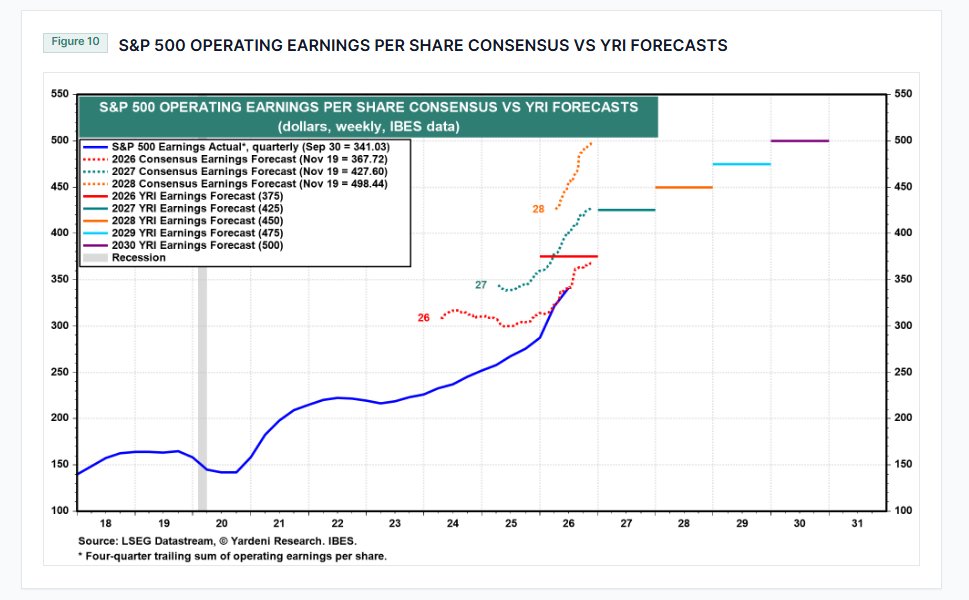
The S&P 500 fell 3.7% on Nov. 20, putting the benchmark roughly 10% below its October high and into correction territory, with the Dow joining it and the Nasdaq dropping 5.28% in a single session. On the same day, market commentator Mike Zaccardi, citing Duality Research, noted that consensus S&P 500 EPS estimates had climbed to an all-time high, leaving the index at just 16.1x calendar-2027 earnings.
FactSet data through Nov. 13 showed 91% of constituents had reported for Q3, with blended earnings growth of 31.9% and 84% beating EPS estimates — above the five-year average of 78% and the ten-year average of 77%. Revenue beats stood at 74%, seven of 11 sectors posted double-digit earnings growth led by Energy at 151%, and Information Technology revenue rose 44%. Magnificent 7 earnings grew 27% versus 32.6% for the other 493, confirming that profit growth has broadened well beyond mega-cap tech.
That divergence helps explain the rotation into equal weighting: the S&P 500 Equal Weight Index was up 8.09% year-to-date as of Nov. 20, versus roughly 0.9% for the cap-weighted benchmark — a gap of about 720 basis points. Yardeni's published forecasts put EPS growth at 33.7% for 2026, 16.3% for 2027 and 16.6% for 2028, though Zaccardi cautioned that other income, tax and tariff refunds, and depreciation tied to AI capex will make coming comparisons harder to clear.
The debate now centers on whether valuations already discount the risk. Yardeni cut its year-end forward P/E target to 18.6 from 19.8 in late October while keeping its 2027 EPS estimate at $425, whereas Capital Economics expects AI investment to slow and sees the index 12% below current levels by end-2027. Flows into the Invesco S&P 500 Equal Weight ETF (RSP) versus mega-cap tech remain the most direct read on which side is winning.
Markets🔥Developing
Nvidia closes at $125.53, down about 42% from October peak, P/E back to 2019 levels
Revenue is still doubling, yet the multiple has reset to seven-year lows as an SEC accounting probe and a CEO exit force a repricing
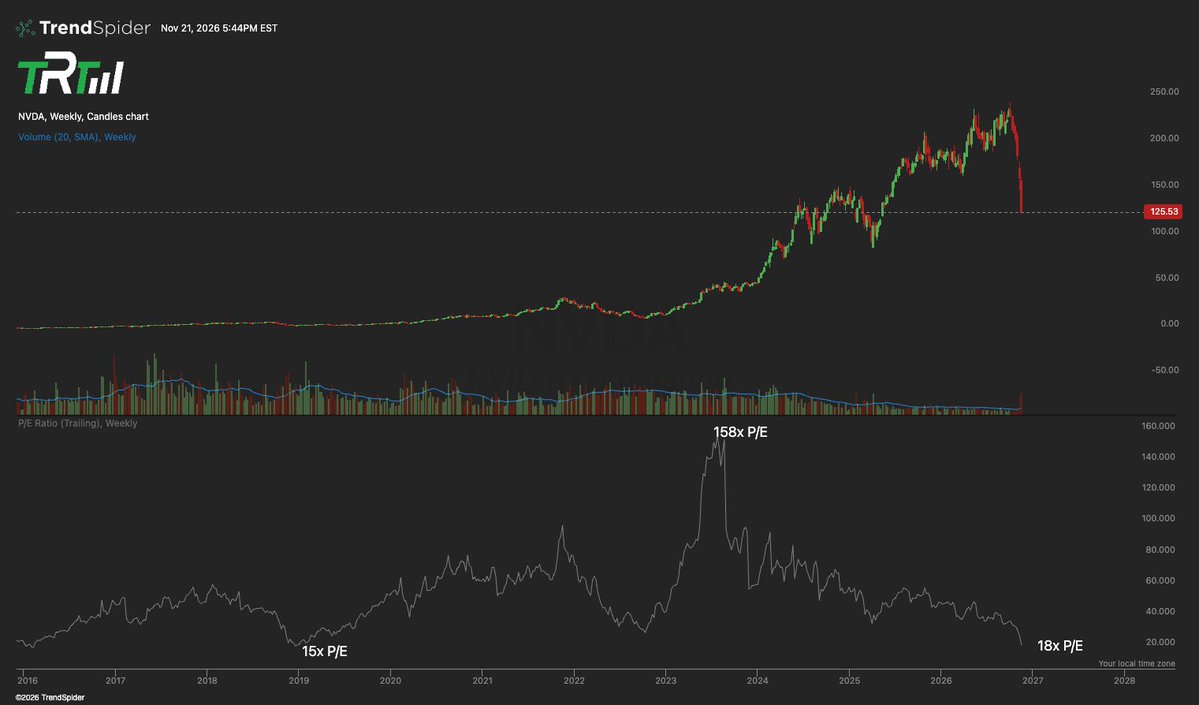
Nvidia closed down 14.01% at $125.53 on Nov. 20, capping its worst week since 2008 and extending a rout that has erased more than $2.5 trillion in market value since the Oct. 6 record. Trailing P/E has fallen to roughly 15.8x, the lowest since 2019, according to fullratio and macrotrends data.
Traders on X are drawing the 2019 comparison directly: the stock traded near $5 split-adjusted then at about 18x earnings. The difference is the earnings base — Nvidia reported $115.8 billion in fiscal Q3 2027 revenue on Nov. 17, up 103% year over year, with data-center sales of $107.6 billion.
The immediate trigger is regulatory. Reuters reported on Nov. 20 that the SEC's probe is examining potential accounting issues, after the Wall Street Journal disclosed the investigation earlier without specifying its focus. That followed Jensen Huang's Nov. 12 resignation over extramarital affairs, including one involving a suspected Chinese spy; CFO Colette Kress is interim CEO.
Bulls note the forward multiple on FY2028 estimates has compressed into single digits, far below the 2019 level. But if the accounting treatment is challenged, the earnings base itself is in question — which is why the discount has been slow to close.
How this story unfolded
2026-09-249 posts · 9 authors
U.S. Treasury yields hit 5.1% amid strong PMI, while Nvidia open-sourced its Nemotron 3 voice model.
Markets
Taiwan ETF's 23.2% weekly slide is its worst ever as AI rout deepens
Anthropic's record IPO failed to halt the AI unwind; foreign investors sold a net $56bn of Taiwanese equities this quarter
The iShares MSCI Taiwan ETF (EWT) fell 23.2% last week, its largest weekly decline on record and roughly a 6.3 standard deviation move, according to Carson Group chief market strategist Ryan Detrick. Only one of 46 country ETFs he tracks finished the week higher, India.
Taiwan's Taiex lost 7,641.83 points, or 17.50%, over Nov 16-20 to close at 36,033.29, its worst weekly percentage drop since 1990; Friday's 2,393.60-point fall (6.23%) was the third-largest single-day point decline in its history. The trigger was a rotation out of AI names after Anthropic's roughly $81bn IPO failed to lift sentiment; TSMC closed at NT$2,000, down 4.76%, while MediaTek and Delta Electronics hit limit-down.
EWT's drop outpaced the index because of its heavy weighting in TSMC and other large caps and because it absorbs dollar-based foreign selling. International investors have sold a net $56bn of Taiwanese equities this quarter, according to Hedgeweek. Regulators imposed a third round of short-selling curbs on Nov 19, including a full ban on below-close shorting and a 150% margin requirement, and the National Stabilization Fund confirmed it had entered the market, yet selling continued on Friday.
The focus now is whether outflows persist and whether the curbs and state fund support can restore liquidity when trading resumes on Nov 23.
TrendForce Holds Q4 DRAM Contract Price Rise at 10-15% as Memory Stocks Shed a Third in a Month
The pricing call is unchanged since late September, but Micron and SanDisk have already corrected sharply, and analysts warn cheap multiples have historically marked cycle peaks
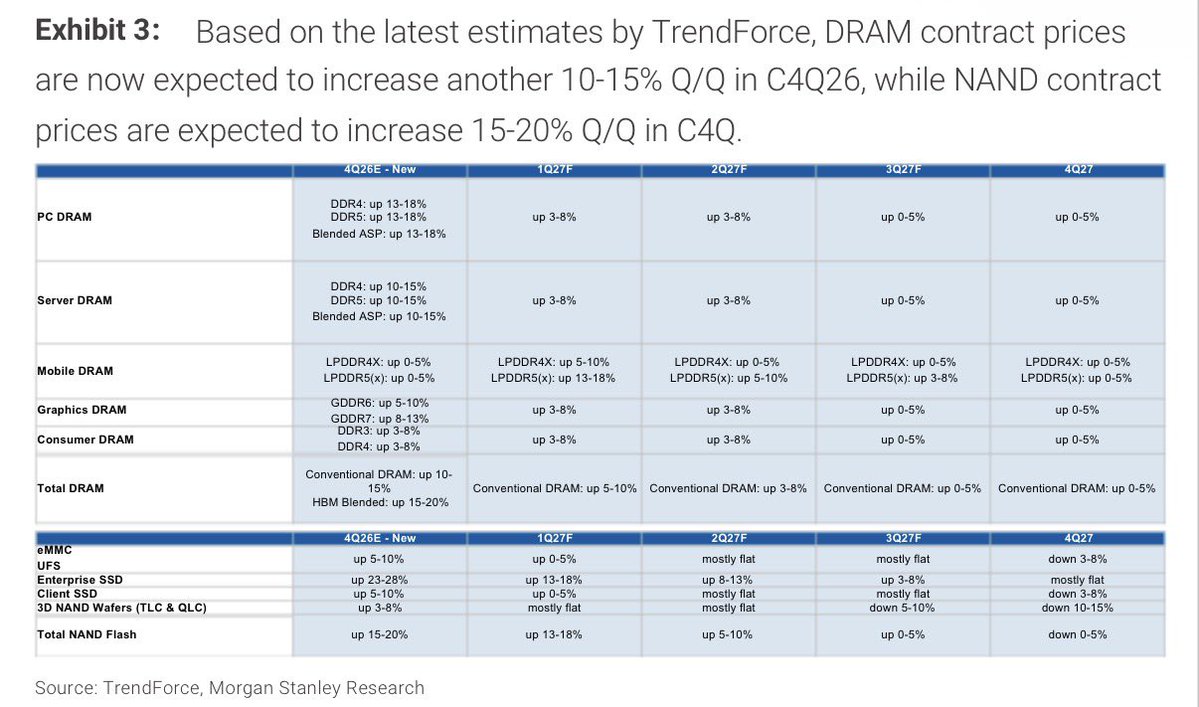
TrendForce is sticking with its fourth-quarter memory outlook: conventional DRAM contract prices up 10-15% quarter on quarter and NAND Flash up 15-20%, with DRAM rising as much as 20% once HBM is included. The figures were first published in the research firm's Sept. 30 4Q26 release and recirculated this week by trading accounts on X, where they now anchor positioning in memory names.
A Nov. 11 update from the same firm showed the picture splitting by product: PC DRAM contract prices are forecast to rise 13-18% QoQ, while client SSD increases are expected to stay below 5%. TrendForce also flagged that PC OEM DRAM inventories climbed from 6-9 weeks at the end of the third quarter to 7-10 weeks in early 4Q26, a sign that end-market demand and stockpiling are moving in different directions.
The price call and the share prices have diverged. Micron closed near $653 on Nov. 20 and is down roughly 32% over the past month, while SanDisk and SK Hynix's U.S. shares have fallen in the same AI-infrastructure selloff. Analysts cited by MarketWatch argue that low valuation multiples on memory stocks have historically coincided with peak pricing, making cheapness itself a contested signal.
The debate now turns on whether contract-price gains extend into 2027. TrendForce's press center already carries a headline projecting NAND price declines in 2027 as Chinese cloud service providers cut orders, which sits awkwardly beside the current 4Q26 increases; long-term supply agreements running to 2030 at the larger suppliers are cited as the offset.
Markets
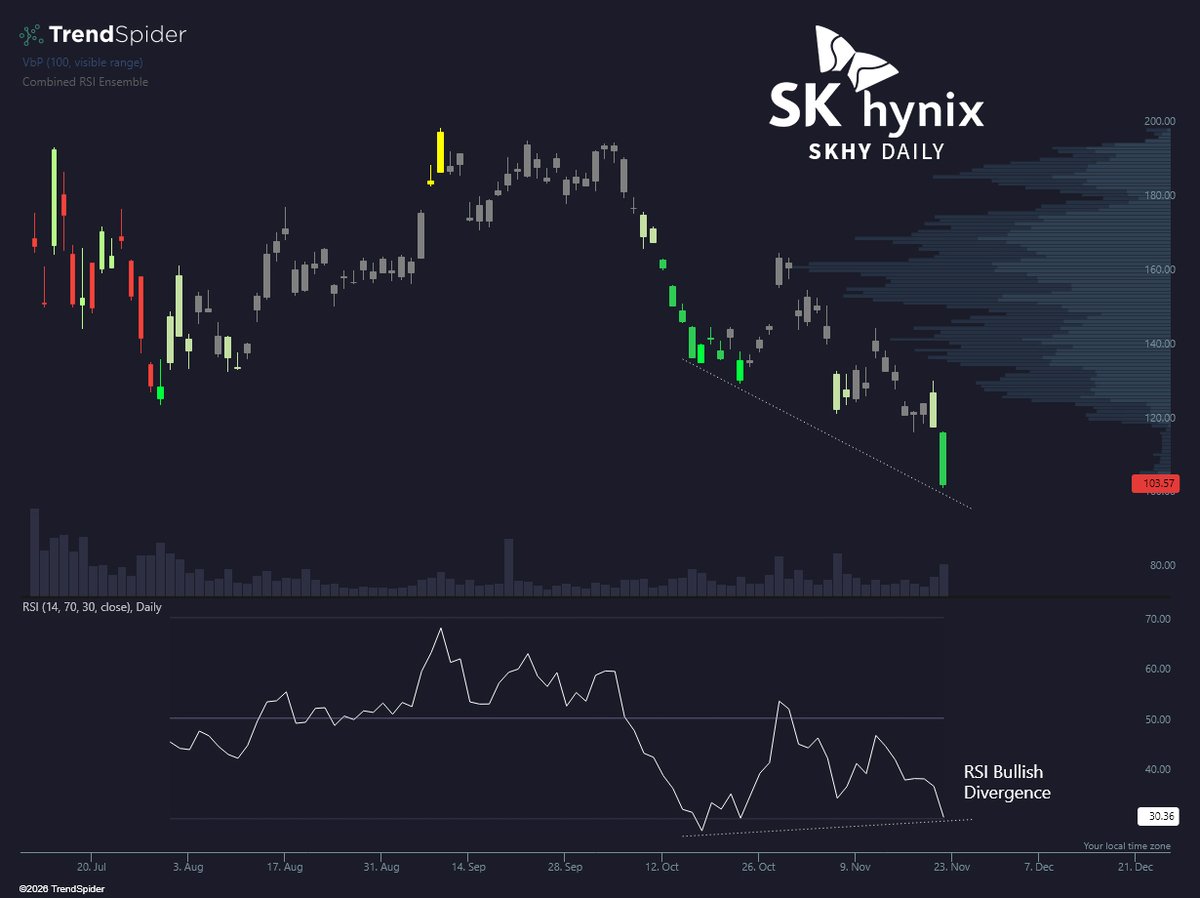
SK Hynix ADRs Close at $103.57 Record Low as Traders Flag RSI Bullish Divergence
Momentum gauge diverges from price at all-time lows after the Kioxia stake conversion filing; chart watchers are watching, not calling a bottom
SK Hynix's US-listed ADRs (SKHY) closed at $103.57 on Nov. 20, down 13.1% from the prior close of $119.20 and a fresh low since its Nasdaq listing. The stock traded between $102.45 and $117.89 on Nov. 21.
The move followed the company's Nov. 20 disclosure that it will convert roughly ¥129 billion (about $810 million) of Kioxia-linked convertible bonds into 129,000 SPC2 common shares and buy 1,001 more shares from a Bain Capital affiliate, giving it an indirect stake of about 14.1% in Kioxia and making it the Japanese NAND maker's largest shareholder ahead of Toshiba. SK Hynix said it has no immediate plans to buy or sell more shares; a 2018 agreement caps its voting stake at 15% until 2028 unless Kioxia consents.
Technical accounts TrendSpider and dissectmarkets both flagged on Nov. 21 that SKHY is printing an RSI bullish divergence at all-time lows — price making lower lows while RSI does not. Traders typically read such divergence as a momentum-exhaustion watch signal rather than a directional call. Memory peers Micron and SanDisk and the Philadelphia Semiconductor Index have also been under pressure.
SK Hynix said the Kioxia change has limited operational impact and that it has no further purchase or sale plans. Attention remains on memory pricing and the durability of AI data-center demand.
FTSE Russell's December semi-annual reconstitution list, updated on Nov. 20, confirms that Ouster (OUST) and Penguin Solutions (PENG) will be deleted from the Russell Microcap Index, alongside technology names including Veritone, Soluna Holdings and Blaize Holdings. The preliminary list was first published on Nov. 13 and is refreshed weekly ahead of implementation.
Both companies are leaving because their market capitalizations have risen above the microcap band rather than because of share-price declines. Macrotrends put Ouster's market value at about $2.28 billion on Nov. 18 and Penguin Solutions at roughly $2.17 billion on Nov. 22, while FTSE Russell's reconstitution summary places the Russell 1000/Russell 2000 breakpoint at approximately $5.8 billion.
The mechanical pressure comes from passive products tracking the index. The changes take effect after the U.S. close on Dec. 11, so index funds must sell the deleted positions before then, which can amplify volume and volatility around the effective date. Ouster closed at $23.80 on Nov. 20, down about 15.5% on the day, though that move coincided with a broad technology selloff and cannot be attributed solely to the index change.
On fundamentals, Ouster reported third-quarter revenue of $59 million on Nov. 3, up 50% year over year, and guided fourth-quarter revenue to $61 million-$64 million. A Nov. 21 Form 13F filing showed Boston Partners cut its Penguin Solutions stake by 61.9% in the prior quarter. Neither company has commented publicly on the index change.
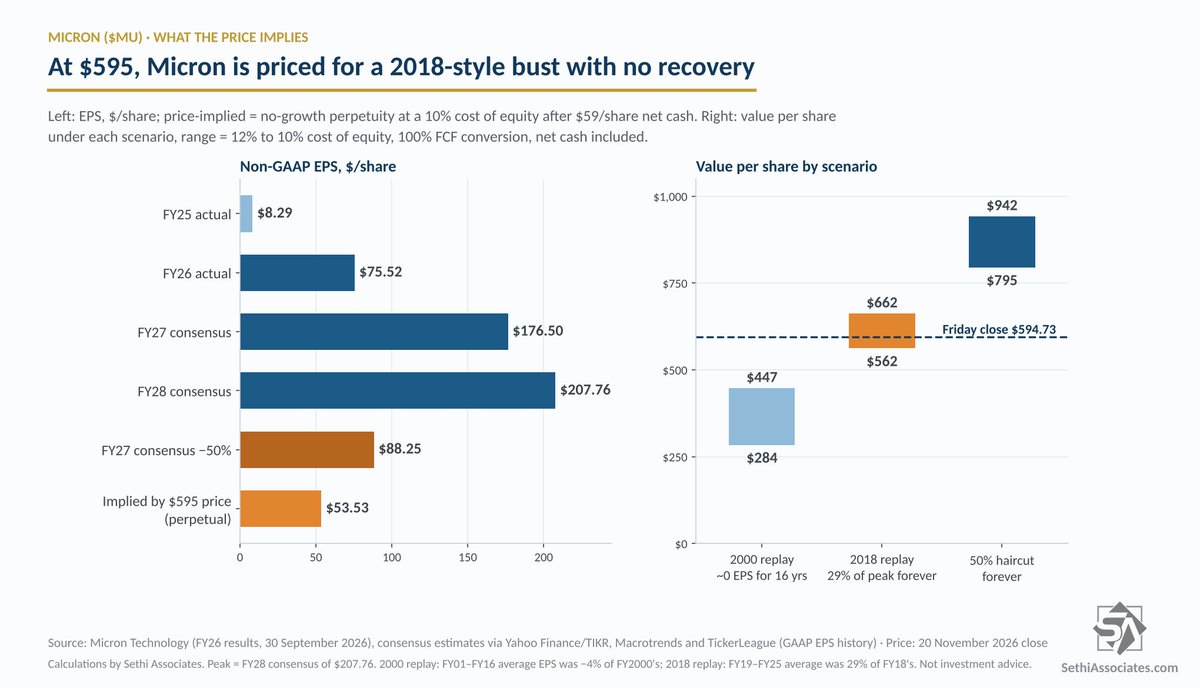
Micron (MU) closed Friday at $594.73, down 13.9% on the day and roughly 51% below its June 25 record close of $1,213.56, its lowest since May. The Nasdaq fell 5.28% the same session and Nvidia dropped about 14%, dragging memory names with it.
The debate on X centers on valuation. Bears argue the low multiple is deserved because current earnings are 'fake' peak-cycle profits and that this is how semis always trade at the top. Bulls point to 2018: Micron filed a 61.0% gross margin in fiscal Q4 2018 and traded at roughly 4-5x forward earnings, yet the stock still halved into 2019 as earnings collapsed.
On fundamentals, Micron reported fiscal Q4 2026 revenue of $54.229 billion and an 86.8% GAAP gross margin, guiding fiscal Q1 2027 revenue to $61.5 billion ±$1.5 billion at about 86.25% gross margin. Management says more than 75% of fiscal 2027 shipments are already committed under long-term agreements; the dispute is whether those commitments hold once industry supply ramps.
The read-through extends to SanDisk (SNDK) and SK Hynix (SKHY), which trade as memory-cycle proxies. Barrow Hanley Mewhinney & Strauss disclosed a new 131,044-share position in a recent 13F, evidence some institutions are building exposure into the drawdown.
How this story unfolded
Markets🔥Developing
BofA: AI cloud providers' free-cash-flow gap to widen to $361B in 2027
After chip stocks' worst week in a quarter century, the sell side is shifting its focus from compute demand to who pays for it
Bank of America's latest semiconductor outlook argues that a durable rally in AI equities may first require a reset in hyperscaler spending. The bank projects the free-cash-flow deficit of AI-related cloud providers will widen from $140 billion in 2026 to $361 billion in 2027, with US cloud capex expected to top $1.5 trillion over the same horizon.
The call lands after a brutal stretch for chip stocks. Nvidia fell 14% to $125.53 on Nov. 20 and lost 23% for the week, its worst weekly performance since 2008, while Broadcom dropped about 12% the same day after an analyst said Google had cut roughly 1 million Broadcom-designed AI chip units. The Nasdaq Composite slid 5.3%, erasing its 2026 gains.
BofA's framing moves the debate from whether AI demand exists to who funds the buildout. A widening cash-flow gap at cloud providers would make financing conditions and depreciation schedules the binding constraint on semiconductor orders, with Nvidia, Broadcom and TSMC most directly exposed, along with AI infrastructure projects reliant on external capital.
BofA's own house view is not uniform: an early-November note called capex cuts "unwelcome" but cycle-extending, and put 2027 free-cash-flow burn at $335 billion, a different basis from the $361 billion cited here. BCA Research separately flags that US tech investment is projected to reach 9% of GDP in 2027, near the peaks of past capex cycles such as US residential investment at 7% and Chinese construction at 9.5%.
How this story unfolded
Markets
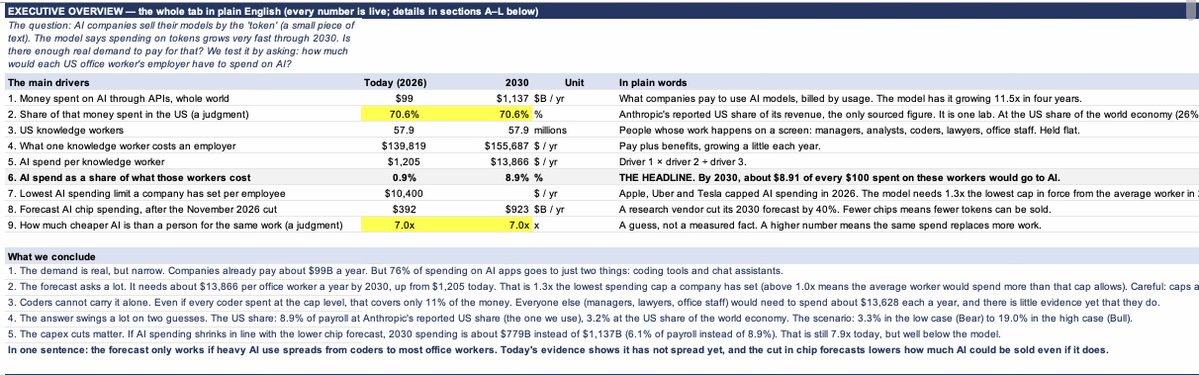
The AI revenue question: if forward numbers hold, this selloff is the opportunity
Two market voices argue AI is still underpenetrated but spending is concentrated in a small cohort of power users, making the next leg of the revenue curve the real debate
Two market commentators on X, jaredkubin and shanumathew93, are reframing the recent AI-linked selloff away from fund flows and toward a longer-horizon question: where AI revenue actually comes from. Both argue adoption remains dramatically underpenetrated across the broader economy, but today's spending is heavily skewed toward a tiny cohort of power users.
The debate lands against a visible drawdown in AI-related names. jaredkubin's framing is that after "all this damage," confidence that forward numbers are "not being very wrong" could be worth a lot of money even if the path higher is uneven — a stress test of valuation assumptions rather than a directional call.
For markets, that framework bears directly on how compute and AI infrastructure names are priced: if revenue arrives slower than capex, forward earnings assumptions need trimming; if not, the pullback reads as mispricing. Neither post names specific tickers or offers quantified estimates.
Both posts are opinion, not forecasts of AI revenue totals or share prices, and neither provides verifiable revenue breakdowns.
Markets
Hennion & Walsh's Mahn Stays Bullish on His "AIR 7" Basket After 25% 2026 Gain
The CIO's custom seven-stock AI-infrastructure list has beaten the Magnificent 7 this year, but it is sliding with the rest of the AI trade in November
Kevin Mahn, president and chief investment officer of Hennion & Walsh, reiterated his bullish case for 2027 and kept pitching his self-styled "AIR 7" basket of AI-revolution-related stocks, according to a post by Phil Rosen. Rosen said the basket is up more than 25% in 2026, while the Magnificent 7 is down about 5%.
The "AIR 7" is not an index product but a personal list Mahn has promoted on financial media since May, with publicly cited members including Nvidia, Alphabet, Micron, Taiwan Semiconductor and Vertiv; recent interviews have added power-and-cooling contractors such as Comfort Systems ($FIX). The thesis pushes the AI trade down the stack from model builders to compute, power and thermal management.
Some fundamentals back the framing: Comfort Systems ended the third quarter with backlog up 90% year over year to $17.8 billion, and Vertiv reported third-quarter adjusted earnings up 78%. Yet AI and data-center names sold off hard after the Nov. 5 midterm results, with the Magnificent 7 shedding more than $1 trillion in market value in a single session; TSMC, Vertiv and Micron have all fallen sharply since mid-November, eroding the year-to-date outperformance.
The 25% figure is Mahn's own accounting and has not been independently verified by an index provider, and the basket is not a tradable product investors can replicate. His 2027 view is a personal call, not a directional guarantee.
X users cantonmeow and dannycheng2022 posted identical text on Nov 22 saying 11 videos were recorded for the latter's Patreon channel, to be released after he wakes up and reviews them. The set includes one video on Nvidia ($NVDA), one on Bitcoin and the crypto sector, and one on the overall market.
The timing is notable. According to fool.com, Nvidia fell 14% on Friday and 23% for the week, its worst weekly slide since 2008, after Reuters reported the SEC had opened an accounting probe; the stock has shed more than $2 trillion in market value in recent weeks. Separate coverage said Jensen Huang resigned as CEO, a claim that has not been confirmed by the company.
For subscribers, the signal is structural: Nvidia, crypto and broad market views are packaged as one thesis, framing the AI-chip repricing and risk-asset pricing as a single question. The videos are not yet public, so no view or positioning can be verified, and the post contains no price targets or trade recommendations.
This is a content preview from a creator, not a factual claim about Nvidia or Bitcoin. What happens next to the stock and to crypto assets still hinges on the SEC probe and any formal disclosure on management changes.
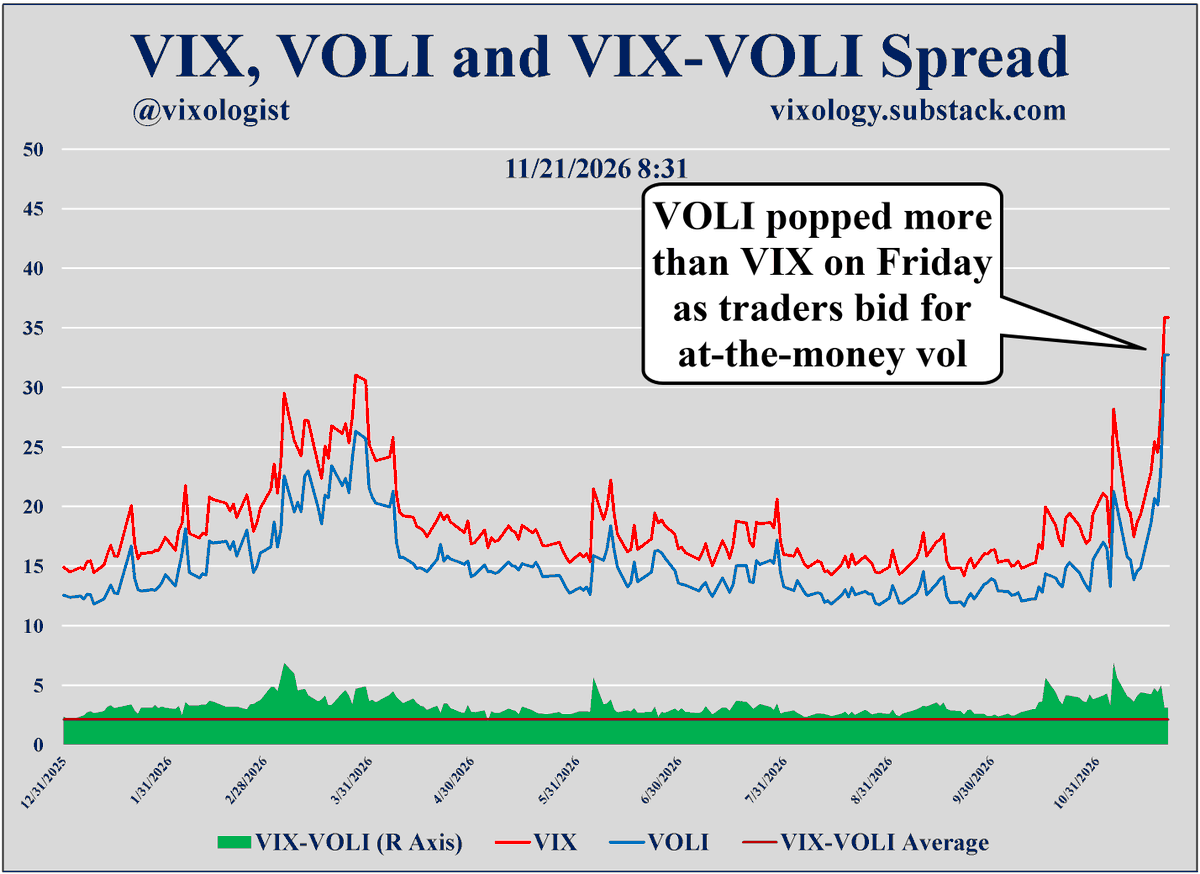
Nations VolDex (^VOLI), which measures implied volatility of at-the-money SPY options, closed at 32.76 on Nov 20, up 9.31 points or 39.73% for the session, according to Yahoo Finance quote data. The Cboe Volatility Index finished at 31.91, up roughly 20.8% on the day.
VolDex is built by Scott Nations' team to strip out deep out-of-the-money puts that VIX includes; the companion TailDex (^TDEX) isolates the cost of crash protection. The gap between the two is the point traders on X were making: the headline fear gauge understated where options demand actually sat.
The move came as the S&P 500 fell 3.7% and the Nasdaq Composite dropped 5.28% to 22,617.73, turning negative for the year, with both the S&P 500 and Dow confirming corrections. Reuters put the wipeout in global equity value at nearly $9 trillion.
Both VOLI and TDEX are proprietary Nations Indexes gauges rather than exchange-listed products, and published readings for the same session vary across data providers, so direct point-for-point comparison with VIX should be treated with caution.
Discussions centered on the Fed's dilemma, Trump's criticism of media for not covering Xi's arrival, and student loan borrowers suing the administration.
2026-10-098 posts · 8 authors
Focus shifted to debates over strong economic data, record-low consumer sentiment, and Brent falling below $103.
2026-11-047 posts · 7 authors
Midterm results sparked discussion on potential Democratic control of both chambers, with Trump's veto power and mixed market reactions.
2026-11-057 posts · 7 authors
Iran claimed credit for Trump's midterm defeat, stocks rallied but concerns over deficits and inflation persisted, and Trump declined comment on credit card rate cap.
2026-11-219 posts · 9 authors
Trump said he would work with Democrats to cap credit card rates at 10%, amid discussions of Fed-Trump conflict and 2026 economic downturn.
2026-11-225 posts · 5 authors
Trump's statement on capping credit card rates dominated, with multiple outlets repeating the announcement.
WSJ reported Nvidia's board was preparing to meet over CEO Jensen Huang's second alleged affair, deciding his future.
2026-11-13182 posts · 101 authors
Reuters confirmed Huang had an intimate relationship with a second employee, bringing his total affairs to three, and he is now former CEO.
2026-11-18224 posts · 143 authors
The SEC opened an investigation into Nvidia over the Huang situation, focusing on disclosure misleadings, amid Commerce and Megaspeed chip concerns.
2026-11-21154 posts · 100 authors
The SEC launched a probe into potential accounting issues at Nvidia, with shares down over 8% on the day and 45% since October 6, plus FBI espionage allegations.
2026-11-2232 posts · 24 authors
Amid market turmoil, Anthropic's cash reserves hit $237 billion post-IPO, Nvidia fell for a seventh straight week, and investors urged the board to reinstate Huang.
Hang Seng needs to hold the 0.886 Fibonacci level to break out of a 20-year consolidation, while the Hang Seng Tech Index is expected to open 0.8% lower.
2026-09-308 posts · 7 authors
Flydubai flight FZ1073 experienced an incident over Jordanian airspace, while the Shanghai Composite and Hang Seng attempted to recover losses ahead of the National Day holiday.
2026-10-2212 posts · 10 authors
The Hang Seng Tech Index is set for its worst day since Trump's 'Liberation Day' in April 2025, with the drop from its peak exceeding 40%.
2026-10-308 posts · 7 authors
The Hang Seng Tech Index rose over 1%, with Xiaomi Group jumping nearly 5% and Meituan, JD Health, and Midea Group climbing over 4%.
2026-11-2017 posts · 12 authors
Asian stock markets erased over $1.1 trillion in a single day, with 11 of 13 major indexes falling, led by declines in Taiwan, South Korea, and Japan.
2026-11-2210 posts · 8 authors
Weekend market updates show the Hang Seng closed at 22,106, up 0.47%, with US and European major indices also posting gains.
CITIC Securities argued market fears over CoreWeave were excessive, stating neocloud firms' short-term funding gaps remain manageable, while US futures rebounded with AI stocks leading gains.
2026-10-253 posts · 3 authors
Amazon's CEO stated memory shortages won't end by 2027; Goldman Sachs' Q3 call highlighted financing access and contract revenue quality as key market differentiators.
2026-11-204 posts · 3 authors
The inaugural TomorrowX Summit concluded successfully, with industry leaders participating and congratulating organizers, focusing on AI infrastructure and cloud services.
2026-11-213 posts · 3 authors
SiliconData launched a GPU price index for CME's new contracts; an analyst rebutted Dawson Lee's 'terminal distribution' thread on data centers.
2026-11-221 post · 1 author
SiliconData's CEO estimated ~20% of GPU rental demand came from China via offshore channels, which BIS moved to shut on November 16.
California DMV ordered Waymo to halt autonomous vehicle operations on state freeways, citing an imminent public safety hazard.
2026-11-193 posts · 3 authors
Waymo suspended freeway rides across all 15 U.S. markets after California safety concerns, with data showing about 24 daily trips per robotaxi in the state.
Market breadth deteriorated sharply with only 15% of S&P 500 industry groups above 10-week averages, while bank stocks fell over 10% from 30-day highs, echoing pre-dot-com bubble conditions.
2026-11-0378 posts · 56 authors
Ahead of the midterms, prediction markets showed nearly 80% odds of a Democratic sweep, prompting profit-taking in prompt oil and discussions on potential gridlock for Trump's agenda.
2026-11-0486 posts · 63 authors
Democrats swept both chambers in the midterms, triggering broad market gains across equities, metals, and crypto, with JPMorgan advising buying dips in AI stocks.
2026-11-20101 posts · 67 authors
Multiple analysts argued the tech bear market represents the best buying opportunity in a decade, unless one believes the AI revolution is over.
2026-11-21111 posts · 78 authors
Nvidia faced SEC and FBI investigations plus CEO allegations, losing $2.8 trillion in market cap over 45 days, marking the largest-ever stock value decline.
2026-11-2235 posts · 31 authors
The S&P 500 lost $2.4 trillion in market cap in one day, entering correction territory, closing 4.1 standard deviations below its 50-day average, the most oversold since 2015.
TrendForce reported Korean suppliers developing 6F² PUA and 4F² VCT architectures, while CXMT and YMTC ramp capacity amid surging Chinese AI demand.
2026-09-3012 posts · 11 authors
TrendForce forecast 4Q26 DRAM contract prices up 10-15% and NAND up 15-20%, with focus on tightest supply bottleneck ahead of Micron earnings.
2026-10-079 posts · 6 authors
DRAM spot prices held flat due to holidays and month-end effects, while Samsung's Q3 operating profit was expected to exceed KRW 100 trillion on rising HBM and DRAM prices.
2026-10-086 posts · 6 authors
TrendForce discussed optical interconnect options for SuperNode, KB Securities saw Samsung HBM prices doubling in 2027, and notebook cost pressures threatened shipments.
2026-11-204 posts · 4 authors
KB Securities noted DRAM spot fell 5% and NAND 20% in the past month, TrendForce saw 2027 NAND contract price reversal, and Micron advanced 3D DRAM partnerships.
2026-11-223 posts · 3 authors
TrendForce reiterated 4Q26 DRAM contract price increase of 10-15% and NAND 15-20%, with market debate on sustainability of memory price hikes.
YMTC won a patent case against Micron, Korea's power utility's prepayment request was rejected by Samsung and SK Hynix, and Robinhood's market cap crossed $1 trillion.
2026-10-01106 posts · 73 authors
Micron's Q4 revenue beat at $54.23B, up 379% YoY, with strong guidance, and noted humanoid robots could require over 200GB of DRAM.
2026-10-0227 posts · 24 authors
Micron said L4+ autonomous vehicles need over 200GB memory, 2027-2028 supply may be tighter than 2026, with market skepticism on cyclicality.
2026-10-1430 posts · 27 authors
Elon Musk said Micron has been reasonable on memory pricing while others have been extortionate, sparking widespread retweets.
2026-11-1916 posts · 12 authors
Micron executives said customer relationships have changed, SCA agreements span 5 years, 3D DRAM expected 2028-2029, shareholder returns start Dec 9.
2026-11-2011 posts · 10 authors
NAND prices fell nearly 30%, Micron CEO cited robust demand and tight supply, but Wall Street criticized for misreading cycles.
2026-11-222 posts · 2 authors
Discussions focused on Micron's 2018 cyclical peak valuation and weekend news of SoftBank's Masayoshi Son approaching Wall Street investors.
BofA warns of classic capital-cycle risks in AI spending, notes Microsoft as the only hyperscaler avoiding negative free cash flow, and projects hyperscaler plus SpaceX capex to reach $1.4 trillion by 2028.
2026-10-243 posts · 3 authors
BofA's Hartnett advises tactical risk-off until mid-November, AI hyperscaler credit spreads near 2022 bear-market lows, and short-term compute deals priced up to four times long-term contracts.
2026-10-303 posts · 3 authors
BofA reports AI hyperscalers' $182 billion debt and $89 billion equity issuance in 2026, signaling end of buyback era; Alphabet's drop weighs on tech, while SanDisk falls 9% despite strong earnings.
2026-11-179 posts · 8 authors
BofA's fund manager survey shows largest tech selling since 2006, with net overweight plunging from 37% to 12%; 38% see overinvestment and 52% expect a hyperscaler capex cut within six months.
2026-11-221 post · 1 author
BofA's semiconductor outlook argues a sustainable AI stock rally may require a hyperscaler spending reset, with AI cloud providers' FCF deficit projected to widen from $140 billion in 2026 to $361 billion.