The United States has imposed 50% tariffs on roughly C$2 billion of Canadian goods, marking a sharp escalation after trade talks failed at the last minute. Prime Minister Mark Carney suspended negotiations and said Canada would respond dollar for dollar.
The dispute intensified after Washington introduced late-stage changes that Ottawa called unfair and uneconomic. Reuters said the two sides had been close to a deal, with vehicles, alcohol sales and agricultural access among the sticking points.
For markets, the immediate pressure point is Canada’s trade-sensitive sectors, including autos, steel, construction materials and logistics. Investors are also watching the country’s benchmark Canada ETF, EWC, for signs of how much further tariff escalation could weigh on exports and growth expectations.
Canadian federal and provincial leaders have lined up behind a firmer response. Ontario Premier Doug Ford backed Carney’s stance and urged Ottawa to use leverage in electricity, energy and critical minerals if needed.
これまでの経緯
2026-06-26投稿3件 · 投稿者3人
Iran attacks a US naval base and cargo ship, prompting US recalculation; Alberta pushes for a new oil pipeline; Trump's tough stance in USMCA talks.
市場🔥進行中
Apple may tap CXMT and YMTC; SNDK falls 5%, MU 3% premarket英語原文
Weekend reports say Washington could let Apple source memory from China, jolting expectations for U.S. chip suppliers
Weekend reports said the Trump administration may allow Apple to source DRAM from CXMT and NAND flash from YMTC in China. The market reaction was immediate: Micron and SanDisk traded lower in premarket Monday as investors reassessed the Apple supply-chain setup.
The issue matters because Apple has been widely viewed as weighing a fourth memory supplier amid a persistent memory shortage. Earlier reporting indicated Apple had tested CXMT DRAM and YMTC storage products, while Commerce Secretary Howard Lutnick said last week the administration was not in favor of Apple using Chinese memory chips.
For U.S. memory names, the concern is not just the direct Apple order flow, but the signal such a policy shift would send about future sourcing preferences. MU and SNDK are the most exposed in Monday trading because they stand to gain or lose relative demand expectations tied to Apple.
So far, the China-supplier reports remain unconfirmed by Apple or the government as formal policy. Apple has only said it is evaluating all viable options, leaving the story in rumor-and-signpost territory rather than a completed policy change.
これまでの経緯
2026-06-27投稿28件 · 投稿者26人
Apple sought US clearance to buy memory chips from CXMT, raising supply constraint concerns.
The Wall Street Journal says President Donald Trump spoke with Live Nation CEO Michael Rapino in February, and that the company’s antitrust settlement with the Justice Department was finalized after a March 5 White House meeting. In court filings, Live Nation said the president and Rapino discussed business topics and the status of the DOJ case, but not any substantive settlement terms.
The case dates back to 2024, when the federal government and dozens of states sued Live Nation and Ticketmaster over alleged monopoly power across ticketing, concert booking, venues and promotions. The original complaint had sought structural remedies, including forcing a Ticketmaster divestiture, before the March deal shifted to behavioral remedies.
For investors, the story matters because Live Nation’s regulatory overhang affects the odds of a breakup scenario and the company’s future operating flexibility. The settlement still faces judicial review, and several states have continued their own litigation after rejecting the federal deal.
Live Nation has not denied the call or the involvement of the White House Counsel’s Office; instead, it has said no substantive settlement terms were discussed. AP, NBC News and CNN separately reported the February call, White House participation, and the March settlement, corroborating the main timeline.
これまでの経緯
2026-06-26投稿6件 · 投稿者5人
UBS report on Chinese distillation of Anthropic gains traction as US firms adopt DeepSeek; Iran attacks cargo ship, Trump claims Iran will buy US crops with sanctioned funds, Iran denies.
企業動向
ModernaとMerck、黒色腫のフェーズ3エンドポイントを達成、MRNAは129%急騰英語原文
The mRNA cancer vaccine’s first late-stage win is reshaping the commercial outlook for both partners
Moderna and Merck said their personalized mRNA cancer vaccine met both primary goals in a Phase 3 melanoma trial, marking a major milestone for the program. The combination with Keytruda showed benefits in recurrence-free survival and distant metastasis-free survival.
The study enrolled patients with completely resected higher-risk melanoma, testing the vaccine plus Merck’s checkpoint inhibitor against Keytruda alone. Earlier Phase 2 data had already pointed in the same direction, with the combo cutting recurrence risk by 49% and distant spread or death risk by 59%.
Investors responded sharply: Moderna shares surged as much as 160% to 177%, while Merck rose about 12%. Stocktwits said MRNA logged a 129% weekly gain, and analysts began framing the therapy as a possible multibillion-dollar opportunity.
The companies have not released full trial data yet and will need to advance the program through regulators before any commercial launch. Merck research chief Dean Li said discussions with regulators should begin in the next few months.
市場🔥進行中
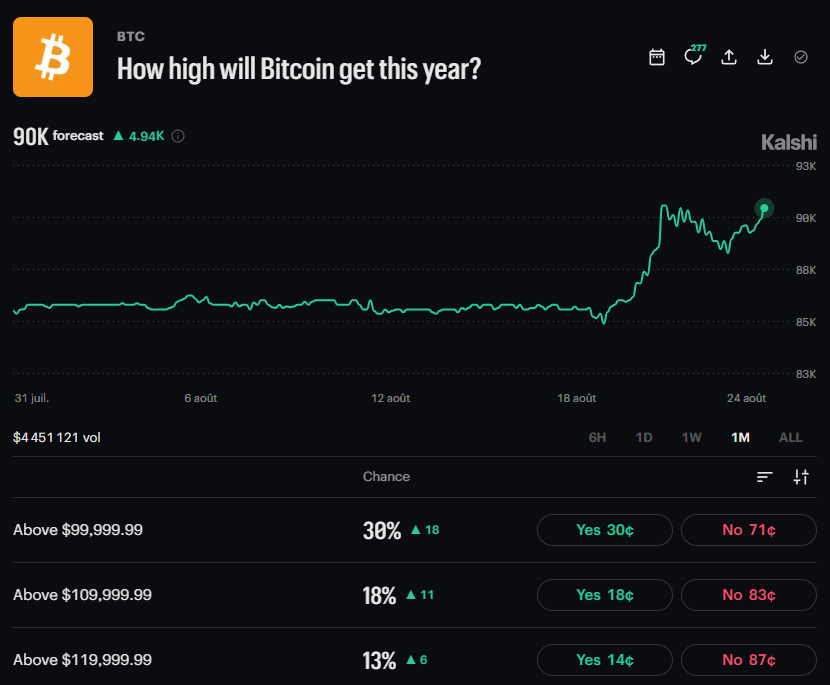
Bitcoin’s 22% rally meets $1.92B ETF inflows as Fear & Greed hits 73英語原文
Fresh sentiment and flow data suggest buyers are back, but the rally still needs confirmation from sustained spot demand.
Bitcoin’s rebound has kept gaining traction, and sentiment has turned quickly. A X signal cited the Crypto Fear & Greed Index at 73, back in “Greed” territory, while spot bitcoin ETFs pulled in about $1.92 billion in net inflows last week, providing a fresh source of support for the move.
The rally has also been framed by macro concerns rather than pure crypto-specific news. Recent coverage pointed to U.S. Treasury buyback plans, debt worries and a broader search for hard assets as catalysts, while Needham said the crypto rebound may have further room if heavy selling has already been flushed out.
Flow data remains the cleanest confirmation of the move. One report said U.S. spot bitcoin ETFs took in roughly $1.92 billion over five sessions through Aug. 21, with total net assets at $96.07 billion; another said BTC-led inflows were broad across crypto spot ETFs, with ETH adding $697.18 million. That combination suggests cash demand, not just leverage, has been doing part of the work.
For market participants, the key watch items are Bitcoin-linked ETFs and high-beta crypto equities tied to trading activity. IBIT is the main product to monitor, while Coinbase (COIN) can benefit from stronger volumes and sentiment, even though the direct story here is the improvement in Bitcoin flows and price action.
これまでの経緯
マクロ
AI電力需要、2033年までに315GWに到達見込み、米国は200GW英語原文
Fresh social-media chatter is pushing the AI story from chips to electricity, as Wall Street re-rates the grid and power-supply chain.
Bloomberg-linked chart commentary circulating on X says AI chip-driven electricity demand could climb to about 315 GW globally by 2033, more than 1,100% above 2025 levels. The U.S. is said to account for roughly 64% of that demand, or about 200 GW.
The new chatter lands on top of a string of earlier revisions from research houses and industry groups. TechTarget cited Lawrence Berkeley National Laboratory saying U.S. data centers used about 176 TWh in 2023, or 4.4% of national electricity, and could rise to 6.7% to 12% by 2028; Quartz cited IEA data showing global data-center use at about 415 TWh in 2024 and projected near 945 TWh by 2030.techtarget.com qz.com
That is why investors have been moving beyond semiconductors toward grid hardware, gas turbines, storage and utilities. Goldman Sachs estimates U.S. data-center growth could require roughly 47 GW of additional generation capacity through 2030, implying about $50 billion in investment tied to that load growth.goldmansachs.com
For the tickers in focus, the X feed points most directly to the power-equipment complex rather than the chip names. The posts are still based on forecasts and commentary, so the reported demand figures should be treated as estimates, not settled outcomes.
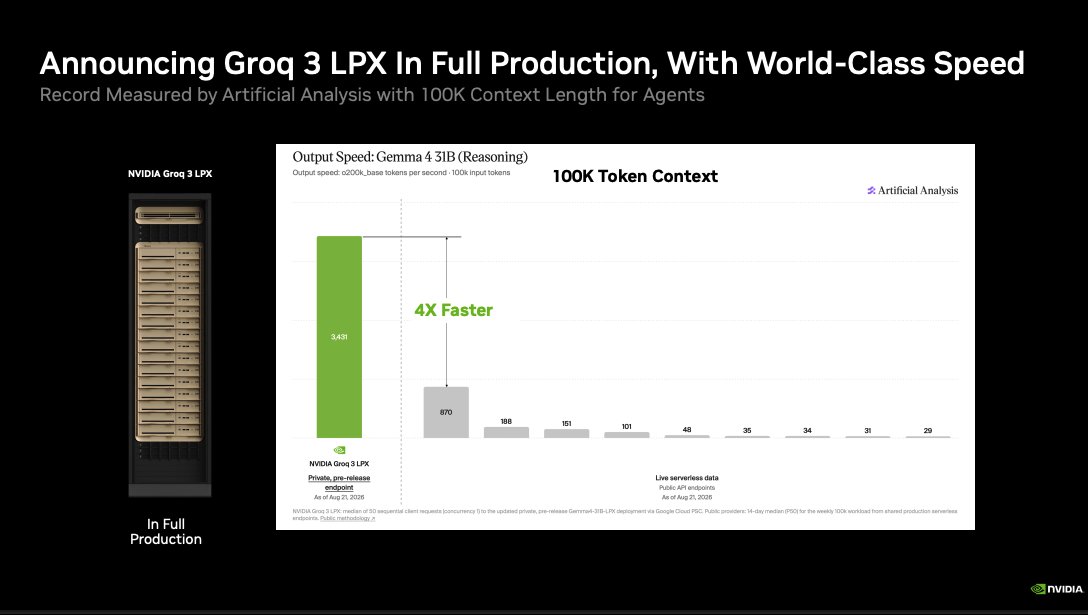
Nvidia said today that Groq 3 LPX, the low-latency inference accelerator built to extend the Vera Rubin NVL72 platform, is now in full production. In a company-cited Artificial Analysis test using Gemma 4 31B and a 100K-token context, Nvidia said the system reached 3,400 output tokens per second.
The update builds on Nvidia’s earlier announcement that the Vera Rubin platform itself had entered full production as a rack-scale AI factory architecture. Nvidia has positioned LPX as a complementary inference path for long-context, high-concurrency agentic workloads, alongside Rubin GPUs handling prefill and attention-heavy tasks.
For investors, the development keeps NVDA tied to the next phase of AI infrastructure spending, while NBIS is drawing attention after social posts said Nebius would be the first AI cloud to deploy the stack. Nvidia’s own materials already list Nebius among the cloud partners slated to offer Vera Rubin-based products in the second half of 2026.
The key confirmed points are Nvidia’s production claim and its own performance figure, plus Nebius’ inclusion in Nvidia’s partner list. The “first deployer” detail remains a social-media assertion for now and has not been independently confirmed in the materials reviewed.
Micron Technology CEO Sanjay Mehrotra said supply may not catch up with memory demand until 2028, and in some remarks suggested there may be no clear end in sight. The message echoed on X was that data-center customers are still asking for roughly 50% more memory than Micron can currently commit to provide.
The comments build on a longer-running narrative. Micron disclosed 16 five-year strategic customer agreements in June, while earlier interviews and reports framed memory as “strategic infrastructure” for the AI era rather than a simple commodity cycle.
For markets, the signal is most directly relevant to Micron’s MU shares, but it also matters for DRAM, HBM and data-center storage suppliers. A supply gap lasting into 2028 would keep pricing, long-term contracts and capacity expansion at the center of valuation debates.
Micron has not, so far, issued a new formal guidance update specifically validating the 2028 timing. The current evidence comes from the CEO’s public comments and earlier company disclosures.
Nancy Pelosi’s latest STOCK Act filing shows new trades tied to Bloom Energy (BE) and Intel (INTC), with disclosed values running as high as $12 million for BE and $1.5 million for INTC. Multiple market-tracking posts on X flagged the filing as a fresh disclosure.
The filing arrives amid a broader market narrative around AI data-center power needs and semiconductor policy. Bloom Energy has been marketed as a potential solution for onsite power generation, while Intel remains a policy-sensitive name tied to U.S. chip manufacturing ambitions.
For markets, the disclosure may keep BE and INTC in focus, especially because both names sit at the intersection of politics and sector themes. The exact mix of shares and options should be read against the filing itself, as secondary coverage has used differing estimates for position size and contract details.
At this stage, the only firm new development is the filing disclosure itself. No immediate corporate response from Bloom Energy or Intel was evident in the materials reviewed.
The latest data being cited in the market says global humanoid robot shipments topped 22,000 units in the first half of 2026, almost 300% higher year over year, according to Counterpoint Research. Smart Analytics Global offered a lower but broadly similar global estimate of about 19,100 units, while both reports put Agibot and Unitree at the top of the leaderboard.
The bigger takeaway is that humanoid robots are moving beyond demos and research into broader commercial deployment. Counterpoint projects full-year 2026 shipments above 50,000 units, while other industry commentary cited in recent coverage points to a much larger China-only figure, underscoring how much the market still depends on differing scope and methodology.
For investors, the data mainly matters for robotics hardware, components and the AI-enablement stack, with Tesla and Nvidia often used as proxies for humanoid-robot exposure. The reports are not a direct read-through on company earnings, but they do reinforce the pace at which expectations around the sector are rising.
The main discrepancy across the latest coverage is not the growth trend but the counting method: global shipments above 22,000 at Counterpoint, about 19,100 at Smart Analytics Global, and more than 30,000 for Chinese vendors alone in a separate industry-alliance claim. Even so, the consensus is clear that the market is expanding fast and remains heavily concentrated among a few vendors.
これまでの経緯
市場🔥進行中
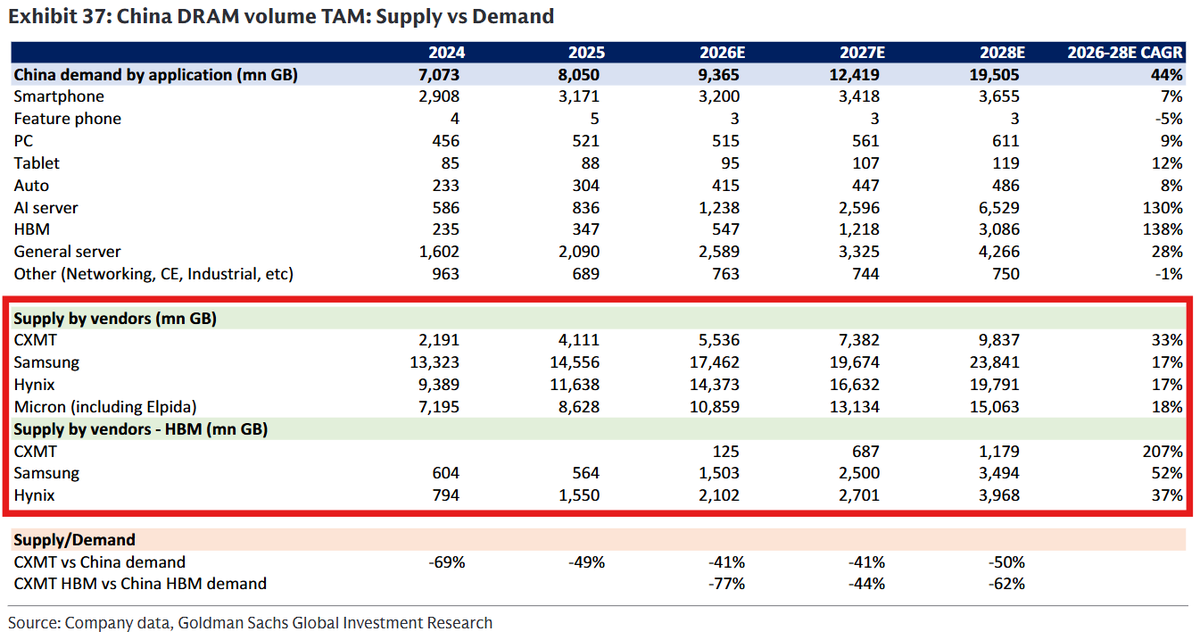
Goldman starts CXMT at Buy, sets RMB129 target as 2028 DRAM supply reaches 41% of Samsung英語原文
New Goldman coverage reframes CXMT as a larger challenger in the global DRAM cycle, with supply assumptions rising sharply into 2028.
Goldman Sachs has initiated coverage on CXMT-linked shares with a Buy rating and a 12-month target price of RMB129, according to the market signal circulated on X. In the same note, Goldman is said to forecast CXMT DRAM supply reaching 41% of Samsung’s level and 50% of SK Hynix’s by 2028, versus 28% and 35% in 2025.
The new call builds on Goldman’s earlier China memory roundtable held on July 24, where the bank and invited experts discussed Chinese DRAM capacity expansion, technology roadmaps and memory pricing. Secondary reports at the time said Chinese leading DRAM makers could roughly double annual capacity by 2030.
For the market, the message is not only about CXMT. It feeds into re-rating discussions across DRAM names and the broader memory chain, including Samsung Electronics and SK hynix, while also keeping the spotlight on Chinese equipment and materials suppliers that could benefit from domestic capacity build-out.
Some of the underlying figures are circulating through third-party summaries rather than the original note, so they should be treated as report-derived estimates rather than independently verified corporate guidance. The core market takeaway remains the same: Goldman is publicly leaning into a larger China-memory expansion story than many investors had priced in.
これまでの経緯
2026-06-27投稿3件 · 投稿者3人
マクロ🔥進行中
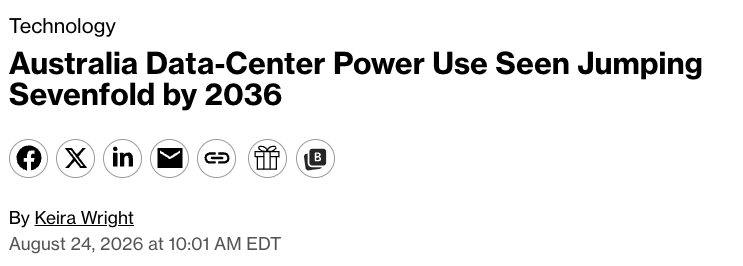
Australia data-centre power use heads toward 34.5 TWh and 13% as nearly 15 GW of coal and gas retires英語原文
AEMO-linked forecasts and state filings point to a much larger grid load, intensifying the need for new wires, generation and connection rules.
Australian grid and media materials point to a sharp rise in data-centre electricity demand. Oxford Economics Australia’s report for AEMO says data centres consumed 3.9 TWh in FY25 and could reach 12.0 TWh by FY30 and 34.5 TWh by FY50 under the Step Change scenario.
The surge comes as the power system faces a separate retirement wave in coal and gas capacity. Reuters-style local coverage and state consultation materials say NSW alone has 28 GW of data-centre connection enquiries, while average daily grid demand in the state typically ranges from 7.5 GW to 10 GW.
For markets, the implication is not just higher power demand but a larger buildout across generation, transmission and connection infrastructure. That could matter for utilities, network owners and data-centre-linked names such as IREN, whose core AI buildout remains in Texas but which retains an Australian footprint.
ABC has also cited research suggesting up to A$150 billion of data-centre investment by 2030. Bloomberg reported that AEMO expects data centres to account for almost 10% of the National Electricity Market’s underlying demand by 2050, underscoring how quickly the load could become system-defining.
これまでの経緯
2026-07-01投稿3件 · 投稿者3人
Data center stocks fell broadly, with NBIS down 7%, as users discussed risks of buying above $200.
企業動向🔥進行中
BitMine、32,447 ETHを追加取得、保有銘柄は585万に英語原文
The latest weekly update keeps the company close to its 5% supply goal while expanding a treasury now worth about $14.6 billion
BitMine Immersion Technologies disclosed a fresh weekly purchase of 32,447 ether, lifting its total holdings to about 5.85 million ETH, or roughly 4.8% of Ethereum’s circulating supply. Based on the company’s referenced pricing, the stash is valued at about $14.6 billion.
The update extends BitMine’s ETH treasury strategy, which began in June 2025 and has repeatedly made the company the subject of weekly accumulation reports. Earlier August coverage put BitMine at roughly 5.82 million ETH, so the latest filing shows another step higher rather than a new strategic pivot.
For markets, the main read-through is to BitMine’s stock BMNR and to sentiment around Ethereum treasury companies, since BitMine has become one of the largest corporate holders of ETH. Its large staking position also keeps protocol yield in focus as an offset to the volatility in the underlying token.
BitMine has not offered a separate new explanation beyond its standing treasury strategy, but the numbers confirm continued accumulation close to the company’s self-described 5% target. The latest disclosure also underscores that its ETH holdings remain a moving market reference point for crypto-linked equities.
これまでの経緯
2026-07-13投稿5件 · 投稿者5人
Tom Lee at WebX 2026 called Ethereum the settlement layer for the AI era, BitMine bought $49M in ETH, and he noted far fewer Ethereum DATs exist compared to Bitcoin.
企業動向🔥進行中
Strategy、米ドル準備金を51億ドルに引き上げ、15.9億ドルの現金プールを追加英語原文
No Bitcoin was bought last week as the firm widened liquidity buffers and repurchased STRC.
Strategy said it did not buy or sell any Bitcoin last week, while boosting its USD reserve to $5.1 billion and setting up an additional $1.59 billion cash pool that can be used for Bitcoin purchases, share repurchases or debt management. The company also repurchased $136.4 million of STRC preferred shares.
The latest disclosure extends Strategy’s recent capital-allocation pattern: raise money through MSTR equity sales, then split the proceeds between reserve funding, preferred-stock buybacks and obligations tied to its capital structure. Earlier reporting had placed the reserve near $4.8 billion, so the new figures mark a fresh step up in liquidity.
For investors, the immediate focus remains MSTR and STRC. MSTR is the funding vehicle that supports the company’s Bitcoin strategy, while STRC buybacks and reserve growth affect preferred holders and the firm’s debt-and-dividend coverage.
The key takeaway from the new disclosure is that Strategy is prioritizing balance-sheet flexibility over adding to Bitcoin holdings for now, even though the company says the new cash pool could be used for future BTC purchases.
これまでの経緯
2026-06-25投稿7件 · 投稿者4人
Rosen Law Firm opened an investigation into Strategy, STRC hit a record low of $75, and Bitcoin's drop below $59,000 left its holdings with over $14B in unrealized losses.
企業動向
Phantom to drop Sui support on Sept. 24 after 20 months英語原文
Users must move assets or swap out before the deadline, with fees waived on eligible swaps; the change trims Phantom’s multichain roster.
Phantom has confirmed it will stop supporting Sui inside its wallet on Sept. 24. Users will need to move SUI assets to another compatible wallet or swap them into assets that Phantom still supports, and the company says fees on those swaps will be waived before the cutoff.
The move comes after Phantom first announced Sui support in December 2024 and launched the integration on Jan. 29, 2025, putting the network on the wallet for roughly 20 months. Media reports say the decision was made jointly with the Sui team.
For Sui users, the practical impact is mainly operational: wallet access through Phantom will change, but the underlying assets remain on-chain. The announcement also underscores that wallet providers can prune network support even after adding a chain to a multichain lineup.
Phantom has not publicly detailed a deeper business reason beyond the joint decision. Users are being told to complete migration ahead of the deadline and to verify they are using official or trusted Sui-compatible wallets.
CME Group said it has added Ethena’s ENA to its suite of single-asset crypto benchmarks. The new pricing feed extends institutional reference and real-time pricing coverage for the token.
The move comes after Ethena has drawn heightened market attention in recent weeks, including reports of a $1 billion institutional lending arrangement involving FalconX. CME’s benchmark addition gives traders and risk managers another standardized pricing source for ENA.
For the market, benchmark inclusion matters because it can improve consistency across spot trading, lending and valuation workflows. CME also said the new indices are for pricing reference only and will not be used for contract settlement.
That means the development is best viewed as infrastructure expansion rather than a new listed contract. For Ethena, it strengthens visibility inside traditional market data systems at a time when ENA volatility has already been elevated.
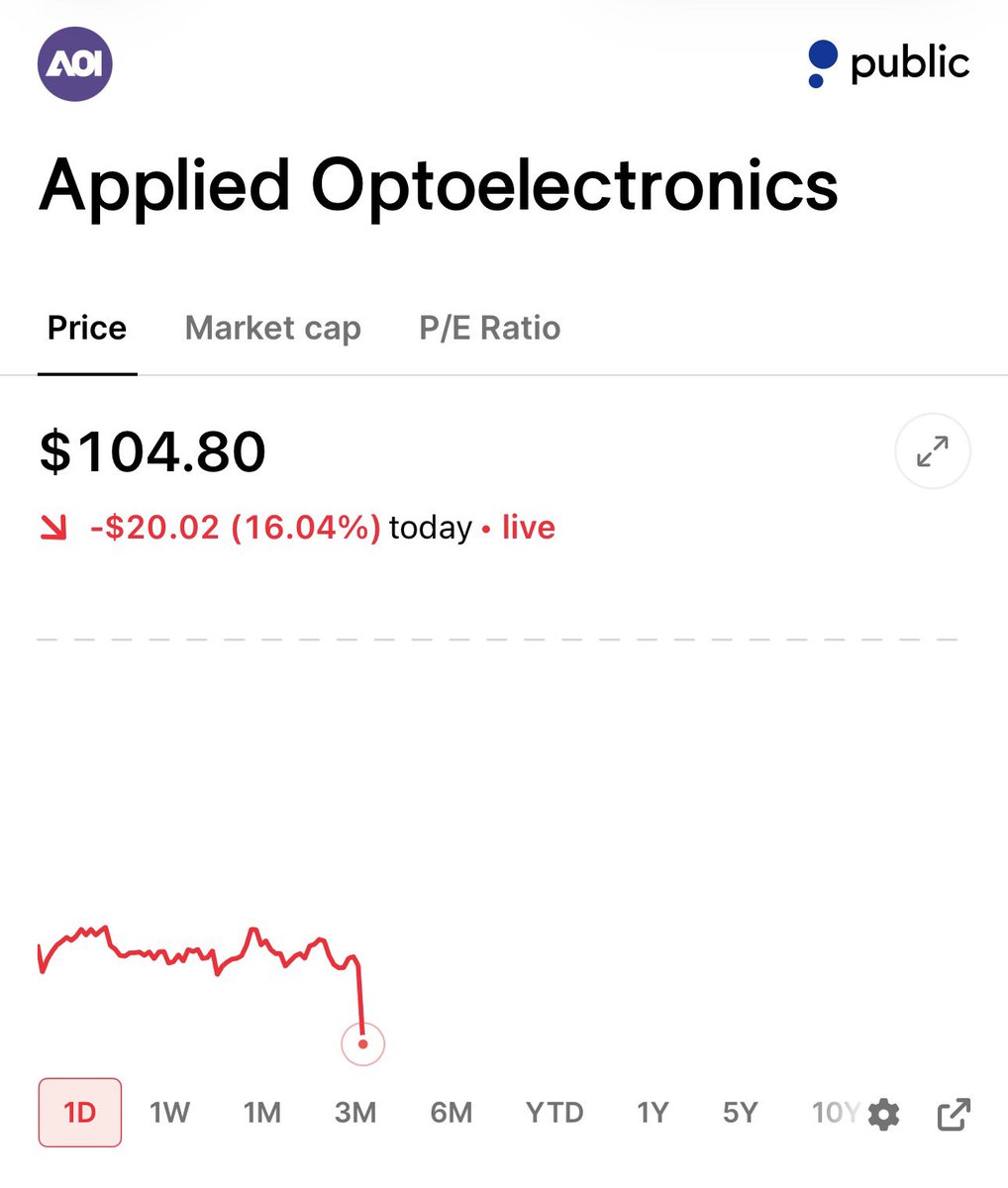
Applied Optoelectronics said after Friday’s close that it has entered into a new equity distribution agreement with Raymond James and Needham, allowing the company to sell up to $600 million of common stock through an at-the-market program. The company said the sales, if any, may be made from time to time at prevailing market prices.
The filing extends a busy fundraising year for AAOI. Public disclosures and follow-on coverage indicate the company had already launched two ATM programs earlier in 2026, which together generated about $1.05 billion by the end of the second quarter; with the new authorization, the company’s 2026 ATM capacity rises to roughly $1.7 billion.
Shares fell in after-hours trading after the announcement, with reports citing declines of roughly 10% to 16%. Investors are weighing the funding need for AAOI’s manufacturing ramp against the dilution that can come with repeated equity issuance, as the company expands its Pearland, Texas, capacity for 800G and 1.6T optical transceivers.
AAOI said proceeds may be used for working capital, capital expenditures, debt repayment or acquisitions. The company has no obligation to sell any shares under the agreement, and it may suspend offers and sales at any time.
Libya’s National Oil Corporation said on Aug. 24 that it has signed a production-sharing agreement with Chevron, according to wire reports circulating on X. No full contract text was immediately available in the public materials reviewed.
The deal builds on a series of earlier moves between the two sides. Chevron signed an MoU with NOC in January to assess onshore Libya’s exploration potential, followed by a March MoU on offshore Block NC146 and an April Reuters-reported study agreement on shale oil and gas resources.
Libya has been trying to draw foreign capital back into its oil sector. The National on Aug. 18 quoted NOC as saying the country needs about $30 billion to $40 billion in investment and still has more than 60 undeveloped fields.
For Chevron, the news reinforces its North Africa exploration strategy and keeps CVX in focus as investors track whether the company can convert early-stage Libya access into workable acreage and future reserves. The market impact should remain limited until the PSA terms, block details and spending obligations are disclosed.
これまでの経緯
2026-08-14投稿4件 · 投稿者4人
Major US oil firms cut shale capital spending by 10-20% in key basins, prioritizing shareholder returns over output growth.
2026-08-24投稿3件 · 投稿者3人
Canadian oil output is largely controlled by US-owned firms, while Libya's NOC signs a production-sharing deal with Chevron.
企業動向
Netflix weighs Peacock and Fox One inside its app as US share slips to 7.8%英語原文
The latest reports point to a deeper platform play, with Netflix eyeing third-party bundles as it tries to keep viewers inside its ecosystem longer.
Netflix is discussing whether to bring rival streaming services such as Peacock and Fox One directly into its app, according to new media reports. The talks are described as preliminary, and no deal appears imminent.
The idea fits a broader effort at Netflix to improve engagement, not just subscriptions. Earlier reporting showed Netflix’s share of U.S. TV viewing fell to 7.8%, underscoring the problem executives are trying to solve.
If the company follows through, Netflix would move closer to acting as a streaming hub rather than only a content library. That would put NFLX at the center of the story, while Comcast and Fox would become the most relevant partners to watch.
Netflix has not confirmed any launch plan, pricing, or rollout timeline. For now, the key development is the expansion of the discussion itself, not a completed product announcement.
Nvidia said Groq racks will be online this year, according to a CNBC report published today. The comment marks a new execution milestone for the roughly $20 billion transaction tied to Groq’s inference technology and assets.
The deal was first publicly reported in December 2025, when Nvidia agreed to acquire Groq assets for about $20 billion and bring over key leaders and engineers. Groq said at the time it would continue operating as an independent company, while Nvidia later folded Groq-based language-processing hardware into its broader AI infrastructure plans.
For investors, the update matters most for NVDA because it speaks to whether the acquired inference stack can be turned into deployable products and revenue. A successful rollout would also deepen Nvidia’s push into low-latency inference, a market where competition is intensifying.
The public record still frames the transaction as an asset, technology and talent deal rather than a full acquisition of Groq as a company. Groq has also said its cloud business will keep operating, and Nvidia has separately denied having a China-specific LPU product on its roadmap.
これまでの経緯
2026-07-16投稿4件 · 投稿者4人
Nvidia's Groq 3 LPX racks are slated for H2 2026 shipment, featuring 256 LPUs and a 52-layer PCB.
企業動向
Largan pushes CPO testing with TSMC, AMD-linked samples reportedly in trial英語原文
A fresh report adds detail to Largan’s optical push, extending Taiwan’s AI packaging chain beyond phones and lenses.
Economic Daily reported that Largan Precision is expanding into co-packaged optics through its subsidiary PhotoniCore, developing collimator components with TSMC. The report says sample units have already been delivered to TSMC for testing, and that the project is tied to AMD.
This follows earlier reporting from Taipei Times on July 25, which said Largan chairman Adam Lin had told investors the company was entering the CPO market via fiber arrays, with samples scheduled for customer certification and a pilot line still on track. That background suggests today’s signal is a follow-up, not a fresh launch.
For investors, the story keeps TSMC at the center of Taiwan’s AI supply-chain buildout while also putting AMD and NVDA in the wider demand frame for advanced packaging and optical interconnects. Largan, best known for smartphone lenses, is signaling a deeper move into AI infrastructure hardware.
Largan declined to comment on the latest report, and the new claims remain media-sourced rather than company-confirmed. No order size, customer name, or mass-production timetable was disclosed in the fresh report.
Walmart is launching a new in-house women’s brand called Scenario, with most items priced below $25. The line includes jeans, blouses, tops, bags and accessories, according to reporting first published on Sunday.
The move extends a broader apparel strategy that has already included revamps of adult and younger-skewing labels. Walmart has spent years trying to make its clothing business feel more fashion-forward without abandoning its core low-price positioning.
For investors, the immediate relevance is to Walmart’s own merchandising mix and private-label growth story rather than to the wider retail sector. The new brand gives the company another way to attract younger shoppers and encourage higher-margin discretionary purchases alongside everyday essentials.
No separate financial targets were disclosed for Scenario, and Walmart has not said how much sales it expects the brand to generate. The company’s latest earnings update also showed continued e-commerce growth and a raised full-year outlook, reinforcing the importance of traffic-driving initiatives like apparel.
Multiple market wires reported that the Chicago Fed National Activity Index fell to -0.08 in July, missing the -0.05 consensus and easing from -0.02 previously. The reading kept the broad U.S. activity barometer below zero, which signals growth running under historical trend.
For context, the Chicago Fed says the CFNAI is a weighted average of 85 indicators across production, employment, consumption and housing, and the three-month average is often watched for trend confirmation. Haver’s June recap put CFNAI at -0.02 and CFNAI-MA3 at -0.05, well above the Fed’s recession threshold discussion at -0.70.haver.com mql5.com
The report matters more for macro pricing than for company-specific equities: weaker activity readings can feed into Treasury and dollar moves, while traders use them alongside jobs and industrial data to judge whether soft growth is broadening or staying noisy.
No official Fed commentary on the July print was included in the wires cited in the signal.
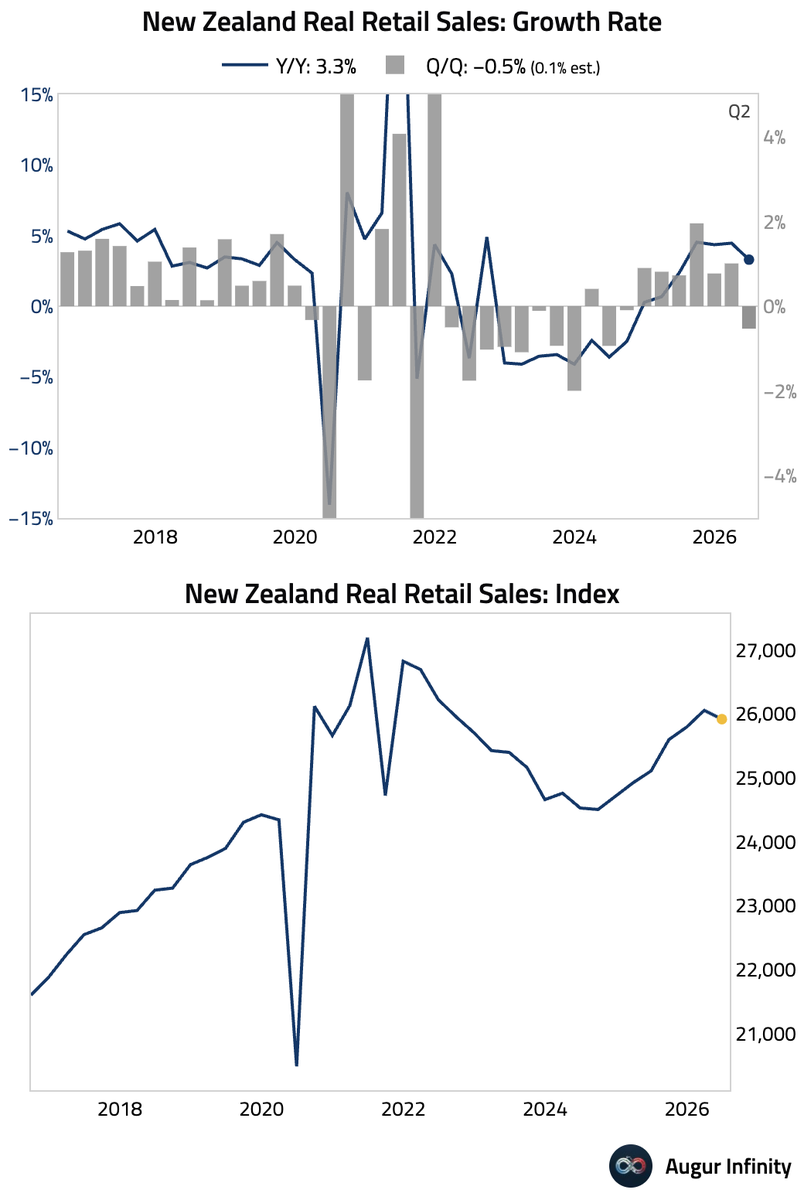
Statistics New Zealand said seasonally adjusted, inflation-adjusted retail sales volume fell 0.5% in the June quarter of 2026, missing expectations for a 0.1% rise. On a year-over-year basis, sales rose 3.3%, slowing from 4.5% in the first quarter.
The decline was broad-based, with 8 of 15 retail industries reporting lower volumes. Notable drops were seen in fuel, motor vehicles and parts, accommodation, and food and beverage services, while electrical and electronic goods posted gains.
The figures matter because retail sales are a key read on household spending in New Zealand and can shape views on the pace of domestic demand. The report may also feed into expectations for the NZD and for sectors tied to consumer activity, including retailers, restaurants, tourism businesses, and auto dealers.
Trading Economics’ release summary matched Stats NZ on the key headline numbers, showing Q2 retail sales at -0.5% q/q and 3.3% y/y. RBNZ data also showed retail trade sales were still up 1.4% q/q in the December 2025 quarter, underscoring the slowdown in the latest print.
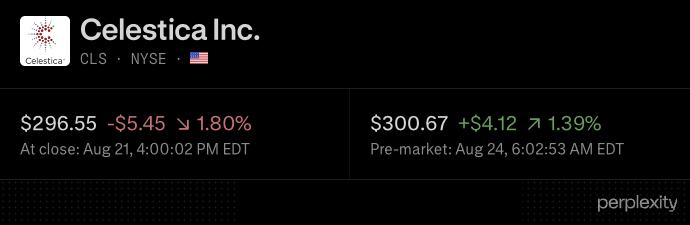
UBS upgraded Celestica to Buy from Neutral and raised its price target to $430 from $410. The firm said strong AI-driven demand for Ethernet switching and machine-learning compute, along with a 1.6T rack-scale solution tied to OpenAI, should support faster revenue growth and earnings expansion.
The call adds to a run of bullish coverage around Celestica, which has become a key AI data-center supplier. Earlier reporting noted that the company posted second-quarter adjusted EPS of $2.54 on revenue of $4.7 billion, both ahead of expectations, and lifted full-year guidance, reinforcing the market’s view that its AI hardware exposure is paying off.longbridge.com 61893.com
UBS’ note also landed against a backdrop of broader analyst optimism. Longbridge’s coverage said several analysts have rated Celestica a Buy over the past month, with an average target of $455 and a high of $535, showing how the stock remains tightly linked to AI infrastructure spending trends.longbridge.com
For investors, the stock remains a read-through on AI servers, Ethernet switching and cloud-infrastructure capex rather than a standalone manufacturer story. That means CLS can move on updates to hyperscaler spending, rack-scale deployments and networking demand, even when the company itself has not released fresh results.
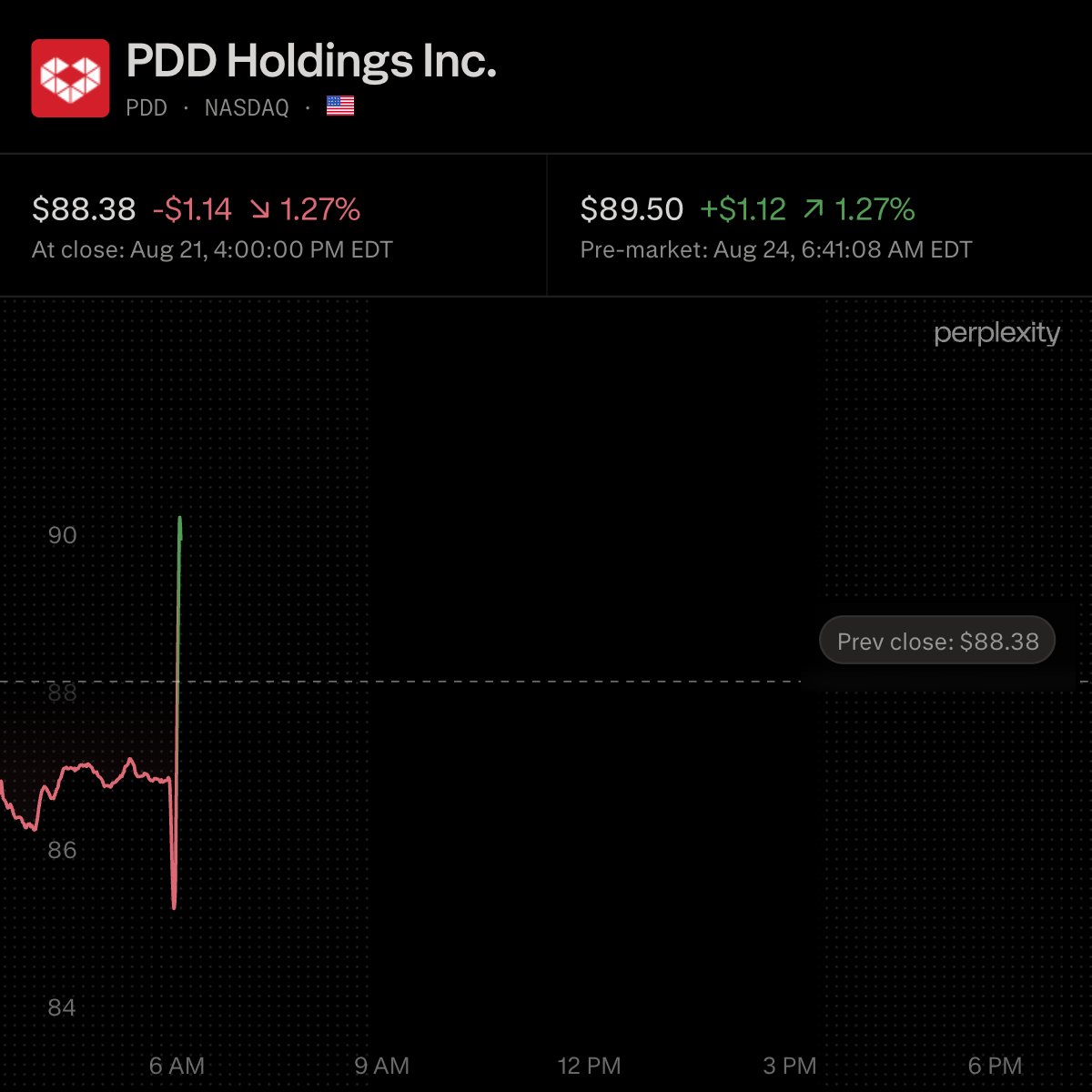
PDD Holdings reported second-quarter 2026 unaudited revenue of RMB 112.4 billion, up 8% year over year and below market expectations. Adjusted EPS came in at RMB 19.33, while adjusted operating profit was RMB 29.1 billion; adjusted net income was RMB 28.5 billion, down 13% from a year earlier.
The results were released on Aug. 24, following the company’s Aug. 17 announcement that it would publish its quarterly figures before U.S. markets opened. Reuters said the revenue shortfall reflected intense price competition in China and rising regulatory pressure, underscoring how growth is being tested even as profitability held up better than expected.reuters.com
In premarket trading, PDD was firmer, with X-posts citing gains of roughly 1.6% to 4%. Traders also highlighted the company’s cash and short-term investments, which one post put at about $67.3 billion, fueling debate over how much balance-sheet strength can offset slower earnings growth.
PDD has already scheduled a conference call for 7:30 a.m. ET on Aug. 24 to discuss the quarter. Investors will be listening for management’s view on consumer demand, discounting and whether profit improvement can keep pace with revenue moderation.
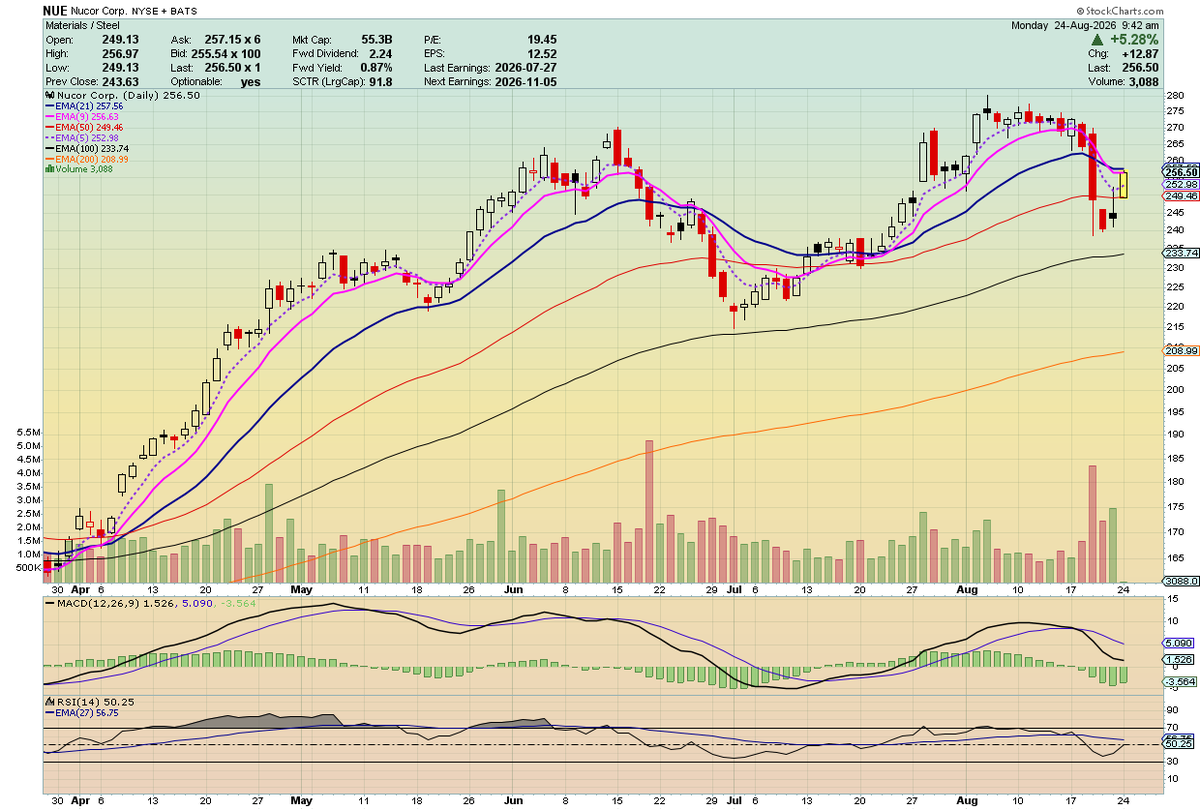
U.S.-Canada trade talks collapsed late Friday, and U.S. steel stocks were bid higher in early trading on Monday. Trading signals flagged Nucor, Steel Dynamics, Cleveland-Cliffs and Reliance as investors reacted to the tariff flare-up.
Reuters-linked coverage cited by Chinese outlets says Prime Minister Mark Carney suspended the talks after Washington made last-minute demands he described as unfair and a threat to Canadian sovereignty. Carney said Canada’s matching retaliation on $20 billion of U.S.-tariffed Canadian goods would take effect Sept. 8.
The market logic is straightforward: more trade barriers can support pricing power and relative demand for domestic steel producers. That is why NUE, STLD, CLF and RS were the names most closely associated with the move.
Carney said Canada would not accept terms that compromise sovereignty, while U.S. Trade Representative Jamieson Greer blamed Ottawa for the collapse. Neither side has announced a date to restart negotiations.
Fresh X chatter says Nvidia’s Vera Rubin platform still looks superior on performance, total cost of ownership and supply-chain availability, while Nvidia’s CoWoS share at TSMC is expected to stay stable into 2027. Separate note-taking after recent earnings also kept a constructive stance on Marvell, MediaTek and Intel.
The backdrop is a market that is tilting from training toward inference. A recent industry report said inference spending surpassed training for the first time in 2026, with Gartner forecasting about $42 billion of AI-optimized cloud infrastructure spending this year, including $23.3 billion for inference, or 55%.aistockwire.com
For Nvidia, that puts more weight on Rubin’s economics, packaging, memory access and system-level efficiency, not just raw GPU speed. The same report said Nvidia’s FY2026 data-center revenue reached $193.7 billion, underscoring how much customers are still paying for the company’s platform, even as custom ASICs draw attention for certain workloads.aistockwire.com
The immediate market read-through is broader than one chip roadmap. NVDA remains the main ticker at the center of the debate, while TSMC’s CoWoS capacity, and the relative positioning of AVGO, MRVL and AMD in AI custom silicon, also stay in focus.
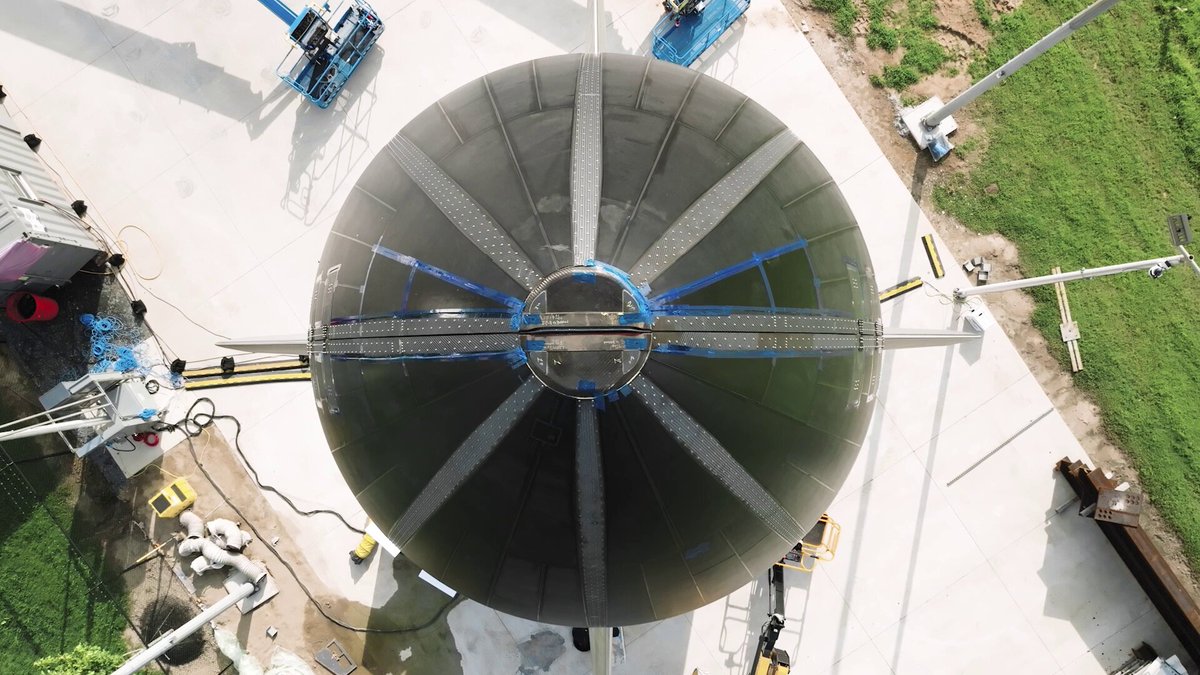
Rocket Lab said on X that Neutron’s reusable Hungry Hippo fairing has entered pre-flight testing, with the two permanently attached fairing halves being opened and closed under flight-like conditions. The company said the work is meant to simulate stage-two deployment and the vehicle’s return to Earth.
Hungry Hippo is a key piece of Rocket Lab’s Neutron architecture. The company disclosed in December 2025 that the fairing had completed qualification testing and was headed to Virginia, and in January 2026 said it had arrived at the Wallops Island launch site for further pre-launch work.
For RKLB, the update reinforces the development path for Neutron, which Rocket Lab has said is designed to carry up to 13,000 kg (33,000 pounds). The milestone matters because Neutron remains central to the company’s competition in the reusable-launch market.
Rocket Lab did not announce a new launch date or provide additional technical data in the latest update. It only confirmed that Hungry Hippo is now undergoing flight-like testing before final integration.
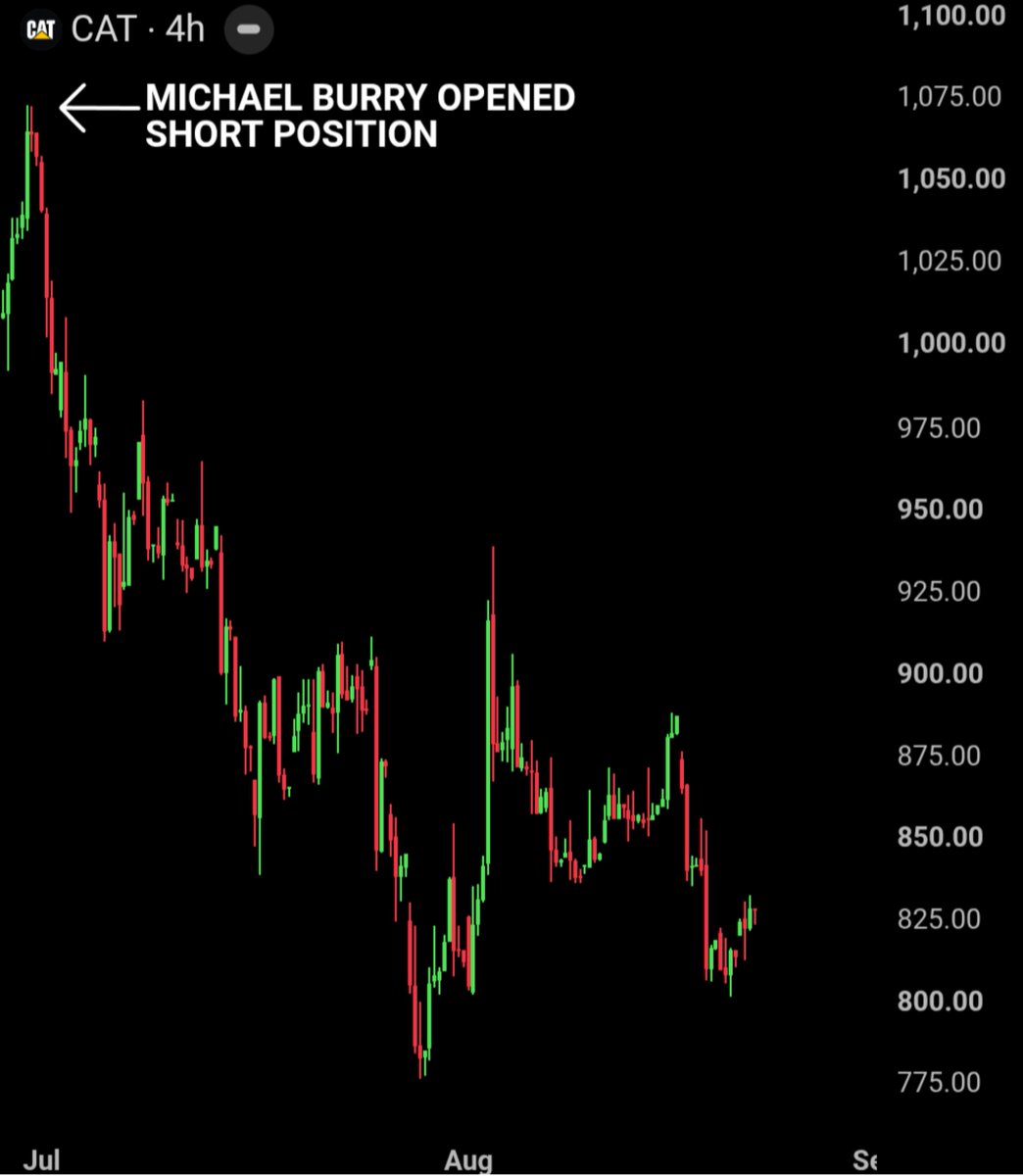
The latest discussion around Caterpillar centers on a fresh market read-through: CAT is down about 22% since Michael Burry disclosed a short position on June 30. The X signal lines up with recent market coverage tracking the stock’s retreat from its AI-driven highs.
The backdrop is Caterpillar’s re-rating as an AI infrastructure beneficiary, especially through power and energy equipment used for data-center backup generation. Earlier reporting said the company’s first-quarter revenue rose 22% year over year and its order backlog reached a record $63 billion, helping fuel the stock’s surge before sentiment reversed.
For the market, this is not just a Caterpillar story. CAT has been a bellwether for industrial stocks tied to data-center power demand, while related names in turbines and backup power have also been bid on the same theme. The recent pullback suggests investors are taking a harder look at whether the valuation premium can persist.
No new company response was cited in the X signal. The immediate focus remains on backlog conversion, margins and whether AI-related demand can justify the stock’s still-elevated multiple.
これまでの経緯
2026-06-25投稿4件 · 投稿者4人
Burry published a paid Lululemon analysis, sparking debate over his fees versus SNDK's 87% gain.
市場
McDonald’s MCD slips below its 200-week EMA as shares trail the February high by 18.1%英語原文
Recent trading signals point to a softer chart even as latest sales data keeps the defensive-stock case intact.
Latest X trading commentary says McDonald’s shares are sitting below their 200-week EMA, with momentum starting to turn bullish. The move keeps the spotlight on price action rather than the company’s operating story.
Recent market coverage suggests the business remains fairly resilient. Yahoo Finance’s summary of the latest quarterly report said total sales rose 5% year over year, while comparable sales increased 1.3% overall and 0.8% in the U.S.
The stock has still lagged. StockStory reported McDonald’s at $279.27, down 7.9% year to date and 18.1% below its February 2026 high of $341.06, while Investor’s Business Daily said the shares were down about 10% this year and highlighted the 260-265 area as support.
For investors, that makes MCD a battleground between defensive-earnings appeal and weaker chart structure. The debate can spill over into restaurant stocks more broadly, but the company itself has not issued any new response tied to the technical chatter.
On-chain monitoring accounts said Arthur Hayes bought back about 1.9 million ETHFI tokens at an average price of $0.62 each, a position worth roughly $1.17 million. The same trackers noted that he had sold 265,461 ETHFI four months earlier at about $0.44 apiece, or around $118,000.
That puts the new purchase about 41% above his prior selling price. Arkham and Lookonchain both pointed to the trade, making it one of the more closely watched ETHFI transfers of the day.
ETHFI is the governance token of Ether.fi, and large wallet activity often feeds into short-term sentiment around the token’s liquidity and trading interest. The token has also recently seen perpetuals activity on Hyperliquid, adding to the attention around the name.
Still, the record shows only a single on-chain buy, not a full disclosure of Hayes’s broader portfolio or strategy. For now, the trade is mainly notable as a high-profile return to a token he had exited at a lower price earlier this year.
Trump’s Aug. 22 OGE Form 278-T disclosure shows 1,051 securities transactions in June, with an aggregate value range of $78.1 million to $263.1 million. The filing has quickly become a market talking point because it lays out the month’s trading volume in unusually large detail.
The clearest sign of the reshuffle came on June 18, when Trump reportedly sold Meta Platforms and Motorola Solutions in the $1 million to $5 million range, then bought Berkshire Hathaway, Visa, Mastercard and Cintas in the same range. Multiple reports also said the accounts are overseen by independent managers using computer-based strategies, not by Trump placing the trades himself.
For markets, Meta and Berkshire Hathaway are the most prominent names in the disclosure, while Visa and Mastercard add further interest because they sit in the same cluster of same-day purchases. The trading pattern has revived scrutiny over the overlap between presidential policymaking and personal investments, although the filing itself does not show misconduct or the use of nonpublic information.
So far, there is no new substantive response from the White House on the latest filing. Earlier, a spokesman said Trump’s assets were held in a trust managed by his children and denied conflicts of interest.
A new X post says open-source AI’s token share at Vercel has climbed from 28% to 62% over the past two months, while the combined usage of OpenAI and Anthropic still accelerated in July. The implication is not a collapse in demand, but a sharp change in how that demand is being routed.
The update lands amid a broader Wall Street debate over AI monetization, with investors increasingly asking where usage converts into revenue. Industry commentary has been converging on a split outcome: open source may capture most tokens, while closed frontier models retain most of the economic value.
That matters for AI-exposed software and infrastructure names, including Palantir, Snowflake and the IGV software ETF basket. If more enterprise workloads move to open or self-hosted models, pricing power and enterprise ARR mix could come under pressure even if overall AI consumption keeps rising.
For now, the data appears to be X-sourced rather than a full official disclosure from Vercel, so it should be treated as a signal rather than a final accounting. Still, it lines up with a growing body of commentary that token share and revenue share are diverging quickly in enterprise AI.
Fresh X posts indicate that Leverage Shares and WOLF Financial are teaming up for a two-week stock-picking competition on GameStock HQ, with registration routed through a dedicated GameStock link. A separate repost says the free contest starts this Wednesday and highlights a list of candidate names for entrants to pick from.
GameStock is a trading-competition app built around stocks, crypto and futures, featuring virtual bankroll formats, cash prizes and creator-led tournaments. The platform’s public pages also show it routinely runs themed competitions with different durations and prize structures.
For the market, the immediate impact is mostly about attention and trading activity around the associated names rather than any fundamental change. The tickers mentioned in the posts — $HOOG, $SKHX, $MUG and $AMZG — appear to be the contest’s pick pool, which could draw short-term interest if participation builds.
So far, there has been no additional official detail in the public posts on prize size, full eligibility or the complete ruleset. Any firmer read on the event will have to wait for updates from the organizers or the contest page itself.
H.B. Fuller’s board has rejected Ancora Holdings Group’s unsolicited offer to buy the company’s Building Adhesives Solutions unit for $1.1 billion to $1.2 billion in cash, according to a Bloomberg report cited by the X signal on Aug. 24. H.B. Fuller had previously confirmed receipt of the proposal and said it would review it with advisers.
The bid was first made public on Aug. 12. At the time, H.B. Fuller said BAS generated about $850 million in fiscal 2024 revenue and roughly $130 million in adjusted EBITDA, underscoring why the segment has become a focal point in the company’s portfolio debate.
For investors, the key stock is FUL. BAS is a carved-out operating unit within H.B. Fuller, so a sale could have affected leverage, portfolio mix and capital allocation; the rejection keeps those strategic questions open and may prolong the activist campaign around the company.
Neither side has publicly said a definitive agreement has been reached. H.B. Fuller said it would carefully evaluate the proposal, while Ancora said its letter was an expression of interest and that it was prepared to move into due diligence if the company engaged.
これまでの経緯
2026-08-13投稿5件 · 投稿者3人
Ancora offered up to $1.2 billion in cash for H.B. Fuller's adhesive unit, with the board saying it would evaluate the proposal.
2026-08-24
2026-07-18投稿26件 · 投稿者22人
Trump threatens higher tariffs on Canada over wildfire smoke polluting US air.
2026-07-21投稿35件 · 投稿者26人
Trump prepares new tariffs on up to 60 countries; Google develops efficient AI chip; criticism of Trump's Canada tariff policy.
2026-08-19投稿75件 · 投稿者41人
Trump announces US-Canada trade deal, pauses 50% tariffs for three days; Canada offers concessions.
2026-08-23投稿25件 · 投稿者18人
US-Canada trade talks collapse; commentators suggest Trump may lose trade war; legality of new tariffs questioned.
2026-08-24投稿38件 · 投稿者26人
Trump raises auto and steel tariffs on Canada to 50% effective Jan 1, 2027, and declares Canada will no longer be treated like a state.
Apple's price negotiations with CXMT for mobile DRAM, including LPDDR5X, were rejected, boosting Samsung and SK's bargaining power.
2026-08-09投稿19件 · 投稿者17人
Apple reportedly tested CXMT chips for iPhones and MacBooks; CXMT's capacity was maxed out, with HP and Acer securing limited supplies.
2026-08-10投稿17件 · 投稿者14人
Apple proceeded with testing CXMT and YMTC chips despite Senate pressure, with commentary noting availability outweighs cost in shortages.
2026-08-16投稿3件 · 投稿者3人
Commerce Secretary Lutnick said the White House opposes Apple sourcing memory from China, potentially pushing Apple to alternatives like Samsung, SK, and Micron.
2026-08-17投稿4件 · 投稿者4人
Lutnick's comments could benefit Micron and others; CXMT became China's most valuable firm, with UBS calling Apple's sourcing report a key catalyst.
2026-08-24投稿2件 · 投稿者2人
Weekend reports suggested the Trump administration may allow Apple to source DRAM from CXMT, causing Micron and SanDisk shares to fall pre-market.
Multiple research reports highlight China's CXMT as a challenger to DRAM incumbents and CPU server demand drivers.
2026-08-24投稿1件 · 投稿者1人
Goldman initiates coverage on CXMT with a Buy rating and Rmb129 target, projecting its DRAM supply to reach 41% and 50% of Samsung and SK Hynix by 2028.
BitMine reported $45.7M in Ethereum staking revenue last quarter, making up 98% of total revenue, with annualized rewards projected at $284M.
2026-07-20投稿3件 · 投稿者3人
BitMine slowed ETH purchases to 7,430 coins (~$14M) last week, shifting to share buybacks, while disclosing holdings of 5.77M ETH, nearing 5% of supply.
2026-07-28投稿4件 · 投稿者4人
BitMine bought another $19.5M in ETH and accelerated its stock buyback, repurchasing ~$100M in BMNR shares, with shares surging on the ETH bet.
2026-08-03投稿4件 · 投稿者4人
BitMine acquired 10,399 ETH, and Tom Lee explained institutional money must buy BMNR shares instead of ETH due to wallet maintenance constraints.
2026-08-17投稿3件 · 投稿者3人
BitMine bought $18.9M in ETH last week, with cumulative holdings reaching 4.8% of Ethereum's supply.
2026-08-24投稿1件 · 投稿者1人
BitMine purchased $81M in ETH in a single week, marking its largest weekly buy in recent period.
Ripple CEO criticized Saylor's borrow-to-buy model, calling STRC's 25% discount a 'damning indictment,' while analysts warned of a potential feedback loop.
2026-06-29投稿18件 · 投稿者14人
Strategy unveiled a Digital Credit Capital Framework, raised STRC dividend to 12%, authorized $2B in buybacks, and MSTR rose 4.98% on the day.
2026-08-03投稿17件 · 投稿者13人
Strategy added $250M to its USD Reserve, repurchased $81M of STRC, and sold 3.01M shares for $290.6M, reducing its Bitcoin holdings by 1,638 BTC.
2026-08-18投稿4件 · 投稿者4人
CEO Phuong Le prioritized increasing Bitcoin per share over dividends, while STRC paid its semi-monthly $0.50 dividend.
2026-08-24投稿5件 · 投稿者5人
Strategy boosted its USD Reserve to $5.10B, established a $1.59B cash pool, repurchased $136M of STRC, and kept Bitcoin holdings unchanged at 840,447 BTC.