U.S. stock futures were under pressure Tuesday, with Dow futures down more than 300 points at one stage, S&P 500 futures off about 0.2%, and Nasdaq 100 futures modestly higher. The move came as Brent and WTI climbed to roughly $97 and $93 a barrel, both at six-week highs.
The latest leg higher follows renewed hostilities in the Middle East, after the U.S. and Iran exchanged strikes over the weekend. Reuters said Brent had already reached its highest since July 24 on Monday, while Goldman Sachs lifted its December 2026 Brent and WTI forecasts to $85 and $80 per barrel.
Higher crude is feeding back into inflation expectations and rate-sensitive assets. Energy shares are relatively supported, while technology and other duration-sensitive parts of the market are under pressure.
Investors are now watching whether elevated oil prices persist long enough to influence upcoming U.S. inflation data and the Federal Reserve’s policy messaging.
President Donald Trump said on Sept. 7 that Bombardier would no longer be allowed to sell in the United States unless the Canadian aircraft maker started manufacturing in the country. He framed the message as a push for “Buy American” policy and singled out Bombardier’s reliance on U.S. buyers.
The comments came just before Canada’s retaliatory tariffs on U.S. goods were set to take effect, adding another layer to the trade dispute. Bombardier said it already supports thousands of U.S. jobs and operates a supply chain that spans dozens of states.
The company’s U.S. footprint matters because Bombardier sells business jets into the American market and sources key components from U.S. suppliers. Trump also referenced Canadian treatment of Gulfstream, a General Dynamics unit, which put GD back into the conversation as an indirect market read-through.
Multiple outlets reported the post and the company’s response, but the practical mechanics of any ban remain unclear. Aircraft certification is handled by U.S. aviation regulators, not the White House.
Saudi authorities said Houthi attacks hit four cities in southern Saudi Arabia on Sept. 8, injuring at least 73 people. The Saudi Energy Ministry said fires broke out at several energy facilities and some operations were temporarily halted while emergency crews worked to secure the sites.reuters.com aa.com.tr
The attacks add to regional tension around the Red Sea and the Bab al-Mandab corridor, where shipping security has already been strained by the Yemen conflict. Reuters quoted the Saudi-led coalition as saying the wounded included civilians, and that the strikes targeted the cities of Abha, Khamis Mushait, Jazan and Najran.reuters.com
Markets focused on the implications for crude prices, refined-product supply and regional energy infrastructure. U.S. refiners such as Marathon Petroleum, Phillips 66, Valero and PBF Energy were among the stocks mentioned in trading chatter because higher crude volatility and wider crack spreads can quickly move the group.bloomberg.com
The Houthis claimed responsibility through their media channels, saying they had hit targets including airports, a military base and Aramco-related facilities. Saudi officials have confirmed fires and operational disruptions, but have not publicly detailed the full extent of damage, so the confirmed record remains limited to official Saudi statements and wire reports.
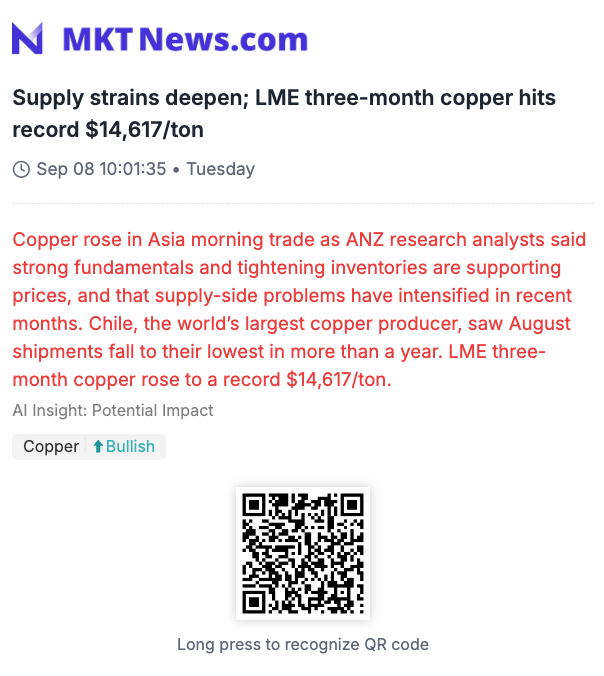
Three-month copper on the London Metal Exchange climbed as high as $14,533 a ton on Sept. 7, setting a new all-time high. The move extended a weeks-long rally, with prices holding near record territory after the session peak.
The latest leg higher was driven by expectations that the U.S. could broaden tariffs to refined copper imports. A tight mining backdrop and firmer demand from AI data centers, renewable energy projects and power grids have added a structural lift beneath the market.
For equities, the rally keeps names with copper exposure in the spotlight, including Freeport-McMoRan, Southern Copper and BHP. Traders are also watching the spread between U.S. and overseas prices, as continued flows into COMEX warehouses could keep non-U.S. inventories tight.
Bloomberg said the market’s concern is that tariff front-running has been pulling metal into the U.S. Asia Business Daily and Mysteel both reported that COMEX stocks have surged while LME and Shanghai inventories have eased, reinforcing the picture of regional supply imbalance.
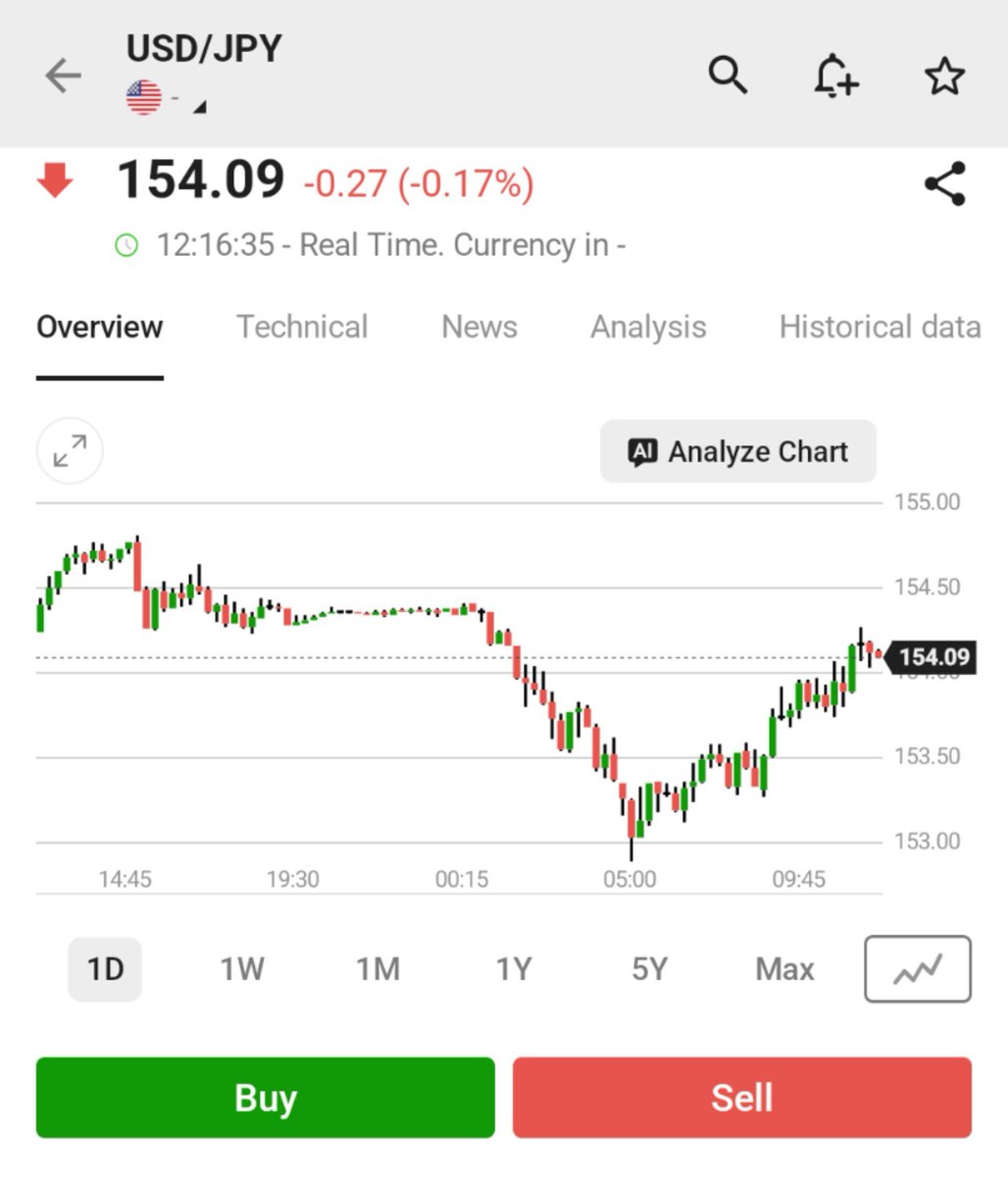
The Japanese yen strengthened sharply on Tuesday, trading as high as the 153.80 area and moving toward 152 per dollar, its strongest level of 2026 so far. Reuters said USD/JPY returned to the 153 handle, while Nikkei Asia reported the pair touched the 152 range.
The immediate catalyst was a break below 155 that triggered stop-loss orders, alongside rising expectations that the Bank of Japan may raise rates next week. Reuters also noted that traders are rethinking yen carry positions as the currency’s momentum accelerates.
The move matters for Japan’s exporters, especially automakers that have built earnings assumptions around a weaker yen. Bloomberg said Toyota Motor and other carmakers could face bottom-line pressure as the currency climbs to its highest level in more than six months.
For now, the trade is being driven by technical levels, rate expectations and positioning rather than any confirmed new policy action. Social-media speculation about fresh intervention has circulated, but it has not been verified by authoritative reporting and should not be treated as fact.
The National Transportation Safety Board said the Amazon-operated Boeing 767 cargo jet that overran a runway at Miami International Airport struck two vehicles and came to rest about 1,300 feet beyond the runway end. Officials said at least five people were killed and five were injured in the crash.
The accident happened on Sept. 7 and is now the focus of a federal probe into a deadly cargo-aviation incident. Investigators are expected to examine whether the aircraft touched down too late, as well as braking performance, thrust reversers, runway condition and weather at the time of landing.
For Amazon, the crash puts its outsourced air-cargo network under a brighter spotlight. The flight was operated by 21 Air using a Boeing 767, and the case could keep pressure on Amazon's logistics oversight and the resilience of its delivery network; Boeing shares may also be watched closely as the investigation develops.
Amazon said it would cooperate with any investigation. The NTSB has not yet released a final cause, and no conclusion should be drawn before the investigation is complete.
Novartis said its experimental drug del-desiran failed to meet the primary endpoint in the Phase 3 HARBOR study in myotonic dystrophy type 1, missing a statistically significant improvement in hand-opening time versus placebo. Shares of Novartis fell as much as 10% in Zurich after the announcement.
The result came after Novartis’ earlier Phase 3 setback for pelacarsen, making this the company’s third clinical-trial disappointment in a week. The drug was among the assets Novartis gained through its roughly $12 billion acquisition of Avidity Biosciences.
The stock reaction reflects investor concern that repeated late-stage failures could slow Novartis’ pipeline-led growth narrative. Novartis has kept its guidance for 5% to 6% annual sales growth over 2025-2030, but the latest miss adds pressure to that target.
Novartis said it is reviewing the full study data and will engage with health authorities on the most appropriate development path. Reuters said the company continues to see clinical development in myotonic dystrophy type 1 as challenging.
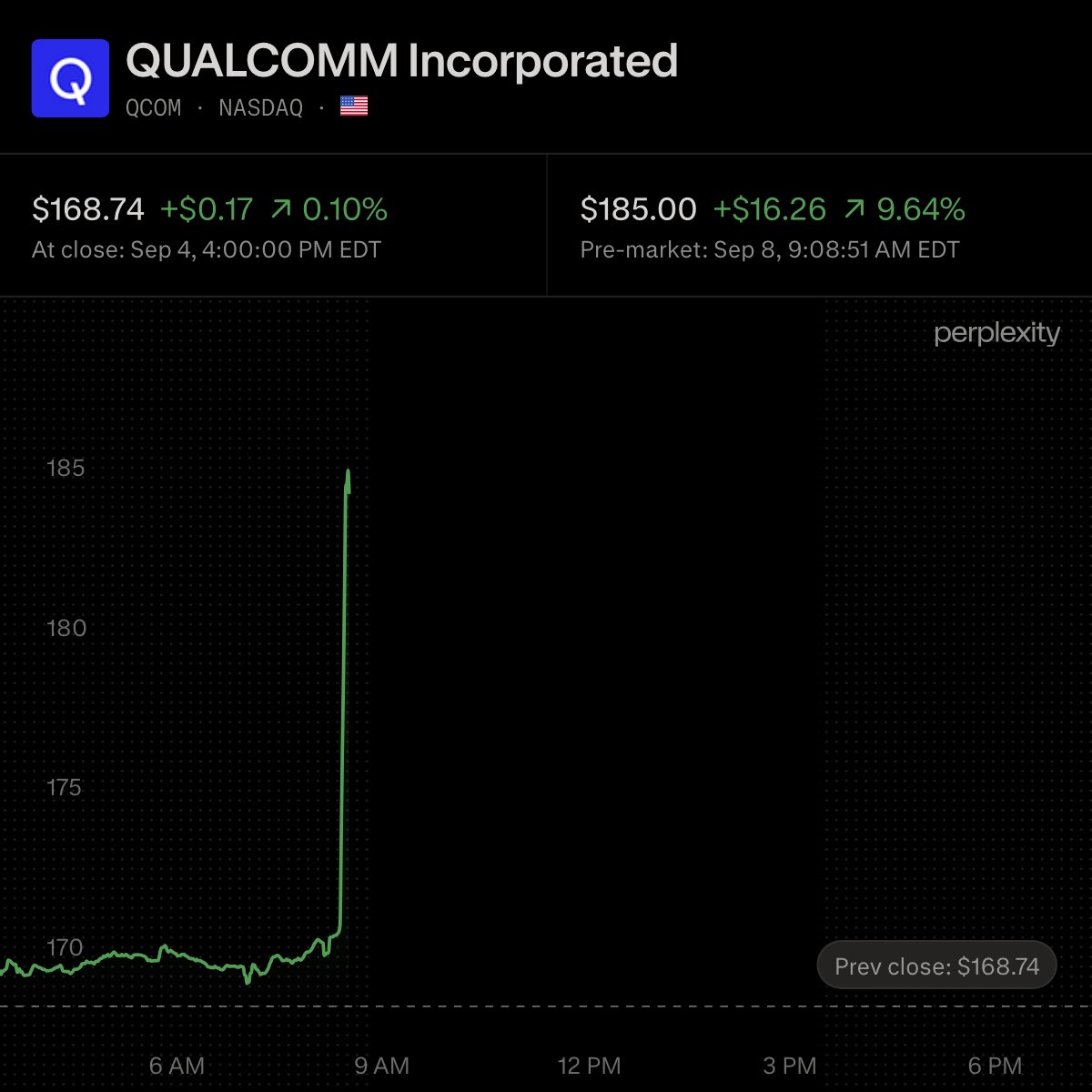
Qualcomm and Amazon said they have agreed to a multi-generation collaboration to develop custom silicon for AWS AI infrastructure, initially focused on large-scale AI inference. Amazon also received a warrant to buy up to 25 million Qualcomm shares at $161.26 each, exercisable through 2036.
The deal underscores Qualcomm’s push deeper into data centers, extending its expansion beyond smartphones and PCs. It also shows Amazon continuing to broaden its AI supply chain as hyperscalers race to secure chips, networking and supporting infrastructure.
At the warrant price, the maximum equity value is about $4.03 billion if fully exercised. Some market reports also said the chip-buying framework could reach as much as $60 billion, though that figure has not yet been fully detailed in the companies’ own announcement.
Shares of Qualcomm moved sharply higher on the news, as investors reassessed the company’s addressable market in AI infrastructure. For Amazon, the arrangement adds another custom-silicon option for AWS as it seeks to diversify compute sources and support future AI workloads.
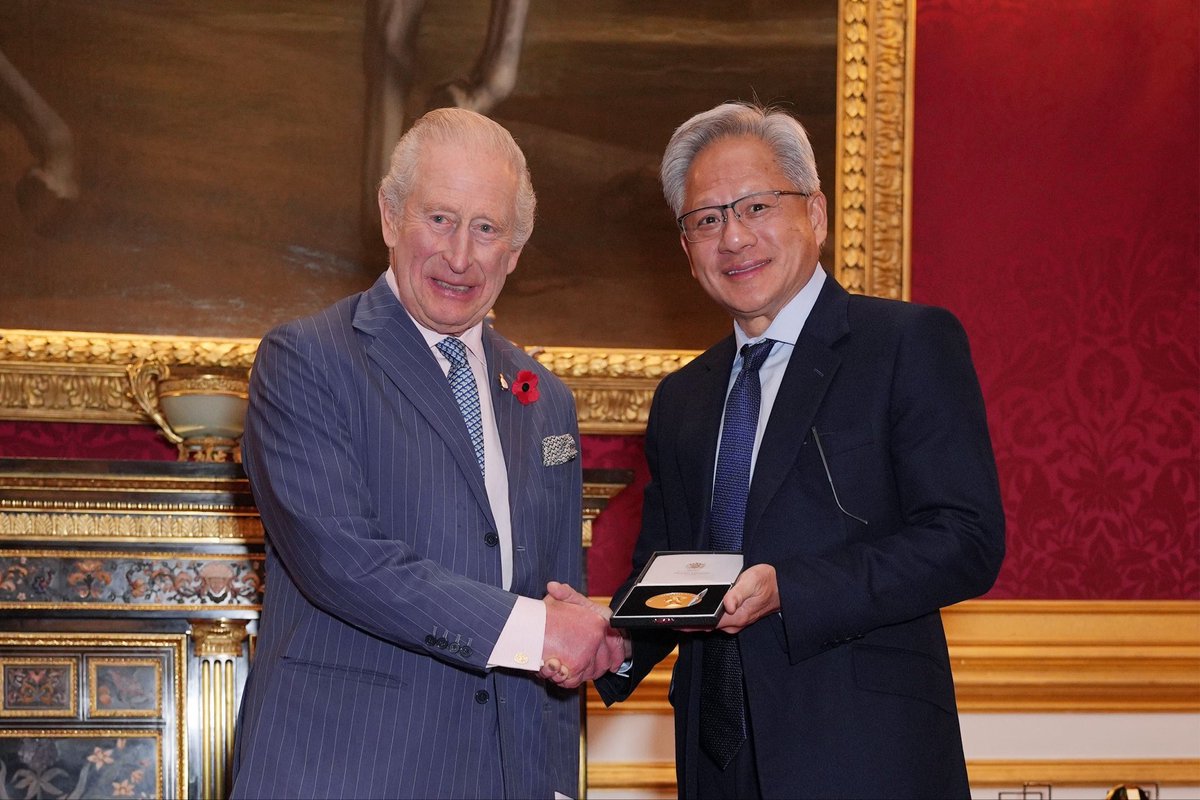
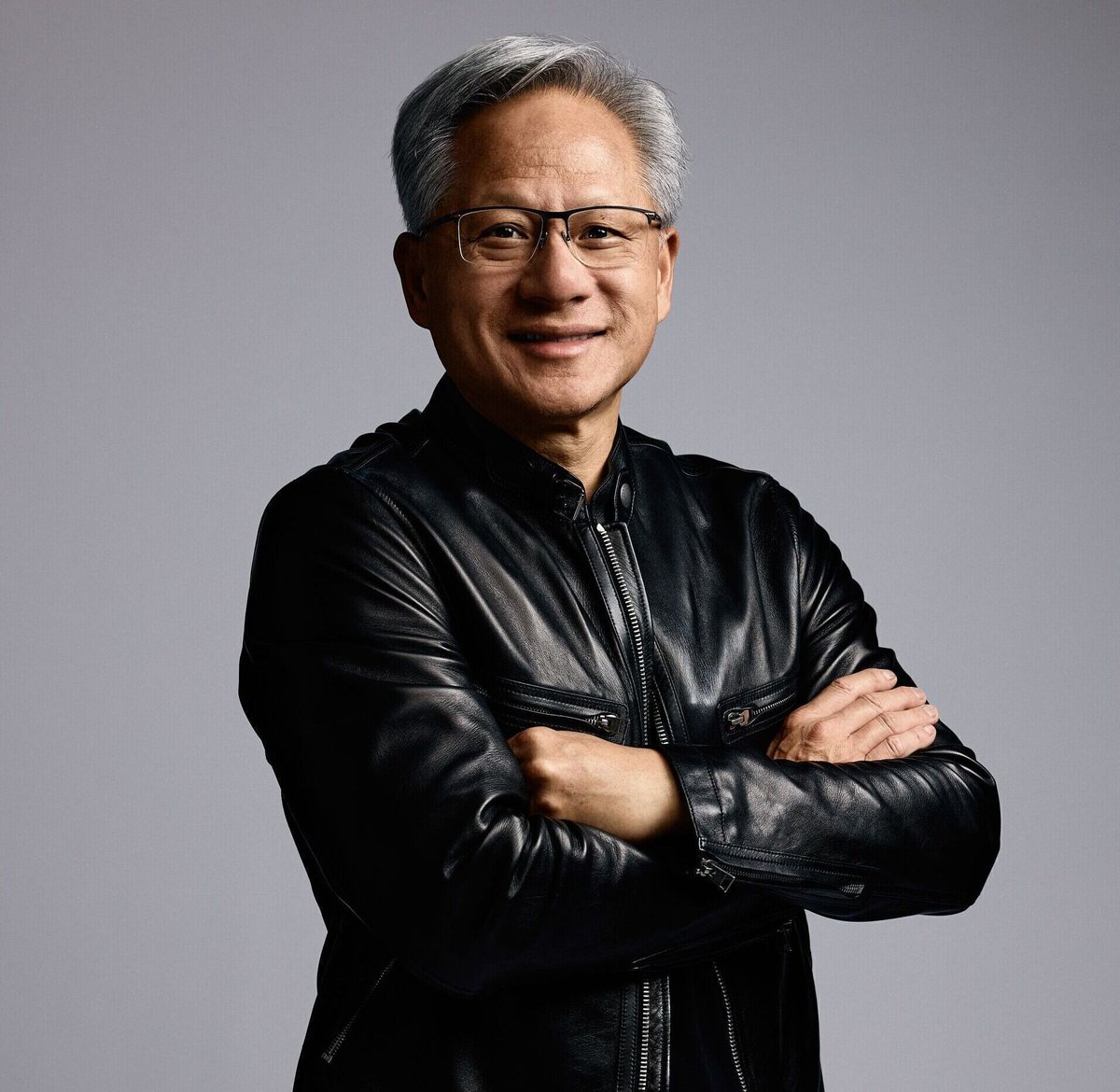
According to reports first surfaced through Politico and amplified across markets on X, King Charles III is expected to host a small AI gathering in Scotland later this month, with Nvidia CEO Jensen Huang reportedly on the guest list. DeepMind chief Demis Hassabis is also said to be among the invitees, though neither the Palace nor Nvidia has publicly confirmed the lineup.
The development extends a well-established thread between Huang, the British royal household and the UK’s AI agenda. Earlier coverage showed King Charles meeting tech leaders to discuss startup funding and separately handing Huang a letter on AI safety, underscoring Britain’s continuing focus on AI entrepreneurship, governance and university spinouts.
For investors, Nvidia remains the key ticker. Multiple reports have already placed Nvidia’s market cap above $4 trillion, and any new policy-facing appearance by Huang keeps the company central to the conversation around AI infrastructure, European partnerships and regulatory diplomacy.
No official event details have been released so far. Based on the available reporting, this is a fresh media-driven update on an invitation list rather than a formal announcement from the Palace.
Palantir and Nebius said they are partnering to bring Nebius compute and inference into Palantir’s enterprise environment, with Palantir naming Nebius its preferred sovereign AI infrastructure partner. The companies framed the deal around sovereign AI deployments where customers want tighter control over data and model operations.
The announcement builds on a broader ecosystem around sovereign AI. Palantir and NVIDIA recently unveiled a sovereign AI operating system reference architecture built on NVIDIA Blackwell Ultra systems, while NVIDIA said in March it would invest $2 billion in Nebius and help support the company’s plan to exceed 5 gigawatts of capacity by the end of 2030.
For PLTR, the partnership strengthens the company’s AI stack with external infrastructure and inference capacity. For NBIS, it offers a direct route into Palantir’s commercial customer base and positions Nebius more squarely in enterprise sovereign-AI deployments.
Neither company disclosed deal economics, rollout timing, or revenue contribution from the partnership. Investors will likely watch for any follow-up on customer adoption and whether the collaboration expands beyond the initial infrastructure integration.
WSJ says Robinhood will add Crypto.com event contracts to its app and buy minority stakes in both the exchange and its prediction business, widening its supply network.
According to The Wall Street Journal, citing people familiar with the matter, Robinhood has agreed to add Crypto.com's yes-or-no event contracts to its trading app and take minority stakes in Crypto.com and its prediction-markets business. Multiple X posts surfaced the same development today, pointing to the newly disclosed transaction structure and the inclusion of Crypto.com's OG platform.
The move builds on Robinhood's rapid push into prediction markets. The company already routes contracts through Kalshi, ForecastEx and Rothera, while Crypto.com launched its standalone OG prediction-market platform in February and has been expanding event-contract distribution since late 2024.
For Robinhood, the deal could broaden contract supply and reduce reliance on any single provider, while also sharpening competition with existing partner Kalshi. HOOD traded up 2.6% premarket, suggesting investors are still treating prediction markets as a meaningful growth lever for the brokerage.
Robinhood told the Journal it intends to keep working with multiple exchanges to give customers access to a diverse and resilient marketplace. Crypto.com has not publicly commented on the reported agreement.
これまでの経緯
2026-07-25投稿3件 · 投稿者3人
Robinhood is reportedly in talks with Crypto.com on prediction markets, as its relationship with Kalshi shifts toward direct competition.
企業動向
ASTS関連の欧州協議:4社の通信事業者がダイレクト・トゥ・モバイル向け2GHz帯を検討英語原文
Bloomberg says Deutsche Telekom, Orange, Vodafone and Telefónica are in early consortium talks, a fresh sign Europe’s D2D market may be moving from pilots toward spectrum competition.
Bloomberg, as carried by Reuters, says Deutsche Telekom, Orange, Vodafone Group and Telefónica are in early-stage talks to form a consortium and bid for satellite spectrum for direct-to-mobile services. The plan would position the group as a European rival to Starlink’s satellite-to-device push.
The backdrop is a growing European D2D ecosystem. Reuters reported in March that Orange added AST SpaceMobile and Vodafone’s Satellite Connect Europe to its partner roster, and later reported Vodafone and AST SpaceMobile unveiled plans for a Europe-led satellite constellation, reinforcing the strategic role of ASTS in the region.
For AST SpaceMobile, investors will watch whether the European carrier coalition becomes more concrete and whether spectrum policy in the EU translates into commercial opportunities. European telecom names such as Vodafone, Orange, Deutsche Telekom and Telefónica could also draw attention as the market weighs spectrum access and partnership economics.
For now, there is no final decision on the consortium or any bid, and the carriers involved have mostly declined comment or not immediately responded.
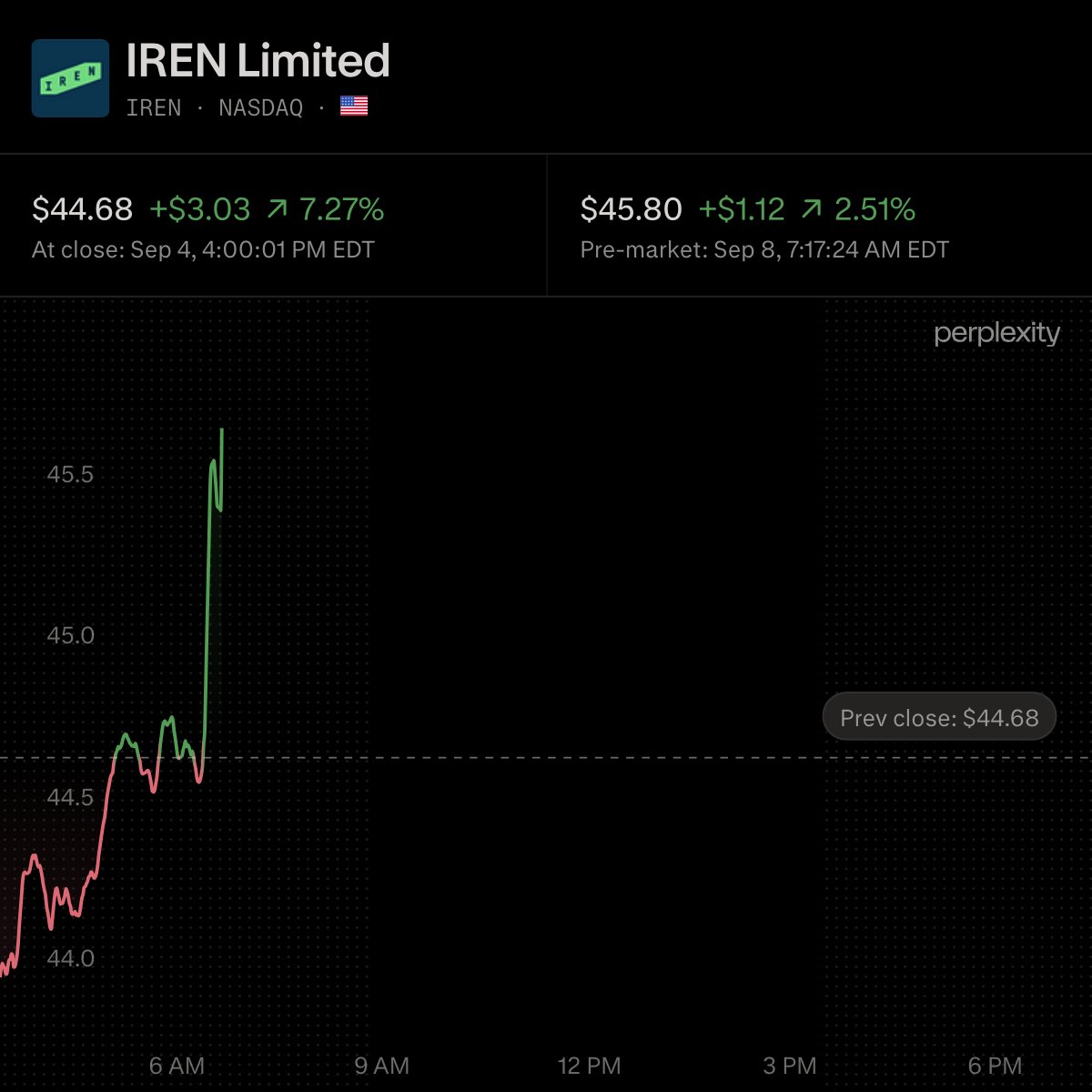
IREN said on Sept. 8 that its 2 GW Sweetwater Hub in Texas has been conditionally included in ERCOT’s Batch Zero process and classified as Base Load. The hub consists of Sweetwater 1 at 1.4 GW and Sweetwater 2 at 600 MW, with IREN saying the first 300 MW of data-center capacity at Sweetwater 1 is targeted for Q4 2027.
The update builds on ERCOT’s new framework for large-load interconnections. ERCOT has said Batch Zero applies to projects of 75 MW or more, while the grid operator also paused Batch Zero classification and certain energization approvals in August pending eligibility verification.
For investors, the announcement keeps IREN at the center of the AI-infrastructure and power-availability trade. ERCOT’s process matters because these projects need grid access, classification, and study completion before they can move toward energization.
ERCOT earlier said it was tracking more than 438,000 MW of large-load requests, nearly 89% from data centers. IREN had previously disclosed that Sweetwater 1’s high-voltage substation was energized in May, making today’s update a further step in the project’s Texas buildout rather than a fresh site launch.
Samsung Electronics and ASML said on Sept. 8 that they are expanding their strategic partnership, with Samsung planning to introduce ASML’s High-NA EUV into future high-volume DRAM manufacturing by 2028. The companies described it as an industry first for memory production.
The announcement comes a day after ASML and TSMC launched a separate industry initiative to move EUV photomasks from the current 6-inch format to 12-inch masks. That program targets a 12-inch mask pilot line by 2031 and readiness for advanced-node production by 2033.
For investors, the key takeaway is broader customer commitment around ASML’s most advanced lithography tools. The development ties ASML more closely to Samsung and TSMC, while reinforcing the strategic importance of High-NA EUV for future memory and logic chips.
Samsung said it will work with industry partners on the required mask technologies and supporting infrastructure. ASML said larger masks should improve fab productivity, lower chipmaking costs and remove stitching constraints.
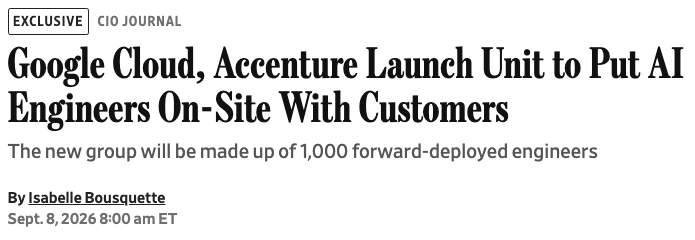
Google Cloud and Accenture are said to be forming the Accenture Gemini Enterprise Business Group, with Google helping train up to 1,000 Accenture forward-deployed engineers. The move would push more AI delivery resources directly into customer environments around Gemini Enterprise.
The partnership is an extension of a broader collaboration announced in April 2026, when the companies launched the Gemini Enterprise Acceleration Program. That earlier deal centered on thousands of AI-skilled engineers, FDEs and industry experts, plus early access to Google DeepMind frontier models.
For investors, the development matters most for Alphabet and Accenture. Alphabet gets a deeper enterprise distribution channel for Gemini, while Accenture expands its ability to package consulting, implementation and AI operations into a more integrated offering.
The newly circulated detail is the proposed training of up to 1,000 FDEs, which is the fresh increment in today’s signal. Broader partnership terms had already been disclosed, but execution specifics around staffing and on-site deployment are still being fleshed out.
Bloomberg reported today that Anthropic has walked away from negotiations to buy AI startup Decart for about $6 billion, ending a deal process that had advanced through due diligence. Other wire reports echoed that the talks are off for now.
Decart focuses on software that improves AI inference efficiency, helping the same chips deliver more output per dollar. Earlier coverage put Decart’s most recent valuation at about $4 billion after a May financing round, and said Nvidia was already an investor; some reports also said Nvidia had offered a higher price, but the process did not get to a signed agreement.
The failed deal matters because it would have been Anthropic’s largest known acquisition and a pre-IPO move to strengthen infrastructure efficiency. For Nvidia, the outcome removes a chance to deepen its exposure to a chip-efficiency company at a time when AI compute economics remain a strategic battleground.
Neither company has announced a finalized transaction. For now, the story is a stalled acquisition process rather than a completed strategic pivot.
これまでの経緯
2026-08-13投稿19件 · 投稿者17人
Anthropic is reportedly in talks to acquire AI startup Decart for $6 billion to improve inference efficiency.
企業動向
GE Aerospace、CPPを117.5億ドルで買収、鋳造能力を追加英語原文
The deal targets a critical supply bottleneck for jet engines and defense parts, with closing expected late in 2026.
GE Aerospace has agreed to acquire Consolidated Precision Products (CPP) for $11.75 billion from Warburg Pincus and Berkshire Partners. The company said the deal is meant to expand mission-critical castings capacity for commercial engines, aftermarket services and defense work.
CPP is a key supplier of engineered castings used in aerospace and industrial gas turbines. The move comes as GE Aerospace continues to emphasize manufacturing resilience and supply-chain control across its civil and military businesses.
Investors are likely to focus on GE Aerospace shares and broader aerospace-supply-chain names as the deal underscores how expensive capacity can be in a tight industrial market. For GE, owning more of the casting chain could reduce dependence on outside suppliers and support growth across its engine franchise.
GE said closing is expected toward the end of 2026, subject to customary conditions. The company has not yet disclosed additional integration details, while the financing mix and leverage impact will remain a key follow-up item.
Multiple outlets reported today that Circle has agreed to acquire Singapore-based B2B payments platform Tazapay. The reports cite annualized payment volume above $2.5 billion and say roughly 60% of that flow already involves stablecoins.
The backdrop is Circle’s push to deepen its cross-border payments footprint over the past year. Circle’s own site said in 2025 that its payments network had partnered with Tazapay to move USDC-based settlement and compliant payouts across Latin America and Asia-Pacific.
If completed, the deal would give Circle a larger operating base in regulated cross-border payments. That matters for CRCL because it ties the company’s USDC franchise more directly to merchant settlement rails, though the transaction still needs regulatory approval and additional terms have not been publicly disclosed.
For now, the key new information is the reported acquisition agreement and the disclosed scale of Tazapay’s business. The main parties are Circle and Tazapay, with USDC as the central settlement asset in the deal narrative.
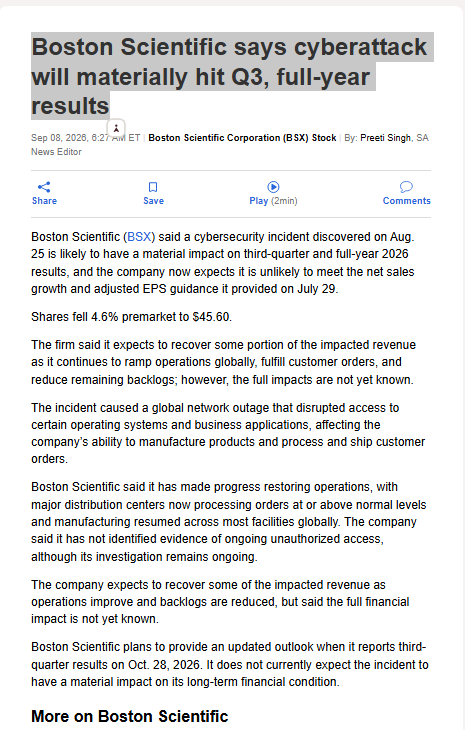
Boston Scientific said on Sept. 8 that a cybersecurity incident it disclosed in late August is likely to have a material impact on third-quarter results and could keep the company from meeting its 2026 sales and profit guidance. The update is the clearest sign yet that the disruption has moved beyond operations and into earnings.
The company said it detected the incident on Aug. 25 and has since been working to restore systems that were hit by outages affecting order processing and shipments. Its Aug. 26 update said the full restoration timeline was still unknown.
Shares of Boston Scientific slipped in premarket trading after the warning, according to market reports. Investors are now weighing how long the operational disruption may last and how much revenue could be deferred or lost in 2026.
Boston Scientific has not publicly confirmed a data breach. Reuters and the company’s own updates say it is working with outside cybersecurity specialists to investigate and contain the incident.
DIGITIMES, citing supply-chain sources, said Intel is preparing another 10% increase in PC CPU prices in October. The report also says Intel may phase out its low-margin Small Core product line.
The significance is that Intel’s pricing has reportedly shifted from share-taking to margin repair. The same report says global PC shipments could ease from about 260 million units to 250 million units by 2027, leaving less room for pricing flexibility.
If Small Core is reduced, industrial PCs, edge computing and IoT could see product gaps. That keeps INTC’s portfolio mix and pricing strategy in focus, while potentially creating openings for QCOM and MediaTek in Arm-based designs.
For now, the move remains a supply-chain report rather than a company announcement. TechPowerUp and Tom’s Hardware also relayed the story, but neither added official confirmation from Intel.
これまでの経緯
2026-07-11投稿6件 · 投稿者6人
Grant Cardone and Brian Dixon discussed Bittensor TAO as decentralized intelligence investment, alongside mentions of AI platform Canary and Elon Musk-related topics.
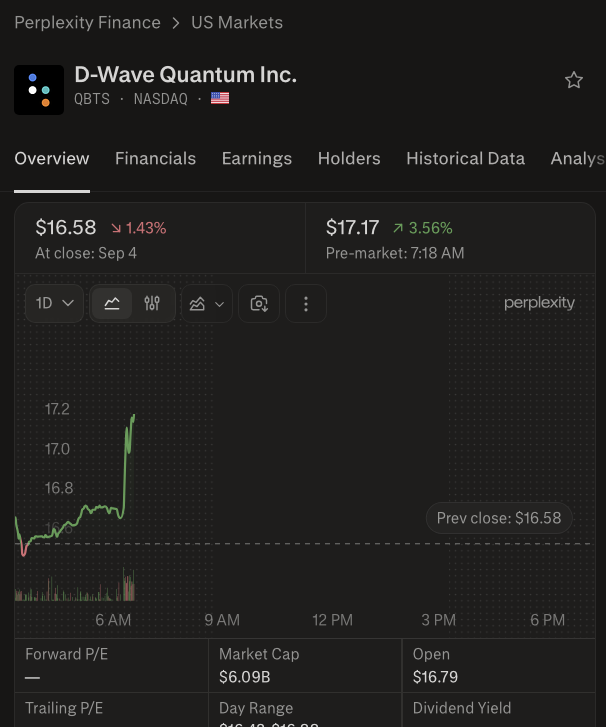
Rigetti Computing and D-Wave Quantum have each signed definitive agreements for up to $100 million with the U.S. Department of Commerce, bringing the combined support to up to $200 million. The Rigetti agreement targets bottlenecks in superconducting quantum systems, including cryogenics, readout electronics and high-connectivity chips.
The funding comes under the CHIPS Act framework, underscoring Washington’s willingness to back quantum computing with direct capital and, according to market reports, minority non-controlling stakes. Rigetti’s deal maps to its superconducting approach, while D-Wave’s package supports annealing systems and capacity expansion.
The announcement is most relevant for RGTI and QBTS, which are the direct beneficiaries of the government-backed programs. For investors, the significance lies less in immediate earnings impact than in policy validation, R&D support and a stronger commercialization narrative for both names.
Public reporting indicates Rigetti has finalized a $100 million agreement, while D-Wave has also been described as securing up to $100 million in federal support. The claim that the U.S. government will take minority equity stakes has circulated in market coverage, but the most reliable fact set remains the companies’ own agreement disclosures and wire reports.
CryptoQuant analyst Arab Chain said XRP futures trading volume hit a six-month high in August. Follow-up reports put total monthly volume at about $64.6 billion across Binance, Bybit and OKX.
The increase adds a fresh data point to a market that had been quieter in prior months. It also follows a period of heavier spot and derivatives activity in XRP, but volume by itself does not show direction because both longs and shorts can expand at the same time.
For traders, the more important read-through is liquidity: a jump in futures turnover usually brings XRP back onto short-term watchlists and can make price discovery more active. The exchange breakdown also shows the move was broad-based rather than isolated to one venue.
What comes next will depend on whether open interest, funding rates and price action confirm the renewed turnover. For now, the new signal is simply that XRP derivatives activity has recovered to its strongest monthly pace since February.
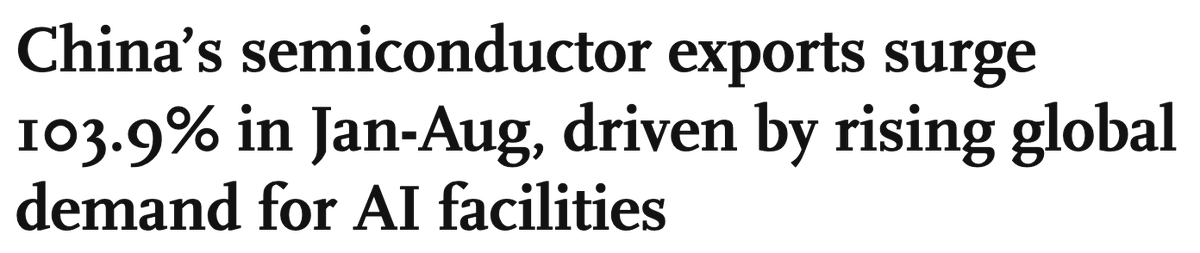
China’s exports rose 25% in August, according to the latest wire reports, with the trade surplus widening as well. Reuters said demand tied to high-tech production and AI infrastructure helped prop up the numbers.
The data lands ahead of a crucial meeting between Donald Trump and Xi Jinping later this month, and underscores how exports are doing more of the heavy lifting in China’s growth mix. A separate market note said semiconductor exports more than doubled in the first eight months of the year.
For investors, the read-through is clearest for China’s export supply chain, chipmakers and AI infrastructure suppliers. Alibaba is part of the broader AI and cloud narrative, but this item is about the macro backdrop rather than company-specific earnings.
No official denial of the export figures appeared in the available sources. The semiconductor acceleration was corroborated by both the Reuters-linked reporting and the X signal citing the first eight months of the year.
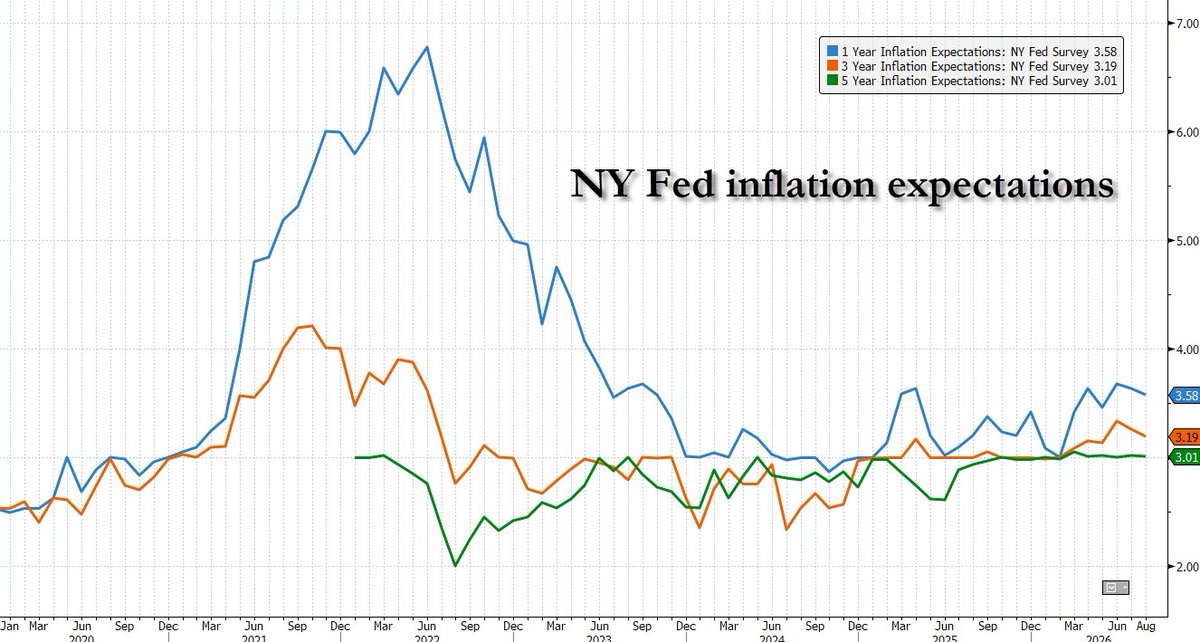
The New York Fed’s August Survey of Consumer Expectations showed median one-year inflation expectations at 3.58%, essentially unchanged from 3.6% in July. Three-year expectations fell to 3.2% from 3.3%, while five-year expectations stayed at 3.0%.
The survey is one of the Federal Reserve’s most closely watched gauges of household inflation expectations. July’s reading had already shown one-year expectations easing from 3.7% in June to 3.6%, so the August report extends the recent cooling in medium-term expectations.
For markets, the data mainly matters for Treasury yields, the dollar and rate-sensitive equities because it feeds into views on how firmly inflation is anchored and how much policy room the Fed may have. Five-year expectations remaining at 3.0% still leaves the measure above the Fed’s 2% inflation target.
The same report also showed unemployment and job-loss expectations deteriorating, while households became less pessimistic about their finances and future credit availability improved. That mix underscores a more uneven household outlook rather than a clean macro improvement.
Japan’s Cabinet Office said on Sept. 8 that real GDP grew at a 1.4% annualized pace in the April-June quarter, up from the earlier 1.1% estimate. On a quarter-on-quarter basis, GDP rose 0.4%, matching the market consensus and confirming a modest expansion in the second quarter.
The revision was driven mainly by a smaller decline in business investment. Private capital expenditure fell 0.9% from the previous quarter, improved from the initial 1.2% drop, while net exports still added 0.5 percentage point to growth.
The data keeps the Bank of Japan’s Sept. 19 policy meeting in sharp focus. Reuters and Nikkei said markets continue to see a high probability of a rate increase, with investors now watching wage trends, inflation pressures and the impact of Middle East tensions on the policy outlook.
For markets, firmer growth and a less-weak capex print are supportive for banks and other rate-sensitive shares, while companies tied to domestic demand and capital goods may remain under scrutiny if investment stays soft. Japanese government bonds and the yen could stay volatile as traders reassess the pace of policy normalization.
これまでの経緯
2026-07-11投稿4件 · 投稿者4人
BOJ total assets hit a Q1 2020 low in Q2, marking the largest quarterly drop since QT began; Finance Minister urged GPIF and households to boost Japanese asset investment.
マクロ
U.S. NFIB small-business optimism eases to 98.7 from 99.8 in August英語原文
The index stays above its 98 long-run average, but hiring and capex intentions cooled modestly.
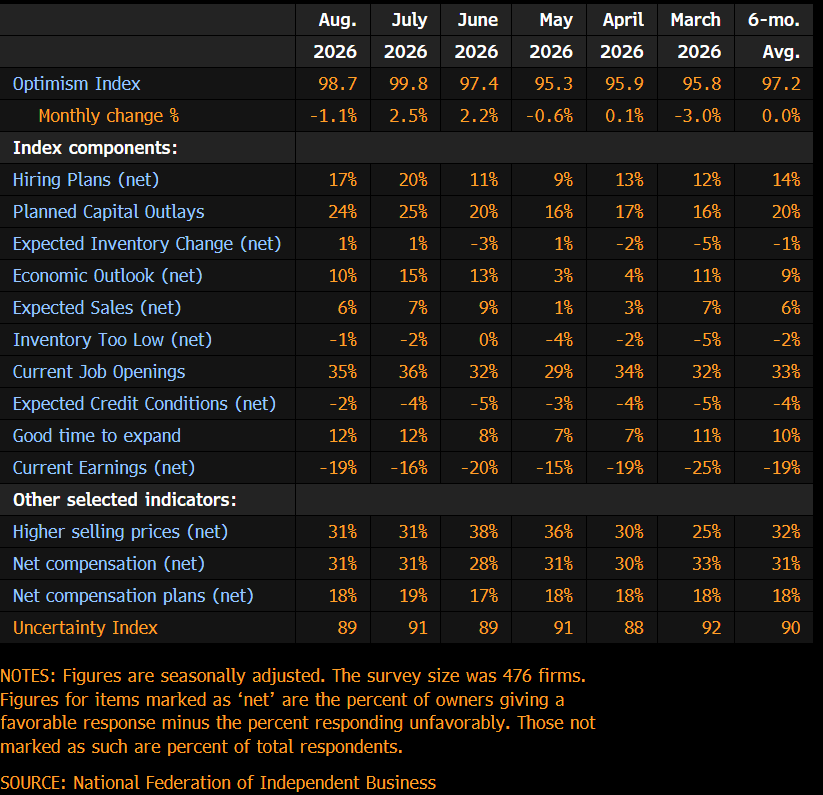
The National Federation of Independent Business said its Small Business Optimism Index slipped to 98.7 in August from 99.8 in July, in line with wire reports and below the 99.3 forecast cited by market feeds. The reading marks a modest pullback after July’s near-one-year high.
The survey matters because it captures how small firms view hiring, investment, pricing and overall business conditions — a useful read-through for U.S. domestic demand. Even after August’s decline, the gauge remained above its long-run average of 98, suggesting sentiment is still broadly resilient.
The biggest market sensitivity is typically in U.S. small-cap equities, banks and cyclical names tied to Main Street activity, as the survey can hint at future hiring and capex appetite. A softer monthly print may also feed into rate expectations at the margin, though this release is more a sentiment check than a hard activity indicator.
NFIB’s monthly survey is not a policy announcement, and no counter-statement from the federation was reported alongside the data. The latest result therefore stands as the newest snapshot of small-business confidence for August.
EverBank Financial Corp. and WaFd Inc. have agreed to a $3.9 billion reverse merger, according to company statements released Monday. After the transaction closes, WaFd will remain publicly listed, change its name to EverBank Financial Corp. and trade under the new ticker EVBK.
The combination brings together a digitally focused consumer and commercial bank with a western U.S. branch network, creating a pro forma institution with about $75 billion in assets. The companies said the deal is expected to close in early 2027 and is intended to improve scale and profitability.
For investors, the key detail is the ownership split: EverBank’s existing investor group is set to own about 59.2% of the combined company, while WaFd shareholders will own 40.8%. WaFd shares and the future EVBK listing are the main tickers tied to the transaction.
Both banks said the merger should broaden deposits, deepen commercial banking capabilities and expand fee-based businesses such as wealth management. Reuters, The Wall Street Journal and the companies’ own release all matched on the $3.9 billion valuation and the roughly $75 billion asset figure.
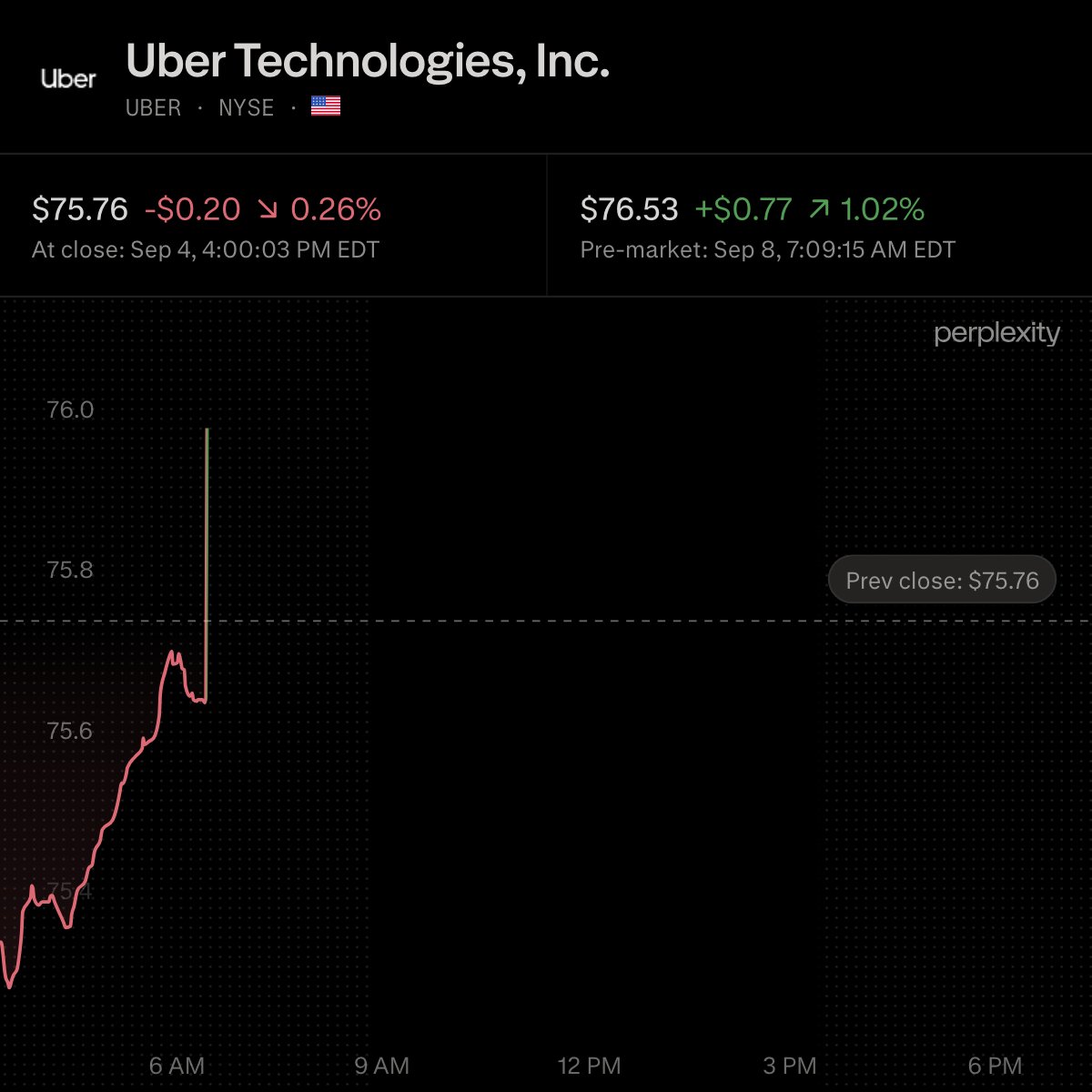
Uber Chief Operating Officer Andrew Macdonald disclosed a purchase of 70,000 Uber shares on Sept. 4, worth about $5.31 million, according to a new SEC Form 4 filing. The shares were bought at prices ranging from roughly $75.65 to $76.44 each.
The filing adds a fresh data point to a year in which Uber has remained under close investor scrutiny. Recent coverage has focused on the company’s delivery expansion, autonomous-vehicle partnerships and takeover chatter, but the latest filing only confirms Macdonald’s personal share purchase.
Uber stock has been trading around the mid-$70s, so insider buying may draw attention from investors watching management conviction. Still, the transaction should not be read as a forecast for the stock’s next move.
Uber has not separately commented on the purchase. The Form 4 indicates the trade was made by Macdonald individually rather than as part of a company buyback or other corporate action.
これまでの経緯
2026-08-17投稿3件 · 投稿者3人
Andrew Gordon Mac's interview dropped, downplaying autonomous vehicle threats and highlighting Uber's growth.
2026-08-18
企業動向
ベライゾンとコーニング、最低10.5億ドル相当の2032年光ファイバー契約を締結英語原文
The long-term supply deal locks in high-density fiber for broadband buildout and AI infrastructure.
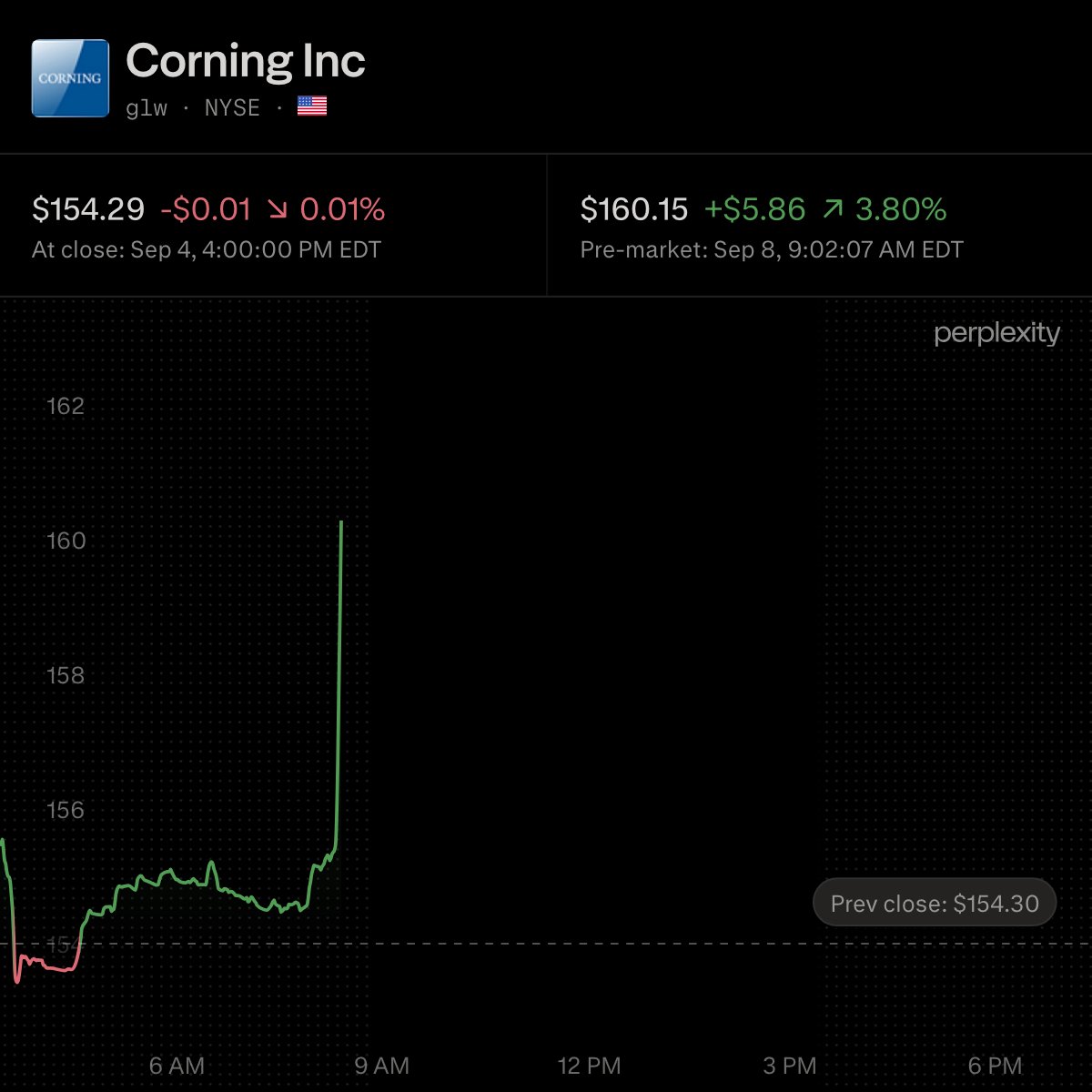
Verizon and Corning have entered into a multi-year fiber supply agreement running through 2032, covering high-density optical fiber and related solutions for broadband expansion and AI infrastructure. Multiple reports said the deal is a multi-billion-dollar arrangement, while one report cited a minimum purchase commitment of about $1.05 billion.
The pact comes as Verizon continues to expand its fixed broadband and fiber footprint, while Corning remains a key supplier of optical connectivity products. Earlier coverage also showed Corning deepening its role in AI-related fiber capacity through a separate Nvidia partnership, underscoring how tight the fiber supply chain has become.
Shares of Corning moved higher on the news, while Verizon gains more visibility on a strategic input for its network buildout. For GLW, the agreement reinforces demand; for VZ, it improves supply certainty for a capital-intensive expansion cycle.
So far, the public reports describe this as a newly announced long-term supply arrangement, with no additional financial breakdown disclosed by the companies. Investors will be watching the execution pace and whether the agreement helps Verizon accelerate broadband deployment while supporting Corning’s shipments.
President Donald Trump said on Truth Social on Sept. 7 that Canada-based Bombardier could no longer sell in the United States unless it moved manufacturing into the country. He also claimed the jet maker gets more than 50% of its revenue from the U.S. and said its products are “not good enough.”
The post landed as Canada’s retaliatory tariffs on U.S. goods were about to take effect, adding another layer to an already tense trade fight. Reuters and other outlets noted that Bombardier aircraft remain U.S.-certified, while the company did not immediately respond to Trump’s latest remarks.
For markets, the threat is aimed squarely at Bombardier’s U.S. sales exposure and its cross-border aerospace supply chain. Bombardier has said it has a broad U.S. footprint, including workers and suppliers in multiple states, so any policy move could ripple through the business-jet and aerospace supply ecosystem.
Company statements highlighted its U.S. jobs and American-made components, while U.S. coverage noted that the FAA, not the White House, is the agency that certifies or decertifies aircraft. That makes the practical enforcement path uncertain even as the rhetoric escalates.
Bitcoin fell in Monday trading and briefly slipped back below $80,000 as thin holiday liquidity amplified intraday swings. Multiple reports put the move at about 2% lower on the day, after the token had posted its strongest weekly close since early May.
The backdrop is a market waiting for this week’s US inflation data and the Federal Reserve’s next policy decision. At the same time, recent reporting showed US spot bitcoin ETFs drew $731 million of net inflows in a single day, the biggest daily intake since January, underscoring that institutional demand has not disappeared.
The price action matters most for spot bitcoin ETFs and crypto trading venues, which tend to see sentiment and volume shift quickly when BTC loses a round-number level. Cross-crypto liquidations were also reported at about $178 million over the past 24 hours, indicating that both long and short positioning were being flushed in the low-liquidity session.
Traders are watching nearby levels around $78,800 and $80,500, where liquidity was reported to be thickening. For now, the move looks less like a thesis change than a holiday-driven reset ahead of macro catalysts later in the week.
After resuming BTC purchases last week, the company again shifted capital toward preferred-share repurchases, keeping investors focused on its weekly funding mix.
Strategy did not buy any Bitcoin in the week ended Sept. 7, while repurchasing $176.3 million of STRC preferred shares, according to follow-up reports. The move comes just one week after the company returned to BTC accumulation following a roughly 10-week pause.
The latest update extends a capital-allocation pattern that has become the main story for Strategy: Bitcoin purchases, preferred-share buybacks and liquidity management are all competing for the same pool of proceeds. Last week’s renewed BTC buying had raised expectations that the company might be back to a steadier accumulation pace, but this week’s pause shows the cadence is still uneven.
For investors, the key tickers remain MSTR and STRC, because weekly disclosure shifts can affect Bitcoin holdings growth, preferred-share supply and the company’s cash profile. The market is watching not just whether Strategy buys Bitcoin, but where each dollar is directed inside its broader capital structure.
Publicly available follow-up coverage points to the pause in BTC buying and the continued STRC repurchase, while prior disclosures established the company’s recent 4,603-BTC purchase and larger dollar-asset base. No new Bitcoin addition has been confirmed for the latest week.
これまでの経緯
2026-07-13投稿5件 · 投稿者4人
Strategy announced a $450M increase in USD reserves, with BTC reserves at 843,775 and USD reserves at $3.0B.
企業動向🔥進行中
Huang calls NVIDIA compute fungible and rentable as the AI asset story strengthens英語原文
The Nvidia chief’s latest framing underscores how investors are increasingly valuing GPUs as revenue-producing infrastructure, not just hardware.
NVIDIA CEO Jensen Huang said compute is “fungible, durable and highly rentable” and described it as a “productive, revenue-generating asset.” The quote circulated widely on X today through multiple reposts, making it the main new data point in the market conversation.
The comment fits a broader push by Nvidia to position GPUs as financeable infrastructure. In August, Nvidia said it had struck a cooperation memorandum with six major asset managers to mobilize more than $500 billion in third-party capital, while CME separately outlined plans for futures tied to GPU rental prices, both of which point toward more standardized pricing for compute.
For markets, that framing matters because it can reinforce the investment case for NVDA as both a chip seller and a platform for AI infrastructure economics. It also keeps attention on the wider ecosystem — cloud providers, data-center builders and any emerging derivatives tied to GPU utilization or rental rates.
No additional company clarification was available alongside the reposts, so the quote should be treated as a circulated market signal rather than a separately confirmed standalone release.
これまでの経緯
2026-07-24投稿23件 · 投稿者22人
Jensen Huang's first post shares an NVIDIA-signed letter on why open models matter.
企業動向
Apple reportedly buys Sonera as 9/9 launch nears英語原文
The reported deal would add non-invasive magnetic sensing tech to Apple’s health and wearable pipeline ahead of its September product event.
Multiple X posts say Apple has reportedly acquired Sonera, a California startup that builds non-invasive magnetic sensors for detecting brain and muscle activity.
If confirmed, the acquisition would fit Apple’s long-running push into health, wearables, and human-computer interaction. It also arrives just ahead of Apple’s September 9 event, where investors are focused on the company’s next hardware cycle.
For AAPL, a small technology buyout like this is more about future product optionality than near-term earnings. The signal may reinforce the market’s view that Apple is still investing behind its device ecosystem even as launch-day attention centers on the rumored foldable iPhone.
Apple has not publicly confirmed the reported acquisition in the material reviewed so far, so the deal should still be treated as unverified until company disclosure or filing emerges.
XPeng said on Sept. 7 that it has launched an automated production line for its advanced general-purpose IRON humanoid robot, with more than 80% of core manufacturing processes automated. The company said the robot is being built using automotive-grade production methods.
The update follows XPeng’s late-August disclosure that its robotics business raised more than $900 million at a post-money valuation above $6.3 billion. That funding was tied to a plan to move IRON into mass production by the end of 2026 and broader deliveries in 2027.
For investors, the key tickers remain XPEV and TSLA. XPeng’s move underscores how Chinese EV makers are trying to leverage car-scale manufacturing for physical AI, while Tesla’s Optimus remains the benchmark comparison in the humanoid-race narrative.
XPeng has not yet provided detailed figures on per-unit output, cost, or initial delivery volumes. The new development adds an execution milestone to a program that had already been framed as a commercialization push rather than a pure research project.
これまでの経緯
2026-08-24投稿6件 · 投稿者6人
Xpeng Robotics raised over $900M in Series A at a $6.3B+ valuation, setting a record for China's embodied AI private financing.
決算🔥進行中
IonQ lifts 2026 revenue outlook to $450M-$460M after SkyWater close英語原文
The update folds in SkyWater’s contribution after the acquisition, while IonQ also unveiled its Superion 256 platform.
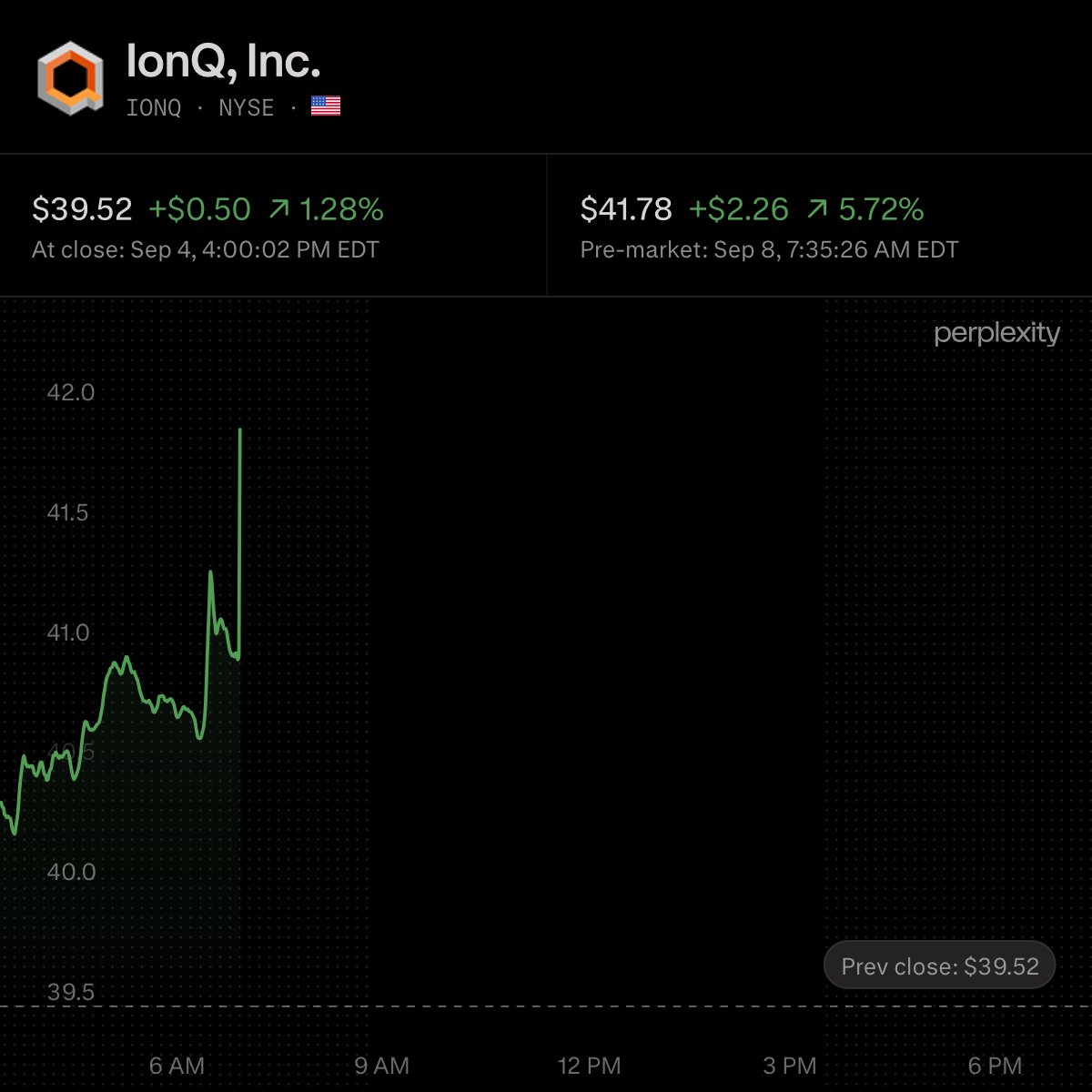
IonQ said on Sept. 8 that it now expects full-year 2026 revenue of $450 million to $460 million, up from its prior $280 million to $290 million outlook. The company said the revised range includes SkyWater’s post-close contribution, but excludes intercompany revenue between the two businesses.
The update follows IonQ’s July 31 acquisition of SkyWater Technology. In an Aug. 5 earnings call, IonQ said it expected about $120 million of 2026 spending with SkyWater under their commercial arrangement, which would have been internal revenue before the merger and would be eliminated in consolidation.
IonQ also launched its Superion 256 product line the same day, describing it as its sixth-generation quantum computing platform, with first chips fabricated at SkyWater. For investors, IonQ is the key name here because the acquisition changes both its revenue base and the manufacturing footprint behind its quantum roadmap.
Management said the company is still integrating operations and has not yet provided combined-company revenue or EBITDA guidance. The move gives a clearer near-term revenue frame, but the new outlook still reflects only IonQ’s post-close view rather than a full merged-company forecast.
これまでの経緯
2026-07-29投稿5件 · 投稿者5人
IonQ received final regulatory approval to complete its $1.8B acquisition of SkyWater, with the deal expected to close on July 31.
マクロ
Vitol says 10 million barrels a day pass Hormuz, 9 million of them crude英語原文
Fuel markets are tightening even as crude flows recover through the Strait of Hormuz, shifting attention to refiners and product spreads.
Vitol CEO Russell Hardy said daily petroleum shipments through the Strait of Hormuz are running at about 10 million barrels a day, including roughly 9 million barrels of crude. He added that oil-product markets are showing signs of tightness while crude’s outlook looks “reasonable.”
The latest comments fit with recent reporting that flows through Hormuz have been recovering, including more barrels from Kuwait and Qatar and greater use of ship-to-ship transfers outside the strait. Reuters also said oil prices kept climbing as traders priced in a prolonged Middle East conflict and supply-disruption risk.
For U.S. energy equities, the market focus is shifting from upstream crude to downstream fuels and refining margins. Zacks has been highlighting tighter product supply and constrained refining capacity as a constructive backdrop for Marathon Petroleum, Valero, Phillips 66 and PBF Energy.
Hardy cautioned that the flow estimate is uncertain and can vary. The clearest takeaway is that Hormuz remains open, but refined-product tightness is becoming the more visible bottleneck.
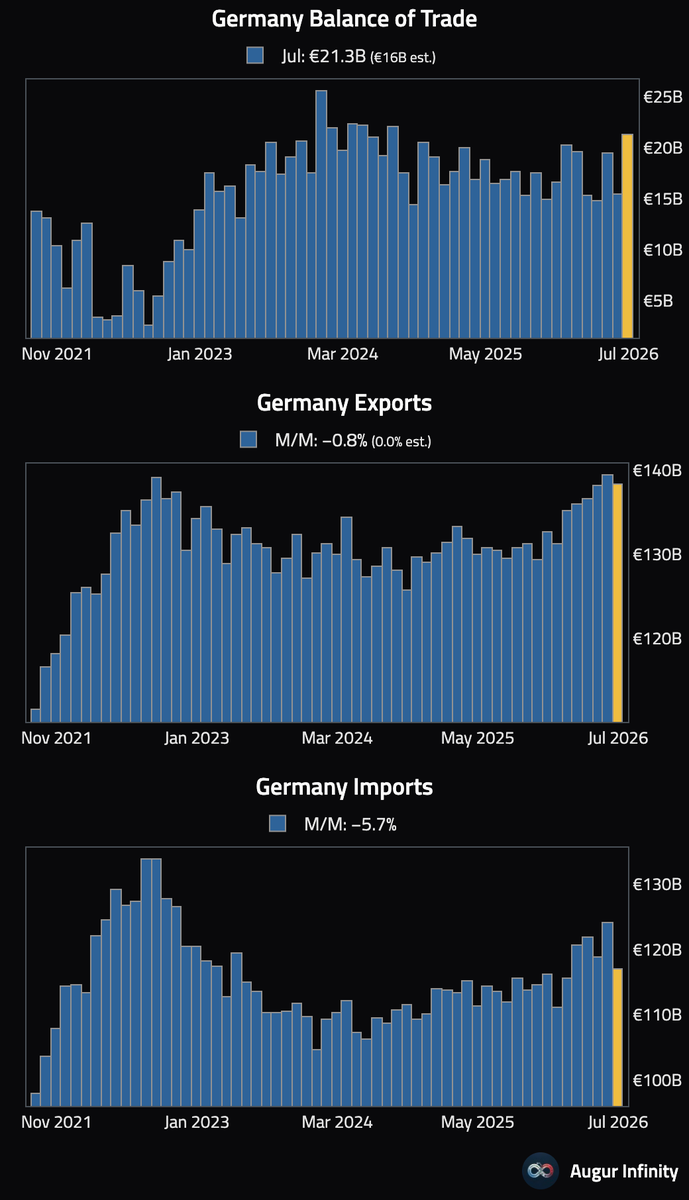
Germany posted a seasonally adjusted trade surplus of €21.3 billion in July, well above the €15.8 billion forecast and up from €15.4 billion in June, according to Destatis data cited by multiple outlets. Exports fell 0.8% month on month, while imports dropped 5.7%.
The main driver was a sharper decline in imports than exports. Reuters reported that German exports unexpectedly fell in July, ending a streak of monthly gains since February, with shipments to European Union countries weakening.
For markets, the release is another key gauge of external demand and the pace of Germany’s recovery, with potential implications for the euro and German cyclical assets. MarketScreener said imports fell to €116.9 billion and exports to €138.2 billion, underscoring that the wider surplus came from weaker imports rather than stronger exports.
The reporting is consistent across outlets, and no party has disputed the numbers. Investors will now watch whether export weakness broadens or stabilizes in coming months as Europe’s growth outlook remains in focus.
Australia’s NAB August business survey showed confidence falling to -8 from -6 in July, while business conditions slipped to -1 from +4. The dual miss points to a weaker operating backdrop for firms after July’s modest improvement.
The new reading follows a July survey that had signaled some resilience in conditions. NAB’s earlier release and Westpac’s commentary highlighted persistent cost pressures, softer demand expectations and lingering uncertainty as key drags on sentiment and margins.nabtrade.com.au westpaciq.com.au
For markets, the survey matters mainly through Australian rate expectations and the currency. Softer business conditions can reinforce attention on the RBA’s read of private demand, inflation persistence and the outlook for the Aussie dollar, rather than driving a direct stock-specific reaction.
The fresh August print suggests the July rebound did not carry through, keeping investors focused on the detailed NAB release for clues on margins, hiring, costs and forward orders.
これまでの経緯
2026-08-11投稿10件 · 投稿者5人
NAB business confidence fell to -6, and Pete Steel was appointed group executive for technology and AI.
2026-08-12投稿3件 · 投稿者3人
Hims' Eucalyptus acquisition sparked debate, while LENZ pivoted to telehealth amid sluggish VIZZ adoption.
Microsoft reported strong Q4 FY2026 earnings with revenue and net income growth, while Silicon Motion's Q2 results and AI data company perspectives were shared.
2026-08-06投稿11件 · 投稿者9人
Trump maintained communication with Fed Chair Warsh, SpaceX shares flooded the market, and Google's chief scientist Jeff Dean left to start a new venture.
2026-08-25投稿9件 · 投稿者9人
Macro backdrop discussions dominated, with US pursuing zero-leakage Iran sanctions targeting digital assets and tech, alongside Planet Labs earnings focus.
2026-09-04投稿6件 · 投稿者6人
OpenAI released GPT-6 Astra, calling it the world's most intelligent model, with Sam Altman emphasizing low cost and high capability, while Planet Labs reported 90% defense revenue growth.
2026-09-08投稿4件 · 投稿者4人
Intel plans another 10% PC CPU price hike in October to improve gross margins, potentially ending low-margin small core product lines.
Asian stocks added nearly $1 trillion as KOSPI surged a record 17.9%; Japan and South Korea sold US dollars in the open market on the same night.
2026-08-03投稿20件 · 投稿者16人
US Treasury Secretary confirmed coordinated FX action with Japan; yen carry trade estimated at $20 trillion, while Japanese yields kept rising despite intervention.
2026-08-31投稿17件 · 投稿者15人
Japan's 2-year JGB auction demand plunged 18%, yields hit a 31-year high, and unemployment came in stronger than expected.
2026-09-07投稿6件 · 投稿者5人
Yen surged to a six-month high, surpassing post-intervention levels, with markets pricing a 25bp BOJ hike on September 17-18.
2026-09-08投稿11件 · 投稿者9人
BOJ's JGB holdings saw the largest annual decline ever, 10-year yield topped 3% for the first time, and the yen broke a key technical level.
IonQ reported Q2 revenue beating estimates, but GAAP EPS swung to a large loss on non-cash items, while raising full-year guidance.
2026-09-08投稿8件 · 投稿者7人
IonQ raised its 2026 revenue outlook to $450M-$460M after closing SkyWater, while Rigetti and D-Wave each announced $100M deals with the US government.