Marvell Technologies CEO Matt Murphy said the company’s implied data-center revenue could top $30 billion by 2028, according to CNBC-linked reporting cited in multiple market signals today. That is the new incremental takeaway from Marvell’s Investor Day coverage.
The same set of signals said Marvell expects about $20 billion in total FY2028 revenue, with a longer-term plan calling for $70 billion to $90 billion in FY2031 revenue. Another cited comment put the AI market opportunity at roughly $400 billion by 2030.
Shares of MRVL drew a strong reaction in trading, with one report saying the stock rose as much as 11% intraday after the Investor Day buzz. The market is treating the update as a fresh read-through on Marvell’s data-center and AI infrastructure growth profile.
The key point for investors is not just the headline number, but the pace implied by Marvell’s forward targets. Further detail from the company would be needed to see how those revenue milestones are broken down across products and end markets.
Anthropic said on Tuesday that Claude for Google Workspace has entered public beta for all paid Claude plans. The add-on lets users open Claude in a sidebar inside Google Docs, Sheets and Slides, while new beta connectors also let Claude create and edit Google files from its chat interface.
The update pushes Claude deeper into document workflows. In Docs, it can make minor formatting-preserving edits or larger rewrites as reviewable changes; in Sheets, it can write formulas, build pivot tables and charts; and in Slides, it can generate new slides that match an existing deck and check layouts for problems.
For investors, the move further ties Anthropic to Google’s productivity stack and keeps Alphabet at the center of the enterprise AI office race. Google already has Gemini embedded across Workspace, so Claude’s new role looks more like added distribution and feature competition than a replacement of existing AI tools.
Anthropic said the add-on is available through the Google Workspace Marketplace and can be deployed by admins through Google Admin console, while Team and Enterprise customers need an owner or primary owner to enable the connectors. Existing Google sharing permissions still govern access to linked files.
BitMine Chairman Tom Lee said at Token2049 in Singapore that the company will stop buying ether once its holdings reach 5% of ETH’s circulating supply. He said the firm needs about 100,000 more ETH to reach the threshold and described it as a hard cap.
The comment comes after BitMine spent more than a year building an Ether treasury strategy launched in June 2025. In its latest update, the company said it held 6,016,414 ETH, or about 4.9% of the 122.1 million tokens in circulation, worth roughly $15.5 billion at the time of the update.
For the market, the key issue is whether BitMine is about to lose its role as a consistent source of ETH demand. CoinDesk said the company has bought ETH every week since the strategy began, and BMNR shares remain closely tied to investor views on the treasury strategy and Ether exposure.
Lee also framed the decision as a capital-allocation move, saying the company would no longer need to raise funds to keep buying ETH once the cap is reached. That leaves BitMine’s current pace of accumulation as the focus for traders watching both Ether and BMNR.
Multiple market wires on Tuesday said the American Petroleum Institute’s weekly survey showed a 2.1 million-barrel draw in U.S. crude inventories for the week ended Oct. 2. Gasoline stocks fell by 1.4 million barrels, while Cushing crude inventories rose 866,000 barrels and distillate stocks increased 461,000 barrels.
The API is an industry survey and typically lands before the Energy Information Administration’s official weekly petroleum status report. Because the two reports use different samples and methods, they often diverge in size and sometimes even direction.
The numbers matter for crude benchmarks and fuel-refining names because traders use the API as an early read on supply-demand balances. The bigger confirmation test now is the EIA report, which is generally treated as the authoritative weekly inventory count.
Markets also parsed the smaller Reuters-cited figure of a 2.09 million-barrel crude draw and a 1.37 million-barrel gasoline decline, which is close to the headline API read. That keeps the focus on whether the official EIA release validates the private survey.
Aehr Test Systemsは10月7日、主要なハイパースケール顧客から次世代AIプロセッサーのパッケージレベル・バーンイン向けに約600万ドルの追加工注を受けたと発表した。内容には追加のSonoma高出力システム、バーンインモジュール、カスタムソケット、ソフトウェア拡張が含まれ、納入は今後6か月間に分散される。
Bitcoin slipped back below $84,000 today, matching a cluster of bearish order-book chatter on X. Bitfinex Alpha said BTC printed an intraday low of $83,524 on Oct. 7, close to the Oct. 1 low of $83,218.bitfinex.com
The move comes against a backdrop of a heavy cost-basis band built around this zone. Bitfinex Alpha said roughly 1.72 million BTC, or 8.6% of circulating supply, was accumulated between $84,000 and $86,500, while Glassnode said new asks were stacked around $86,500-$86,750 and bids were most concentrated near $81,000-$81,250.glassnode.com
Derivatives were hit hard as price broke the lower end of the range. Bitfinex Alpha estimated $510.6 million in total crypto futures liquidations over the past 24 hours, including $417.6 million in longs, while Cointelegraph cited CoinGlass data showing roughly $550 million in long liquidations.cointelegraph.com
For listed equities, the read-through is mainly sentiment-driven for bitcoin-linked names and exchanges, not a company-specific catalyst. For now, the market is still focused on whether BTC can reclaim the mid-$80,000 area or remains vulnerable to another test of the lower end of the range.
Penguin Solutions (NASDAQ: PENG) reported fiscal fourth-quarter net sales of $566.7 million, above the $519.9 million consensus estimate. Adjusted EPS came in at $1.00, ahead of the $0.77 estimate.
On a year-over-year basis, Q4 net sales rose 68%. Adjusted operating income reached $89.8 million, up 129%, while adjusted EBITDA was about $93 million, up 115%. Full-year FY2026 revenue totaled $1.73 billion, with adjusted EPS of $2.8.
The results were framed around AI infrastructure and data-center demand in the company’s release and in follow-up coverage. In the current coverage set, PENG is the primary ticker; Dell (DELL) appears only as a related AI-server peer mentioned in the news flow.
Several X posts used slightly different rounded figures for the same quarter, but they point to the same reported earnings package. No source in the provided material says the company disputed the numbers.
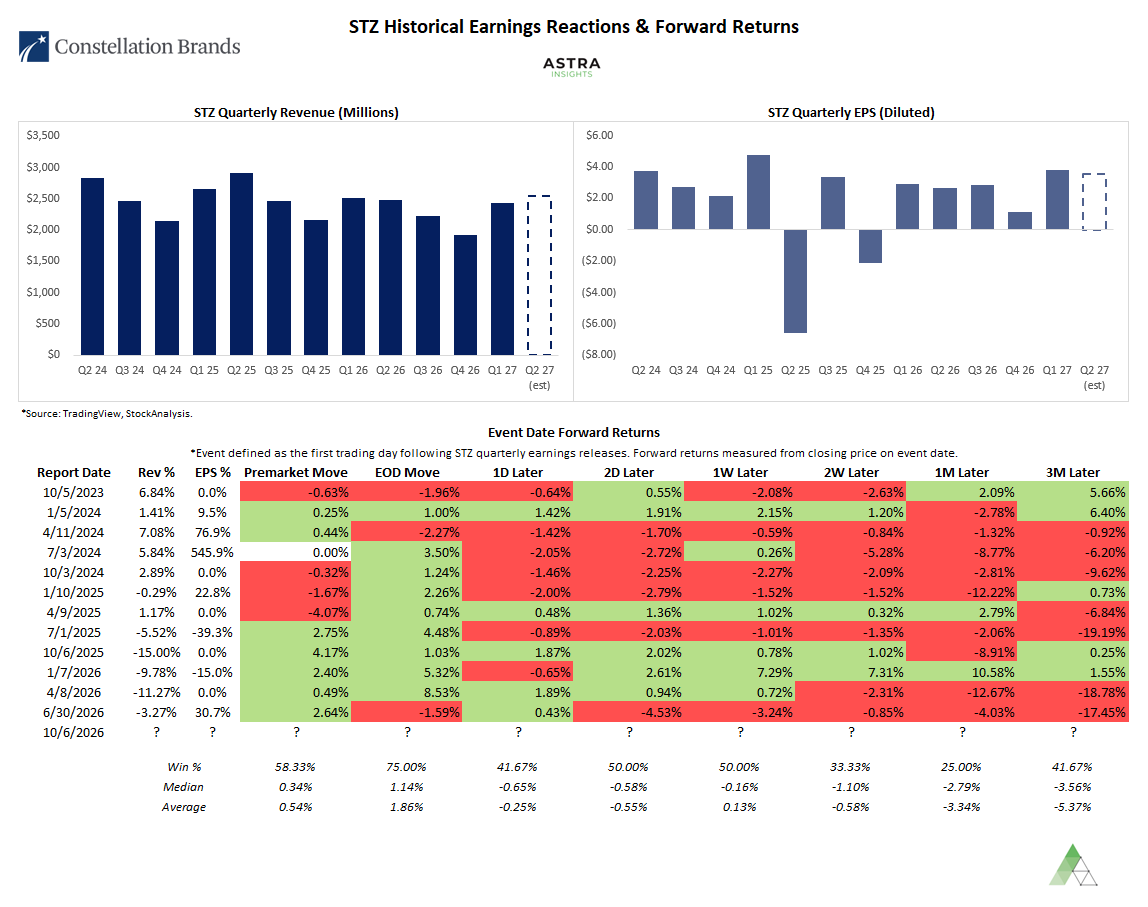
Constellation Brands will report earnings after the close. The latest X signals and our news file both center on the same event, with investors focused on the company’s beer, wine and spirits businesses.
In the latest quarter on file, Constellation Brands posted earnings of $3.74 per share, ahead of the Zacks consensus estimate of $3.62. WSJ also reported that beer sales rose 5% and wine and spirits sales rose 17%, setting a high bar for tonight’s update.
Pre-market chatter has already turned cautious, with one signal citing a 1.6% decline in STZ and questioning the durability of beer demand. Another trader note put the options-implied move at around plus or minus 5.75%, suggesting the market expects a meaningful reaction after the numbers.
The X feed also includes commentary on the company’s positioning and an example options trade, but those are market views rather than new facts. For now, the main incremental catalyst is the earnings release itself.