Multiple reports citing senior Treasury officials say Treasury Secretary Scott Bessent is considering using the Treasury General Account, which stands near $1 trillion, to fund a larger program of Treasury buybacks aimed at long-dated securities. The plan would build on earlier announcements and could lift repurchase sizes to more than $4 billion per operation from roughly $2 billion.
The debate comes as the 10-year Treasury yield remains near 4.7% and U.S. federal debt has climbed to about $40 trillion. Treasury has already been leaning on buybacks as a debt-management tool, but investors are still debating whether the program can meaningfully suppress term premia or merely smooth liquidity.
Any expanded use of the TGA would matter most for the Treasury market itself, along with bond funds and other rate-sensitive assets that track intermediate- and long-duration government debt. Traders and dealers are watching for clues on whether Treasury is preparing a one-off calibration or a more sustained intervention.
Treasury has not formally announced a new operating framework. CNBC reported that officials see the TGA as a source of considerable firepower, while Bloomberg reported that Bessent is looking at stronger steps to curb higher long-term borrowing costs.
Bitcoin climbed back above $80,000 on Monday for the first time since May 15, briefly reaching $81,237.94. Derivatives data showed more than $220 million in crypto short positions were liquidated over the prior 24 hours.
The move came as the U.S. dollar weakened and the Treasury expanded longer-dated bond buybacks, while investors returned to U.S. spot Bitcoin ETFs. Reuters said those ETFs drew about $1.9 billion in net inflows last week, their strongest weekly haul since October.
The rally also triggered forced short covering, which can add fuel to momentum once prices break key resistance levels. Traders are now watching whether BTC can hold above $80,000 and absorb supply near the $76,700 liquidity band.
Macro strategists say the setup has revived debate over the so-called debasement trade, with bitcoin and gold both benefiting from concerns about borrowing, yields and currency purchasing power. Any sustained follow-through will likely depend on whether ETF demand persists at higher prices.
Nvidia will report quarterly earnings after Wednesday’s U.S. close, with Jackson Hole following later in the week. Multiple market previews say those two events are the key catalysts for stocks, as investors watch both AI demand and the Fed’s policy signal.reuters.com
The backdrop is a sharp rise in long-dated Treasury yields, which briefly pushed the 30-year yield to its highest level since 2007. That matters for growth stocks because richer valuations and heavy AI infrastructure spending are more sensitive to borrowing costs.
Nvidia remains the focal point for the AI trade. Recent coverage citing Yahoo Finance said the company has beaten Wall Street estimates for 14 straight quarters, but the stock fell after six of the last eight reports, including each of the last four, underscoring how much is already priced in.youtube.com
Beyond Nvidia, the week also includes July PCE inflation data, which Reuters and Yahoo Finance both flagged as a potential reset for rate expectations.finance.yahoo.com
The SEC has reportedly opened an investigation into trading at Leopold Aschenbrenner’s Situational Awareness fund and sent subpoenas to multiple Wall Street banks that provided financing to the vehicle. According to the reporting cited across several outlets, regulators are seeking details on trade timing, leverage, and how positions were unwound.
The backdrop is a fast-growing AI hedge fund that was reported to have managed more than $30 billion at its peak. The SEC has also been active on enforcement this month; on Aug. 18, 2026, it announced several new enforcement actions, underscoring a still-heavy regulatory posture.SEC.gov
For markets, the immediate focus is on lenders and prime-brokerage counterparties tied to the fund’s trading and financing structure. If the inquiry broadens, banks with exposure to the fund’s leverage or execution flows could face more compliance scrutiny, though the public record so far remains limited to reporting and subpoenas.
Neither the fund nor the banks named in the reports have, at least publicly, provided a detailed response in the material available here. The next confirmation point would likely be either an SEC filing, a court filing, or direct comment from the parties involved.
Taiwan’s Keelung District Prosecutors Office said on Monday it indicted nine people in a case alleging the diversion of Supermicro AI servers equipped with Nvidia B300 GPUs to China. Prosecutors said 130 servers were approved for purchase, 74 were routed onward to Chinese buyers, and 56 were seized in Taiwan.
The case dates back to February 2025, when the group allegedly sought access to Supermicro’s whitelist process and concealed key details during the required checks. Subsequent reporting identified a senior Nvidia Taiwan manager, Supermicro Taiwan staff and employees tied to distributors and logistics firms among the defendants.
For investors, the immediate relevance is compliance risk across the AI hardware supply chain rather than a direct hit to Nvidia’s business. Nvidia and Supermicro sit at the center of the story because the servers used Nvidia B300 chips and were supplied through Supermicro’s channel; Nvidia has previously said smuggling is “a nonstarter.”
Prosecutors have not accused Nvidia itself of wrongdoing, and the company was not named as a defendant. The case remains in the judicial stage, with some suspects detained and one person still at large.
사건 전개
2026-06-30
규제
China revises road traffic law in first reading, adds autonomous-driving chapter영어 원문
The draft spells out definitions, road-use conditions, liability and insurance rules for autonomous vehicles, tightening China’s legal framework for smart driving.
China has proposed an amendment to its Road Traffic Safety Law that adds a dedicated chapter on autonomous vehicles. Xinhua said the draft was submitted to the Standing Committee of the National People’s Congress for its first reading on Aug. 25.
The draft defines autonomous-driving and driver-assistance functions and clarifies liability when violations occur in autonomous mode. Under the proposal, manufacturers or importers would handle violations committed while autonomous driving is activated, while manual driving and assisted-driving use would remain under existing traffic rules.
The move would give China a more explicit legal framework for road testing and commercial deployment of smart vehicles. It also touches insurance arrangements, a key issue for automakers, importers and autonomous-driving operators.
No company-specific penalties or market impact figures were disclosed in the reporting. The draft is still in the legislative process and has yet to become law.
Nvidia shares fell 2.9% on Monday to $208.48, marking a seventh straight trading-day decline and the stock’s longest losing streak since September 2022. Bloomberg-linked reporting said the selloff has left the shares down about 7.5% since Aug. 14.
The latest wrinkle heading into Wednesday’s earnings is a weekend report that Nvidia has told customers some AI server systems slated for next year could rise in price by as much as 15%, citing higher memory-chip costs. That has sharpened a broader debate over whether AI buyers can absorb higher total system costs.
The market reaction has spilled across semiconductors, with the Philadelphia Semiconductor Index falling 2.7% and peers including AMD, Broadcom and Micron also lower. Nvidia’s results are widely viewed as a bellwether for AI stocks, especially with consensus expectations centered around about $92 billion in revenue and $2.09 in adjusted EPS.
The stock’s drift lower comes even as the company remains at the center of AI infrastructure spending. For now, traders are focused less on whether Nvidia will beat estimates and more on whether demand can stay exceptional as system prices and component costs move higher.
사건 전개
기업🔥진행 중
OpenAI says its new chip beats Nvidia in tests after a 9-month design sprint영어 원문
Internal-test claims add new evidence that OpenAI is pushing harder into custom silicon and away from Nvidia GPUs
OpenAI is now being reported to claim that its new AI chip outperforms Nvidia processors in internal tests. The claim appears to relate to inference workloads, the stage where a model answers user prompts after training is complete.
This is the latest step in a longer hardware effort. Earlier reporting said OpenAI and Broadcom unveiled Jalapeño, OpenAI’s first custom chip, with a roughly nine-month design cycle and a roadmap aimed at large-scale deployment by the end of 2026.
For investors, the immediate readthrough is to Nvidia, Microsoft and Broadcom. A larger share of inference on OpenAI-owned silicon could reduce some Nvidia GPU demand, while Broadcom stands to benefit from the custom-chip buildout and system integration work.
The public record remains limited to internal-test claims and inference-focused comparisons. OpenAI has not disclosed the technical details behind the benchmark, and it has not publicly provided a full comparison against its own closed-source models.
사건 전개
2026-06-30게시물 7개 · 작성자 7명
OpenAI engineers found inference optimizations that cut model running costs by over half, reducing the need for Nvidia chips.
기업
Nvidia survey says 78% of employees are millionaires, 50% are above $25 million영어 원문
The latest wave of reporting highlights how stock-based compensation has turned the AI chipmaker’s workforce into a wealth case study.
A reported internal survey of Nvidia employees says roughly 76% to 78% of staff are millionaires, while about half have a net worth above $25 million. The survey was said to have covered about 3,000 employees and to have been conducted in June 2025.
The wealth effect is tied to Nvidia’s employee stock purchase program, which reportedly allows workers to buy shares at a 15% discount. After the company overhauled the plan following the 2008 downturn, long-term holders benefited enormously as Nvidia’s stock surged during the AI boom.
For investors, the story underscores how tightly employee compensation and share-price performance are linked at Nvidia. It does not change the company’s business outlook, but it reinforces Nvidia’s central role in the AI infrastructure trade and in Silicon Valley compensation norms.
The new reporting is based on media recaps of the internal survey, and Nvidia has not issued a fresh public comment on the figures. The event line itself dates back to earlier coverage of the same survey rather than to a brand-new corporate disclosure.
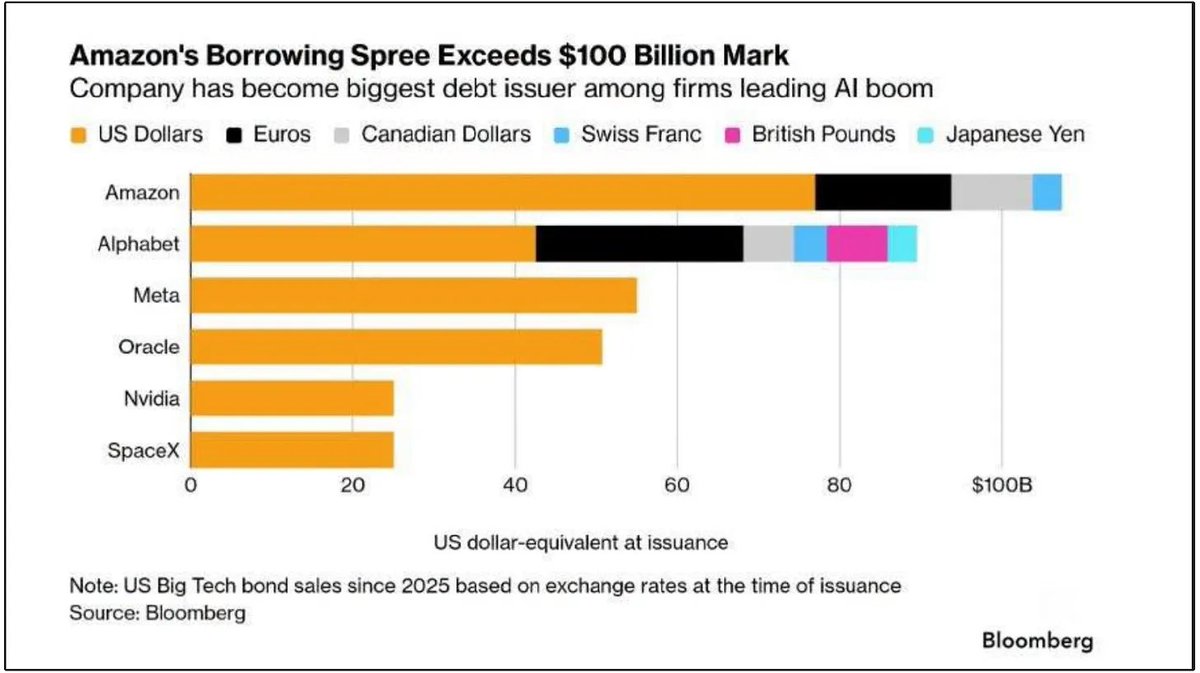
Market signals suggest AI-related companies have issued roughly $220 billion of debt this year, while SemiAnalysis says cumulative lifetime AI capex will approach $3 trillion by year-end. The surge is being tied to data centers, chips and power infrastructure rather than to software spending alone.
The backdrop is a much larger AI buildout that accelerated through late 2025 and into 2026, with investors increasingly focused on how quickly infrastructure spending can translate into revenue. Separate reporting has highlighted AI firms such as OpenAI and Anthropic as part of the broader financing wave.
For markets, heavier corporate issuance means AI companies are competing more directly with Treasuries for fixed-income capital, keeping attention on long-duration yields. That keeps Alphabet (GOOGL) and the broader AI supply chain in focus, especially cloud, semiconductor and power-equipment names.
The $220 billion figure is best treated as a cross-report aggregate rather than a number disclosed by one issuer. The key question for investors is not whether AI spending is large, but how much more debt the sector can absorb before credit and equity pricing adjust further.
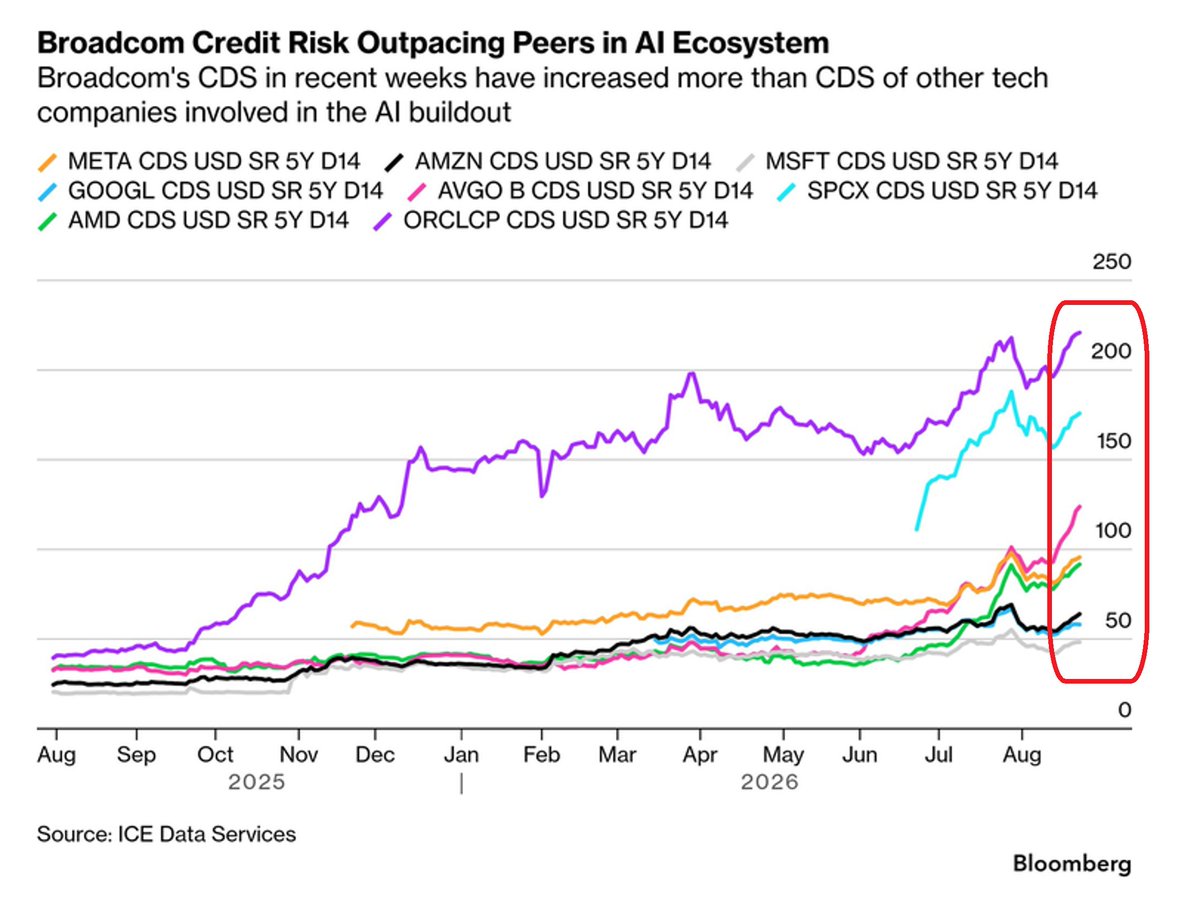
Broadcom’s 5-year credit default swaps climbed further on August 24, according to Bloomberg-linked reporting cited by the X signal, as investors reassessed the company’s exposure to AI financing backstops. The new wrinkle is a reported negotiation for as much as $100 billion more in AI chip funding through special purpose vehicles.
The move builds on Broadcom’s June deal, when it was reported to have backstopped most of a $35 billion financing package tied to Anthropic’s chip purchases. That structure, often described as residual value support, lets lenders lean on the chipmaker’s credit while keeping the debt off the operating company’s balance sheet.
For credit investors, the concern is less about the headline size of one transaction than the spread of the structure across the AI supply chain. Broadcom’s rising CDS has become a market signal that these contingent obligations are increasingly being priced like real credit risk, alongside similar scrutiny on Nvidia and Oracle.
Broadcom has not publicly confirmed the latest reported $100 billion negotiation in the X signal material. The broader debate now centers on whether AI infrastructure funding is becoming dependent on large, under-disclosed support commitments from the vendors selling the compute.
사건 전개
기업
Nebius closes $5.75 billion convertible deal, swaps $800 million of old notes영어 원문
Proceeds will fund data centers, GPUs and AI cloud expansion, while the exchange adds about 15.8 million shares of potential dilution.
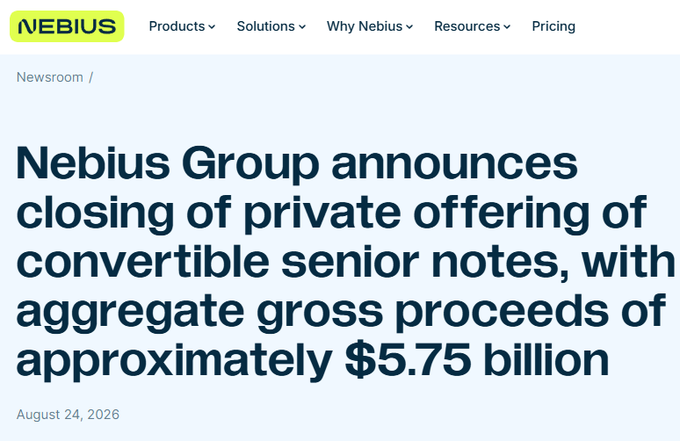
Nebius Group said on August 24 that it had closed its previously announced private offering of convertible senior notes, raising about $5.75 billion in gross proceeds. The deal was split into two tranches: 0.50% notes due 2030 and 4.50% notes due 2034.
At the same time, Nebius entered into exchange agreements with holders of its 2029 and 2031 convertible notes, swapping $800 million of the old debt for roughly 15.8 million Class A shares. The company said recipients may sell the shares or use derivative hedges, which could pressure the stock or limit upside.
Nebius said the new capital will support data center construction and expansion, AI cloud development, added data-center footprint and GPU procurement, along with general corporate purposes. For an AI infrastructure company, the financing materially increases funding capacity for its buildout.
NBIS remained a closely watched name as investors weighed the scale of the financing against potential dilution from the exchange. The transaction also extends the company’s convertible maturity profile by replacing part of the older notes with equity and new longer-dated debt.
The U.S. Department of War on Aug. 24 disclosed that Boeing won a $131.23 billion ceiling indefinite-delivery/indefinite-quantity contract for the F-15 Eagle Crest program. The award covers aircraft production, systems integration, modernization, upgrades, retrofits, sustainment and organic depot maintenance capabilities, with work to be performed in St. Louis, Missouri and expected to run through August 2037.
Reuters independently reported the same contract value, program name and scope the same day, adding that the ordering period runs through Aug. 24, 2031, with an option to extend to Aug. 24, 2036. The contract also includes foreign military sales to Japan, Israel, Saudi Arabia, South Korea, Singapore, Indonesia and Poland.
For Boeing, the contract bolsters the visibility of its defense business and centers attention on BA. Because this is a ceiling-value IDIQ award, the eventual revenue recognition will depend on the pace and size of individual task orders rather than the headline maximum alone.
The award comes as investors continue to track Boeing’s broader portfolio reshaping, including asset sales earlier in the week. So far, the publicly reported terms have been consistent across the Pentagon release and Reuters coverage, with no denial from either side.
Business Insider reports that Amazon is developing an internal effort called Project Tetromino to automate delivery stations, the last warehouse stop before packages are handed off to drivers. The report says an internal roadmap points to a $103 million pilot in 2028 and more than $530 million of investment through 2029.
The move fits a broader pattern at Amazon: the company has already been expanding robotics across its fulfillment network and recently highlighted further automation and logistics upgrades in Europe. In that context, Tetromino looks like an extension of Amazon’s push to move AI from planning and picking into more complex physical workflows.aboutamazon.com
For investors, the key implications are on AMZN’s capital intensity and on the long-term efficiency of its logistics stack. If automated delivery stations materially improve throughput and lower labor dependence, the benefits could flow through to fulfillment costs, operating leverage and the broader valuation case for Amazon’s logistics platform.
Amazon has not publicly confirmed the full budget figures cited in the report, and the project is described as early-stage. The new reporting nevertheless adds concrete numbers to Amazon’s automation roadmap at a time when markets are already focused on its AI and infrastructure spending.
The Information reported that Meta plans to launch a consumer AI agent called Hatch within the coming weeks. The project is described as the consumer version of Meta’s internal AI agent OpenClaw, while the company is also targeting October for its next AI model, Watermelon.
The move fits Meta’s broader push to extend AI from enterprise tools into consumer products and commerce. Meta already introduced Meta Business Agent for businesses, and the company says more than 1 million businesses are using it on WhatsApp and Messenger.
For investors, the key question is how tightly Hatch could be integrated into Instagram, WhatsApp and Messenger, and whether it can support advertising, customer service and social-commerce workflows. That makes META the central stock to watch in this story.
Meta has not publicly confirmed Hatch or its launch timing. So far, the reporting is based on The Information and subsequent wire coverage, rather than a company announcement.
Google Cloud is expanding Gemini Enterprise into legal and financial services. Reuters reported that the preview launch targets law firms and lawyers, with Cleary, Freshfields, Weil and Williams & Connolly among the first customers. The product is aimed at contract review, regulatory monitoring, legal-brief drafting and citation verification.
The move builds on Google’s April 2026 rollout of Gemini Enterprise, which bundled enterprise AI, data connections, governance and agent orchestration into a single platform. Google also said the product starts at $30 per seat per month, underscoring its push to monetize AI through business workflows rather than consumer chat alone.
For Alphabet, regulated industries are a key test case for Google Cloud’s enterprise AI strategy. Investors will likely focus on whether GOOGL and GOOG can translate product adoption into faster cloud growth, higher seat penetration and more durable software revenue with enterprise-grade margins.
Google has previously said Gemini Enterprise connects to company data inside secure environments and includes governance and audit tools. Reuters’ report adds the first named law-firm customers and use cases, but no deal sizes or financial guidance were disclosed.
사건 전개
2026-06-30
기업
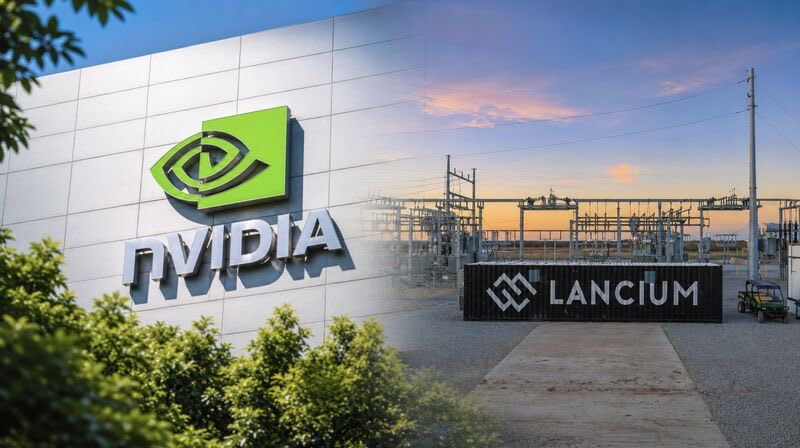
Nvidia backs Lancium as 15+ GW AI factory pipeline expands영어 원문
The new deal extends Nvidia’s full-stack push into power-secured campuses, with Lancium adding scale at the infrastructure layer
According to multiple market wires and social posts, Nvidia has made a strategic investment in Lancium and will deploy its full-stack AI factory platform across Lancium’s more than 15 GW of power-secured campus portfolio. Lancium also said it has 4 GW of capacity under lease and more than 15 GW of powered capacity in its pipeline.
Lancium sits in a critical layer of the AI buildout: power, land and campus design that can support very large data-center clusters. The move fits Nvidia’s broader shift from selling chips alone toward supplying integrated AI systems, networking and infrastructure design.
For the market, the immediate read-through is to Nvidia’s AI infrastructure narrative and to suppliers tied to data-center construction, power and connectivity. The news also keeps names such as Larsen & Toubro and Coherent in the conversation as adjacent beneficiaries of the broader AI factory trend.
At this stage, the clearest hard numbers come from the wire-style reports and are still awaiting direct confirmation in an official Nvidia or Lancium release surfaced in search results. Any later filing or company statement should be treated as the primary source for contract scope and financing details.
JPMorgan reiterated an Overweight rating on SpaceX and kept its $240 price target, saying its conviction in Grok’s AI prospects has improved. The note also said SpaceX closed its acquisition of Cursor on Aug. 14, a step the bank sees as important for building enterprise AI capabilities.
The call lands after several weeks of Wall Street debate over how much of SpaceX’s value should be tied to AI rather than rockets and Starlink. Earlier coverage from other analysts had already framed the stock around rising capital spending, faster AI monetization and the company’s expanding data-center ambitions.
The new emphasis is Cursor, which JPMorgan said reportedly generates about $4 billion in annual recurring revenue, with roughly 75% coming from businesses. If investors accept that figure, SpaceX’s valuation case shifts further toward an enterprise software-style multiple, even as questions remain about execution and capex.
SPCX is the direct equity proxy for that story. The stock’s near-term trading will likely stay sensitive to any fresh disclosures on AI revenue, customer mix and capital intensity, while the broader market continues to weigh how much of SpaceX’s growth is already priced in.
Multiple X accounts quoted Elon Musk as saying SpaceX and Nvidia have co-designed a space-optimized Vera Rubin NVL72 system, with an orbital launch targeted for Q4 2027 and meaningful scale-up in 2028. The posts are circulating as fresh social-media evidence, but no joint filing or detailed launch brief has surfaced yet.
The backdrop is Nvidia’s aggressive push into AI infrastructure and SpaceX’s growing role as a launch platform for ambitious space hardware. By linking a flagship Nvidia system with orbital deployment, the message connects compute demand and launch capability in a way that immediately caught trader attention.
For markets, the read-through is most direct for NVDA and for SpaceX-linked exposure, including the SPCX fund that some investors use as a proxy for private-market SpaceX value. Any follow-up disclosure would matter for expectations around AI compute demand, space infrastructure spending and supply-chain timing.
So far, the only hard evidence is the X signal and its reposts; the companies have not publicly confirmed detailed commercial terms, deployment capacity or an official program schedule. For now, the 2028 scale-up should be treated as Musk’s stated timeline rather than a completed corporate commitment.
Multiple market wires said Tesla has raised U.S. prices on two Cybertruck variants by $5,000 each, lifting the dual-motor model to $74,990 and the higher-end AWD version to $84,990. Reports said Tesla’s online configurator has been updated with the new pricing.
The latest move lands against a backdrop of ongoing demand questions, recalls and quality-control concerns around Cybertruck. In February 2026, Tesla had priced the dual-motor AWD Cybertruck at $59,990 and said the introductory price would only last for a limited window, underscoring how frequently the truck’s pricing has been in flux.
For TSLA investors, the change matters because Cybertruck pricing feeds directly into revenue per unit and margin expectations for Tesla’s electric-vehicle business. If higher prices are absorbed by buyers, Tesla could improve per-vehicle economics; if not, the market may reassess demand resilience for the pickup line.
Tesla has not yet provided a detailed public explanation for the latest adjustment in the reports reviewed. The immediate story is the updated pricing itself, with Tesla and Cybertruck as the key entities at the center of the move.
사건 전개
2026-07-02게시물 3개 · 작성자 3명
Tesla reported Q2 deliveries beating Wall Street estimates, yet the market reacted negatively due to normalized gas prices and weak Cybertruck sales.
2026-08-25
기업
Jack Ma buys Alibaba shares after HK$8 billion, 710 million-share AI sale영어 원문
The founder’s move follows insider buying and spotlights the company’s push to fund full-stack AI
Jack Ma has joined Alibaba insiders in buying company stock after the firm’s latest AI financing move, according to a Bloomberg report citing the South China Morning Post. The founder’s purchase adds another high-profile vote of confidence after the company completed an HK$8 billion share placement.
Alibaba recently sold 710 million new shares at HK$112.70 each, raising HK$80 billion, or about $10.2 billion, with all proceeds earmarked for AI infrastructure and full-stack AI capabilities. The placement came as the stock fell sharply in Hong Kong, reflecting investor reaction to dilution and heavier AI spending.
The buying spree is centered on Alibaba’s Hong Kong-listed shares, ticker 9988, and its U.S.-listed ADRs, BABA, which moved lower after the financing announcement. Chairman Joe Tsai and CEO Eddie Wu had already bought shares on the open market, helping frame the latest insider activity as support for the company’s AI strategy.
Alibaba has not yet provided a separate public comment on Jack Ma’s purchase. The company has continued rolling out AI products and infrastructure, underscoring that the fundraising is intended to accelerate rather than slow its AI buildout.
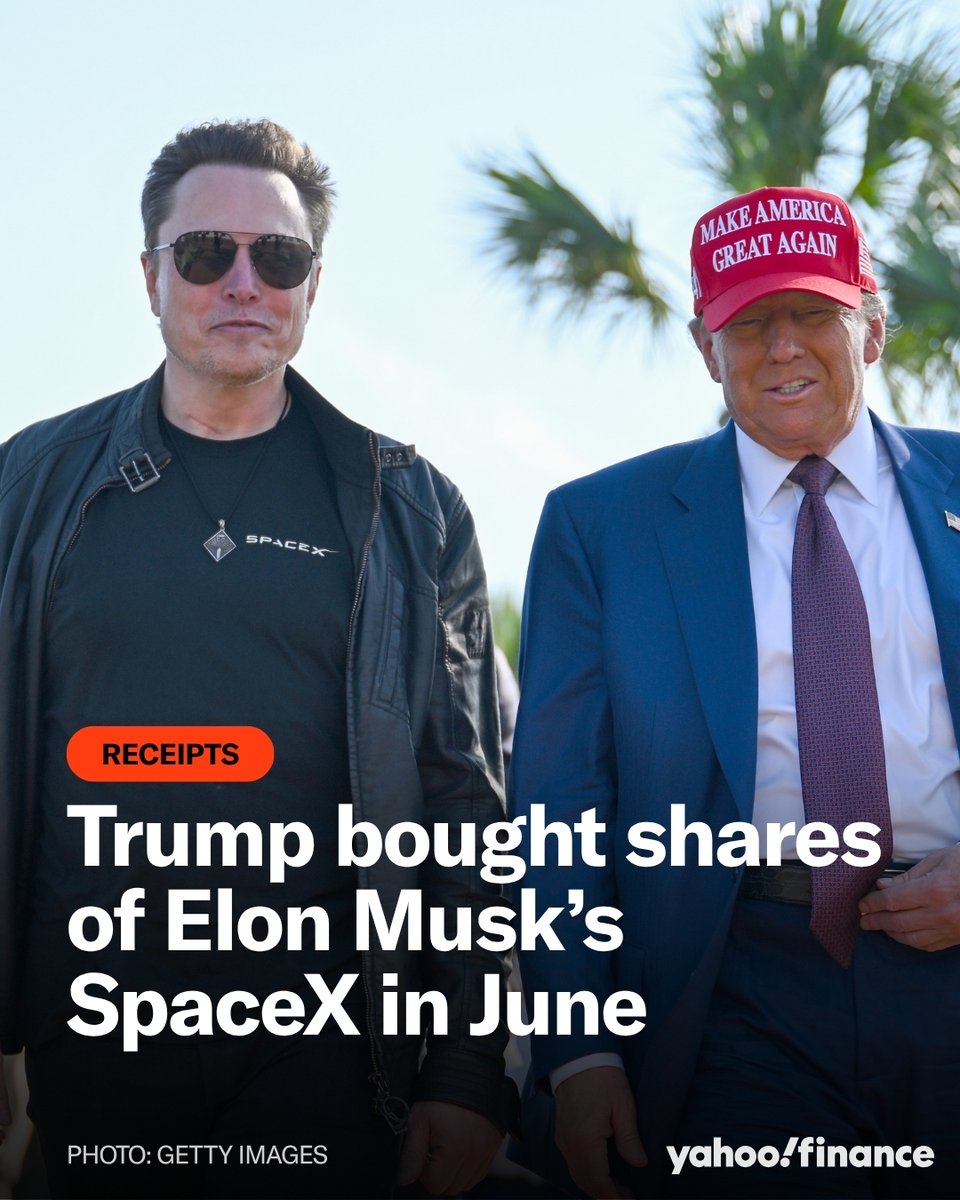
Newly public financial disclosures show President Donald Trump bought SpaceX shares on June 23, with the reported value range pegged at $15,001 to $50,000. The form was signed on Aug. 12 and made public on Aug. 22, Reuters reported on Aug. 24.reuters
The purchase came shortly after SpaceX’s June 12 IPO, which Reuters said was priced as the biggest-ever U.S. listing and valued the space, satellite and AI company at $1.77 trillion. SpaceX is also a major U.S. government contractor and frequently seeks federal approvals.reuters
For markets, the disclosure is relevant to SpaceX-linked sentiment and the publicly traded SPCX line that tracks the company. Reuters quoted White House spokesman Davis Ingle as saying Trump’s portfolio is managed by third-party financial institutions that replicate recognized indexes such as the Schwab 1000.reuters
The filing does not disclose an exact dollar amount, only a range. Reuters also noted the purchase was part of more than 1,000 stock trades Trump made in June.
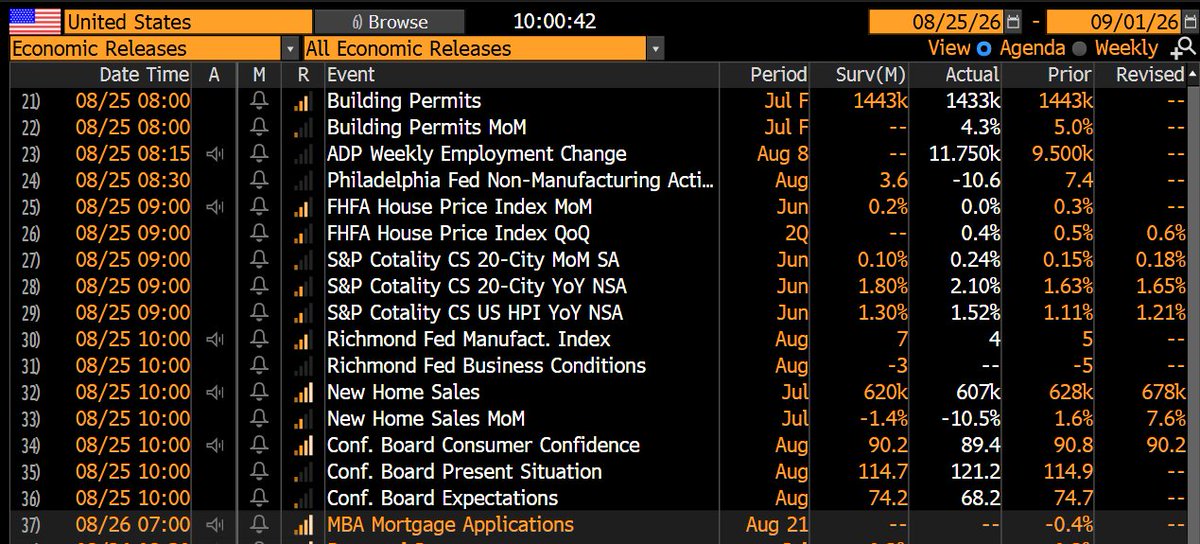
U.S. new home sales fell 10.5% in July to an annualized pace of 607,000 units, below economists’ expectations of 620,000. The median sales price eased 0.9% from a year earlier to $393,800.
Supply climbed to 9.6 months from 8.5 months in June, while homes for sale increased to 488,000 from 479,000. The report adds to signs that higher mortgage rates and ample inventory are slowing the pace of housing demand.
The data may weigh on sentiment around homebuilders and housing-linked retailers, which are sensitive to order trends, pricing and inventory turnover. It also comes after existing-home sales fell 1.7% in July, even as the median resale price hit a record July high of $434,100.
Taken together, the reports suggest a split housing market: resale prices remain elevated, but new-home demand is losing momentum and builders are carrying more supply. That mix could matter for shares tied to residential construction and broader consumer housing exposure.
ADP weekly private payrolls rise to 11,750, from 9,500영어 원문
The August 8 reading points to a modest pickup in U.S. hiring momentum. Traders use the weekly ADP pulse as a high-frequency read on the labor market between monthly payroll reports.
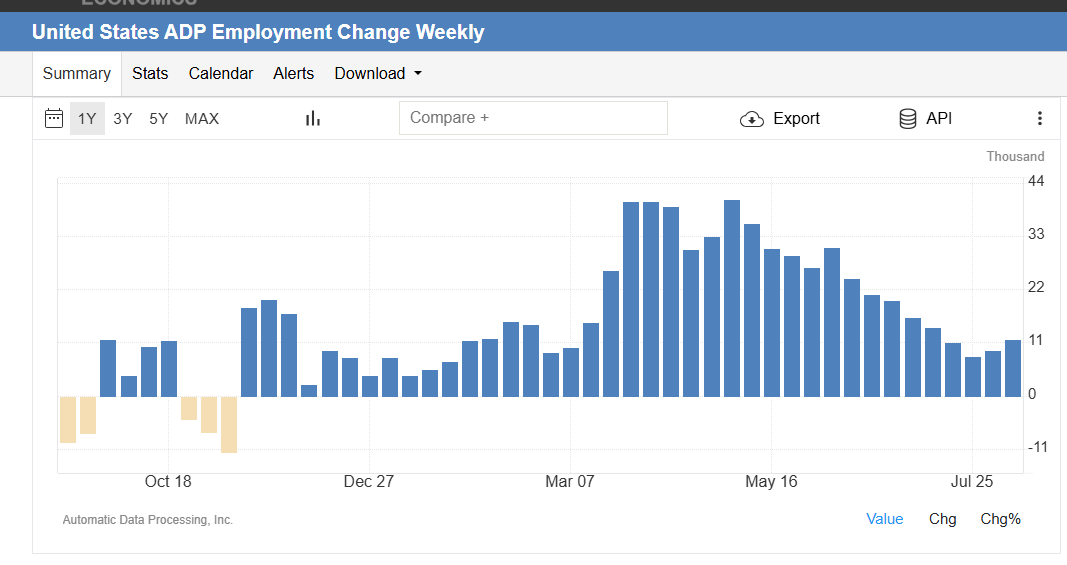
ADP’s weekly employment pulse showed U.S. private employers adding an average of 11,750 jobs per week in the four weeks ending August 8, up from 9,500 in the prior update. Multiple X wires carried the same figure, and no consensus forecast was shown in the feed.
The number adds color to ADP’s earlier August 1 release, which showed a 9,500 weekly average after seven straight weeks of declines. ADP says the series is a preliminary, seasonally adjusted estimate meant to track near-real-time labor-market trends ahead of the monthly National Employment Report.
For markets, the reading matters mainly through rates and FX: stronger hiring momentum can nudge Treasury yields, the dollar and rate-sensitive sectors as traders reassess the labor backdrop. It is not a company-specific event, but it is closely watched as a macro input into Federal Reserve expectations.
The verified figures line up with both the wire signal and ADP’s published high-frequency series: 11.75K for the week ended Aug. 8 versus 9.50K in the prior week’s update. Because the data are preliminary, ADP notes they may change as more information is added.
사건 전개
2026-07-01게시물 13개 · 작성자 12명
ADP June private payrolls rose 98K, missing the 120K estimate, with annual pay up 4.4%.
실적
DICK’S misses Q2 on $5.59B revenue and $3.53 EPS, cuts FY26 sales guide to $21.9B-$22.2B영어 원문
Foot Locker integration and a more promotional footwear market weighed on margins and the full-year outlook
DICK’S Sporting Goods reported fiscal Q2 revenue of $5.59 billion and adjusted EPS of $3.53, both below Wall Street estimates. The company also trimmed its full-year net sales and adjusted EPS guidance, citing a tougher athletic footwear backdrop.
The quarter was the latest test of the Foot Locker integration, which is still pressuring profitability. Management pointed to a more promotional market for athletic footwear and apparel, along with weaker-than-expected product launches, as key headwinds.
Shares of DKS fell sharply as investors re-priced the earnings miss and the lower outlook. The read-through also hit sentiment around peers such as Academy Sports and Nike, which were viewed through the same competitive and promotional lens.
DICK’S had already flagged higher integration costs in prior reporting, and this update suggests the market is focusing more on margin repair than top-line growth. The company did not deny demand remained resilient, but said the category environment has become more difficult.
Mercury Research data showed AMD crossed 30% of the x86 PC CPU market for the first time in the second quarter of 2026, reaching 30.3% versus Intel’s 69.7%. Arm’s share of the overall PC CPU market also rose to 15.3% in the same period.
The new reading extends AMD’s gains over the past two years. Electronics Weekly, citing Mercury Research, said AMD’s share was 21.1% two years earlier on the same basis, highlighting a nearly double-digit point increase.
The share figures matter because they track competitive momentum between AMD and Intel in PCs, a market that still shapes investor expectations around both chipmakers. Arm’s rising presence adds another layer of competition in the broader client CPU landscape.
As of the latest reports, neither AMD nor Intel had issued a new public response specifically to the share data.
A new congressional financial disclosure showed former House Speaker Nancy Pelosi bought 15,000 shares of Bloom Energy and 100 call options, along with 10,000 shares of Intel and 50 Intel call options. Multiple reports put the disclosed value range for the combined trades at roughly $3 million to $12 million.
Bloom Energy has been trading with an AI-power narrative for months. In April, the company announced an expanded Oracle deal for as much as 2.8 GW of fuel-cell capacity, and Bloom has long supplied power to Intel’s Santa Clara data center.
The filing helped lift both names in premarket trading, with BE up about 5% and INTC around 3% in reports from market outlets. The move reflects how congressional trade disclosures can quickly feed into short-term sentiment around stocks already linked to AI infrastructure.
The disclosure itself is a record of transactions, not a forecast. Separately, Bloom Energy has also been the subject of recent securities-class-action notices, but those legal alerts are distinct from Monday’s trading disclosure.
Bitwise President Teddy Fusaro said on X that the Bitwise Solana Staking ETF (BSOL) recorded its highest single-day trading volume yet, with more than $108 million traded today. He added that volume totaled $261 million over the past four sessions.
Bitwise co-founder Hunter Horsley amplified the update, saying the Solana staking ETF had taken in nearly $1 billion in inflows. The comments add fresh evidence that the new Solana ETF is attracting active trading interest beyond its launch-day buzz.
For markets, the key reference points are BSOL and SOL, since heavy ETF volume can shape liquidity, sentiment and comparisons across digital-asset funds. Investors are also likely to watch whether trading activity spills over into Solana-linked spot and derivatives markets.
The figures were disclosed by Bitwise executives on social media, and no denial appeared in the provided signal. The new data point here is the latest trading and flow update, not the ETF’s original launch story.
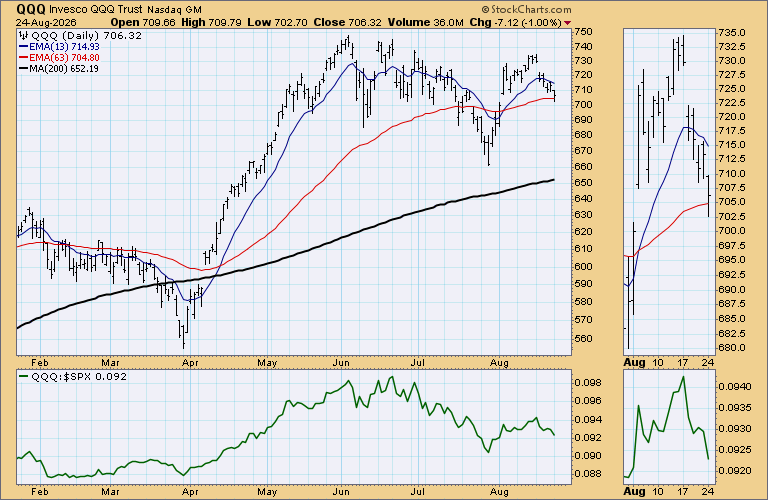
In intraday trading today, the Invesco QQQ Trust hit a low of $702.70, leaving a gap-fill level at $701.59 just out of reach. Traders also pointed to a downside gap near $729.27 and said the ETF has slipped below its 20-day moving average, with the 100-day average around $696 as the next potential support.
The signals are coming from chart watchers rather than company disclosures, but they matter because QQQ is a liquid proxy for Nasdaq-100 sentiment. Reuters-style market coverage and quote pages show QQQ still trading above $700, underscoring how closely investors are tracking short-term technical levels in a heavyweight growth benchmark.
Adobe is part of the broader tech backdrop today. Zacks said on August 24 that ADBE has rebounded 16% over the past month, but valuation, AI monetization and competition remain key questions, keeping software names in the market’s rotation conversation.
For now, the latest move is a mix of intraday price action and technical reading, not a new corporate announcement. The main watchpoints remain QQQ’s gap levels, moving averages and whether large-cap tech can stabilize after recent choppiness.
U.S. stocks ended mixed on Monday, with the S&P 500 down 0.28% at 7,652.86, the Nasdaq Composite off 0.76% at 25,980.19, and the Dow Jones Industrial Average up 0.26% at 53,417.16. Semiconductor and AI infrastructure names were the main drag on the broader market.
The selloff came as investors digested fresh U.S. sanctions pressure on Iran and positioned for Wednesday’s July personal consumption expenditures inflation reading and Nvidia’s quarterly results. Treasury yields moved lower, with the 10-year yield falling to about 4.704%, but that was not enough to offset the tech weakness.
Chip stocks led the downside: the Philadelphia Semiconductor Index fell about 2.6%-2.7%, SOXX slid 2.7%, and names including Sandisk, Seagate, Micron, AMD and Broadcom all sold off. Market signals also flagged that SPY closed below its 20-day moving average for the first time since July.
Investors will now focus on Nvidia and Marvell Technology earnings later this week, along with the inflation data, for clues on whether the recent pullback in large-cap tech has further to run.
AMD drew fresh attention on Tuesday as traders on X flagged a key support zone around $450, while market reports said the stock was up about 3% after a strong-buy upgrade and other name-specific catalysts. The move kept Advanced Micro Devices at the center of the semiconductor tape.247wallst.com
The bigger fundamental backdrop is AMD’s plan to invest more than $10 billion in Taiwan through 2029 to expand advanced packaging, substrates and manufacturing capacity across its supply chain. That puts fresh capital behind the company’s push in high-end chips and AI-related infrastructure.fool.com
Barron’s separately argued that AMD could benefit from surging CPU demand and potentially challenge Nvidia’s moat, adding another layer of investor interest around the name. The combination of a strategic spending plan and supportive sell-side coverage helps explain why the stock remained a focal point for both momentum and fundamental traders.barrons.com
For now, the key market question is less about the broader sector and more about whether AMD can hold the support level traders are watching. The stock’s next move is likely to continue influencing sentiment across the chip complex, especially versus Nvidia and Intel.247wallst.com
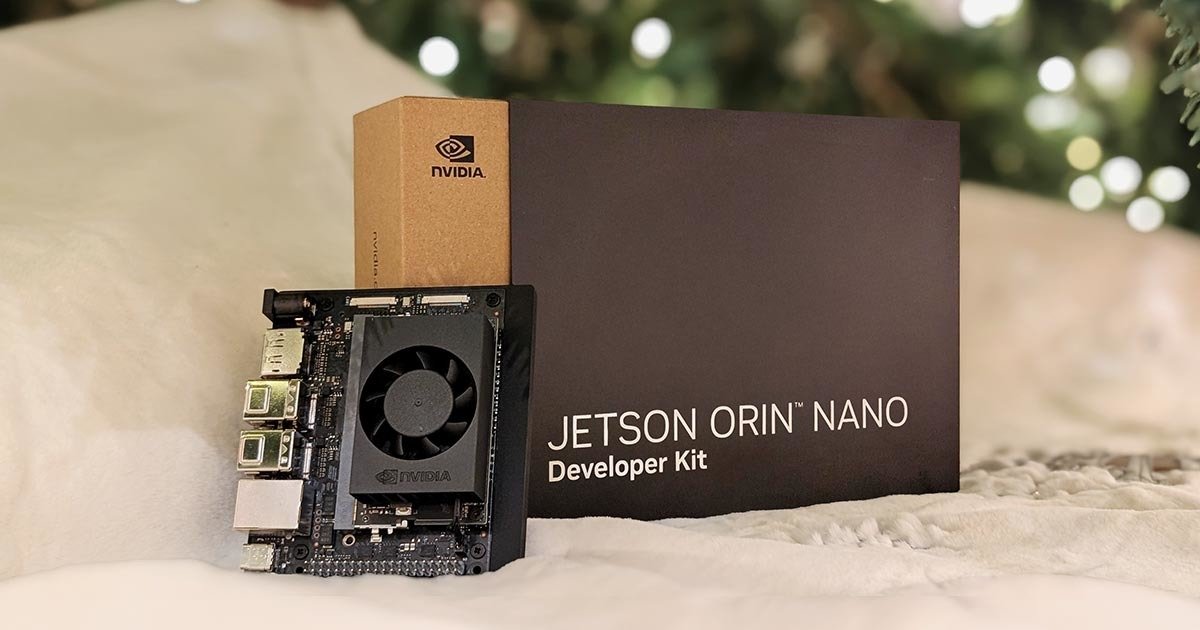
NVIDIA appears to be preparing Jetson Orin Nano 2, an entry-level edge AI computer aimed at robots, delivery drones and inspection systems. Posts circulating on X say the new device delivers 78 TOPS of AI compute, 8GB of memory and an 8-core Arm CPU, with roughly 2x inference performance versus Jetson Orin Nano Super.
That follows NVIDIA’s earlier Jetson Orin Nano Super refresh, which the company said raised AI performance from 40 TOPS to 67 TOPS, lifted memory bandwidth from 68 GB/s to 102 GB/s and cut the price to $249. NVIDIA’s technical blog said the Super boost was enabled by a software update and a new power mode, underscoring how active the Jetson line has become.
If the new Jetson Orin Nano 2 specifications are confirmed, the biggest beneficiaries would be NVIDIA’s own Jetson ecosystem and developers building robots, computer-vision systems and local AI agents. For NVDA, the launch would signal a broader push beyond data-center AI into edge devices; for the robotics supply chain, it could mean more demand for local inference hardware and software support.
As of now, NVIDIA’s official pages and blog can verify the Super model’s 67 TOPS and $249 pricing, but the Jetson Orin Nano 2 name and 78 TOPS claim still need direct confirmation from an official product page or release note.
사건 전개
2026-07-16게시물 8개 · 작성자 8명
Nvidia announced two new Blackwell modules, T2000 and T3000, with the T3000 halving size and power while matching T5000 inference performance, and adoption by Japanese robotics firms.
기업
NVTS to buy Claros for up to $232.8M, lifting 2030 SAM to $8B+영어 원문
The deal extends Navitas from 800V rack power toward processor-side voltage regulation as it pushes deeper into AI infrastructure.
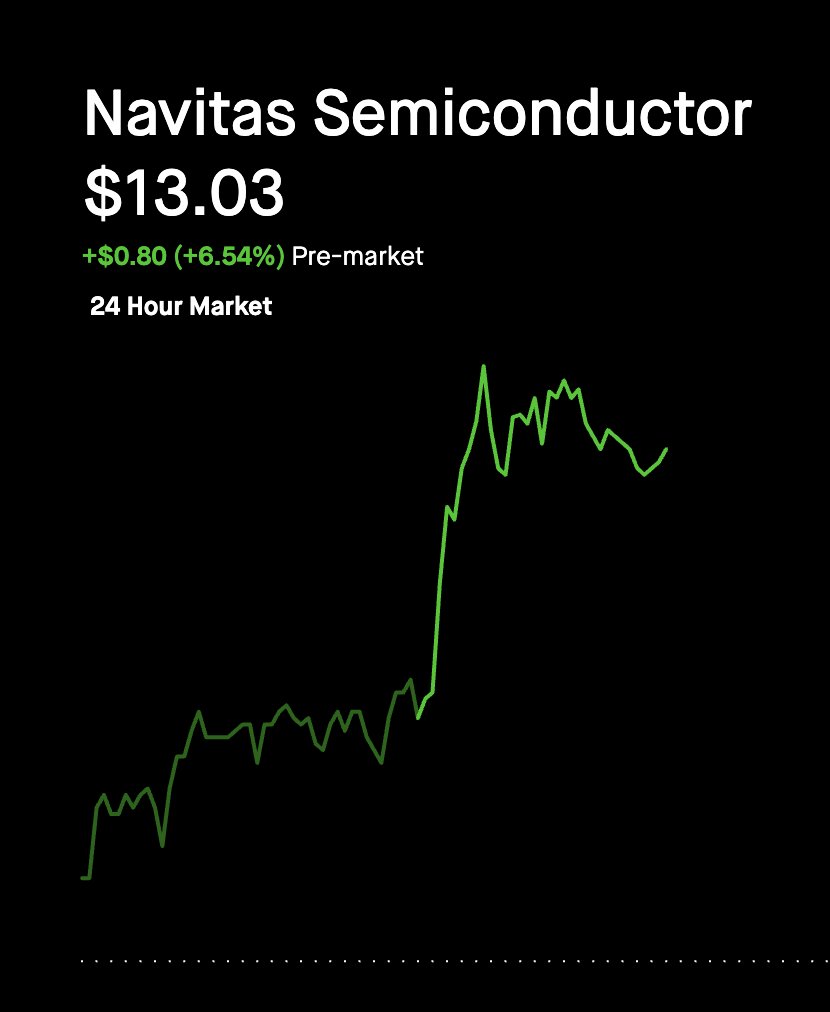
Navitas Semiconductor said it will acquire AI power-management company Claros for as much as $232.8 million, moving its reach from rack-level power delivery closer to the processor. The company also said the deal could lift its identified 2030 serviceable addressable market to more than $8 billion.
The acquisition fits into Navitas’ broader AI power strategy, which already includes 800V HVDC architectures and GaN/SiC devices for data centers and grid infrastructure. In its latest quarterly update, the company said AI data centers and grid/energy infrastructure are becoming its main growth engines.
NVTS was higher in premarket trading as investors focused on the potential for a broader AI power-stack offering and a larger market opportunity. NVDA is part of the background here because its AI infrastructure demand helps shape the power-delivery architectures that Navitas is targeting.
For now, the deal is an announced transaction rather than a completed integration story. The key question for investors is how quickly Claros’ voltage-regulation technology can be folded into Navitas’ product roadmap and customer programs.
BlackBerry says robotics is its fastest-growing business as QNX reaches 275 million vehicles영어 원문
The company is widening QNX beyond cars into warehouses, industrial automation and medical robotics, underscoring the value of safety-certified software.
BlackBerry CEO John Giamatteo told CNBC that robotics has become one of the fastest-growing businesses inside the company’s QNX portfolio. BlackBerry also said QNX now runs in 275 million vehicles, as it pushes the software stack beyond cars into physical AI and robotics.
The theme is not new, but it is getting sharper. In recent conference remarks, BlackBerry highlighted medical, industrial automation and robotics as key focus areas, including warehouse forklifts, mobile logistics robots and medical equipment, where real-time and safety-certified software requirements closely resemble automotive systems.
For investors, the message matters most for BB shares. The stock was cited as up about 2% premarket in X signals, suggesting the market is again weighing the commercial upside of QNX expanding from vehicle software into higher-margin industrial and healthcare use cases.
BlackBerry’s emphasis remains on safety-critical software rather than humanoid robots. Giamatteo has also pointed to partnerships with platform makers such as Nvidia as the company works to adapt QNX for robotics stacks built around deterministic, real-time performance.
U.S. rolls out Iran ‘economic outcast’ drive; nearly 60 targets named영어 원문
The Treasury is expanding pressure on Iran’s financing and logistics networks, with fresh sanctions aimed at firms and vessels tied to evasion schemes.
U.S. Treasury Secretary Scott Bessent unveiled a new sanctions push against Iran, saying Washington will move to cut off the regime’s so-called enablers from the dollar system. Publicly disclosed materials indicate nearly 60 entities, individuals and vessels were targeted in the latest round.
The move extends the administration’s broader maximum-pressure framework and focuses on oil, shipping, gold, technology and digital-asset channels used to evade sanctions. Washington has also warned that countries and companies doing business with Tehran could face secondary sanctions.
Energy-linked markets often react to Iran sanctions headlines because they can affect oil-supply expectations and tanker logistics. USO and XLE are among the ETF names investors typically watch on this kind of news; one report said USO fell 2.2% and XLE fell 1.1% when the announcement hit.
At this stage, the official U.S. message is one of isolation and network disruption. In the materials reviewed, there was no contemporaneous public response from Iran to the latest Treasury framing.
사건 전개
2026-06-27게시물 3개 · 작성자 3명
시장
Killa says Bitcoin bottom is in, flags $80,000-$83,000 as the next wall영어 원문
The trader’s latest X posts add to the bullish case after BTC reclaimed the upper-$70,000s, but he says the $80,000-$83,000 zone still needs to be cleared.
On X, trader Killa said Bitcoin’s bottom is already in and argued that BTC is unlikely to revisit $50,000. He identified the $80,000-$83,000 area as the next major sell wall that the market still has to break.
The call follows his earlier view that $70,000-$73,000 could mark the floor, after BTC moved back above its short-term holder cost basis. Independent reports also note that Bitcoin has climbed back above $80,000, putting renewed focus on supply sitting near that cost cluster.
That backdrop matters because several market reports point to short-term holder profit-taking and liquidation pressure around the same price band. Recent ETF inflows and a looser liquidity backdrop have helped the rebound, but traders are now watching whether that demand can absorb supply at the first major resistance zone.
For markets, the key watch is Bitcoin itself and the related ETF complex, especially spot vehicles like IBIT. A decisive move through the $80,000-$83,000 area would likely shift attention to whether the rally can extend, while rejection there could keep short-term crypto sentiment choppy.
OpenAI plans to begin deploying its Jalapeño chip in compute infrastructure by the end of 2026. Today’s X signal is a timing update on a project that had already been publicly unveiled, pointing to the first real deployment phase rather than a new product announcement.
OpenAI and Broadcom first announced Jalapeño on June 24, saying the chip is OpenAI’s first Intelligence Processor and that initial deployment was targeted for the end of 2026. Broadcom said the platform is being built with OpenAI, Celestica and its own silicon and networking technologies.
For the market, the development keeps attention on NVDA and AMD as investors gauge whether OpenAI’s in-house silicon could eventually alter some of its GPU buying mix. It also reinforces Broadcom’s role in custom AI accelerators, networking and rack-level systems.
No new shipment volume, installed base or financial impact was disclosed in the signal today, so it should not be read as a quantified revenue event. The clearest takeaway remains that OpenAI is still working toward the previously stated end-2026 deployment window.
사건 전개
2026-07-07게시물 5개 · 작성자 4명
SpaceX joins Nasdaq 100, Nvidia drops on DeepSeek chip plans, OpenAI partners with Broadcom on AI chips.
Pelosi's Uber disclosure preceded a 5% stock gain, Micron's valuation flagged as too good to be true, and Nvidia chip rental prices rose 64% in six months.
2026-07-29게시물 21개 · 작성자 17명
Big Tech credit default swap costs hit record highs, SK Hynix Q2 revenue missed but surged 257% YoY, and six companies now make up 40% of the S&P 500 with five trading below decade-average multiples.
2026-08-05게시물 37개 · 작성자 27명
Musk said SpaceX will exceed 2GW compute by year-end and approach 10GW by end-2027; SpaceX partnered with Nvidia for orbital data centers, sending shares up 9.5%.
2026-08-12게시물 22개 · 작성자 18명
LITE guided laser chip demand ramp in H2 2027, Tianfeng Securities declared AI bull market return, and CoreWeave reported $2.6B Q2 revenue with raised ARR targets.
2026-08-24게시물 93개 · 작성자 52명
Markets focused on Nvidia earnings expected to hit another record, Rosenblatt reiterated Buy with $325 target, and Iran threats plus key economic data loomed.
2026-08-25게시물 76개 · 작성자 47명
Nvidia fell for a seventh straight session, its longest losing streak since 2022, ahead of Wednesday's earnings; Raymond James said it could lead global CPU revenue.
Nvidia launched the entry-level edge AI computer Jetson Orin Nano 2, offering 78 TOPS of AI compute with 8GB memory for robotics and drone applications.