Federal Reserve Chair Kevin Warsh is set to deliver his first Jackson Hole keynote on Friday, and markets have not made a dramatic move ahead of it. The 10-year Treasury yield has been hovering around 4.49%, underscoring a wait-and-see mood rather than a strong directional bet.
The backdrop is a central bank chief who has been criticized for saying too little about the policy path. After one recent press conference, traders briefly priced the odds of a September rate hike as high as 57%, showing how quickly his remarks can reshape rate expectations.
Any clearer signal on inflation or the policy outlook would likely hit Treasuries, the dollar and rate-sensitive equities first. If Warsh sticks to a sparse communication style, the bigger reaction could still be in bonds rather than the broader stock market.
No new policy decision has been announced. Investors are watching the speech and Q&A for clues on how he views incoming data, inflation and the next few meetings.
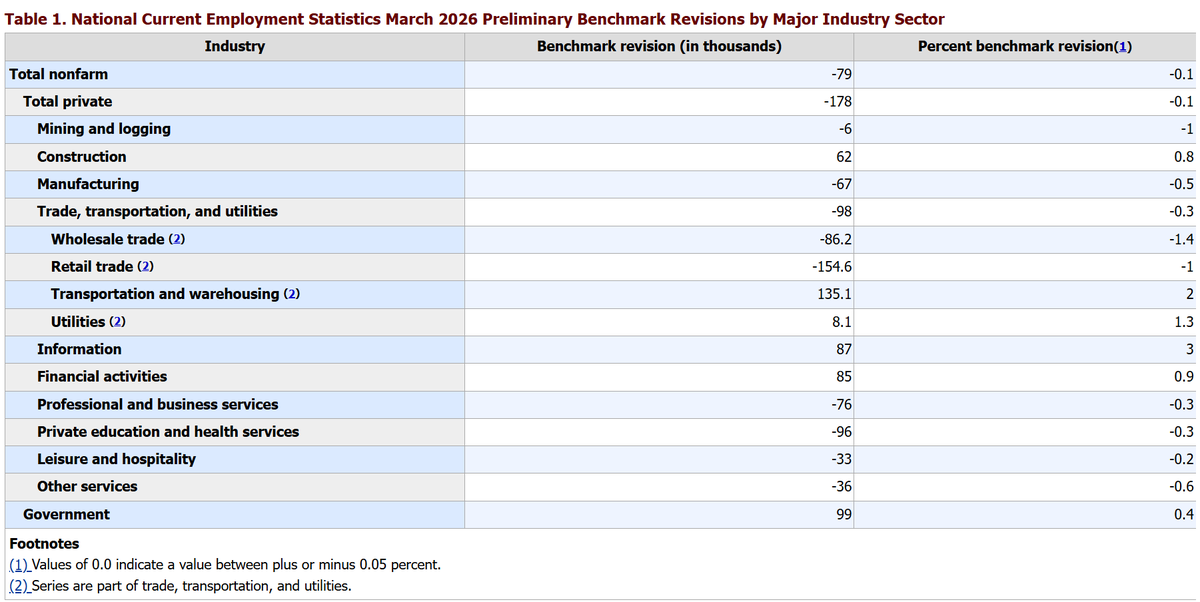
U.S. preliminary payroll benchmark revision shrinks to -79,000 after last year’s -911,000영어 원문
BLS’s 2026 preliminary benchmark points to a much smaller payroll adjustment than the prior cycle, a key read-through for labor-market pricing and rate expectations.
The Bureau of Labor Statistics said on Aug. 28 that the preliminary benchmark revision to U.S. payrolls for 2026 is a decline of 79,000 jobs. That is far smaller than the -911,000 preliminary revision reported in the prior cycle, underscoring a narrower gap between the survey estimate and administrative records.
The benchmark process reconciles the Current Employment Statistics survey with the Quarterly Census of Employment and Wages, which is built mainly from unemployment-insurance tax filings. The preliminary figure does not immediately rewrite the official monthly nonfarm payroll series; the final annual benchmark is typically folded into the January Employment Situation release the following February.
For markets, the number matters because payroll benchmark revisions can change the perceived path of U.S. labor demand and, by extension, interest-rate expectations. Treasuries, the dollar and rate-sensitive equities are the main macro channels, but there is no single company tied to the release.
The latest read was quickly echoed by wire services and trading platforms after the BLS publication. Investors will now look for the full table split by private payrolls and government employment to gauge where the adjustment was concentrated.
Chicago PMI drops to 47.1, missing 57.9 forecast and 57.6 prior영어 원문
The August reading slips back below 50, a key signal that Chicago-area business activity is cooling and that investors will watch for spillovers into broader U.S. manufacturing.
The MNI Chicago PMI for August came in at 47.1, well below the 57.9 forecast and the prior 57.6 reading. The index fell back below the 50 threshold, indicating a contraction in business activity across the Chicago area.
The Chicago PMI is often treated as an early gauge for the U.S. manufacturing cycle because it tends to move with the broader ISM manufacturing print. A sharp drop like this can therefore shape expectations for the national factory backdrop.
For markets, the weaker reading is likely to weigh on sentiment around industrials, machinery, transport and other cyclicals tied to the U.S. manufacturing chain. It may also nudge rate and dollar expectations if traders read it as a softer growth signal.
The series has been volatile in recent months: Trading Economics showed a 52.8 reading in March, 49.2 in April and a rebound to 62.7 in May. August’s return below 50 suggests that any recent improvement has not yet held.
Bitcoin ETFs pull in $2.5 billion in 7 days as IBIT and GLD ride the debasement trade영어 원문
The latest fund flows show investors piling into scarce assets again, using Bitcoin and gold as parallel hedges against fiscal and currency uncertainty.
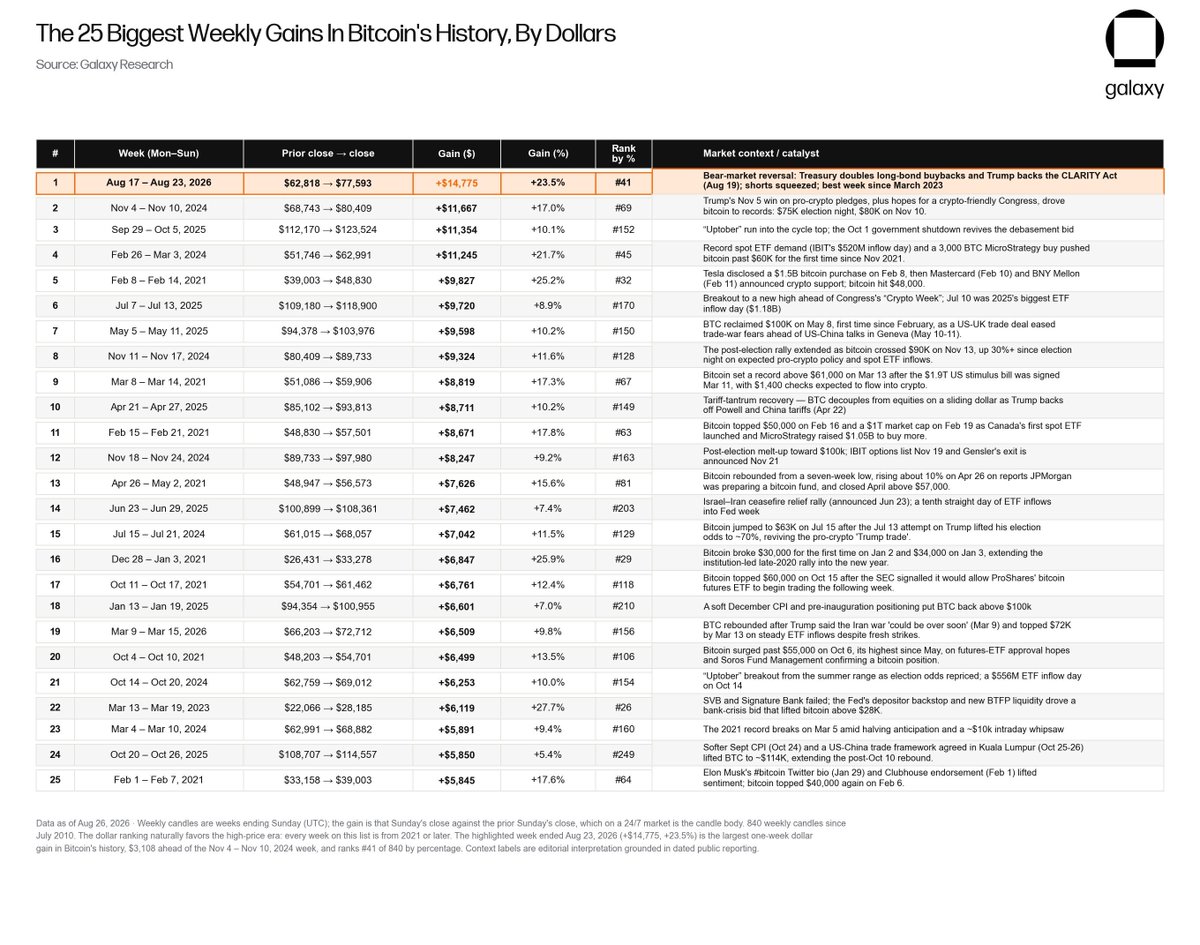
U.S. spot Bitcoin ETFs جذب roughly $2.5 billion over the past seven trading days, marking the strongest inflow stretch since October. The move comes as Bitcoin pushed back above $80,000 and gold also caught a renewed scarcity bid.
The latest buying wave builds on the Treasury’s expanded long-dated buyback program, which initially pressured the dollar and long yields. That backdrop revived the so-called debasement trade, where investors seek assets with fixed or constrained supply as a hedge against fiscal stress.
Most of the capital has flowed into flagship funds such as BlackRock’s IBIT, while State Street’s GLD has led the gold side of the same theme. The flow impulse matters because ETF creations translate directly into spot demand, helping support crypto proxies such as MSTR and miners like RIOT and BMNR.
For now, the new information is the scale and persistence of the cash coming in, not a fresh policy announcement. Whether the trend extends will depend on continued ETF subscriptions, the dollar and Treasury-market conditions.
Salesforce shares surged as much as 23% on Thursday and closed up 22.58%, making it one of the day’s top performers in both the Dow and the S&P 500. The fresh catalyst was the company’s quarterly report, which paired a revenue beat with an expanded tie-up with Anthropic.
CNBC reported second-quarter revenue of $11.35 billion versus $11.32 billion expected, with adjusted EPS of $5.90 against a $3.27 estimate. The company also said it booked a $2.6 billion gain from its strategic Anthropic investment, while unveiling a new “Claudeforce” plugin that brings Salesforce workflows into Claude.
The rally spilled into software and SaaS peers, including Adobe, Palantir, ServiceNow, Autodesk and Figma, while the iShares Expanded Tech-Software ETF rose about 5%. Cybersecurity names such as CrowdStrike and Okta also moved sharply, underscoring how strongly the market leaned into enterprise software and AI exposure on the day.
Cross-checks show the move was unusually large even by Salesforce standards: The Motley Fool called it the company’s second-biggest single-day gain ever, behind an August 26, 2020 jump of roughly 26%, while 24/7 Wall St. cited a 22.5% close. The exact figure varies by intraday versus closing print, but the scale of the rally does not.
Bloomberg reported on Aug. 28 that Advent and Stripe’s consortium has decided to abandon its pursuit of PayPal. The news hit the stock in premarket trading, where PYPL fell roughly 13% to 17% as traders unwound deal speculation.
The bid was first reported in July at $60.50 a share, implying a valuation of about $53 billion. PayPal’s board initially judged that price too low, and later reports from TechCrunch and PYMNTS on Aug. 14 said discussions were still active and could produce a higher offer.
The market response was centered on PayPal because takeover hopes had become part of the stock’s setup. Barron’s said shares moved lower on the report that the deal may be off, while Investors.com described an overnight drop after the consortium was said to have walked away.
Bloomberg’s report left open the possibility of talks resuming later with a revised proposal, but neither PayPal nor Stripe had publicly confirmed the transaction. For now, the confirmed development is that the acquisition process has been paused, forcing investors to reassess the odds of a deal and the valuation support behind the shares.
사건 전개
2026-07-15게시물 55개 · 작성자 45명
Stripe and Advent jointly bid $60.50 per share for PayPal, valuing the deal at about $53 billion.
기업
Musk says SpaceX could reach $3.5 trillion revenue by 2033, 7 years ahead of Morgan Stanley영어 원문
The new X post is a fresh timing call, not company guidance, and it widens the gap between Musk’s personal view and the bank’s long-range model.
Elon Musk said on X that his “best guess” is SpaceX could reach about $3.5 trillion in annual revenue by roughly 2033. The post was widely picked up by market feeds and news wires as the latest update in his long-running bullish outlook for the company.
The comment is Musk’s personal forecast, not official SpaceX guidance. It also comes against Morgan Stanley’s earlier model that puts the same revenue level in 2040, leaving a seven-year gap between the two timelines.
Investors are likely to focus on SpaceX’s satellite internet, launch, and AI-compute ambitions, which have become central to the company’s valuation narrative. The stock ticker in circulation is SPCX, while MS is the bank behind the benchmark model being referenced.
For now, the figure should be treated as a forward-looking estimate rather than an achieved number. The latest development is the timing shift itself: Musk has effectively pulled the revenue milestone forward again in public comments on X.
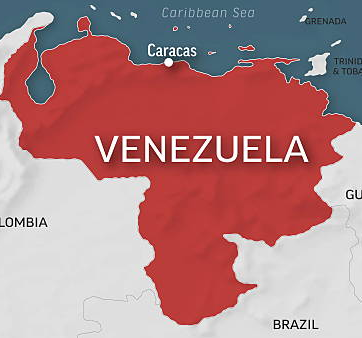
The Wall Street Journal reported that Chevron is nearing a deal to expand its Venezuela footprint by adding two heavy-oil fields to its portfolio. Halliburton is also said to be in talks, while broader U.S.-Venezuela discussions are centered on long-term access to oil assets.
The story matters because Venezuela holds some of the world’s largest proven crude reserves, yet its oil sector has been constrained for years by sanctions, property disputes and political risk. Reuters reported in January that U.S. officials were telling oil executives that any compensation for expropriated assets would require substantial new investment in the country.
For markets, Chevron is the clearest corporate focal point: a successful agreement would deepen its exposure to Venezuelan heavy oil and could affect sentiment around CVX. Halliburton would be the other ticker to watch if the reported negotiations broaden into service contracts, although the public details remain incomplete.
So far, there has been no full public disclosure of the deal terms, and the reported talks have not been formally confirmed in detail by the parties involved. Given the sanctions and legal issues around Venezuelan assets, the key question is whether the negotiations translate into a signed agreement and what approvals would be required.
사건 전개
기업
SK Hynix says memory shortage will last to 2030 as $4 billion Indiana plant advances영어 원문
The CEO reiterated a tight HBM market in Indiana, adding that oversupply risk remains low amid AI demand.
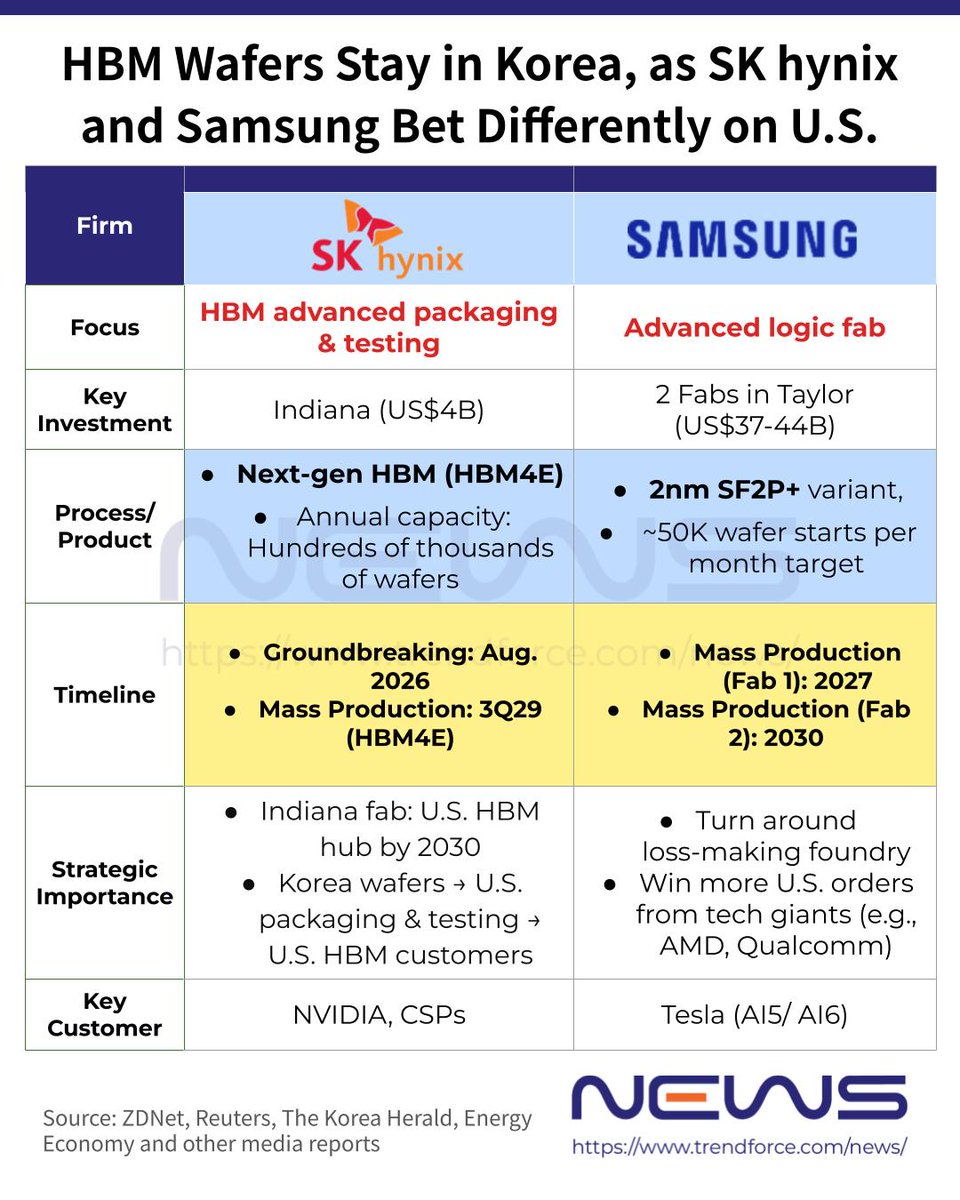
SK Hynix CEO Kwak Noh-Jung said in Indiana that the global memory-chip shortage is expected to last until the end of 2030, while he sees no clear sign of oversupply. He made the remarks at the groundbreaking for the company’s advanced packaging facility in West Lafayette, Indiana.
The update builds on earlier reporting that the project carries a price tag of about $4 billion, with cleanroom operations slated for the second half of 2028 and volume production of HBM4E targeted for the third quarter of 2029. SK Hynix has also said its U.S. investments and assets will exceed $45 billion by 2030.
For investors, the comments reinforce the idea that high-bandwidth memory supply remains tight, a backdrop that matters for SK Hynix, Samsung Electronics and Micron Technology across the AI supply chain. Reuters-linked reporting cited Counterpoint Research data showing SK Hynix held 58% of the global HBM market by revenue in the first quarter of 2026.
Kwak also said any eventual slowdown would likely be a moderation in demand rather than a sharp drop. The company has already secured up to $458 million in CHIPS Act grants and up to $500 million in loans for the Indiana project.
According to an internal memo seen by Business Insider, Meta is testing a personal AI agent called Hatch, with employees outside its Superintelligence Labs group already getting access for evaluation. The memo says the agent can handle real online tasks such as booking restaurants, ordering food, filling out forms and making purchases.businessinsider.com
The new detail is that Meta appears to be pushing beyond conversational AI and toward software that can actually execute tasks on a user’s behalf. Reporting also says Hatch was trained against simulated versions of services including DoorDash, Etsy, Reddit, Yelp and Outlook, underscoring the product’s ambition to work across multiple services rather than inside a single app.businessinsider.com htx.com
For investors, the main listed name in focus is Meta itself: a successful rollout could strengthen its consumer AI push and deepen engagement across Instagram, Facebook and WhatsApp. But the same cross-service automation also raises product and compliance questions around permissions, payments and data handling, especially while Meta is still working through legal overhangs.insight.tmcnet.com cnbc.com
OpenAI, Anthropic, Google, Microsoft and 112 other companies and organizations signed an open letter warning that AI-enabled cyberattacks are likely to become far more common and sophisticated within months. The letter says today’s security posture is not enough and singles out hospitals, water systems and internet infrastructure as especially exposed.bbc.com cbsnews.com
The appeal goes beyond generic risk warnings. It asks governments, cybersecurity firms and frontier AI developers to work together on testing, threat sharing and deployment of defensive AI tools, with signatories spanning tech, finance and security, including Capital One, Mastercard, Visa, CrowdStrike and Palo Alto Networks.techcrunch.com cyberscoop.com
For markets, the message keeps the spotlight on cloud providers, cybersecurity vendors and AI infrastructure names such as Microsoft, Google, Amazon Web Services, CrowdStrike, Cloudflare, Palo Alto Networks, Akamai and Cisco. OpenAI and Anthropic are central not because they are victims in this case, but because they are both model builders and signatories pushing for defensive deployment, which could translate into more partnerships and security-focused products.
OpenAI CEO Sam Altman said on X that “there is not much time to act,” echoing the letter’s “limited window” framing. The letter also says frontier AI companies should provide responsible model access, funding, training and hands-on support to under-resourced defenders.businessinsider.com
FTC moves toward a YouTube lawsuit over content-policy suspensions영어 원문
Bloomberg says the probe has been running since 2025 and is now nearing a potential complaint, putting Alphabet’s moderation policies back under scrutiny.
The U.S. Federal Trade Commission is investigating whether Alphabet’s YouTube violated consumer protection laws when it suspended accounts or demoted content in ways that conflicted with its own stated policies, Bloomberg reported on Aug. 27. People familiar with the matter said the probe, which began in 2025, is now in the final stages of preparation for a possible lawsuit.
The issue is less about whether YouTube can moderate content and more about whether the company’s public rules matched how the platform actually enforced them. The FTC has previously sought public comment on whether social media companies misled users with unfair or deceptive terms of service, including rules around suspensions and appeals.
For Alphabet, the matter keeps regulatory risk centered on YouTube, a key part of its ad-driven business, and it may affect sentiment around the GOOGL and GOOG share classes. So far, neither YouTube nor the FTC has publicly detailed any wrongdoing, and the report is still based on people familiar with a confidential probe.
Reuters also carried the Bloomberg report, which helps corroborate the basic factual frame, although the underlying investigation remains uncharged and could still end without enforcement action.
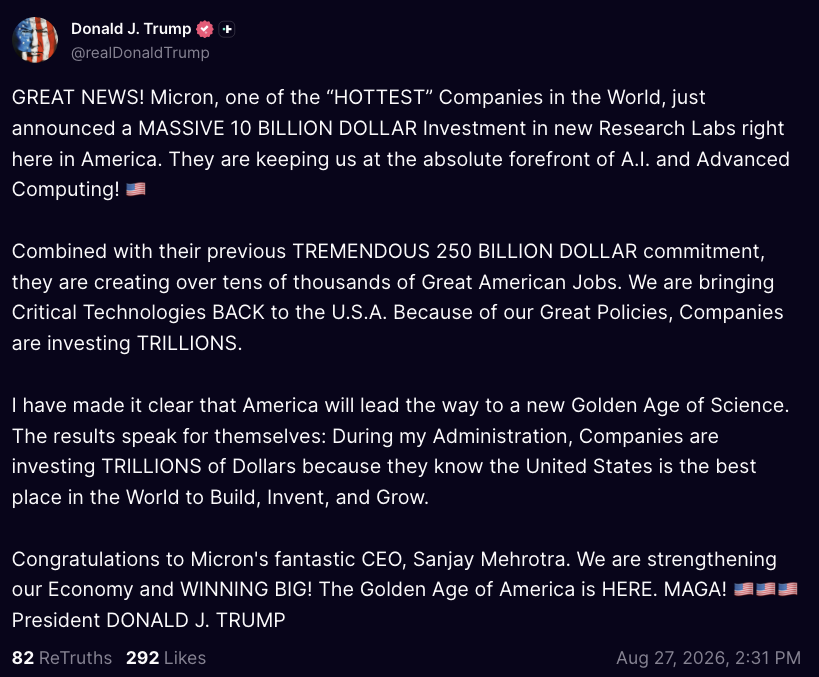
President Trump said on Truth Social that Micron Technology will invest $10 billion in new research labs in the United States, calling the memory-chip maker one of the world’s “hottest” companies. The statement was quickly amplified by multiple market-news outlets.
The backdrop is Micron’s previously announced $250 billion long-term commitment in the U.S. The new figure adds fresh attention to the company’s domestic R&D footprint and its exposure to AI-driven memory demand.
Micron (MU) is the direct equity at the center of the news. Peers and rivals such as SK Hynix and China’s YMTC may be discussed as industry comparables, but they are not the subject of the latest claim.
For now, the market is reacting to a political endorsement rather than a fresh corporate filing. Any final read-through will depend on whether Micron later discloses project locations, timing, and capital-spending details.
The U.S. Food and Drug Administration has approved Eli Lilly’s Mounjaro for reducing cardiovascular risk in adults with type 2 diabetes and established heart disease. Lilly said the decision follows the SURPASS-CVOT study.
The phase 3 trial enrolled 13,299 patients and showed Mounjaro was non-inferior to Trulicity on cardiovascular death, heart attack and stroke. The approval adds a new cardiovascular indication to a drug already used in diabetes care.
For Lilly, the label expansion strengthens Mounjaro’s position in the crowded diabetes and cardiometabolic market. It also puts the drug in more direct competition with other GLP-1-based therapies, including products from Novo Nordisk.
Lilly previously said it would submit the data to global regulators, and Reuters confirmed the FDA action on Friday. Investors will likely watch how the new indication affects prescribing trends and U.S. sales momentum.
사건 전개
2026-07-21게시물 3개 · 작성자 3명
Novo Nordisk sued Eli Lilly, alleging misleading ads for Zepbound and Mounjaro unfairly compare highest doses against lower ones.
2026-08-05게시물 14개 · 작성자 12명
Eli Lilly posted strong Q2 results with revenue at $23.0B, Mounjaro leading as top weight-loss drug, and raised full-year guidance.
기업
Apple raises Apple TV to $14.99, annual plan to $119영어 원문
The U.S. price reset extends Apple’s subscription push, with Apple One also moving higher.
Apple has raised the U.S. monthly price of Apple TV to $14.99 from $12.99, while the annual plan moves to $119 from $99. Apple One Individual is also increasing to $21.95 from $19.95, with the change taking effect on August 28.
The move follows an earlier round of Apple TV+ increases. CBS reported that Apple TV+ was lifted to $12.99 a month in August 2025, and Variety said Apple raised the service by 30% last year as it continued funding premium original programming.
For Apple, the higher sticker prices feed directly into services revenue and the broader subscription bundle strategy. The update matters for AAPL investors because services have been a key profit engine, while Apple TV+ remains part of Apple’s wider ecosystem monetization play.
The latest pricing change was first surfaced in social-media trading chatter and then matched by Deadline coverage. Apple has not, as of this writing, issued a fresh detailed explanation beyond the new pricing itself.
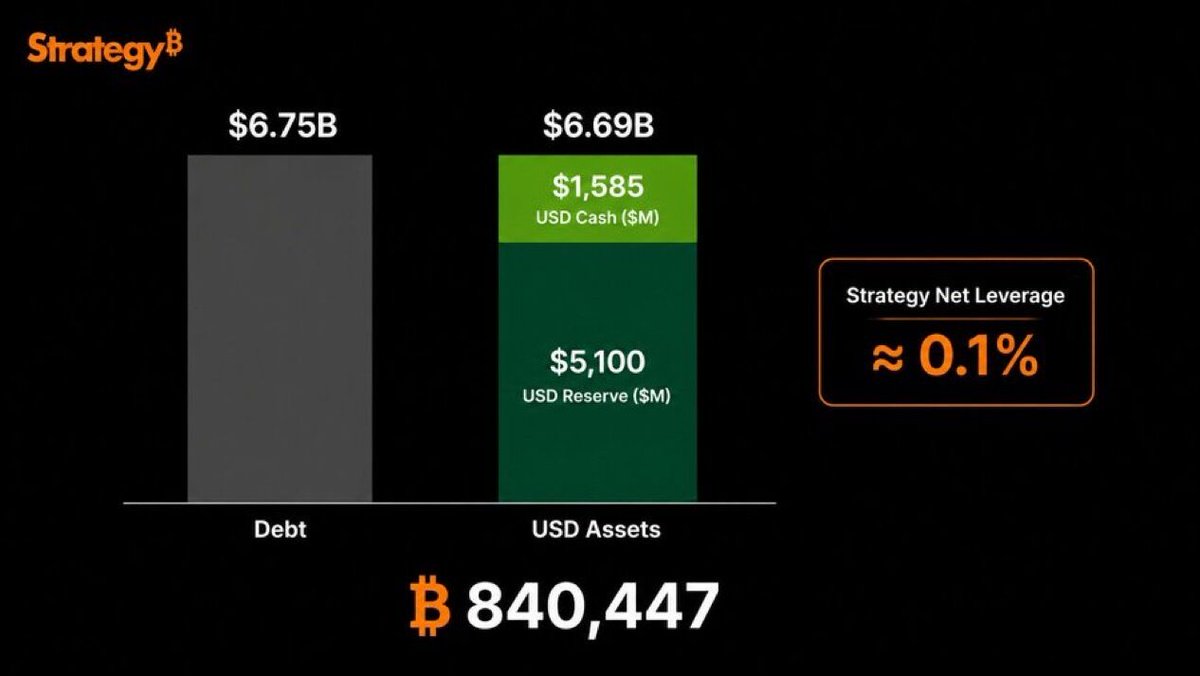
Strategy says $6.69B cash buffer nearly offsets $6.7B debt, cutting net leverage to 0.1%영어 원문
A new USD Cash account and recent share sales left the bitcoin treasury firm with a far larger liquidity cushion than before, changing how investors read its balance-sheet risk.
Strategy disclosed that its USD assets now nearly match its debt, pushing net leverage to roughly 0.1% as of August 23. In its latest 8-K filing, the company said it held $5.10 billion in USD Reserve and $1.59 billion in USD Cash, or about $6.69 billion combined, against roughly $6.7 billion of convertible debt.
The shift was driven by capital raising rather than bitcoin transactions. During August 17-23, Strategy sold 18,261,118 MSTR shares under its ATM program for net proceeds of $2.0065 billion; the company said $300 million went to the USD Reserve, $136.4 million funded STRC repurchases, and the rest was added to USD Cash. In May, it also retired $1.5 billion face value of 2029 zero-coupon convertible notes for $1.38 billion.
For investors, the update sharpens the case for MSTR as a leveraged bitcoin proxy with a larger liquidity buffer and less balance-sheet stress. The market has already been reacting to the combination of the filing and bitcoin’s recovery, with MSTR rallying on August 27 as traders reassessed the firm’s funding risk.
Strategy also said it had 840,447 bitcoin on the balance sheet, acquired for $63.36 billion at an average price of $75,385 per bitcoin. The company framed the new USD Cash pool as extra flexibility for future bitcoin purchases, preferred dividends, note repurchases and other treasury actions.
사건 전개
2026-06-30
실적
Marvell guides Q3 revenue to $3.15 billion as shares fall 8% after earnings영어 원문
Revenue rose 37% in the latest quarter, but investors are focused on forward guidance and Google-linked expectations.
Marvell Technology’s latest quarterly report sent the stock lower in after-hours trading. The company said revenue grew 37% year over year and guided third-quarter revenue to $3.15 billion, plus or minus 5%; shares were down about 8% after the release.
The market reaction was driven less by the headline results than by the bar for future growth. Several reports said investors had been looking for more upside from Marvell’s Google-related business, while management’s outlook landed below those expectations.
MRVL became one of the clearest examples of AI-chip stocks giving back gains after earnings. Even with data-center revenue up 46% and AI demand described as robust, traders appeared more focused on whether the company can justify its valuation through sustained guidance.
Marvell’s own forecast remains above analyst consensus, and management continues to point to data-center and custom silicon as the key growth engines. The next stretch of trading will likely center on execution against the Q3 revenue guide and the visibility of AI bookings rather than the quarterly beat itself.
Statistics Canada said on Aug. 28 that Canada’s economy grew at a 3.3% annualized pace in the second quarter, while June GDP rose 0.3% month over month. The agency also estimated July GDP was flat, pointing to a softer start to the third quarter.
The new release extends the recovery seen earlier in the year. Reuters reported that May GDP rose 0.3% month over month, and the June figure confirms output was still expanding through the middle of the year after a weak first quarter.
For markets, a stronger-than-expected GDP print can shift expectations for Bank of Canada policy and support the Canadian dollar. It also tends to matter for rate-sensitive sectors such as banks and housing-related names, which are closely tied to growth and borrowing costs.
The data also showed a June budget surplus of C$0.99 billion, according to the market wires cited in the X signal. That adds a fiscal backdrop to the growth reading, though July’s flat estimate suggests investors will watch upcoming releases for confirmation.
Workday revenue rises 12.8% to $2.649 billion as AI drives over 25% of new ACV영어 원문
The company lifted full-year subscription revenue guidance, underscoring how AI adoption is becoming a key growth lever in Workday’s core HR and finance software business.
Workday reported second-quarter fiscal 2027 revenue of $2.649 billion, up 12.8% from a year earlier, with subscription revenue rising 13.9% to $2.471 billion. The company said AI drove more than 25% of new ACV during the quarter.
The results extend Workday’s push to embed AI across its HR, finance and IT platform. Workday said more than 5,500 customers now use at least one of its organic agents, up more than 35% from the prior quarter.
Investors are focusing on the company’s AI uptake and updated outlook as much as the beat itself. Workday raised full-year fiscal 2027 subscription revenue guidance to $9.940 billion-$9.950 billion and lifted its non-GAAP operating margin target to 31.0%.
Workday also authorized a new $4.0 billion share repurchase program and ended the quarter with $3.403 billion in cash, cash equivalents and marketable securities. The combination of stronger AI adoption and higher margin guidance was the main incremental message in the release.
BYD net profit rebounds 30% as overseas revenue tops half영어 원문
The automaker’s latest quarter points to a shift in mix, with exports and higher-priced models doing more of the work while China’s price war remains in the background.
BYD said on Aug. 28 that quarterly net profit rose about 30% year over year, marking its first profit increase in five quarters. Bloomberg reported that the rebound was driven by stronger exports and firmer demand for some of the company’s pricier models.
The improvement comes as China’s EV price war has continued to pressure margins at home. Recent coverage has shown BYD leaning harder on overseas markets, where its sales mix has been rising quickly and now represents a much larger part of the story than it did earlier this year.
Investors are watching whether the earnings recovery can support the roughly $20 billion increase in market value that the stock has added over about two months. BYD’s Hong Kong shares (1211.HK) have stayed firm ahead of the release, while Tesla (TSLA) remains the benchmark for global EV competition and margin comparisons.
The key question from here is whether export growth can keep translating into durable profitability rather than just higher volume. That will depend on the company’s regional revenue mix, gross margin trend and how much pricing pressure remains in China.
President Donald Trump said he is authorizing legal documents to allow farmers and ranchers to process their own food, calling major meat processors a “nasty monopoly.” The remarks add a fresh policy signal to his broader effort to lower beef prices and challenge industry concentration.
The backdrop is a highly concentrated market: the U.S. Department of Agriculture says about 85% of cattle purchases are made by four companies — Tyson, JBS, Cargill and National Beef. Trump has already backed an antitrust probe into meatpackers, while the USDA has pledged up to $500 million to support midsize processors.
For investors, the latest comments keep JBS and Tyson Foods in focus because any regulatory easing could alter the competitive landscape and the cost of expanding processing capacity. The policy mix also intersects with the administration’s recent move to adjust tariffs on certain beef imports, reinforcing the pressure on the beef supply chain.
Trump has not yet released specific legal text or implementation details. Industry advocates say easing inspection and permitting burdens could make it easier for small ranchers to build their own processing plants, but no final rule has been announced.
Citi’s Dirk Willer said a 30-year Treasury yield capped below 5.30% could create downside pressure on the U.S. dollar. The comment adds a fresh macro angle to a market already focused on Treasury’s bond-buyback plan.
The backdrop is the Treasury Department’s August 19 decision to raise the cap on buybacks of 10- to 20-year and 20- to 30-year nominal securities from $2 billion to at least $4 billion per operation, starting Sept. 9 and running through Nov. 4.bloomberg.com The move has fueled debate over whether officials are merely improving market liquidity or effectively managing yields.financenews.one
In markets, the dollar softened after the announcement, while the 30-year yield was reported near 5.34%, close to its highest level since 2007. Citi also withdrew an underweight Treasury stance after Scott Bessent’s buyback announcement, highlighting how quickly positioning is adjusting around the policy shift.
Treasury has said the program is intended to improve trading conditions, and Bessent has said, “We haven’t bought a single bond yet.” Investors will be watching the first buyback operations in September for clues on whether the policy can keep long-end yields contained.
사건 전개
2026-08-04게시물 3개 · 작성자 3명
Citi disclosed buying more Strategy shares, alongside discussions on the end of the bond bull market and Japan's yen defense tools.
2026-08-20
기업
Moderna upsizes convertible note sale to $2.6 billion from $2.0 billion영어 원문
The 2032 zero-coupon notes were priced after an initially announced offering, with proceeds earmarked for corporate purposes and oncology spending.
Moderna has priced an upsized $2.6 billion offering of convertible senior notes due 2032, expanding the deal from the $2.0 billion amount it initially proposed a day earlier. The notes are unsecured, pay no regular interest, and the company said the final terms were set at pricing. The initial purchasers also have a 13-day option to buy up to an additional $300 million of notes.
The financing follows Moderna’s August 27 proposal to raise $2.0 billion through a private placement. In its latest announcement, the company said net proceeds will be used for general corporate purposes, including potential investment in its oncology business and debt repayment. It also expects to enter capped call transactions intended to reduce dilution from any future conversion.
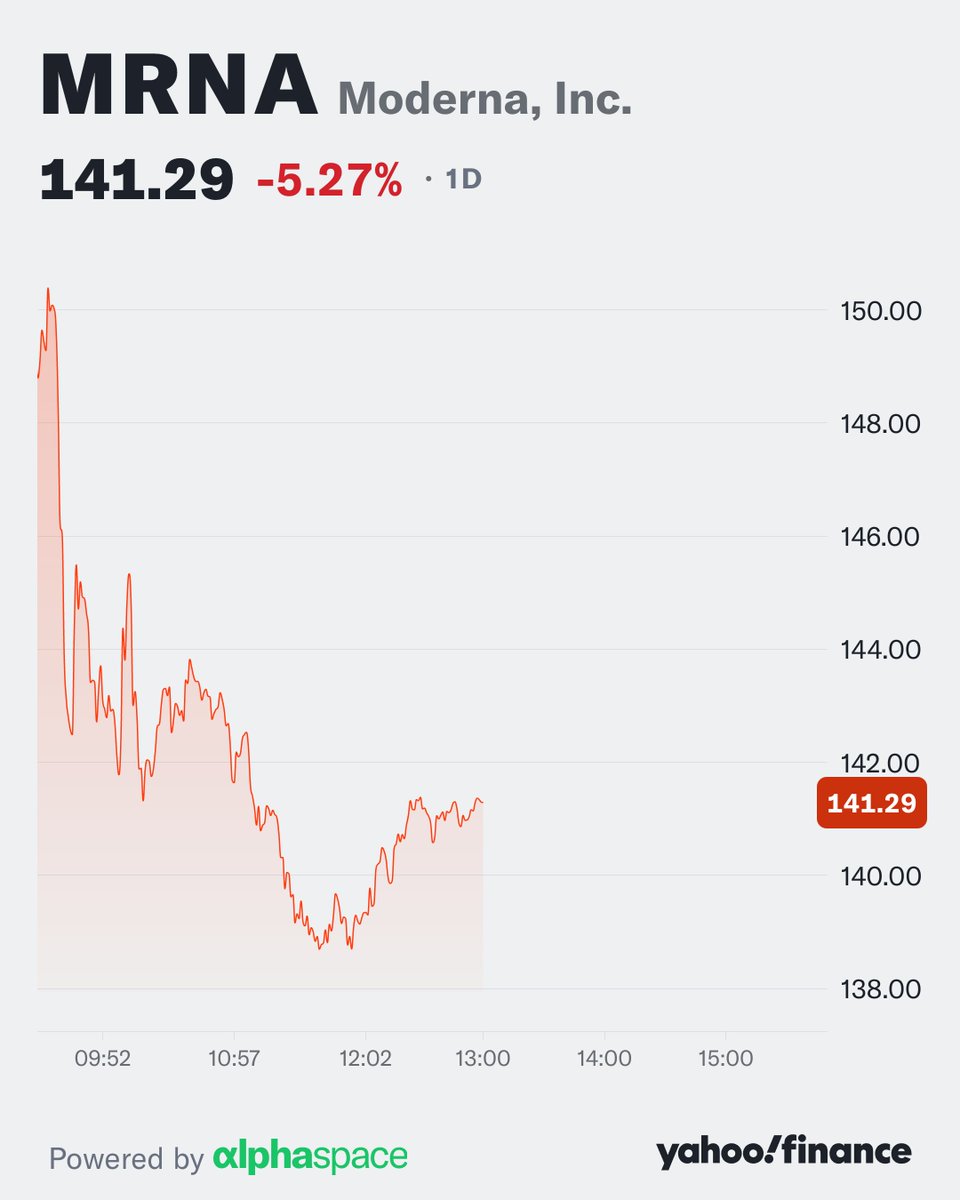
The news matters because the transaction is large relative to Moderna’s balance sheet and arrives as the company continues to fund a late-stage pipeline beyond COVID vaccines. X posts and market reports indicated MRNA traded lower around the financing news, reflecting investor sensitivity to dilution and capital-allocation questions.
Separately, Moderna recently received FDA approval for updated 2026-2027 COVID-19 vaccines, adding to the backdrop of active product and pipeline developments. For now, the key near-term issue is the completed pricing of the convertible deal rather than the earlier proposal stage.
Evercore ISI raised its price target on Amazon to $355 from $315.16 and kept an Outperform rating. The firm said its 14th Annual U.S. Online Retail survey offers the first evidence that agentic AI is additive for Amazon retail rather than merely converting demand already in the funnel.
A key data point in the note was that 57% of Alexa AI users bought a product they were not previously aware of. Evercore framed that as evidence that AI shopping tools can create new purchase intent, extending the case for Amazon’s retail and advertising businesses beyond simple conversion gains.
For markets, the update keeps attention on AMZN’s retail monetization and ad pricing power, because better product discovery can lift gross merchandise volume and ad efficiency. It also supports broader valuation debates around AI-enabled commerce, with Amazon seen as one of the clearest large-cap beneficiaries.
This is a broker research call, not a new company announcement, but it adds a fresh catalyst to the AMZN story line that investors have been tracking this year. Evercore had already lifted its target earlier in 2026, and the latest move extends that bullish trend with a new survey-based argument.
Switzerland’s KOF economic barometer rose to 106.7 in August, beating forecasts around 103.0-103.3 and up from July’s revised 104.2. Multiple market wires reported the same figure, confirming the data surprise.
KOF said the improvement was driven mainly by manufacturing, other services and foreign demand, and that the reading was the strongest since November 2021. Private consumption, however, remained under pressure, suggesting the recovery is not broad-based yet.
The release matters for the Swiss franc, Swiss equities and exporters linked to the country’s industrial cycle. Traders will be watching whether the stronger barometer feeds into FX moves and rate expectations, although the immediate impact will depend on how it is absorbed alongside upcoming Swiss inflation and growth data.
No official revision or correction was mentioned in the wires, and the print has been cross-checked against multiple market sources. The next signal to watch is whether subsequent Swiss macro data confirms the improving tone in business sentiment.
French consumer spending rose 0.5% month on month in July, beating the 0% forecast and improving from 0.4% previously. On a year-on-year basis, spending accelerated to 1.4% from 0.1%, according to INSEE.
The latest figure suggests household demand held up through early summer, with energy outlays again playing a major role. That follows a volatile run of monthly readings earlier this year, when weather and energy use helped drive swings in goods consumption.
For markets, the report is more relevant for macro sentiment than for any single stock, but it can still shape views on French growth, rates and the euro. Retail and consumer-linked equities may see a modest sentiment lift, while utilities and energy-related names are watched for category-level demand trends.
No conflicting official reading was available in the search results at the time of writing. Investors will now look to upcoming inflation and broader euro area demand data for confirmation of the consumption trend.
Japan’s government said on Aug. 28 that the seasonally adjusted unemployment rate fell to 2.4% in July from 2.5% in June, while the seasonally adjusted jobs-to-applicants ratio stayed unchanged at 1.18. The readings came in slightly better than market expectations, according to wire reports and local coverage.mainichi.jp
The update matters because it offers a fresh read on the country’s labor tightness. A steady vacancies ratio alongside a lower jobless rate suggests demand for workers remains firm even as broader hiring conditions vary by sector; local reporting cited semiconductor-, electronics- and EV-related demand as a support.kab.co.jp
For markets, the data are most relevant to the yen, rate expectations and domestic-demand names such as retail, services, manufacturing and staffing companies. This is a macro release rather than a company-specific event, so investors are likely to focus on what it implies for wages, consumption and the Bank of Japan’s policy read-through.
Official figures and market references aligned closely on the key numbers: unemployment rate at 2.4% versus 2.5% expected, and jobs-to-applicants ratio at 1.18 versus 1.19 expected, with the prior ratio also at 1.18.tradingeconomics.com
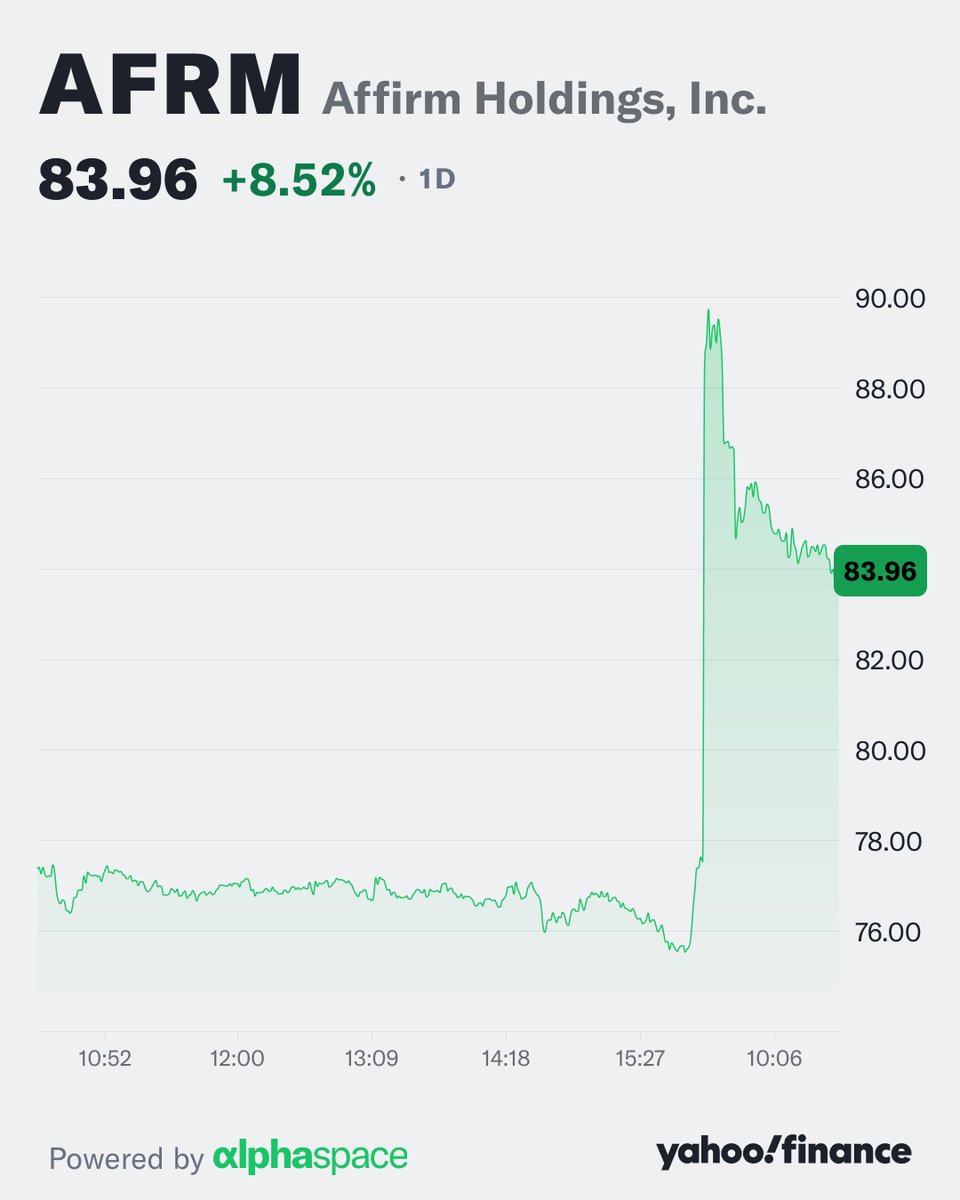
Affirm reported fiscal Q4 2026 results on Aug. 27, posting EPS of $4.62, revenue of $1.166 billion and gross merchandise volume of $14.1 billion. The company said it delivered one of its most profitable quarters ever, and the stock rose about 12% in after-hours trading.
The quarter lands as Affirm keeps broadening beyond its core checkout loans, including the launch of Shop Pay Installments in Australia and continued investment in the Affirm Card. Management framed those moves as part of a longer-term push into products, services and global markets.
Investors focused on improved transaction economics and guidance. Reports cited revenue less transaction costs of $589.1 million and GAAP operating income of $147.3 million, while the company’s fiscal 2027 outlook came in ahead of expectations and helped drive the move in AFRM.
Affirm also disclosed a leadership change, naming Michael Linford president effective Aug. 27 with expanded oversight across legal, compliance, public affairs, revenue and global markets. The appointment did not change his compensation terms.
Autodesk reported fiscal Q2 revenue of $2.046 billion, up 16% year over year, and non-GAAP EPS of $3.30, both ahead of expectations. The company also raised its full-year revenue outlook to $8.295 billion-$8.345 billion.
The results show solid demand across its design and construction-related businesses, but growth has moderated versus prior quarters. Autodesk said remaining performance obligations reached $7.433 billion, indicating a still-healthy backlog.
Investors focused on the weaker-than-expected Q3 profit guide. Reuters said the stock fell more than 5% in after-hours trading after the outlook, as the market reassessed near-term earnings power.
Autodesk said the improved full-year revenue and billings outlook reflects stronger underlying growth and the addition of MaintainX, while roughly $45 million of transaction expenses tied to the acquisition weighed on margin and free-cash-flow outlooks.
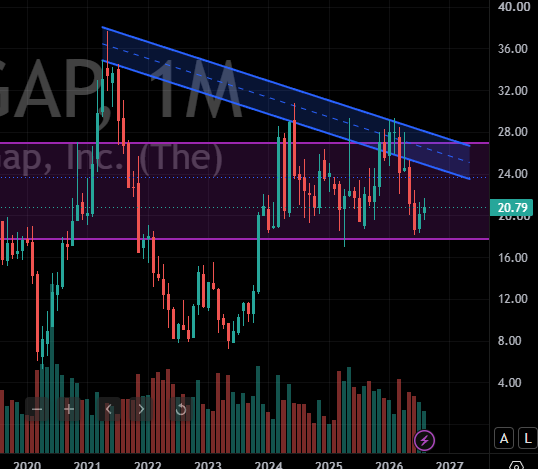
Gap reported fiscal second-quarter net sales of $3.65 billion, down 2% from a year earlier, while adjusted earnings per share came in at $0.52, ahead of consensus. The company also recorded a $417 million accounting adjustment tied to tariff recovery during the quarter.
The bigger fresh catalyst was Gap's decision to name Michael Francis as Old Navy's next president and CEO, effective Nov. 2, with current chief Haio Barbeito moving into an advisory role through Jan. 30, 2027. Gap said Old Navy posted $2.1 billion in net sales, down 4%, while comparable sales also fell 4%.
Investors are also digesting an improved outlook: Gap lifted its fiscal 2026 adjusted EPS guidance to $2.35-$2.45 from $2.30-$2.40. The Gap brand delivered 10% comparable sales growth in the quarter, helping offset weakness at other banners.
In premarket trading, the stock jumped about 15%, according to X signals. The move reflects renewed focus on brand execution, margin recovery and whether the new Old Navy leadership can stabilize the chain's performance.
The U.S. Food and Drug Administration has approved Gilead Sciences’ Bixlenvo, a once-daily HIV tablet for adults whose virus is already suppressed but who cannot take currently available single-tablet regimens. Gilead says it is the first and only option of its kind for patients on complex regimens.
The company said the wholesale acquisition cost is $4,595 for a 30-day supply, and estimated that 5% or more of people living with HIV in the U.S. are on complex regimens that could fit the label. The drug requires a two-day initiation dose with Sunlenca before patients switch to Bixlenvo alone.
Gilead shares were indicated higher in premarket trading as investors weighed another expansion in the company’s HIV franchise. The approval also adds a new competitor in the market for suppressed-patient switch therapies, including Merck’s recently approved option.
Gilead said the approval rests on Phase 3 ARTISTRY-1 and ARTISTRY-2 data showing maintained viral suppression at week 48, with no significant new safety concerns. The company added that bictegravir and lenacapavir in combination are not approved outside the U.S.
Google has agreed to a £260 million settlement of a UK class action accusing the company of abusing its dominance and charging excessive commissions in the Play Store. The agreement does not include an admission of liability and still needs approval from London’s Competition Appeal Tribunal.
The lawsuit was brought on behalf of app developers by academic Barry Rodger and had previously been valued at more than £1 billion. Reuters reported that £160 million would go to developers who sold apps on the Play Store between August 2018 and July 2026, while £100 million would cover the costs of bringing and funding the case.
For Alphabet, the immediate issue is legal and regulatory exposure around Google Play rather than a large financial hit. Investors may also compare the case with other app-store disputes involving companies such as Apple, which keeps the broader platform-commission debate in focus.
Google did not immediately comment. The next key milestone is whether the tribunal signs off on the settlement, which would formalize the payout and close out a UK-specific overhang for the company.
IREN raises FY27 capex guide to $25 billion-$30 billion with $14 billion secured영어 원문
The company says another $8 billion is targeted through GPU financing and prepayments, with the rest covered by datacenter funding, cash flow and corporate sources
IREN said on its latest earnings call that fiscal 2027 capital expenditures are expected to range from $25 billion to $30 billion. The company said about $14 billion is already secured through cash, committed GPU financing and customer prepayments, while it is targeting another $8 billion from the same channels.
The update came alongside IREN’s FY2026 results on August 27. Management said the company had about $7.6 billion in cash at June 30, that its data-center portfolio remains unencumbered, and that contracted ARR stood at $4 billion with about $1 billion operating today.
For investors, the scale of the spending plan matters because it signals how aggressively IREN is trying to convert power and land into AI-cloud capacity. Shares of IREN and peers in the neocloud/datacenter complex tend to react when capital intensity, financing mix and contract visibility are updated together.
IREN said the FY2027 capex envelope includes contracted Microsoft deliveries, 2027 air-cooled deployments, new liquid-cooled capacity at Childress and Sweetwater 1, and some early 2028 investment. The company did not say the financing is fully complete; it outlined the sources it expects to use.
실적
Rubrik revenue jumps 38% to $427.3 million, yet stock falls 9.7% after hours영어 원문
The software company raised full-year guidance and said subscription ARR reached $1.66 billion, but investors sold the beat.
Rubrik reported fiscal second-quarter 2027 results on August 27, saying revenue climbed 38% year over year to $427.3 million and non-GAAP earnings came in at $0.20 a share. The company also lifted full-year guidance for revenue, subscription ARR and free cash flow, yet the stock fell in after-hours trading.businesswire.com
On the business side, Rubrik said subscription ARR rose 33% from a year earlier to $1.66 billion, while cloud ARR increased 39% to $1.48 billion. Cash, cash equivalents and short-term investments totaled $1.75 billion as of July 31, underscoring a stronger balance sheet.businesswire.com
Despite the beat, Rubrik shares were cited as falling about 9.7% to roughly $97 in extended trading. The move came after a strong run-up earlier in the year, and several analysts subsequently raised their price targets.scanx.trade
Rubrik did not specifically address the stock move in its release, but management framed the quarter as one of strong execution and raised outlook. The earnings reaction now turns attention to whether the company can sustain growth while meeting its upgraded targets.businesswire.com
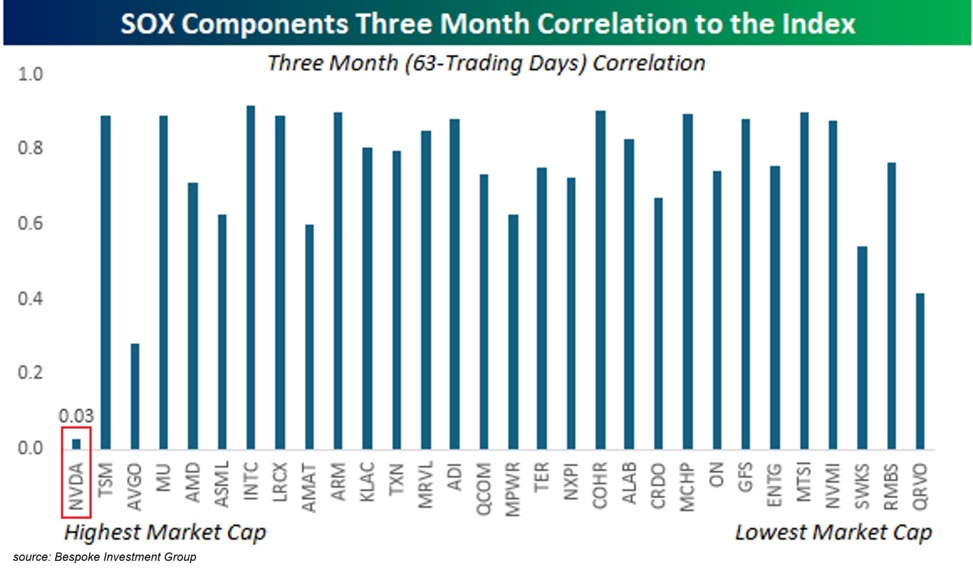
Fresh market signals from X show Nvidia (NVDA) with a 3-month correlation of just 0.03 versus the Philadelphia Semiconductor Index (SOX), essentially decoupling the stock from the broader chip complex. By contrast, Micron (MU) and Intel (INTC) are both still showing 0.90+ correlation with SOX, underscoring how differently investors are trading the group.
The setup comes right after Nvidia’s latest earnings release, where the company reported fiscal Q2 2027 revenue of about $96.2 billion, up 106% year over year, and guided fiscal Q3 revenue to roughly $108 billion. Nvidia also said it expects about 70% revenue growth in fiscal 2028, framing the outlook as supply constrained rather than demand constrained.
That split matters for the rest of semis: NVDA’s idiosyncratic AI narrative can dominate price action even when the sector index is moving for other reasons. MU and INTC, meanwhile, appear more tied to the broader semiconductor tape and the memory/cycle trade, which can make their moves look much closer to SOX.
For now, the X signal is best read as a change in trading structure, not a directional call. Nvidia management has repeatedly emphasized constrained supply, which helps explain why the stock can behave more like a standalone AI asset than a typical index component.
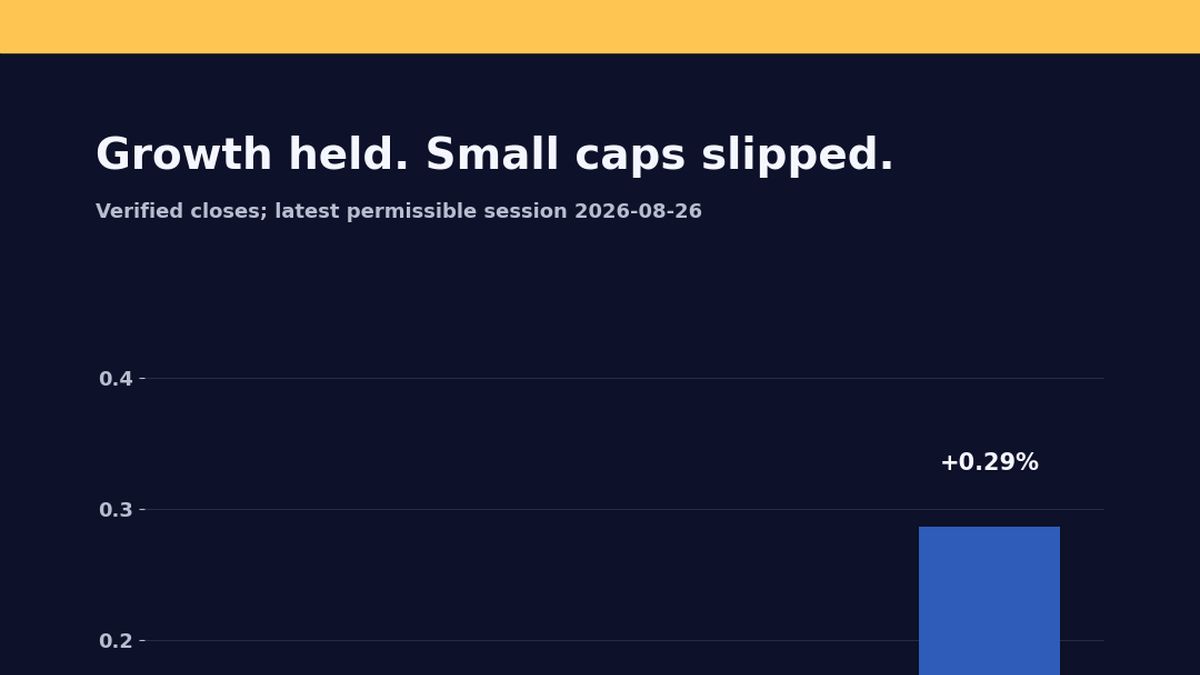
On Aug. 26, U.S. markets continued to split into winners and laggards: SPY rose 0.32% while TLT also gained 1.10%, and the VIX fell 2.52%. The X signal framed it as a session where growth held up, but duration did not fully confirm the move.
The broader context is a selective market rather than a clean risk-on breakout. X posts pointed to QQQ up just 0.09%, IWM down 0.10%, and UUP up 0.29%, a mix that suggests strong growth leadership alongside a firmer dollar and softer breadth.
That backdrop matters because equal-weight participation is a key check on whether the rally is widening. A news item in the local wire noted that Invesco’s RSP crossed $100 billion in assets this month, underscoring the market’s ongoing focus on breadth, while the X feed said RSP was negative and tech remained the main source of support.
For trading, the signal is about relative performance across SPY, TLT, QQQ, IWM and UUP rather than a simple index-level headline. If long-duration assets and the dollar keep moving in the same direction, dispersion across sectors and market caps is likely to remain the dominant feature of the tape.
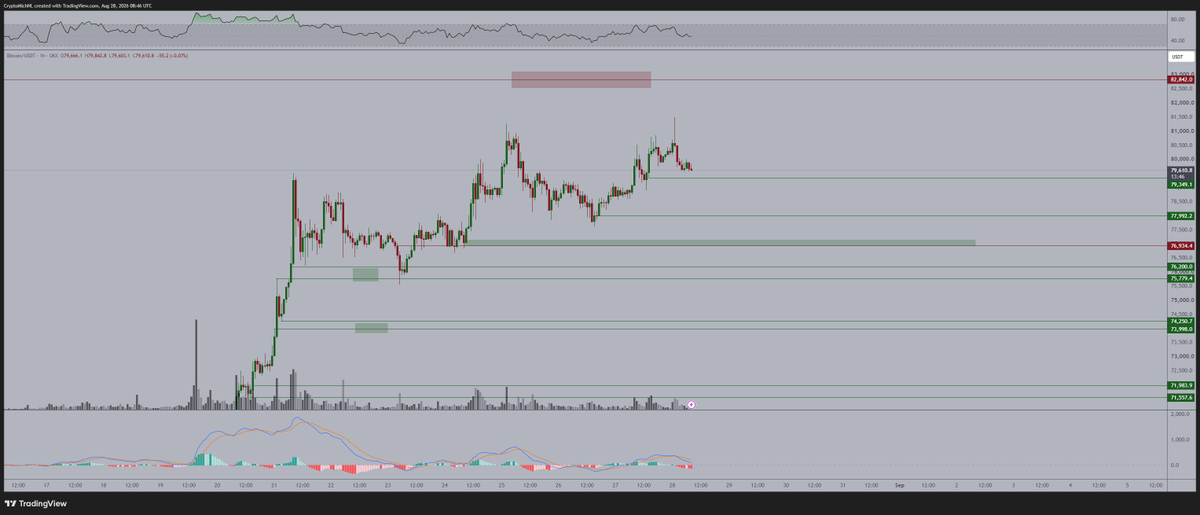
Bitcoin briefly swept the highs and then eased back, but it remained above $79,000. Traders on X are now flagging $79,300 as near-term support, with $77,900 and $76,900 seen as possible quick retest levels.
The broader setup still has a well-watched overhead supply zone near $82,000 to $82,500. Fund-flow data also remains constructive: U.S. spot Bitcoin ETFs have posted eight straight sessions of net inflows totaling about $2.8 billion, with August inflows running at roughly $3.3 billion so far.
For market participants, that keeps the focus on crypto-exposed equities such as Coinbase (COIN), even as short-term traders debate whether the stock is nearing a take-profit zone. Those comments reflect trading views rather than any new corporate disclosure.
No fresh company filing or regulatory decision was cited in the latest signals. The immediate story is the market’s attempt to define the next trading range while waiting to see whether demand from ETFs and spot buyers can keep absorbing selling near resistance.
Marvell Technology fell as much as 5.8% in after-hours trading after reporting second-quarter results. The company posted revenue of $2.73 billion and adjusted earnings of $0.94 per share, both ahead of Wall Street expectations.
The market’s focus was less on the beat itself than on what comes next. After Nvidia’s strong results lifted the AI complex, Marvell became another checkpoint for investors looking to confirm that demand for data-center chips and networking gear is still holding up.
The stock’s post-earnings slide suggests investors still want more than a modest upside surprise in a name that has already run hard this year. Even with an upgraded outlook, Marvell was not enough to extend the AI rally on its own.
Attention is now shifting to Fed Chair Warsh’s Jackson Hole remarks, which could shape rate expectations and keep pressure on growth-stock valuations. For Marvell, the key question is whether its data-center momentum can continue into the next quarter.
Strategy unveiled a new capital framework with up to $1B in MSTR and Digital Credit buybacks, lifting shares 12%+ while Benchmark reiterated Buy with a $570 target.
2026-07-06게시물 27개 · 작성자 25명
MicroStrategy sold $216M in Bitcoin to fund dividends, pushing BTC below $62K, with the firm's cash reserves rising to $2.55B.
2026-08-03게시물 26개 · 작성자 20명
Strategy boosted USD reserves by $250M and repurchased $81M of STRC, extended USD Duration to 2.3 years, and sold 1,638 BTC at $63,957 average; shares down 41% YTD.
2026-08-10게시물 17개 · 작성자 15명
Strategy increased USD reserves by $650M, repurchased $109M of STRC, extended Duration to 2.7 years, and sold 1,690 BTC at $64,262 average.
2026-08-27게시물 5개 · 작성자 5명
Strategy claims holdings of 840,447 BTC (1 in every 25 ever to exist), with market cap surpassing eBay at $48.45B.
2026-08-28게시물 4개 · 작성자 4명
BTC reclaimed $80K (up 25% from June low) fueling MSTR +12%, Peter Schiff flagged short-covering rally, while Strategy said USD assets nearly offset debt, net leverage down to 0.1%.
Market recap featured Moderna's vaccine progress, Treasury Secretary Bessent hinting at fiscal news, and a growing divergence between Treasury yields and economic surprises.
2026-08-21게시물 6개 · 작성자 6명
Crypto saw its seventh-largest liquidation event, Bitcoin gained, and Bessent confirmed plans for a new fiscal-consolidation announcement.
2026-08-22게시물 4개 · 작성자 3명
Focus shifted to China's oil role in sanctions, IRS tax credit changes, and Bessent's rule altering noncitizen eligibility.
2026-08-24게시물 3개 · 작성자 3명
Fidelity doubled gold holdings amid Fed uncertainty, gold exceeded $4,700, and Treasury yields fell over potential big buyback plans.
2026-08-27게시물 3개 · 작성자 3명
More crude shipments from Kuwait and Qatar through the Strait of Hormuz, with a Fed governor citing this in inflation forecasts.
2026-08-28게시물 2개 · 작성자 2명
Citi noted Treasury cap could pressure the dollar and removed its underweight Treasury position.