Nvidia reported second-quarter revenue of $96.22 billion for the period ended July 31, 2026, with data center revenue reaching $89 billion. The company also guided third-quarter revenue to $108 billion, plus or minus 2%, according to the latest earnings release and wire reports.
The new numbers add fresh evidence that demand for AI infrastructure remains exceptionally strong. Nvidia has been at the center of a broader wave of spending by cloud providers and large enterprise customers, and market commentary has increasingly framed the company as a key barometer for the AI capex cycle.
For investors, the report matters well beyond NVDA itself. Semiconductor peers, memory suppliers, and data center hardware names often trade off expectations for sustained GPU demand, while the broader Nasdaq can react to any sign that AI spending is accelerating or cooling.
Some social posts described the quarter as a move past $1 billion in daily revenue and cited 106% growth, but the clearest and most verifiable figures remain the company’s reported quarterly revenue and guidance. Those official numbers are enough to keep Nvidia at the center of the market’s AI debate.
Salesforce reported fiscal second-quarter revenue of $11.35 billion, up 11% year over year, and adjusted earnings of $5.90 a share, both ahead of Wall Street expectations. The company also disclosed a $2.6 billion gain on strategic investments, including the value uplift from its Anthropic stake.
The clearest incremental signal was AI traction. Salesforce said annualized revenue from Agentforce passed $1.5 billion, up 240% from a year earlier, while Agentforce and Data 360 together reached nearly $3.9 billion in annual recurring revenue.
Investors responded positively, with the stock rising in after-hours trading and reports putting the move between 12% and 14%. Salesforce also lifted its full-year revenue guidance to $46.1 billion-$46.4 billion and unveiled an expanded Anthropic partnership that brings Claude deeper into its platform.
The market is still weighing whether Salesforce can turn AI usage into durable, repeatable revenue, rather than one-off valuation gains. Today’s update matters because it combines operating results, higher guidance and a fresh product integration in a single print.
NVIDIA said on Aug. 26 that Amazon Web Services plans to deploy an additional 2 million NVIDIA GPUs across its global infrastructure in 2027-2028, alongside plans for 100,000 GPUs in secure AWS facilities for U.S. government workloads.nvidianews.nvidia.com
The expansion goes beyond accelerators. NVIDIA said the collaboration also covers Vera CPUs, networking, Nemotron open models and physical-AI tooling such as Omniverse, Isaac and Jetson, building on an earlier AWS plan to add 1 million NVIDIA GPUs starting in 2026.theverge.com
For investors, the announcement reinforces NVIDIA’s data-center demand backdrop and underscores Amazon’s role as one of the largest buyers of AI infrastructure. The news also landed alongside NVIDIA’s quarterly outlook, which helped keep attention on its cloud and chip spending cycle.straitstimes.com
NVIDIA’s earnings-call commentary suggested the AWS rollout starts this quarter and extends through fiscal 2029 Q2, though media reports vary on the wording of the timetable. The 2 million-GPU figure itself was consistent across NVIDIA’s release and multiple wire reports.themarketsdaily.com
Apple has started sending media invites for a product event on Sept. 9, with multiple outlets and a Reuters report aligning on a 1 p.m. Eastern start time. The company is expected to use the keynote to unveil its next iPhone lineup.
The event matters because Apple is widely expected to introduce the iPhone 18 Pro and iPhone 18 Pro Max, alongside its first foldable iPhone. Separate reporting suggests the standard iPhone 18 and some lower-end models may be held back until spring 2027, underscoring a shift in Apple’s launch cadence.
For markets, AAPL is the main name to watch, with Apple’s launch events often acting as short-term catalysts for the shares. If a foldable device is unveiled, suppliers tied to displays, hinges and assembly could also draw attention, though the concrete impact will depend on what Apple actually shows on stage.
Reuters and other outlet coverage have now independently reinforced the Sept. 9 date. Apple has not publicly detailed the product list beyond the event invite, and some naming rumors remain unconfirmed reporting rather than fact.
Trump signs order to curb foreign 69 kV grid gear, including transformers and inverters영어 원문
The White House can block selected equipment from the bulk-power grid on national-security grounds, with DOE due to write implementation rules in 120 days.
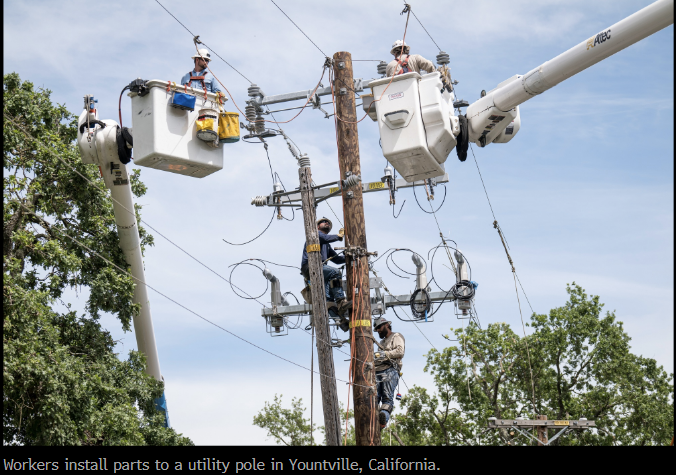
President Donald Trump has signed an emergency order that would let the White House restrict certain foreign-made equipment and software from the U.S. bulk-power grid when officials deem it a security risk. Reports say the scope covers 69 kV-and-up equipment, including transformers, inverters and battery-storage-related gear.
The move extends Washington’s recent tightening around critical-energy supply chains and grid cybersecurity. In July and August 2026, the FCC added foreign-produced connected power inverters to its Covered List, limiting new equipment authorizations for those devices; the broader policy trend has been toward category-based, entity-neutral restrictions rather than named-company sanctions.
Markets have already started to price the inverter angle. SolarEdge rose after UBS pointed to new inverter import curbs and lifted its rating, with the stock trading as high as $32.22, up about 8%; Enphase has also been dragged into the policy discussion, though the latest signal is centered on grid-security screening rather than a direct action against any one company.
The public reporting indicates the order is signed and the Energy Department has 120 days to write the rules. Exactly which models, suppliers and previously authorized devices will be affected remains unclear until the implementing text is released.
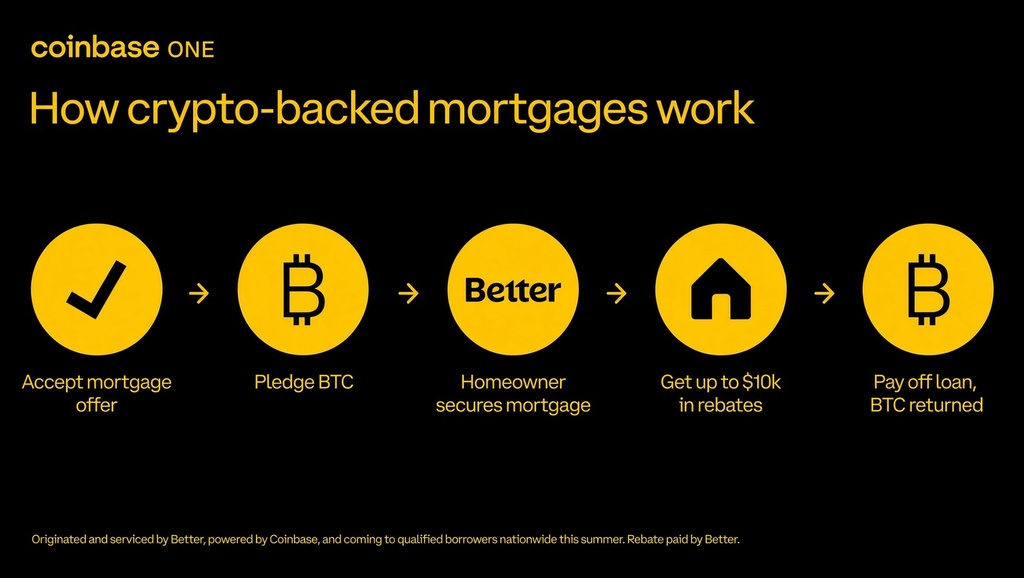
Coinbase and Better Mortgage have widened their Bitcoin-backed home loan offering to more qualified U.S. borrowers, allowing BTC to stand in as collateral for a down payment instead of forcing a sale. The structure pairs a standard conforming mortgage with a separate loan secured by pledged Bitcoin, and the companies say normal market moves will not trigger margin calls.
The product is not brand new. Public reporting first surfaced the plan in March, and the companies later closed an initial deal in June; the latest change is a broader availability push, including eligibility for Coinbase One members and a lender credit worth 1% of the mortgage amount, capped at $10,000.
For Coinbase, the move reinforces a key theme in its consumer strategy: making digital assets more useful in everyday finance. For Better, it creates a niche funding path tied to crypto wealth, while keeping the first lien aligned with conventional mortgage rules.
The offering still comes with tight underwriting and collateral requirements. Borrowers must pledge Bitcoin worth about 250% of the down-payment loan amount, and the collateral can still be liquidated if the loan falls into serious delinquency.
Polymarket-linked chatter on August 26-27 showed Anthropic rising to a 63% implied chance of becoming the largest IPO by market cap in 2026, overtaking SpaceX in the market’s view. Multiple outlets picked up the move and framed it as a fresh shift in the private-company IPO race.
The latest swing comes against a backdrop of Anthropic’s June confidential S-1 submission to the SEC and a May funding round that reportedly priced the company at a $965 billion post-money valuation. SpaceX remains the main comparator, but the betting market now sees Anthropic as the more likely leader.
For markets, the bigger story is how public-IPO expectations are reshaping valuation references for two of the most closely watched private tech companies. Any eventual listing would also feed into sentiment around other possible 2026 IPOs, including OpenAI and other large-cap private names.
Neither company has publicly confirmed a firm IPO date. For now, the only hard number moving intraday is the market-implied probability, not the offering itself.
사건 전개
2026-06-30게시물 3개 · 작성자 3명
Palantir and Nvidia expanded their sovereign AI partnership, Goldman noted IPO volumes lag prior years, and Gulf investors sought a more active role in Silicon Valley.
시장
GLD and IBIT draw over $7 billion in a week as MSCI risk returns for Strategy영어 원문
Investors are piling into both gold and bitcoin as fiscal anxiety drives a fresh debasement trade, while Strategy faces renewed index-exit chatter.
Bloomberg reported on Aug. 26 that gold ETFs and bitcoin ETFs pulled in more than $7 billion over the past week, a record for any five-trading-day stretch. SPDR Gold Shares (GLD) and BlackRock’s iShares Bitcoin Trust (IBIT) were among the top inflow vehicles.
The surge underscores a “debasement trade” narrative, with investors using both gold and bitcoin as hedges against fiscal stress and currency erosion. The report also said IBIT’s year-to-date flow profile has moved back into positive territory after earlier outflows.
At the same time, Strategy remains in focus. Bloomberg said a rebound in bitcoin has eased some pressure on Michael Saylor’s company, but fresh concerns are resurfacing around the risk of an MSCI exclusion, which could affect passive investment flows into the stock.
For bitcoin-linked products, strong ETF demand continues to support the asset’s macro appeal. For Strategy, the MSCI question matters because index inclusion can influence ownership by benchmark-tracking funds and, in turn, liquidity for the shares.
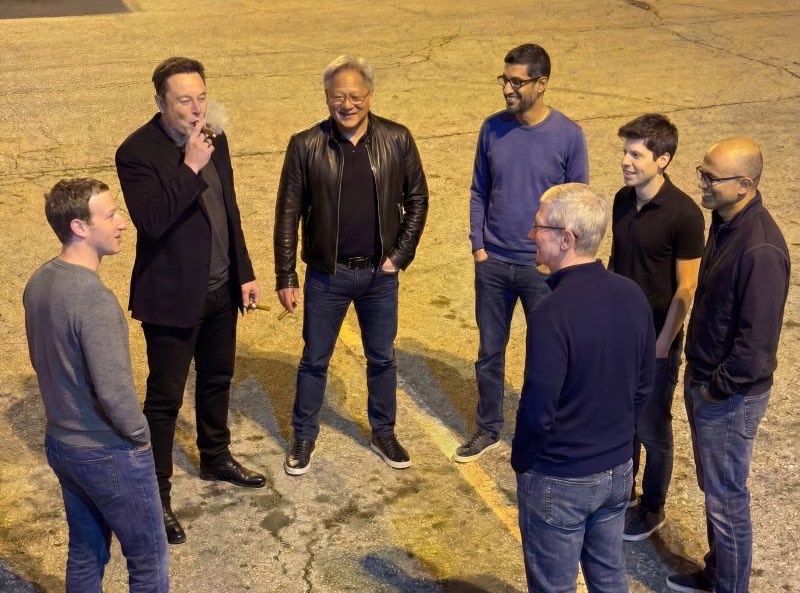
Multiple reports and market signals indicate that Elon Musk, Sam Altman, Jensen Huang and David Sacks are set to speak at a G20 technology meeting in North Carolina next week. The ministerial is scheduled for Sept. 1-2 at the Carolina Inn in Chapel Hill, with AI regulation and innovation on the agenda.
The key new wrinkle is that U.S. officials are said to be advancing a lighter-touch framework dubbed the “Carolina Principles,” which would discourage the creation of new oversight bodies. That adds a fresh policy signal after this month’s G7-side conversations on AI standards, chip access and international coordination.thenextweb.com
For markets, Nvidia and AI-linked equities are the obvious focal points because Huang and Altman are among the scheduled speakers. Investors will be watching for any guidance on model testing, compute buildouts or chip flows, although the current reports are still about event participation rather than formal policy announcements.
So far, the public record is limited to media reports and trading-platform alerts; there is no full official agenda or binding outcome. That means the meeting is best viewed as a policy-setting venue, not a source of immediate regulation. It could still shape how Washington frames AI oversight heading into the autumn.
The Wall Street Journal reports that Google is moving its roughly 90-person AI responsibility team out of DeepMind and into its global affairs organization. The team focuses on the risks and societal impact of artificial intelligence, making it a key part of Alphabet’s AI governance structure.
The move comes after Google DeepMind’s earlier leadership reshuffle, in which Demis Hassabis stepped back from day-to-day management and Koray Kavukcuoglu took on a larger role. Recent reports have also said some nontechnical DeepMind teams were shifted into corporate reporting lines, reinforcing the perception that Google is tightening control over its AI organization.
For investors, the immediate impact is about Alphabet’s AI narrative and governance expectations rather than near-term revenue. Any widening gap between AI product teams and responsibility functions could draw more scrutiny around GOOGL’s Gemini rollout, Google Cloud AI push, and broader commercialization strategy.
Google has not yet laid out a detailed public explanation for the latest internal move. For now, the change underscores a continuing rebalancing between AI development speed and the company’s safety and policy infrastructure.
사건 전개
2026-07-14게시물 14개 · 작성자 11명
Reflection AI signed a $1B+ compute deal with Nebius for Nvidia GB300 chips, while a DeepMind co-founder urged the US government to create a new agency for frontier AI safety testing.
매크로🔥진행 중
US 5-year note auction clears at 4.393% as bid-to-cover rises to 2.37영어 원문
The latest Treasury sale showed firmer demand for intermediate maturities, with the tail narrowing sharply from the prior auction.
The U.S. Treasury sold $70 billion of 5-year notes with a high yield of 4.393%, down from 4.408% at the prior sale. The tail narrowed to 0.2 basis points, while the bid-to-cover ratio improved to 2.37 from 2.28.
The allocation mix also firmed: indirect bidders took 61.51% of the issue, direct bidders absorbed 28.44%, and primary dealers took 10.05%. That compares with the prior auction’s 59.2% indirect share and 13.53% dealer take, suggesting less balance-sheet strain at the auction.
The result marks a clear improvement from the weaker 5-year auction on July 27, when demand metrics softened across the board. Market participants often watch the 5-year tenor closely because it sits at the hinge between front-end policy expectations and longer-dated term premium.
The auction itself did not include an official policy response. Its significance lies in what it says about demand for intermediate-duration Treasuries, which can feed into Treasury yields and broader dollar pricing if the improvement persists.
사건 전개
2026-08-20게시물 3개 · 작성자 3명
Treasury Secretary Bessent recommends 5-year corporate debt issuance, US national debt tops $40 trillion, and Hyperliquid and Ethereum lead the rally.
The U.S. advance goods trade deficit widened to $118.8 billion in July, up from a revised $101.4 billion in June and well above the roughly $100 billion consensus. Goods imports rose 3.7% to $318.2 billion, while goods exports fell 2.9% to $199.4 billion.
The figure comes from the Census Bureau’s advance estimate and was also mirrored by FRED’s AITGCBS series at -$118.806 billion for July. Advance trade data are closely watched because they can move the market’s read on net exports and third-quarter GDP.
For markets, the release mainly feeds into the dollar, Treasury yields and trade-sensitive sectors such as shipping, logistics, retailers and industrial suppliers. No single stock is the direct subject here, as the report is a macroeconomic data point.
The full trade report and later revisions will matter for the composition of the move, especially whether the July swing was driven by capital goods, consumer goods or industrial inputs. That will help determine how much of the deficit widening flows through to growth estimates.
OpenAI on Aug. 26 unveiled Jalapeño, its first custom inference chip, saying the system delivered 1.5x to 1.9x more AI work per watt in tests against Nvidia Blackwell/GB300-based systems, with lower end-to-end latency. The chip, co-developed with Broadcom, is slated to enter OpenAI’s infrastructure by year-end.
The announcement adds hard numbers to a theme that has been building for months: hyperscalers want more control over inference economics. SemiAnalysis said Jalapeño’s results are notable, while also warning the comparison is not perfectly apples-to-apples because the chip uses HBM4, making Nvidia’s newer Rubin platform a closer peer.
For the market, the immediate read-through is to Nvidia and Broadcom. Analysts quoted by CNBC said a custom ASIC can reduce OpenAI’s reliance on Nvidia for some workloads, especially inference, though Nvidia still matters for training and highly programmable tasks thanks to CUDA and its broader software stack.
OpenAI said it will continue using accelerators from Nvidia and other partners, rather than replacing them outright. Jim Cramer said he remains unconvinced the chip changes Nvidia’s competitive position in a meaningful way.
사건 전개
기업
Strategy says 840,447 BTC equals 4% of Bitcoin’s 21 million cap영어 원문
The latest X post reiterates its massive BTC stash as investors keep watching MSTR’s balance-sheet strategy
Strategy said on X that it holds 840,447 bitcoin, describing the position as “1 of every 25 bitcoin that will ever exist.” Cointelegraph independently echoed the same figure in a same-day update, reinforcing that the company’s BTC stash remains unchanged.
The fresh signal is not a new purchase but a renewed emphasis on the scale of Strategy’s holdings. That comes after reporting this week that the company bought zero bitcoin in the Aug. 17–23 period and instead expanded cash reserves and a separate USD Cash account.
For the market, the post keeps MSTR in focus as a leveraged proxy on bitcoin and on the company’s evolving capital structure. With 840,447 BTC representing about 4% of the 21 million-coin supply, investors continue to price the stock around both BTC exposure and the firm’s financing tools.
The post itself did not announce any new buying or selling. It should therefore be read as a status update on holdings, with the broader context coming from the company’s Aug. 24 disclosure and subsequent coverage.
Nvidia said in its latest quarterly filing that it took a $400 million charge in the first half tied to excess H200 inventory and purchase obligations as demand softened. The company also disclosed that three direct customers accounted for 44% of first-half revenue.
The update adds to a year of export-control-related friction around Nvidia’s high-end data center chips. Nvidia had previously taken a $4.5 billion charge tied to H20 inventory and purchase obligations, and the new H200 disclosure underscores that inventory risk has not fully cleared.
Operationally, Nvidia still posted $46.7 billion in quarterly revenue and $41.1 billion from data center sales, highlighting robust AI infrastructure demand. But the H200 charge and concentrated customer mix will keep investors focused on order timing, product allocation, and exposure to a small number of large buyers.
Nvidia did not frame the H200 charge as a sign of renewed China shipments. Instead, the filing reads as another reminder that inventory and purchase-commitment costs remain a live issue alongside growth in Blackwell-related demand.
Nike shares slid again on Aug. 26, closing at $39.48, down 3.12% on the day and widely described as a fresh 10-year low. Intraday and closing-price references from market coverage both point to the same level.
The latest move was not driven by a single company announcement. JPMorgan cut Nike to Sell on Aug. 4 with a $40 target, and weak results from Dick’s Sporting Goods renewed concerns about athletic footwear demand and wholesale conditions.
The selloff has also weighed on sentiment across the sportswear space, including names such as Lululemon and On Holding. For Nike, investors are focusing on the pace of wholesale recovery, overseas demand, and inventory normalization rather than any short-term bounce.
Nike did not issue a new standalone response to the stock move. The market is instead repricing the company against a slower recovery path and a still-soft retail backdrop.
The U.S. FDA has approved Revolution Medicines’ daraxonrasib, to be sold as Rasonque, for previously treated metastatic pancreatic cancer and for patients who are not candidates for multi-agent systemic therapy. The company said physicians can prescribe it immediately, and the wholesale acquisition cost is $39,800 for a 30-day supply.
The decision was backed by a Phase 3 study of about 500 adults with metastatic pancreatic adenocarcinoma. In the trial, median overall survival was 13.2 months with Rasonque versus 6.7 months with chemotherapy, and company/disclosed data cited a roughly 60% reduction in death risk.
For investors, the approval converts RVMD’s pancreas program into a commercial launch and sharpens attention on reimbursement, gross-to-net discounts and uptake among government payers. Revolution said more than 2,000 patients had already received the drug through an expanded-access program, and some of those patients are expected to transition to commercial supply within months.
The FDA said the approval came more than six months ahead of the user-fee deadline. Revolution also said it expects a meaningful share of eligible patients to be covered by government payers, with initial gross-to-net discounts likely in the 20% to 30% range.
Kioxia and SanDisk said today they plan to invest more than $31 billion in Japan to expand memory production. The announcement centers on high-density 3D NAND aimed at AI data centers.
The new disclosure builds on earlier market chatter that Kioxia was preparing a major new project in Iwate and that the two companies were lining up a broader expansion in Japan. Today’s formal statement confirms the partnership and gives the plan a much firmer footing.
For investors, the headline matters most for SanDisk, whose turnaround story is tied to tighter NAND supply and firmer pricing. The move also keeps attention on memory-equipment suppliers and on whether AI demand can support another leg of capital spending across the sector.
The companies have not yet laid out a full multi-year spending schedule or complete commissioning timeline. Government support, site development and the pace of fab build-out remain the key follow-up items to watch.
Abercrombie & Fitch reported second-quarter fiscal 2026 net sales of about $1.3 billion, up 5% year over year, and earnings of $4.17 per diluted share. The company said roughly $100 million of IEEPA tariff refunds boosted operating income and helped drive the sharp earnings beat.sec.gov
The refund equated to about $1.75 per diluted share, according to the company’s earnings materials. Abercrombie also lifted its full-year EPS outlook to $13.10 to $13.60 and increased planned share repurchases to at least $500 million, underscoring a stronger cash-return narrative after the quarter.sec.gov
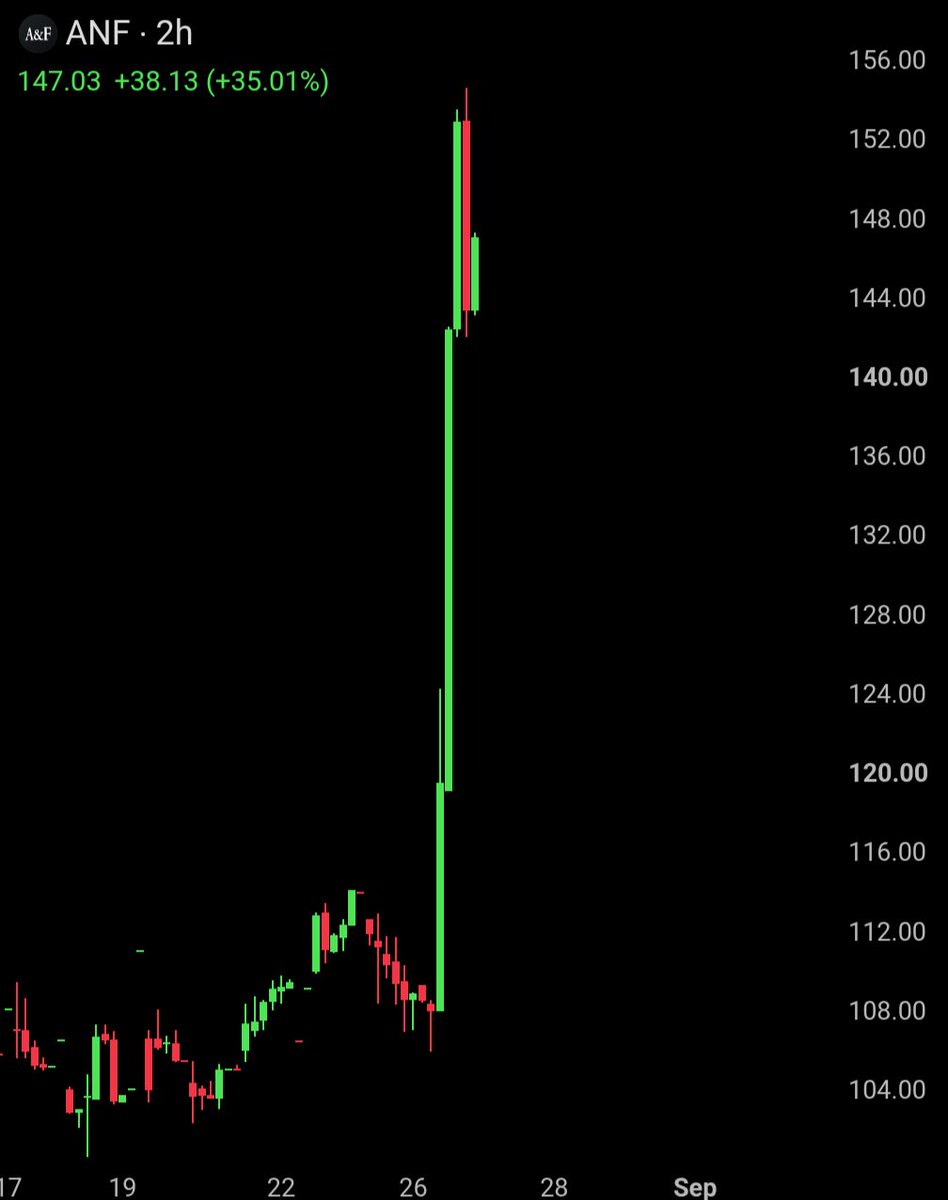
Shares of ANF surged about 35% to 40% intraday on Wednesday, with some reports describing the move as the company’s biggest one-day gain in years. The stock reaction was driven by company-specific earnings and guidance rather than broader market trends.forbes.com zacks.com
Salesforce reported fiscal second-quarter revenue of $11.35 billion for the period ended July 31, with adjusted earnings of $5.90 per share, both ahead of Wall Street expectations. The company also raised its full-year revenue outlook to $46.1 billion-$46.4 billion and guided third-quarter revenue to $11.42 billion-$11.50 billion.
The latest results showed continued momentum in Salesforce’s AI and data offerings. The company said annual recurring revenue from Agentforce and Data 360 was approaching $3.9 billion, with Agentforce alone topping $1.5 billion, while this quarter also included a contribution from Informatica following its acquisition.
For investors, the earnings update remains a major catalyst for CRM shares and a read-through for enterprise software peers watching AI monetization. Salesforce also expanded its partnership with Anthropic, adding more Claude integrations and a plugin for business workflows, which keeps the stock’s AI narrative front and center.
The quarter is important because it follows a market setup already focused on whether Salesforce can turn AI demand into durable growth. Today’s increment is not the launch itself but the fresh earnings evidence, updated guidance, and partnership details that sharpen the story around the company’s near-term trajectory.
Reuters reported on Aug. 13 that diesel was trading above jet fuel in Europe for the first time in more than a year, underscoring the strain in the region’s middle distillate market. Bloomberg’s Aug. 26 update adds a fresh development: Europe is taking diesel from Mexico for the first time in seven years as it scrambles for supply.
The supply backdrop has deteriorated on multiple fronts. Public reporting says Europe’s seaborne middle distillate imports from the Middle East Gulf fell to 40,000 barrels a day in May 2026, while Russian diesel exports were around 234,000 barrels a day in early July, versus an average of about 817,000 barrels a day in 2025.
The pressure is not confined to Europe. Bloomberg also said U.S. diesel inventories fell to the lowest seasonal level on record, a setup that could keep cracks elevated and support margins for refiners with export capacity, while raising costs for transport, farming and industry.
No new official response from Mexico or the European Union was included in the latest reports. The key update is the physical rerouting of diesel cargoes, which shows that the shortage has moved from a market warning to a trade-flow reality.
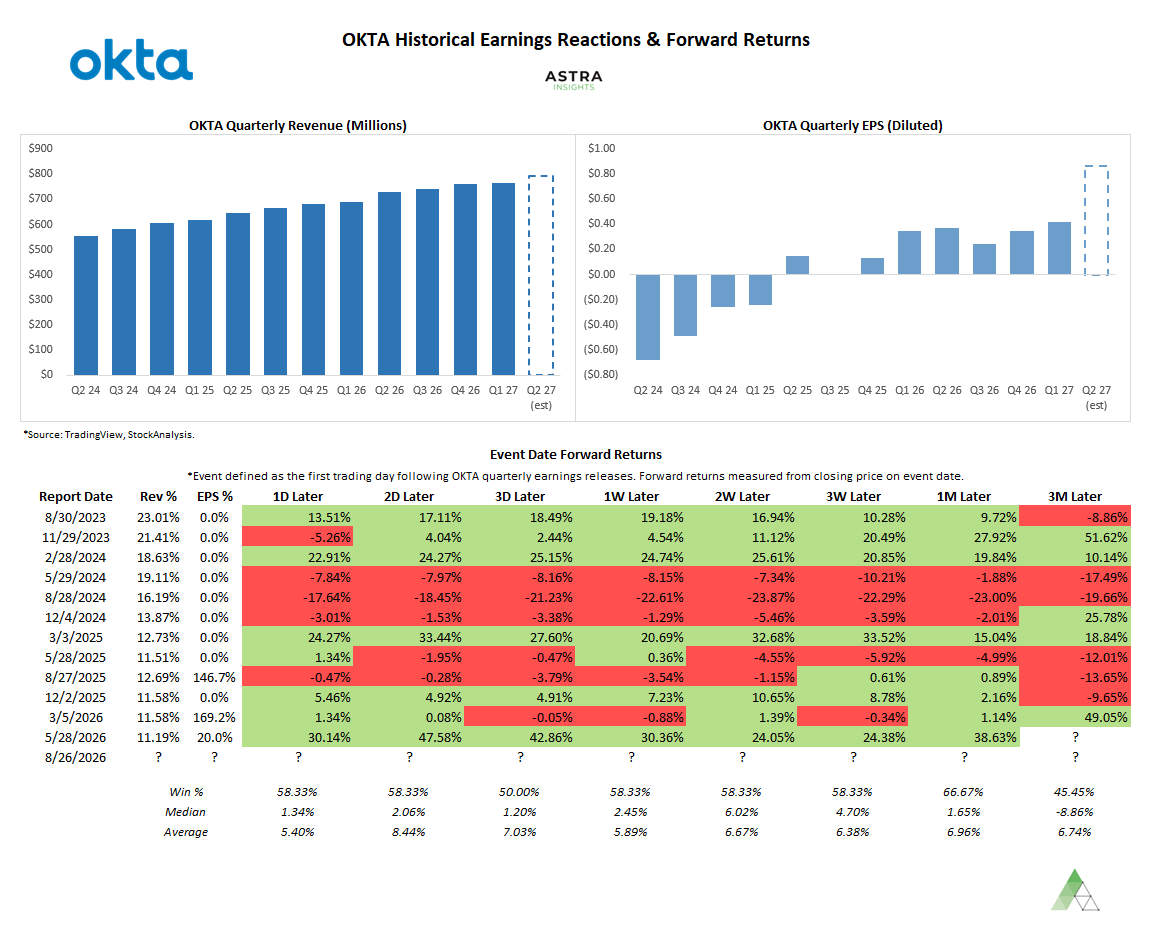
Okta reported fiscal second-quarter revenue of $805 million, up 11% year over year, and adjusted earnings of $1.05 per share, both ahead of estimates. Subscription revenue rose 12% to $793 million.
The new numbers were confirmed in Okta’s official earnings release, while X posts today focused on the same beats and the company’s updated outlook. Okta also said remaining performance obligations reached $4.858 billion, up 17%, with current RPO up 14% to $2.585 billion.
Management raised fiscal 2027 revenue guidance to $3.216 billion-$3.226 billion and pointed to AI agents as a growing security use case. The stock moved higher after hours, and the broader cybersecurity group also traded firmer as investors digested the reports from Okta and peers.
Claims that the results were leaked before the release were not independently verified, so they should be treated as commentary rather than fact. What is confirmed is that Okta has now published its quarterly results and improved its full-year outlook.
Moderna said on Wednesday it plans to sell $2 billion of convertible senior notes due 2032 in a private placement, with an option for initial purchasers to buy up to an additional $300 million. The company said proceeds will go toward general corporate purposes and capped call transactions.
The notes are part of a standard convert-debt financing structure used to raise capital while managing dilution risk. The filing also outlines a 2032 maturity, while follow-up coverage said the company may use proceeds for growth investments, including oncology, as well as debt repayment.
For Moderna shares, the news matters because MRNA is the direct issuer and any convertible deal can affect leverage, dilution expectations and trading dynamics. The transaction is still proposed rather than completed, so final size and pricing remain subject to market terms.
Follow-up reporting shows this is a financing step rather than a product or regulatory update. Investors will be watching the eventual terms, which will determine the deal’s cost and the extent of any equity-linked hedging.
Best Buy reported fiscal Q2 2027 adjusted earnings per share of $1.47, topping expectations, on revenue of $9.78 billion. The company also raised full-year adjusted EPS guidance to $6.70–$6.90 and revenue guidance to $42.3 billion–$42.8 billion.
The update extends the improvement signaled in the company’s prior quarterly report, when management had reiterated a full-year adjusted EPS range of $6.30–$6.60 and revenue of $41.2 billion–$42.1 billion. Best Buy said demand for computing and tablet upgrades remained resilient, helping offset a still-cautious consumer backdrop.
For investors, the key read-through is to BBY and other consumer electronics retailers and distributors, where a better replacement cycle can support sales and margin trends. The report also puts names tied to PCs, tablets and omnichannel retail back in focus as the company continues to frame demand as upgrade-driven rather than broad-based.
Best Buy’s results and outlook are being checked against the company’s official earnings release and multiple wire reports, all pointing to the same beat-and-raise setup.
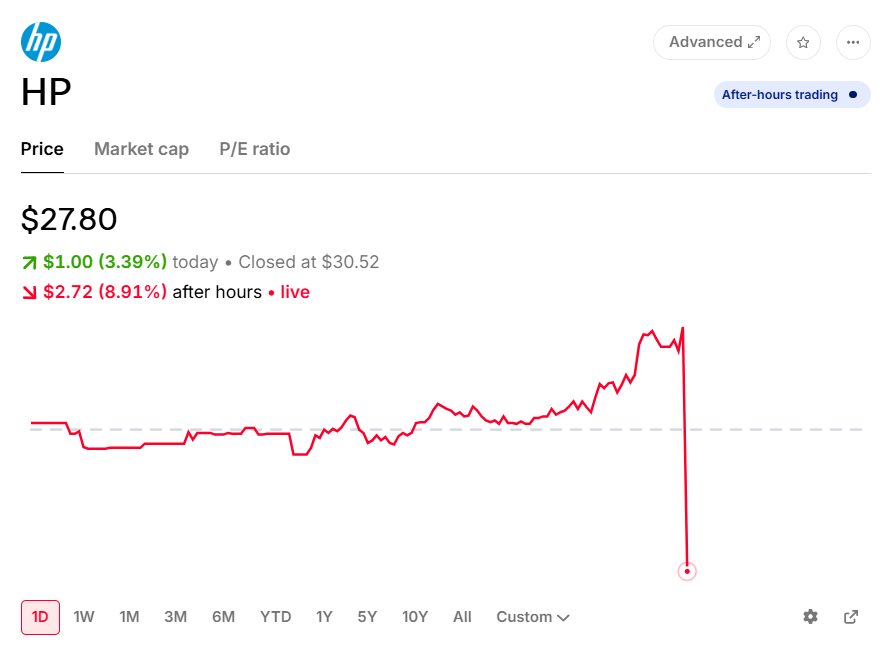
HP Inc. reported fiscal third-quarter revenue of $15.7 billion, up 12.5% year over year, with adjusted EPS of $0.83, up 11%. The company also raised its full-year FY26 adjusted EPS outlook to $3.19 to $3.29 and free cash flow guidance to $3.0 billion to $3.2 billion.
For the fourth quarter, HP guided adjusted EPS to $0.69 to $0.79, above consensus. Management said higher pricing, strength in premium and AI PCs, and a $0.19-per-share tariff refund benefit were part of the improved outlook.
The market response was softer, with HPQ falling about 10% to 11% after the report as investors focused on profitability pressure rather than the headline beats. Personal Systems revenue rose to $11.8 billion, but units fell 16%, while Printing revenue slipped to $3.9 billion, underscoring the cost and mix challenges in the business.
The print and PC maker’s results showed solid top-line momentum, but also highlighted how memory and component costs can weigh on margins. Going forward, investors will be watching whether premium PCs, AI PC adoption and cost actions can offset those headwinds.
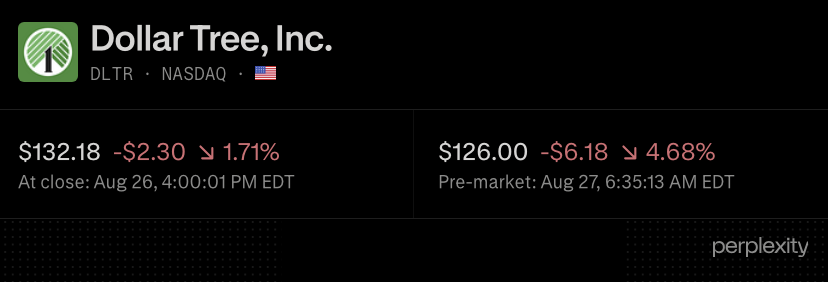
Dollar Tree reported second-quarter net sales of $4.89 billion on August 27, topping Wall Street estimates, while adjusted earnings per share came in at $1.39, also ahead of expectations. The company raised its fiscal 2026 adjusted EPS outlook to $7.70 to $8.05.
The update matters because management said the quarter benefited from tariff refunds, helping drive a sharp improvement in profitability. Dollar Tree had already scheduled its earnings release and conference call for Thursday morning, and the new numbers now give the market a clearer read on the company’s earnings power.
DLTR is the direct market focus here, with investors looking at same-store sales growth, margin expansion and whether the benefit from refunds can persist. Dollar General may come up in comparison, but the key story is Dollar Tree’s own beat and raised guidance.
Management is set to discuss the results and outlook on the earnings call. So far, the sales, EPS and full-year guide figures have been cross-checked by multiple outlets and the company’s filing-related disclosures.
Synopsys reported fiscal third-quarter revenue of $2.48 billion and non-GAAP earnings of $3.91 per share, both ahead of Wall Street expectations. The company also guided fourth-quarter revenue to $2.53 billion-$2.58 billion and non-GAAP EPS to $4.10-$4.16.
The quarter extends Synopsys’ run of AI-driven demand for chip design software, IP and simulation tools. Management has repeatedly said rising chip complexity and broader semiconductor investment are supporting demand across its design workflows.
Even so, the market’s reaction was muted after hours, with traders focusing on the fourth-quarter sales outlook, which was only roughly in line with consensus. Investors are also watching Ansys integration progress, margin trends and the company’s updated full-year targets.
Synopsys raised its fiscal 2026 revenue guide to $9.69 billion-$9.74 billion and EPS guide to $15.04-$15.10. As a result, SNPS remains the key ticker in focus, while any read-through to semiconductor design software peers depends on how sustainable the AI demand narrative looks from here.
X traders said AbCellera Biologics (ABCL) has gained about 120% since the first buy signal, but two sell signals have now appeared, pointing to a less clear short-term setup. The poster still argued that the weekly timeframe remains intact.
The backdrop is ABCL’s mid-August re-rating after phase 2 ABCL635 data, a new Vertex collaboration and a $200 million equity offering. Prior coverage said the ABCL635 readout was strong enough to shift the market’s view of the company from a platform story to a pipeline story.
For the tape, ABCL remains the cleanest single-name read-through from that earlier catalyst cluster. The same thread also referenced broader market signals in SPY, QQQ, VIX and TLT, suggesting the risk backdrop is still part of how traders are framing biotech momentum names.
This is a technical read from social media rather than a new company disclosure. The fundamental story around ABCL should still be anchored to the company’s filings and the published reports on ABCL635 and the Vertex deal.
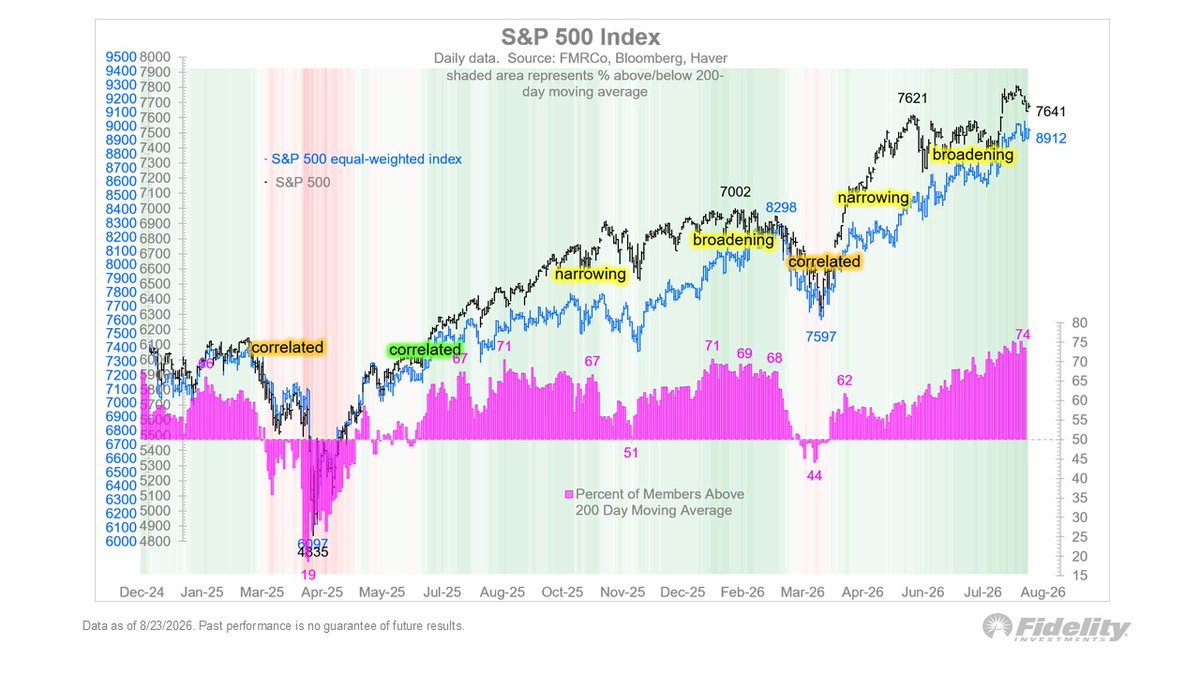
In afternoon trading Wednesday, the S&P 500 erased earlier losses and turned green, putting an end to what had been an eight-session losing streak — its longest since 2018. Market breadth looked constructive, with about 74% of stocks advancing, while the equal-weight S&P 500 was keeping pace with the cap-weighted index.
The move comes as investors continue to digest a busy run of big-tech earnings and valuation debates. Recent reports have kept attention on Nvidia’s results and on Apple-related headlines, including fresh follow-up coverage on Siri staffing changes and Apple’s still-strong profitability profile.
For the tape, Apple matters because Bespoke says AAPL has been the most correlated S&P 500 stock over the past three months. That makes SPY, AAPL and other mega-cap tech names key to watching whether the rebound has enough breadth to stick.
At this stage, the signal is about improving market internals rather than a single company catalyst. There have been no new official denials or confirmations driving this particular move.
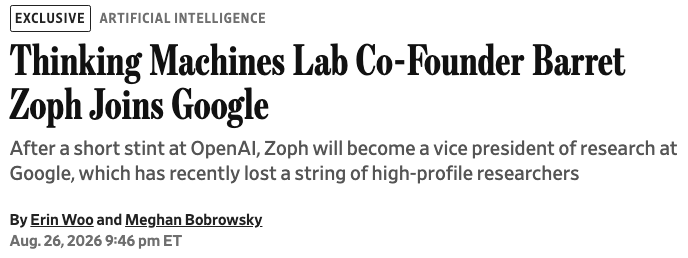
The Wall Street Journal reported that Google has hired Barret Zoph, co-founder and former CTO of Thinking Machines Lab, as vice president of research. Zoph is expected to work on Gemini and bring expertise in reinforcement learning and post-training.
The move underscores Google's continued push to strengthen its generative-AI bench as competition intensifies across model training, post-training, and product deployment. Zoph's background makes the hire notable for Gemini's development roadmap and for Google's broader AI research organization.
For investors, the news is primarily relevant to Alphabet (GOOGL), since executive hiring at this level can signal continued commitment to AI product and infrastructure spending. The appointment also feeds comparisons with other large-model players such as OpenAI and Anthropic.
The report has been widely circulated by market-news accounts on X, but the underlying detail cited in today's signal is the WSJ story itself. No additional official company statement was included in the reposts reviewed for this item.
기업
Benioff calls the “SaaSpocalypse” nonsense as CRM rallies over 20%영어 원문
Salesforce is using earnings, buybacks and AI products to push back on the idea that generative AI will hollow out SaaS economics.
Salesforce CEO Marc Benioff used a fresh media appearance to dismiss the so-called “SaaSpocalypse” as nonsense. The message extends the company’s post-earnings push to argue that AI will strengthen, not destroy, enterprise software demand.
The debate has been building since Salesforce’s latest earnings report, when the company posted $10.7 billion in revenue, up 13% year over year, and $41.5 billion for the full year, up 10%. Salesforce also guided for $45.8 billion to $46.2 billion in the next fiscal year and unveiled a $50 billion buyback plan while highlighting growth in Agentforce and Data 360.
The software sector has been swinging hard. CNBC reported that Twilio and Atlassian each jumped more than 20% after earnings, while Cloudflare rose 5.6%; earlier in the week, HubSpot and Datadog sold off sharply. Salesforce remains under pressure, but Benioff’s latest comments and the company’s AI partnership narrative are helping counter the view that generative AI will erode SaaS economics.
Anthropic CEO Dario Amodei also recently appeared with Benioff and said the company is not interested in destroying anyone, underscoring the public effort to frame the Salesforce-Anthropic relationship as a product partnership rather than a disruption story.
Reuters reported on August 26 that Nelson Peltz’s Trian Fund Management has no plans right now to make a take-private bid for Wendy’s. The update marks a sharp shift from earlier August reports that said Trian was preparing a consortium and could submit an offer in the coming weeks.
The new report lands against a weak operating backdrop for Wendy’s. In its second quarter, U.S. same-store sales fell 7% and traffic dropped 12.5%; the company also withdrew its 2026 outlook and cut its quarterly dividend to 7 cents a share.
Markets have been reacting to the bid chatter. Reuters previously reported Wendy’s shares rose about 12% after the first take-private story, while the latest denial led to a late-session selloff, according to the X signal cited in today’s news flow.
Wendy’s has said it would review any proposal submitted by Trian in line with fiduciary duties. Trian’s stake of 16.24% makes it one of the chain’s most important shareholders, even without a formal bid on the table.
사건 전개
2026-08-12게시물 3개 · 작성자 3명
Reports emerged that Nelson Peltz's Trian was preparing a take-private bid for Wendy's with a consortium, sending shares higher.
2026-08-27게시물 7개 · 작성자 6명
Trian denied plans to bid for Wendy's at this time, according to sources, clarifying earlier reports.
기업
Infleqtion adds $20 million NASA follow-on, QGGPf funding reaches $40 million영어 원문
The new contract doubles NASA’s committed investment in the quantum gravity pathfinder while the 2030 demo timeline stays in place.
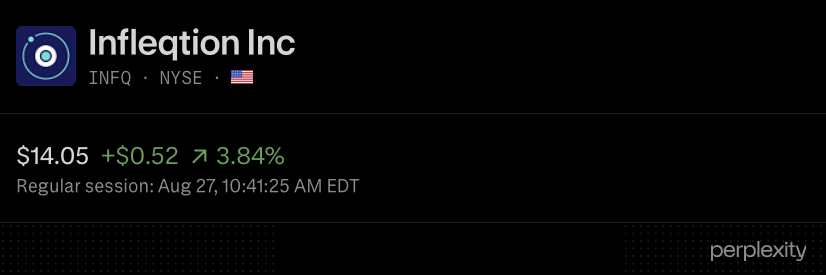
Infleqtion said NASA has awarded it a $20 million follow-on contract for the Quantum Gravity Gradiometer Pathfinder, lifting total NASA investment in the program to $40 million. The company framed the award as another step toward the mission’s planned flight demonstration.
QGGPf is a NASA Jet Propulsion Laboratory-led effort to fly a standalone quantum gravity sensor in low Earth orbit. Earlier company and project materials said the mission had already secured more than $20 million in contracted funding and was targeting a one-year demonstration in 2030.
For Infleqtion, the award reinforces the credibility of its neutral-atom sensing platform and keeps the NASA relationship front and center as the company moves through its public-market process tied to Churchill Capital Corp X. Investors may also watch broader quantum and space-tech sentiment, although this is a contract update rather than a change in commercial revenue recognition.
NASA’s public materials and Infleqtion’s February 2026 release both describe a collaboration with Goddard Space Flight Center, the University of Texas at Austin, Monarch Quantum and Jemba9. The mission is designed to measure subtle changes in Earth’s gravity field to help track water, ice and land mass movement over time.
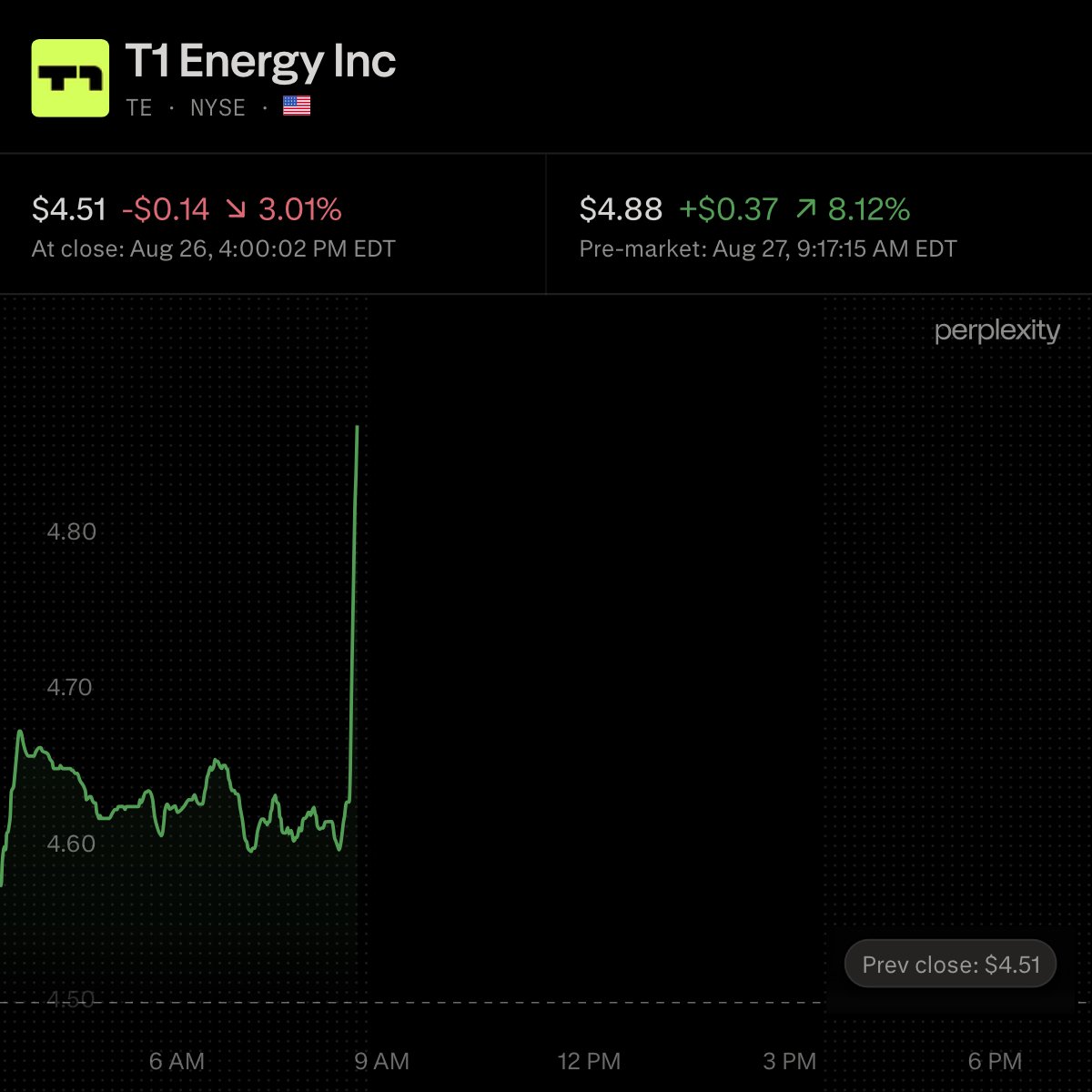
T1 Energy said local officials in Mo i Rana, Norway, approved a rezoning permit for part of its Giga Arctic campus for data-center use. The company said the initial 50 MW target remains aimed at 2027, while its grid-queue position stands at as much as 396 MW.
This is the latest step in a longer-running project. In March 2026, T1 said Norway grid operator Statnett had assigned 50 MW to its existing industrial building in Mo i Rana, and the company has also been appealing a separate dispute over an additional 60 MW of grid capacity.
For investors, the key question is whether T1 can monetize the site as AI and data-center infrastructure rather than legacy manufacturing space. T1 says it is in talks with multiple counterparties, which could broaden the project’s optionality if power and build-out milestones hold.
The approval is an important planning milestone, but execution still depends on power delivery, construction timing and the outcome of the broader grid-capacity process. T1’s shares are the most directly exposed to the development.
Everpure (NYSE: P) reported fiscal second-quarter revenue of about $1.2 billion and adjusted earnings of $0.70 per share, both ahead of Wall Street expectations. The company also raised its FY27 revenue outlook to $5.03 billion-$5.07 billion and lifted its adjusted operating income guidance to $940 million-$960 million.
The key takeaway is not only the quarterly beat, but the size of the full-year reset higher. In its earnings release, Everpure said revenue grew 38% year over year, product revenue jumped 54%, and core software and services including Evergreen//One, Cloud Block Store and Portworx continued to gain traction.
The update matters for P because higher annual revenue and profit guidance can improve visibility into the business and support a re-rating narrative. Company disclosures and post-earnings coverage also pointed to RPO rising 44% to about $4.1 billion, reinforcing the longer-term demand pipeline.
Everpure published the results and call details through its investor relations site, and the company reiterated that the metrics include non-GAAP measures where applicable. No conflicting statement from the company was identified on the key figures cited here.
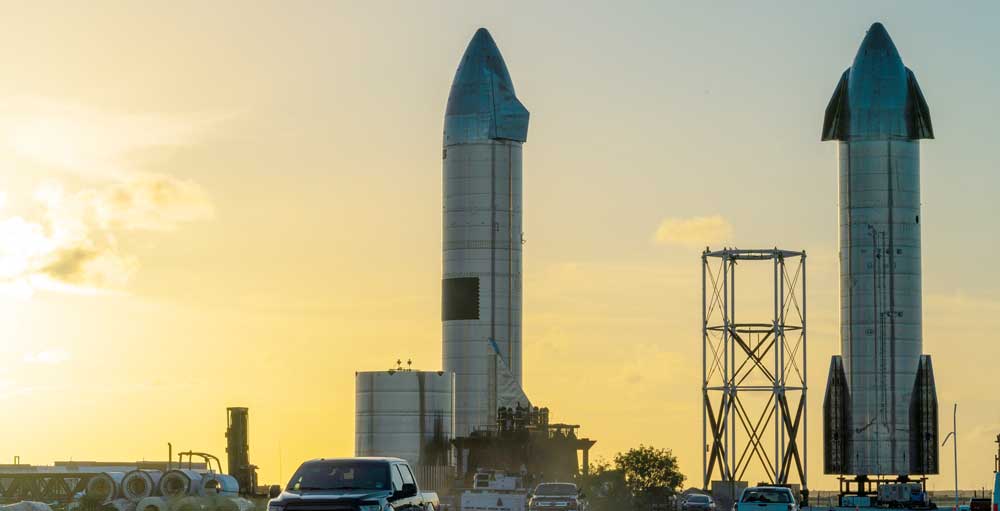
SpaceX said on Aug. 25 that it will build a new Starbase facility in Vermilion Parish, Louisiana, with an announced investment of $100 billion and construction slated to begin in 2027. The company said it is targeting the first Starship launch from the site in 2029.
The project extends SpaceX’s broader push to scale Starship operations beyond Texas and Florida. BBC reported the site will span 125,000 acres, while The Register said SpaceX described the Louisiana complex as being designed to handle as many as about 30 launches per day.
For markets, the announcement matters mainly as another sign of SpaceX’s capital intensity and the long runway for its Starship-dependent businesses, especially Starlink. TechCrunch said SpaceX has already spent more than $8 billion on Starship development, underscoring how central the rocket is to the company’s launch and satellite roadmap.
Louisiana economic officials said the project could create 3,000 direct jobs and more than 30,000 construction jobs at peak buildout. SpaceX also said it plans to work with state and federal agencies on shoreline protection, marsh restoration and wildlife conservation.
U.S. spot crypto ETFs continued to post net inflows on Aug. 26, according to a market flow post circulating on X: bitcoin funds drew $232.12 million, ether funds $192.35 million, Solana funds $9.14 million and XRP funds $28.14 million. The post also said BlackRock accounted for $115.66 million of ether buying on the day.
The new print follows a strong Aug. 25 session, when bitcoin ETFs took in $314.37 million and ether ETFs added $179.80 million, extending both categories’ streaks of positive flows. Earlier reporting put bitcoin ETF net assets at $99.05 billion and ether ETF net assets at $14.88 billion after that session.
For the market, the significance is breadth: capital is still entering BTC and ETH, while smaller allocations are also showing up in SOL and XRP products. That keeps leading names such as ETHA and IBIT at the center of the flow story and gives ETF trading volumes a fresh tailwind.
No issuer was reported to have disputed the Aug. 26 flow figures in the materials reviewed. Still, one day of inflows should not be read as a price call on its own.
Demis Hassabis stepped down as Google DeepMind CEO to become Chair, and Jeff Dean left Google to start his own company, sparking widespread discussion.
2026-08-07게시물 15개 · 작성자 9명
SemiAnalysis declared DeepMind no longer a frontier lab, and FT reported Google shifting AI control from London to Silicon Valley due to weak coding and enterprise AI.
2026-08-13게시물 7개 · 작성자 7명
Google sold AI resume-screening tools while its safety team built bypass filters; Gemini flagship delayed two months due to lagging performance, and Hassabis moved to chairman.
2026-08-20게시물 3개 · 작성자 3명
Discussions covered Google-Reddit partnership and AI talent exodus; Cognition denied sale rumors despite 123% headcount growth, and Hassabis highlighted cancer treatment goals.
2026-08-27게시물 5개 · 작성자 5명
WSJ exclusively reported Google moving its 90-person AI-responsibility team out of DeepMind into global affairs, raising independence concerns.