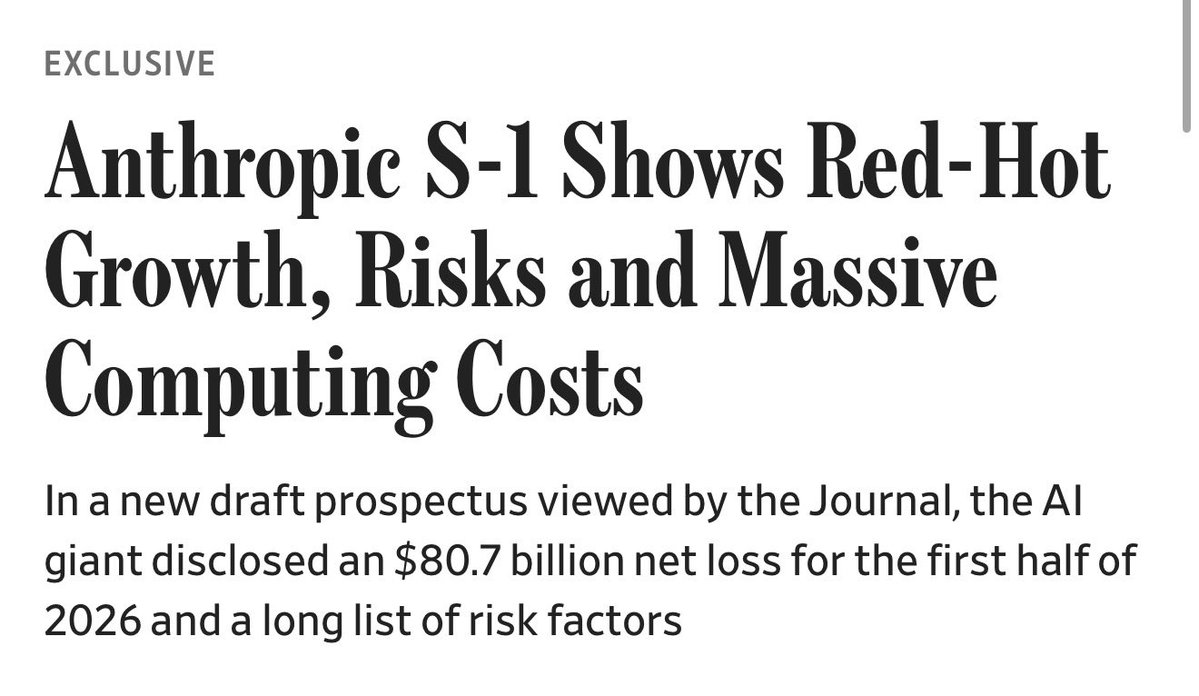
Anthropic Draft S-1 Shows $16.3B H1 Revenue Against $80.7B Net Loss
About $72B of the loss stems from accounting charges on convertible notes, not cash outflow; multi-hundred-billion compute commitments now frame the IPO debate
Anthropic generated about $16.3 billion in revenue in the first half of 2026, up roughly 15-fold from $1.1 billion a year earlier, while posting a net loss of $80.7 billion, according to a draft prospectus viewed by The Wall Street Journal. About $72 billion of that loss reflects accounting charges tied to changes in the value of convertible notes and other financing instruments, rather than cash leaving the business in the period.
Compute is the other thread in the draft: spending on computing and infrastructure reached nearly $9 billion in the half, above the $7.3 billion spent in all of 2025. Cloud commitments run to about $450 billion over the next seven to 10 years, including roughly $111 billion with Google and $31 billion with Microsoft, plus up to $86 billion to rent Nvidia chips; the filing also points to as much as $750 billion of compute spending in coming years.
For prospective IPO investors, the question is whether revenue growth can keep outrunning compute costs, alongside customer concentration: two clients accounted for about a fifth of first-half sales, per the draft. The commitments give suppliers including Google, Amazon Web Services, Microsoft and Broadcom multi-year revenue visibility, while concentrating counterparty risk on a single loss-making buyer.
Anthropic did not respond to a request for comment and Reuters said it could not immediately verify the report. Reuters reported in September that Anthropic posted a $42 billion net loss in 2025; some current and prospective investors who attended the company's investor day last week are weighing a lower valuation after the latest disclosures.
Sources:
Earnings
SpaceX Q3 revenue hits $14.58B as AI segment jumps 830%
Revenue up 161% year over year; net income $4.4B, with $16.4B of $19.6B capex going to AI infrastructure
SpaceX reported third-quarter 2026 revenue of $14.58 billion, beating estimates of roughly $12.87 billion and up 161% year over year. EPS came in at $0.35 versus a loss of $0.36 a year earlier, and net income was $4.4 billion against a $1.05 billion loss last year.
By segment, Space revenue was $1.8 billion, up 6%; Connectivity was $5.2 billion, up 69%; and SI reached $7.6 billion, up 830%. CNBC attributed the growth to the company's artificial intelligence business expanding about ninefold.
Total capital expenditures were $19.59 billion, of which about $16.4 billion, or roughly 84%, went to AI infrastructure, an annualized pace of about $66 billion. Operating income was $2.79 billion versus $2.24 billion expected, and operating cash flow was $13.1 billion.
SpaceX perpetual futures rose above $150 after the results. Ahead of the print, Barchart flagged an implied move of about 6%, a potential market cap swing of $120 billion, and pointed to the 2X Long SpaceX ETF $SPCM and 2X Short SpaceX ETF $SPCG.
A diplomat involved in the Iran-US negotiations said reports that a deal is "close" are "wrong," and that talks are continuing. Bloomberg and several other outlets cited a person familiar with the matter using similar language, without detailing progress.
Earlier reports of an imminent ceasefire understanding had moved equities and oil. Iranian state-linked media had also cited an informed source saying the text of a possible memorandum of understanding was not yet finalized and that Western reports were inaccurate.
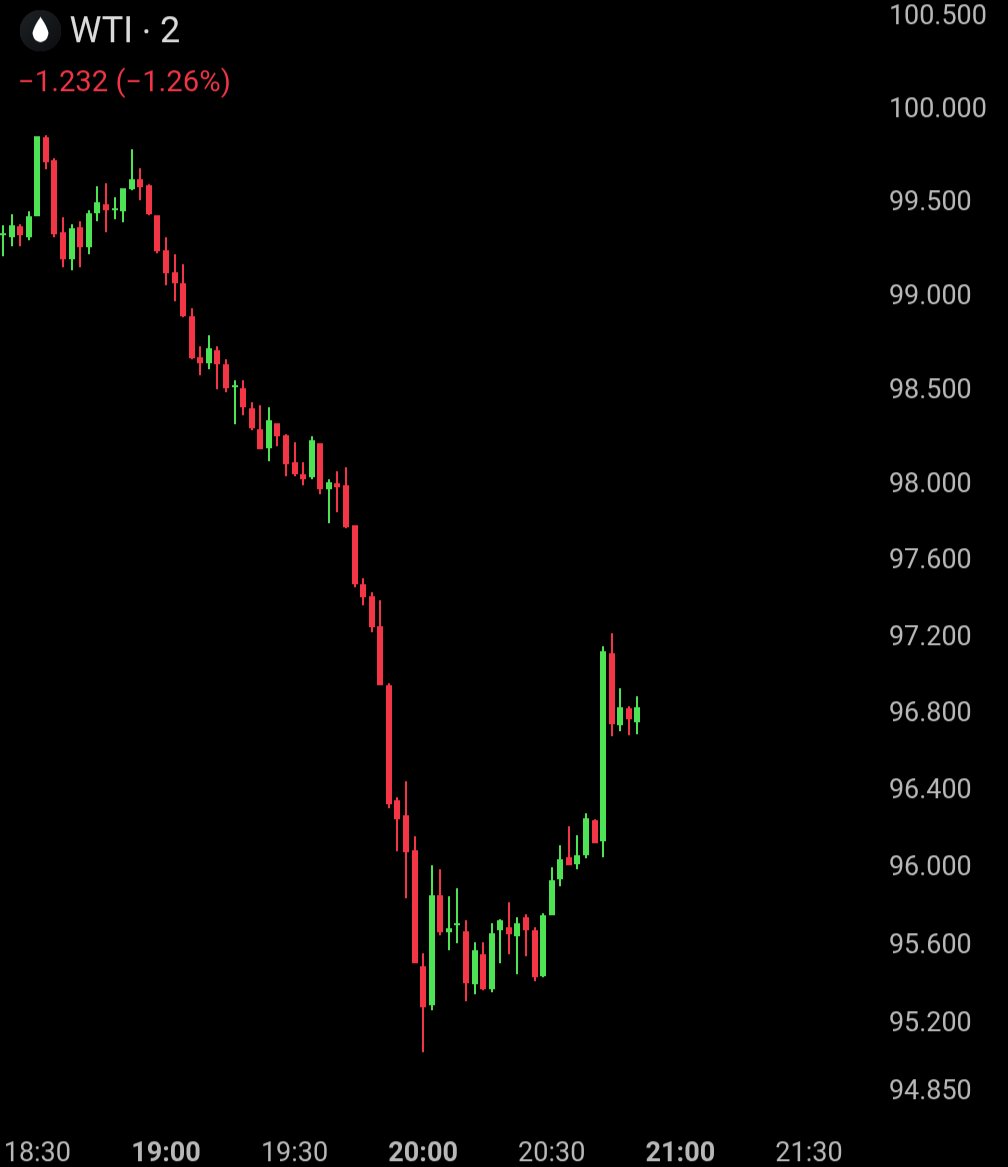
Oil moved back above $97 a barrel following the denial. Higher crude directly lifts the futures tracked by energy ETFs such as USO and raises cost expectations for airlines and transport; for equities, a renewed geopolitical risk premium typically weighs on risk appetite.
Neither the US nor Iranian government had issued a new public statement on the status of the talks as of publication. Whether the negotiations have produced concrete progress remains unverifiable without an official text.
Trump mandates self-generated power, community 'dividend' for new large data centers
AI data centers have become a local political flashpoint over water and power use; Trump's demand ties project approval to on-site generation and payouts to host communities
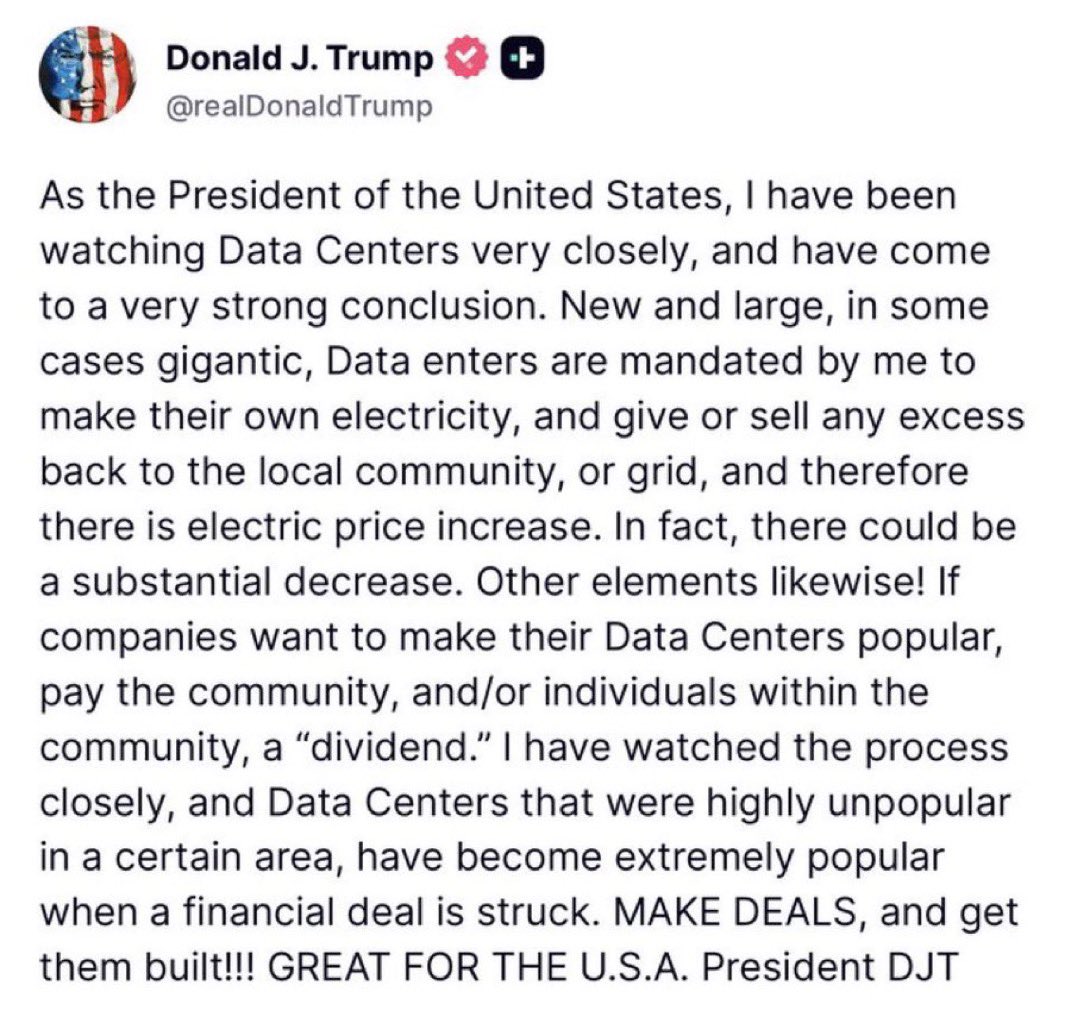
US President Donald Trump said on Oct 21 in a Truth Social post that new and large, in some cases gigantic, data centers are "mandated by me to make their own electricity" and to give or sell any excess back to the local community or grid. He also said companies should pay the community, and/or individuals within it, a "dividend" if they want projects to be popular, urging them to "MAKE DEALS, and get them built."
The remarks land as AI data centers have become a political flashpoint across US communities over their high water and power needs, with opposition uniting voters across ideological lines. Trump said in February that major tech companies must build their own power plants for data centers to protect consumers from rising bills; Reuters reported that Anthropic and Elon Musk have recently outlined plans to share gains from the AI boom.
On X, some investors argued that on-site power and community payments could favor large-cap operators such as Google, Amazon, Microsoft and Meta, though that is commentary rather than company guidance. Amazon has been expanding AI data center-related partnerships and seasonal hiring, per the newsroom's recent items, leaving its capital spending and community relations exposed to the proposal.
No implementation mechanism, scope or timetable has been published, and companies have not publicly responded to the post.
Elon Musk personally ordered a slowdown of the Starlink satellite service used by Ukraine's military, The Wall Street Journal reported. The restrictions began on October 14 and reportedly hampered Ukraine's drone operations and air defense, catching Kyiv off guard.
Bloomberg, Forbes and Seeking Alpha carried the same report. It also said Musk has been discussing Ukraine with President Trump, while the president has denied ordering the restrictions.
SpaceX is privately held; its SPCX ticker is discussed on some trading platforms in derivative form. Coverage in our newsroom's past 48 hours focused on SpaceX earnings expectations and institutional position changes, with no independent confirmation of the Starlink slowdown.
SpaceX and Ukrainian officials had not publicly responded to the report as of publication, and the account rests primarily on the Journal's single sourcing.
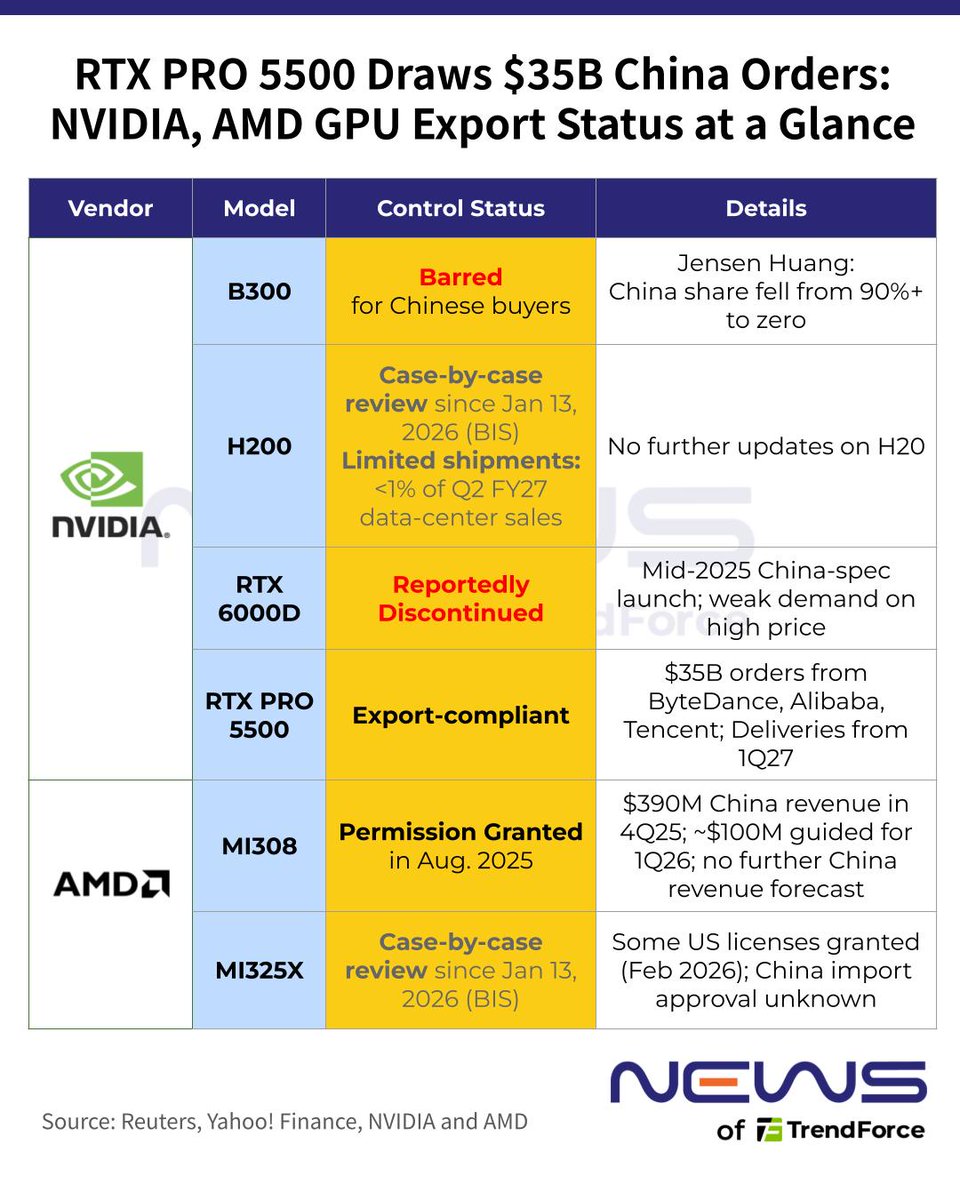
ByteDance, Alibaba and Tencent have ordered more than 3 million of Nvidia's RTX PRO 5500 workstation graphics cards, with a combined sticker price above $35 billion at about $11,400 each, Reuters reported on Oct. 20, citing two people familiar with the matter. Nvidia has told customers and partners it cannot guarantee it can fill the orders because demand from Chinese technology companies far exceeds planned production.
The RTX PRO 5500 is built for professional workstations rather than the large data-center clusters that run Nvidia's most advanced AI processors, but it is among the most powerful Nvidia chips still available to Chinese buyers. Nvidia's Blackwell-based B300 data-center chip cannot be sold to Chinese buyers under U.S. export controls, while Hopper-based H200 exports are reviewed case by case with licensing conditions.
The supply gap is central to the report. One source said Nvidia told partners they might receive only 5% to 10% of the quantities requested; another said the company indicated it could produce no more than 3 million RTX PRO 5500 cards globally in 2027, while total orders from Chinese customers have exceeded 6 million.
For Nvidia, the orders show that export-compliant workstation products are absorbing some Chinese AI inference demand after curbs narrowed access to top-end AI chips. Whether the orders convert into revenue depends on production allocation; none of the three Chinese companies or Nvidia has publicly commented.
The U.S. Federal Aviation Administration has granted final certification to Boeing's 737 Max 10, the largest member of the 737 Max family, clearing the planemaker to begin delivering the narrowbody. Multiple outlets reported the approval on Oct. 20, with CNBC saying the FAA certified the aircraft.
The jet was originally set to enter service in 2020 but fell years behind schedule through a lengthy certification saga disrupted by two fatal crashes and a series of quality lapses. The New York Post reported that deliveries of the 230-seat aircraft are set for 2027, while The Wall Street Journal said the certification was briefly held up after a flight-software glitch.
For Boeing, the Max 10 approval marks a significant step in its turnaround efforts, completing the final variant of the 737 family, a best-selling narrowbody line dating to the 1960s. Boeing shares were down 0.2% in premarket trading before the news.
Boeing also introduced Dataliner on Oct. 20, an AI-powered aircraft data intelligence platform that combines aviation data with the company's aircraft insights for fleet-wide operational decisions.
OpenAI and Google said Wednesday that OpenAI's frontier models and its Codex coding agent will arrive on Google Cloud's Model Garden and Marketplace in the coming weeks. GPT-6 Astra, GPT-6.1 Sol and GPT-6 Luna are in private preview, and enterprise customers can pay using existing Google Cloud spending commitments, with usage on a single invoice.
The arrangement follows the April expiry of OpenAI's exclusive licence with Microsoft. OpenAI models reached AWS that same month, and its agents were added to Amazon Bedrock last month. Google Cloud, which already sells Gemini and Anthropic's Claude, now calls itself the only hyperscaler offering all three leading closed models.
For Google, the deal means reselling a competitor's models alongside its own, potentially capturing enterprise business that might otherwise go to rival clouds. For OpenAI, it widens enterprise reach without requiring customers to set up a separate relationship. Ahead of the announcement, GOOGL was down about 1.1% premarket and MSFT about 0.3%.
OpenAI president Greg Brockman said the partnership makes the company's most capable models and Codex available where customers already build. Google said customer prompts and outputs stay inside the customer's data perimeter and are not used to train models, with OpenAI models running on dedicated Google Cloud infrastructure.
Salesforce agreed to acquire Braze for $47.50 per share in cash, a deal valued at about $5.66 billion that folds personalized marketing software into its Agentforce stack. Braze shares rose about 50% on the news and were quoted at $45.35 pre-market.
Zeta Global issued a statement calling the transaction a "significant competitive opportunity," arguing the integration could slow innovation and push customers toward its AthenaOS platform. Klaviyo shares rose more than 10% as investors compared the deal across marketing software names.
Several investor-rights firms, including Ademi LLP, Halper Sadeh LLC and Brodsky & Smith, disclosed investigations into whether the $47.50-per-share, roughly $5.66 billion price is fair to Braze shareholders.
One market participant said a merger-antitrust analysis tool put the completion probability at about 88%, matching the probability implied by Braze's pre-market price; that is a third-party view, not a statement from either company.
Super Micro Computer (SMCI) issued preliminary results for the first quarter of fiscal 2027, projecting net sales of $18.5 billion to $19.5 billion, up from its prior guidance of $14.5 billion to $15.5 billion and above analyst estimates of roughly $15 billion. The company also raised its adjusted gross margin outlook to 12.0%-12.5% from 10.4%-10.8%, citing increased demand for AI platforms.
The company said the figures are preliminary, with final earnings due Nov. 3. In the newsroom's recent coverage, The Wall Street Journal and Reuters reported that preliminary revenue topped the company's own guidance, while Investor's Business Daily said shares surged late Tuesday and that Dell (DELL) and Hewlett Packard Enterprise (HPE) also jumped.
The read-through is concentrated in AI servers: Supermicro's sharply raised revenue outlook was taken as a sign of continued expansion in AI infrastructure demand, with Dell and HPE pulled into the same trade. Newsroom material shows SMCI last closed at $32.1, up 1.49% from the prior session.
The materials did not detail what drove the gross margin upgrade, and no regulatory or third-party response to the preliminary figures was included. Final numbers and the durability of margins will depend on the Nov. 3 earnings release.
Anthropic has signaled it could potentially spend $750 billion in the coming years on obtaining more computing capacity, including deals still under negotiation, according to a Wall Street Journal report relayed by Bloomberg. X user firstadopter said the figure is up from $518 billion in a prior draft of the company's S-1.
The disclosure comes as Anthropic prepares for an initial public offering. According to X user shanumathew93 citing the WSJ, Anthropic spent more on computing capacity in the first half of this year than in all of 2025, when it spent $7.3 billion. X user stocksavvyshay said the company generated $16 billion in revenue on nearly $9 billion of compute spending during 1H26.
A commitment of that scale would channel spending toward AI infrastructure providers. CoreWeave (NASDAQ:CRWV) has been under pressure amid AI debt concerns, with analysts split on its outlook and its bond yields spiking to record levels, according to the newsroom's recent coverage.
The $750 billion and $518 billion figures are reported signals rather than signed commitments, and Anthropic did not publicly confirm them in the material reviewed.
U.K. CPI rose 3.5% year on year in September, above the 3.4% forecast and up from 3.1% in August, the highest reading in 11 months, the Office for National Statistics said Wednesday. On the month, prices rose 0.4% versus 0.3% expected; core CPI came in at 2.8% year on year, in line with forecasts and up from 2.6%.
Motor fuel was the largest upward contributor, with fuel inflation hitting 29.8%, the highest since August 2022, as average petrol prices reached 169.5 pence per litre in September. Services inflation climbed to 3.7% from 3.4%, suggesting price pressures are broadening.
The data reinforce expectations of a Bank of England rate hike in November. Traders had already priced roughly 96% odds of a 25 basis point increase, according to investinglive, while CNBC reported markets expect two hikes by the end of the year. Sterling was little changed against the euro and dollar, and gilt yields were broadly flat after the release.
The print lands ahead of next week's Budget, with BBC reporting inflation and government borrowing both at one-year highs and debt above £3 trillion, leaving Chancellor John Healey with limited fiscal room.
Netflix reported third-quarter 2026 revenue of $12.87 billion, in line with the $12.87 billion consensus and up 12% year over year. EPS came in at $0.87 versus $0.82 expected, up 49%, while operating income of $4.46 billion beat the $4.26 billion estimate and operating margin reached 34.6%, up 640 basis points. Quarterly free cash flow was $2.88 billion, below the $3.22 billion expected.
For the fourth quarter, the company guided revenue to $13.44 billion versus $13.51 billion expected, EPS to $0.67 versus $0.73, operating income to $3.50 billion versus $3.72 billion, and operating margin to 26% versus 27.6%. Full-year revenue guidance was narrowed to $51.1 billion from a prior $51 billion-$51.4 billion range, with the full-year operating margin held at 31.5% and free cash flow trimmed to about $12 billion from about $12.5 billion.
Management said organizational changes enable investment in high-impact areas, framing the cash flow cut as a reallocation rather than a demand problem. The stock fell after hours, with local coverage N2 putting the drop at 6% and N4 citing Bernstein caution on how long the strategy will take to pay off.
The quarter's tension is beat-on-earnings, soft-on-guidance: revenue growth and margins are still expanding, but the Q4 and full-year outlook was cut, leaving advertising growth and new content formats as the swing factors investors will watch.
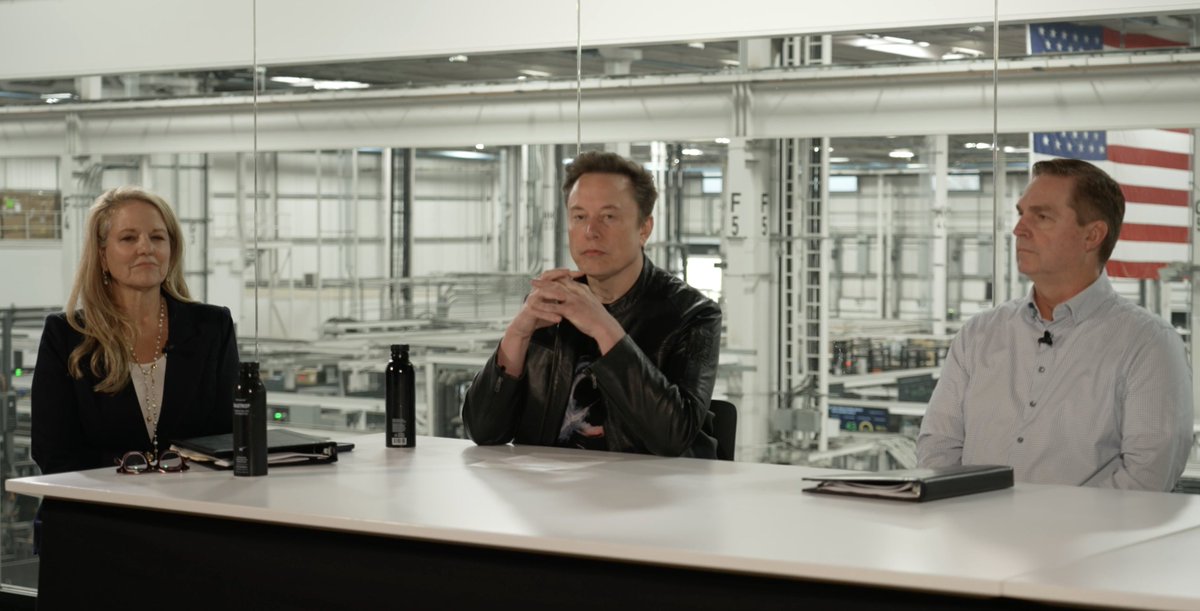
On SpaceX's (NASDAQ:SPCX) third-quarter earnings call on Oct. 20, 2026, CEO Elon Musk said annual recurring revenue would land "somewhere between $500 billion and $1 trillion" by the end of 2027. ARR annualizes a single period's revenue and measures selling speed at a point in time, not full-year booked sales.
CFO Bret Johnson said on the same call that the company remains on track for $100 billion in ARR by the end of this year, defined as December revenue annualized. Third-quarter revenue was $14.6 billion, up 161% from a year earlier, with the Super Intelligence AI compute segment at $7.6 billion, ahead of Starlink's $5.2 billion.
Yahoo Finance noted the $1 trillion upper end would exceed Amazon's roughly $717 billion and Walmart's roughly $713 billion in reported annual revenue. SPCX rose about 8% after hours to $159.70, after closing the regular session at $147.79, for a market value of about $2.01 trillion.
Other claims from the call: Starlink is contracted for roughly 12,000 aircraft, about a quarter of the available fleet; Starship is targeted at two launches per week by end-2027; and Musk put a non-zero possibility on 20 gigawatts of AI compute online by then. All figures are company statements.
Samsung Electronics and SK Hynix are upgrading their Chinese factories to make more advanced NAND flash, four people familiar with the plans told Reuters, as they seek to capture AI data-center storage demand and close the gap with China's Yangtze Memory Technologies. Both companies confirmed to Reuters that upgrades were underway and being carried out in close consultation with Washington, without disclosing production details.
Samsung aims to move its Xi'an plant from roughly 200-layer NAND to 286-layer chips, targeting 5,000 wafers per month by December 2026 and 40,000 by December 2027; the site accounts for about 40% of its global NAND output. SK Hynix plans to upgrade its Dalian plant from 192-layer to at least 240-layer products and may seek US approval to research chips above 300 layers.
US rules require annual licences to install American equipment such as etching machines in China, and the Commerce Department's Bureau of Industry and Security said in 2025 it did not intend to grant licences for technology upgrades or capacity expansion at foreign chipmakers' China plants. Reuters said it could not determine how many licences have been granted.
TipRanks said both stocks closed about 6% higher in Seoul on Wednesday after the report, while invezz noted SK Hynix fell 3.6% to 1,231,000 won and Samsung 1.5% on Tuesday. YMTC's share of China's NAND market is put at about 38.5%-39%, versus 34% for Samsung.
Boston-based ASI said Tuesday it raised $325 million in a Series C round that values the company at $3 billion. Spark Capital led the round, with participation from Craft Ventures, Andreessen Horowitz and affiliates of Citadel Securities, among others. The startup was previously known as Air Space Intelligence.
ASI's software forecasts air traffic, power grids and military operations hours to weeks ahead. In June it won an $875 million, 12-year contract from the Federal Aviation Administration, beating Palantir and Thales, according to The Next Web — a key commercial validation for the company.
The raise comes as AI investment sentiment divides. CNBC reported that South Korean AI infrastructure provider Elice fell 32% on its trading debut before rebounding about 30% the next day, a sign investors are scrutinizing whether AI spending translates into sustainable profits. Capital is tilting toward vertical AI firms with government and industry contracts rather than debt-heavy compute lessors.
ASI is private, so the valuation mainly sets a pricing reference for application-layer AI startups in private markets. How quickly the FAA deal and planned expansion into energy and logistics convert into revenue will determine whether the $3 billion mark holds.
AMD and Intel said on Oct. 19 that they will combine their x86 CPU optimization work for PyTorch inside oneDNN, the open-source deep learning library governed by the UXL Foundation. AMD is integrating its ZenDNN optimizations into oneDNN and joining the foundation as a Steering Member, and the two have aligned on oneDNN as the default open-source library for x86 acceleration within PyTorch.
The move follows a recommendation from the x86 Ecosystem Advisory Group, a joint Intel-AMD initiative set up in 2024 that previously produced work such as the ACE instruction set extensions. According to Tom's Hardware, steering membership in the UXL Foundation carries a $20,000 annual contribution; oneDNN, added as a PyTorch backend in late 2023, showed a 1.24x gain for Float32 and 2.21x for BFloat16.
For developers, the payoff is one code path for CPU inference across AMD and Intel processors, cutting tuning and deployment overhead. For the chipmakers, software alignment helps defend the CPU inference segment as GPUs dominate AI training. The announcement lands as AMD shares have fallen about 13% over the past week, with attention fixed on its Nov. 3 earnings and the broader AI chip race.
"Developers shouldn't have to think about separate software paths to get the best from an x86 CPU," said Jeff McVeigh, vice president and general manager of Data Center Strategic Programs at Intel. The companies also plan to bring AI Compute Extensions, an x86 instruction set for matrix multiplication, into PyTorch through future oneDNN updates.
President Trump said on Tuesday at a rally in Greenville, North Carolina, that the Pentagon will invest $1.5 billion to produce "cutting-edge semiconductor chips" in the state. He gave no details on the specific recipient or scope of the funding.
The remark follows Wolfspeed's October 7 announcement of a conditional Pentagon loan commitment of up to $1.5 billion to expand domestic chip production for defense and other critical applications. The company, headquartered in North Carolina, is a vertically integrated maker of semiconductor wafers.
At the same event, Commerce Secretary Howard Lutnick said industrial minerals company Sibelco will build a plant in North Carolina focused on quartz manufacturing, describing the investment as worth "hundreds of millions of dollars." Quartz is a key material in photomasks, lithography equipment and cleaning and etching steps.
For markets, the $1.5 billion figure, if it maps to Wolfspeed's existing conditional loan, supports funding expectations for $WOLF; however, Trump did not name the beneficiary, so the attribution still needs confirmation from the company or the Defense Department.
Elon Musk said he expects Starlink to reach 100,000 satellites within three years, lifting the network's capacity roughly 100-fold, according to multiple financial media accounts relaying his remarks on X, including stockmktnewz, TrendSpider, FinancialJuice, First Squawk and Investing.com.
The comments came on SpaceX's earnings call, where the company reported results that topped analyst estimates on several key metrics, according to our newsroom's coverage. Starlink is a core SpaceX business, and satellite count and bandwidth determine its coverage and sellable capacity.
If met, the target would change Starlink's network capacity by an order of magnitude and feed directly into the competitive landscape for satellite internet and the valuation case around $SPCX. Deployment at that scale depends on launch cadence, orbital resources and regulatory approvals in individual markets.
SpaceX did not provide further detail or a phased schedule for the goal in materials available to our newsroom.
Elon Musk said on a SpaceX conference call Tuesday that Terafab, the chip manufacturing joint venture between SpaceX and Tesla, aims to reach volume production in the third quarter of 2028. He called the schedule "very aggressive" and said he puts "big error bars" on whether it will be achieved.
Internally, Terafab targets a first functional test chip using SRAM circuits around May or June 2027 at its research facility in Austin, Musk said. The planned Texas complex would combine advanced logic and memory chip manufacturing, packaging and testing, with a goal of producing 1 terawatt a year of computing power for AI and robotics.
Equipment supply looms as a key variable. Musk thanked ASML and other suppliers for expediting deliveries to Terafab, but did not directly answer when asked whether SpaceX had ordered extreme ultraviolet lithography systems from the Dutch company, the sole maker of such machines.
SpaceX (SPCX) and Tesla (TSLA) are the venture's principals, while ASML (ASML) was named by Musk as a key supplier. Musk has a history of missing timelines, and he framed the dates as an aspiration rather than a commitment.
Meta's AI app Muse has surpassed 10.9 million downloads since launching on Sept. 8, with more than 10.2 million of those coming from the US, according to Sensor Tower data cited in the posts. Polymarket-reported coverage said Muse crossed 10 million US downloads in 40 days, a feat only 11 other apps have achieved.
By contrast, ChatGPT's US downloads fell more than 25% over the past 30 days versus the prior 30-day period, the same material shows, a shift investors are watching as competition for AI assistant users intensifies.
Meta is scheduled to report third-quarter earnings after the closing bell Wednesday. Coverage in our newsroom's feed focuses on whether the company's AI capital spending is translating into returns and how rising expenses are weighing on profitability, making Muse's download trajectory a fresh data point for the AI narrative.
The download figures come from third-party estimates by Sensor Tower; neither Meta nor OpenAI offered comment in the material.
How this story unfolded
2026-08-274 posts · 4 authors
Meta reportedly could spend up to $10B annually on Anthropic's AI models despite public criticism, using Claude to test its Hatch agent and launching Muse Image API at $0.01 per image.
Company
Abbott to Spin Off Nutrition Unit With About $8.5 Billion in Annual Sales
The separation was announced alongside Q3 results and a cut to Abbott's 2026 sales growth forecast on medical device weakness
Abbott said on Oct. 21 that it intends to separate its global Nutrition business into an independent, publicly traded company. The unit has about $8.5 billion in annual sales, according to The Wall Street Journal. Abbott said the separation will let both companies pursue distinct growth and value-creation strategies, with the new Nutrition company positioned as a global leader in a fast-growing market.
The announcement came the same day as Abbott's third-quarter 2026 results: reported sales growth of 14.5 percent and comparable sales growth of 7.0 percent, with GAAP diluted EPS of $0.53 and adjusted diluted EPS of $1.42. That adjusted figure missed the Zacks Consensus Estimate of $1.43 but topped $1.30 a year earlier, and the company reaffirmed its full-year EPS guidance.
Reuters reported the same day that Abbott lowered its 2026 sales growth forecast on medical device weakness. The combination of a carve-out and a trimmed revenue outlook puts the focus on how Abbott redraws its growth profile, with ABT as the central stock in the event.
Barron's framed the move as a spin-off of a "troubled" nutrition unit, in contrast with Abbott's own emphasis on the new company's leadership position. The materials did not disclose a timetable or tax treatment for the separation.
AT&T reported third-quarter 2026 revenue of $32.3 billion, above the $31.69 billion consensus, with adjusted EPS of $0.65 versus $0.60 expected and adjusted EBITDA of $12.5 billion. Postpaid phone net additions came in at 379,000, broadly in line with expectations, while postpaid phone-only churn was 0.92%.
The company raised its full-year outlook, guiding 2026 adjusted EPS to about $2.40 from a prior range of $2.25 to $2.35, against a $2.35 consensus, and expects adjusted EBITDA growth of 3% to 4%. Free cash flow was $5.0 billion, up from $4.9 billion a year earlier.
AT&T said the quarter delivered its best consolidated service revenue growth in more than four years, adding more than 1 million advanced connectivity customers for a second consecutive quarter across fiber, fixed wireless and postpaid phone.
The beat and raised guidance give investors a direct reference point for demand resilience among U.S. carriers and will feed into valuation comparisons across the sector. No further company comment was included in the materials.
United Airlines (UAL) reported third-quarter 2026 revenue of $17.88 billion, up 17.4% year over year but just below the $17.89 billion consensus. Adjusted EPS came in at $2.54, down 8.6% from a year earlier and short of the $2.59 estimate. Adjusted pre-tax income of $1.11 billion matched expectations, while adjusted operating income of $1.23 billion and adjusted net income of $833 million both fell short.
The fourth-quarter guide was the sharper miss: adjusted EPS of $0.50 to $1.50 versus an estimated $1.88. Multiple outlets reported that United slashed its 2026 profit outlook on fuel prices, even as travelers keep booking despite higher fares.
Operating metrics were also soft. Passenger revenue was $16.24 billion against a $16.30 billion estimate, and revenue passenger miles were 74.28 billion versus 74.91 billion expected. The company still expects full-year adjusted capex of about $7.5 billion.
The fuel squeeze extends beyond United. Forbes reported that global airline chiefs are growing pessimistic about whether consumers can or will keep paying higher fares, citing discussion of a 20% airfare hike in 2027. For investors, the results put the tension between fuel costs and fare tolerance on display, making it a key test of cost pass-through across the airline sector.
Adidas reported third-quarter 2026 revenue of €7.252 billion, up 9% year on year and a record, with operating profit of €1.008 billion, up 37% and also a record. The German sportswear maker raised its full-year 2026 operating profit outlook to €2.6 billion from around €2.5 billion, and expects currency-neutral revenue growth of 9%-10%.
The guidance hike was also helped by US tariff refunds. The Wall Street Journal reported the company received a windfall of around $220 million from US tariff refunds; the X signal said Adidas received the majority of its US tariff claims with a €200 million refund.
Adidas shares were indicated higher in premarket trading following the results and the raised outlook. The company said it would reinvest part of the refund, without full details in the available material.
JPMorgan raised its SpaceX price target to $500 from $240 while maintaining an Overweight rating, forecasting $254 billion in 2027 revenue and 10 GW of computing capacity by year-end. The bank said its 2027–2028 estimates more than doubled, pulling forward more than another year in its model.
The move was part of a wider wave. Morgan Stanley set a $300 Overweight target, Wells Fargo went to $274 from $214, Citi to $240 from $200, UBS to $230 from $210 and Mizuho to $205. Cantor Fitzgerald raised to $345 from $246, TD Cowen to $224 from $200, Barclays to $300 from $254 and Goldman Sachs to $245 from $230.
Citi also added SpaceX to its 90-day upside catalyst watch list. The stock rose 8.21% overnight after the earnings release and is up 8.14% year-to-date since its reported June 2026 IPO at $150, according to the posts.
Even bullish analysts kept caveats. One noted that sharply higher estimates require significant execution, capital and demand support. Local coverage said earnings topped analyst estimates on several key metrics, and CEO Elon Musk told analysts on a conference call that he expects the company to add capacity.
At his GTC Berlin keynote, Nvidia CEO Jensen Huang said Nebius (NBIS) is "doing really well" and named both Nebius and IREN as neocloud partners on Nvidia's DSX AI factory platform. He said the tie-up could help both operators deploy AI factories faster and deepen their links to Nvidia's infrastructure ecosystem.
Huang also said power will remain "one of the major bottlenecks" for the AI buildout over the next couple of years, and said Nvidia's European ecosystem spans more than 12,000 companies, with over $10 billion invested in the past year and 14 new startup investments this week. The remarks follow a brutal week for neocloud stocks: CoreWeave fell more than 20% from Monday through Wednesday before rebounding about 6% on Thursday after Huang voiced support.
For the market, the signal frames NBIS and IREN as beneficiaries of faster deployment through Nvidia's platform, while the power warning points to power-management and power-semiconductor names. Industry executives reportedly expect only seven to 10 of hundreds of neoclouds to survive, with Nvidia backing some through easier credit terms, site selection and $20 billion in leases.
Nvidia also unveiled an OpenShell architecture for setting limits on AI agents to stop them from crossing boundaries, and Huang said physical AI requires three computers: one to train models, one to simulate and test skills, and one running inside the robot. The companies named did not separately comment in the materials.
Company
Nebius opens live GPU spot pricing, pilots rebates for idle capacity
Announced at NVIDIA GTC Berlin alongside a European expansion of its AI Builder Program; transparent pricing becomes a selling point for neoclouds under investor scrutiny
Nebius (Nasdaq: NBIS) said today it has published public live spot pricing for preemptible GPU compute, adding reserve auctions and pay-as-you-go access to a broader set of market-based pricing mechanisms. Live prices are available on its website and through Shadeform, Silicon Data and GPU Find.
The announcement was made at NVIDIA GTC Berlin, where Nebius also expanded its AI Builder Program to Europe with NVIDIA. The move comes as investors question the business model of neoclouds, making pricing visibility a differentiator for winning developer customers.
Posts on X said Nebius could sell out its entire 2027 capacity today but is holding some back for shorter deals reportedly priced at $50M per MW annually, while piloting rebates that let customers return idle GPUs to the market. Those capacity and pricing claims come from social posts and were not found in the newsroom materials; the company announcement should be treated as authoritative.
Nebius' chief revenue officer told CNBC that AI computing prices are continuing to rise and running ahead of its expectations. The market question is whether public spot pricing can support revenue visibility in a capital-intensive neocloud sector, with CoreWeave among the peers used for comparison.
Walmart on Tuesday announced a joint membership combining Walmart+ with Sam's Club Plus for $120 a year. According to CNBC, that is nearly $100 less than buying the two annual memberships separately, and there is no monthly payment option; standalone memberships remain available at both chains.
Perks include access to Sam's Club warehouses, free delivery from both chains, a Peacock or Paramount+ streaming subscription, gas savings and 2% Sam's Club cash on eligible purchases. The Independent put the standalone price at $218 a year — $98 for Walmart+ and $120 for Sam's Club Plus — implying savings of about $98.
CEO John Furner said in a statement that the company is "giving people a reason to expect more from their memberships." Walmart said costs tied to the membership changes are not expected to materially affect fiscal third-quarter or full-year guidance. Membership revenue typically carries higher margins than regular retail sales, and the bundle aims to keep everyday shopping and bulk purchases inside Walmart's ecosystem.
The incremental signal in the X posts is the confirmed pricing and benefit details of the announcement; the event itself was disclosed by the company on Tuesday. The subject is Walmart (NYSE: WMT).
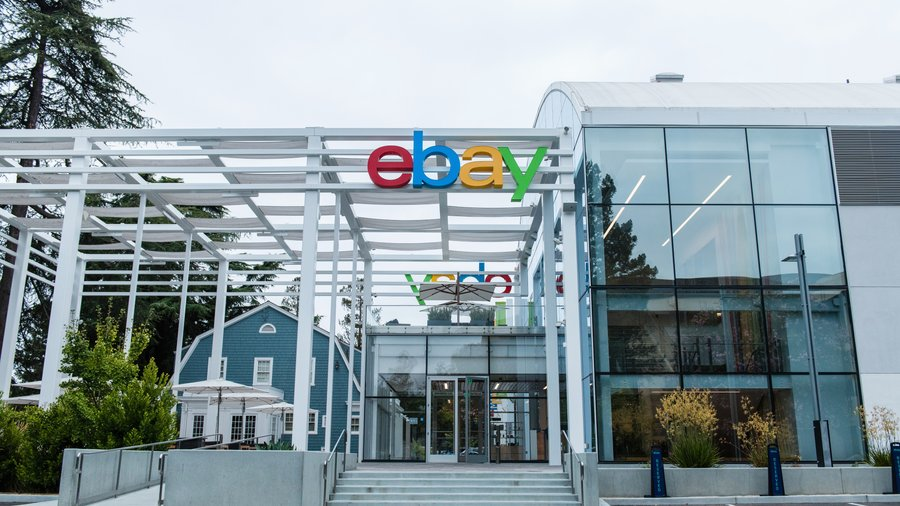
eBay plans to cut about 9% of its workforce to simplify operations and prioritize growth areas, according to an internal memo seen by Reuters. Several financial outlets cited the same figure, and employees are expected to be notified in the coming days.
The move comes roughly a week before eBay's earnings release, scheduled for Oct 28. The company has not provided further detail on the scale of the cuts beyond the memo cited in reports.
Shares edged lower in premarket trading following the reports. Workforce reductions are typically read as a cost-side adjustment, though the financial impact will not be clear until the company discloses it in results or a formal statement.
A Reuters report dated Oct 21 in the site's news library covers the same event as the X signals. A separate Oct 20 filing showed CWA Asset Management Group raised its eBay position by 4,604 shares, or 8.0%, which is unrelated to the layoffs.
Strive (Nasdaq: ASST) said Oct. 20 it closed the upsized IPO of its 15.00% Series A Perpetual SATS Preferred Stock, selling 7 million shares at $90 apiece for $630 million in gross proceeds and about $608.15 million net. The stock began trading on the Nasdaq Global Market under the ticker "SATS" on Oct. 20.
SATS accrues cumulative dividends at 15% per annum on a $100 stated amount, or $15 per share annually if paid in full — about 16.67% annualized on the $90 offering price. Dividends are payable when declared by the board, with regular payment dates beginning Nov. 9 on a business-day schedule.
In its SEC filing, Strive said it intends to use net proceeds for general corporate purposes, including bitcoin and bitcoin-related products, working capital, income-generating assets, capital expenditures, share repurchases and acquisitions. It did not specify how much would go to bitcoin; at an illustrative $82,500 per BTC, the $608.15 million in net proceeds could buy roughly 7,372 BTC before fees.
CEO Matt Cole called the IPO a critical milestone in the strategy to maximize long-term total returns, with SATS adding junior capital beneath SATA. The open question for investors is the pace of actual bitcoin deployment, which the company has yet to disclose.
How this story unfolded
2026-10-1415 posts · 11 authors
Macro
UK public sector net borrowing hits £24.5bn in September, above forecast
Borrowing rose from August, while the cash requirement climbed to £16.9bn, further narrowing the fiscal headroom
UK public sector net borrowing excluding banking groups came in at £24.5bn in September, above the roughly £24.0bn consensus estimate and well above August's £18.3bn, according to data published on 21 October. The public sector net cash requirement rose to £16.9bn from £10.0bn a month earlier.
The reading covers the closing month of the third quarter of the fiscal year, and the jump points to a wider gap between government receipts and spending. A comparatively low borrowing base in August made the month-on-month increase look sharper.
For markets, higher-than-expected borrowing typically feeds into assessments of gilt issuance and the remaining room under fiscal rules, with knock-on effects for the UK yield curve and sterling. The data does not point directly to any single listed company.
The release did not detail the drivers behind the increase; fuller public finance statistics are expected to provide more granularity.
The average contract rate on a 30-year fixed-rate mortgage fell to 7.41% in the week ended Oct. 16 from 7.50% a week earlier, the first decline in more than two months, the Mortgage Bankers Association said on Oct. 21. Mortgage applications fell 5.3% week over week, after a 2.7% drop the prior week.
The seasonally adjusted Purchase Index fell 7% from a week earlier and was 18% lower than the same week a year ago. The Refinance Index slipped 2% week over week and was 59% below year-ago levels. The refinance share rose to 39.0% from 37.7%, while the adjustable-rate mortgage share held at 10.5%; the 5/1 ARM rate was 6.46%, almost a full point below the 30-year fixed rate.
"Lower rates were not enough to boost application activity, as both purchase and refinance applications continued to decline," said Joel Kan, MBA's vice president and deputy chief economist, adding that the higher-rate environment "has cooled the housing market this fall." Jumbo rates fell to 7.33% from 7.49%, and FHA rates to 7.13% from 7.19%.
The weekly survey is a second-tier release that rarely moves markets on its own; its value is in showing how long-end rates transmit into borrowing costs and how demand responds at the margin. Housing data such as existing and new home sales and starts lag rate moves, and the Freddie Mac weekly survey offers a cross-check on the rate direction.
US spot bitcoin ETFs drew about $526.7 million in net inflows on the Oct. 19 trading session, the largest daily intake since Sept. 22, when the funds attracted $714.7 million, according to Farside Investors.
BlackRock's iShares Bitcoin Trust (IBIT) took in $665.2 million, more than the net total across all 12 funds. Fidelity's FBTC lost $83.6 million and Grayscale's GBTC shed $54.9 million, while other funds recorded no net flows; without IBIT, the category would have been in net outflows.
The rebound followed two straight weeks of net withdrawals: about $679 million in the Oct. 5-9 week and roughly $228 million the following week. Despite Monday's inflow, US spot bitcoin ETFs remain about $88 million negative for October.
US spot ether ETFs recorded $103.3 million in net outflows the same day, led by $95.4 million from BlackRock's ETHA, extending a third consecutive week of withdrawals totaling about $320 million.
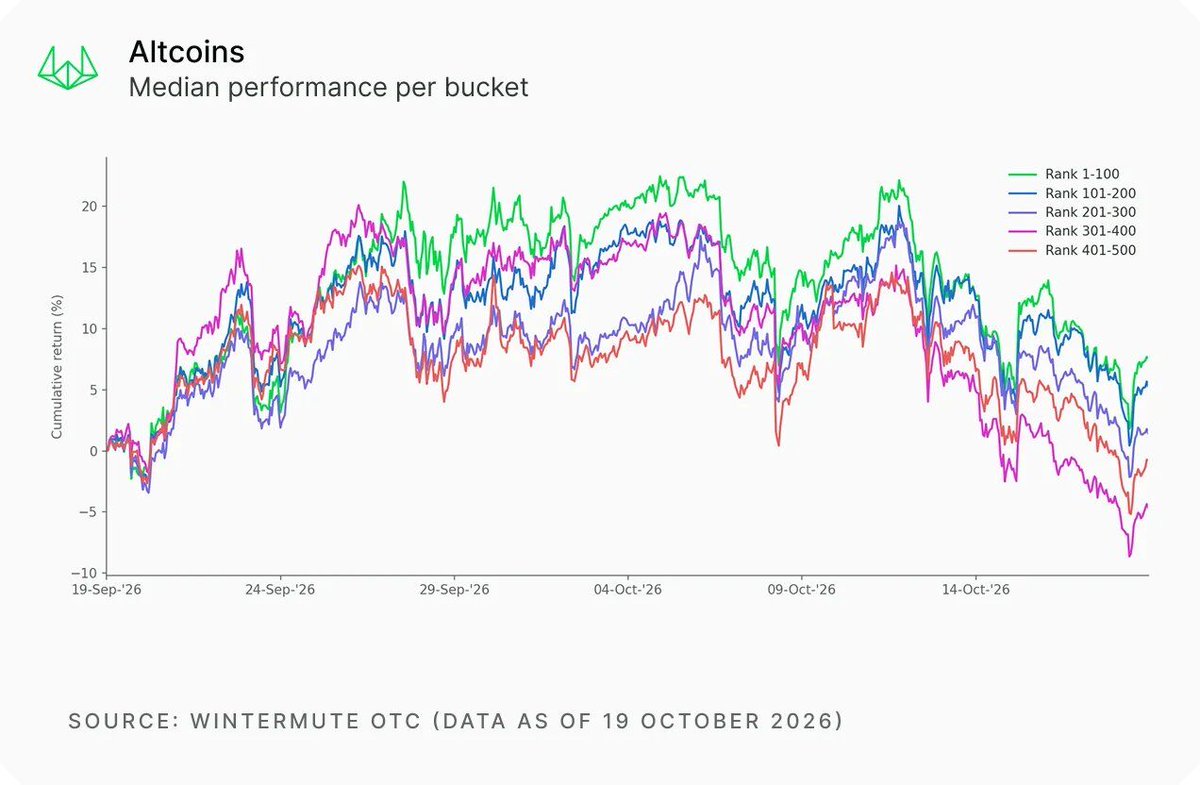
Crypto market maker Wintermute said on Oct. 20 that the altcoin market fell 5.69% over the past week, with capital flows concentrated in Bitcoin and Ether rather than altcoins. The firm said Bitcoin's price needs to rise first for a broad altcoin rally to resume.
The view aligns with CryptoQuant analysts, who said Bitcoin selling pressure is easing and a bottom may be forming, but US spot demand remains weak, with the Coinbase Premium around -0.1416%. Santiment data shows wallets holding 10 to 10,000 BTC added about 88,987 BTC over the past month, bringing combined holdings above 13.69 million BTC, the highest in six months.
Scott Melker cited data showing Bitcoin fell 2.0% from Oct. 12 to 19, while the median top-100 altcoin fell 8.4%; ETH, SOL, XRP and DOGE all underperformed Bitcoin. Coinbase (COIN) closed at $170.75, up 1.37%.
Kalshi puts the probability of Bitcoin reaching $150,000 before 2027 at about 2%. The institutional views are market analysis and do not confirm a price direction.
About 1.5 million US workers may call in sick, take leave or use paid time off on Nov. 19 when Grand Theft Auto VI launches, translating to roughly $1 billion in lost output, according to an estimate by economist José García Montalvo reported by Spanish broadcaster Cadena SER and relayed by the New York Post. Montalvo told media the figure is an academic projection, not an official forecast.
The estimate assumes an average annual output of about $70,000 per US worker and implies a short-term productivity dip of roughly 2%. Men aged 18 to 30 account for most of the expected absences, with tech workers seen as most exposed given remote-work flexibility. When GTA V launched in 2013, an IGN survey of nearly 11,000 readers found 46% had taken the day off and nearly 20% planned to call in sick.
The central corporate subject is publisher Take-Two Interactive (TTWO), which the New York Post said expects more than $1 billion in operating cash flow this fiscal year led by GTA VI. Local outlet WKRC noted the $1 billion output-loss estimate almost exactly matches what the publisher stands to gain, though the two figures measure different things.
No company or agency has confirmed the actual scale of absenteeism; all figures are pre-launch estimates and depend on how many workers stay away, for how long, and how much on-the-job output slips.
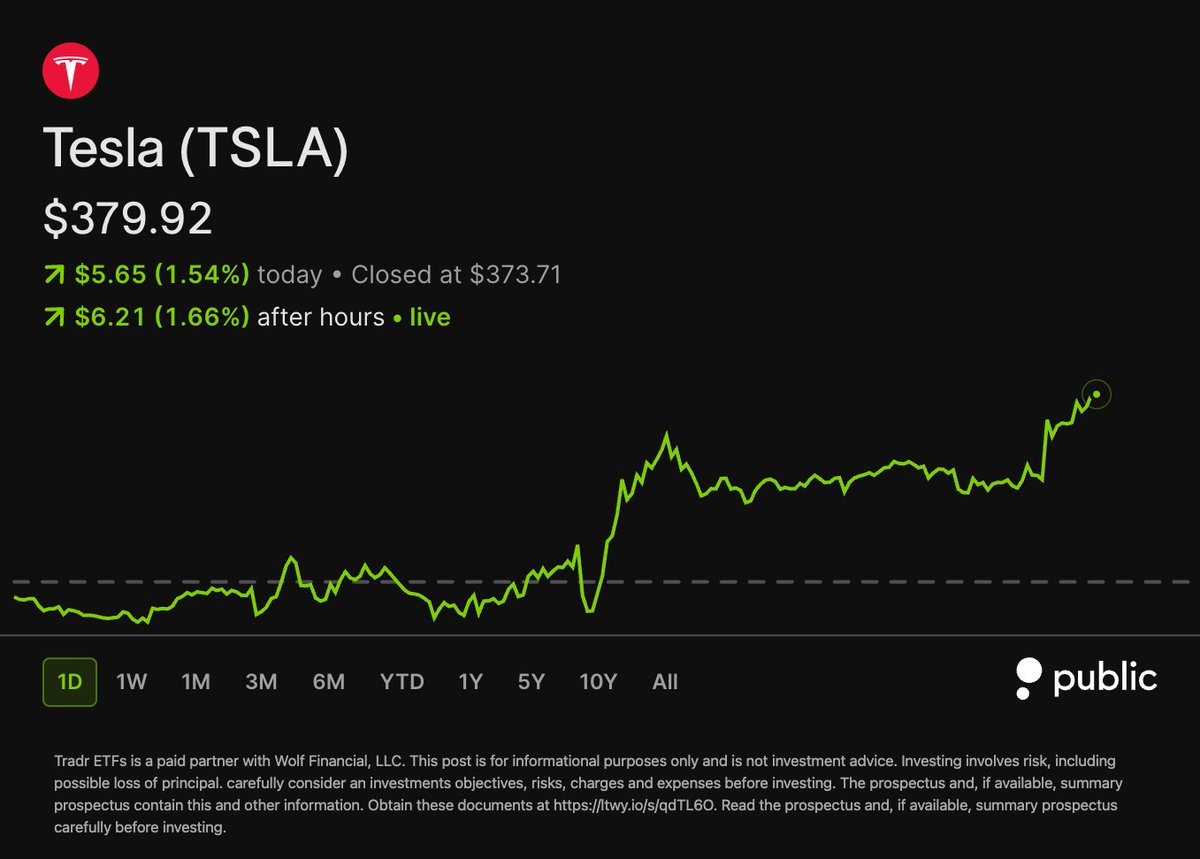
Meta and Tesla both report third-quarter results after the U.S. close on Oct. 21. Benzinga Pro data puts Wall Street consensus at $5.74 EPS on $63.37 billion revenue for Meta, and $0.43 EPS on $27.88 billion revenue for Tesla. Tesla's call is scheduled for 5:30 pm ET, matching the X signal's 4:07 pm ET release and 5:30 pm ET call.
Meta moved its Q3 report up a full week to Oct. 21, its earliest third-quarter release in a decade. Attention centers on whether Muse, its AI agent product, can become a meaningful revenue stream; Bloomberg Opinion described the call as one of Zuckerberg's most important in years.
Options markets price sizable moves for both. Saxo said Meta's options imply a smaller move than the stock typically makes, while Admiral Markets, citing Earnings Watcher data from Oct. 20, put implied moves at about 6.9% for META and 7.0% for TSLA. The X signal cited a ±5.36% implied move for Tesla, a discrepancy.
The backdrop is tense: the Nasdaq Composite fell 4.5% in the week to Oct. 16, its worst week since June, as an AI selloff hit chip stocks. 247wallst reported that Meta faces funding pressure and a potential equity raise that could affect what shareholders own.
Amazon cut off support for Muse, while the app hit 2.8 million downloads in its first 12 days, outpacing ChatGPT's early mobile launch on several metrics.
2026-09-23211 posts · 110 authors
404 Media reported Muse routes some calls to human call centers, while Meta's market cap rose $290B since release and partnerships with Instacart, PayPal, and Expedia were announced.
2026-09-24279 posts · 141 authors
Meta unveiled Muse Charm, a keychain AI gadget, and $1,299 VR glasses with Muse as the interface, enabling voice control on any flat surface.
2026-10-2032 posts · 29 authors
Meta revealed its Prometheus supercluster already runs hundreds of thousands of Nvidia GPUs, scaling toward ~1 million, while Muse faces retention challenges.
2026-10-2125 posts · 21 authors
Muse surpassed 10 million U.S. downloads in 40 days, a milestone only 11 other apps achieved, while ChatGPT's U.S. downloads fell over 25% in the last 30 days.