President Donald Trump said on Friday that the US may carry out another small-scale "Epic Fury" operation against Iran, telling a Republican campaign rally in Florida that Washington could strike again or Tehran could agree to a deal. "If they're smart, they'll just say, 'let's get down to business,'" he said, adding that he doubted they would. He did not set out any conditions Iran would have to meet.
Operation Epic Fury was the joint US-Israeli campaign launched against Iran on February 28, following an earlier operation codenamed Midnight Hammer. Trump said the two operations destroyed Iran's nuclear enrichment capacity. Earlier on Friday he said the US could end the war quickly, but questioned whether to finish it decisively or let the conflict wind down.
The New York Times reported on October 21 that US and Israeli militaries had drawn up concrete plans to strike Iran again after the November US midterm elections, though it was unclear whether Trump would approve. Trump said this month the US would not attack before the November 3 vote. The war has pushed up oil and gas prices worldwide, a factor in the midterm campaign.
Iran warned Washington not to "play with fire." Two senior Iranian security officials told Reuters that Tehran has drawn up detailed plans to target undersea communications cables in the Gulf and to hinder repairs if the US and Israel attack again. Washington has trimmed staffing at several embassies in the region, citing threats against US diplomats.
How this story unfolded
2026-08-2548 posts · 28 authors
Beijing warned the US of retaliation over new Iran sanctions hitting Chinese firms; Trump announced a major cut in joint drills with South Korea; oil plunged as Trump sought a deal via Pakistan.
Geopolitics
White House confirms removal of some Canada tariffs, replaced by duties on other goods
Move comes weeks before midterms as Maine Sen. Susan Collins faces a tight race; auto and steel tariffs still set to rise Jan. 1
The White House said Friday that President Donald Trump is removing tariffs on some Canadian goods but is "replacing” them with tariffs on other products from the top U.S. trade partner. According to The Wall Street Journal, the relief covers some Canadian agricultural and forestry products and could take effect as early as Friday.
Republican Sen. Susan Collins of Maine announced the exemptions Friday. Maine's economy is heavily tied to trade with Canada, and Collins faces a tight Senate reelection contest that is being watched as a bellwether for the midterms.
Tariffs on Canadian vehicles, auto parts and steel are still set to rise to 50% on Jan. 1, according to Bloomberg, suggesting the relief is limited in scope. The Canadian dollar hit a five-week high Friday, supported by rising oil prices and domestic retail sales data.
The White House framed the step as a "replacement” rather than a straight reduction, and a full list of exempted categories has not been published. Canadian officials have not publicly responded to the scope of the exemptions.
Nvidia's role as financier of the AI buildout is facing its first major stress test. As of its July quarterly filing, the company had $36 billion in off-balance-sheet AI cloud agreements backing neoclouds, plus a guarantee of up to $105 billion for chips, land and power at a proposed 10-gigawatt OpenAI data center in Ohio. It also signed as tenant for $20 billion in future data center leases to be assigned to third parties.
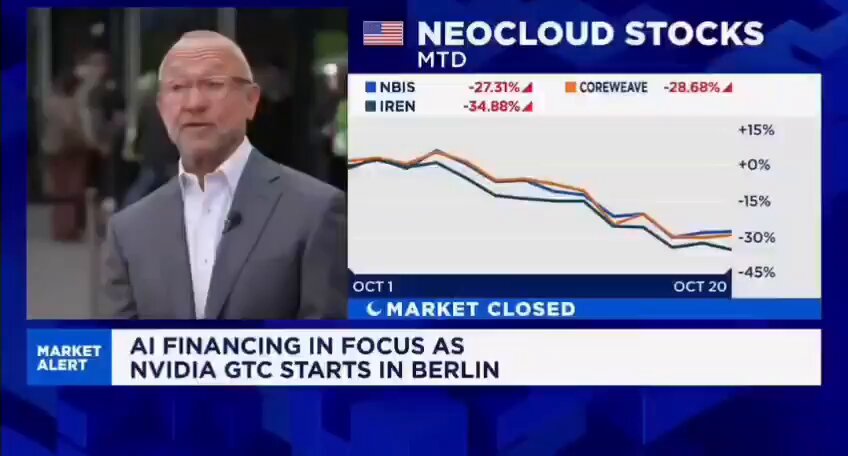
Credit markets are already repricing the risk. Shares of CoreWeave, Nebius and IREN are each down more than 30% this month; CoreWeave's credit default swap spread has widened past 11%, and yields on its 2031 and 2032 notes topped 15%. Nvidia stock is off 7.6% in October, on pace for its worst month since November last year. New Constructs puts the net present value of Nvidia's fiscal 2026 off-balance-sheet liabilities at more than $153 billion, up over $100 billion from a year earlier.
The strain is spreading. Meta reported negative free cash flow of more than $2 billion in the third quarter and raised the floor of its full-year capex to $135 billion from $130 billion, while its five-year CDS spread hit an all-time high above 124 basis points. Nvidia and Oracle CDS spreads touched records of 126 and 343 basis points, respectively. SK Hynix pulled the IPO of its Solidigm unit, citing market volatility.
CEO Jensen Huang told CNBC at GTC Berlin that demand across AI sectors is outstripping available capital, and that CoreWeave does not need Nvidia's backstop as its cost of capital declines. Gartner expects 80% of neocloud companies to cease operations or be absorbed by 2030.
Earnings
Anthropic Posts $80.7 Billion First-Half Net Loss, With $72 Billion Tied to Accounting Charges
The WSJ-reported figure is dominated by convertible-note and funding-instrument charges rather than operating cash burn, which shapes how the AI lab's real spending is read
Anthropic reported a net loss of more than $80 billion in the first half of 2026, according to the Wall Street Journal, with roughly $72 billion of that stemming from accounting charges tied to convertible notes and other funding instruments. The X account globalmktobserv put the net loss at $80.7 billion, up from $13 billion a year earlier.
The gap matters: convertible-note fair-value charges flow through net loss without matching cash leaving the business in the same period, so the headline figure overstates the company's cash burn.
The signal tags Anthropic alongside $AMZN, $GOOG and $NVDA, framing the unlisted AI lab's finances as a reference point for cloud and compute demand. News in our database over the past 48 hours shows Amazon cloud capacity sold out through 2027 and Alphabet pushing Gemini 4 Argon on owned chips, power and data-center assets.
Anthropic did not respond to the figures in the materials provided. The split between accounting charges and operating losses still needs confirmation from the company or its auditors.
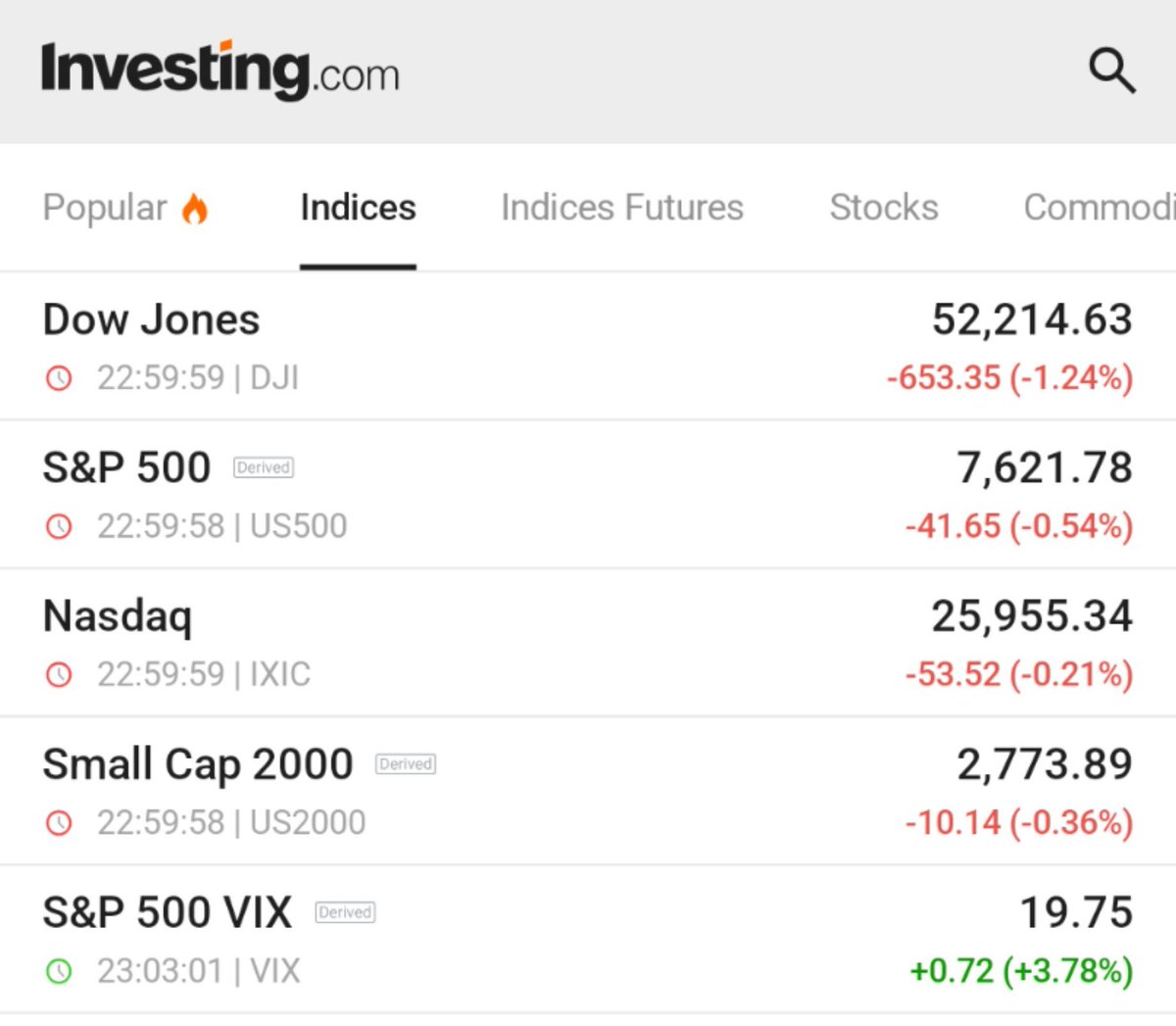
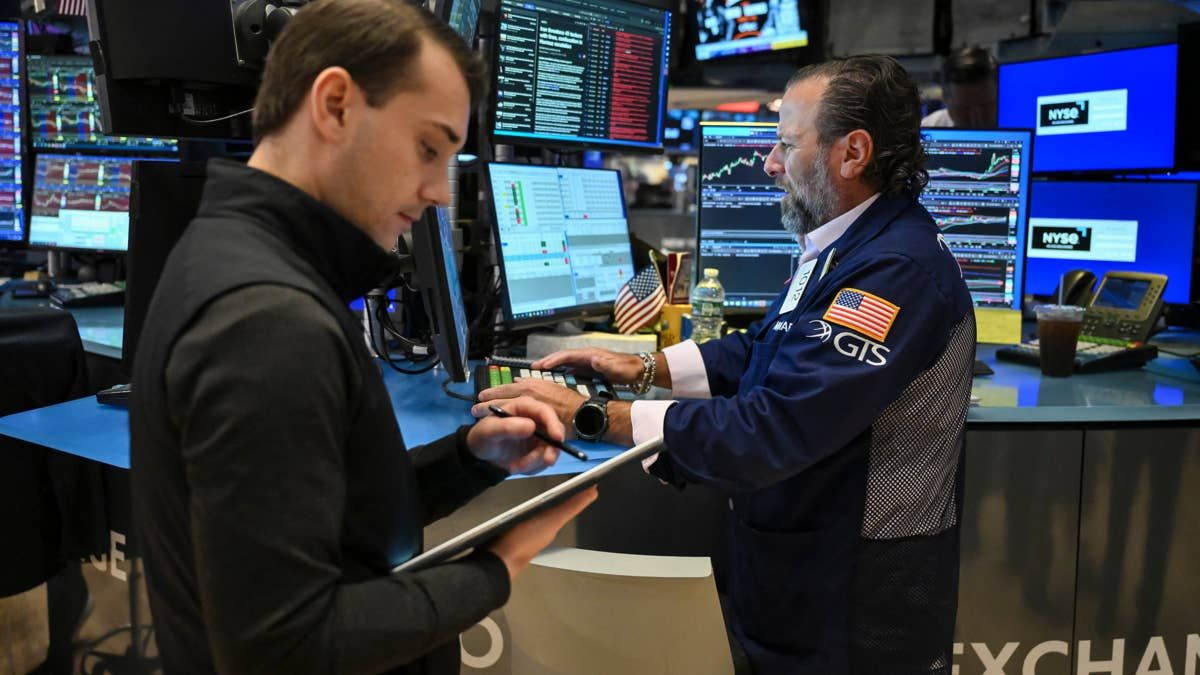
US stocks closed lower on Friday, with the Dow Jones Industrial Average falling 652.82 points, or 1.23%, to 52,215.16. The S&P 500 lost 0.52% to 7,623.68 and the Nasdaq Composite slipped 0.21% to 25,955.34, leaving the S&P 500 with a second straight weekly loss. The S&P 500 technology sector rose 0.35% on the day, though a key semiconductor index still logged its longest weekly losing streak since November.
Oil drove the move. December Brent crude settled at $116.72 a barrel, up 3.14% and the highest since late April, while WTI settled at $103.27, up 3.82%, as escalating Middle East violence raised concerns about energy supply disruption. The S&P 500 energy sector rose 2.5% to a record high, while communication services lagged on steep telecom losses.
Inflation gauges moved the wrong way. S&P Global's flash US composite PMI slipped to 57.6 in October from 58.4, but selling prices rose at the fastest rate since August 2022. The University of Michigan consumer sentiment index held at a five-month low of 48, with one-year inflation expectations at 4.7%. AAA put the national average gasoline price at $4.29 a gallon.
American Express fell 3.68% despite record third-quarter revenue of $20.06 billion, as it said it would cut about 5% of its global workforce. AT&T and T-Mobile each fell about 8% on reports that SpaceX is seeking cell-tower sites for a nationwide wireless carrier. With the Fed in its pre-meeting quiet period, CME FedWatch indicated roughly a 90% probability of no change at the Oct. 27-28 meeting.
Apple's first foldable iPhone, the iPhone Duo, went on sale in more than 70 countries on Oct. 23 at a price of about $2,000. CNBC reported that outside Apple's Sanlitun store in Beijing, scalpers offered buyers $448 in cash on the spot for newly purchased devices on launch day.
A post on X claimed the $1,999 iPhone Duo sold out of preorders by 5:20 a.m. and that Apple raised its top price by 54%. The claim comes from an individual account and was not confirmed by Apple or independently verified by this outlet.
Reuters reported less fanfare around the Duo launch than prior iPhone debuts, while Bloomberg described a pre-order misstep that Apple now needs to address on the supply side. Analyst Gene Munster said the Duo could lift Street expectations for Apple's FY27 iPhone growth from 10% to 13%.
Apple shares hit a record high on launch day and sit about $20 billion away from overtaking Nvidia as the world's most valuable company. Pricing power and first-weekend demand for the Duo will be key inputs for Apple's next earnings report.
Amazon CEO Andy Jassy said AWS cloud computing capacity is largely sold out through 2027, with a significant portion of 2028 already booked. Reuters reported the remarks on October 23, matching multiple accounts circulating on X.
The disclosure lands as Amazon keeps pouring money into AI infrastructure. The company reports third-quarter results on October 29, with capex spending the focus for investors; recent analysis noted that shareholders have been rattled by the AI-related spending commitments of major tech firms.
For $AMZN, sold-out capacity raises demand visibility but shifts the question to supply: whether Amazon can build capacity at a reasonable cost. Jassy said that even with heavy capex this year, a meaningful amount of demand would be left on the table.
The stock has been under pressure, closing at $250.28 on October 22, down 4.61% on the day. Balancing tight capacity against expanding spending will be the key issue this earnings season.
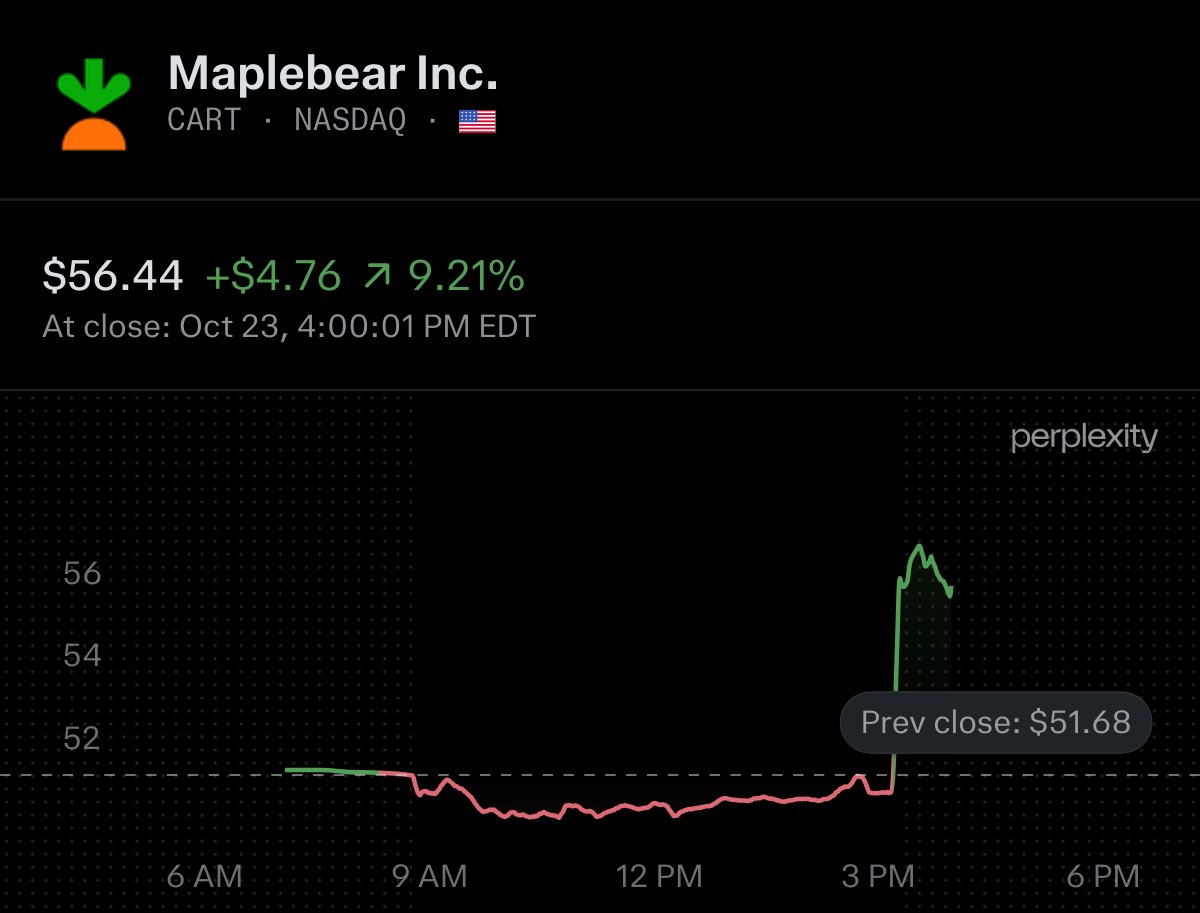
Instacart is exploring a sale and has held at least preliminary conversations with Uber and DoorDash, according to The Information, which reported that the grocery-delivery company has been working with an investment bank to weigh its options. Instacart declined to comment.
The two sides have history: Instacart held acquisition talks with DoorDash in 2021 and partnership discussions with Uber. The report revives expectations of consolidation in the delivery sector.
Instacart shares rose about 9% on Friday and closed at an all-time high. Reports put a potential deal value at $16 billion to $17 billion, against a current market value cited at roughly $12 billion to $13.1 billion across sources. Uber and DoorDash have not publicly responded.
For Uber and DoorDash, a deal would fold grocery delivery into their existing networks, though preliminary talks are far from a transaction and regulatory review would be a factor.
公司
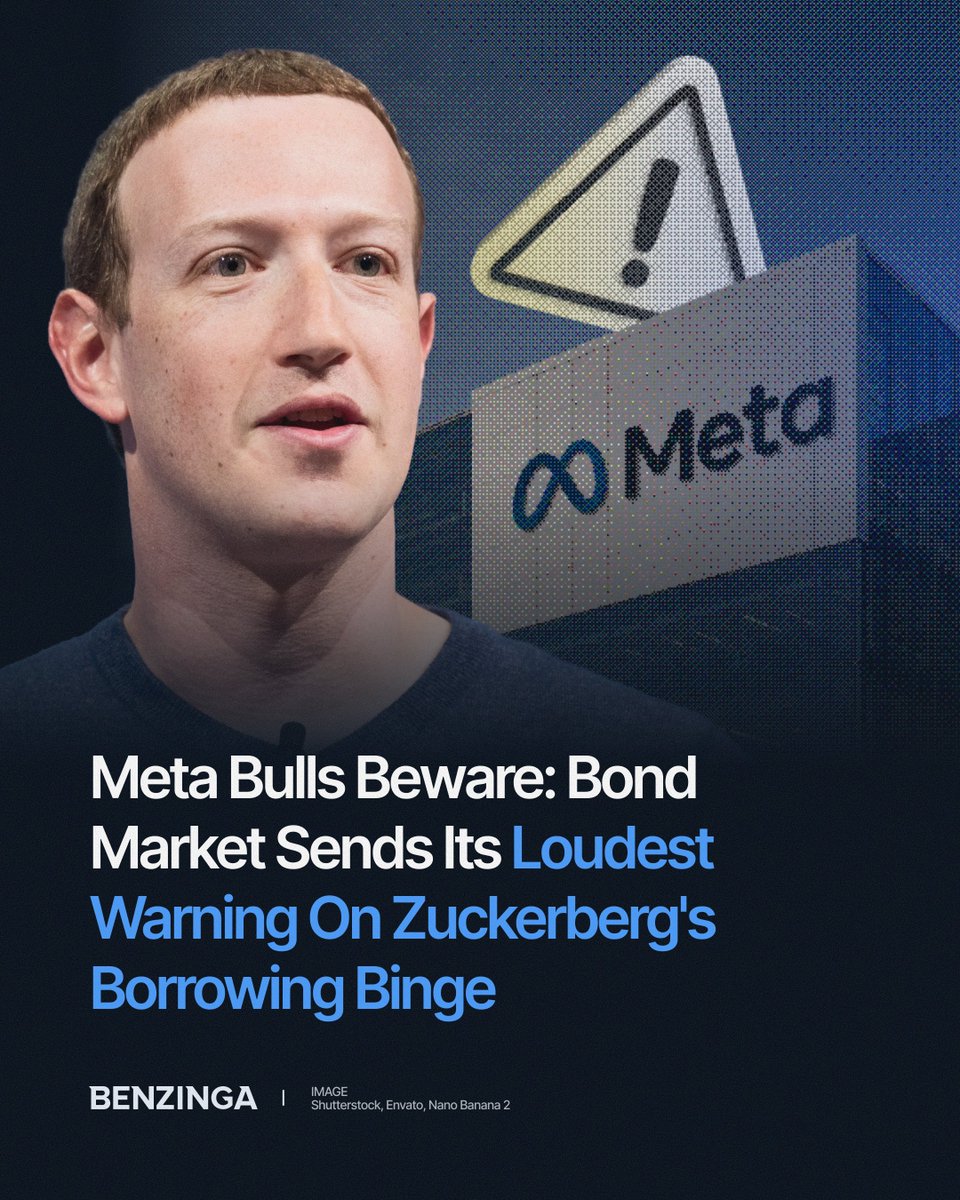
Meta five-year CDS widens 7.6 bp to record 114.79 bp on AI spending concerns
The bond market's cost of insuring Meta debt against default hit a record, days after the stock fell 7% despite a Q3 earnings beat
Meta Platforms' five-year credit default swaps widened 7.6 basis points to 114.79 basis points, a record level, according to Kalshi Wire and Benzinga. Credit default swaps are the cost of insuring against a borrower's default, and a wider spread signals that investors are pricing in more credit risk.
The move follows Meta's third-quarter results. According to Zacks, the company beat estimates and offered a strong outlook, yet the shares fell 7%; 247wallst.com also flagged a cash flow surprise that rattled markets. The bond market's repricing suggests some investors are revisiting the pace of the company's artificial intelligence spending.
The widening CDS spread and the equity pullback point to a similar read across both markets on Meta's AI outlays. The materials reviewed did not include a response from Meta on the CDS move, and the effect on ETFs with heavy META exposure remains to be seen.
Hedge funds have been selling stocks short at roughly five times the rate they were buying this month, according to Goldman Sachs prime brokerage data cited by Bloomberg. Short leverage in Goldman's book sits at the 99th percentile of the past five years, putting bearish positioning near a five-year high.
The shift follows a bruising month for hedge funds. MarketWatch reported that volatility in AI stocks, U.S. Treasuries and French government debt wrong-footed managers, with Goldman estimating that on Thursday alone systematic funds lost 1.2%, fundamental strategies 1.1% and multi-strategy funds 1.4%.
Citing Goldman client materials, Reuters reported that global fundamental long/short funds lost 2.9% in the week to October 15, with negative returns on every trading day of that stretch, while Asia-focused stock pickers fell 6.8% in the first half of October. Net leverage among fundamental long/short funds dropped to a roughly three-year low even as gross leverage rose.
Mark Wilson, Goldman's head of European equity franchise sales and hedge fund coverage, said in an interview recorded October 7 that hedge funds' net equity exposure was at historic lows, with rising rates and energy prices prompting investors to revisit equity allocations and risk. Goldman framed the short positioning as a squeeze risk, not a forecast.
Nvidia CEO Jensen Huang said demand for neoclouds is "off the charts" but that the sector lacks the working capital to fund growth, speaking to CNBC on the sidelines of the company's GTC conference in Berlin. "The demand of the capital is much greater than the availability of the capital," he said, adding that it "is going to get solved."
The comments came as neocloud stocks sold off. CoreWeave, Nebius and IREN are each down at least 30% this month, according to CNBC, while the spread on CoreWeave's credit default swaps has topped 11% and yields on its 2031 and 2032 bonds exceeded 15%. Huang said CoreWeave does not need Nvidia's backstop and that its cost of capital is falling.
Nvidia's exposure is growing alongside the buildout. As of its July quarterly filing, the company had $36 billion in off-balance-sheet AI cloud agreements for neoclouds and a guarantee of up to $105 billion for chips, land and power at a proposed 10-gigawatt OpenAI data center in Ohio; it also signed as tenant for $20 billion in future data center leases. New Constructs puts the net present value of Nvidia's fiscal 2026 off-balance-sheet liabilities at more than $153 billion.
Huang said a 1-gigawatt data center costs about $50 billion, and Goldman Sachs estimates AI-related capital spending could total about $7.6 trillion from 2026 through 2031. Moody's vice president David Gonzales said guarantees are the fastest-growing type of off-balance-sheet financing in 2026, though the agency does not count them as debt when rating corporate buyers.
CrowdStrike CEO Kurtz Warns of Breach Wave From Two Critical PHP Flaws
Patches for the PHP2Shell flaws are out, but sprawling installs and end-of-life versions leave a wide remediation gap that vendors say attackers will exploit.
CrowdStrike CEO George Kurtz said in a CNBC interview that a wave of breaches is likely in the coming months from critical flaws in PHP. The two vulnerabilities, tracked as CVE-2026-109618 and CVE-2026-109619 and collectively dubbed PHP2Shell, were disclosed on October 21 and rated 9.2 out of 10, allowing unauthenticated attackers to execute arbitrary code.
PHP has released emergency fixes in versions 8.5.12, 8.4.27, 8.3.36 and 8.2.35, but evidence of exploitation is mixed: watchTowr reported attempts without successful exploitation on its sensors, while Hadrian described exploitation at scale. PHP 8.2 reaches end-of-life on December 31, 2026, adding urgency to remediation.
For investors, the remark is a demand narrative rather than a CrowdStrike incident. The company reported $5.84 billion in annual recurring revenue as of July 31, 2026, and said 51% of subscription customers use six or more Falcon modules. CRWD was little changed in premarket trading after the interview, a reminder that a single vendor warning rarely reprices the sector without named victim disclosures or regulator advisories.
Singapore's Cyber Security Agency updated its alert on October 23 urging immediate patching and inventories covering PHP embedded in third-party products, while the Netherlands' NCSC is maintaining operational information on affected products and vendor fixes. In the U.S., public companies must disclose material cyber incidents within four business days; EU entities under NIS2 face a 24-hour early warning and 72-hour notification.
SpaceX disclosed in its quarterly filing on Oct. 20 a $561 million unrealized investment gain on its stake in The Boring Company, accounting for more than half of its "other income" and helping lift net income to just over $4 billion. The gain is a fair-value mark-up and generated no cash.
The Boring Company was created inside SpaceX in 2017 and spun out a year later. In September it raised $3 billion from investors including the UAE and longtime Musk backers, giving SpaceX a fresh valuation reference for its holding.
SpaceX reported $14.6 billion in quarterly revenue and $2.8 billion in operating income, with Starlink contributing $2.4 billion. Capital expenditure reached $19.6 billion in the quarter and $48.1 billion over nine months, against $13.1 billion in operating cash flow.
The filing also showed $151 million of Tesla Megapack purchases during the quarter. Musk said on the earnings call that a merger of the two companies would be a "good idea," and that special committees have been formed to discuss a potential transaction.
Federal judge Marcelo Martínez de Giorgi on Oct. 23 dismissed the criminal investigation into President Javier Milei, his sister and chief of staff Karina Milei and nine other defendants, granting prosecutor Eduardo Taiano's request to close the case. The reported events "do not constitute a criminal offence," the judge wrote, finding no "criminally relevant deception" had been proven.
The case stemmed from Milei's Feb. 14, 2025 post on X recommending the little-known $LIBRA token, which rallied briefly before plunging within hours; Milei deleted the post. Blockchain researchers said eight wallets linked to the token's creator withdrew about $99 million from the market, while the Buenos Aires Times cited investor losses estimated at about $100 million.
US businessman Hayden Davis, who called himself a "launch adviser" for the token and acknowledged holding close to $100 million after the crash, was also cleared; he has denied wrongdoing. The judge said Milei's institutional standing may have given the launch "greater impact," but that this did not in itself amount to a fraudulent scheme.
Milei has denied promoting the coin, saying he "merely shared it" and did not know the project's details. The dismissal ends the criminal probe unless the ruling is successfully challenged; opposition lawmakers had earlier floated impeachment proceedings over the episode.
Backpack Securities said on October 24 that its tokenized Apple shares are live on Solana through Sunrise, tradable around the clock and redeemable 1:1 for Apple (Nasdaq: AAPL) stock held by Backpack Securities. The issuer published a dedicated Solana mint address to distinguish the token from similarly named products.
The launch is Backpack's third batch of tokenized equities on Solana, following tokenized Cerebras (CBRS) and Ferrari (RACE) shares on October 6; a tokenized Nvidia (NVDA) product was announced the same day. Conversion requires a KYC-completed Backpack account and a Solana wallet, with an estimated withdrawal fee of about $0.50 paid in the security being withdrawn.
Unlike most tokenized stocks that only track a price, Backpack says its tokens are redeemable for real underlying shares, with dividends automatically reinvested into additional tokenized shares and corporate actions reflected through proportional token-balance adjustments. The products are issued by Backpack, not by Apple itself.
Backpack's published materials conflict on one point: the Apple and Nvidia launch articles describe the tokens as transferable to traditional brokerages, while its tokenized-securities support page states that transfers from Backpack to another broker are not currently supported, with only incoming DTC transfers of eligible whole shares available. Users should confirm outbound transfer functionality directly with the platform.
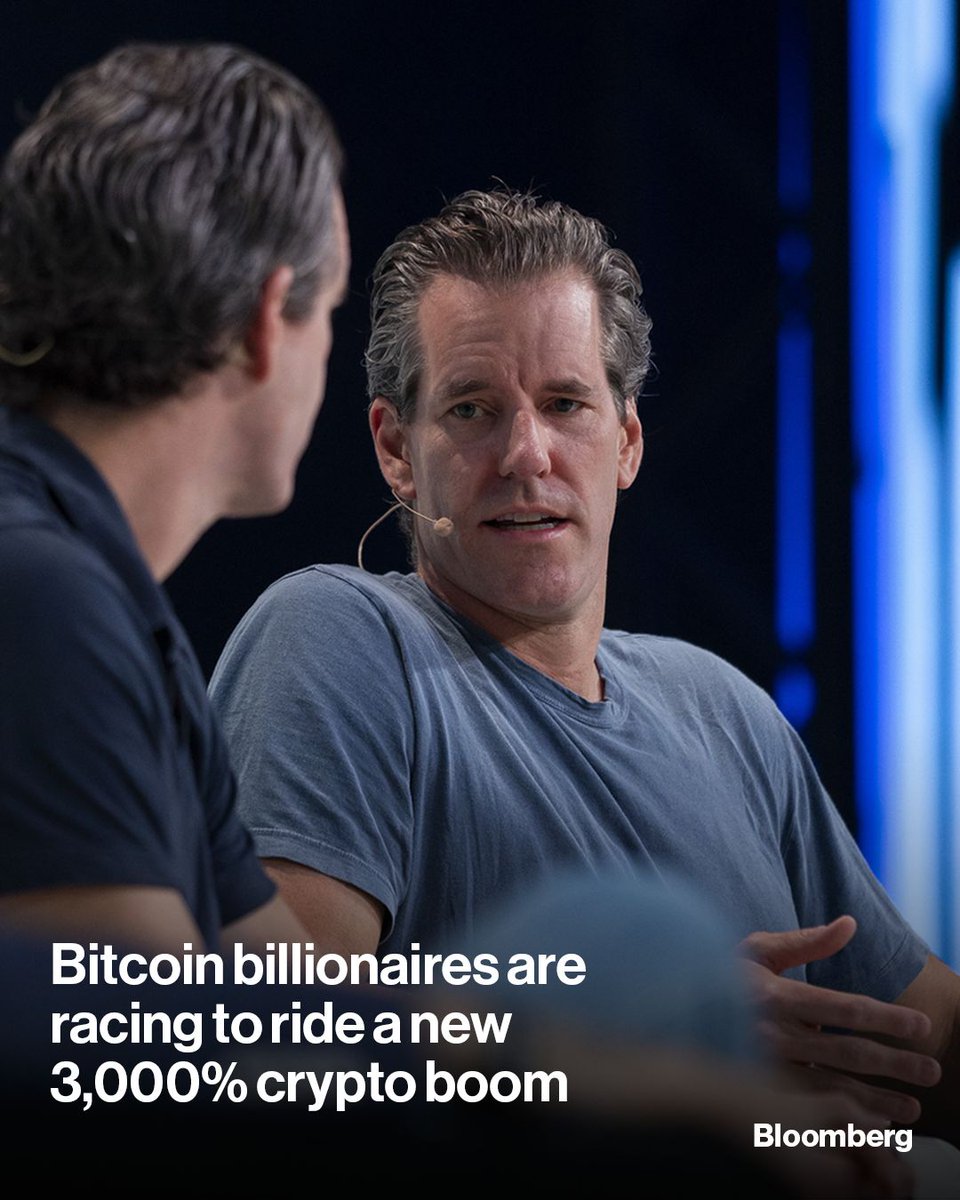
Cameron Winklevoss and Digital Currency Group founder Barry Silbert are competing over Zcash, the privacy-focused cryptocurrency that has rallied roughly 3,000% over the past year, according to Bloomberg. Speaking at Token2049 in Singapore, Winklevoss called it "deja vu all over again" and said "you now have that chance with Zcash." Both sides declined to comment to Bloomberg.
Zcash launched about a decade ago and drew fresh interest after a March 2025 U.S. court ruling reduced legal uncertainty around privacy coins. Benzinga and Bloomberg reported that promoters including Arthur Hayes pitched the token as a Bitcoin hedge, and institutional capital followed.
Each camp has built out competing entities. Cypherpunk Technologies, backed by the Winklevoss twins, and Fortitude Mining, backed by Silbert, have become two of the largest Zcash miners, each spending tens of millions of dollars on additional computing power and each holding roughly 20% of total network mining capacity. On the product side, Grayscale converted a trust it had run since 2013 into the first U.S. Zcash ETF in August, while the Winklevoss twins filed for a rival ETF this month.
The concentration of mining power and fund ownership has raised questions about how decentralized the network remains. Chainalysis head of research Eric Jardine said privacy coins carry regulatory risk tied to a lack of transaction transparency, while Two Prime CEO Alexander Blume said today's Zcash buyers are focused on making money rather than ideology.
Bloom Energy reported third-quarter 2026 revenue of $1.24 billion, up 138% year over year and 16% sequentially, with product revenue of $1.07 billion, up 179% and above $1 billion for the first time. The company raised full-year revenue guidance to $4.4 billion to $4.6 billion.
According to reports in our newsroom database, it was the company's third guidance raise this year and the results beat estimates. Negative cash flow and expansion costs, however, weighed on the shares.
The stock fell 11% despite the beat. On X, some investors framed Bloom as a way to bet on natural gas for data centers, arguing its solid-oxide fuel cells have turned AI power demand into profit; the market focused instead on the cash position.
Peer fuel-cell names FuelCell Energy and Plug Power held relatively steady, suggesting the selloff was specific to Bloom's financial structure rather than the broader AI-power theme. No additional company comment on the share move appeared in the materials.
Leaked data from Moderna and Merck's personalized cancer vaccine intismeran autogene drew positive reactions from oncologists, with CNBC quoting doctors who described the melanoma results as an important milestone in treatment. Yet Moderna shares fell after the same data emerged, producing a rare disconnect between clinicians and Wall Street.
The vaccine is designed to reduce the risk of melanoma recurrence after surgery. According to fool.com, Moderna and Merck reported in August that the vaccine cut that recurrence risk. The leaked results are being treated as the program's first major test.
On the market side, Moderna stock had already fallen 23.07%, prompting a securities-fraud investigation announcement from a law firm. WSJ's Heard on the Street argued that even after the latest sharp decline, the stock still prices in wildly optimistic assumptions, while Seeking Alpha said the data leak brings observers no closer to the truth about the vaccine.
Reactions so far center on how to read the data: doctors stress the clinical significance, while analysts focus on data completeness and valuation, and the two camps remain far apart.
Meta has acquired Sundial, an AI data and analytics platform founded by former Meta executives, according to Axios. Posts circulating on X cited the same report; deal terms and the purchase price were not disclosed in the available material.
The deal lands as Meta ramps up AI spending. According to the X posts, Meta is spending more than $130 billion on AI this year, making it as important to identify which models, compute clusters and ad products generate returns as to build them.
Meta this week reported better-than-expected third-quarter results and announced a 2-for-1 stock split, yet the stock fell 7%, according to N2 in the newsroom archive. Sundial's analytics capabilities map onto the return-measurement question, though the material does not quantify any share-price effect from the deal.
Meta and Sundial did not comment in the provided material, and no authoritative figure for the transaction was available; this article does not estimate one.
Meta Chief AI Officer Alexandr Wang told Nikkei that Muse carries no ads and there are no plans to add them. Instead, Meta will monetize through subscriptions and plans paid enterprise services, taking commissions from sellers on purchases made using agents.
The comments draw a clear line between Muse's business model and Meta's core advertising engine. Wang framed Muse as a subscription play aimed at competing with Chinese models rather than an ad-supported product.
For META, the approach means AI spending must be recovered through subscriptions and enterprise offerings. Meta shares have fallen more than 10% over five days amid a sharp rise in quarterly capital expenditure (N3), putting Muse's monetization under investor scrutiny.
Separately, a New Mexico judge hit Meta with a $25 billion penalty (N2), an unrelated matter that adds to the company's news flow.
Chainlink teams with LG CNS to target Korea's $68 billion digital asset market
LG CNS, lead contractor on the Bank of Korea's Project Hangang, will integrate Chainlink's oracle and cross-chain tools into its institutional platform
Chainlink said on Oct. 22 that it has formed a strategic partnership with LG CNS, the IT services arm of LG Group, to integrate Chainlink's cross-chain, data and orchestration infrastructure into LG CNS's institutional digital asset platform solution. The two companies also plan to jointly develop oracle and cross-chain interoperability standards for Korea's digital asset framework. Chainlink put the size of Korea's digital asset market at $68 billion and said more than 11 million users are eligible for Korean stablecoin services.
LG CNS is the lead contractor on the Bank of Korea's Project Hangang digital currency initiative, whose first phase involved about 80,000 customers across seven Korean banks. The company this month also unveiled its digital asset infrastructure platform, KITL, which the partnership aims to combine with Chainlink's services.
The announcement did not disclose financial terms, named customers or a commercial deployment timetable, and it did not establish that Chainlink's technology would be integrated directly into Project Hangang. Johann Eid, chief business officer at Chainlink Labs, said LG CNS's institutional expertise would complement Chainlink's technical standards, while Hongkeun Kim, executive vice president and head of LG CNS's digital business division, said the tie-up aims to accelerate growth of Korea's tokenized securities market.
For Chainlink, the deal adds another institutional relationship in financial market infrastructure, following existing work with Swift, Euroclear, Mastercard and UBS. Market attention now centers on the pace at which won-denominated stablecoins and tokenized assets move toward commercial deployment, though the specific path remains to be disclosed.
IREN said it is partnering with Nvidia to launch Minerva, Nvidia's new AIOps platform, on IREN AI Cloud. IREN VP of AI Cloud Jason Forrester appeared alongside Nvidia's Gilad Shainer and 650 Group's Alan Weckel to discuss how the operator's approach to AIOps improves visibility and keeps compute productive. Minerva, announced at Nvidia's GTC Berlin conference, pulls data from GPUs, networking gear, storage, job schedulers and the workloads themselves into one map of the data center, uses machine learning to flag and predict failures, groups related alerts into single incidents and includes an AI assistant that answers questions about cluster health in plain language.
Nvidia argues that in clusters of hundreds of thousands of GPUs, a single GPU running hotter than its neighbours or a storage drive slowing under load can hold up an entire training job, and that such signals get missed when network, compute and workload teams each watch their own slice. IREN is an early user; Bitdeer AI, IBM, Jio, Lambda and Tesla also plan to adopt Minerva, and Dell, IBM's hardware peers Lenovo and Supermicro will offer it to customers. Nvidia did not disclose pricing.
The software sits on top of a broader relationship. The two companies have announced a strategic partnership to deploy up to 5 gigawatts of Nvidia DSX-aligned AI infrastructure across IREN's global pipeline, with Nvidia holding a five-year right to buy up to 30 million IREN shares at $70 apiece, a right to invest up to $2.1 billion. IREN also signed a five-year contract worth about $3.4 billion to provide Nvidia with managed GPU cloud services for its internal AI and research workloads. For IREN, operations software maps directly onto revenue from GPUs it has already bought.
For Nvidia, Minerva extends a push to sell more than accelerators to AI data center builders; this week it also said European partners are adopting its DSX blueprint to cut water and power use. The claims come from executives at both companies, and no public figures yet quantify Minerva's effect on uptime or cost.
Company🔥Developing
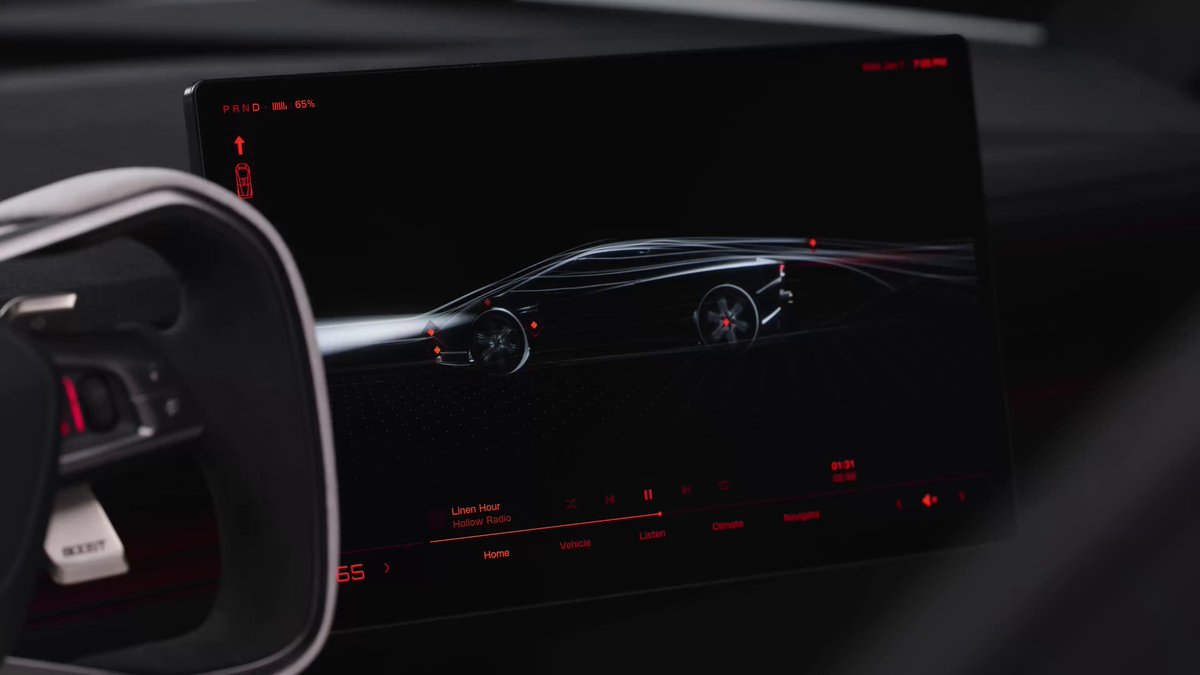
Tesla Posts Official Roadster Cockpit Video, Track Mode Shows 5,500 PSI Thruster Gauge
First official 4K look at the fighter-jet-inspired interface; pricing and production timing remain unannounced
Tesla on Oct. 23 posted a 34-second official video on X showing the next-generation Roadster's touchscreen interface, captioned "Inspired by fighter jet cockpits, Roadster's interface was designed around the pilot." The screen sits beside a squared-off steering wheel and includes a 3D wireframe of the car, rear wing settings for low drag and high downforce, a charge-limit bar and a music player, with Home, Vehicle, Listen, Climate and Navigate tabs along the bottom.
Most of the clip runs in track mode, displaying a live lap map, session lap times, brake and motor temperatures, and per-corner tire pressures and temperatures. A setup page offers Auto, Low Drag, High Downforce and Custom aero modes, plus aero and brake balance adjustment and switches to disable stability and traction control. A bar at the bottom reads "Thruster · 5,500 PSI" next to "Boost Ready."
The interface was first filmed by attendees at Tesla's Oct. 15 closed event in Waco, Texas; the company's own 4K version makes labels and readouts legible full-frame. Tesla's stated targets are under 1.6 seconds from 0 to 60 mph for the Performance version, under 0.9 for Thrust and under 0.59 for the single-seat Rocket. Pricing has not been announced, and reservations reopened in September with a $50,000 deposit.
For $TSLA, the video is product marketing rather than a financial datapoint: no production timeline or price has been disclosed, and Tesla has not said whether the car will be sold outside the U.S. Investor attention remains on capital expenditure guidance after third-quarter results and on speculation about a Tesla-SpaceX combination, which loom larger for the stock than an interior reveal.
How this story unfolded
Markets
Apple Hits Record High as iPhone Duo Launch Tops S&P 500 New-High List
Record close narrows gap with Nvidia to $42 billion; next week's earnings are the test for breakout confirmation
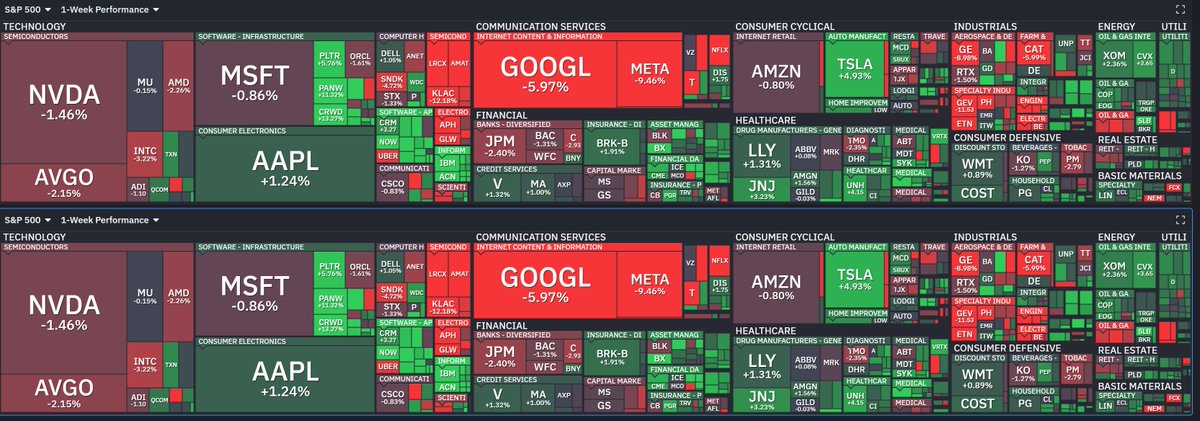
Apple (AAPL) topped the list of S&P 500 stocks trading at a new 52-week high while above their 20-, 50- and 200-day moving averages, according to a weekly heat map of index performance. The stock closed at an all-time high Friday, the same day its first folding iPhone, the iPhone Duo, went on sale in stores from Singapore to Shanghai.
The record came even as the broader technology sector faced pressure. Nvidia shed market value in a sector selloff, and the gap between the two most valuable companies has narrowed to $42 billion, according to 247wallst.com, with Nvidia still holding the top spot.
Two factors matter for investors: the iPhone Duo's hardware and services opportunity is being read as a signal for Apple's product roadmap, and the upcoming earnings report is the test for whether the breakout holds. fxempire.com noted a weaker weekly finish and flagged breakout confirmation, key support and upside targets as the focus.
Separately, one analysis argued Apple's pricing power supports persistently high margins, while debate continues over whether the stock is overpriced. Those are analyst views, not a forecast of price direction.
Bank of America analysts expect SK hynix and Samsung Electronics to announce expanded shareholder returns, including additional cash dividends and share buybacks, at their upcoming earnings calls, according to an Oct 23 report. SK hynix reports on Oct 28 and Samsung Electronics on Oct 29.
The calls follow the completion of buybacks totaling 55 trillion won (about $41.5 billion): 15 trillion won at Samsung Electronics and 40 trillion won at SK hynix. Samsung has already flagged an additional return plan of up to 40 trillion won this year, with the market anticipating 70-80 trillion won in cash dividends and 30-40 trillion won in buybacks and cancellations.
BofA's case rests on free cash flow and valuation. In an Oct 16 note it put 2027 estimated P/E at 2.99x for Samsung and 2.72x for SK hynix, versus 4-7x in past upcycles, and estimated SK hynix's annualized free cash flow at more than $150 billion.
The direct names are SK hynix, which trades in the US as SKHY, and Samsung Electronics, with Korea exposure also available through EWY; Micron (MU) is cited as a peer. Flows run the other way: foreign investors net sold a combined 13.485 trillion won (about $10.2 billion) of the two Korean chipmakers over the same stretch.
How this story unfolded
2026-09-013 posts · 3 authors
Markets
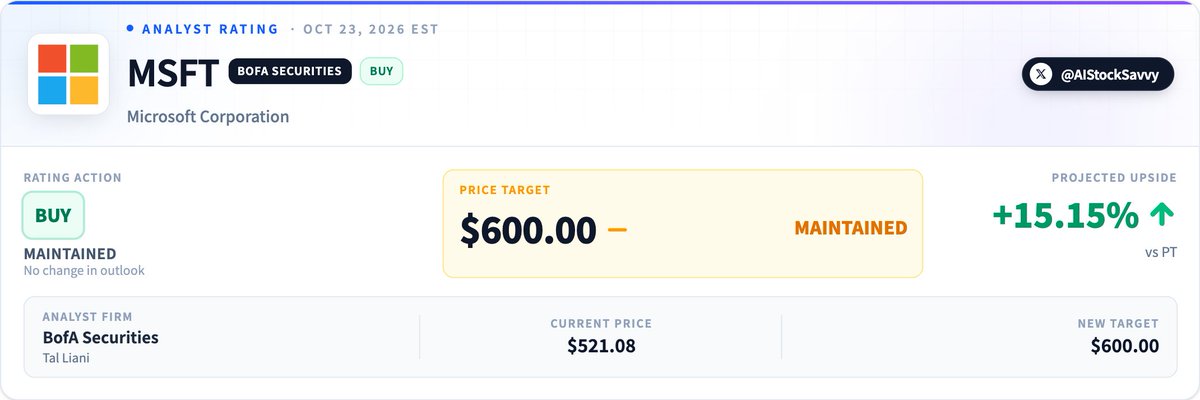
BofA Reiterates Buy on Microsoft With $600 Price Target
A week before earnings, analyst views and free cash flow forecasts frame the valuation debate
BofA Securities maintained a Buy rating on Microsoft with a $600 price target, according to a post from X account aistocksavvy dated Oct. 24.
Microsoft reports earnings Oct. 28, with Wall Street expecting $4.72 in EPS on $90.69B in revenue, Benzinga reported.
X account venu_7_ cited projections showing Microsoft free cash flow rising from $34.6B in FY2027 to $49.4B in FY2028 and $98.1B by FY2029, arguing it is one of the few Mag7 names generating substantial positive FCF despite heavy AI spending.
Recent coverage in the newsroom's 48-hour window focused on institutional position changes and earnings previews, including 13F disclosures from Archer Investment Corp and Bridger Management LLC, while Investors.com noted Microsoft shares holding near highs amid a broader AI-sector pullback.
Nebius chief revenue officer Marc Boroditsky told CNBC the company could sell all of its planned 2027 AI compute capacity today at current prices, that pricing per megawatt is still rising and that demand extends into 2028. He pointed to an auction of computing capacity held on Oct. 20 as evidence of continued upward pricing, and said Nebius is "not carrying the kind of debt" that CoreWeave is.
The comments come as neocloud stocks have come under pressure over the past month amid scrutiny of borrowing and the economics of AI data-center buildouts; Nebius shares have fallen about a third in that period. Nebius reports more than $40 billion in total customer commitments, anchored by Microsoft and Meta, and expects more than $9 billion in customer prepayments this year, against 2026 capital spending guidance of $20 billion to $25 billion.
Financing is the focal point. Nebius closed a $3.5 billion senior secured facility arranged by Citi on Oct. 22 with a 364-day maturity, priced at Term SOFR plus 2.75 percentage points and rising to a maximum of 3.50 points; its August convertible notes carried coupons of 0.50% and 4.50%, versus roughly 16% on CoreWeave bonds. Piper Sandler's James Fish cut his price target to $185 from $237 on Wednesday, keeping a Neutral rating, citing questions about AI demand, return on invested capital and financing.
Boroditsky's remarks are a sales-side demand signal and do not by themselves settle the funding and return question. Consensus data cited by Foreign Policy Journal via TIKR shows net debt rising from about $450 million at end-2025 to roughly $14 billion at end-2026 and near $34 billion at end-2027, with interest expense heading toward $1.1 billion in 2027. The next borrowing terms, capacity delivery schedule and durability of pricing are the concrete checkpoints.
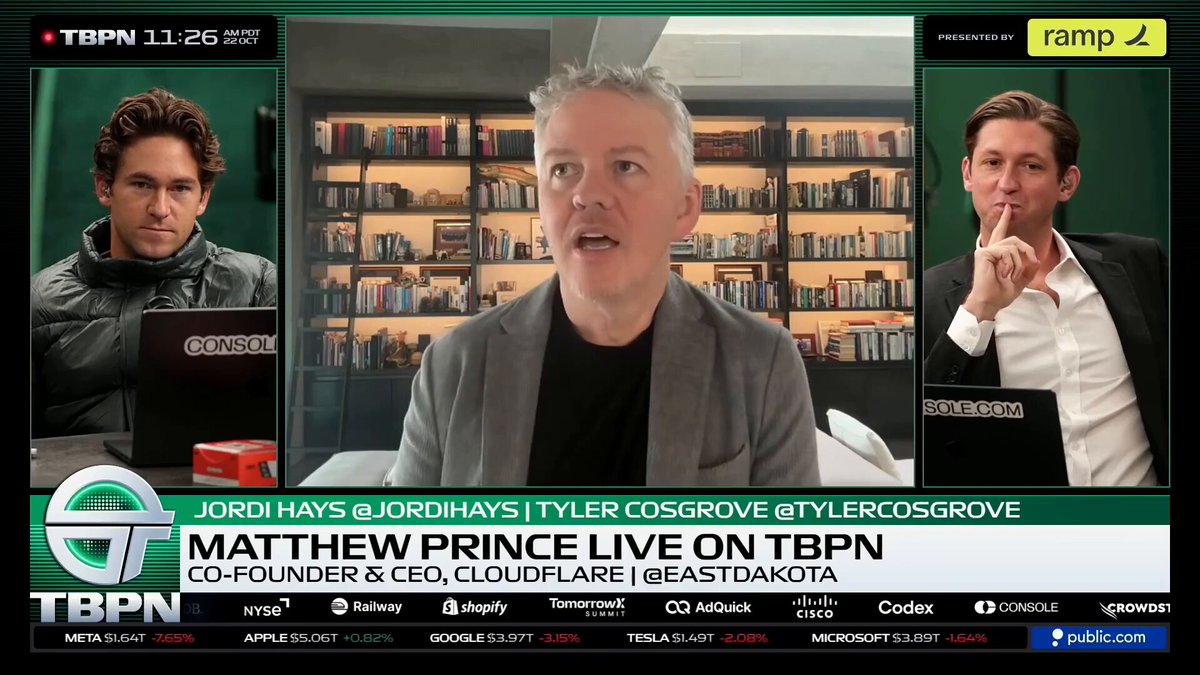
Cloudflare CEO Prince Sees Agent Traffic at 1,000x Human in Five Years, Floats Fraction-of-a-Cent Page Fees
Automated traffic already passed human traffic in May, Cloudflare says; with ads unable to pay for bots, the company argues the web's billing model must change
Cloudflare (NYSE:NET) CEO Matthew Prince said on TBPN on Oct. 22 that if current trends hold, traffic from AI agents will reach 1,000 times human traffic within five years. He pointed to COVID, when doubled traffic nearly overwhelmed the internet, as a scale reference for the servers, routers and bandwidth that agent demand would require.
His proposed fix is micropayment per access: an agent pays a ten-thousandth of a penny to read a page, with the price falling or going to zero if the agent discloses what it is looking for, and some sites potentially paying agents to visit. He also expects a new form of advertising aimed at agents rather than people. Cloudflare's data showed automated traffic overtaking human traffic in May, ahead of his own 2027 forecast, he said in an earlier Decoder interview.
The thesis maps onto Cloudflare's position: its network spans more than 350 cities and sits in front of over 20% of the web, so a per-request billing norm would enlarge its role in settlement and protection. Cloudflare shares rose about 6% on Oct. 23 as cloud software names rebounded, with Datadog up roughly 5%.
The 1,000x figure is Prince's own extrapolation, and he has acknowledged past forecasts missed; pricing levels, settlement frequency and who bears the cost remain unspecified, making this a directional argument rather than a product plan.
Dr. Reddy's Laboratories reported second-quarter FY2027 revenue of INR 86.7 billion, down 1.5% from a year earlier, with net profit at INR 9.3 billion, a 36% decline. EPS came in at INR 11.10, above the INR 8.64 estimate.
Gross margin was 52.1%, down 254 basis points YoY, while EBITDA reached INR 17.8 billion. North America revenue fell 23% to INR 24.9 billion, which the company linked to fading US cancer-drug sales, partly offset by overseas growth.
Capex was INR 1.9 billion and free cash flow INR 1.7 billion. MarketBeat reported revenue of $905 million, up 7.4% sequentially.
The company also disclosed another recall of its weight-loss drug. Dr. Reddy's held its earnings call on October 23.
Baker Hughes data for the week ending Oct. 23 showed the US oil rig count rising by 1 to 460, while gas rigs fell by 1 to 132, leaving the total unchanged at 603 for a third consecutive week. Miscellaneous rigs held at 11.
Year over year, activity is clearly higher: oil rigs are up 40 from 420, gas rigs up 11 from 121, and the total up 53, or 9.6%, from 550. Canada added 3 rigs to 220, bringing the North American count to 823, up 74 from a year ago.
Oil rigs account for roughly 76% of the US total and most of this year's increase, with gas at about 22%. For oilfield service and drilling contractors, a flat headline count implies little near-term incremental activity, though the higher year-on-year base still supports utilization.
The weekly change is modest and insufficient on its own to establish a trend; the question is whether oil price moves feed through to rig deployment in coming weeks.
Basrah crude trades near $10 below Dubai as Brent settles at $116.72
With the US-Iran war in its eighth month, ship-to-ship workarounds are maturing, and the paper-physical gap is the clearest read on real supply tightness.
Physical prices for some Middle East crude grades sold outside the Persian Gulf weakened this week. A cargo of Iraqi Basrah Medium changed hands in the Gulf of Oman via ship-to-ship transfer at nearly $10 a barrel below the physical Dubai benchmark, compared with near parity about a month earlier, according to Asian refiners who received offers.
The shift comes as the US-Iran war nears the end of its eighth month, with Tehran apparently stepping up attacks on shipping ahead of November US midterms. Producers and traders have grown more adept at moving cargoes through Hormuz; Khafji from the Saudi-Kuwaiti neutral zone and Qatar's Al-Shaheen were offered for delivery as late as January 2027, and refiners in India, Taiwan and South Korea bought or tendered for crude deliverable into early 2027.
The divergence between paper and physical markets has been a hallmark of the conflict. Brent settled at $116.72 a barrel on Oct. 23, up $3.55, or 3.14%, after touching its highest since May, putting futures on track for a third weekly gain. ING's Warren Patterson said the rally is "not fundamentally driven" but reflects supply-risk trading. For equities, higher crude supports energy ETFs such as USO and XLE, while wider physical discounts suggest spot tightness is milder than futures imply.
President Donald Trump says more crude is leaving the region than before the conflict, a claim not independently verified. The market's focus is on how sustainable Hormuz flows are if attacks resume.
Applied Digital co-founders Wes Cummins and Jason Zhang bought roughly $6.7 million of the company's shares as the data-center stock fell to a one-year low, according to Barron's. A finance account on X also relayed the size of the purchase.
The company sits in the AI data-center cohort, which has come under pressure. A separate report in our newsroom's 48-hour feed said short sellers booked about $6 billion in October gains betting against AI data-center stocks.
Insider purchases are often read as a sign that management sees value at current levels, but at roughly $6.7 million the buying is modest in scale and its effect on the share price remains to be seen.
The company did not provide further comment on the purchases as of publication.
CrowdStrike founder and CEO George Kurtz said in an Oct. 23 interview on CNBC's "Squawk on the Street" that a lot of breaches will emerge in coming months from PHP vulnerabilities, and pointed to a rise in the frequency of AI attacks. 247wallst.com followed up on Oct. 24, saying the market rewarded the warning.
Kurtz did not specify how many systems are affected or give a timeline, and the materials contain no technical detail on the PHP flaws or vendor response. The 247wallst.com report framed the remarks as a positive signal for the cybersecurity sector rather than evidence of a breach wave already underway.
Across the sector, Cloudflare (NYSE:NET) rose 6% and Datadog gained 5% on Oct. 23, while Snowflake edged higher; an investing.com post flagged $PANW, $OKTA, $CRWD and $NET. A fool.com comparison of CrowdStrike and SentinelOne published the same day pointed to renewed scrutiny of security names.
Those moves came on the day of the interview and were part of a broader cloud-software rebound, so they cannot be attributed to the warning alone. Whether the flaws are being actively exploited, and which software stacks are exposed, remains to be disclosed.
US stocks closed lower, though technology shares steadied to end a turbulent week for the AI trade, Reuters reported.
Earlier, AI-linked shares extended declines on funding concerns, while telecom stocks fell on news of potential new competition. Investors were also awaiting key earnings reports.
Amazon (AMZN) has come under pressure; Zacks reported the stock closed at $246.02, down 4.02% from the prior session. Amazon is scheduled to report third-quarter results on Thursday, Oct. 29, with attention on capex.
Reuters reported that Amazon cloud chief Jassy said cloud capacity is sold out through 2027, a remark that contrasts with market focus on AI infrastructure spending.
IREN (NASDAQ:IREN) fell about 2.4% on Oct. 23 to close at $24.91, with an intraday low of $24.88, just above its 52-week low of $24.86. Volume was roughly 38.3 million shares, about 12% below the 43.4 million average. The move followed an 8.76% drop on Thursday that set a fresh 52-week low.
Technical accounts on X flagged the highest weekly volume ever on a strong selling candle last week, with elevated volume again this week. One account said the stock is down about 30% since a weekly South Star signal, while noting a potential bullish divergence between price and RSI on the daily chart.
Short interest has climbed to 21.34% from 15.78% at the start of 2026, according to Benzinga Pro data. The 6-day RSI sits at 17.17, in oversold territory, while the shares trade about 35% below the 50-day moving average and 42% below the 200-day, following a death cross in August.
On fundamentals, IREN secured authorization this week for a proposed 300 MW AI data-center campus in Badajoz, Spain, targeted for 2028, and launched IREN Europe. MarketBeat's consensus rating is "Moderate Buy" with an average price target of $80.79, though fallout from a Q4 revenue miss continues to weigh on sentiment.
How this story unfolded
2026-09-10
Markets
Viral post claims Nvidia's market cap tops combined GDP of all African nations; no confirmation in our newsroom
The claim comes from investor blogger JesseCohenInv and was reshared by an investing.com account; our recent Nvidia coverage does not address it
Investor blogger JesseCohenInv posted on X that Nvidia's ($NVDA) market capitalization is now larger than the combined GDP of every African country, a claim framed as a "wild stat." An investing.com-affiliated account reshared the post.
The post does not provide the market-cap figure, the GDP aggregate, the statistical source or the reference date behind the comparison.
Our newsroom's Nvidia coverage over the past 48 hours has focused elsewhere: analyst buy recommendations, a 7,404-share position increase by Brown Financial Advisors, debate over whether the stock can serve as an AI safe haven, and a historical look at its valuation.
None of those reports address the market-cap-to-GDP comparison, so the central figure in the post cannot be traced to any source in our materials.
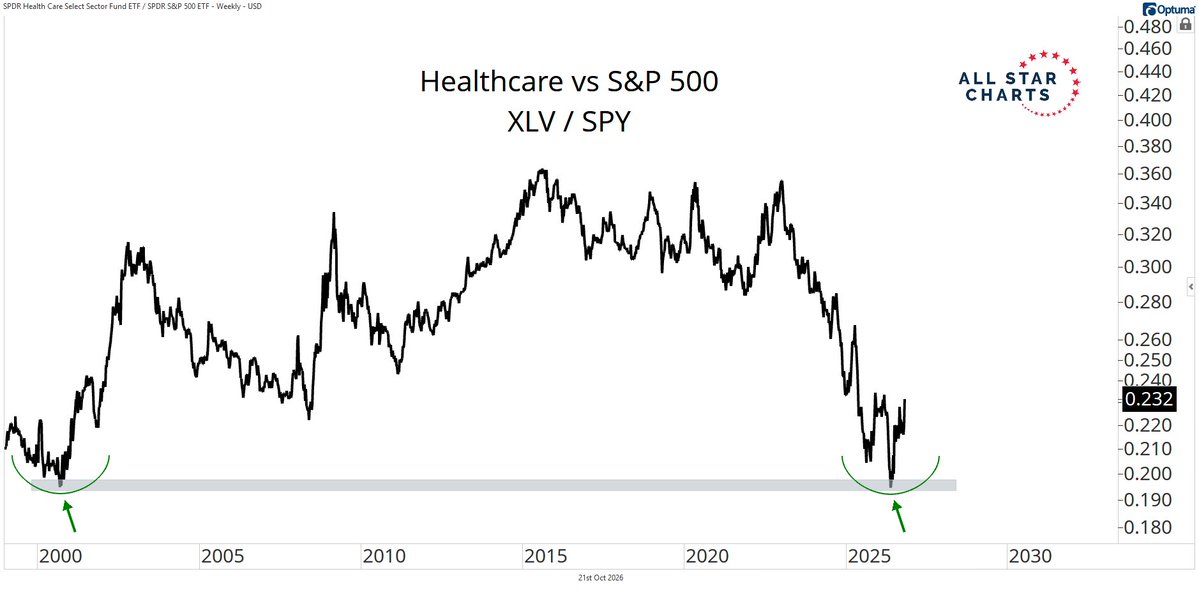
Technical analyst Alfonso De Pablos flagged on X that the XLV/SPY ratio has returned to the level where healthcare last massively outperformed the S&P 500, saying "if it's going to happen again, this is the level." The CMT Association amplified the chart call, which follows a double bottom in the ratio, a bullish MACD divergence and a 20-day moving average crossing above its 200-day counterpart.
The backdrop is a reversal in relative valuation. A year ago the S&P 500 healthcare sector traded at about 17.1x forward earnings, a roughly 24% discount to the index, according to FactSet; by Oct. 16 it stood at 19.3x versus 19.0x for the S&P 500, erasing the discount and flipping to a slight premium. XLV closed at $179.82 on Oct. 20, up 23.9% over the past year against a 14.5% gain for the S&P 500.
Rates are one driver. September US CPI rose to 3.7% and the 10-year Treasury yield reached 5.24% on Oct. 9 and was still 5.15% on Oct. 19, pressuring expectations for AI-related capital spending. Eli Lilly and Johnson & Johnson together account for about 25.4% of XLV, and Lilly raised its full-year revenue guidance to $85 billion-$87 billion.
History cuts both ways: from January 2006 to October 2007, XLV returned 16.6% including dividends while SPY returned 28.2%, leaving early defensive investors behind for nearly two years. Only from October 2007 to February 2009 did the trade pay off, with SPY falling 50.8% against a 34.7% decline for XLV.
How this story unfolded
2026-10-15
Company
Unconfirmed PENG Buyout Talk on X Points to Dell and SK Hynix as Possible Suitors
No party has confirmed the rumor, and our news library shows no same-event coverage recently, only Dell shareholder sales and its AI server backlog
A post on X dated Oct. 24 said buyout rumors were circulating around PENG ($PENG) and asked whether anyone had details. A second user replied that the rumored potential acquirers were "most likely" Dell Technologies ($DELL) and SK Hynix ($SKHY). Neither post cited a source, a deal value or a timeline.
As of publication, PENG, Dell and SK Hynix have not responded to the rumor, and our news library contains no PENG buyout coverage in the past 48 hours. The only Dell items available for cross-checking are routine institutional filings: Brookstone Capital Management cut its Dell position by 18.7% and Atlatl Advisers LLC by 20.2% in the most recent quarter, neither of which bears directly on a takeover.
The Dell angle rests on its AI infrastructure exposure. A Zacks comparison published Oct. 23 noted Dell's record $95B AI server backlog and lower valuation versus Applied Digital, whose $36B contracted pipeline carries mounting financial risks. That context may explain why Dell's name surfaced, but the available material does not support any conclusion about a transaction.
For traders, this remains an unverified social-media rumor rather than actionable information. The tickers involved are PENG as the rumored target and Dell and SK Hynix as rumored suitors; whether their shares react depends on a statement from the parties or a formal disclosure.
Trump said the US may bomb Iran's 'Pickaxe Mountain' and revealed a three-hour US-Iran delegation meeting, calling it productive.
2026-09-29149 posts · 68 authors
Iran reportedly agreed to halt uranium enrichment for US sanctions relief; Trump signaled readiness to ease sanctions and unfreeze assets, crashing oil by 3.6%.
2026-10-09125 posts · 66 authors
Trump said the US will not attack Iran before the November 3rd midterm elections, adding that talks are underway.
2026-10-2368 posts · 33 authors
Trump believes he can force Iran's capitulation; Netanyahu advocates more bombing for regime change, with Trump leaning that way; he reiterated no attack before midterms.
2026-10-2452 posts · 25 authors
Trump said the US will 'take care of Cuba on the way back from Iran' and, one minute after the US market close, hinted at another operation against Iran.