Major U.S. banks are beginning to report earnings today, with JPMorgan, Goldman Sachs, Citigroup and Wells Fargo among the names in focus. The latest X signals point to a heavy day for bank results and investor attention.
The reports matter because investors are looking for clues on the American consumer and loan demand while long-term borrowing costs remain elevated. Our newsroom has also highlighted JPMorgan as a key read on the U.S. economy and consumer health.
Bank shares are already under pressure, with Bloomberg noting that large U.S. bank stocks are hovering in correction territory ahead of earnings. That puts extra weight on management commentary about margins, credit quality and lending activity.
Markets are also watching the first wave of guidance from the group after a choppy session for futures. The tone from these reports could shape sentiment across the sector into the rest of earnings season.
South Korea’s KOSPI fell below 6,000 intraday on Tuesday, dropping as low as 5,911.11 and triggering a five-minute sell-side sidecar at 9:47:58 a.m. local time. The circuit-breaker style measure was activated after program sell orders pushed the mini KOSPI 200 futures down more than 5% for one minute.
The move came amid a broad sell-off in semiconductor shares. Reports pointed to renewed pressure on chip sentiment after news around China’s CXMT memory technology progress, alongside fresh worries over the capital intensity of AI spending.
Samsung Electronics closed down 7.39% and SK hynix lost 10.09%, while foreigners net sold 4.53 trillion won on the main board. KOSPI ended the session at 6,035.35, down 5.46% from Monday, according to Korea Exchange.
AP reported the index had fallen 7.4% at one point to 5,914.35, while Yonhap Infomax and The Herald Business confirmed the sidecar activation, intraday low and closing level. The session underscored how concentrated chip exposure continues to drive swings in Korea’s market.
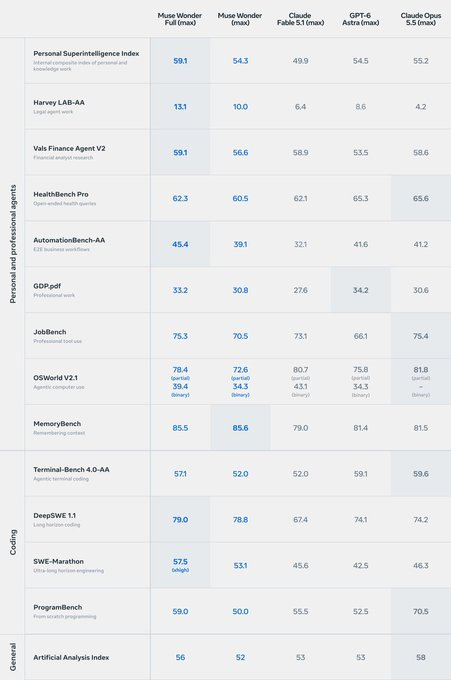
Meta has launched Muse Wonder, a new AI model it says beats rival systems from OpenAI and Anthropic on several benchmarks. Other posts say the company also introduced Muse Wonder Full, described as one of its most capable models so far.
The release extends Meta’s recent push to rebuild its AI stack around frontier models and agent-style products. Zuckerberg was quoted saying the company has caught up with competitors at the frontier of AI and is already working on the next steps.
Market reaction in the X stream was positive for $META, with one post citing a 4% gain. The key question for investors is whether the new model can translate technical claims into products for personal assistants and enterprise workflows.
For now, the headlines rely on company claims and media-reported comments, so the benchmark comparisons and practical capabilities will need further confirmation.
UnitedHealth Group reported third-quarter revenue of $112.69 billion and adjusted earnings per share of $4.69, both ahead of expectations. The company also reported EPS of $4.56 versus $2.59 a year earlier.
The update matters because investors have been watching whether medical cost pressure can keep easing across the insurer’s businesses. Bloomberg and CNBC said the stronger quarter led UnitedHealth to lift its profit outlook for the year.
The stock reacted favorably in premarket trading, with X posts saying UNH was up about 5%. The move reflects how closely traders are watching the company’s margins and cost trends after a difficult stretch for managed-care names.
Additional figures showed UnitedHealthcare revenue of $86.33 billion, Optum revenue of $66.88 billion, total enrollments of 48.30 million, and a medical care ratio of 88.4%. Those details suggest the improvement was broad-based across the quarter.
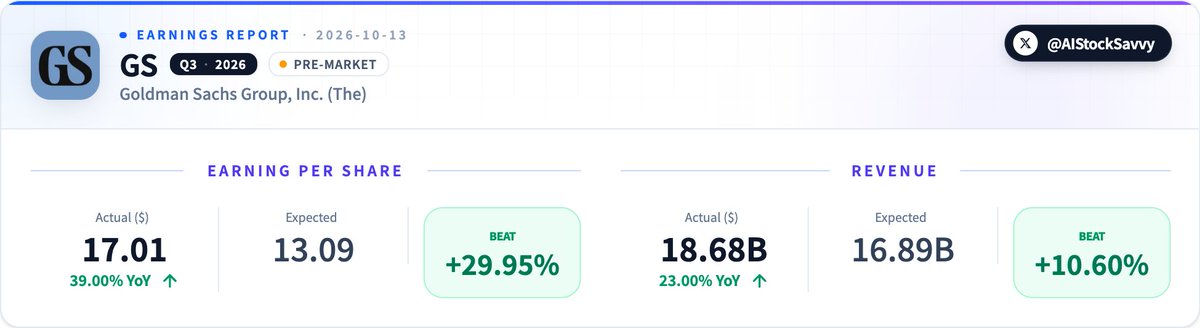
Goldman Sachs reported a clear third-quarter beat. CoinBureau said adjusted EPS came in at $17.01 versus $13.02 expected, revenue at $18.68 billion versus $16.71 billion, and net income at $3.77 billion versus $3.61 billion.
The firm also turned more constructive in its market outlook. unusual_whales and Scott Melker both cited Goldman saying it is bullish on global stocks for the next 3 months, while also upgrading its 12-month bond outlook to overweight.
Shares of GS were firmer in premarket trade, with stockmktnewz citing a move of nearly 5% and CoinBureau citing a 3.3% gain. Bloomberg said equity traders beat expectations, while fixed-income and rates trading came in below estimates.
Zacks published a matching report from the same earnings release, confirming that Goldman Sachs beat both EPS and revenue estimates. The new signal set is drawing attention to the bank’s trading mix as well as its updated asset-allocation stance.
Kremlin denies Trump’s diesel deal is tied to Ukraine talks
The Kremlin pushed back on the latest framing of the Russia-U.S. fuel agreement, deepening uncertainty over whether it is a trade move or diplomacy by another name.
The Kremlin said Russia’s diesel export agreement with the U.S. has no direct connection to negotiations over Ukraine. The denial came after Reuters reported that Trump’s envoys had presented the deal as part of an effort to bring Moscow back to the table.
The X signal indicates Trump’s team had told Ukrainian officials the arrangement was meant to soften Russia and entice it into renewed talks. That makes the Kremlin’s rejection the latest public clash over the deal’s real purpose.
In the market context, several reports have tied the agreement to fuel-pricing and refinery-related debates, but the material provided here does not include company-specific financial data. The immediate impact in the supplied coverage is political, with the deal drawing bipartisan criticism in the U.S. and scrutiny abroad.
Trump defended the deal in CNBC coverage, saying he “made the right choice.” The Kremlin, however, maintained that the agreement is not directly linked to Ukraine peace negotiations.
Multiple X posts show Asian markets under pressure today, with semiconductors and technology names leading the decline. The immediate catalyst cited in the feed is a prominent tech CEO’s remark comparing parts of the AI trade to a casino and questioning whether enterprise AI is delivering ROI.
In the site news archive, 24 Wall St. reported that SK Hynix fell 6% in early trading to $153.04, extending a Seoul selloff into a fifth session. A separate archive item said the stock was down about 3.6% on October 12, underscoring that the weakness has been building for several sessions.
The broader market move was not limited to one name. The X feed also mentioned Nvidia, AMD, other memory-chip stocks, and even copper and aluminum easing as investors reassessed the demand outlook tied to AI infrastructure spending.
For this item, SK Hynix is the clearest core ticker. The other AI chip names appear as part of the same market sentiment shock rather than as the main corporate subject.
Fitch Ratings said France’s sovereign A+ rating faces pressure from rising public debt, weaker growth and persistent political fragmentation. The agency said the government’s proposed 2027 budget targets a deficit of 5% of GDP, but still leaves the debt trajectory difficult to stabilize.
The warning comes against a heavy fiscal backdrop. CNBC said France posted a 5.1% budget deficit in 2025 and debt of 115.6% of GDP, while other reports said the 10-year government bond yield has been approaching 5% and the spread over German debt has widened.
The market impact is centered on French sovereign bonds and broader European risk sentiment rather than any single company. The X feed also pointed to European bank ETF EUFN, which is being affected by spillover from higher French yields and broader concern over sovereign stress.
Fitch said passage of the 2027 budget may be smoother procedurally than in recent years, but that alone would not solve the scale of adjustment needed to stabilize debt. The agency warned that a lack of substantive deficit reduction could still prompt a negative outlook revision.
Apple on Tuesday introduced HomeView, a 7-inch smart home display priced at $299. The device is designed to act as a household hub for voice control, touch interaction, video calls, music, photos and connected-home management, while recognizing up to six users for personalized experiences.
The launch underscores Apple’s effort to make Siri AI more central to daily home use, with privacy and personalization presented as the product’s main selling points. Apple says preorders are open now and shipping begins November 13.
For markets, HomeView adds a new front in the smart-home race against Amazon and Google. The most direct equity focus remains AAPL, while the announcement also spotlights Apple’s broader home-accessory ecosystem, including cameras, locks and thermostats.
Apple’s newsroom post and reporting from CNBC and The Verge align on the key details: $299 pricing, a 7-inch screen, facial recognition for up to six people and a November 13 launch. That consistency helps confirm the product as a formal launch rather than rumor-level chatter.
Nvidia and Cisco have introduced a new pluggable optics form factor called USFP for AI factories. Nvidia says the module is the first to support 400Gb/s per lane and delivers four times the bandwidth density of today’s optics.
The announcement extends a collaboration that has already surfaced in Cisco’s recent messaging around scalable, open infrastructure for AI data centers. In the newsroom materials, Cisco said it plans to develop an open industry specification with Nvidia, while also framing the effort as part of broader OCP 2026 work.
For investors, the immediate tickers in focus are NVDA and CSCO, with related supply-chain names such as TE Connectivity and Amphenol mentioned in the X posts. Nvidia also said it supports both pluggable and co-packaged optics, suggesting the company is not treating the two approaches as mutually exclusive.
The companies say the design is meant to let builders connect more compute to the same switch with fewer network tiers and lower power per bit moved. That makes the announcement a networking-infrastructure update rather than a chip launch, even though it sits squarely inside the AI buildout theme.
Kobeissi Letter said the 52-week correlation between the equal-weighted S&P 500 and the cap-weighted S&P 500 has fallen to 0.67, the lowest on record. The same signal set also shows the S&P 500 earnings yield minus the 10-year Treasury yield at -1.5 percentage points, the weakest reading since 2009.
The backdrop is a highly concentrated rally in which a small group of mega-cap names continues to dominate index performance. CNBC noted that market breadth has deteriorated to levels not seen since the dot-com era, even as the headline S&P 500 remains near record territory.
That split matters because it means the index can look healthy while a broad swath of constituents lags far behind. Reuters reported that roughly 40% of S&P 500 stocks are down this year, underscoring how narrow leadership has become.
Cross-checking the numbers, multiple market reports repeated the 0.67 correlation and the -1.5 percentage-point spread. Together they point to the same theme: extreme concentration is now the defining feature of the U.S. large-cap market.
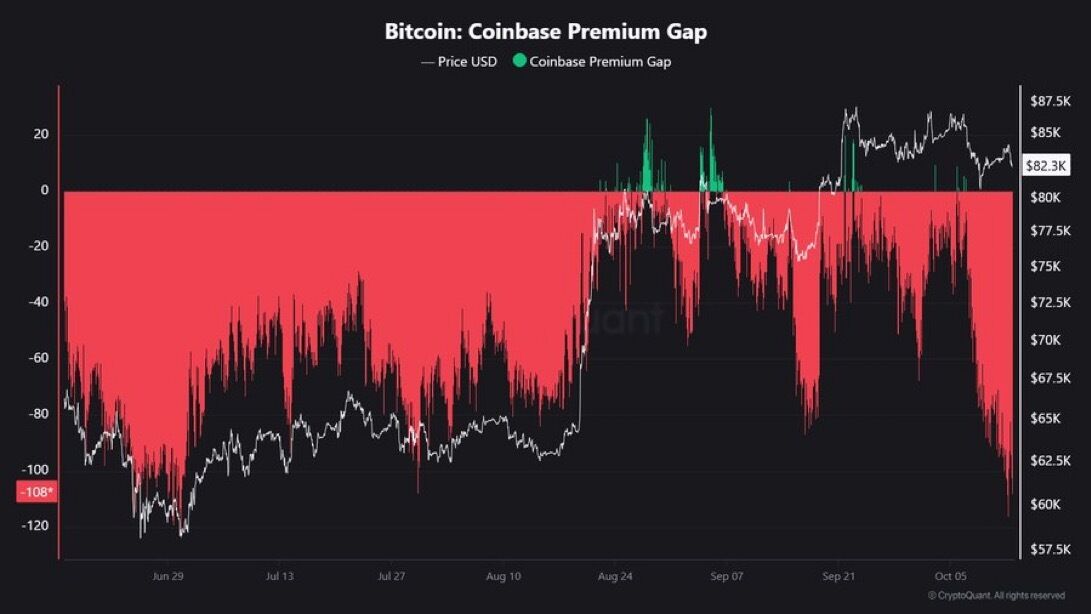
CryptoQuant analyst data cited on social media shows Bitcoin’s Coinbase Premium Gap falling to minus $107, a sign that BTC is trading cheaper on Coinbase than on other venues. Traders typically read that as weaker U.S. spot demand.
The latest signal lands while Bitcoin has been oscillating in the $82,000 to $85,000 range, with market chatter also focused on downside bids near $80,000 and resistance around $84,000. Separate posts have highlighted both bearish positioning and indicators that historically precede rebounds, keeping the tape mixed.
The move matters most for Bitcoin spot trading, perpetual futures and exchange volumes, with Coinbase often used as a proxy for U.S. investor appetite. Negative funding rates and a flipped MACD are being cited alongside the premium gap, showing that short-term sentiment is divided rather than one-way.
For now, this is a market read, not an exchange statement or issuer announcement. The key verifiable figures in the signal are the -$107 Coinbase premium gap and the repeatedly cited $80,000, $82,000 and $84,000 price zones.
Multiple reports say Kroger plans to eliminate about 3,000 corporate jobs over the next three years, or roughly 37% of its 8,200-person corporate workforce. The reporting ties the move to broader use of AI and a push to simplify operations.
The same event is being described by Bloomberg- and Reuters-linked follow-ups in the news library, which say management wants to cut duplicate work, reduce overhead and improve efficiency. The stated aim is to free up resources for lower prices and frontline investment.
For markets, the headline centers on Kroger, the core ticker in this story. The company’s shares were already in focus in recent coverage, but this update adds a fresh labor-cost and operating-structure angle to the KR narrative.
So far, the material reflects media reporting and a memo-based account rather than a formal public denial or a revised company announcement. Any final read-through will depend on whether Kroger confirms the scope and timing of the cuts.
Epic Games has delayed an as-yet unnamed Disney-linked shooter and told developers to move to an “AI first” production model. According to Bloomberg, internal messages said there would be “no more hand-written code,” while art assets would be produced through full AI workflows and then supervised by humans.
The game is part of the 2024 Epic-Disney partnership, which included a $1.5 billion investment and was expected to launch a Marvel-and-Star Wars-themed shooter in March 2027. Bloomberg said the project now has no release date, after development fell behind schedule as Epic underestimated the headcount and time required.
For investors, the immediate read-through is more about DIS’s IP partnership pipeline and Epic’s development model than near-term revenue. Epic said it is embracing AI-accelerated development, while Bloomberg reported staff had already been concerned about the project’s pace.
Disney had no public comment in the report. Based on the available reporting, this is a project-level reset rather than a confirmed cancellation of the broader partnership.
Moscow Exchange plans to offer cryptocurrency trading from December 1, according to remarks by senior managing director Boris Blokhin reported by TASS. The exchange said it is still testing the setup and intends to use its existing market infrastructure.
The move follows Russia’s newer digital-asset regime, which has opened the door for regulated crypto activity through licensed financial institutions. Under the framework, investor access remains segmented and subject to qualification tests and limits for ordinary retail clients.
For markets, the most immediate impact would fall on exchanges, brokers, and digital custodians tied to the new onshore flow. If spot trading is routed through MOEX, the exchange could become a regulated gateway for Bitcoin, Ether and USDT trading inside Russia’s financial system.
The December 1 date, however, is still a plan from the exchange rather than a confirmed nationwide launch by the central bank. The Bank of Russia’s rules continue to determine who can trade, what they can buy, and under what caps.
How this story unfolded
2026-09-234 posts · 4 authors
Moscow Exchange launched perpetual futures trading for Bitcoin, Ethereum, Solana, XRP, and Tron.
Markets
S&P, Kaiko complete first Canton onchain OTC swap
DRW and Marex executed the deal, marking a new institutional use case for tokenized benchmarks on chain
S&P Dow Jones Indices, Kaiko and Derivnex have completed what they say is the first OTC swap on the Canton Network referencing a tokenized benchmark, with DRW and Marex on opposite sides of the trade. Media reports say the contract used a tokenized version of S&P’s iBoxx bond index.
The move matters because it pushes a traditional institutional derivatives workflow — benchmark reference, trade execution and recordkeeping — further into blockchain infrastructure. Canton has been positioning itself as a network built for regulated financial activity, with privacy and interoperability features aimed at institutional use.
For markets, the announcement is more about the infrastructure narrative than a direct earnings driver for any listed company. X posts also cited a short-term move in Canton’s CC token, but that price action was not part of the official trade disclosure and should be treated as market chatter.
At this stage, the publicly verifiable details are limited to the parties involved and the fact that the trade was executed. Key economics such as notional size were not disclosed, and the next catalyst will be whether more indices or more counterparties are added to the Canton venue.
Strive disclosed in an 8-K on Oct. 13 that it bought 3,311 bitcoin between Oct. 5 and Oct. 9 at an average price of about $84,500 each, inclusive of fees and expenses. The purchase lifted its total bitcoin holdings to 32,773 BTC as of Oct. 9.stocktitan.net
The filing also showed Strive’s cash and cash equivalents rising to $310.3 million from $284.7 million a week earlier, while SATA preferred shares outstanding increased and the shares underlying traditional warrants declined. The move underscores how the company continues to fund bitcoin accumulation through capital-markets activity rather than cash depletion alone.theblock.co
Market attention remains on ASST because Strive is one of the larger public bitcoin holders and has tied its financing structure to its treasury strategy. The latest disclosure adds another data point for investors tracking how the company balances bitcoin exposure, preferred equity issuance, and warrant exercises.theblock.co
Unchained reported that CEO Matt Cole said about $208 million of warrants were exercised ahead of the Oct. 13 expiration window. That financing detail is not fully broken out in the filing, so the 8-K remains the primary source for the holdings update.unchainedcrypto.com
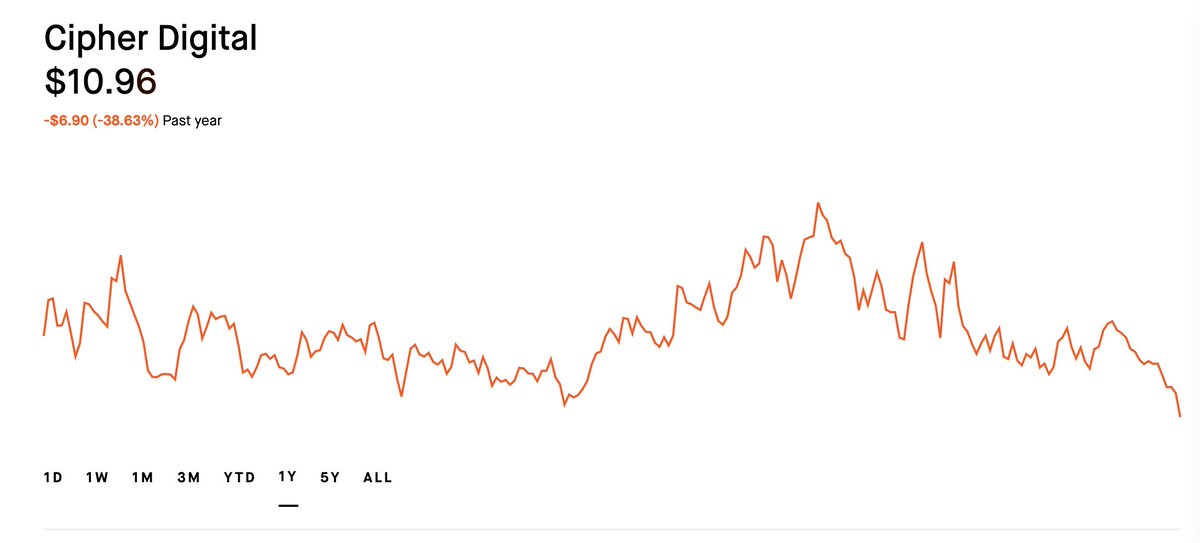
Cipher Digital said on Tuesday it plans a private offering of $850 million of 0.00% convertible senior notes due 2032, while also launching a concurrent exchange offer for its 2030 convertible notes. X posts tied to the news said CIFR traded lower on the announcement, with losses cited in the double digits.
The financing comes as Cipher continues to position itself as a developer, owner and operator of industrial-scale data centers. In the company’s public release, the transaction is framed as part of its broader capital strategy around site expansion and power access.
Market reaction was negative for CIFR, with social posts citing declines of more than 10% and as much as 14% in premarket trading. The move drew attention because the notes carry a 0.00% coupon, making the deal notable for its low-cost funding profile.
The company described the transaction as proposed private offering, so the financing has not yet been completed based on the materials provided.
FGE NexantECA said global crude oil demand may have peaked in 2025, according to a Bloomberg report published on Oct. 12. The latest catalyst is the view that a larger share of incremental fuel demand is being met by biofuels rather than crude-linked products.
The argument is not that total liquids demand has stopped growing, but that crude is losing the marginal barrel to alternatives. The report also said some oil demand was lost after this year's Hormuz crisis disrupted flows through the key Middle East chokepoint.
For the market, the immediate takeaway is more about narrative than a clean directional call. WTI November futures settled at $93.74 a barrel in one market feed cited today, while Brent was quoted around $106.65, leaving traders to weigh a structural demand story against still-tight physical conditions.
The FGE note may matter most for refiners, upstream investors and the shape of the futures curve if more data confirms slower crude growth. For now, it is a new data point in an already active debate over whether oil demand has entered a long plateau.
Regulation🔥Developing
Visa gets PBOC approval to prepare China bank card clearing unit
The move brings Visa one step closer to local clearing operations in China, though a full operating licence still requires another round of approval.
Visa said on Oct. 13 that it had received approval from the People’s Bank of China for its Application to Prepare, allowing it to begin formal preparations to establish a domestic bank card clearing institution in China. CEO Ryan McInerney called it an important milestone in the company’s long-term commitment to the market.
According to Xinhua and China Daily, the approved entity is Visa Information Technology (Beijing) Co Ltd. The company must complete preparatory work within one year and then apply for an operating permit; only after that and further regulatory approval can it begin domestic clearing services.
The development matters for Visa, Mastercard and American Express because China is one of the world’s largest payments markets, while Visa has so far been limited mainly to cross-border clearing services. China’s everyday payments, however, are still dominated by WeChat Pay and Alipay.
Visa said it will continue working under PBOC guidance to move through the process. Xinhua said the approval signals China’s continued opening in financial services.
How this story unfolded
Earnings
Citigroup beats Q3 revenue estimates as trading splits
The bank topped Wall Street on revenue and EPS, but equities trading came in below forecasts even as FICC outperformed.
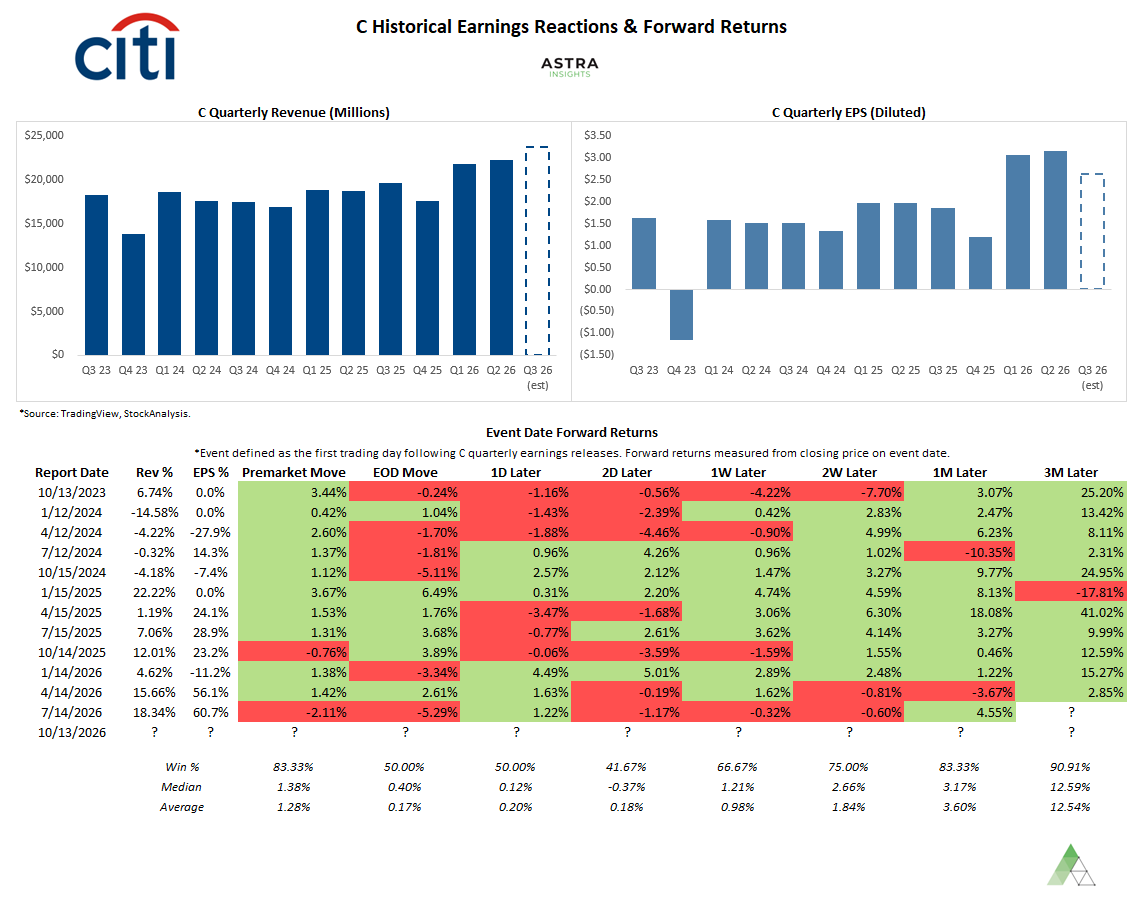
Citigroup reported third-quarter 2026 revenue of $23.85 billion, ahead of the $23.72 billion consensus estimate. Earnings per share came in at $2.85, with net income rising 40% year over year to $5.25 billion.
The top line was supported by markets revenue of $6.11 billion and banking revenue of $1.74 billion, both modestly above expectations. FICC sales and trading revenue reached $4.39 billion, beating estimates, while equities sales and trading revenue of $1.73 billion missed forecasts.
The mixed trading print underscores the different pace across Citi’s market businesses even as the broader quarter showed strength in investment banking, services and wealth. Investors in C will likely focus on how durable that mix proves to be.
Reuters and Business Wire both carried the results as Citi’s official third-quarter release hit the tape. Shares were reported higher in premarket trading following the beat.
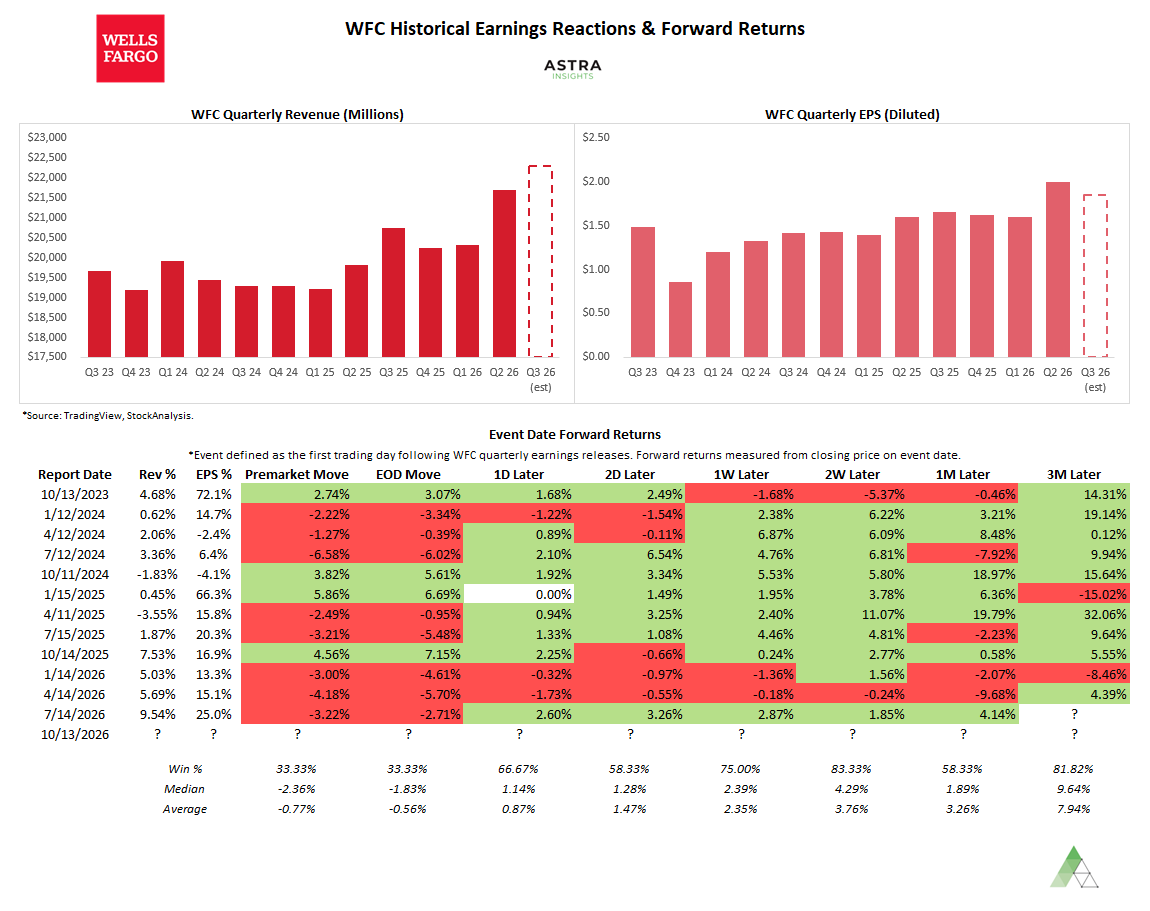
Wells Fargo reported third-quarter 2026 earnings per share of $1.87, ahead of the $1.85 consensus estimate. Net income came in at $5.95 billion, while revenue reached $21.87 billion, below the $22.30 billion estimate.
Net interest income totaled $12.52 billion, also short of the $12.63 billion forecast. Wells Fargo said provision for credit losses was $1.03 billion, and its return on equity was 13.8% with a CET1 capital ratio of 10.0%.
The result is the latest update for WFC after multiple reports in the news flow pointed to the same third-quarter release. Zacks highlighted the earnings beat, while Reuters and Business Wire also identified the filing as Wells Fargo’s third-quarter 2026 results.
For WFC, the key focus remains the mix of stronger earnings and softer top-line metrics, especially net interest income and fee trends. Investors will likely keep tracking loan growth, credit costs and profitability measures in the bank’s ongoing quarter-to-quarter performance.
Dimon says JPMorgan is solid, but flags a broader risk backdrop
After JPMorgan’s quarterly update, Jamie Dimon said the U.S. economy remains resilient while higher rates, sticky inflation and geopolitical tensions keep pressure on the outlook.
Jamie Dimon said the U.S. economy remains solid, supported by business investment and consumer spending. He also warned that rising rates, sticky inflation, large fiscal deficits and geopolitical tensions continue to build beneath the surface.
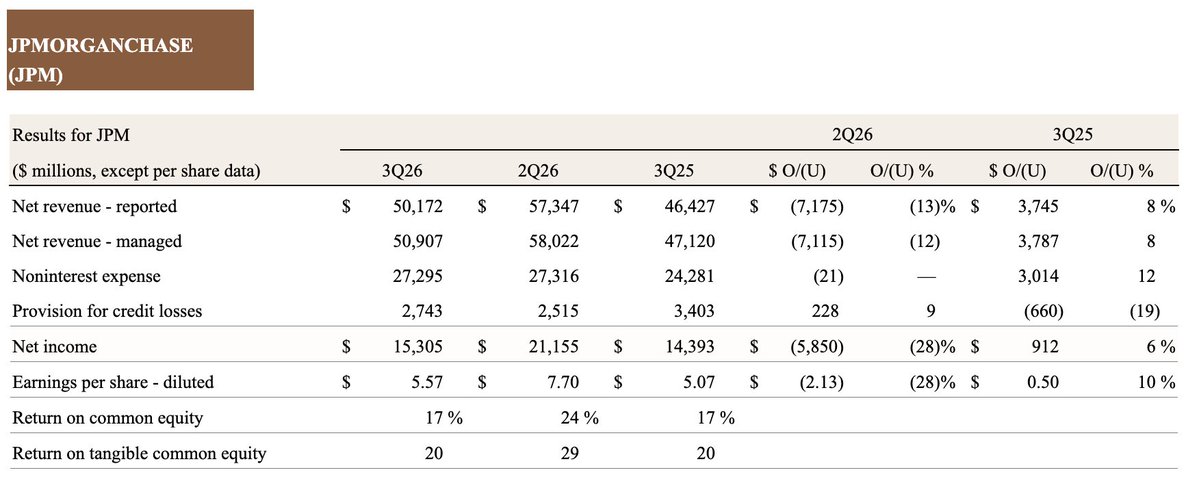
The comments came alongside JPMorgan’s earnings release. The signal materials show net income of $15.3 billion, EPS of $5.57, reported revenue of $50.2 billion and managed revenue of $50.9 billion.
For markets, the remarks keep JPM in focus as investors digest both the bank’s numbers and Dimon’s macro warning. Prior coverage in the news library framed the bank’s results as an early read on the U.S. consumer and the broader economy.
Dimon also said global deficits are not just a U.S. issue, citing China and Europe as examples. The remarks are a fresh management commentary rather than a forecast of direction.
Netflix said on Tuesday it has secured exclusive broadcast rights for the 2030 FIFA World Cup in Spain and Andorra, covering all 104 matches. The company said it will add pre-game, halftime and post-game shows, plus a daily highlights program.
The deal comes as the 2030 tournament marks the World Cup’s 100th anniversary. Spain, Morocco and Portugal will co-host the main tournament, while Argentina, Paraguay and Uruguay will stage centenary celebration matches; Netflix said one match per matchday will be free to watch in Spain, and a package including Spain’s matches, both semifinals and the final will air on a national free-to-air broadcaster.
For Netflix, the agreement expands its sports-rights footprint after it already secured the 2027 Women’s World Cup in the U.S. and Canada. Investors will watch whether marquee live sports can deepen engagement and support advertising, even though Netflix did not disclose financial terms.
FIFA said the partnership is aimed at bringing fans closer to the competition. Netflix also framed the deal as its first major men’s international tournament broadcast in Spain, underscoring how the company is widening its live-sports strategy.
Bumble said on Tuesday it has entered a definitive agreement to be acquired by Ithaca Holdings in a take-private deal valuing the dating app operator at about $1 billion. The announcement turns a weekend of market chatter into a confirmed transaction.
The deal was first reported on October 12, when Reuters said Bumble was in advanced talks with Ithaca, and follow-up reports from BBC and others said an announcement could come as soon as this week. The market moved quickly because Bumble has been under pressure from slower growth and a weaker dating-app backdrop.
Bumble shares jumped about 50% to $3.81 after the report, while BBC said the company’s market value briefly rose above $580 million. That remains far below Bumble’s more than $14 billion peak after its 2021 Nasdaq listing.
Bumble and Ithaca had not commented during the reporting stage, but the company’s filing now confirms the buyer and the price. Prior reporting also showed Bumble ended 2025 with about 3.7 million paying users and roughly $966 million in annual revenue, underscoring why investors saw the move as a valuation reset rather than a growth story.
Getty Images said on Oct. 12 that it has reached a restructuring support agreement with major financial stakeholder groups and plans to move through a prepackaged Chapter 11 process. Under the deal, affiliates of the Getty family and Koch Equity Development would provide up to $533 million in new equity, and the reorganized company would be privately held.
The move follows Getty Images’ earlier abandoned merger plan with Shutterstock, underscoring how the company’s strategic path has shifted from expansion by acquisition to balance-sheet repair. The restructuring also includes debt reduction and changes to secured debt terms, with the company saying the process is designed to address non-operating legal liabilities while preserving operating strength.
Getty said the transaction should not disrupt day-to-day operations, with vendors paid in the ordinary course and no anticipated impact on employees, customers or contributors. Reuters and the company’s release both said the restructuring is expected to be completed by year-end.
For GETY, the immediate story is not a business shutdown but a control and capital-structure reset. Investors will focus on the terms of the private takeout, the debt exchange and how the new ownership structure affects the company’s leverage and liquidity.
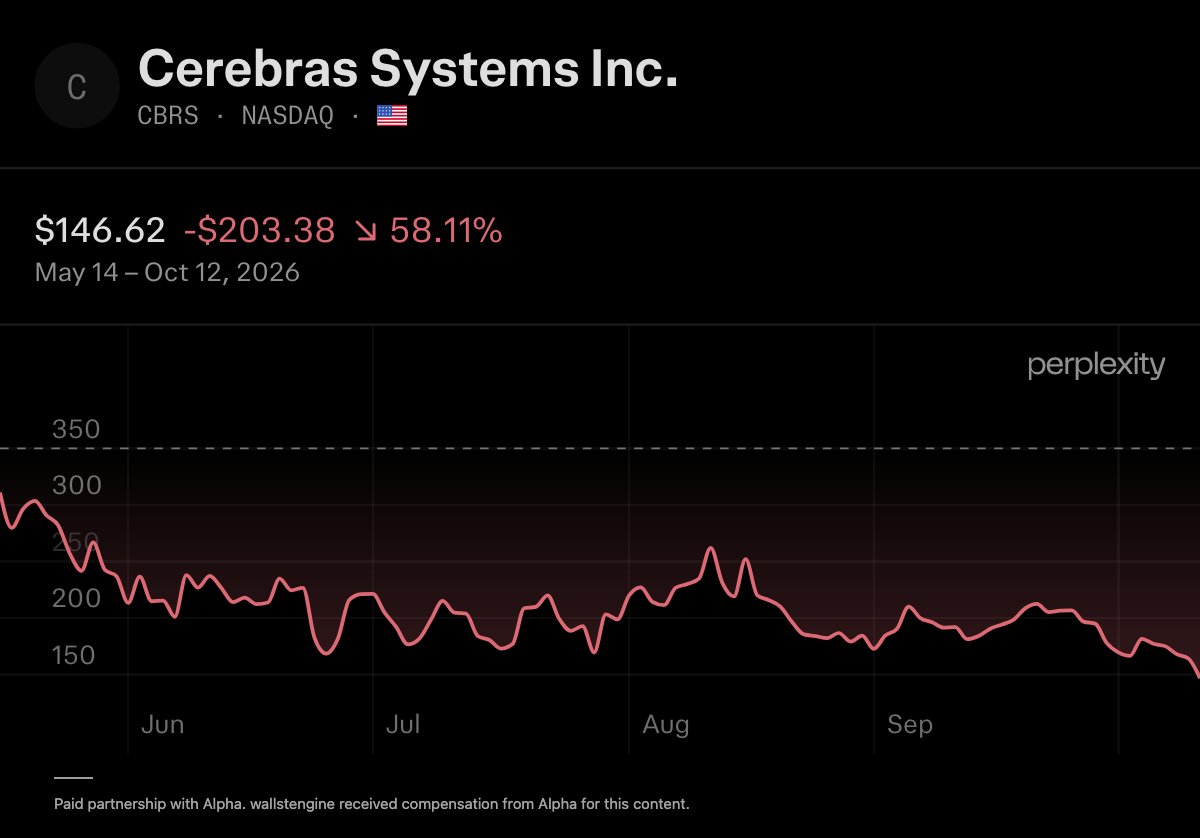
Cerebras Systems (CBRS) hit a record low of $146.98, according to the X signal material. The move left the stock more than 20% below its $185 IPO price and about 62% below its first-day high of $386.34.
The latest leg lower comes after a busy stretch already covered in the newsroom database. Benzinga reported on Oct. 12 that the stock fell on an OpenAI chip report and later rebounded after Sam Altman weighed in, while another item said shares reached a new 52-week low at $155.50.
A key trading issue now is supply. Wallstengine said around 19.4 million shares are expected to become eligible for sale on Oct. 14, alongside concerns over Cerebras’ relationship with OpenAI.
The available materials do not include a fresh company response. For now, the stock remains the center of a market story defined by new lows, a recent OpenAI-related swing, and the looming lockup event.
Intel said it has begun customer sampling of its D-series GPUs and is expanding its agentic AI infrastructure. The company framed the move as part of accelerating open infrastructure for the emerging agentic AI era.
The same event was covered in Intel’s Oct. 12 company release, which highlighted D-series GPUs, Xeon CPUs, open software and ecosystem innovations as tools to help customers scale agentic AI.
For the stock story, the update matters because it ties Intel’s GPU and CPU efforts to a broader software-and-ecosystem pitch around AI infrastructure. Based on the materials provided, INTC is the only core ticker directly tied to the event.
The freshest increment in today’s X signals is the customer-sampling step alongside the infrastructure expansion. No other party response is provided in the source set.
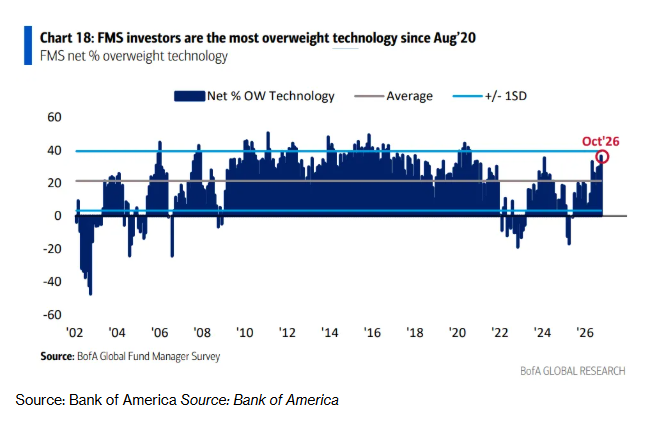
Bank of America’s October Global Fund Manager Survey shows fund managers are the most overweight technology since August 2020. The poll was conducted Oct. 2-8 and covered 161 participants managing $453 billion.
The update matters because positioning is stretched even as sentiment remains constructive: cash holdings held at 3.9%, below BofA’s contrarian sell-signal threshold, while 47% of respondents expect above-trend growth and inflation and 50% see a “no landing” economy.
For markets, the crowding centers on technology, semiconductors and the Magnificent Seven. Long global semiconductors was the most crowded trade, and investors flagged a disorderly rise in bond yields and an AI bubble as top tail risks, keeping the sector highly sensitive to rates and AI spending headlines.
BofA has not issued any correction or denial of the survey framing. The new information is the October readout itself, which updates institutional positioning rather than any single company’s fundamentals.
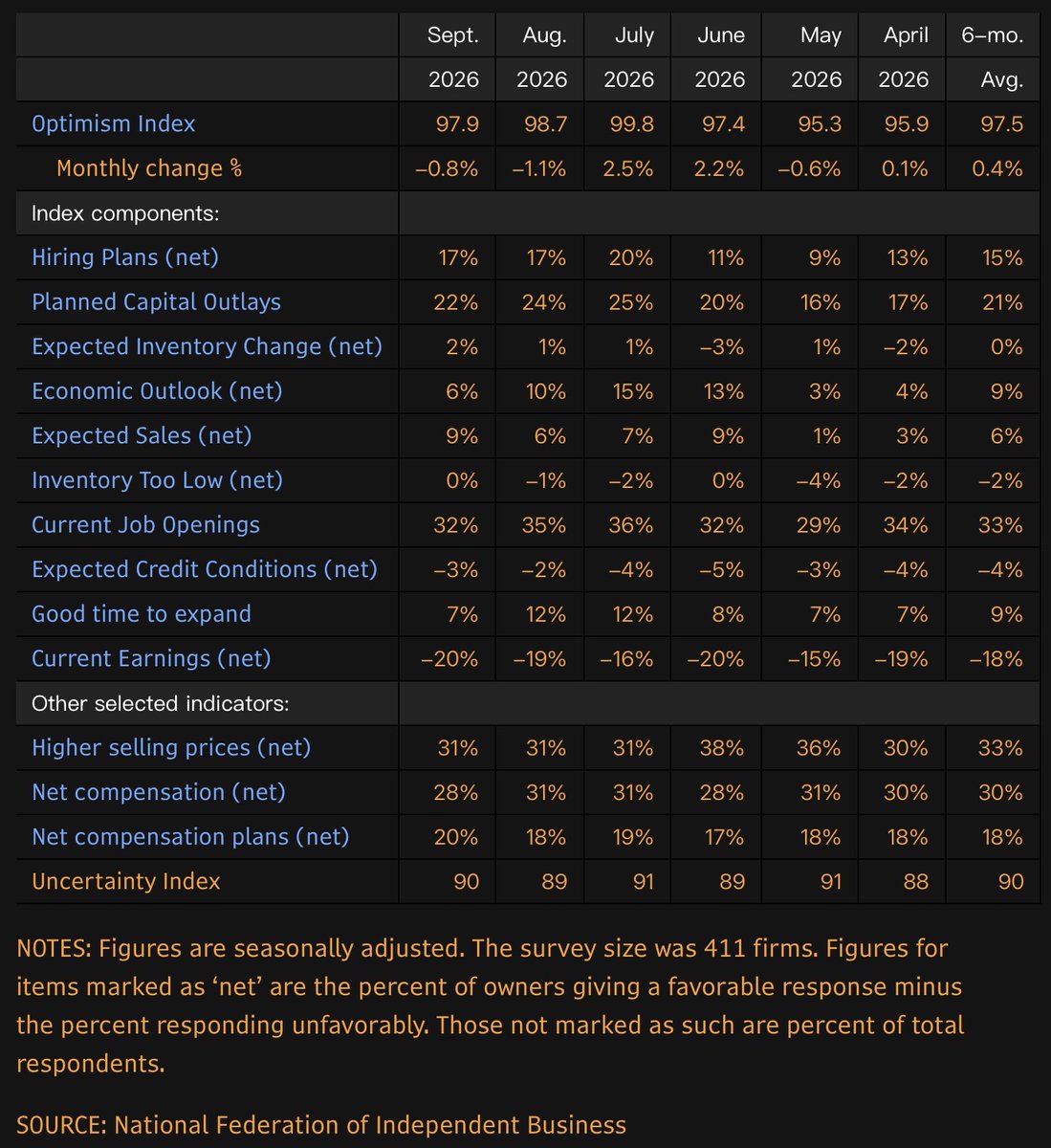
The NFIB said its Small Business Optimism Index fell 0.8 point to 97.9 in September, just below the survey’s 52-year average of 98.0. The group’s Uncertainty Index also rose to 90, well above its historical average of 68.
Labor quality or availability remained the top problem for the third straight month at 26%, while inflation ranked second at 20%. Only 7% of owners said it was a good time to expand, down 5 points from August, underscoring the cautious tone in the report.
The survey also showed 32% of owners had job openings they could not fill, and the average interest rate on short-maturity loans rose to 8.2%. NFIB said 20% of owners plan to raise compensation in the next three months, and 31% plan to raise prices, pointing to continued cost pressure.
The monthly survey drew 411 usable responses from a sample of 5,000 small-business owners. For markets, the report is a read on hiring, pricing and credit conditions among Main Street firms rather than a direct corporate earnings driver, but it can influence views on labor tightness and inflation persistence.
The U.S. private payroll weekly gauge showed an average gain of 24.75K jobs per week in the four weeks through Sep. 26, according to the latest ADP-linked reading. That was above the prior 23.75K print, but modestly below the earlier 25.25K pace cited in market coverage.fxstreet.hk mnimarkets.com
ADP’s weekly employment measure is a companion indicator to the National Employment Report and is used to track short-term changes in private hiring. TradingEconomics shows the series has been volatile this year, with a July 28 reading of 15.0K versus 16.25K previously.tradingeconomics.com
For markets, the release matters mainly as a labor-market read-through for the dollar, Treasury yields and rate expectations. FXStreet noted the dollar index was near 102.00 at the time of publication, alongside softer yields and a weaker risk backdrop.fxstreet.hk
No official commentary accompanying this latest weekly figure was identified in the sourced coverage. Investors will continue to compare it with other labor and inflation releases before drawing broader conclusions.
Goldman Sachs says investors are increasingly framing AI as a global duopoly, with one ecosystem centered on the U.S. and its key trading partners and another taking shape in China. In a note published Sunday, strategists led by Kinger Lau said geopolitics, national security and growth considerations are driving the split.
The bank said recent progress from DeepSeek and Kimi in large language models, along with advances in semiconductor packaging, is helping underpin China’s AI buildout. The analysis shifts the debate from a single AI capex boom to competing supply chains, compute stacks and capital flows.
For U.S. equities, the discussion matters most for AI bellwethers such as Microsoft and Nvidia, whose valuations are tied to expectations that heavy spending will convert into durable earnings. It also comes as investors scrutinize whether the broader AI money loop is creating real returns or merely recycling capital.
Goldman’s view is a market interpretation rather than a corporate disclosure. Investors are now watching whether the two AI ecosystems continue to diverge in spending intensity, model progress and commercialization paths.
Meta unveiled Muse Wonder and Muse Wonder Full today, describing them as its most capable AI models yet. The pitch centers on Active Memory, which is designed to retain relevant context across apps including WhatsApp, Instagram, glasses, and eventually Windows.
A Reuters-style wire in the local news base says the models were trained at Meta’s gigawatt-scale Prometheus data center. CNBC also reported that access to the Muse app may require a subscription, underscoring the company’s push to turn AI features into a paid product.
The release is being framed as a clearer link between Meta’s heavy AI infrastructure spending and products users can pay for. X posts also said the top-end model, Wonder Full, scored 56 on Artificial Analysis, ahead of Astra and Fable at 53 but behind Claude Opus 5.5 at 58.
Investors appeared to welcome the announcement, with market coverage saying Meta shares rose after the debut. The broader takeaway is that Meta is now trying to monetize AI through more persistent personal agents and longer-task workflows, including coding and tool use.
ASML and TSMC are set to report earnings, and the latest X feed treats the pair as a key checkpoint for AI and broader tech spending. The focus is whether the recent selloff in semiconductors is masking still-healthy demand underneath.
Our newsroom’s last 48 hours of coverage is aligned with that same event line. N2 and N3 both point to ASML’s Oct. 14 earnings and highlight the company’s role in EUV lithography for advanced AI chips, while N5 places ASML and TSMC in the same valuation and industry debate for 2026.
In the market, the X signal says semiconductors came under pressure on Tuesday, with Samsung Electronics and SK hynix lower and TSMC also down in Taiwan trading. That has sharpened attention on whether the AI spending cycle is cooling or merely resetting, making the two earnings reports a direct sentiment catalyst.
So far, the new X material is mostly pre-earnings positioning rather than fresh corporate disclosure. The only hard operating update referenced for TSMC is its previously reported third-quarter sales of NT$1.494 trillion, up 51% year over year.
Wells Fargo downgraded Adobe to Underweight from Overweight and cut its price target to $225 from $270. The move was echoed by multiple X posts and matched by recent coverage in the site’s news library.
The backdrop, according to the library, is concern over Adobe’s organic growth, management stability and pricing power. Barron’s described the action as a double downgrade, underscoring a tougher view on the company’s growth quality.
Market reaction was immediate: 247WallSt said Adobe fell 4% to $233 on Monday after the note. The stock stood out as the exception in a firmer enterprise software tape.
No company response was included in the materials provided. The X signal only confirmed the downgrade and the revised target, with no fresh Adobe comment.
StoneX has initiated coverage of SoFi Technologies with a Buy rating and a $25 price target. The call is the fresh incremental development in today's X signal around SOFI.
The move arrives against a backdrop of a weak share-price performance this year. Barron's and Benzinga both framed the note as an upside call after a steep decline, underscoring the market's focus on whether SoFi can re-rate from depressed levels.
For SOFI, the new coverage could help keep attention on valuation and earnings conversion rather than just the stock's year-to-date slide. But the broader analyst debate remains intact: X also highlighted KBW's Underperform rating and a target cut to $15.
StoneX's stated view centers on operating progress, an underappreciated new business line, and profit conversion supporting valuation expansion. That makes the stock a live battleground for analysts even after today's new rating call.
eBay shares rose on Monday after Morgan Stanley named the company its top pick in internet and lifted its price target to $132 from $127, while keeping an Overweight rating. The stock briefly climbed more than 5% intraday before giving back some of those gains.
Morgan Stanley’s call centers on eBay Live, which the bank sees as an underappreciated growth engine. It argues that live shopping in the West is increasingly well suited to eBay’s auction-like marketplace for used, collectible and specialty goods.
The move helped eBay stand out in a session where the broader market offered little support. Reports also noted that eBay has already gained more than 30% year to date, reflecting a renewed investor focus on growth and monetization.
Earlier company disclosures pointed to rapid growth in Live GMV and broader seller participation, though management has also said investments in live commerce and Depop will add near-term costs. Investors are now watching whether those investments can translate into steadier GMV growth and earnings momentum ahead of the next earnings update.
IonQ gets fresh bullish calls as Elisity deal draws new scrutiny
Wedbush and Mizuho both reiterated Outperform ratings, putting the spotlight on how IonQ’s up-to-$1.3 billion all-stock Elisity deal could broaden its platform.
IonQ’s planned acquisition of cybersecurity firm Elisity kept drawing attention on X on Tuesday. Wedbush and Mizuho both reiterated Outperform ratings on IonQ, with the deal’s up-to-$1.3 billion valuation remaining the central talking point.
The transaction was first reported on October 12, when CNBC said IonQ would buy Elisity in an all-stock deal worth up to $1.3 billion, including up to $150 million in performance-based earnouts. Subsequent coverage in the site’s news library continued to frame the deal as a major expansion step for the quantum company.
The stock reaction has already been negative. Zacks said IonQ closed at $36.27 on the prior trading day, down 9.07%, while Proactive Investors and 247WallSt also reported declines after the announcement, suggesting investors are weighing the deal’s financing and integration implications.
Elisity also signaled support on X, with the company posting about a new chapter with IonQ. In the materials available, the latest analyst commentary does not change the core story: IonQ remains rated positively, but the acquisition is now the key lens through which the market is judging the company.
Six Flags Entertainment said it temporarily shut nine roller coasters across six amusement parks after a fatal incident at Six Flags Over Georgia on Monday. Local police said one person died and several others were injured; investigators have not yet released a final explanation for what happened.
The ride involved was identified by local TV and wire reports as Goliath, a hypercoaster at the Georgia park. The company said its staff and local authorities responded immediately and that it is cooperating fully with the investigation.
The market reacted quickly. CNBC reported that Six Flags shares, ticker FUN, fell more than 10% in after-hours trading after having closed up 4.5% in the regular session.
A company spokesperson said details would be withheld out of respect for the family’s privacy. Cobb County police are still investigating, and officials have not confirmed how the person died or what caused the injuries.
Moscow Exchange announced it will offer Bitcoin, Ethereum, and USDT trading to its 40.1 million clients starting December 1.
2026-10-132 posts · 2 authors
Moscow Exchange plans to open Bitcoin, Ethereum, and USDT trading to retail investors for the first time on December 1, following its crypto futures launch.