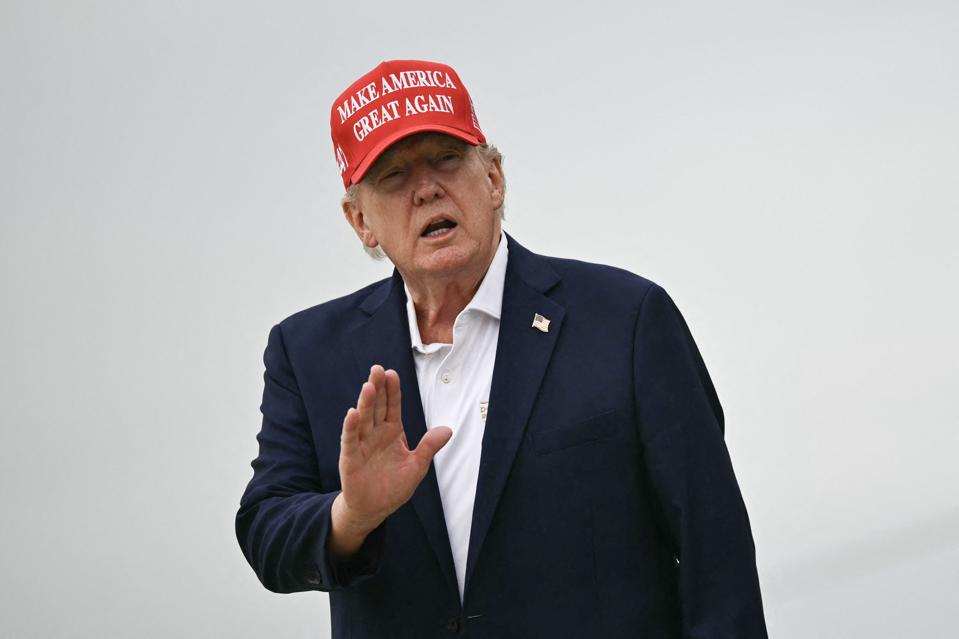
According to Fox News as relayed in X posts, Trump threatened military action against Oman if it stood in the way of U.S. efforts tied to shipping and blockade enforcement around the Strait of Hormuz. The latest wave of posts portrays the warning as directed at Muscat rather than Tehran.
The Strait of Hormuz is one of the world’s most strategic energy chokepoints, handling roughly a fifth of global oil shipments in previously reported estimates. Earlier reporting also said Iran and Oman had been discussing management or fee structures related to passage through the waterway, underscoring why the issue keeps resurfacing.
For markets, the immediate sensitivity sits with crude, tanker shipping and defense-linked names, since any further disruption rhetoric around Hormuz can feed into freight rates and risk premia. Oman’s role as a longstanding U.S. partner in the Gulf makes the rhetoric especially notable from a diplomatic standpoint.
No Omani confirmation of the reported threat was available in the public reporting reviewed here. The next watchpoints are whether the White House or State Department comments, and whether the reporting prompts any change in Hormuz transit arrangements or security posture.
사건 전개
2026-06-26게시물 3개 · 작성자 3명
지정학
US-Iran 60-day truce reportedly extended as Aug. 17 deadline looms영어 원문
Multiple regional reports say the mediators have bought more time, even as Washington and Tehran remain at odds over security guarantees and Hormuz access.
Multiple outlets on Aug. 17 reported that the United States and Iran have reportedly agreed to extend the 60-day ceasefire and negotiating window under the Islamabad framework. The reporting says the extension was conveyed through mediators, but neither Washington nor Tehran has publicly confirmed the terms.
The deal originated with a Pakistan-brokered ceasefire in April, followed by an Islamabad memorandum signed on June 17 that set a 60-day period for talks toward a final agreement. Subsequent reports say negotiations stalled over security guarantees and freedom of navigation through the Strait of Hormuz.
For markets, any extension tends to ease the geopolitical risk premium in crude, while a missed deadline or collapse in talks can quickly revive it. That keeps Brent, WTI, energy shares and shipping names in focus in the near term.
Iranian Foreign Minister Abbas Araghchi has denied that there was a ceasefire needing extension, arguing the memorandum was meant to end the war rather than create a temporary truce. Pakistan’s foreign ministry, meanwhile, says it is still working through direct and indirect channels to bring the sides back to the table.
The U.S. Treasury this week sold 30-year bonds at a 5.216% yield, the highest auction yield for the maturity since 2001. It also sold 10-year notes at 4.683%, the strongest auction yield for that tenor since 2007, before turning to a 20-year sale that investors are watching closely.
The jump in long-dated borrowing costs comes even as recent inflation readings landed broadly in line with expectations and traders trimmed bets on another Fed hike in September. The bigger driver appears to be duration supply, fiscal deficits and investors demanding more compensation to hold long-term government debt.
Higher long-end yields feed directly into the Treasury’s financing bill and ripple through mortgage-backed securities pricing, corporate issuance and liability-driven strategies used by pension funds and insurers. That makes the 20-year auction an important test of whether demand can keep pace with supply.
No new official response from the Treasury has been reported. The next 20-year result will help determine whether the recent surge in long-bond yields is stabilizing or continuing to reset borrowing costs higher.
사건 전개
2026-06-22
매크로
China retail sales rise 0.6% as investment falls 6.7% in July영어 원문
Official July data showed softer consumption and deeper investment weakness, keeping attention on policy support for demand and property-related sectors.
China’s National Bureau of Statistics said on August 17 that retail sales rose 0.6% year over year in July, well below the 1.5% forecast and slower than June’s 1.0% gain. Fixed-asset investment also weakened, falling 6.7% year to date from a year earlier, compared with a 5.7% decline previously, while industrial output rose 4.5% and missed expectations.
The release adds to a run of downbeat China data published in recent weeks. July manufacturing PMI slipped to 49.2, signaling contraction, while trade figures showed exports still resilient even as domestic demand remained soft.cnbc.com cnbc.com
For markets, the numbers keep investors focused on China consumer shares, homebuilder proxies and infrastructure-linked stocks, as well as Hong Kong-listed retailers and property names. The key issue is whether policy makers will provide more support soon enough to stabilize spending and investment.
The July print follows second-quarter GDP growth of 4.3%, which underscored how uneven the recovery has become. Investors are now watching for any additional fiscal or monetary signals from Beijing in the weeks ahead.
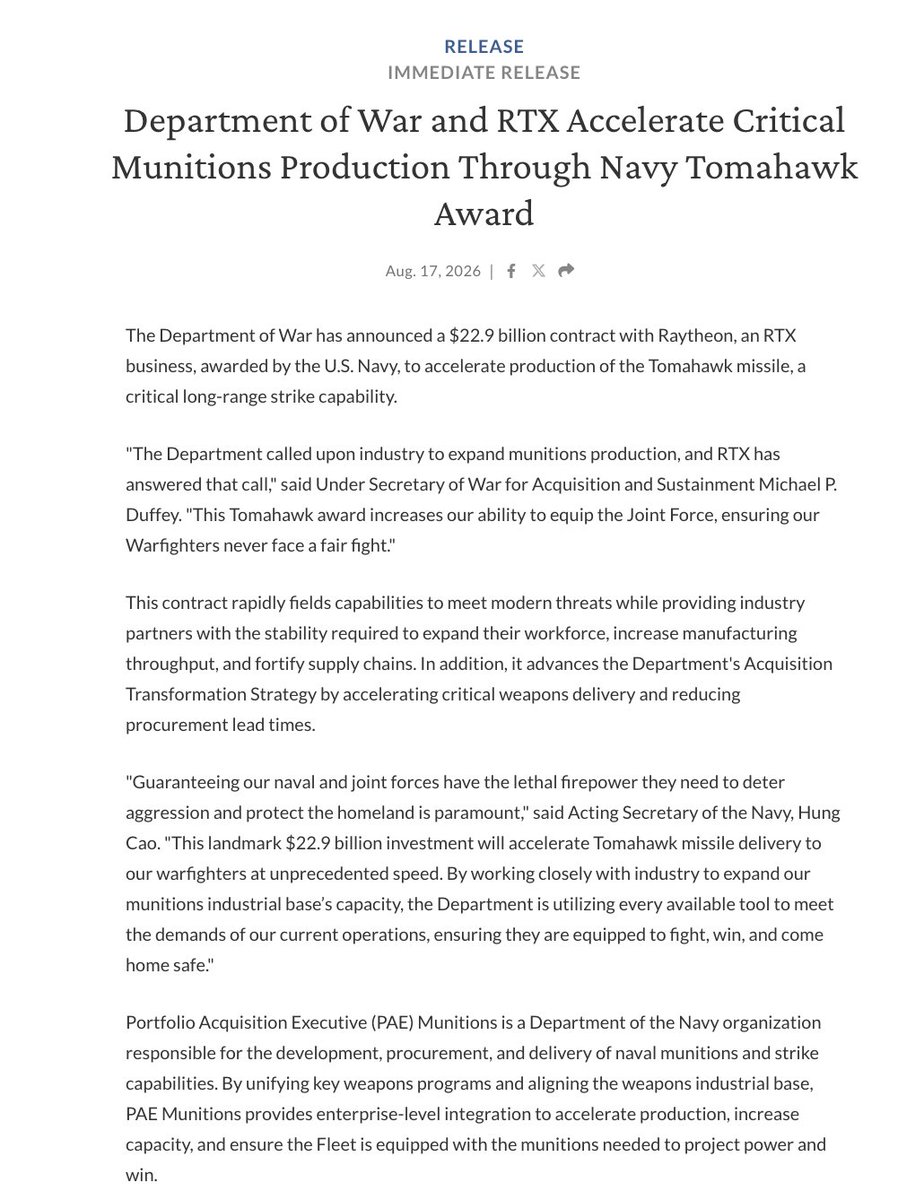
The U.S. Navy said on Monday it awarded RTX unit Raytheon a $22.9 billion contract to boost Tomahawk missile production. RTX said the seven-year framework also covers faster production of AMRAAM, SM-6 and SM-3 interceptors.
The award extends a capacity-expansion plan Raytheon first laid out in February, when it disclosed five long-term agreements aimed at lifting annual Tomahawk output to more than 1,000 missiles and expanding other missile lines. The company said production will be concentrated at facilities in Tucson, Huntsville and Andover.
For investors, the headline reinforces RTX’s role as a key supplier in the U.S. rearmament cycle and points to continued demand for missile manufacturing capacity. The contract also matters because Tomahawk is a core long-range strike weapon for the Navy and allied forces, while SM-6 and AMRAAM remain central to air and missile defense inventories.
RTX said the agreements use a collaborative funding structure intended to preserve upfront free cash flow while the company invests in long-term capacity. Reuters and RTX’s own statement both confirmed the $22.9 billion contract value and the Tomahawk production push.
Multiple reports, citing people familiar with the matter, say Nvidia is now discussing a $3 billion investment in SB Energy as part of the Ohio data-center package tied to OpenAI. The same reports say OpenAI would be the customer under a 20-year lease, with the PORTS-Pike campus in Pike County, Ohio, built out as a 10-gigawatt site.
The financing story has been evolving for weeks. CNBC previously reported that Nvidia and OpenAI had discussed a backstop of up to $250 billion, while a later CNBC report said the expected guarantee had been revised to less than $120 billion, suggesting the structure is still being reshaped.
For investors, the name on the ticket is Nvidia, but the implications spill across the AI supply chain, including SoftBank-linked SB Energy and the broader buildout of power and data-center infrastructure. The reported campus would begin with roughly 800 megawatts in phase one and could become one of the largest AI infrastructure projects announced to date.
Neither company has publicly confirmed the full package of numbers, so the reported investment, credit support and phasing should still be treated as evolving deal terms rather than finalized facts. What is clear is that the Ohio project has moved from broad speculation to a much more detailed financing and construction narrative.
Bloomberg said Stripe has finalized an agreement to acquire OpenRouter for more than $7 billion, in a deal that would bring the AI model-routing startup under the payments giant's umbrella. OpenRouter lets companies switch between AI models and offers a single API for developers.
The acquisition follows OpenRouter's funding round just months ago, when the startup was reportedly valued at about $1.3 billion. Public reports also say the company serves around 8 million developers and gives access to more than 400 AI models.
For investors, the transaction signals Stripe's intent to expand beyond payments into the AI infrastructure stack. The market will watch whether Stripe can monetize OpenRouter's developer base, routing layer and data footprint.
Stripe declined to comment on rumor and speculation, and OpenRouter also declined to comment. Bloomberg said the final price could still change.
Uber and Zipline said they are partnering on U.S. drone delivery for Uber Eats, with Uber also investing in Zipline. The companies said first deliveries are expected to begin later this year and set a long-term target of 1 million drone deliveries per day by the end of 2029.
The deal extends a theme Uber has been building for months: automation across mobility and delivery. In recent remarks, Uber CEO Dara Khosrowshahi said he is increasingly optimistic about drones and argued that cutting delivery times from about 30 minutes to 10 to 15 minutes could materially improve the customer experience.benzinga.com
For investors, the news keeps Uber in focus as it pushes robotaxis, sidewalk robots and aerial delivery under one platform strategy. Public reporting also indicates Uber expects to expand robotaxi availability to 15 cities by year-end, underscoring how central automation has become to the company’s growth narrative.smartcitiesdive.com
Neither company has disputed the reported partnership and investment plan. The 1 million-a-day target is a long-term goal, while key details such as rollout geography and investment size remain undisclosed.
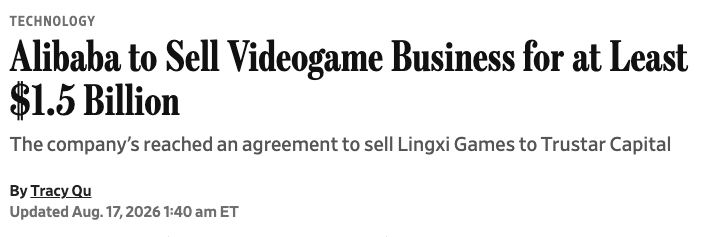
Multiple outlets reported on August 17 that Alibaba plans to sell its gaming arm Lingxi Games to Trustar Capital in a deal worth at least $1.5 billion. Reuters, citing people familiar with the matter, said the transaction could exceed $2 billion.
The move fits Alibaba’s broader effort to streamline its portfolio and concentrate on its core e-commerce and AI businesses. In February 2025, the company had already outlined more than 380 billion yuan of spending over three years on cloud and AI infrastructure.
For investors, the deal reinforces the view that Alibaba is willing to monetize mature, non-core assets while ramping up spending in AI. Alibaba shares rose in premarket trading after the reports, while Lingxi’s flagship title Three Kingdoms: Strategic Edition remains the business’s main cash generator.
The reports are aligned on the buyer and strategic rationale, though they differ on valuation wording, ranging from “at least $1.5 billion” to “more than $2 billion.” Any formal company disclosure would be the key reference for final pricing and closing terms.
Bitcoin is trading around the low-$63,000s, and several market watchers on X say the price has slipped below its 200-week simple moving average. Cointelegraph said Swan Bitcoin CEO Cory Klippsten sees a possible October bottom in the $53,000-$57,000 range before a rebound.
The discussion comes as analysts continue to test key levels. Cointelegraph previously cited 10x Research saying a monthly close above $63,000 could confirm a bear-market bottom, while The Coin Republic reported Coinbase pricing BTC near $62,973 with a market value around $1.26 trillion, placing nearby support and resistance in a tight band.
The market impact is showing up most clearly in Bitcoin itself and in the venues that facilitate trading rather than in the broader altcoin complex. Cointelegraph also quoted Klippsten calling altcoins “basically dead,” arguing that the stronger long-term outcome for crypto is integration into traditional finance; the same report said Hyperliquid generated $5.9 million in weekly revenue, underscoring how concentrated attention remains in a few names.
For now, these are market views and price markers, not a confirmed regime change. The X signal’s reference to the 200-week SMA is a technical read on the chart, while the most immediate levels being debated in the cited coverage sit around $63,000 and $61,600.
사건 전개
2026-06-24
기업
VIX sinks to 2026 low as August S&P 500 daily swings are priced below 0.8%영어 원문
Option traders are chasing upside while downside protection thins, leaving Wall Street calm on the surface but fragile underneath.
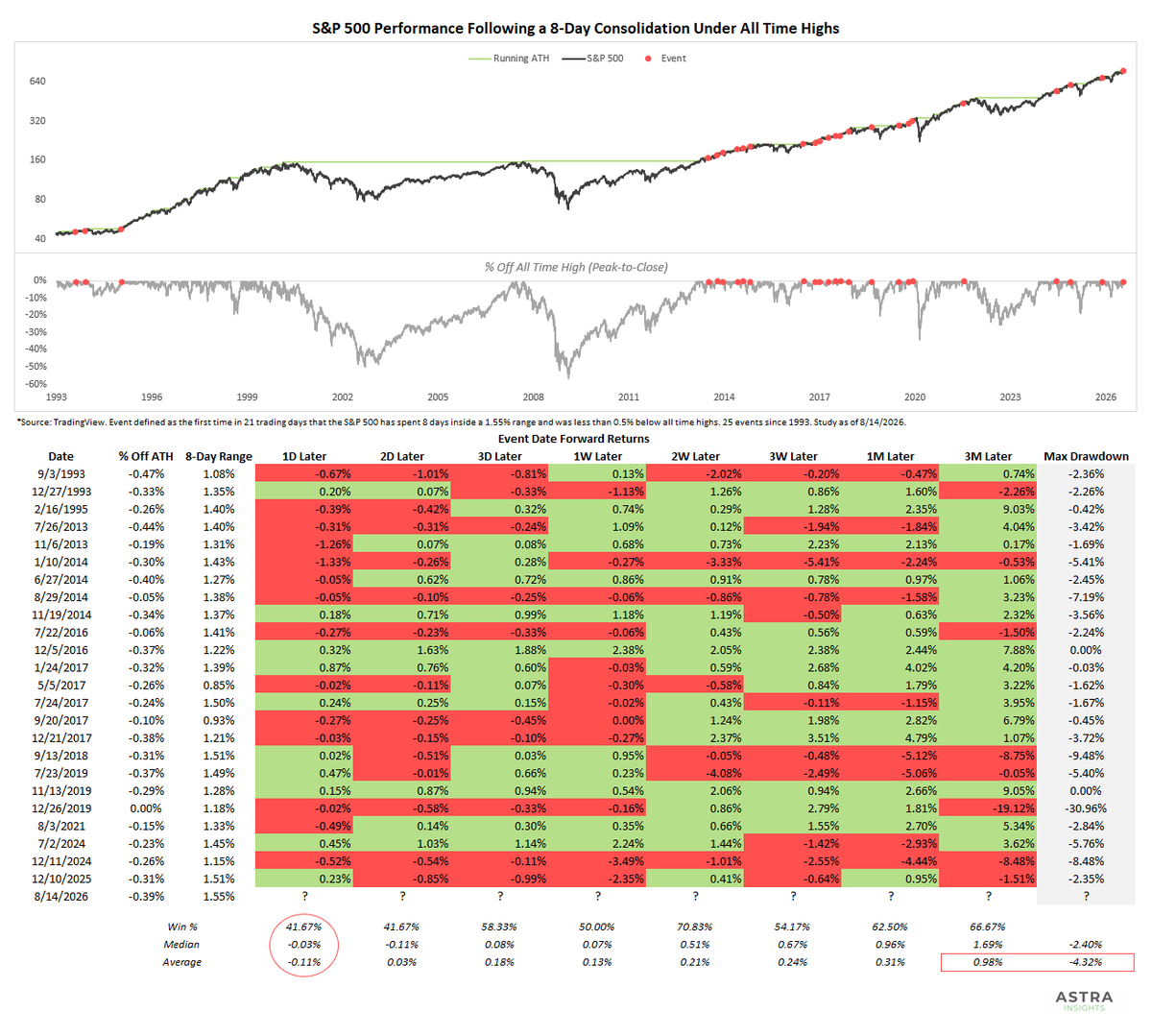
Ahead of Monday’s session, market signals show traders pricing S&P 500 daily moves below 0.8% for the rest of August, with the VIX sliding to a year-to-date low. The shift suggests investors are rotating away from downside hedges and back into upside calls, even as sentiment remains sensitive to momentum.
The move comes against a backdrop of fresh all-time highs for the S&P 500 and cooler inflation data that reinforced rate-cut expectations. TrendSpider noted that last week’s CPI and PPI prints came in softer than feared, while the U.S. sold 30-year bonds at a 5.216% yield, the highest auction yield since 2001.trendspider.com
For markets, lower volatility tends to support large-cap equities and options sellers, but it can also leave positioning more exposed if a new macro shock hits. That makes SPY, S&P 500 options and volatility-linked trades more reactive to any surprise in rates, inflation or geopolitics.
The key point is not a single VIX print but the combination of subdued realized volatility, high equity prices and renewed call buying. Cboe-based reporting put the VIX at 14.56 and said tail-hedge demand was still rising, a sign that investors have not fully abandoned protection.ts2.tech
UBS has reiterated its Buy rating on SpaceX and kept a $210 price target, citing AI demand, Starlink expansion and progress around Starship and V3 satellites as the main drivers. The call surfaced on X today as a fresh market catalyst.
The note lands amid a wave of recent coverage about SpaceX’s valuation. Over the past few days, U.S. media have highlighted the company’s fast-growing AI business and the debate over how much value should be assigned to Starlink, launch operations and future computing ambitions.
For investors, the immediate impact is on sentiment around SpaceX-related private-market pricing and the broader space/AI trade. The key question remains whether Starlink growth and Starship execution can justify the increasingly wide spread among analyst price targets.
SpaceX has not issued a new public response to UBS’s latest view. The stock continues to trade against a backdrop of competing bullish and cautious estimates from Wall Street.
사건 전개
2026-06-19게시물 5개 · 작성자 4명
Moody's and S&P assigned SpaceX investment-grade credit ratings of Baa1 and BBB, respectively.
2026-07-07게시물 13개 · 작성자 11명
SpaceX was added to the Nasdaq 100, with the first wave of Wall Street price targets averaging $278.
기업
CoreWeave backlog reaches $104 billion as market cap sits near $59 billion영어 원문
The latest backlog figure is fueling fresh debate over conversion rates, AI infrastructure demand and how quickly contracted revenue turns into cash flow.
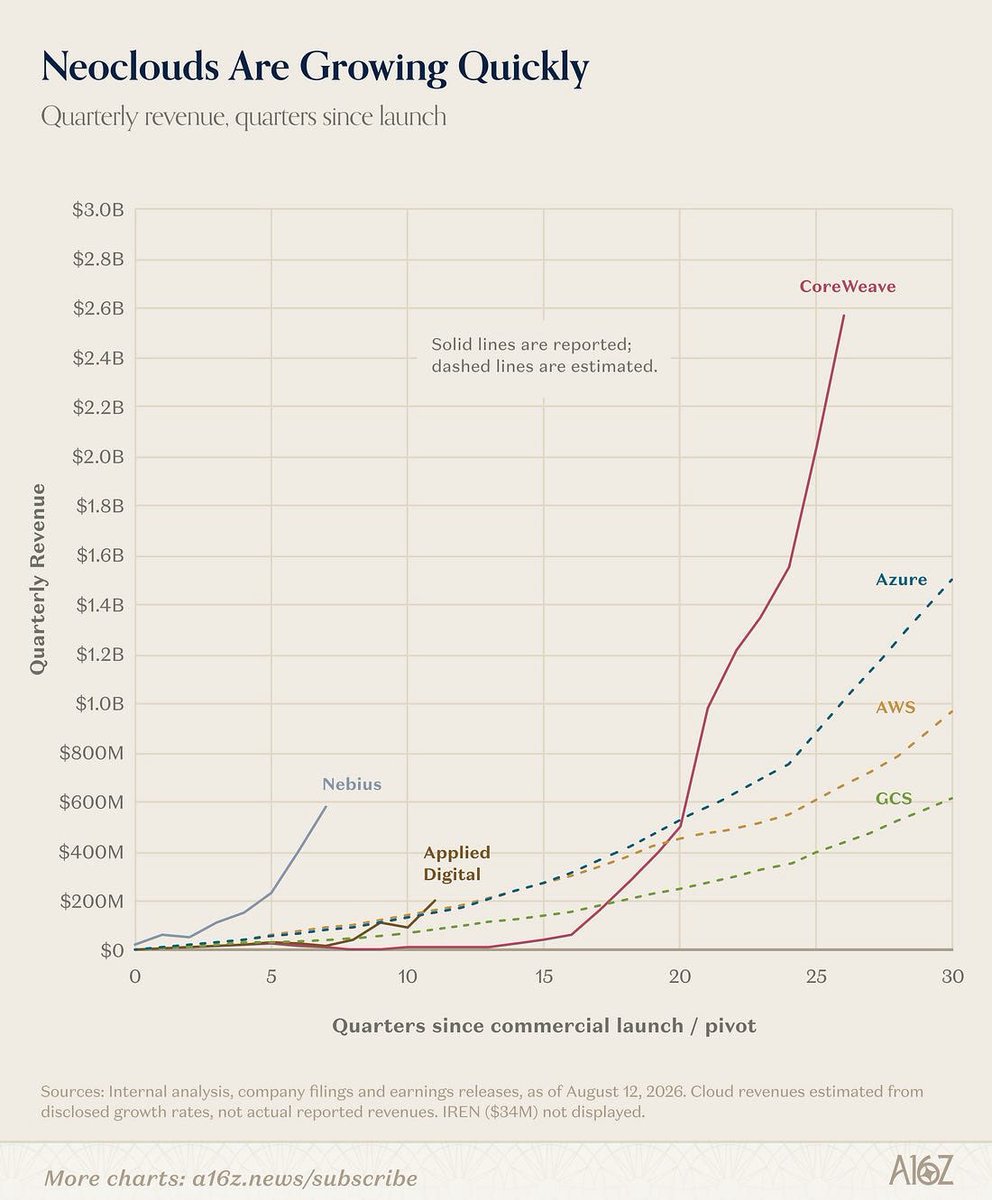
CoreWeave’s latest widely cited backlog figure stands at $104 billion, with some coverage putting the broader backlog above $125 billion. Against a market capitalization near $59 billion, the contract pipeline is now being measured against a much smaller equity valuation.
This is not a brand-new operating event, but it is the freshest data point driving the current market conversation. Investors are focusing on whether those commitments can be converted into revenue on schedule and what that means for the company’s capital intensity.
The stock, ticker CRWV, has seen a surge in trading attention as investors try to re-rate the name around AI infrastructure demand. At the same time, recent insider sale disclosures have added a separate governance angle to the discussion.
No public denial was found for the $104 billion backlog figure in the materials reviewed. Broader coverage frames the number as the latest sign of CoreWeave’s order visibility rather than a formal company announcement in this news cycle.
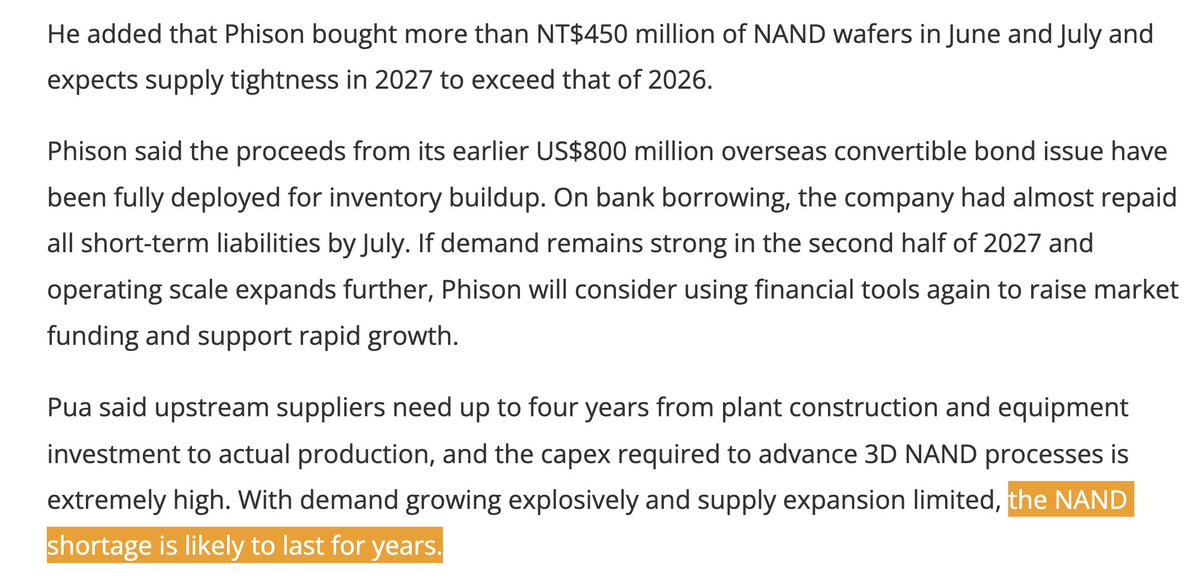
Phison’s CEO was quoted as saying that capacity constraints in 2027 will be even more severe than in 2026, adding that upstream suppliers can need as long as four years from plant construction and equipment spending to actual production. The remark surfaced on X today as a fresh data point on the memory supply squeeze.
The comment fits a broader industry backdrop. TrendForce has said HBM is consuming a large share of DRAM capacity, slowing conventional supply growth, while The Motley Fool reported that NAND supply may not loosen until the second half of 2027. Micron has also said customers are still willing to pay “very high” prices and that 2027 could be tighter than 2026.
That keeps attention on NAND and DRAM names such as SanDisk, SK Hynix, and Micron, along with memory-equipment and packaging suppliers. In the market’s view, the key issue is no longer just near-term pricing, but how long capacity additions will take to catch up with AI-driven demand.
The Phison quote is currently being circulated via social media reposts, so it should be treated as a market signal unless and until the full original context is published.
Nvidia’s new AI infrastructure financing push is drawing fresh scrutiny. In the latest X-linked commentary, Jeff Gundlach questioned the long-term viability of tech-backed debt, while Mark Cuban compared the setup to the rise of crypto.
The discussion follows Nvidia’s disclosure that it is working with Apollo, BlackRock, Blackstone, Brookfield, Goldman Sachs and KKR on a financing effort that could mobilize up to $500 billion for AI data centers. CNBC and TechCrunch reported that Nvidia may backstop up to 25% of certain loans and is structuring the deals around Nvidia-specified systems and residual-value protections.
Markets are watching because the plan reaches beyond Nvidia’s own chip sales and into the financing ecosystem around AI cloud operators and data-center builders such as CoreWeave, Nebius and Lambda. If pricing, collateral values or financing terms come under pressure, investors could reassess both Nvidia-linked infrastructure names and the broader AI buildout trade.
Nvidia says the goal is to bring independent long-term institutional capital into AI infrastructure rather than concentrate all the risk on one company. CNBC also reported that the current agreements are memorandums of understanding, with no detailed borrower list, pricing or launch schedule disclosed yet.
사건 전개
2026-08-11게시물 77개 · 작성자 58명
시장
BofA says 16Gb DDR4 and DDR5 each rise 2% as DRAM logs 18th straight weekly gain영어 원문
Fresh weekly pricing shows memory tightness persisting, with NAND also accelerating against a softer consensus
A post on X citing BofA’s latest memory update said 16Gb DDR4 and 16Gb DDR5 DRAM spot prices each rose another 2% this week, marking the 18th straight weekly increase. The same signal said NAND spot prices surged more sharply, defying expectations for flat or gently lower pricing.
The move fits a broader re-rating in the memory market. Earlier reporting based on BofA’s research said the firm lifted its 2026 global DRAM sales forecast to $573 billion, while TrendForce reported mainstream DDR4 1Gx8 3200MT/s spot pricing at $42.50, up 0.93% from $42.11 a week earlier.
Equity markets have been reacting accordingly, with Samsung Electronics and SK Hynix among the names benefiting from the recent rebound in Korean memory shares. Continued strength in legacy DDR4 and firmer NAND pricing would keep investors focused on margin expansion and the durability of the current cycle.
BofA’s full weekly note was not fully published in the signal, but the available cross-checks point in the same direction: spot pricing remains on an upward path rather than rolling over.
A new X signal points to a YouTube video pitching CrowdStrike as an overlooked compounder “on sale.” The latest background reporting, however, shows the company’s core metrics remain strong: in its most recent quarter it added $256 million in net new ARR, up 32% year over year, taking total ARR to $5.51 billion, up 24% year over year.
The debate is really about valuation. Recent coverage from The Motley Fool and Seeking Alpha says CrowdStrike trades at about 44 times sales and roughly 180 times forward earnings, a premium that leaves little room for any growth hiccup.
That matters for CRWD and for other richly valued software stocks because sentiment can swing quickly when investors are already paying up for growth. Quiver Quantitative also cited recent Form 4 disclosures showing CEO George Kurtz sold shares under a pre-arranged 10b5-1 plan, but that does not by itself signal a fundamental deterioration.
For now, the public record points to continued operating strength rather than a fresh company warning. The live question for investors is whether the business can keep compounding fast enough to justify the price tag.
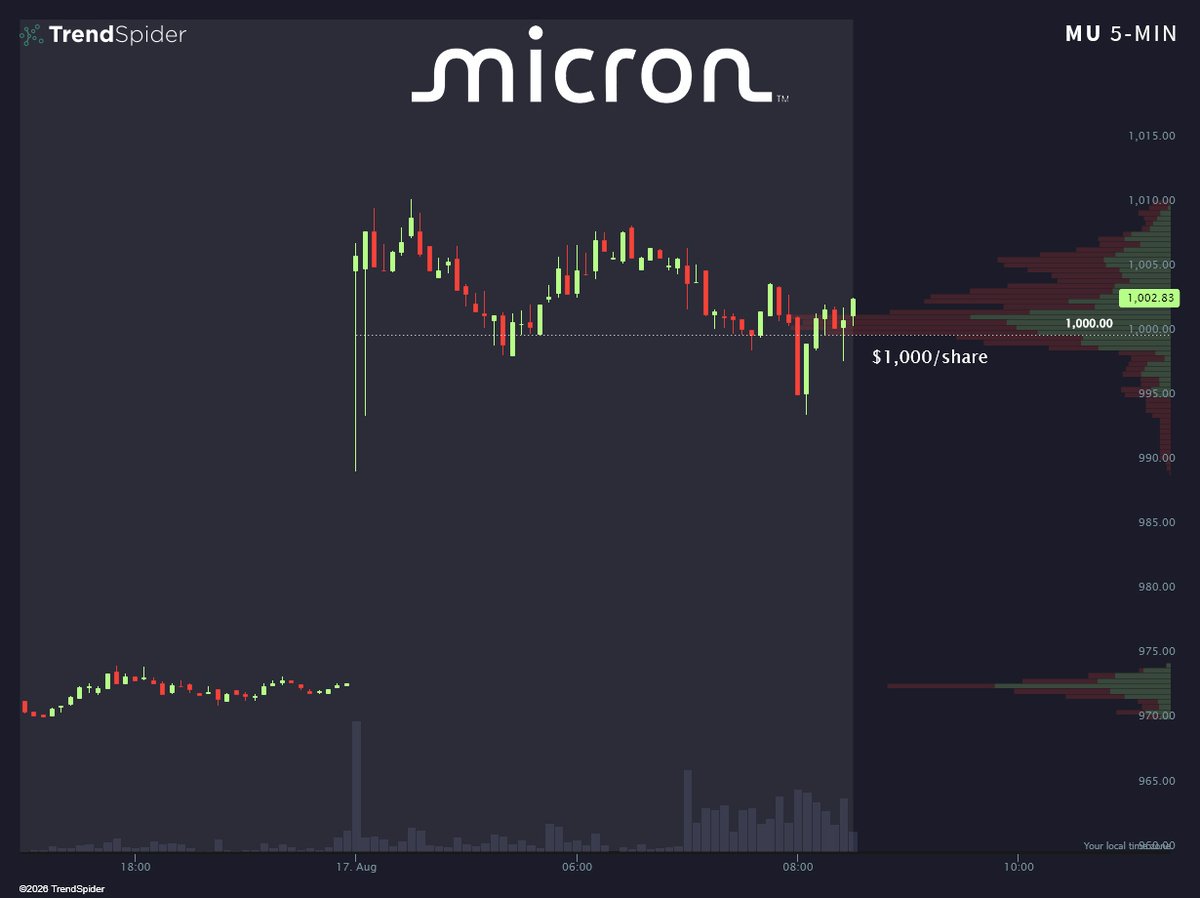
Micron Technology shares briefly moved back above the $1,000 level, and the move quickly became a fresh trading catalyst on social media. The stock had already gained 10.7% over the past week, closing at $971.66 and posting its strongest weekly advance in more than two months. stocktwits.com
The latest buzz centers on Apple’s memory sourcing. Commerce Secretary Howard Lutnick said the U.S. government does not want Apple buying memory chips from Chinese manufacturers, while the U.S. Senate has set an Aug. 21 deadline for Apple to respond to bipartisan senators’ questions about Chinese supplier CXMT. stocktwits.com
For traders, any shift away from Chinese memory suppliers could strengthen the case for Micron, which sits at the center of the high-bandwidth memory and DRAM trade. The move also kept the broader memory complex in focus, including Samsung Electronics and SK Hynix, as investors continued to watch whether AI-driven demand can keep prices elevated. stocktwits.com
At this stage, the Apple angle remains a market narrative rather than a confirmed procurement decision. The stock reaction reflects how sensitive Micron and peer memory names remain to any supply-chain signal involving Apple, China and AI infrastructure demand.
Multiple posts on X say Stanley Druckenmiller initiated a new position in IREN, buying 87,100 shares worth roughly $4 million by the posts’ estimate. Because the signal surfaced today, it should be treated as a fresh lead rather than a fully verified filing-based fact.
Druckenmiller’s Duquesne Family Office is known for macro-driven, highly concentrated bets. Public reporting on his latest 13F showed about $3.4 billion in assets across 68 disclosed positions, which is why any new name in the book tends to draw immediate attention from traders.
IREN has been in the spotlight for its shift from bitcoin mining toward AI infrastructure. On Aug. 13, reports said Microsoft accepted Horizon 1 and NVIDIA granted the site “Exemplar Cloud” status, reinforcing the market’s focus on execution and capital intensity.
For now, the main market implication is sentiment: if Druckenmiller did open IREN, investors may revisit both IREN and other AI infrastructure names. But until a new filing confirms the trade, the share count and purchase size remain unverified and should not be stated as final fact.
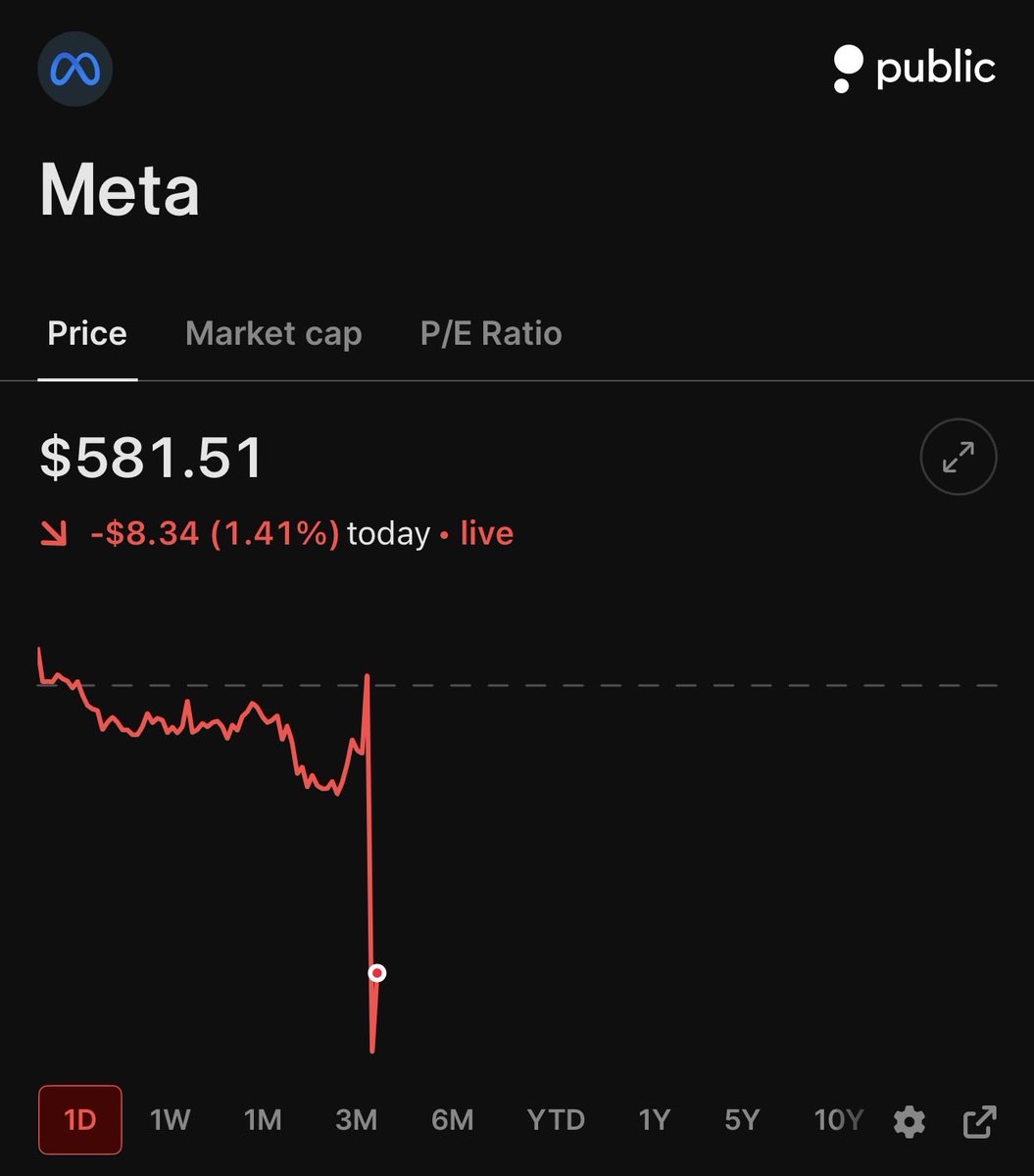
According to the X signal citing BofA, Meta’s U.S. ARPU rose 31% year over year to $125 in Q2, while international ARPU increased 17% to $15.10. BofA also said U.S. revenue per hour climbed 27% to $1.33, and Instagram’s U.S. daily time spent per active user increased 12% in July.
The figures build on Meta’s July 29 second-quarter report, which showed revenue of $60.80 billion, up 28% year over year. Meta said ad revenue reached about $59.4 billion, ad impressions rose 14%, and average ad price increased 12%, underscoring stronger monetization across its ad platform.
For investors, the update matters most for Meta’s ad-driven earnings profile and for peers that trade on engagement and pricing trends. Meta also guided third-quarter revenue to $61 billion to $64 billion, keeping attention on whether ad demand and product engagement can sustain the company’s growth pace.
Meta has said its AI-driven recommendation and advertising tools are improving relevance and performance. BofA’s latest read-through adds another data point that U.S. monetization remains strong even after the quarter closed.
사건 전개
2026-06-22게시물 6개 · 작성자 6명
Meta expanded Instagram for TV to Samsung TVs abbreviating tests of horizontal video, Stories, and phone-to-TV casting.
기업🔥진행 중
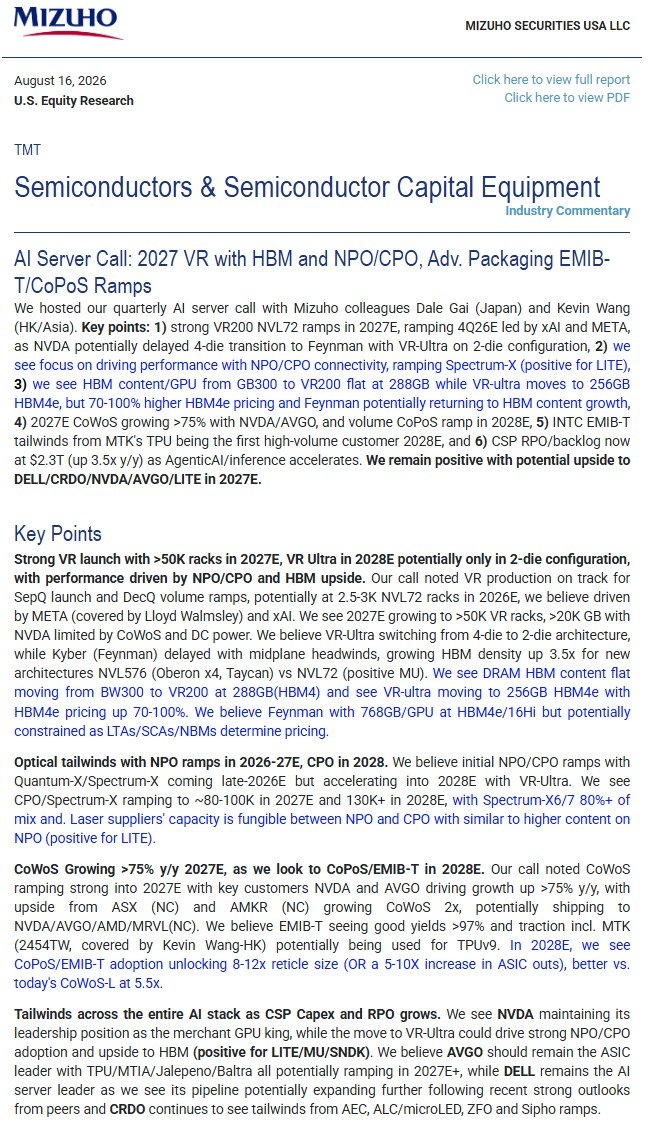
Mizuho sees NVDA VR200 ramping in 2027, with 288GB versus 256GB HBM영어 원문
The note adds fresh detail on how memory shortages may reshape Nvidia’s next AI server generations without shrinking total demand.
A Mizuho note circulating on X says Nvidia’s VR200 NVL72 is expected to start ramping in 4Q26 and accelerate in 2027, led by xAI and Meta. The same note says Nvidia may delay a 4-die transition until Feynman, while keeping VR-Ultra on a 2-die configuration.
The report lands as other outlets continue to describe an HBM down-spec trend across the AI chip stack. The Asia Business Daily said Nvidia has been considering lower HBM stack counts for Rubin Ultra, while UBS-linked coverage said the company may move first to HBM4 8-Hi before later shifting to HBM4E 8-Hi.
For investors, that keeps the focus on memory and advanced packaging names such as NVDA, MU, SK Hynix, AVGO, LITE and CRDO. Even if per-GPU HBM content is trimmed, higher shipment volumes could leave total HBM demand stronger than previously modeled.
These figures remain based on brokerage research and supply-chain reporting rather than Nvidia’s own product confirmation. The 288GB, 256GB and 768GB content estimates should therefore be treated as provisional until harder evidence emerges from launches or supplier disclosures.
사건 전개
2026-06-19
기업
Morgan Stanley lifts Amazon bull case as AWS eyes $1 trillion in revenue영어 원문
The new note keeps a $335 base target but says stronger AI demand could justify a $500 bull case.
Morgan Stanley said Amazon Web Services could reach $1 trillion in annual revenue over the next 8 to 10 years, and used that framework to back a $500 bull-case target for Amazon by year-end 2027. The bank left its base-case price target at $335, but said the bullish scenario is increasingly plausible if AWS keeps accelerating.
The call comes after Amazon said AWS demand is still running ahead of available capacity and that the squeeze may persist into 2027. Amazon also lifted planned 2026 cash capex to about $220 billion, while AWS revenue grew 37% year over year to $42.2 billion in the latest quarter.
For investors, the setup keeps Amazon, Microsoft and Alphabet in the center of the AI infrastructure trade. It also boosts the profile of power and nuclear names tied to data-center expansion, including Constellation Energy and Cameco.
The $500 target and the $1 trillion AWS revenue path are sell-side scenarios, not company guidance. What Amazon has confirmed is heavier spending and tight supply, underscoring the scale of AI infrastructure demand rather than a formal earnings forecast.
According to reports citing The Wall Street Journal, U.S. Commerce Secretary Howard Lutnick has directly told Apple that the Trump administration is not in favor of the company buying Chinese memory chips. The report says Apple has been exploring alternatives involving China-based suppliers CXMT and YMTC, but Apple has not publicly confirmed any testing or purchasing.
The backdrop is a tight memory market, with AI data-center demand pushing up prices and making supply security more important for device makers. U.S. officials are signaling political resistance to Apple’s China sourcing plans, even though finished off-the-shelf purchases are not the same as sharing product information for customized parts under export-control rules.
Investors are watching the memory complex for spillover effects. If Apple shifts demand away from Chinese vendors, the business could migrate toward Micron, SanDisk, Samsung and SK Hynix, which are seen as potential beneficiaries of any supply reallocation.
For now, the key point is pressure rather than policy: Apple has not confirmed the reported testing, and the U.S. has not announced a new outright ban in this area. Lutnick’s comments add to the political risk around any future sourcing decisions, but they do not themselves establish a prohibited transaction.
UBS Group disclosed in its latest 13F filing that it held 407,890 shares of BlackRock’s iShares Bitcoin Trust (IBIT) as of June 30, worth about $13.6 million. More notably, the bank’s IBIT call exposure surged to the equivalent of 1.95 million underlying shares from 80,000 three months earlier, while put exposure fell to 143,300 from 303,300.
The filing comes as UBS has been expanding access to digital assets for some private-banking clients in Switzerland. But the document does not say whether the jump in IBIT options was driven by client demand, market-making, hedging, or proprietary positioning, and it does not disclose strike prices or expirations.
For the market, the disclosure matters because it highlights continued institutional use of a regulated bitcoin ETF rather than direct token custody. It also affects attention on IBIT and its issuer BlackRock, even though 13F options counts do not equal direct ownership of the underlying shares.
On the same day, Tudor Investment reported lifting its IBIT stake to 688,529 shares, worth $22.9 million, while cutting reported IBIT call exposure by 85.2%. Together, the filings suggest large investors are still actively reallocating around bitcoin ETF exposure, but not in a single direction.
사건 전개
2026-06-30게시물 3개 · 작성자 3명
Investment committees framed LongCat-2.0 as a systems-engineering event; ALAB rose 16% on a UBS price-target hike while SMCI fell 8% after an office raid.
매크로
Canada July CPI jumps to 3.0% as core gauges firm영어 원문
A hotter-than-expected July inflation print and firmer core measures keep the Bank of Canada in focus for rate expectations and the Canadian dollar.
Statistics Canada said July consumer prices rose 3.0% from a year earlier, above the 2.9% market forecast and up from 2.8% in June. On a monthly basis, CPI increased 0.5%.
The Bank of Canada’s preferred core gauges also edged higher: CPI-Common rose 2.7% year over year, CPI-Median reached 2.0%, and CPI-Trim was 1.9%. BoC core CPI increased 2.3% from a year earlier and 0.2% on the month.
The report leaves inflation running above the BoC’s 2% target and keeps policy expectations under scrutiny. A firmer inflation print typically supports the Canadian dollar and can put upward pressure on rate-sensitive assets such as Canadian government bonds.
Ahead of the release, market previews from FXStreet and Continuum Economics pointed to a 2.9% headline reading, while Statistics Canada had flagged gasoline and travel tours as key drivers. Today’s outcome came in slightly hotter than expected, confirming a renewed uptick in price pressure.
Goldman says Fed hike odds look too high as 2026 pricing falls to 38%영어 원문
Cooling inflation and softer jobs data are pushing traders to price a steadier Fed path, with Treasury yields and risk assets repricing around the shift.
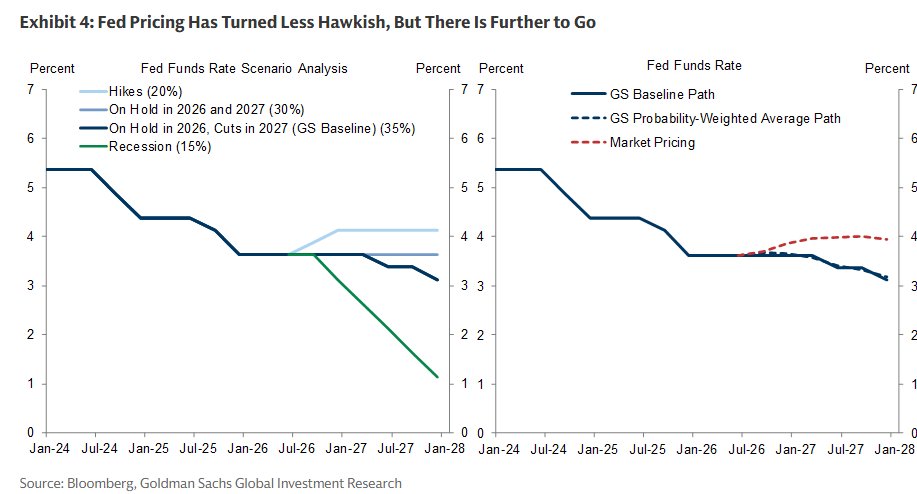
Goldman Sachs said markets are still pricing too much chance of further Federal Reserve tightening, arguing that a September rate hike is very unlikely. Bloomberg reported that traders have pushed the next quarter-point hike expectation back to January after previously fully pricing a move in December.
The reassessment follows softer U.S. retail sales, weaker employment data and cooler inflation prints. Reuters said traders had sharply reduced the odds of a September hike after unexpected job losses and mild inflation readings, even as some still expect rates could end the year higher.
The move matters for Treasuries and global rate markets, where bond investors are balancing cooling inflation against heavy government borrowing and elevated term premium. Bloomberg said the U.S. 2-year yield remains above 4%, underscoring how sensitive front-end markets remain to any change in Fed expectations.
For equities, lower rate-hike odds can ease pressure on valuation-sensitive sectors such as technology, while also supporting duration-heavy assets. But the broader bond backdrop remains complicated by fiscal supply and tightening expectations outside the U.S.
사건 전개
2026-07-20게시물 3개 · 작성자 3명
Goldman Sachs released a note on copper, highlighting its price resilience amid geopolitical tensions, hawkish Fed commentary, and an AI stock sell-off.
매크로
NAHB Housing Market Index rises to 35 in August, beats 33 forecast영어 원문
Homebuilder confidence improved slightly, but the index stayed below 40, underscoring persistent pressure in U.S. new-home demand.
The National Association of Home Builders said its Housing Market Index rose to 35 in August from 34 in July, topping the consensus forecast of 33.nahb.org
NAHB said the August reading marked the 16th consecutive month below 40. The current-sales gauge climbed to 39, while six-month sales expectations held at 43 and buyer traffic stayed at 23. Builders also reported ongoing price cuts and incentives, with 35% lowering prices and 63% offering sales incentives.nahb.org
The data is relevant for U.S. homebuilders including D.R. Horton, Lennar and PulteGroup because it tracks demand conditions in newly built single-family homes. It also feeds into broader housing-rate sensitivity as mortgage costs and construction expenses remain a drag on affordability.marketscreener.com
Market watchers had expected a 33 reading, so the 35 print offered a small upside surprise, but not enough to change the broader picture of a subdued housing backdrop.marketscreener.com
Japan’s June capacity utilization rose 4.1% month on month, beating the -1% market forecast and reversing the pace seen in earlier releases. The figure came through on X via multiple wire-style reports and is the day’s fresh macro data point.
For context, Trading Economics shows Japan’s capacity utilization rose just 0.1% in May after a 0.8% decline in April. The indicator measures actual output against production capacity and is used as a gauge of how intensely manufacturers are running their plants.
The release matters most for the yen and for Japan’s cyclical equities, especially machinery, industrial equipment and electronics names that tend to track changes in factory activity. Investors also watch it alongside industrial production to judge whether the manufacturing recovery is broadening.
The signal cites METI as the source, consistent with the official Japanese macro release framework.
사건 전개
2026-06-23게시물 4개 · 작성자 4명
Alberta discussed crude exports to Japan, Blackstone announced $30B AI data center investment in Japan, and US banks called MLCC a super cycle.
2026-07-16게시물 9개 · 작성자 9명
Nvidia partnered with Noetra to build the world's first national AI factory in Japan with 13,750 Vera CPUs and 27,500 Rubin GPUs; TSMC Q2 earnings showed HPC demand squeezing foundry capacity.
매크로
US August NY Fed Manufacturing and NAHB data land on August 17영어 원문
Two closely watched US indicators are due today, offering a same-day read on factory activity and homebuilder sentiment.
The US will publish the New York Fed manufacturing index at 08:30 ET and the NAHB Housing Market Index at 10:00 ET on Monday, August 17. The day’s X signal also flags 4:00 p.m. ET releases for total net capital flows and TIC long-term transactions, making it a packed macro calendar.
The latest schedules point to an August NY Fed reading of 10 versus 15.6 previously, while the NAHB index is expected at 33 after 34 in the prior month. Market calendars and weekly notes have highlighted these prints as key checks on whether manufacturing momentum and builder sentiment are holding up.fhlbny.com forex.tradingcharts.com
For markets, the releases can shape views on the dollar, rates, and the resilience of the US economy. The X signal also names H World Group, XP, Fabrinet and Flexsteel Industries, suggesting traders will watch those stocks alongside the macro numbers; XP and Fabrinet were also highlighted in a recent watchlist item.morningstar.com benzinga.com
At this stage, the item is a scheduled data day rather than a company-specific breaking story. The focus later today will be on the actual prints for the NY Fed index, the NAHB index, and the 4:00 p.m. ET TIC flow data.
On Aug. 17, market signals pointed to gold holding above $4,400 per ounce while copper was described as moving toward its highest closing level on record. A separate crypto- and FX-focused market note said emerging-market currencies were also hitting record highs.
The backdrop is softer U.S. data: FXEmpire said July U.S. retail sales fell 0.6%, far below the expected 0.1% rise, which weakened the dollar and Treasury yields. In that setup, spot gold climbed to about $4,395, with $4,500 emerging as a key resistance area.
The move matters for miners and bullion-linked assets, including the VanEck Gold Miners ETF (GDX). 247WallSt noted that gold broke above $4,400 on Aug. 11 and that miners were finally catching up, underscoring how leverage to bullion is starting to show up in equity prices.
For now, the market read is about confirmation rather than a fresh catalyst: sustained strength in gold depends on whether the metal can stay above the $4,300-$4,400 zone, while copper traders are watching if the metal can finish at a new record close.
사건 전개
2026-06-21
시장
JPMorgan is 4% from $1 trillion after a record $21.2 billion quarter영어 원문
The latest market chatter centers on whether the bank can turn a blowout earnings run into a new valuation milestone.
JPMorgan Chase is now reported to be just 4% away from becoming the first bank ever to reach a $1 trillion market value. The renewed buzz follows its second-quarter net income of $21.2 billion, the biggest quarterly profit ever posted by a U.S. bank.
The milestone talk first gathered force in July, when Reuters said the lender’s market cap was around $935 billion after its record-quarter results. CNBC and other outlets later cited analysts arguing that JPMorgan could be the first bank to join the $1 trillion club, with Wells Fargo’s Mike Mayo even floating a longer-term path toward a $2 trillion valuation.
For markets, the move matters because JPMorgan is a bellwether for large-cap banking sentiment, especially around trading revenue, investment-banking fees and net interest income. Zacks also highlighted the stock again this week, underscoring that investors are still treating JPM as a momentum-and-earnings story rather than a pure defensive play.
There has been no fresh company comment on the 4% figure. The latest reports frame the issue as a valuation threshold rather than a business-model change, with investors watching whether the bank can keep converting strong earnings into further share-price gains.
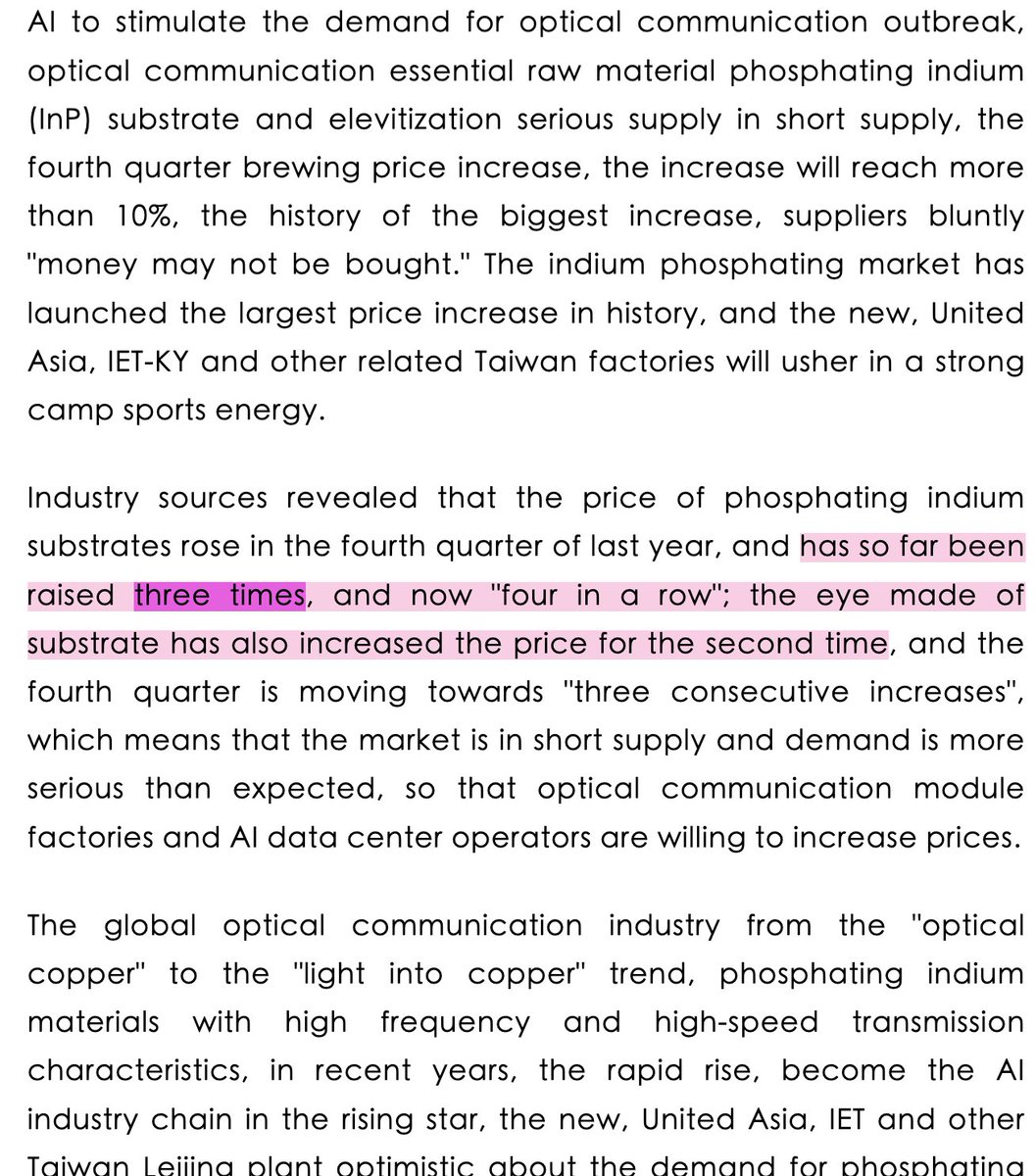
Media reports citing industry sources said indium phosphide (InP) substrates and epi-wafers are set to rise by more than 10% in the fourth quarter, the biggest single quarterly increase on record. Suppliers were quoted as saying that even buyers willing to pay up may still fail to secure material.
The move is the latest step in an escalation that began in Q4 last year. According to the reports, substrate prices have already been raised three times, while epi-wafers have seen two increases and are heading toward a third.
The squeeze is being driven by surging demand for AI data-center optical interconnects, especially 800G and 1.6T transceivers. That keeps attention on InP-linked names such as AXT (AXTI) and other suppliers with expansion plans or longer-term supply contracts.
For now, the market is reacting to a supply-chain story rather than a new company disclosure. The key question for investors is whether upstream capacity can catch up with demand, not whether the shortage exists.
사건 전개
2026-07-03게시물 5개 · 작성자 3명
AXTI signed a 3-year 6-inch InP wafer supply deal with Coherent, including a $22.3M prepayment.
기업
Piper Sandler Starts SoFi at Overweight, Sets $22 Target on 22% Revenue CAGR Through 2028영어 원문
New coverage gives SoFi a fresh valuation anchor as investors weigh its growth mix and earnings trajectory.
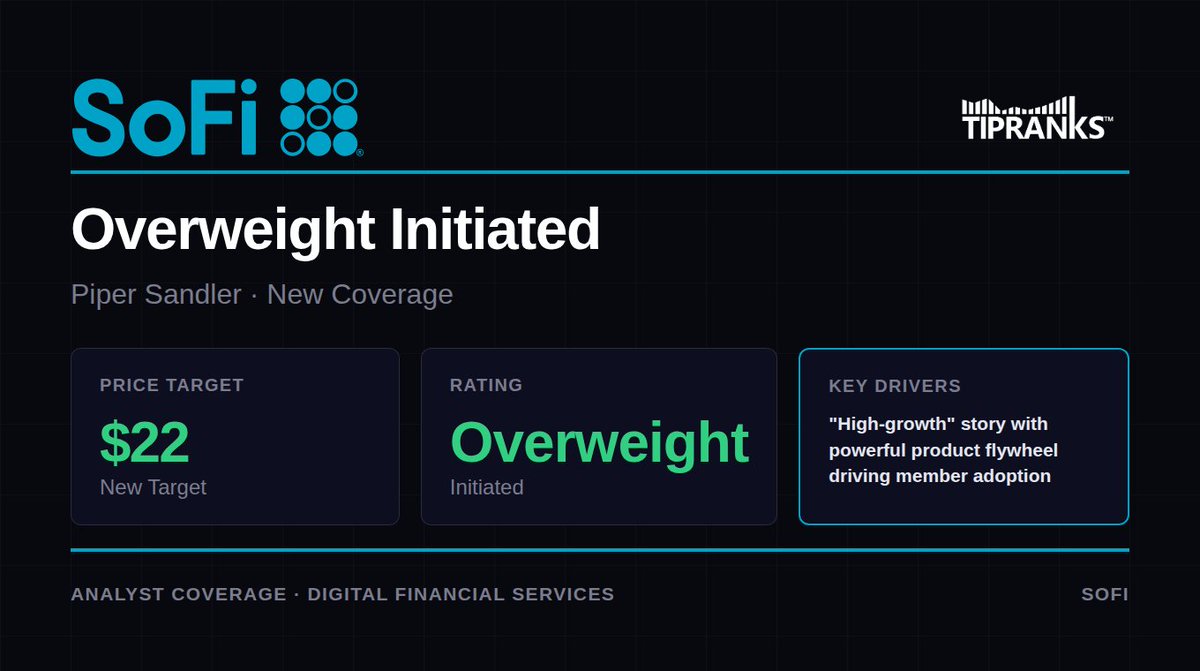
Piper Sandler initiated coverage of SoFi Technologies with an Overweight rating and a $22 price target. The firm called SoFi a “high-growth personal finance story” and said current levels look like an attractive entry point for long-term investors.
The new call adds fresh detail to the bull case: Piper Sandler models a 22% revenue CAGR and a 27% adjusted EBITDA CAGR through 2028. That view builds on SoFi’s latest quarterly results, where the company reported record adjusted net revenue of $1.2 billion and adjusted EBITDA of $357.8 million in Q2.
Shares of SoFi moved higher in early trading after the note, with Schaeffer’s Research reporting a 1.5% rise to about $18.56. The market response matters because SoFi has been trading as a debate stock — investors are still split on how quickly its growth can translate into higher-quality earnings.
SoFi’s own July earnings release showed record member and product growth, alongside management’s full-year outlook. Piper Sandler’s coverage effectively adds another data point to the valuation conversation, especially around whether SoFi can sustain its “productivity loop” and fee-based revenue mix.
기업
Intuitive Machines lands authorization for a $600 million-plus multi-satellite program영어 원문
The company says an undisclosed customer has given it the green light to begin work on a communications infrastructure project.
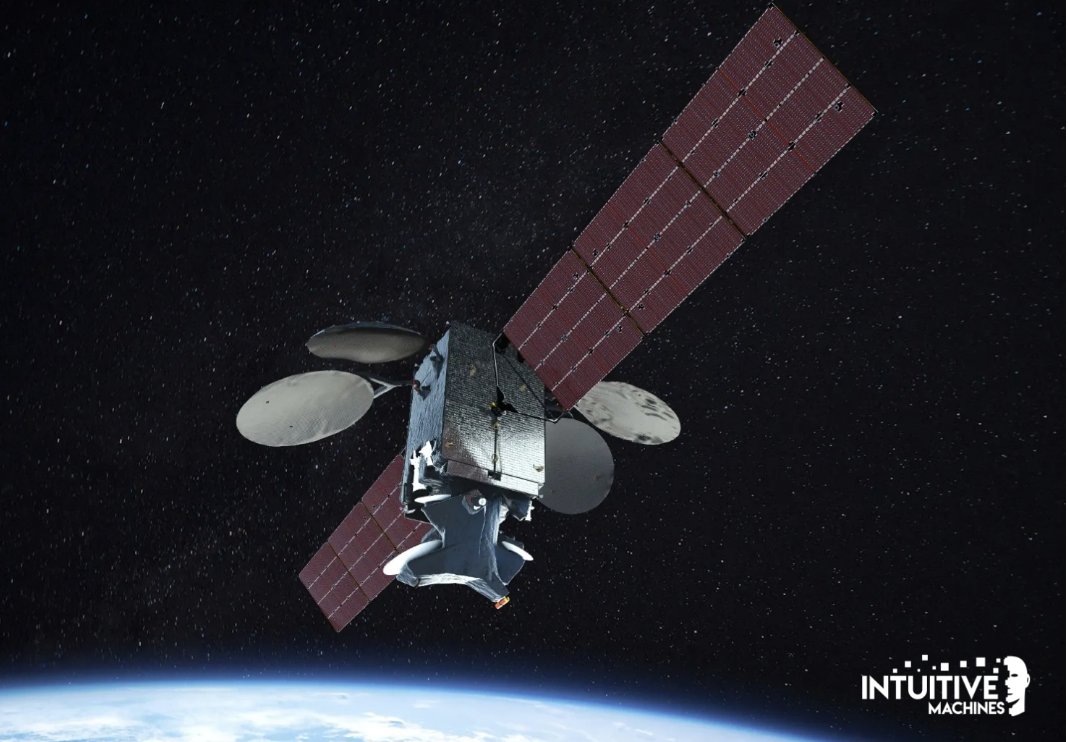
Intuitive Machines said on Aug. 17 that it received authorization to proceed from an undisclosed customer for a multi-satellite communications infrastructure program with an expected value of more than $600 million. The company did not disclose the customer, satellite count, or the full schedule.
The announcement adds to a series of recent contract wins for the space company. SpaceNews reported last week that Intuitive Machines had separately booked a contract worth more than $600 million for three geostationary communications satellites, underscoring a broader push beyond lunar lander work.
For investors in LUNR, the significance is less about a single launch and more about backlog visibility and the company’s widening commercial footprint. The latest authorization suggests another source of future revenue, although Intuitive Machines has not quantified any near-term financial contribution.
The company did not say whether the new authorization is linked to its earlier GEO satellite award or to spectrum-clearing replacements in the market. As disclosed, it remains a fresh program-start notice rather than a fully detailed end-to-end contract announcement.
Higgsfield has raised $400 million at a $5.4 billion valuation, according to media reports citing the Financial Times. Investors reportedly include Goldman Sachs, Intel and DST Global, marking another sharp step-up in the company’s financing profile.
The new reporting also says Higgsfield reached a $700 million annualized revenue run rate in August, up from $20 million a year ago. Other figures cited in coverage include more than 30 million users and availability across 238 countries and territories.
The company makes text- and image-to-video tools and has been leaning harder into enterprise use cases, especially marketing and commercial production. That matters for AI investors because it suggests the company is being valued less like a consumer novelty app and more like a usage-based software platform.
The latest data are still largely coming through secondary reporting and company disclosure rather than a full public filing. Even so, the jump from a roughly $1.3 billion valuation earlier this year to $5.4 billion now shows how aggressively the market is repricing fast-growing AI applications.
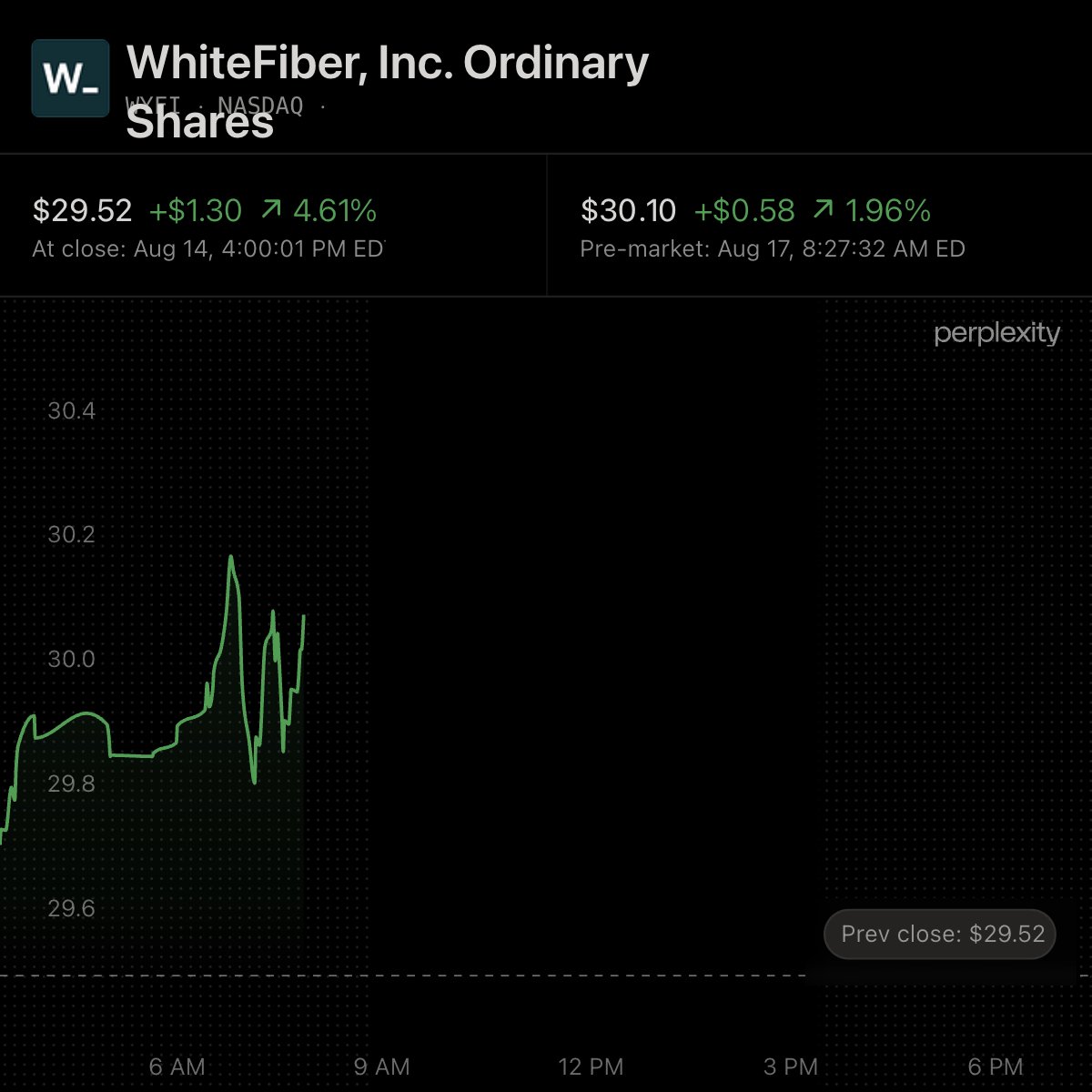
WhiteFiber Inc. (NASDAQ: WYFI) said on Aug. 17 that it has agreed to acquire two additional development sites in North Carolina, designated NC-2 and NC-3. The company said the properties would add at least 60 MW of initial utility capacity, with the potential to scale to about 200 MW over time.
The move builds on WhiteFiber’s existing NC-1 campus in Madison, where the company has already been working through power delivery, customer deployment and financing steps. The North Carolina footprint has become central to WhiteFiber’s AI infrastructure strategy.
For investors, the announcement keeps WhiteFiber parent Bit Digital (NASDAQ: BTBT) in focus, alongside the broader data-center and power-infrastructure supply chain. The latest expansion underscores how capacity, interconnection and tenant execution remain the main variables.
WhiteFiber has previously framed its North Carolina projects as long-duration development assets. The newest sites add to that runway, but the market will still be watching for concrete progress on power, financing and customer commitments.
Viasat said on Aug. 17, 2026 that it selected Rocket Lab to build a satellite bus for the U.S. Space Force’s Space Systems Command under the Protected Tactical SATCOM-Global (PTS-G) program. The spacecraft will use Rocket Lab’s Lightning-GEO platform and host Viasat’s dual-band X/Ka-band payload.
The award follows Viasat’s May 22, 2026 prime contract win for PTS-G. The program is aimed at protected, maneuverable tactical communications that can keep U.S. forces connected in contested environments.
For Rocket Lab, the selection deepens its national security footprint and adds another defense-facing spacecraft role alongside launch and space systems. For investors, the main tickers in focus are RKLB and VSAT, as the announcement underscores Rocket Lab’s growing exposure to government satellite programs.
Rocket Lab has previously said it created its Rocket Lab National Security subsidiary in 2022 to serve U.S. defense and intelligence customers. This new Viasat work is the latest concrete step showing that strategy in action.
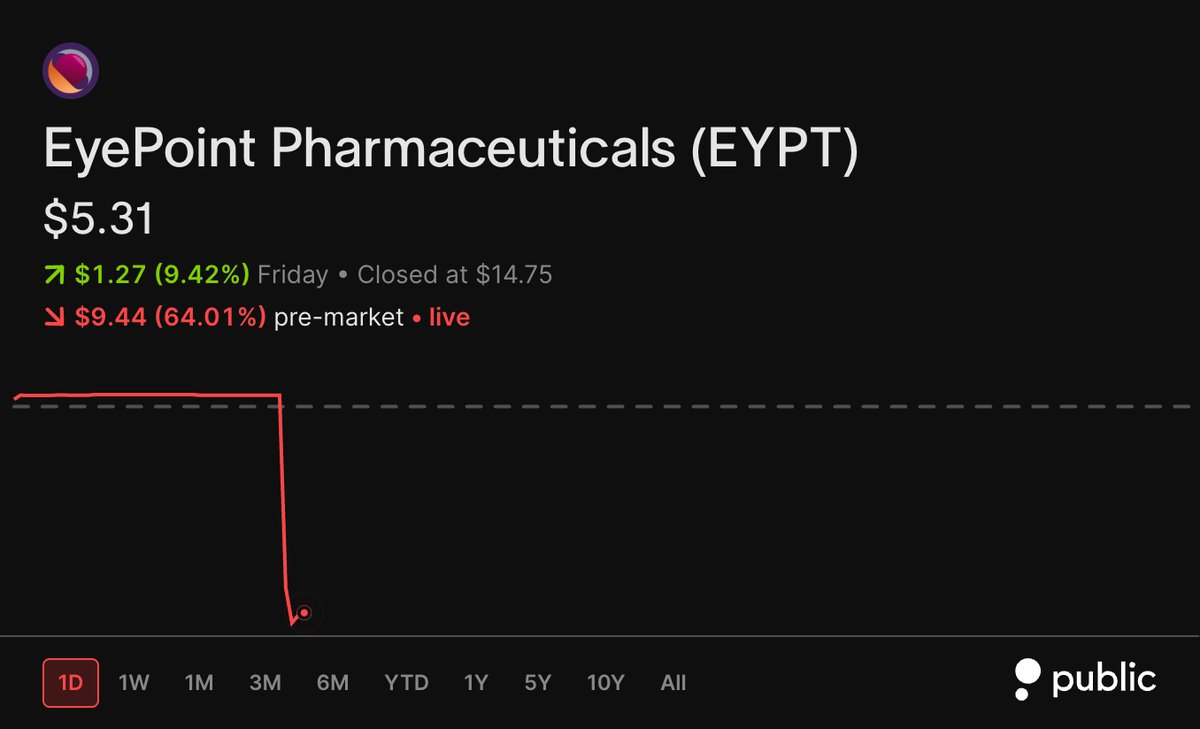
EyePoint said on Monday that DURAVYU, its experimental eye drug, failed to meet the primary endpoint of non-inferiority versus aflibercept in the full dataset of the Phase 3 LUGANO trial in wet age-related macular degeneration. The company said the miss was driven by 9 of 211 patients who experienced vision loss unrelated to wet AMD.
The result marks a sharp turn from the company’s early-August update, when EyePoint said topline data from LUGANO were due in August and LUCIA would follow in the fourth quarter. In its latest quarterly materials, EyePoint described LUGANO and LUCIA as FDA-aligned pivotal trials with more than 900 patients enrolled across both studies.
The readout matters because LUGANO is the first pivotal wet AMD dataset for DURAVYU, a candidate that had been positioned as a sustained-delivery treatment for retinal disease. Investors are now focusing on whether the upcoming LUCIA data can offset the setback and what it means for the program’s path forward.
The market response was immediate in related names: EyePoint shares were under pressure in premarket trading, while Ocugen moved higher on the readthrough from the negative result. Reuters reported the trial miss on the same day, matching the company’s disclosure.
AstraZeneca said on Monday it has stopped a phase 3 trial of volrustomig plus chemotherapy in metastatic non-small cell lung cancer. The decision came after a scheduled review by the Independent Data Monitoring Committee.
The committee concluded the combination was unlikely to meet either of the study’s primary endpoints, progression-free survival or overall survival, versus pembrolizumab plus chemotherapy. AstraZeneca said it will continue studies of volrustomig in cervical cancer, head and neck squamous cell carcinoma and mesothelioma.
The setback matters because late-stage oncology readouts can quickly shift expectations for big pharma pipelines and valuation, especially in a highly competitive lung-cancer market. Shares in AstraZeneca were described as firmer in early trading, even as investors weighed the latest pipeline update.
Susan Galbraith, the company’s oncology and hematology R&D chief, called the decision disappointing and said the company would learn from the study while continuing to develop new medicines. The move comes alongside other lung-cancer updates from AstraZeneca, keeping attention on the breadth of its late-stage portfolio.
L3Harris said on Monday that Sam Mehta has become president and chief executive officer effective immediately, replacing Christopher Kubasik, who stepped down from the board and as CEO the same day. The company said the move followed a board-led conduct review and was not tied to financial reporting, controls, customers or operating performance.
The change comes with L3Harris reiterating its 2026 consolidated revenue, organic growth, segment margin, GAAP EPS and free cash flow guidance. The company also said Mehta will work with the board on a smooth transition and that Lewis Hay III has been named independent chairman.
Shares fell in premarket trading as investors absorbed the abrupt leadership shift. L3Harris also said it remains committed to its previously announced $3 billion capital buildout to expand solid rocket motor production and strengthen its supply chain.
Mehta, who joined L3Harris in 2023, previously led the company’s Space & Mission Systems and Communications & Spectrum Dominance segments, which together account for about 80% of revenue. The company said those businesses continue under new segment leadership appointments announced alongside the CEO change.
Meta is now in federal court in Oakland for a landmark trial over claims that Facebook and Instagram were engineered to keep children hooked and that the company collected data on users under 13 without parental consent. The case features four states at this stage — California, Colorado, Kentucky and New Jersey — with the broader coalition totaling 29 states.
The lawsuit dates back to 2023 and is part of a larger wave of state-level litigation over social media and youth harm. Prosecutors have also placed CEO Mark Zuckerberg on the witness list, while some reports say Instagram head Adam Mosseri is also expected to be called.
Meta disclosed in court filings that the states’ damages theory could reach as much as $1.4 trillion, a figure legal experts say is far beyond what would likely be awarded. The company says it disputes the allegations and will show evidence of its efforts to support young users.
For investors, the key issue is less the headline number than the possibility of court-ordered product changes. Any remedy affecting Facebook and Instagram’s recommendation systems, data collection or ad targeting could matter more operationally than the theoretical damages claim.
Intel disclosed in a Form 4 filing that CEO Tan Lip-Bu bought 105,263 shares of common stock on Aug. 11 at $95 each, for a total of about $10 million. The filing was submitted on Aug. 14, making it the latest fresh evidence behind the CEO-buy chatter now circulating on social media.
The purchase comes shortly after Intel completed a roughly $2 billion equity raise. Public reporting indicates the company sold about 20.96 million shares at $95 apiece, with proceeds earmarked for foundry expansion, physical AI-related projects and other capital-intensive plans.
For the market, the update matters because it combines two competing signals: a chief executive adding personal capital, and a new equity issuance that can dilute existing holders. That combination keeps INTC and the broader semiconductor group in focus as investors weigh funding needs against execution risk.
Intel has not issued a separate response to the filing. The new disclosure does not change the facts of the offering, but it does give the social-media message a firmer factual base by tying the insider buy to an already reported financing event.
Fulcrum Therapeutics and Slate Medicines said on Aug. 17 they have agreed to merge in an all-stock transaction. The combined company will operate as Slate Medicines and focus on advancing Slate’s next-generation migraine portfolio; Reuters said the deal values the transaction at about $2.35 billion.reuters.com
The merger comes less than three months after Fulcrum disclosed it was discontinuing its pociredir program for sickle cell disease and launching a strategic review. In late May, the company also approved a restructuring plan that cut its workforce by about 85%, from 57 employees to 9, underscoring a broader strategic reset.sec.gov sec.gov
Shares of Fulcrum were indicated up 1.6% premarket after the announcement. But the deal also quickly attracted scrutiny: Halper Sadeh LLC said it is investigating whether Fulcrum shareholders are getting a fair price, highlighting investor sensitivity to valuation and deal terms.businesswire.com
Fulcrum said in April that it ended the first quarter with $333.3 million in cash, cash equivalents and marketable securities, and that the balance sheet would fund operations into 2029 under then-current plans. The merger marks a sharp pivot from rare-blood-disorder development toward migraine assets, with further deal economics to be set out in formal filings.ir.fulcrumtx.com globenewswire.com
Retail earnings take center stage this week as Home Depot, Target and Walmart report back-to-back results. The cluster has become a market readout on both consumer resilience and the durability of the recent rally.
The schedule matters because each name captures a different slice of demand: Home Depot on Tuesday, Target on Wednesday and Walmart on Thursday, with Lowe’s also in the mix. Home Depot’s print will be watched for signs that pro contractor demand can offset weaker housing turnover, while Walmart and Target will shed light on spending patterns across value and middle-income shoppers.
For investors, the updates could move the retail complex and related ETFs such as XRT, especially if management commentary shifts on inventories, traffic and second-half demand. Home improvement names are also being watched for any hint that repair-and-maintenance spending is doing more of the work than bigger discretionary projects.
No new corporate disclosure is involved beyond the earnings calendar itself; the incremental development is the concentration of major retail reports in a single week, which raises the stakes for consumer-sector read-throughs.
TSMC’s half-year report shows TSMC Arizona generated NT$36.066 billion in profit in the first half of 2026, with TSMC recognizing NT$31.151 billion in investment income. JASM in Kumamoto also turned profitable, posting roughly NT$1.6 billion in first-half profit and NT$1.219 billion in recognized investment gain for TSMC.
This follows earlier disclosures that Arizona earned NT$18.808 billion in the first quarter and NT$14.603 billion in the second quarter, while JASM moved from losses in 2025 to profit in 2026. The company’s Q2 results also showed revenue and margins holding up well, underscoring that the overseas ramp is now feeding through to earnings.
For investors, the key takeaway is that TSMC’s U.S. and Japan fabs are no longer just a capex story; they are becoming real profit contributors. That makes depreciation, expansion timing and manufacturing yields the main variables to watch, alongside the stock’s ADR and supplier chains.
The Kumamoto plant still faces a post-quake operating check after the July 28 earthquake in Japan, which prompted evacuation under emergency procedures. Structural inspections found the plant safe and production has been resuming, but equipment recalibration and work-in-process losses could weigh on third-quarter performance.
사건 전개
2026-07-16
실적
AppLovin Q2 revenue hits $1.924 billion, shares fell 19% after a miss영어 원문
Strong 53% growth was not enough to satisfy Wall Street as investors focused on the timing of ad-model gains
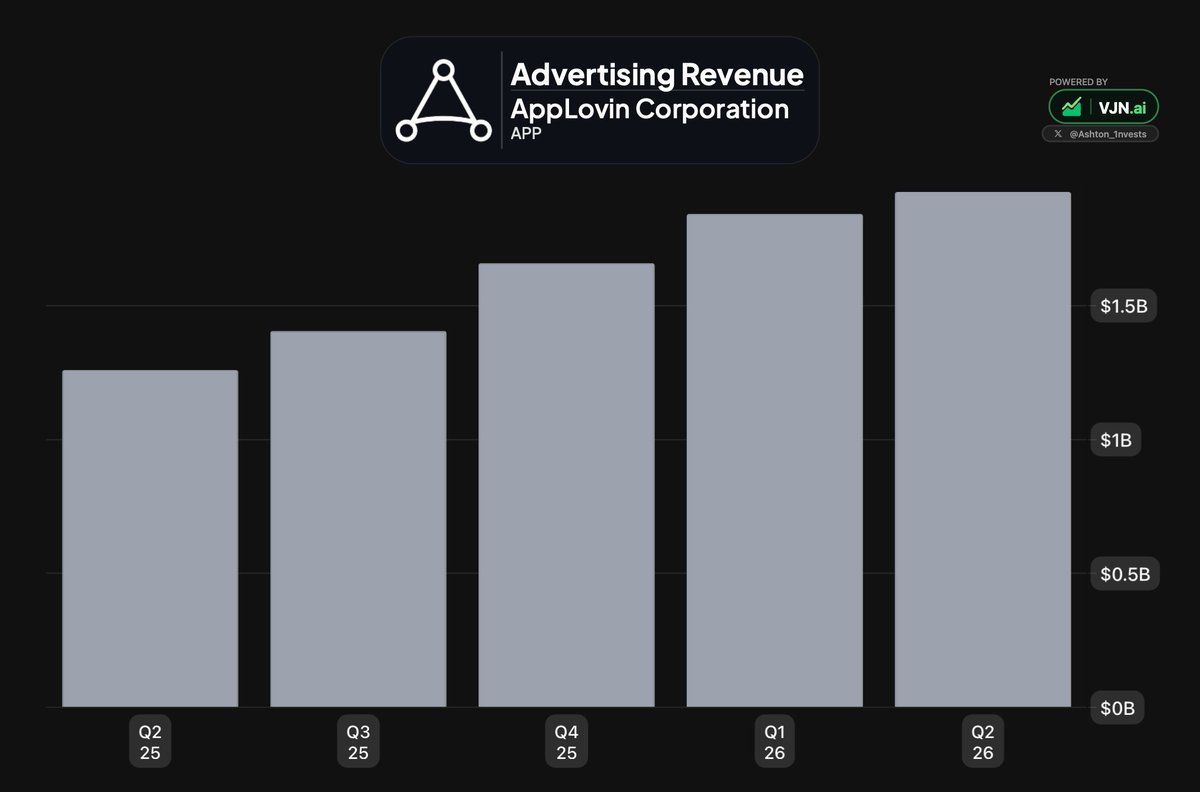
AppLovin posted second-quarter revenue of $1.924 billion, up 53% from $1.259 billion a year earlier, while adjusted EPS came in at $3.76 and matched expectations. The company said the revenue shortfall reflected the timing of improvements to its advertising models, with the next step-up in performance landing after quarter-end.
The result extends a broader post-earnings selloff that began when the company reported the miss. CNBC said the stock fell 19% on Thursday, while Proactive reported that after-hours losses topped 24% before the market settled on a smaller but still sharp decline.
For investors, the question is less about whether AppLovin is still growing and more about how quickly that growth converts into beats versus merely meeting high expectations. Recent coverage also highlighted a Rule of 40 score of 131 and a forward P/E below 16x 2027 estimates, underscoring why the stock remains closely watched despite the pullback.
AppLovin's management said it remains focused on improving its AI-powered adtech model and did not flag a demand collapse or new competitive threat in the earnings commentary. The market reaction instead suggests that timing, not the long-term growth story, is now driving near-term trading in the shares.
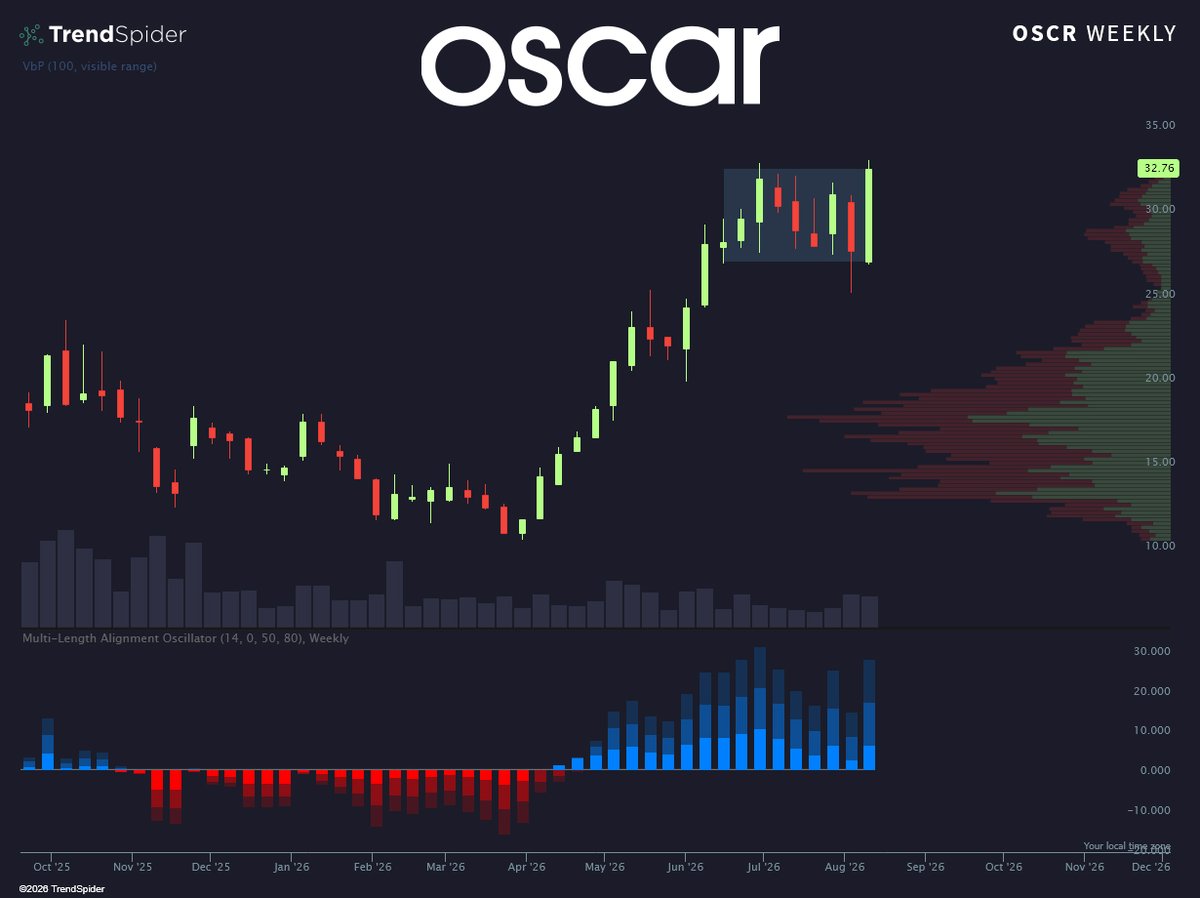
X trading chatter highlighted that Oscar Health (OSCR) has “engulfed 8 weeks of price action in a single weekly candle,” according to TrendSpider. That is a technical read of the chart, not a new corporate announcement.
The fundamental backdrop comes from Oscar’s August 6 second-quarter report, when the company posted about $4.88 billion in revenue versus $2.86 billion a year earlier. Net income was $361.8 million, compared with a $228.4 million loss in the prior-year quarter, and management lifted full-year 2026 guidance.
For the market, OSCR’s move still appears tied to post-earnings re-rating rather than a fresh company-specific catalyst. Quiver Quantitative said the recent advance was largely driven by the stronger earnings picture and expectations around a September 16 investor day; the stock was last around $32.76, near its 52-week high of $33.27.
So far, Oscar has not issued a separate response to the chart-based callout. Investors remain focused on whether the improved profitability can hold up against medical-cost trends and the company’s updated outlook.
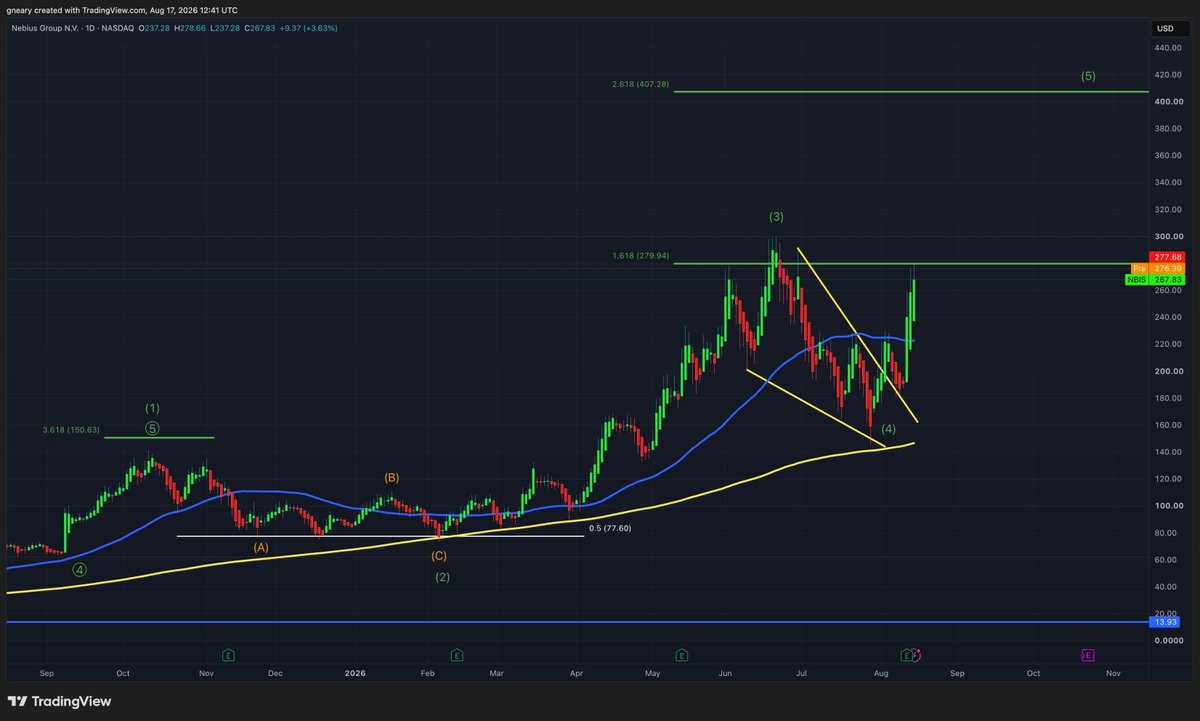
Nebius Group (NASDAQ: NBIS) remained a major market talking point on Aug. 17 after its Aug. 12 earnings-driven rally kept traders focused on the stock’s latest run. Multiple reports said shares climbed roughly 15% to 18% after the print, with the stock trading close to its June 22 record of $299.86.
The backdrop is a blowout second quarter: Nebius reported revenue of $582.3 million, up 454% year over year. Short interest also remains elevated, with Schaeffer’s Research citing 28.8% of float sold short and Benzinga putting the figure at 25.6%, underscoring how split investors remain on valuation versus growth.
On X, traders discussed whether NBIS could revisit the highs and even push toward $310, while some marked profits after buying below $200. The stock’s move is also spilling over into the broader AI cloud group, especially names like CoreWeave, as investors continue to price in demand for AI infrastructure and contracted capacity.
No new company announcement drove today’s chatter. Instead, the fresh signal is the market’s continued appetite for the post-earnings trade, with price action and short positioning still dominating the NBIS conversation.
사건 전개
2026-06-19게시물 5개 · 작성자 5명
WSJ reported that some neo-clouds fear losing future GPU allocations if they stop buying Nvidia's full stack, coining the term "Jensen jail," while five companies including Astera Labs are set to join the Nasdaq-100 on June 22.
시장
Anthropic revenue seen jumping 14-fold as S&P 500 gains 0.2% and Nasdaq 0.6%영어 원문
AI spending optimism kept tech in the lead, while lower Treasury yields and oil prices added support across risk assets
U.S. stocks extended a tech-led advance on Monday, with the S&P 500 up 0.2% and the Nasdaq rising 0.6%. Markets were buoyed by reports that Anthropic’s second-quarter revenue increased at least 14-fold from a year earlier, reinforcing expectations that AI spending remains strong.
The latest move came as softer U.S. data pulled down expectations for another near-term Federal Reserve rate hike. Reuters and AP both said investors have been reducing those bets, while Treasury yields and oil prices eased, helping sentiment in rate-sensitive equities.
The advance was concentrated in AI-linked names, including semiconductors, memory chips and other infrastructure suppliers. A weaker dollar, firmer gold and gains in bitcoin also reflected a broader bid for risk assets, even as Middle East tensions kept traders cautious.
The Anthropic figure was reported from documents seen by Bloomberg rather than a company press release, so investors are still treating it as a market-moving disclosure rather than a full earnings print.
Bank of America has raised the long-term earnings debate around Micron Technology, with a social-media signal citing a path to $236 in earnings per share by 2030. Publicly reported coverage confirms that analyst Vivek Arya kept a Buy rating on Micron and reiterated a $1,550 price target.
The call comes against a backdrop of tight AI-related memory supply, especially high-bandwidth memory and DRAM. Separate reporting says BofA still sees roughly $100 a share in Micron earnings by calendar 2028 even under a more negative pricing scenario, versus about $12 at the prior cycle peak in 2018.
For the market, the issue is no longer just Micron’s near-term quarter-to-quarter volatility but the durability of the memory boom itself. Investors have been repricing memory names as AI data-center buildouts lift demand while capacity expansion takes time to catch up.
No separate company response was cited in the reports reviewed. BofA’s broader argument is that AI has changed the supply-demand framework for memory enough that old-cycle comparisons may understate Micron’s earnings power.
사건 전개
2026-06-22게시물 4개 · 작성자 3명
Multiple Wall Street firms raised Micron price targets ahead of earnings, with the highest at $1,500.
2026-06-24게시물 9개 · 작성자 7명
Bank of America raised Micron's target to $1,500 and lifted its 2030 AI data center TAM estimate to $2.7 trillion.
기업
Berenberg lifts Mobileye to Buy, raises target to $11영어 원문
The brokerage says the post-CEO-exit pullback has overshot and Mobileye’s mid-term growth is being mispriced
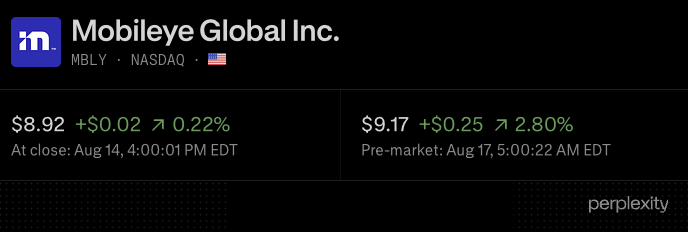
Berenberg upgraded Mobileye Global to Buy from Hold and raised its price target to $11 from $10.80. The firm said the stock has overreacted to the departure of co-founder and former CEO Amnon Shashua and now offers a more attractive entry point.
The call follows Mobileye’s second-quarter results, which showed revenue of about $508 million and system shipments of 10 million units. The company had also lifted its 2026 revenue outlook to a midpoint of $1.99 billion, reinforcing the broker’s view that the core business remains resilient.
Mobileye shares have been volatile since the July leadership announcement, while several other brokerages have moved to a more cautious stance with targets in the $8 to $9 range. Berenberg’s upgrade highlights the widening split on how the market should value Mobileye’s ADAS franchise and its longer-term robotaxi ambitions.
Separately, Mobileye said it is searching for a new CEO. Shashua is set to remain on the board and has been offered the chairmanship, though he has not made a final decision.
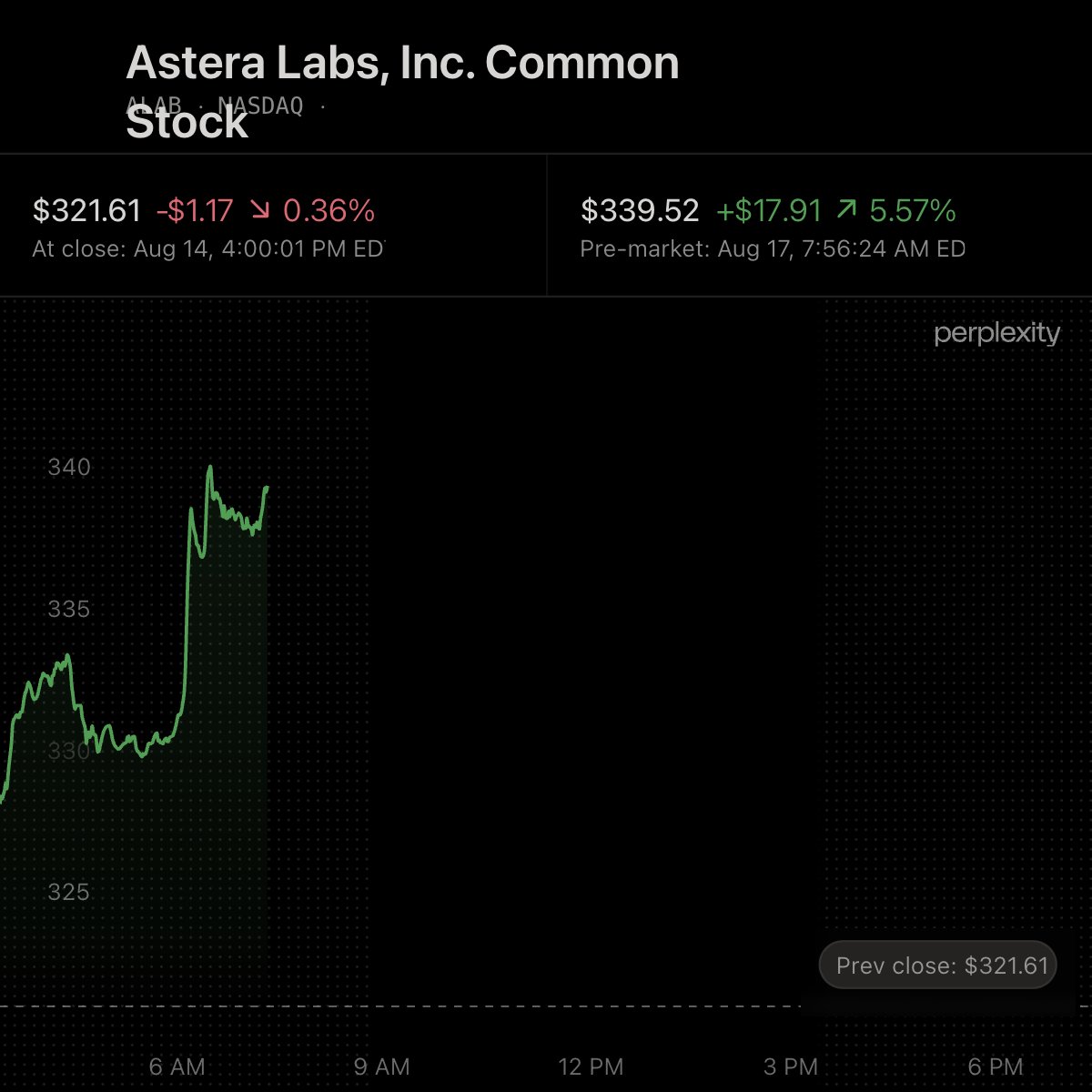
Northland Capital Markets upgraded Astera Labs to Outperform from Market Perform and set a $350 price target. The firm said the call is driven by expectations for more positive earnings revisions and a longer-than-expected AI infrastructure spending cycle.
The move comes after a string of bullish and bearish views on ALAB this year. In August, other analysts highlighted stronger-than-expected quarterly results, firm guidance and expanding AI connectivity products, while Northland had previously cut the stock in May on valuation concerns and worries about datacenter spending in 2027.
For the market, the upgrade matters most for Astera Labs itself and for sentiment across AI connectivity names. Astera Labs supplies connectivity silicon for datacenters and AI servers, and Northland’s focus on higher content per rack points to deeper penetration at hyperscale customers.
No fresh company response was available in the signals reviewed. Investors will keep watching AI capex trends, Scorpio-X ramp timing and the pace of earnings estimate revisions.
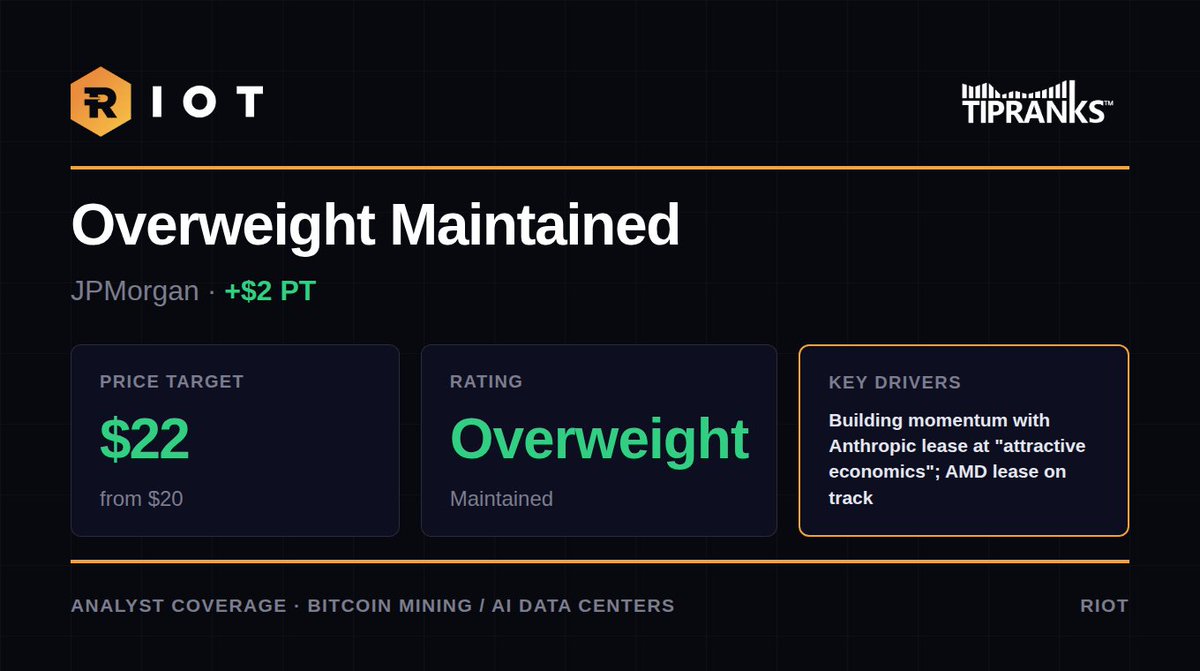
JPMorgan lifts Riot Platforms target to $22 as AI lease keeps re-rating alive영어 원문
The new note extends Wall Street’s reassessment of Riot after its Anthropic-linked data center deal, underscoring the shift in how the stock is being valued.
JPMorgan raised its price target on Riot Platforms to $22 from $20 and kept an Overweight rating. The firm pointed to momentum from Riot’s Anthropic-linked lease and called the economics attractive.
The lease itself was disclosed earlier this month: Riot signed a 20-year agreement for 191 megawatts of data center capacity at its Rockdale campus, with about $9.1 billion of contract revenue expected over the initial term. That deal marked a major step in Riot’s move from bitcoin mining toward AI infrastructure.
For the market, the significance is less about a new contract and more about the continuing sell-side re-rating. Riot shares have been trading as a hybrid of bitcoin miner and data-center developer, and the new JPMorgan note reinforces that shift in the valuation debate.
Riot previously said the first 96 MW should be delivered in December 2027, with the remaining 95 MW in June 2028. Investors now remain focused on financing, construction execution and whether more AI leasing follows.
사건 전개
2026-08-11게시물 39개 · 작성자 36명
Anthropic signed a $9.1B, 20-year compute deal with Riot Platforms, sending Riot shares up 25% after hours.
기업🔥진행 중
Kratos, GE win JASSM engine contract; GEK800 and GEK1500 designated F143-ZZ-100영어 원문
The U.S. Air Force’s move adds a second propulsion option for JASSM and broadens the low-cost missile engine supplier base.
Kratos Defense and GE Aerospace said they have won a U.S. Air Force contract to develop a second-source engine option for the JASSM cruise missile, and that the military has designated the engine F143-ZZ-100. The companies said the program builds on the GEK800 architecture and the larger GEK1500 design.
This is the latest step in a longer-running effort. On Feb. 23, 2026, Kratos and GE said they had already secured a $12.4 million Air Force award to design a next-generation engine for small Collaborative Combat Aircraft, with the GEK1500 described as a 1,500-pound-thrust engine that could also power unmanned systems and missiles.
For investors, the update reinforces KTOS’s positioning in low-cost propulsion and gives GE Aerospace another defense-engine foothold. The JASSM angle also links the program to broader missile-production and supply-chain discussions, including the company’s earlier work on the GEK800 and the possibility of additional demand from cruise-missile families such as LRASM.
No party has publicly denied the contract or the engine designation in the materials reviewed. Earlier disclosures also said GEK800 altitude testing had already been completed, helping de-risk the GEK1500 design work.
사건 전개
2026-07-28
기업
Union Pacific adds $91.1 million from fuel surcharges in Q2영어 원문
The railroad’s regulatory filing shows surcharge revenue outpaced fuel costs, giving a lift to earnings and highlighting how diesel-linked pricing works in practice.
Union Pacific said its fuel surcharges exceeded fuel costs by $91.1 million in the second quarter, according to a filing with the Surface Transportation Board. Reuters reported that the surplus helped lift quarterly profit and stood out among major U.S. railroads.
Fuel surcharges on rail shipments are typically tied to diesel-price benchmarks, but they can lag changes in fuel markets by weeks. Reuters said Union Pacific had the opposite pattern in the first quarter, and that it was the only major railroad to report surcharge revenue above fuel costs in the first half of 2026.
The company’s second-quarter earnings release already pointed to the benefit: Union Pacific reported $6.9 billion in operating revenue, up 12% year over year, with freight revenue excluding fuel up 4%. For investors, that keeps surcharge mechanics and pricing power in focus across the rail sector.
Union Pacific said its year-over-year increase in fuel surcharges was in line with the industry and that surcharge levels are part of overall customer pricing discussions. Reuters noted that Norfolk Southern and CSX also posted small second-quarter surpluses, though far below Union Pacific’s.
Journey Energy back in focus as C$28 million asset sale and buyout chatter collide영어 원문
X posts revived attention on JOY.TO, but the hard catalyst remains the company’s C$28 million Northwest Alberta divestiture and capital reallocation plan.
Journey Energy was back in the market spotlight on August 17 after X posts linked the stock’s advance to buyout chatter and a free update from a Bison Insights account. That chatter remains unverified; the latest hard catalyst is the company’s announced asset sale earlier this month.
On August 12, Journey said it struck a definitive deal to sell certain Northwest Alberta assets for C$28 million in cash, with closing targeted for September 1. The package includes Ante Creek, Pine Creek and other minor properties, and the company said the sale should trim 2026 volumes guidance by about 390 boe/d.
The backdrop is a solid second quarter: Journey reported C$18.5 million in net income and C$18.4 million in adjusted funds flow on Aug. 6, with sales volumes of 10,017 boe/d. Those numbers help explain why investors are still trading the name actively, even though no takeover process has been confirmed publicly.
For now, the market is reacting to a mix of asset monetization, Duvernay reinvestment and rumor-driven speculation. Journey has said the proceeds from divestitures will be directed to Duvernay development, while reducing end-of-life liabilities and sharpening the company’s portfolio.
Tango Therapeutics is back in focus after a trading note circulating on X said Stifel reiterated a Buy rating and a $40 price target on the stock, while flagging the upcoming ESMO 2026 poster update for the vopimetostat plus RAS(ON) inhibitor program. The key question is whether the company will show meaningfully longer follow-up and a modest increase in patient count, rather than a wholesale change in the readout.
The backdrop is the company’s June combination-data disclosure in pancreatic cancer. BioPharma Dive reported that Tango said 11 of 12 evaluable patients responded in the early dataset, a result that drew strong attention but still came from a very small cohort with limited follow-up.
For the market, the catalyst matters because TNGX has traded heavily on whether vopimetostat can evolve from an encouraging early signal into a broader franchise. Seeking Alpha noted the planned front-line phase 3 design, timing and regulatory path remain unsettled, which keeps the stock sensitive to any incremental clinical detail.
Investors are therefore watching whether ESMO adds enough evidence to reinforce the combination story in pancreatic cancer and potentially beyond, or whether the discussion remains centered on the same small but striking early dataset. The company’s own messaging, as reflected in the X signal, suggests expectations should be kept measured until more patients and longer follow-up are available.
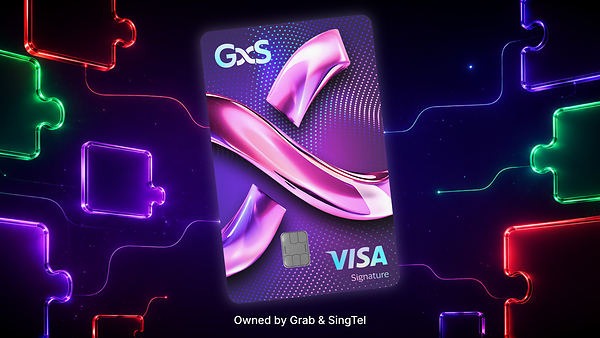
GXS Bank has launched its GXS Credit Card in Singapore in partnership with Grab and Singtel. The card offers up to 10% back in GrabCoins on eligible Grab spending and 1.75% cashback on Singtel bill payments, according to GXS’s website and recent notices.
The launch follows a series of prior product updates. GXS disclosed on July 20 and July 31 that eligible customers could apply through the Grab app, link the card automatically after approval, and earn the new Singtel cashback feature; Fintech Singapore also reported that the bank trialed the card with more than 1,000 users in a month-long beta.
For Grab and Singtel, the product adds another layer to an ecosystem that already spans transport, delivery, telecoms and payments. For GXS, it expands the bank’s retail offering beyond savings, debit cards and FlexiLoan into consumer credit.
GXS says the card is Singapore’s first bank-issued credit card that can be applied for through a third-party app. The main near-term focus will be adoption inside the Grab ecosystem and whether the product increases transaction stickiness rather than serving as a standalone card push.
Alphabet has hired banks for what would be its first Australian-dollar bond offering, according to a Bloomberg report and a Reuters-reviewed bookrunner message. The planned deal would mark the company’s debut in the Kangaroo bond market, with maturities under consideration at 3, 5, 10 and 20 years.
The move comes after Alphabet sold $25 billion of U.S. dollar bonds earlier this month, while foreign issuers have already sold about A$60 billion of Australian-dollar bonds this year, a record pace, Reuters reported. The message did not disclose a target size or use of proceeds.
For credit investors, a debut from a mega-cap tech issuer could add supply to Australia’s local-currency bond market and provide another funding channel for AI-related capital spending. The expected bookrunners are ANZ, Deutsche Bank, RBC Capital Markets and TD Securities, according to Reuters.
At this stage, Alphabet has only mandated banks to work on the transaction; final pricing and size have not been announced. The deal is being watched as part of a broader shift by global tech firms toward capital-market funding rather than relying solely on cash reserves.
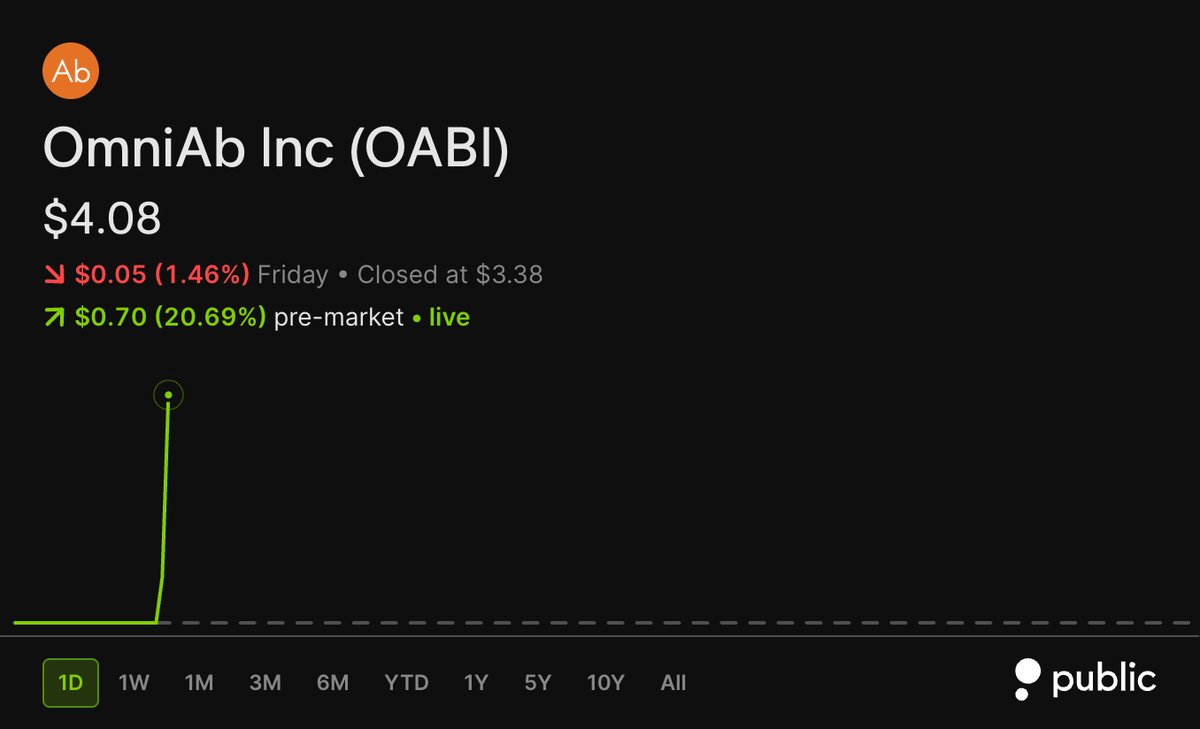
OmniAb said it has entered into a global collaboration and license agreement with Eli Lilly to launch a new ion-channel drug discovery program. The deal includes an upfront payment and eligibility for as much as $370 million in research, development and commercial milestones, plus tiered royalties.
The announcement comes as Lilly continues to spend aggressively on external innovation. In its Aug. 5 second-quarter update, Lilly said revenue rose 48% year over year to $23.0 billion and lifted full-year revenue guidance to $85.0 billion-$87.0 billion, underscoring its appetite for pipeline-building deals.
For OmniAb, the pact adds another validation point for its discovery platform and gives investors a new potential milestone stream to track. For Lilly, it broadens a roster of business-development moves aimed at supplementing internal R&D with outside programs.
So far, the details that matter most to the market are the upfront economics and the size of the milestone package. The companies have not publicly disclosed a deeper breakdown of the target biology or the timeline for first program milestones.
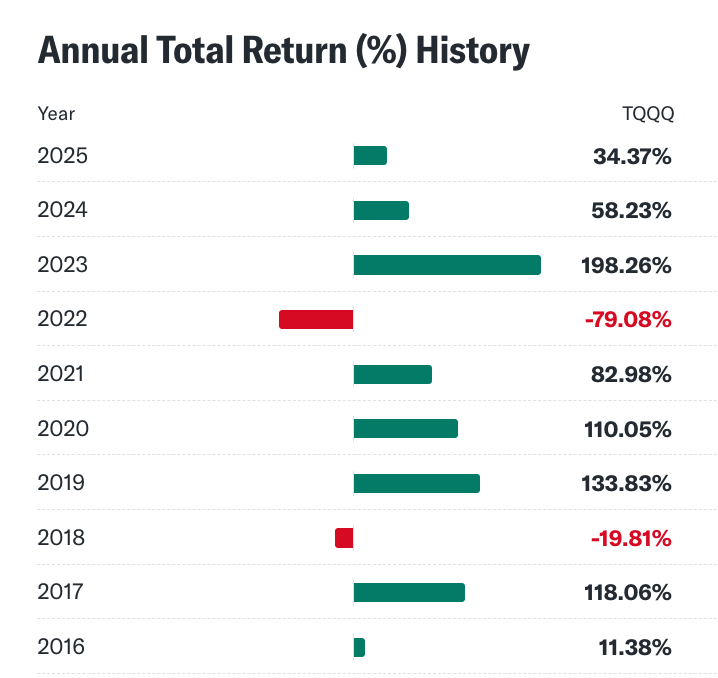
Recent posts on X highlighted the decade-long annual performance of ProShares UltraPro QQQ (TQQQ), the 3x leveraged Nasdaq-100 ETF. The figures show extreme swings, including a 198.26% total return in 2023 and a 79.08% drop in 2022.
Third-party data broadly confirms the same pattern. ETFreplay lists TQQQ’s annual total returns at +11.38% in 2016, +118.06% in 2017, +58.23% in 2024 and +34.37% in 2025, while FinanceCharts shows a 63.12% trailing-12-month total return and 35.91% year-to-date total return.
The fund’s design helps explain the volatility: TQQQ seeks to deliver three times the daily move of the Nasdaq-100, making it a popular vehicle for short-horizon trading rather than passive long-term exposure. That means its performance can diverge sharply from plain-vanilla Nasdaq-100 products like QQQ over full market cycles.
No new company-specific announcement was identified behind the X posts; the key development is the renewed circulation of verified historical return data.
Micron 80.4%, SK hynix 76.3%: AI chip margin rankings go viral영어 원문
A widely shared X post revived a margin-comparison chart for AI semiconductor names, highlighting how HBM and memory are reshaping profitability across the supply chain.
An X post circulating today is pushing a “most profitable AI semiconductor stocks” chart that ranks names by operating margin. The list highlights Micron, NVIDIA and Sandisk, with the conversation centering on which AI hardware companies are capturing the most profit.
The comparison is built on recently reported quarterly figures. Axis Intelligence’s compilation shows Micron with an 80.4% operating margin in fiscal Q3 2026, SK hynix at 76.3% in Q2 2026, Samsung’s Device Solutions division at 70.0% in Q2 2026, NVIDIA at 65.6% in Q1 FY2027, and TSMC at 60.3% in Q2 2026.
The reason the chart resonates is that HBM and premium memory have become one of the highest-margin layers in the AI stack. Recent reporting also says Micron has disclosed more than $1 billion in HBM4 revenue, while SK hynix and Samsung are moving through HBM4 volume shipment and sample-sharing milestones, keeping MU, memory suppliers and parts of the broader AI semiconductor group in focus.
Still, the social post is a resharing of already-public numbers, not a fresh earnings release or new guidance. Its main value is as a market snapshot: it shows how investors are now comparing AI names by profitability, not just by revenue growth or order momentum.
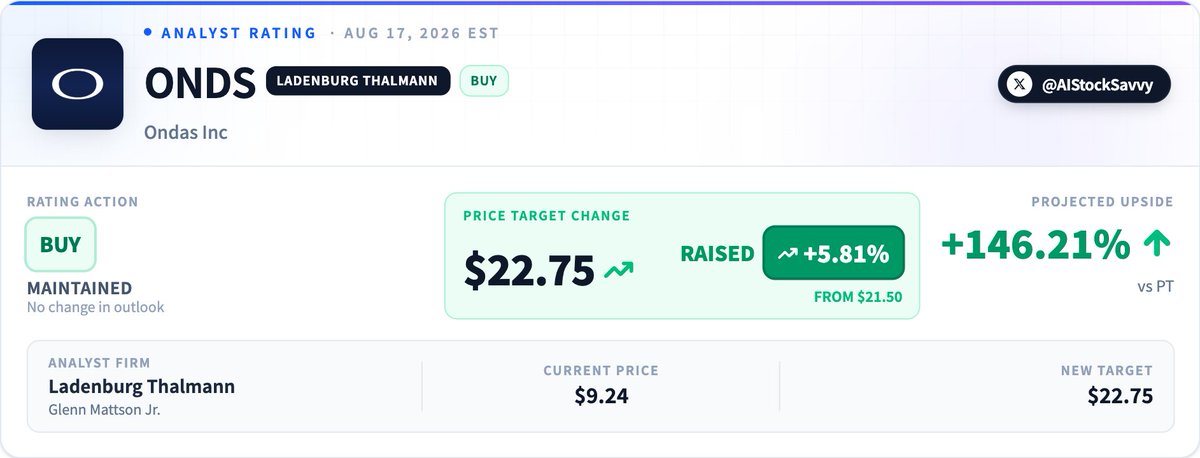
Ladenburg Thalmann raised its price target on Ondas Holdings (NASDAQ: ONDS) to $22.75 from $21.75 and kept a Buy rating, according to the X signal cited by traders. The firm’s stated rationale was accelerating revenue expectations.
The move comes just days after Ondas reported record second-quarter 2026 revenue of $83.8 million and raised its full-year revenue target to $525 million-$550 million. The company also said pro forma backlog reached about $757 million after recent acquisitions and order capture.
For investors, the key issue is whether Ondas can convert its expanding backlog and acquisition-driven scale into sustained top-line execution. The stock has been attracting fresh analyst attention as the company pushes deeper into drones, counter-UAS and robotics.
The analyst note adds to a mixed but active debate around ONDS, with recent coverage highlighting both higher targets and cautious voices. Ondas’ latest earnings release did not include a response to Ladenburg’s latest target-price revision.
X users are arguing that if Tesla eventually adds $100 billion of revenue from Robotaxi and Optimus, the stock could look cheap even if the share price does not move. But that argument rests on a long-dated scenario, not on fresh operating evidence disclosed today.
Morgan Stanley’s new lead analyst has taken the opposite tack: Tesla needs to prove the robots are real, with public demonstrations, factory use without constant human supervision, external orders, and credible manufacturing economics. A separate recent report said Tesla’s Q2 2026 revenue was about $28.24 billion and free cash flow was negative, underscoring the gap between current results and the robotics narrative.
For TSLA, the debate is less about next quarter’s earnings and more about whether Robotaxi and Optimus can turn into repeatable revenue streams. Until Tesla publishes more concrete operating metrics, the valuation case remains aspirational rather than verified.
사건 전개
2026-06-19게시물 6개 · 작성자 5명
Tesla adds official Cybercab logos at Giga Texas, and Goldman Sachs raises Q2 delivery forecast.
2026-07-22게시물 13개 · 작성자 11명
Tesla begins unsupervised Model Y robotaxi rides in Tampa, Florida, and gets zoning approval for a charging facility in San Antonio.
SK hynix shipped 12-layer HBM4E samples to major customers, while discussions highlighted DRAM, NAND, and HBM supply bottlenecks and Samsung Electro-Mechanics' $1B silicon capacitor deal.
2026-06-25게시물 18개 · 작성자 16명
Micron delivered a record earnings beat with revenue and gross margin surging, while SK hynix announced a Nasdaq listing to raise $29 billion.
2026-07-25게시물 26개 · 작성자 24명
SK Group and Nvidia unveiled a $500B+ AI initiative including a 2GW AI factory and next-gen memory collaboration, with Vera Rubin supply chain details emerging.
2026-07-28게시물 17개 · 작성자 14명
SK hynix plans LPDDR6 mass production in H2 with Xiaomi as first customer, while reports noted Rubin production delays impacting supply chain and HBM4 costs rising to $31-32/GB.
2026-08-15게시물 4개 · 작성자 4명
BofA expects no HBM content reduction in new GPUs, AMD's next-gen roadmap shows major performance gains, and HBF offers strong specs but limited ecosystem.
2026-08-16게시물 4개 · 작성자 4명
SanDisk projected strong margins through 2030 with LTAs covering two-thirds of 2028 output, while a professor warned the memory shortage could turn into a glut by 2028.
2026-08-17게시물 2개 · 작성자 2명
Investors discussed AI stock valuations, noting Nvidia as undervalued vs AMD, while Samsung's China sales surpassed the US, with HBM4 and eSSD potentially shifting dynamics.
Movement Labs' bankruptcy docket revealed a novel crypto restructuring tactic; NVIDIA detailed Vera Rubin as an architectural shift; Rogers' earnings showed media-led growth but wireless headwinds.
2026-07-23게시물 5개 · 작성자 4명
Bitcoin ETFs saw $900M weekly inflows, the largest since early May; a Chinese AI admission highlighted compute over talent; peptide regulation debate centered on guardrails.
2026-08-05게시물 5개 · 작성자 5명
Open-weights model roles were deemed misunderstood; NASA updated Moon Base commercial progress; mining valuation analysis favored mine economics over EV/resource.
2026-08-13게시물 4개 · 작성자 4명
UBS tripled its Bitcoin ETF position to $90M; investors reflected on the 1984-2021 market paradigm; Melco's Q2 profit growth was called an accounting illusion.
Goldman Sachs and Citadel diverged on Fed rate expectations, with Goldman arguing markets are too hawkish on hikes while Citadel warned of a potential surprise July increase.
Analysts projected upside for Sivers Semiconductors based on FY2028 operating profit targets, while others debated the copper-gold ratio as a market bottom signal and criticized developer bailout narratives.
2026-07-15게시물 8개 · 작성자 8명
Copper's resilience was highlighted as supporting gold, metals and mining ETF trading volume hit a record $530 billion, and China allocated a $9 billion war chest for state-backed miner overseas co-investments.
2026-07-23게시물 10개 · 작성자 9명
Discussions centered on a potential super capital rotation event roadmap across commodities like gold, silver, copper, oil, uranium, and platinum, with a specific mention of uranium coverage.
2026-08-11게시물 8개 · 작성자 8명
A video suggested a new commodity bull run may have started, gold miners ETF broke out of a 22-week base, and copper held ground through the Iran spike while gold dropped 20%.
2026-08-13게시물 7개 · 작성자 7명
Financial Times reported on metals-crypto fusion bets, and the copper-gold ratio fell below 0.16 for the first time in six months, with historical signals indicating copper gains ahead.
2026-08-14게시물 3개 · 작성자 3명
Spot copper surged above later-dated futures on the London Metal Exchange, analysts flagged energy sector lagging despite commodity gains, and Americas Gold and Silver reported transformative Q2 earnings.
2026-08-17게시물 2개 · 작성자 2명
Geopolitical tensions continued, while analysts countered the view that price spikes would quickly unleash supply, noting mine lead times have stretched from 6.7 years in the 1990s to nearly 16 years today.
Meta shares surged 8.8% on reports it may sell excess AI compute capacity, while CoreWeave and Nebius fell 14% and 17% respectively, with Corning down 14%.
2026-08-12게시물 12개 · 작성자 12명
CoreWeave reported a backlog exceeding $104 billion, with strong earnings from Nebius and other AI infrastructure firms, leading several institutions to declare the AI bull market's return.
2026-08-13게시물 11개 · 작성자 11명
A Bloomberg article exposed a circular financing map among AI cloud providers, raising concerns about revenue quality, while other analyses highlighted five trends in the CSP sector, emphasizing demand still outstripping supply.
2026-08-16게시물 4개 · 작성자 4명
Gavin Baker disclosed his Q2 portfolio with major positions in SpaceX and Micron, while Jim Cramer named six AI stocks to watch in 2026.
2026-08-17게시물 4개 · 작성자 4명
NVIDIA's 13F filing revealed its SpaceX position resulted from the xAI acquisition conversion, not a new purchase, while markets debated SpaceX's potential to reach a $2 trillion valuation.