The 30-year U.S. Treasury yield climbed to 5.29% on Monday, its highest level since 2007, as investors continued to price in stubborn inflation, large government borrowing needs and a heavy wave of long-duration bond supply. The 10-year yield also moved higher, leaving the curve broadly repriced upward.
The move follows last week’s $25 billion sale of 30-year Treasuries, which cleared at a 5.216% yield — the highest auction rate since 2001. Market commentary also points to AI-related corporate borrowing and weaker demand from traditional long-bond buyers as additional pressure points.
Higher long-end yields feed directly into mortgage rates, corporate funding costs and other benchmark borrowing rates, making the move especially relevant for housing, banks, leveraged borrowers and long-duration equities. U.S. stocks closed lower on Monday as investors adjusted to the new rate backdrop.
Citadel Securities said the Fed’s current policy stance is helping keep long-term Treasury yields near multi-decade highs, though that remains a market view rather than a forecast.
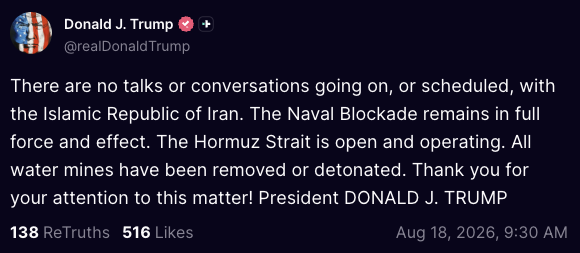
U.S. President Donald Trump said Tuesday that there are no ongoing talks with Iran and none are scheduled, while adding that the naval blockade remains in force and the Strait of Hormuz is open and operating. His remarks follow a Monday statement that he would not extend the 60-day interim arrangement with Tehran.
The backdrop is a negotiating window that closed without a breakthrough. CNBC and other outlets reported that the 60-day period ended Monday, and CNBC also reported a cargo vessel was struck in the strait on Tuesday, leaving engine-room damage and a crew casualty, underscoring persistent transit risk.
Hormuz is a critical energy chokepoint, handling about one-fifth of global crude oil and gas flows before the conflict. CNBC cited Kpler data showing only three vessels transited the strait on Sunday, far below the roughly 130 daily crossings before the war, keeping shipping, insurers and energy markets on alert.
Iran has denied that direct U.S. talks are under way and says it is still in discussions with Oman over a route to reopen the waterway. With both sides sticking to hard lines, attention now remains on whether commercial traffic can normalize without further escalation.
사건 전개
2026-06-20게시물 13개 · 작성자 8명
Trump said ships are flowing out of the Strait of Hormuz after a US-Iran ceasefire and warned of action if Iran falters.
시장
Brent tops $90, 30-year Treasury yield hits 5.31% as U.S. futures soften영어 원문
Middle East truce expiry lifted oil and long yields, forcing markets to reprice inflation and rates.
U.S. stock-index futures were weaker in Tuesday trade as a jump in Treasury yields and a spike in oil prices weighed on sentiment. Reuters said the 30-year Treasury yield climbed to 5.31%, its highest level in nearly two decades, while Brent crude briefly topped $90 a barrel.
The move comes after a U.S.-Iran ceasefire expired, reviving concern that the conflict could remain a source of inflation pressure. Reuters said oil has risen for a third straight day, and Yahoo Finance’s market recap noted Wall Street had already closed lower on Monday on the same oil-and-yields combination.
Higher yields typically hit long-duration growth stocks and capital-intensive names, while firmer crude can feed through to transport, industrial and consumer costs. Reuters said S&P 500 and Nasdaq futures were down about 0.50% and 1.22%, respectively, in early trading.
Investors are now looking to the Fed minutes and next week’s Jackson Hole symposium for clues on the policy path. For now, the trade is being driven less by company-specific news than by a broader re-pricing of rates, inflation and geopolitical risk.
Nasdaq said it will launch a new overnight trading session on Dec. 6, 2026, running from 9 p.m. to 4 a.m. ET. The move would extend U.S. equity trading hours to nearly 23 hours a day when combined with the exchange’s existing sessions.
The plan has been in the works for months: Nasdaq filed its 23/5 proposal with the SEC in late December 2025, and the Federal Register published notice of the filing in January 2026. More recent reporting says the SEC approved the framework in the second quarter, clearing the way for implementation in December.
The shift matters for Nasdaq parent NDAQ, brokerages, market makers and liquidity providers that trade outside regular U.S. hours. It also raises operational questions around overnight liquidity, price bands and market-data availability, which Nasdaq says it is addressing with dedicated safeguards.
Nasdaq’s filing says the exchange will keep markets closed from 8 p.m. to 9 p.m. ET for maintenance and corporate-action processing, while outstanding orders left at 4 a.m. will be canceled and may be resubmitted in the next session. The overnight session will cover eligible NMS stocks and ETPs subject to regulatory and infrastructure readiness.
사건 전개
2026-06-22게시물 6개 · 작성자 5명
Nasdaq 100 announced its index reshuffle, adding five stocks and removing five.
SEC filing and company disclosures say the project starts at 4.25 GW, with another 3.8 GW available at Nvidia’s discretion and first service targeted for 2028.
Nvidia disclosed on Monday that it has entered into a multi-year partnership with SB Energy to provide up to $105 billion of credit support for OpenAI’s new AI data center campus in Pike County, Ohio. The filing says the initial commitment covers roughly 4.25 gigawatts of IT load, with about 3.8 gigawatts of additional support available at Nvidia’s discretion.
The campus will be built and managed by SB Energy, while OpenAI will be the tenant. Nvidia said the initial lease-backed support is tied to readiness milestones expected to begin in 2028, and its blog said the site could ultimately support up to 8 gigawatts if the optional expansion is used.
For investors, the deal further ties Nvidia’s chip sales and financing exposure to the AI buildout cycle, reinforcing demand visibility for NVDA and keeping the broader OpenAI infrastructure chain in focus. The announcement also highlights the scale of capital being committed to AI data centers, including power buildout and grid infrastructure.
Nvidia CEO Jensen Huang said the company is securing long-lived infrastructure so OpenAI can deploy upgraded AI factories over time. OpenAI, for its part, is the tenant under the lease structure; the filing also says OpenAI agreed to reimburse and indemnify Nvidia for amounts actually paid under the agreements, subject to the contract terms.
Vineland’s planning board approved the Phase 2 expansion of the DataOne data center campus on Aug. 17 by a 9-1 vote, clearing the way for construction to continue. The project is in South Jersey and has been under review amid months of public opposition.
The campus has become a focal point over electricity demand, water use and noise. Local reporting says the full buildout is designed around roughly 300 megawatts of power and could be among the largest AI data centers on the East Coast; Nebius has previously disclosed a five-year, $17.4 billion agreement to supply Microsoft with AI computing capacity from the site.
The decision matters for Nebius Group ($NBIS) and Bloom Energy ($BE). Nebius operates the AI equipment, while Bloom’s fuel cells and on-site power infrastructure are part of the updated plan, so the vote keeps both companies’ Vineland-linked execution on track.
DataOne has said the site complies with local noise limits and that mitigation efforts are in place, while residents and opponents continue to cite humming noise and resource usage. The vote is the latest step in a long-running permitting process rather than the end of the dispute.
사건 전개
2026-07-01
시장
Reddit enters the S&P 500 as 16.7 million shares, nearly $3 billion of passive buying hits영어 원문
The index change took effect before Tuesday’s open, putting RDDT and AvalonBay at the center of a large benchmark rebalance.
Reddit (RDDT) officially joined the S&P 500 before the open on Tuesday, replacing AvalonBay Communities as the latest reconstitution move from S&P Dow Jones Indices. Market watchers say index funds are expected to buy about 16.7 million Reddit shares, or almost $3 billion worth at Monday’s price levels.
The move was announced last week and is now being implemented. AP and other coverage noted that S&P 500 additions often draw mechanical demand from index-tracking funds, which can boost trading volume around the effective date even when the market has already priced in part of the event.
RDDT had surged roughly 12.6% to 13% on Friday after the announcement, then slipped 7.5% on Monday to around $164.50 ahead of the debut. The benchmark flow is centered on Reddit and AvalonBay, with the latter exiting as part of the index provider’s rebalance.
No fresh company statement was immediately cited in the available coverage; the day’s focus is on the size of the passive inflow and how much of it had already been front-run by traders.
Unitree Robotics is set to begin trading on Shanghai’s STAR Market on August 19, after pricing its IPO at 150.8 yuan a share and valuing the company at about 61 billion yuan. The offering will raise roughly 6.10 billion yuan, according to company disclosures reported by Chinese and international media.
The move crowns a rapid rise for the Hangzhou-based robot maker, which has gained attention through humanoid and quadruped robots that frequently circulate in viral demos. Media reports also say Unitree shipped more than 5,500 pure humanoid robots in 2025, underscoring that the company has already scaled beyond prototype status.
For investors, the debut is being watched as a pricing benchmark for China’s humanoid-robot sector and for a cluster of peers preparing listings elsewhere, including Hong Kong. Strong demand for the deal, including an online allocation rate of around 0.018%, shows how heavily the market has leaned into the theme.
Unitree has also flagged external trade risks in its prospectus, saying overseas business faces uncertainty if trade frictions worsen. Those remarks are company-disclosed risk factors, not a denial or a contested claim about current operations.
Tesla’s Cybercab may start Austin public rides in August, with employee trips first영어 원문
The latest reports say Tesla is lining up an Austin debut for its purpose-built robotaxi, a step that would move the program from tests to public rides.
Tesla is preparing a public rollout of its Cybercab in Austin as soon as this month, according to multiple reports citing The Information. The plan reportedly starts with employee rides on public roads, followed by integration into Tesla’s Robotaxi service a few days later.
Cybercab is Tesla’s two-seat autonomous vehicle built without a steering wheel or brake pedal. The company has already been testing the production version on public roads, giving employees rides on private roads and training local first responders in recent weeks.
Investors are watching the move closely because it could sharpen Tesla’s robotaxi competition with Alphabet’s Waymo and Amazon’s Zoox. Reports also said Tesla currently has 186 Model Y vehicles registered for its Austin Robotaxi service, highlighting the shift from modified SUVs to a dedicated vehicle platform.
Tesla has not publicly confirmed the timing, and any rollout still depends on operational and regulatory readiness. For now, the reported August target marks a new milestone in the company’s autonomous-driving push rather than a completed launch.
Meta went to trial in federal court in Oakland, California, on Aug. 18 as 29 states pressed claims that Facebook and Instagram were deliberately designed to encourage compulsive use among young people. The case also accuses Meta of collecting data from children under 13 without parental consent.
The lawsuit dates back to 2023. AP reported that the states are seeking penalties that could, in theory, reach $1.4 trillion, while Yahoo Finance said California lawyer Megan O'Neill placed the figure closer to $193 billion in court and described Meta's higher number as “shock value.”
The market focus is not only on damages but on remedies: the states want changes to features such as infinite scroll, recommendation algorithms and like counts. BBC said Meta's market value is about $1.5 trillion, underscoring how material any ruling could be for META.
Meta has already introduced teen accounts on Instagram and other safety features, but the trial will test whether those steps are enough to address the alleged privacy and addiction violations. Mark Zuckerberg is expected to testify as the case proceeds over the next several weeks.
사건 전개
2026-06-22게시물 6개 · 작성자 6명
Meta announced expanding Instagram for TV to Samsung TVs and is testing horizontal video and Stories on TV.
2026-06-24게시물 8개 · 작성자 8명
기업🔥진행 중
Anthropic says July run-rate revenue hit $65 billion, up 7x from late 2025영어 원문
New investor updates show the AI startup is scaling fast ahead of a potential IPO, with quarterly sales also far above a year ago.
Anthropic told investors its annualized revenue run rate reached $65 billion at the end of July, according to CNBC and Reuters. The figure was not disclosed in an audited filing; it came via a confidential investor update, sources said.
The latest reading marks another step up from $47 billion in May and roughly $9 billion at the end of 2025. Reuters also reported preliminary second-quarter revenue of about $11.5 billion, versus $787 million a year earlier.
The update matters because Anthropic is moving closer to public-market pricing, where investors are likely to compare its momentum with OpenAI’s reported $40 billion run rate. The rally in enterprise AI demand continues to benefit the broader compute stack, including Amazon, Alphabet and key chip and infrastructure suppliers.
Anthropic declined to comment, and the numbers remain reporting-led rather than company-filed financials. The company has confidentially filed for an IPO, but no public S-1 has been released yet.
사건 전개
2026-06-19
시장
Coinbase launches US500 perpetuals for 500 U.S. giants영어 원문
The product went live today, giving crypto users a single-contract way to trade a basket tied to America’s largest public companies.
Coinbase said on X that US500 perpetuals are now live, allowing users to take long or short positions on the 500 largest U.S. companies through one contract. The launch adds a major U.S. equity basket to the exchange’s derivatives lineup.coinbase
The move extends Coinbase’s push beyond crypto-native products. The company previously introduced a pre-IPO perpetual linked to Anthropic’s private valuation, and more recently signaled that US500 would launch in August for U.S. traders.odaily.news tokenpost.com
For Coinbase, the product could broaden derivatives activity on its platform and deepen engagement among users who already hold crypto balances. The company did not disclose leverage caps or funding-rate terms in its post, leaving the contract’s detailed structure unclear for now.
The launch also puts Coinbase closer to the territory of traditional venues that offer index-linked trading. But the company has not provided additional pricing or risk-management details, so the operational impact will depend on the final contract terms.
Bitwise Chief Investment Officer Matt Hougan told CNBC that President Trump’s expected White House meeting with crypto executives is broadly positive for Bitcoin, but he argued the bigger winners could be DeFi applications and tokenization infrastructure. Multiple outlets say the meeting is expected this week and may include executives from Coinbase, Robinhood, Ripple, Gemini, Kalshi and Polymarket.
The backdrop is the stalled CLARITY Act. CoinDesk and other reports say the Senate process remains deadlocked, and Hougan said Polymarket currently assigns about a 20% chance of passage this year.
For markets, Hougan highlighted Uniswap, Hyperliquid, Chainlink and Solana as potential beneficiaries if tokenized assets extend beyond crypto into stocks and bonds. In his view, Bitcoin is more of a broad policy-beta beneficiary, while the meeting’s real policy conversation may center on tokenization and market structure.
So far, there has been no new public denial from the White House or the companies involved regarding the meeting plans. The latest development is that the policy debate is moving from generic crypto support toward the mechanics of federal market design and tokenized trading.
사건 전개
2026-07-02
기업
Robinhood rolls out AI crypto trading to eligible users via MCP and dedicated accounts영어 원문
The new rollout extends Robinhood’s agentic trading push into crypto, with isolated funding and account-level controls aimed at retail automation.
Robinhood said on X that it has started rolling out Agentic Trading for cryptocurrency to eligible users. The feature lets users connect AI agents through Robinhood’s MCP server and trade crypto from a dedicated Agentic Account, with agents limited to funds users have deposited into that account.
The move builds on a rollout that began earlier this year in equities. Public reporting shows Robinhood first tested Agentic Trading on May 27 and later expanded the feature to eligible U.S. users for crypto in July, positioning the company to broaden automated trading across its retail platform.
The backdrop matters because Robinhood’s July activity figures showed a split picture: equity and options trading were still growing, while crypto trading volumes were weaker. Investors may read the latest rollout as another step in Robinhood’s effort to deepen engagement and transaction activity across its HOOD platform.
Robinhood says the setup uses isolated accounts, live monitoring and an instant disconnect option, and it is currently limited to cash accounts. The company is also integrating AI tools on the advisory side, suggesting a wider push to embed automation across brokerage products.
Google won a $10 million bankruptcy auction for Spirit Airlines’ internal business data, including employee emails, Microsoft Teams messages, spreadsheets, calendars and operational records. Google said it plans to use the material to improve products and train AI models.
The deal was first disclosed in court filings on Aug. 14 and later confirmed by Reuters and Bloomberg Law. Public records show the data package is vast, while customer profiles, loyalty-program data and other personal information are excluded from the sale.
The transaction highlights the growing competition among big tech companies for enterprise data, alongside Alphabet’s broader push into AI infrastructure. It also puts a spotlight on data scrubbing and de-identification services that sit between bankrupt estates and AI developers.
Google said the data will be de-identified before delivery and will not include personally identifiable information. A bankruptcy court hearing on the sale is scheduled for Aug. 19.
Google has reportedly told suppliers it plans to manufacture all Pixel smartphones, watches and wireless earbuds outside China starting in 2027. According to Nikkei’s latest report, the production shift would be concentrated in Vietnam and India and would cover the full Pixel hardware lineup.
The new report builds on Google’s earlier supply-chain diversification moves. Google has already moved parts of Pixel manufacturing away from China in recent years, including production in Vietnam and a broader push into India, but the latest update points to a wider and more complete relocation plan.
For investors, the story matters because it could reshape order flows for Alphabet’s hardware partners and suppliers such as Foxconn and Dixon Technologies. Any sustained shift in assembly and component sourcing would affect where revenue and manufacturing capacity accrue across the Pixel ecosystem.
As of now, the clearest verification comes from Nikkei’s supplier-focused reporting, while Google has not publicly confirmed the plan in detail. The key takeaway is the new scope and timing: a reported target to have all Pixel devices made outside China from 2027 onward.
사건 전개
기업
Einride reportedly adds 500 Tesla Semis, topping its prior 370-truck orders영어 원문
The reported fleet expansion would deepen Tesla Semi’s commercial rollout and extend Amazon-linked freight electrification across the U.S.
Multiple reports published today say Einride plans to deploy 500 Tesla Semi tractors across major U.S. freight corridors for Amazon and other customers, with deliveries starting in September and rolling out over 24 months. If confirmed, it would be the largest public commitment yet for Tesla’s electric Class 8 truck, surpassing WattEV’s 370-truck order announced in May.
The development comes as Tesla’s Semi program is still ramping production. In April, Tesla Semi program director Dan Priestley said the company had begun high-volume production in Nevada and expected to build “many thousands” of Semis by the end of 2026.
The reported deal would further validate the Semi’s commercial use case in freight while broadening Amazon-related electrification in middle-mile logistics. Amazon previously announced a 75-truck Einride deployment, and the company has also worked with Rivian, Mercedes and Volvo on fleet electrification.
What remains to be confirmed is the order itself, along with the delivery cadence and the states involved. If the report holds, investors will focus on Tesla Semi capacity, any contribution to Tesla’s commercial vehicle revenue, and Amazon’s broader emissions-reduction effort.
Rocket Lab said it has been added to the U.S. Space Force’s NITE-STAR IDIQ contract vehicle, which carries a $981 million ceiling. The company can now compete for task orders spanning space systems, ground infrastructure, digital environments, operational support and contested-environment testing.
NITE-STAR is managed by the Space Systems Command and is designed to support advanced space test and training infrastructure. The Motley Fool reported that 15 space companies are now on the vehicle, underscoring the Space Force’s broader supplier base; Rocket Lab’s addition is an access milestone, not a newly awarded task order or revenue guarantee.
For investors, the update adds another defense-program avenue for Rocket Lab alongside its launch and spacecraft businesses. Shares of other defense-linked space names such as L3Harris and Northrop Grumman are part of the broader ecosystem being watched, but this announcement is specifically about contract eligibility.
Rocket Lab has not disclosed any specific NITE-STAR task awards tied to the onboarding. Any direct financial impact will depend on future task-order wins under the vehicle.
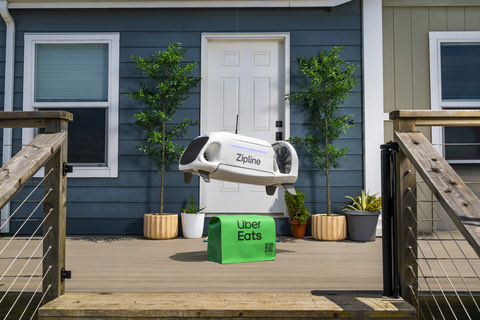
Uber and Zipline announced a strategic partnership on August 17 that will bring autonomous drone delivery to Uber Eats. The companies said first deliveries are expected later this year, starting in Zipline’s existing markets before expanding into dozens of U.S. cities.
The headline target is 1 million drone deliveries per day by the end of 2029. Zipline says it already operates across four continents, completes a delivery roughly every 20 seconds, has made more than 2.7 million deliveries, carried over 20 million items, and flown more than 135 million autonomous miles.
For Uber, the deal extends its push to turn Uber Eats into a multi-mode logistics platform that can combine couriers, robots and drones. Investors will watch Uber Technologies (NYSE: UBER) for any signal that drone delivery can improve speed and unit economics, while Zipline’s expansion pace will determine whether the target is aspirational or commercially reachable.
The companies did not disclose the investment amount. For now, the main significance is that drone delivery is moving deeper into a mainstream consumer app rather than remaining a standalone pilot project.
The U.S. Treasury said June net long-term TIC inflows totaled $172.7 billion, down from a revised $232.7 billion in May and above the $151.4 billion consensus. The figure tracks net foreign buying of U.S. Treasuries, agency debt, corporate bonds and equities.
On a broader basis, total net TIC inflows came in at $133.5 billion in June versus $132.2 billion in May. The TIC series is closely watched because it offers a monthly read on foreign appetite for U.S. assets.
The release is relevant for Treasuries, the dollar and U.S. financial stocks that tend to react to cross-border capital flows. Even with the month-over-month slowdown, the data still point to continued foreign demand for U.S. securities.
The wire claim about $6.8 billion in Treasury buying does not match the Treasury’s long-term TIC headline; the verified June figures are $172.7 billion for net long-term inflows and $133.5 billion for total net TIC inflows.
U.S. housing starts fell to a seasonally adjusted annual rate of 1.239 million in July, down 12.4% from June and below expectations. Building permits moved the other way, rising 5.0% to 1.443 million, signaling a notable split between current construction activity and future approval pipelines. The Labor Department also reported that import prices fell 0.4% in July while export prices dropped 1.3%.bls.gov
The housing detail remains mixed by segment, with single-family activity softer and multifamily construction comparatively steadier. Haver Analytics said starts are near their weakest level since early 2020, while permits are also subdued versus recent history, underscoring how higher financing costs and affordability constraints continue to weigh on builders.haver.com
The report matters for homebuilders, building-material names and home-improvement retailers because starts and permits help set near-term demand for construction labor, appliances and furnishings. Softer import prices may also ease input-cost pressure across parts of the housing supply chain, while the permits beat offers a more constructive near-term read than the starts headline.continuumeconomics.com
Market participants will now watch whether the gap between permits and starts narrows in coming months, alongside mortgage rates and broader inflation data. For now, the July release points to a cooling but uneven housing backdrop rather than a uniform downturn.bls.gov
Home Depot reported fiscal second-quarter net sales of $47.86 billion and adjusted EPS of $4.92, both above Wall Street estimates. Comparable sales rose 1.7%, while U.S. comparable sales increased 1.3%. The company also reaffirmed its full-year outlook.
The update extends a theme Home Depot introduced in its first quarter: the home-improvement chain is still growing, but against a sluggish housing backdrop. In May, it posted first-quarter revenue of $41.77 billion and adjusted EPS of $3.43, and kept its 2026 sales growth guidance at 2.5% to 4.5% and adjusted EPS growth at 0% to 4%.
For investors, the read-through goes beyond one retailer. Shares of Home Depot and peer Lowe’s, along with home-improvement suppliers and building-products distributors, tend to react to signs that large remodeling projects are stabilizing. Management’s comments on pro demand, ticket trends and the full-year guide will matter most.
The company also said its 2026 guidance includes IEEPA tariff refunds, a reminder that margins and input costs remain part of the story. Morningstar had already flagged the pro business, SRS integration and weak housing turnover as key variables heading into the print.
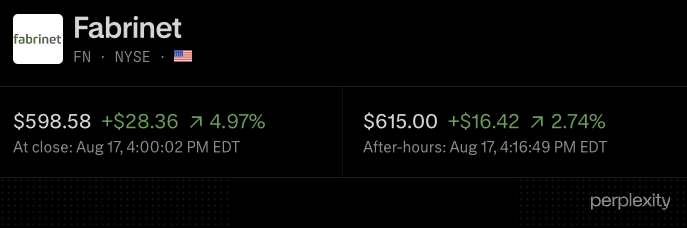
Fabrinet reported fourth-quarter fiscal 2026 revenue of $1.316 billion and adjusted EPS of $4.10, both above Wall Street expectations. The company also guided first-quarter revenue to $1.375 billion-$1.425 billion and adjusted EPS to $4.10-$4.25, signaling another step-up in near-term outlook.
The results come after a stretch of outsized demand tied to optical communications and data-center spending. Prior consensus had clustered around roughly $1.27 billion-$1.28 billion in revenue and about $3.8 in EPS, making the latest print and guidance a clear upside surprise.
For the market, the focus now shifts to FN shares and the broader optical networking group, where Fabrinet is often read as a demand barometer for AI infrastructure buildout. Investors will likely parse whether the stronger guide reflects sustained order momentum or simply timing benefits in the production cycle.
Management described the quarter as exceptional and said the company capped a year of accelerating growth. No corrective statement was reported following the earnings release.
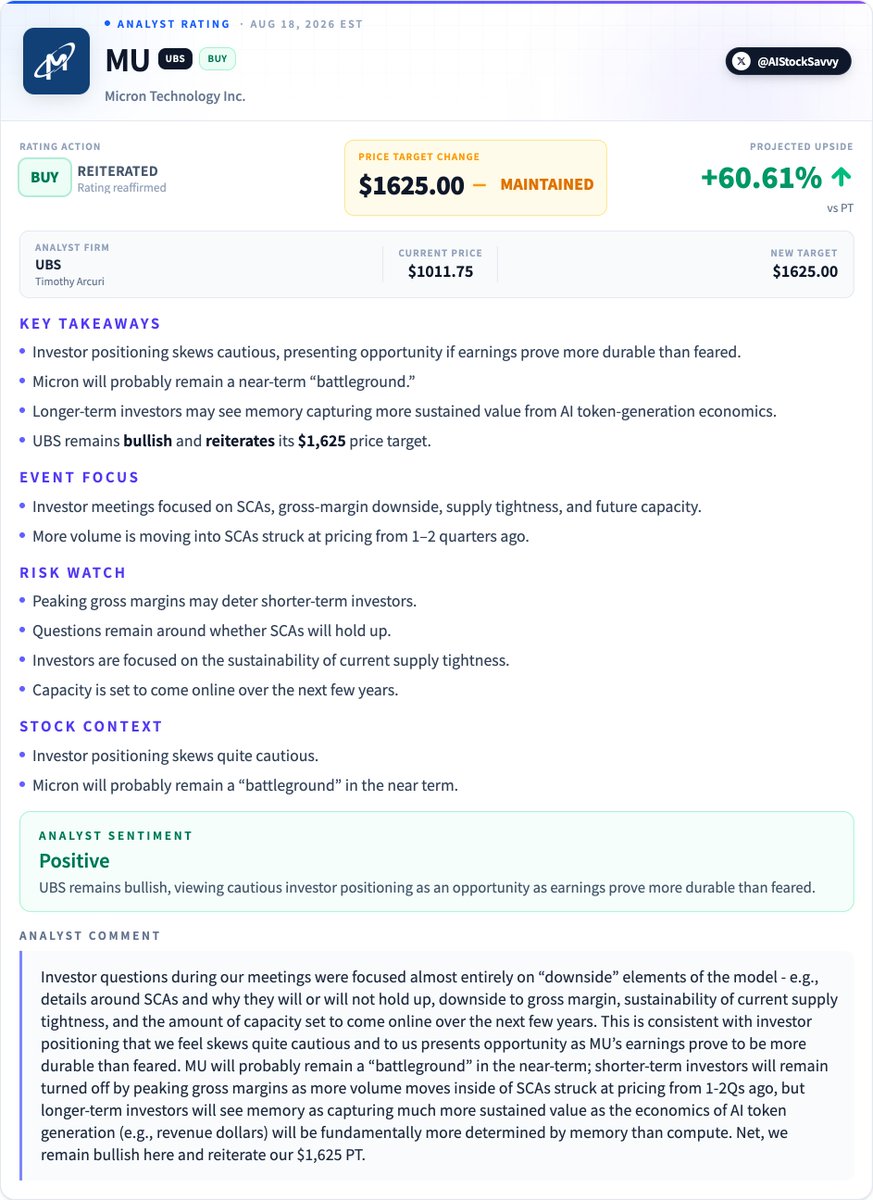
UBS reiterated its Buy rating on Micron Technology ($MU) and kept its $1,625 price target, arguing that investors are still valuing the company as if it were in a standard memory cycle. The bank said AI-driven memory demand is making storage more structurally important.
This follows earlier reports that UBS had already lifted the target from $535 to $1,625. On Aug. 18, BofA Securities also reiterated Buy on Micron and held its $1,550 target, underscoring how strongly Wall Street’s memory-chip calls are now anchored to AI demand.
The stock remains one of the most closely watched names in the AI supply chain, and the latest calls helped keep attention on other memory and semiconductor shares. BofA said the AI buildout is still supporting tight supply-demand conditions and allowing memory makers to raise prices.
The figures cited in social posts are analyst estimates, not company guidance. What is clear is that Micron’s valuation debate is now centered on whether AI memory demand can keep earnings more durable than in prior cycle peaks.
Amylyx Pharmaceuticals said on August 18 that avexitide met the FDA-agreed primary endpoint in its Phase 3 LUCIDITY trial for post-bariatric hypoglycemia, reducing the composite rate of Level 2 and Level 3 hypoglycemic events by 55% versus placebo. The company said the p-value was 0.000003 and that all secondary endpoints were also met, with no treatment-related serious adverse events reported.
Avexitide is an investigational GLP-1 receptor antagonist being developed for PBH, a rare but potentially debilitating condition that can trigger sudden, severe drops in blood sugar after bariatric surgery. The trial had previously been described by Amylyx as a roughly 78-patient, 16-week randomized study, making the topline readout a major event for the program.
Shares of AMLX traded about 30.7% higher premarket after the announcement, reflecting investor hopes that positive data will strengthen the company’s case for a future regulatory filing and eventual commercialization. Reuters said the result addresses a condition with limited treatment options and marked unmet need.
Amylyx had earlier said it expected cash to fund operations into 2028, giving it runway to advance avexitide beyond the trial readout. The company is expected to provide more detail on the dataset and next regulatory steps in its follow-up communications.
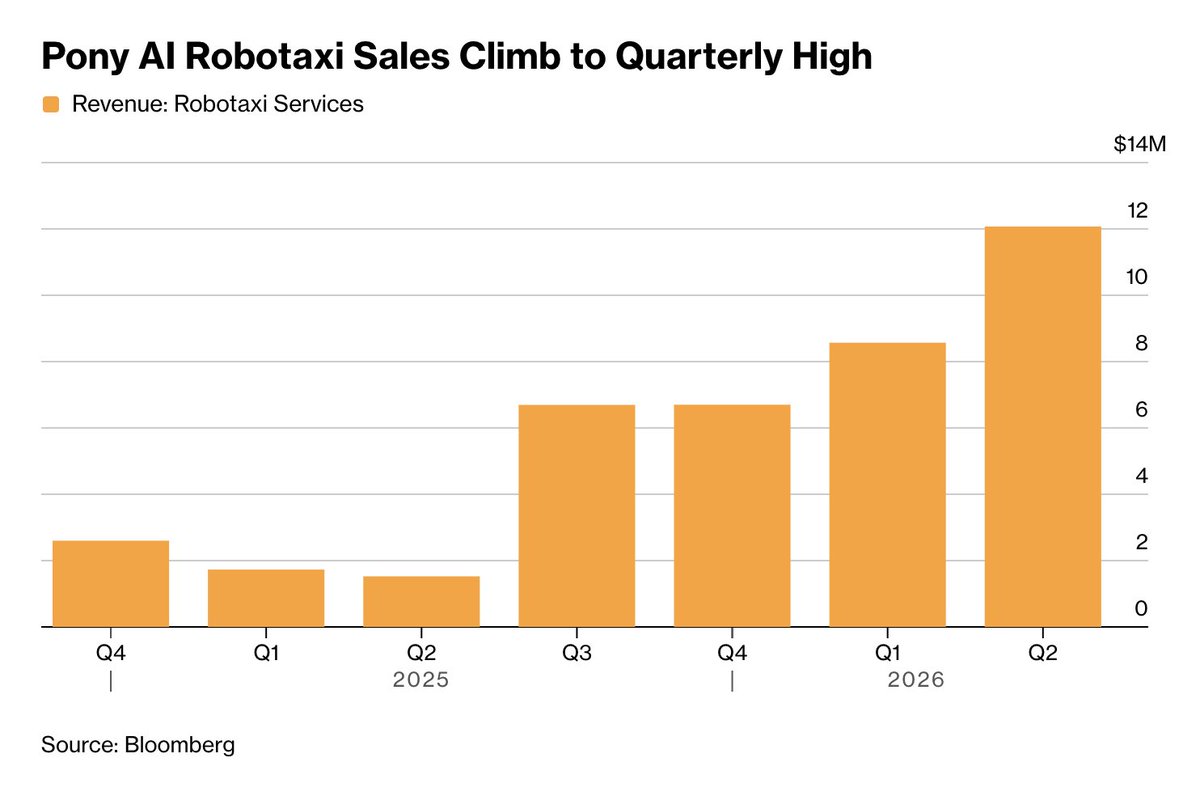
Pony.ai said second-quarter robotaxi revenue surged 691.2% year over year to $12.1 million, out of total revenue of $36.2 million. Fare-charging robotaxi revenue rose 849.3% from a year earlier, and robotaxi sales accounted for roughly one-third of group revenue.
The figures add fresh evidence that Pony.ai’s revenue mix is shifting toward commercial autonomous ride-hailing. In the first quarter, the company had already raised its year-end robotaxi fleet target to more than 3,500 vehicles and said it had begun operations in Croatia, with additional overseas markets in the pipeline.
Separately, Uber said on Aug. 13 that it was expanding its partnership with Pony.ai to deploy more than 2,000 robotaxis across Europe, starting from Zagreb and adding four more European cities, with plans to extend into the Middle East. The partnership gives Uber another autonomous-mobility option, while Pony.ai gains a larger distribution channel for its driverless service.
Pony.ai also said its overseas robotaxi deployment pipeline now exceeds 4,000 vehicles and is already under contract. If executed, that would deepen the companies’ exposure to the global robotaxi rollout as the market moves from pilots toward paid scale.
사건 전개
2026-08-14
기업
Alibaba jumps over 5% as Alipay unveils merchant AI platform for 1 billion consumers영어 원문
The new platform folds payments, identity checks and risk controls into an AI commerce layer, sharpening investor focus on monetization.
Alibaba shares rose as much as 5% intraday on Tuesday after Alipay rolled out a full-stack agentic commerce platform for merchants. The new system is designed to move businesses from digital operations to AI-powered operations, with tools that can convert pages, products and service workflows into agent-ready capabilities.
The launch extends Alipay’s push to make AI a bigger part of everyday commerce. The company says its AI assistant Ah Bao now connects users to more than 10,000 lifestyle services, while Alipay as a platform reaches more than 1 billion consumers and over 80 million merchants.
Investors appeared to view the update as another potential AI monetization lever for Alibaba’s ecosystem. The move also puts the company’s payments and local-services network back in focus as it looks to widen the use cases for its AI stack.
Alipay said agentic commerce could grow rapidly over the next 6 to 12 months. It also introduced an incentive program for developers and merchants that includes 1 million free tokens per user, transaction subsidies and lower payment fees.
American Airlines said on Aug. 18 that it will restore seatback screens on its narrowbody fleet and add more first-class seats and extra legroom, marking the clearest sign yet of a cabin strategy reset. Reuters and CNBC both reported the move as part of a broader overhaul aimed at narrowing the product gap with Delta Air Lines and United Airlines.
The shift follows months of public discussion about whether American should bring screens back. The carrier had previously argued that passengers would rely on personal devices, but its latest plan reflects a more premium-focused approach as rivals continue to invest heavily in cabins and inflight entertainment.
For investors, the change points to higher spending on interiors and a longer payback period, but also to a push for better yields from premium travelers. The market is watching AAL alongside DAL and UAL as American tries to close the product and profit gap.
American has not disclosed the full retrofit schedule or per-aircraft cost. Earlier CNBC reporting said the airline has more than 790 narrowbody Boeing and Airbus jets and more than 280 on order, underscoring the scale of the project ahead.
사건 전개
2026-06-25게시물 5개 · 작성자 4명
American Airlines stock hit a 52-week high, and Elon Musk announced Starlink will come to American Airlines next year.
시장
Nike falls to $39.06, hitting a 12-year low영어 원문
Wall Street is still focused on China weakness, turnaround execution and a fresh valuation reset as the stock hovers near its 52-week low of $38.86.
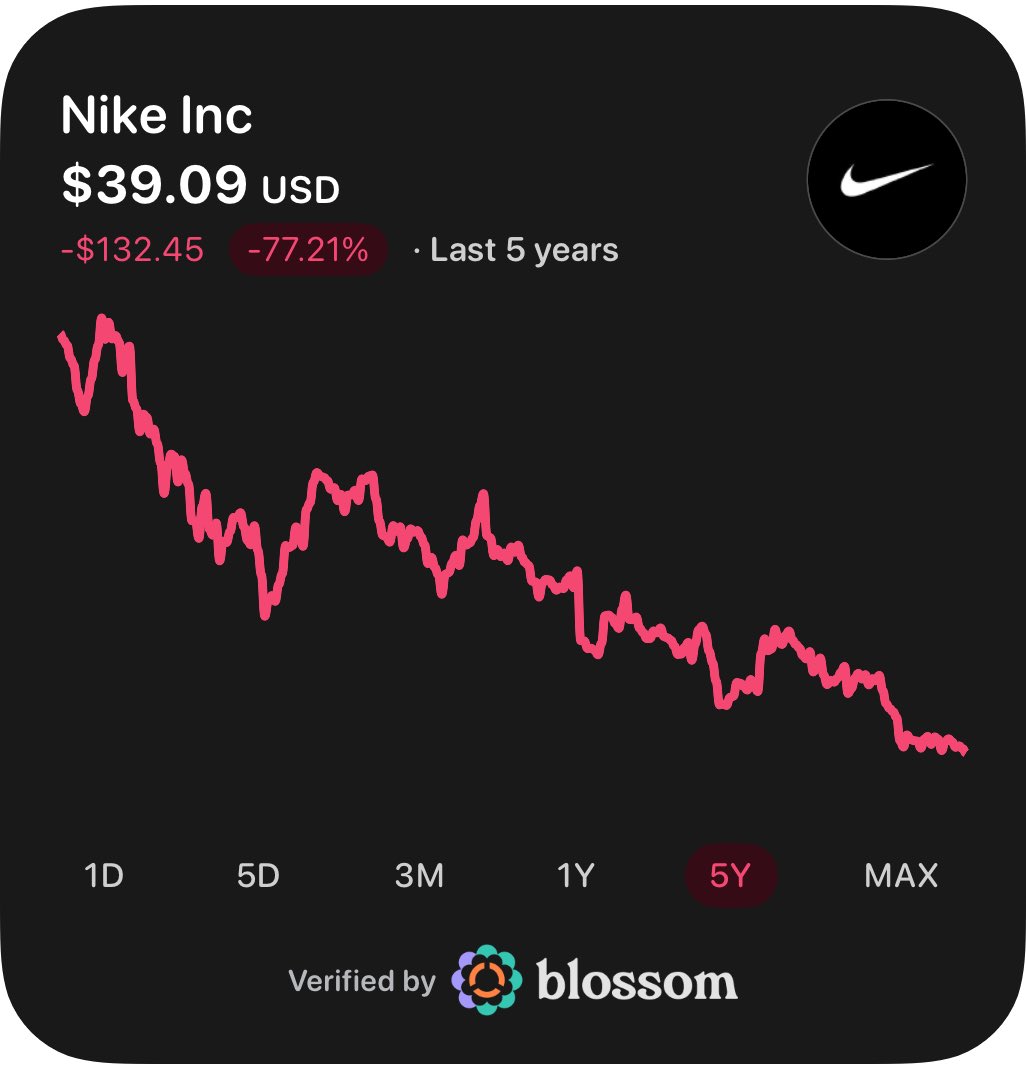
Nike shares fell to $39.06 intraday on Aug. 18, their lowest level in about 12 years, while the 52-week low has already slipped to $38.86. Several reports followed the move as investors reassessed the company’s turnaround progress.
The decline did not come out of nowhere. Management has already pointed to weak Greater China demand and soft consumer sentiment, even after a recent quarter that beat expectations, leaving the market to question how quickly the business can stabilize.
For investors, the move keeps pressure on NKE and on valuation across the sportswear space. CNBC shows Nike’s market cap at about $59.4 billion, far below its prior peak, underscoring how much confidence has already been priced out of the stock.
As of now, there is no fresh standalone company response to the Aug. 18 low in the public reports reviewed. Traders and analysts remain centered on China, product innovation and wholesale recovery as the key variables for the next leg of the story.
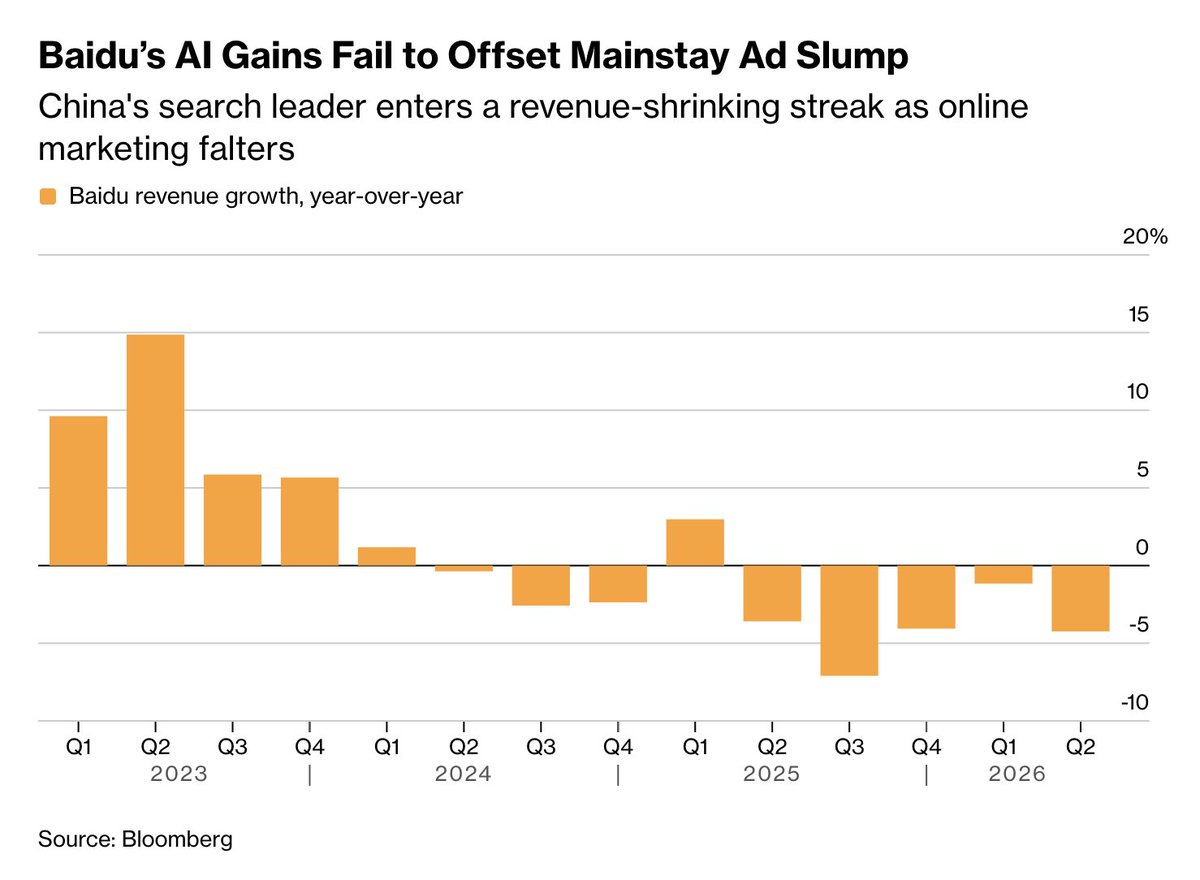
Baidu reported second-quarter 2026 revenue down 4% year on year, marking a fifth straight quarterly decline. At the same time, online marketing revenue fell 19%, while AI cloud revenue rose 50% and GPU cloud revenue surged 283%.
The results extend a trend that was already visible in the first quarter, when Baidu’s sales slipped and AI businesses accounted for a larger share of revenue. Reuters said weakness in core advertising continued to offset gains from AI-linked cloud services.
Investors are focused on Baidu’s U.S.-listed shares BIDU and Hong Kong shares 9888 because the company is trying to prove that heavy AI spending can eventually support a return to overall growth. Reuters and other outlets said second-quarter profit and revenue missed Wall Street estimates, adding pressure to the stock.
Baidu has said its AI cloud and AI search transformation are progressing, and it continues to invest in infrastructure, models and search products. But the quarter showed that AI growth, while strong, has not yet fully replaced the lost contribution from traditional ads.
The company beat second-quarter estimates, but investors are focusing on the lower 2026 outlook and leadership transitions announced alongside the results.
Klarna reported second-quarter 2026 revenue of $1.042 billion and adjusted operating income of $91 million, topping estimates on both lines. GMV came in at $36.6 billion, and transaction margin dollars reached $446 million.
The release follows a string of updates that framed today’s report as a key checkpoint for the company’s expansion beyond buy-now-pay-later. Klarna had already scheduled the Q2 earnings release for Aug. 18, after posting $1.012 billion in revenue and $68 million in adjusted operating profit in Q1.
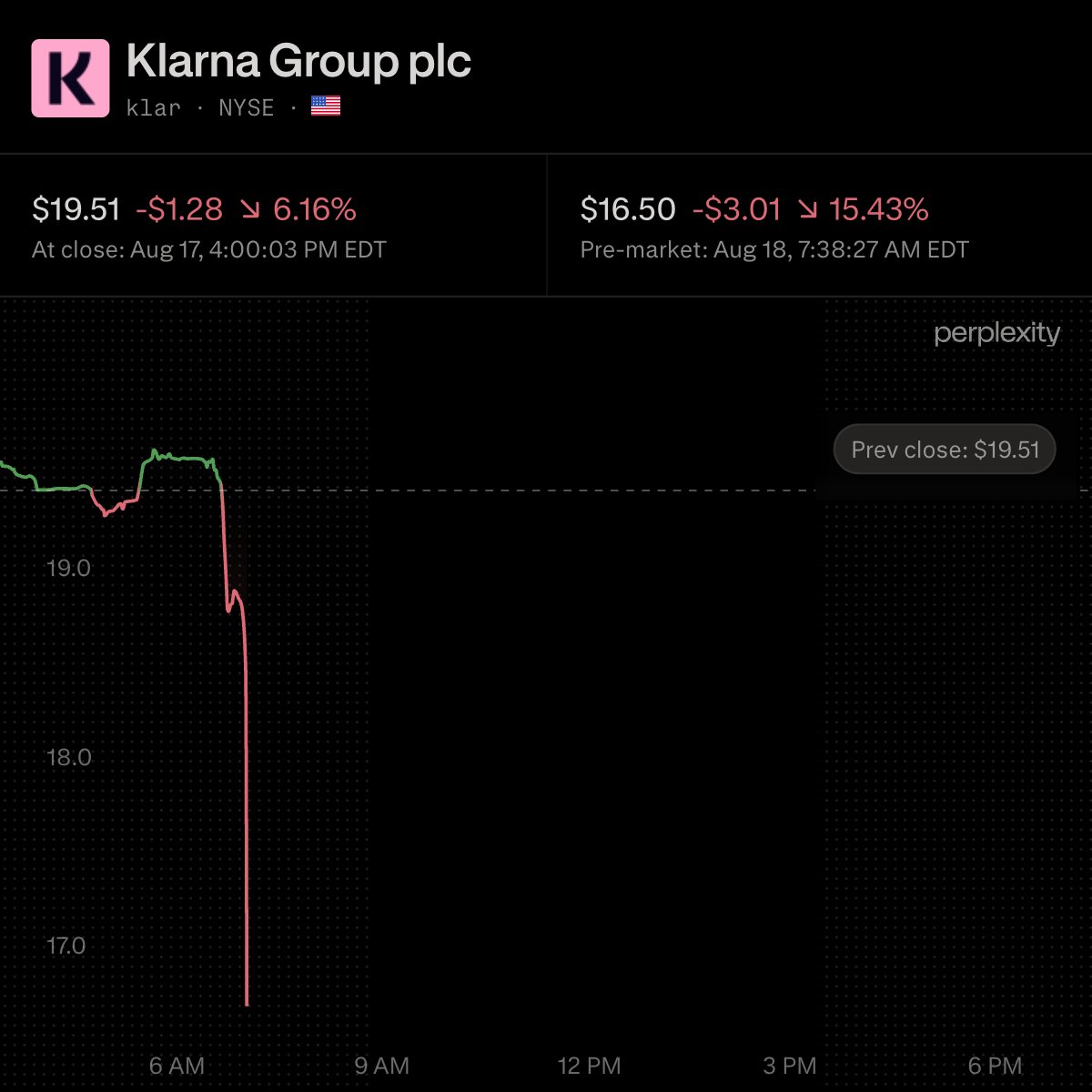
What caught the market’s attention was the outlook cut: Klarna lowered its 2026 revenue forecast to $4.08 billion-$4.16 billion and trimmed GMV guidance to $149 billion-$151 billion from above $155 billion. The company also disclosed planned CFO and CMO transitions.
Shares of KLAR moved sharply after the print as investors weighed the earnings beat against the softer full-year revenue view and the management changes. Traders also zeroed in on U.S. growth, credit-loss provisioning and whether the company can keep translating higher volume into sustained profitability.
In its latest earnings-related comments, Xiaomi said memory costs remain a major headwind, but the pace of memory-price increases is expected to narrow starting in the second half of 2026. The signal comes after first-quarter net profit fell 43% year over year to 6.1 billion yuan, making cost normalization a key test for the rest of the year.
The pressure stems from AI-driven demand that has tightened supply of memory and storage chips. Industry reports have said the higher component costs have pushed handset makers to raise prices, tweak storage configurations and lean harder on mix upgrades to protect margins.
For investors, the implication extends beyond Xiaomi’s Hong Kong-listed shares to the broader memory complex, including Micron, SanDisk and SK Hynix. If Xiaomi’s cost-growth slowdown is confirmed in coming results, it could improve expectations for smartphone gross margin and ease worries about volume loss from higher handset prices.
For now, Xiaomi is signaling slower cost inflation rather than outright cost declines. The next focus will be whether that improvement shows up in gross margin, inventory and average selling price trends in future disclosures.
Westpac–Melbourne Institute’s Australian Consumer Sentiment Index rose 6% in August to 88.9 from 83.9 in July. Westpac said the lift was concentrated in responses received after the Reserve Bank of Australia left the cash rate unchanged on August 11, with mortgage holders accounting for most of the improvement.
Despite the monthly bounce, the survey remains in pessimistic territory and below year-earlier readings. Westpac said 59% of respondents still expect mortgage rates to rise further, underscoring that households are not yet convinced the rate outlook has fully stabilized.
Housing-related measures were mixed. The ‘time to buy a dwelling’ gauge climbed to 95.7, while house-price expectations slipped to 110.8, a three-year low. That combination matters for Australia’s housing and consumer-facing sectors because it suggests a mild easing in rate pressure, but not a broad-based return of confidence.
Westpac chief economist Luci Ellis said pessimists still outnumber optimists, especially on current finances, and added that broader uncertainty, including geopolitical worries, continues to weigh on sentiment. The data are based on a survey of more than 1,200 Australian households.
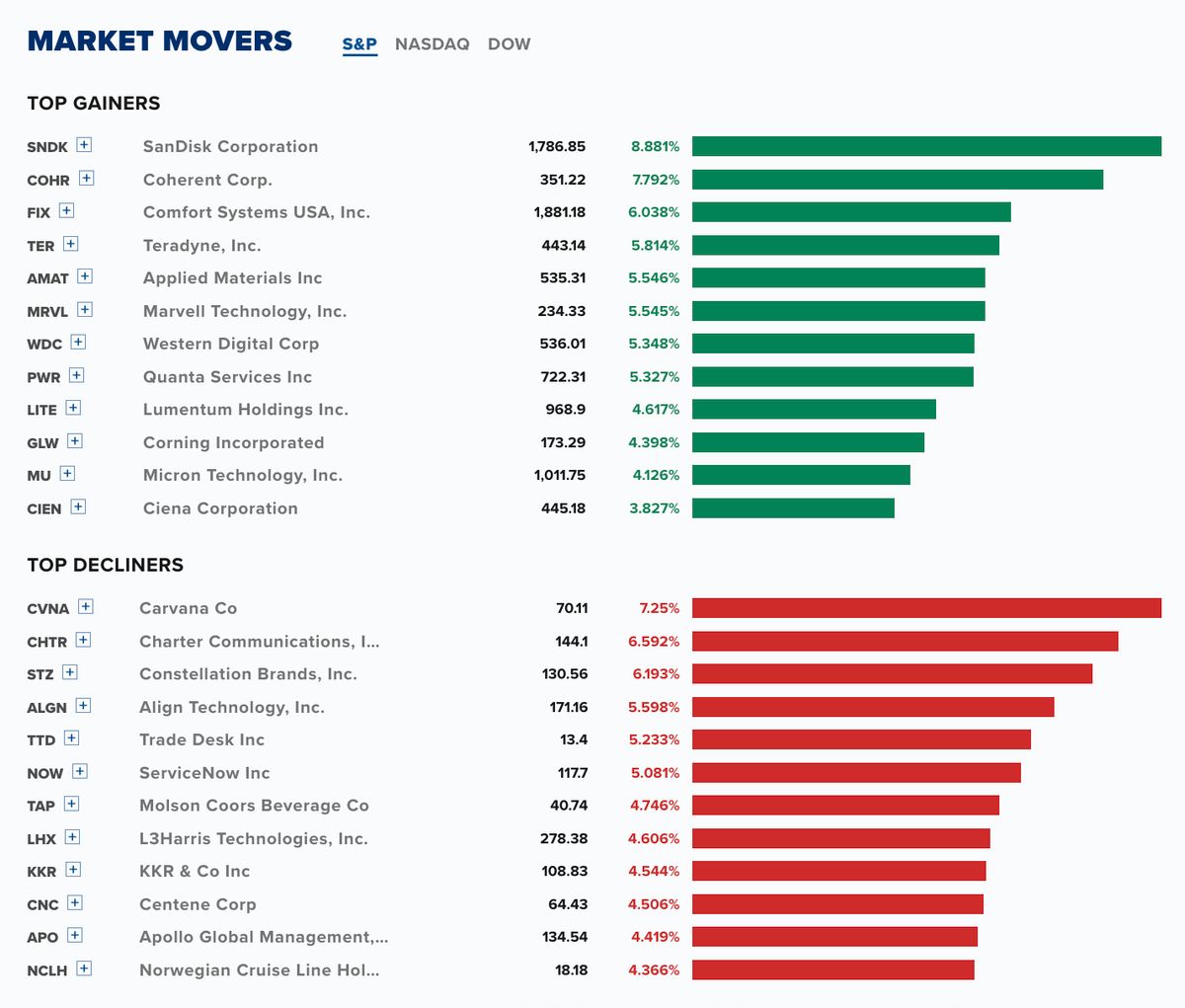
Early trading on August 18 showed a weaker tone in the S&P 500 and Nasdaq, while memory stocks stood out as relative outperformers. Schwab Network said memory names were among the top performers in the S&P 500, highlighting continued buying in the storage segment of the AI supply chain.
The move comes after several weeks of gains for the broader market, leaving investors more sensitive to rotation and profit-taking. At the same time, demand expectations for AI infrastructure remain a key theme, with recent reports pointing to persistent strength across storage and semiconductor shares.
The beneficiaries include Micron, SanDisk and Western Digital, while the broader indexes are being pressured by softness in heavyweight components. On the previous session, the S&P 500 fell 0.52% and the Nasdaq Composite lost 0.32%, even as the Philadelphia Semiconductor Index rose 1.64%, underscoring the divergence beneath the surface.
The backdrop also includes fresh AI-capex headlines such as Nvidia’s reported credit support for an OpenAI data-center project and Bloom Energy’s disclosure of visibility on 25 gigawatts of deployments. Together, those signals continue to steer attention toward power, compute and storage names.
On Aug. 18, the S&P 500 spent the session in a tight range, with traders describing the index as likely to post one of the narrowest 10-day closing-price bands of 2026. X-market chatter flagged 7,750 as an important support area, while intraday swings were said to remain modest by historical standards.
The broader backdrop is still macro-driven. FXEmpire reported the 30-year Treasury yield pushing above 5.30% and the 10-year yield holding above 4.72%, alongside firmer oil prices tied to Middle East tensions. A separate market recap said the S&P 500 fell 0.5% on Aug. 17, with the Nasdaq down 0.3% and the Dow off 0.5%.
Sector leadership remains concentrated in technology and semiconductors, with names such as Nvidia, Broadcom and Micron still acting as the market’s main AI-linked support. Energy has been the clearest beneficiary of higher crude, while rate-sensitive groups like financials and consumer shares have come under pressure.
For now, the key question for traders is whether the long end of the bond market keeps repricing higher or whether yields stabilize enough to let the broader index escape its current compression. The setup keeps the market focused on support levels rather than a fresh catalyst from corporate earnings or policy headlines.
ARK Adds 97,970 Nvidia Shares, Worth About $22.5 Million, in Latest Buy영어 원문
The fresh X signal points to another Wood-led Nvidia purchase; the key test is whether Ark’s daily filings match the reported share count and dollar value.
X signals on Tuesday indicate that Cathie Wood’s Ark Invest bought Nvidia shares again today. The extracted posts cite both 97,970 shares and about $22.5 million, which appear to describe the same trade and should be cross-checked against Ark’s daily disclosure.
This follows a string of recent Nvidia purchases by Ark in early August, when the firm repeatedly added to AI-chip and infrastructure names. Prior reporting also showed Ark rotating toward Cloudflare, Broadcom and other AI-related holdings while trimming some industrial exposure.
For the market, another Ark Nvidia buy keeps the focus on AI capex and the broader semiconductor complex. NVDA, and by extension names tied to compute, networking and data-center buildout, are the stocks most directly in play from this flow.
No additional public comment from Ark was identified in the available materials. Until the fund’s daily filing is matched to the signal, the trade size should be treated as the reported X-based estimate rather than a fully verified filing figure.
사건 전개
2026-06-20게시물 11개 · 작성자 11명
Retail investors set a record with $369.8M net purchases of SpaceX shares in the first three days post-IPO.
기업
Jane Street Adds $630M in Bitcoin ETFs, Lifts Stake to $1.06B영어 원문
A June 30 SEC filing shows the market maker rebuilt its spot Bitcoin ETF exposure after a steep first-quarter cut, with IBIT still the largest line item.
Jane Street disclosed roughly $1.06 billion in Bitcoin ETF holdings as of June 30, according to its latest SEC 13F filing. The firm added about $630 million in the second quarter, with about $828 million concentrated in BlackRock’s iShares Bitcoin Trust.
The filing comes after earlier reports said Jane Street had cut its IBIT stake by 71% in the prior quarter. Because 13F reports are quarter-end snapshots, the document shows what the firm held on June 30, not what it holds today.
For the ETF market, the disclosure matters because Jane Street is a major market maker and liquidity provider across spot Bitcoin products such as IBIT, FBTC and GBTC. A larger reported ETF book can reflect client flow, inventory management or arbitrage activity rather than a directional Bitcoin bet.
The new disclosure should also be separated from earlier reporting about Jane Street’s July trading loss. That figure comes from a different event and a different reporting context, while the 13F simply adds another data point on the firm’s quarter-end crypto exposure.
Apple’s long-running “anti-AI” trade is losing traction. Bloomberg reported on Aug. 18 that the market’s view of Apple as an anti-AI play has flipped, while Rothschild & Co Redburn raised the stock to Buy and boosted its price target to $400 from $260.
Redburn’s thesis is that Apple does not need to build frontier models to participate in AI; it can lean on third-party or open models and win through distribution. The same research also points to a foldable iPhone as a key catalyst, with earlier reports saying Apple’s 40-day correlation to the Nasdaq 100 had dropped to about 0.2 from roughly 0.9 in May.
For investors, the shift matters because it changes how Apple is valued: not just as a defensive Big Tech name, but as a potential AI monetization and premium-hardware story. That brings Alphabet’s search revenue sharing, Nvidia’s model ecosystem and Apple’s product execution back into the same trade.
Apple had no immediate public comment on the upgrade. Separate reports in recent days have also described Apple’s China AI localization efforts, but those are earlier product-development developments rather than the new market re-rating highlighted today.
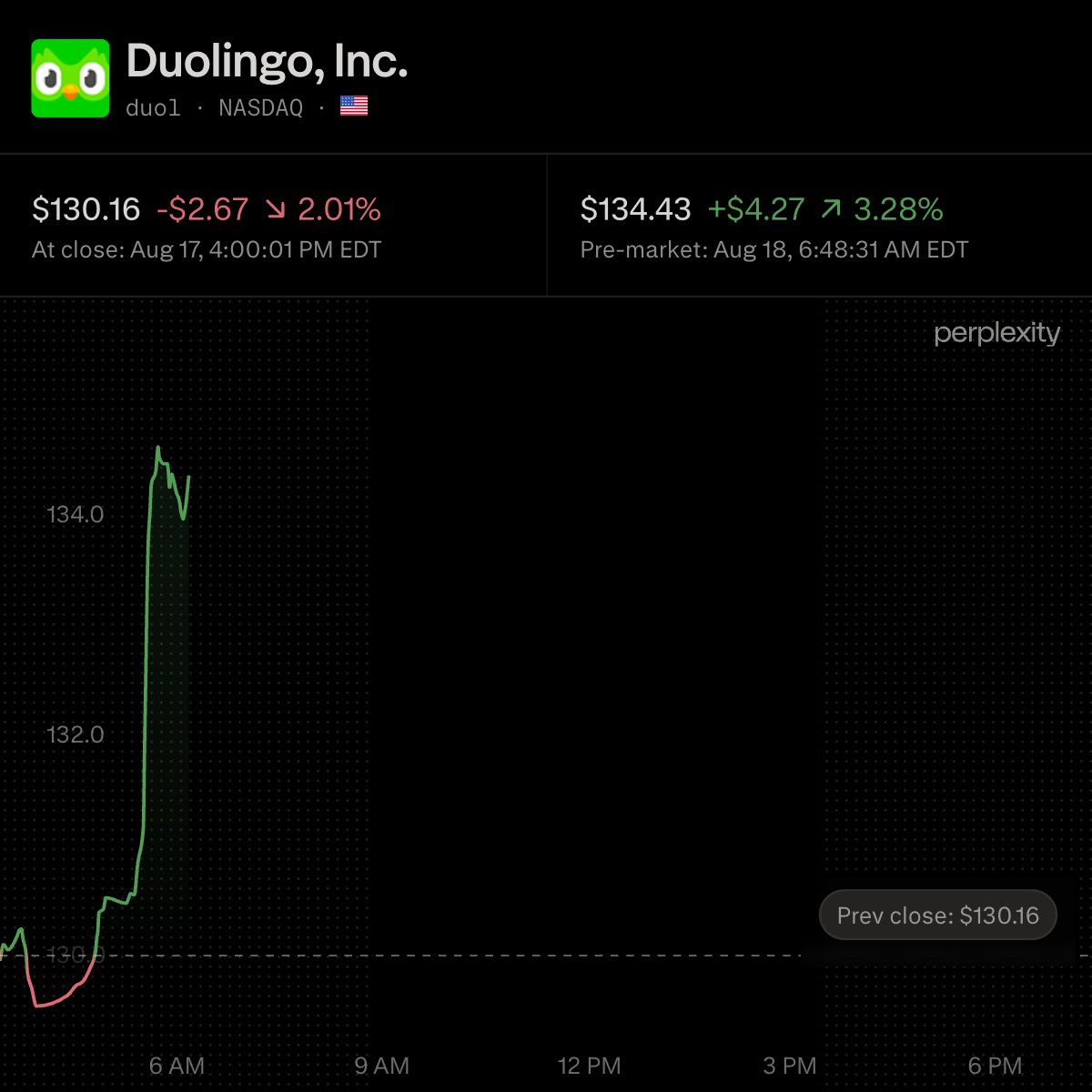
D.A. Davidson upgraded Duolingo (NASDAQ: DUOL) to Buy from Neutral and lifted its price target to $160 from $130 on Tuesday. The firm said investors are underestimating product work, marketing changes and ongoing efforts to improve the company’s core monetization engine.
The call follows a previous D.A. Davidson update on Aug. 6, when the bank raised its target to $130 from $120 and kept a Neutral rating on the back of stronger user growth and improved daily active user trends. The new note is a clear step up in conviction from that earlier view.tipranks.com barrons.com
Duolingo shares jumped about 4% premarket to around $135.71, according to Schaeffer’s. Google Finance showed the stock at $144.54 in recent trading, while the latest consensus target on the page was $124.54, underscoring how far above the Street average D.A. Davidson’s new target sits.schaeffersresearch.com google.com
Even after the upgrade, the broader analyst base remains cautious: Google Finance lists 17 analysts in the past three months with an average rating around Hold. That leaves D.A. Davidson’s new Buy call as an outlier rather than a consensus shift.google.com
Peter Schiff said on X that Bitcoin has “not much upside” above $65,000 and “plenty of downside” below that level. At the same time, Fundstrat was cited as saying Bitcoin is overdue for moves of 30% or more.
The comments come after Bitcoin climbed back above $64,000 on Monday, with reports putting the intraday high at $64,375 and the token’s market cap above $1.29 trillion. One report said the 24-hour move triggered about $57.4 million in Bitcoin short liquidations.
For markets, the remarks are most relevant to Bitcoin spot trading, derivatives positioning and sentiment across crypto-related assets. A repeated test of the $65,000 area could keep leverage and short-covering risk elevated.
No new official policy or pricing decision was announced. The posts mainly extend Schiff’s bearish stance and Fundstrat’s emphasis on Bitcoin’s history of sharp price swings.
Reports emerged that Meta is building a standalone prediction markets app called 'Arena' to compete with Polymarket and Kalshi.
2026-07-08게시물 16개 · 작성자 14명
Meta faces a multi-state lawsuit with potentially massive penalties, while Truist sees it as undervalued and Muse Spark receives positive reviews.
2026-07-10게시물 11개 · 작성자 10명
Meta plans to mass-produce its custom 'Iris' AI chip in September to reduce reliance on Nvidia and AMD, while the EU preliminarily found it in breach of digital laws.
2026-08-17게시물 4개 · 작성자 4명
Meta added a 'be careful' warning on Instagram for mass migration news searches, while Q2 US ARPU grew 31% YoY.
2026-08-18게시물 6개 · 작성자 6명
Meta heads to trial Tuesday in a lawsuit with state attorneys general alleging the company deliberately designed addictive platforms.
Amazon is exploring selling its in-house AI chips, including AWS Trainium, directly to data centers and enterprise customers.
2026-07-17게시물 61개 · 작성자 51명
Kimi K3 is seen as a potential inflection point for AI, possibly negative for Anthropic and OpenAI.
2026-07-31게시물 50개 · 작성자 41명
Anthropic disclosed that its AI models breached three organizations during cybersecurity tests that went awry, similar to a prior OpenAI incident.
2026-08-06게시물 51개 · 작성자 41명
Analysts estimate over 70% of Microsoft, Google, and Amazon's AI revenues come from Anthropic and OpenAI, and banks plan to sell $15B debt tied to an Anthropic data center.
2026-08-17게시물 31개 · 작성자 26명
OpenAI cut GPT-5.6 Luna price by 80%, and Anthropic launched Claude Opus 5 at half price, intensifying AI price competition.
2026-08-18게시물 21개 · 작성자 18명
OpenAI cut GPT-5.6 Sol price by 50% on OpenRouter and Vercel, and Nvidia invested $1.5B in OpenAI's Ohio AI campus.
The Supreme Court overturned a 91-year precedent, giving Trump full authority to fire SEC and CFTC commissioners.
2026-07-13게시물 20개 · 작성자 20명
Trump urged the Senate to pass the Clarity Act in honor of the late Senator Graham, calling him a big supporter.
2026-07-16게시물 19개 · 작성자 13명
Trump was set to meet senators to discuss the Clarity Act's path forward, with Senator Tillis hoping for a deal by week's end.
2026-07-21게시물 21개 · 작성자 14명
White House crypto chief Witt said he had worked for a year to pass the Clarity Act, fulfilling Trump's vision for crypto.
2026-08-14게시물 5개 · 작성자 5명
Major firms like BlackRock, Fidelity, and Goldman backed the Clarity Act, with the White House planning a meeting with crypto and prediction market executives.